
Table of Contents
Introduction: Why Product Positioning Is More Than a Marketing Decision
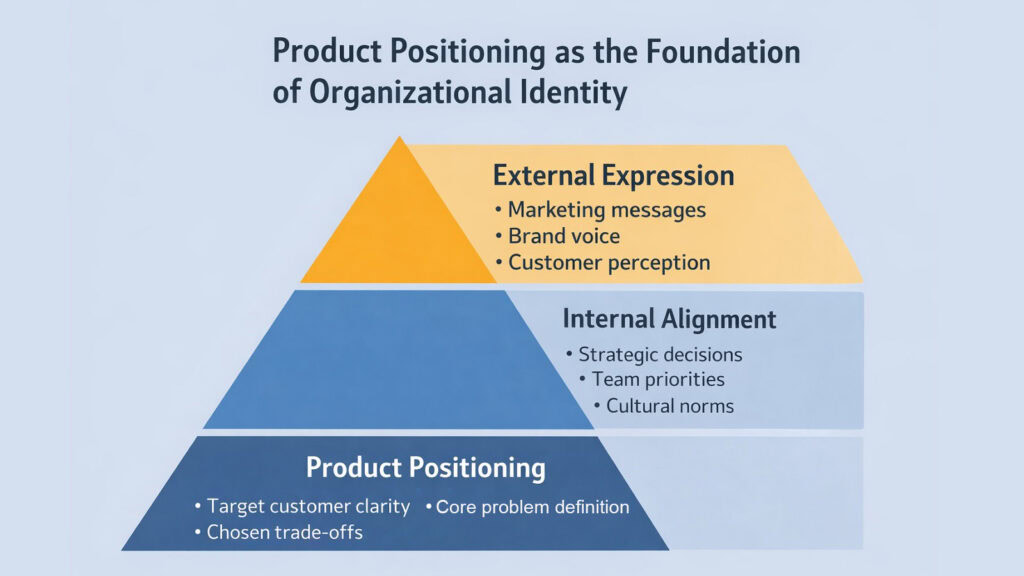
Product Positioning often gets treated like another marketing checklist item. Something you do once, document in a slide deck, and revisit when sales numbers disappoint. But that perspective misses something fundamental about what Product Positioning actually does inside an organization.
Before your market understands your position, your company must understand it first. Product Positioning works inward before it works outward. It changes how teams talk to each other in meetings. It shifts which candidates get hired and which projects get funded. It determines what feels right when someone faces an ambiguous choice at 4 PM on a Wednesday.
This article examines six ways Product Positioning shapes brand identity from the inside out. These are not tactics about messaging or campaigns. They are structural effects that accumulate over time and turn strategic choices into organizational character. Founders who position products are also positioning their teams. Marketers who refine positioning are also refining culture. Leaders who articulate clear positions give their organizations a way to know themselves.
The six areas we will explore show how Product Positioning creates boundaries, language, talent profiles, trade-off patterns, growth filters, and behavioral norms. Each section reveals how positioning decisions compound into something larger than marketing. They become identity.
Product Positioning and Core Marketing Functions
| Marketing Function | How Product Positioning Influences It |
|---|---|
| Marketing Research and Consumer Insights | Product Positioning determines which customer segments receive research focus and which psychographic profiles matter most when interpreting data patterns |
| Brand Management | Product Positioning establishes the strategic foundation that brand managers use to maintain consistency across touchpoints and evaluate brand extension opportunities |
| Service Positioning | Product Positioning creates the reference framework that service teams use to differentiate their offerings and align service delivery with product value propositions |
| Pricing Strategy | Product Positioning defines the value perception that pricing teams leverage when setting price points and determining which customers will accept premium or economy models |
| Promotion and Advertisement | Product Positioning supplies the core message architecture that creative teams use to develop campaigns and select media channels that reach positioned target audiences |
| Content Marketing | Product Positioning shapes editorial direction by clarifying which topics resonate with positioned audiences and which content formats align with brand perception goals |
| Digital Marketing & Performance Analytics | Product Positioning guides channel selection and conversion optimization by identifying where positioned customers spend time and which metrics reflect positioning success |
| Sales Enablement & Lead Generation | Product Positioning provides the qualification criteria that sales teams use to prioritize leads and the value narratives they use during prospect conversations |
| Customer Relationship Management (CRM) | Product Positioning determines segmentation logic within CRM systems and shapes the retention strategies used to deepen relationships with positioned customer groups |
| Distribution & Channel Strategy | Product Positioning influences which distribution partners align with brand perception and which channel environments reinforce or undermine the intended market position |
1. Product Positioning Defines Who the Organization Is For—and Who It Is Not
Every organization wants to serve everyone. Product Positioning forces a different discipline. It makes teams choose which customers matter most and, just as importantly, which customers do not fit.
This choice does more than focus marketing budgets. It shapes how product teams prioritize features. When a team knows its position, it can evaluate feature requests against a clear standard. Does this serve the customer we are for, or does it dilute our identity by chasing someone we are not built to serve?
Exclusion creates clarity. When Basecamp positioned itself for small teams that wanted simple project management, it excluded enterprise buyers who needed complex workflows. That exclusion was not a failure of ambition. It was a commitment to identity. Their product roadmap reflected what small teams needed, not what procurement departments required. Their culture rewarded simplicity over feature sprawl. Their brand became synonymous with a specific kind of buyer.
Product Positioning prevents identity drift. Without clear positioning, organizations chase opportunities that feel urgent but lack strategic coherence. A SaaS company positioned for technical users might be tempted to add features for non-technical buyers because the revenue looks attractive. But each compromise weakens the original position. The product becomes harder to explain. The team loses confidence in who they serve. The brand starts meaning less to everyone.
Strong positioning creates strategic boundaries that protect brand identity. These boundaries help leadership say no to distractions. They help marketers avoid message confusion. They help sales teams qualify leads faster. When everyone knows who the organization is for, decisions become clearer at every level.
Product Positioning Creates Customer Selection Criteria
| Positioning Decision | Identity Impact |
|---|---|
| Premium vs. budget positioning | Premium positioning attracts customers who value quality over price and shapes internal expectations around service excellence and product refinement rather than cost optimization |
| Horizontal vs. vertical positioning | Vertical positioning focuses teams on deep industry expertise and narrows hiring to specialists while horizontal positioning encourages broader skill sets and cross-industry thinking |
| Technical vs. accessible positioning | Technical positioning draws sophisticated users and requires product teams to prioritize power features while accessible positioning serves broader audiences and values intuitive design over advanced functionality |
| Innovator vs. proven solution positioning | Innovator positioning attracts early adopters willing to tolerate imperfection and shapes culture around experimentation while proven solution positioning draws risk-averse buyers and emphasizes reliability |
| Self-service vs. high-touch positioning | Self-service positioning builds automation capabilities and attracts independent customers while high-touch positioning invests in relationship management and serves buyers who value partnership |
| Specialized vs. all-in-one positioning | Specialized positioning develops deep capability in narrow domains and attracts customers with specific problems while all-in-one positioning builds breadth and serves customers seeking consolidation |
2. Product Positioning Shapes Internal Decision-Making Language
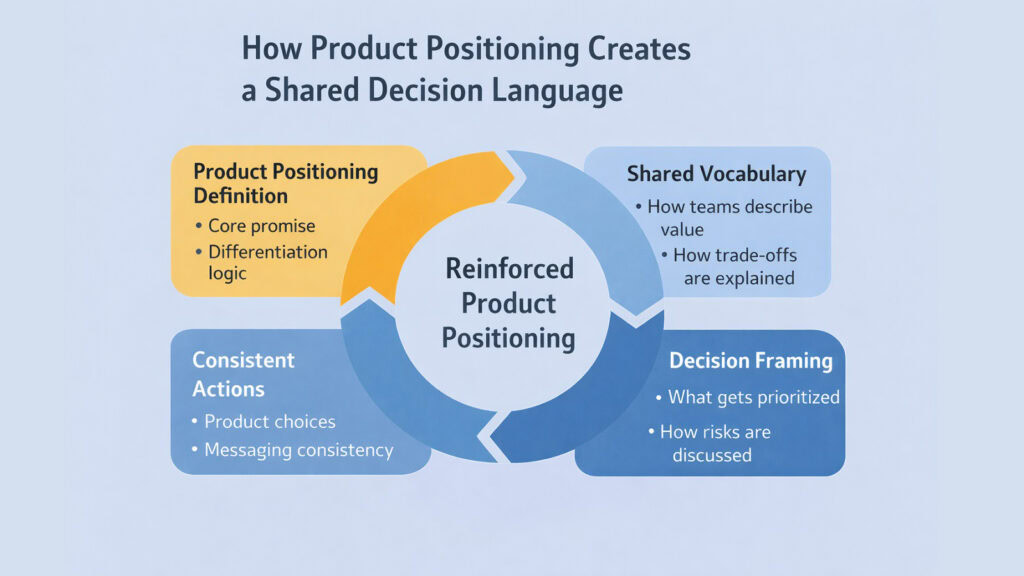
Language reveals belief systems. Product Positioning creates a shared vocabulary that teams use when discussing priorities, evaluating risks, and making trade-offs. This vocabulary becomes the operating system for decision-making.
When Patagonia positioned itself around environmental responsibility, that position created language that permeated the organization. Teams did not just talk about products. They talked about impact. They did not just evaluate materials. They evaluated sustainability. The positioning gave everyone a lens for interpreting choices. A decision that made financial sense but harmed environmental commitments violated the position and, therefore, violated organizational identity.
Shared positioning language creates alignment without requiring constant management oversight. When a product manager in Seattle and a marketer in New York both understand the position, they make consistent choices even when they work asynchronously. The position becomes a decision-making heuristic that scales across teams and time zones.
This language consistency reinforces brand identity internally before it projects externally. When leadership uses positioning language in corporate strategy meetings, when hiring managers use it in interviews, when sales teams use it in forecasts, the position moves from abstract concept to operational reality. People start thinking in terms of the position without conscious effort.
Language also reveals positioning drift. When teams start using words that contradict the position, it signals that identity is shifting. If a company positioned around simplicity starts discussing complex enterprise features in every meeting, the language change precedes strategy change. Listening to internal language helps leaders recognize when positioning needs reinforcement or revision.
Product Positioning makes corporate decision-making legible. When teams share positioning language, they can debate trade-offs using common reference points. They can explain their reasoning to each other. They can build on previous decisions because everyone remembers the logic. Language turns positioning from a static statement into a dynamic decision-making tool.
Product Positioning Language Across Functions
| Organizational Function | How Positioning Language Manifests |
|---|---|
| Product development discussions | Teams positioned around innovation use language emphasizing experimentation and risk-taking while teams positioned around reliability use language prioritizing stability and backward compatibility |
| Customer support interactions | Support teams serving premium-positioned products use language that emphasizes personalized service while teams serving volume-positioned products use language optimizing for efficiency and scale |
| Sales qualification conversations | Sales teams use positioning language to identify fit by asking questions that reveal whether prospects share the values and priorities embedded in the position |
| Performance review criteria | Companies positioned around speed evaluate employees on velocity and iteration while companies positioned around quality evaluate thoroughness and attention to detail |
| Budget allocation debates | Positioning language shapes investment logic by making certain spending categories feel strategically obvious while others feel off-brand or inconsistent with identity |
| External partnership evaluations | Teams assess potential partners using positioning language to determine cultural and strategic alignment rather than just contractual or financial compatibility |
3. Product Positioning Influences Hiring and Talent Identity
Product Positioning attracts specific types of people and repels others. This selection effect happens before anyone submits an application. Job descriptions written by clearly positioned companies signal who belongs and who does not.
When Stripe positioned itself for developers, that position shaped their entire talent strategy. They hired engineers who cared about API design. They hired writers who could explain technical concepts clearly. They hired support staff who understood code. The position became a filter that screened for people who already shared the company’s identity.
Positioning affects hiring criteria in subtle ways. A business positioned around fast execution values different traits than a company positioned around thoughtful craftsmanship. The first hires for bias toward action. The second hires for patient perfectionism. Both companies might hire smart people, but they hire different kinds of smart.
Cultural fit is really positioning fit. When interviewers assess whether a candidate fits the culture, they are often assessing whether the candidate fits the position. Does this person understand who we are? Do they care about what we care about? Would they make decisions that reinforce or undermine our identity?
People become living carriers of positioning through their daily behavior. When employees internalize the position, they communicate it through every customer interaction, product decision, and external conversation. They do not need brand guidelines to stay on message because the position is their message. They embody the brand.
This creates a reinforcing cycle. Clear positioning attracts people who strengthen that positioning through their work. Those people hire others like them. Over time, the organization develops a distinct talent profile that makes the brand identity tangible. The position is not just what the company claims. It is who the company actually is.
Product Positioning and Talent Characteristics
| Positioning Type | Typical Talent Characteristics Attracted |
|---|---|
| Mission-driven positioning | Candidates prioritize purpose over compensation and demonstrate track records of value-aligned work in previous roles even when other opportunities offered better financial terms |
| Performance-focused positioning | Candidates emphasize achievement metrics and competitive accomplishments while showing less interest in work-life balance or collaborative decision-making processes |
| Innovation-centric positioning | Candidates highlight experimental projects and express comfort with ambiguity while showing limited patience for incremental improvement or maintenance work |
| Customer-obsessed positioning | Candidates discuss previous work through customer impact lens and demonstrate empathy-driven decision-making even when it created internal complexity or short-term inefficiency |
| Craft-oriented positioning | Candidates provide detailed examples of quality-focused work and express frustration with shortcuts or compromises that sacrificed excellence for speed or cost savings |
| Collaborative positioning | Candidates emphasize team contributions over individual achievements and demonstrate preference for consensus-building processes even when they slow decision velocity |
4. Product Positioning Aligns Culture With Strategic Trade-Offs
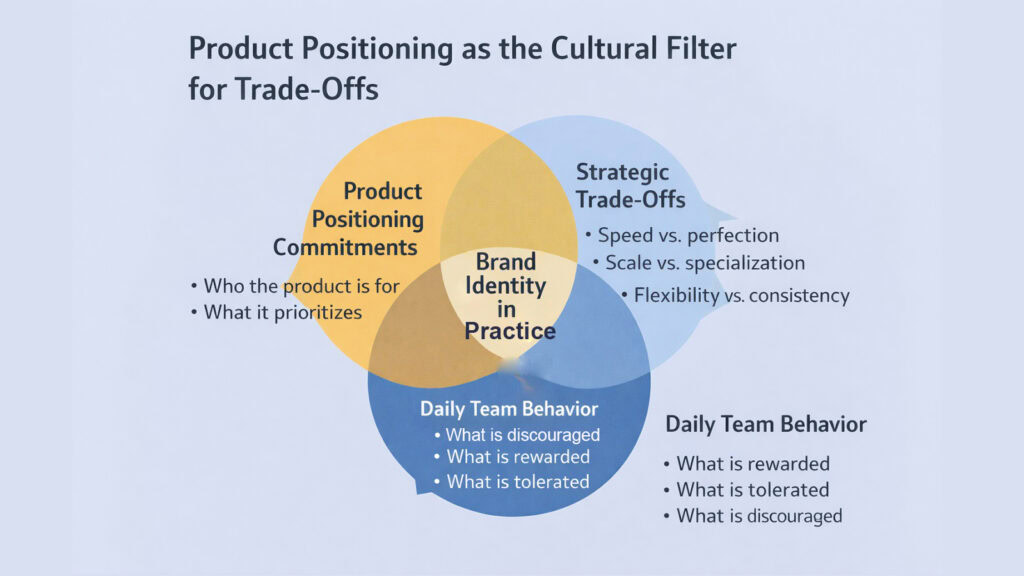
Product Positioning forces organizations to accept specific trade-offs. These trade-offs accumulate into cultural patterns. Teams learn what matters by watching what leadership chooses when two good options conflict.
A company positioned around speed must sometimes sacrifice perfect quality. That trade-off, repeated over months and years, creates a culture where speed is viscerally understood as the priority. People stop debating whether to ship fast or polish longer. They know the answer because the positioning already decided.
Southwest Airlines positioned itself around low fares and high frequency. That positioning created constant trade-offs. Should they add assigned seating like customers requested? No, because it would slow down boarding and reduce frequency. Should they serve meals? No, because it would increase costs and raise fares. Every trade-off reinforced the position. Every reinforcement strengthened cultural understanding.
Trade-offs reveal values. When a company positioned around privacy turns down a lucrative data monetization opportunity, that choice signals what the position actually means. Employees notice. They learn that leadership means what it says. The culture becomes defined by what the organization refuses, not just what it pursues.
Consistent trade-offs create predictable cultural patterns. After enough position-aligned decisions, teams can predict how leadership will respond to new situations. This predictability reduces anxiety and increases autonomy. People make bolder choices because they understand the decision framework.
Product Positioning shapes what gets rewarded and what gets discouraged. In a company positioned around innovation, taking smart risks gets celebrated even when experiments fail. In a company positioned around reliability, preventing problems gets rewarded more than creating breakthroughs. Culture forms around what positioning makes valuable.
Product Positioning Trade-Off Patterns
| Strategic Trade-Off | Cultural Pattern That Emerges |
|---|---|
| Fast iteration vs. comprehensive planning | Fast iteration positioning creates cultures where launching quickly and learning from mistakes feels normal while slow deliberation feels like unnecessary friction or fear |
| Broad appeal vs. deep specialization | Specialization positioning develops cultures where saying no to adjacent opportunities feels disciplined while broad appeal positioning creates cultures where expansion feels natural and limits feel restrictive |
| Transparent operations vs. competitive secrecy | Transparency positioning builds cultures where open information sharing creates trust while secrecy positioning develops cultures where discretion and information control signal professionalism |
| Premium margins vs. market share growth | Premium positioning creates cultures where maintaining standards matters more than volume while market share positioning develops cultures where growth justifies margin pressure |
| Feature richness vs. simplicity | Simplicity positioning builds cultures where removing features feels like improvement while feature-rich positioning creates cultures where addition demonstrates progress and restraint signals stagnation |
| Stability vs. transformation | Stability positioning develops cultures where preserving what works feels responsible while transformation positioning creates cultures where change signals vitality and maintenance suggests complacency |
5. Product Positioning Acts as an Internal Filter for Growth Choices
Growth creates temptation. New market opportunities appear. Adjacent product ideas emerge. Partnership offers arrive. Product Positioning acts as a filter that helps organizations evaluate these opportunities against their identity rather than just their revenue potential.
Strong positioning protects brand identity during growth by forcing teams to ask whether expansion aligns with who they are. When HubSpot positioned itself around inbound marketing, that position filtered their growth choices. They grew by deepening their inbound capabilities, not by adding outbound sales tools that contradicted their position. The filter kept their identity intact.
Without positioning filters, growth dilutes meaning. Companies chase every opportunity that looks profitable. The product becomes a collection of unrelated features. The branding stops standing for anything specific. Customers lose clarity about why this company matters. The organization succeeds financially but fails strategically.
Positioning-guided expansion makes growth coherent. Each new feature or market entry connects to the existing position. Customers understand why the expansion makes sense. Employees see how their work contributes to a larger identity. Investors recognize strategic consistency rather than opportunistic scrambling.
The filter works both ways. It prevents bad growth and enables good growth. When Shopify positioned itself for independent merchants, that position blocked enterprise contracts that would have distracted product teams. But it also revealed opportunities in merchant financing, shipping, and payment processing that served the same positioned customer.
Product Positioning as a growth filter becomes more valuable over time. Early-stage companies chase any revenue. But mature organizations need strategic discipline. Positioning provides that discipline by making some growth opportunities feel right and others feel wrong. The filter is not restrictive. It is clarifying.
Product Positioning Growth Decision Framework
| Growth Opportunity Type | How Positioning Acts as Filter |
|---|---|
| Adjacent product development | Positioning determines whether new products serve positioned customers better or chase new segments that dilute identity and require different capabilities the organization has not built |
| Geographic market expansion | Positioning reveals whether new markets contain customers who share the values and needs of positioned segments or require different approaches that strain organizational coherence |
| Pricing model changes | Positioning guides whether pricing changes reinforce perceived value architecture or contradict the relationship between price and quality that positioned customers expect |
| Partnership and integration decisions | Positioning filters partnerships by identifying which external platforms share positioned customer bases and which associations would confuse brand perception or compromise differentiation |
| Acquisition target evaluation | Positioning helps assess whether acquired companies strengthen core capabilities for positioned customers or represent diversification that scatters focus and weakens competitive advantages |
| Channel expansion strategies | Positioning determines which distribution channels reach positioned customers in contextually appropriate ways versus channels that create brand associations inconsistent with desired perception |
6. Product Positioning Turns Brand Identity Into Daily Behavior
Brand identity becomes real when people can see it. Product Positioning makes identity visible through everyday actions, customer interactions, and internal standards. Strategy becomes behavior through consistent reinforcement.
Zappos positioned itself around exceptional customer service. That positioning became visible in how support staff handled returns. How long did they spend on calls? In how much authority they had to solve problems. The position was not abstract. It was the person on the phone who sent flowers to a customer dealing with a family emergency.
Positioning guides micro-decisions that customers and employees experience directly. How quickly do we respond to support tickets? How thoroughly do we test features? How honestly do we communicate problems? Each small choice either reinforces or undermines the position. Accumulated small choices become brand identity.
Repetition turns strategy into habit. When teams consistently make positioning-aligned choices, those choices become automatic. The position stops requiring conscious thought. It becomes how the organization operates naturally. This automation protects identity during stress or rapid growth when conscious decision-making becomes harder.
Internal standards reflect positioning. A company positioned around quality has a different bug tolerance than a company positioned around speed. A company positioned around accessibility has different documentation expectations than a company positioned around technical sophistication. Standards make positioning operational.
Brand identity is behavioral, not declarative. Customers judge brands by what they do, not what they claim. Product Positioning that shapes actual behavior creates authentic brand identity. Positioning that remains strategic rhetoric creates the opposite. The gap between claimed position and lived behavior becomes visible, and cynicism replaces trust.
Product Positioning Behavioral Indicators
| Organizational Behavior | What It Reveals About Position |
|---|---|
| Response time to customer inquiries | Fast response reinforces positioning around accessibility and customer care while slower response may signal positioning around premium exclusivity or self-service efficiency |
| Product launch quality standards | High polish at launch indicates positioning around reliability and professionalism while rough early releases signal positioning around innovation and customer co-creation |
| Pricing transparency and complexity | Transparent simple pricing reinforces positioning around trust and accessibility while complex tiered pricing may support positioning around customization and sophisticated value delivery |
| Employee autonomy in customer situations | High autonomy demonstrates positioning around empowerment and service excellence while restricted authority may indicate positioning around consistency and process efficiency |
| Public communication during problems | Detailed honest crisis communication reinforces positioning around transparency while minimal communication may reflect positioning around professionalism and discretion |
| Investment in community and education | Heavy community investment signals positioning around movement-building and customer success while minimal investment suggests positioning around transaction efficiency |
Conclusion: How Product Positioning Becomes a Living Brand Identity
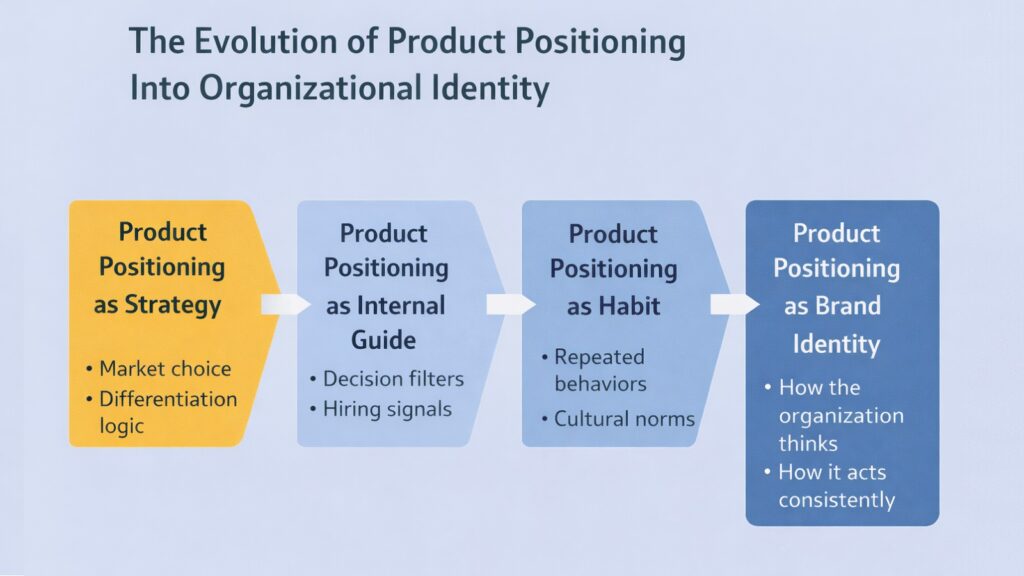
Product Positioning starts as a marketing decision. It ends as organizational identity. The transformation happens through accumulated choices, reinforced language, filtered talent, accepted trade-offs, guided growth, and consistent behavior.
Strong Positioning reshapes how teams think before it reshapes how markets perceive. Internal alignment precedes external recognition. When everyone inside an organization understands the position, they make decisions that reinforce it without needing explicit direction. The position becomes self-perpetuating.
This transformation takes time. Early positioning efforts feel artificial. Teams need reminders. Decisions require debate. But repetition creates fluency. People internalize the position. It stops being something they consult and becomes something they embody. Strategy becomes instinct.
Brand identity is not merely what you assert in your positioning statements. It encompasses your actions when no one is observing. It represents the features you choose not to develop. It signifies the customers you opt not to pursue. It embodies the compromises you embrace because they resonate with your true self. Product Positioning offers the structure that renders these decisions consistent.
Organizations that treat Product Positioning as a one-time exercise miss its power. Positioning is not static. It evolves as organizations learn more about themselves and their markets. But evolution is not the same as drift. Strong positioning provides continuity even as tactics change. It is the stable center around which everything else moves.
The real measure of Product Positioning is not campaign performance or market share. It is whether people inside the organization can explain what the company stands for and why certain choices matter. It is whether new hires understand the position within their first month. It is whether customers can predict how the company will behave in new situations. When positioning becomes legible through action, it has become identity.
Product Positioning Identity Integration Markers
| Integration Indicator | What It Signals About Positioning Maturity |
|---|---|
| Decision-making speed on strategic questions | Fast confident decisions indicate that positioning provides clear evaluation criteria while slow indecisive debates suggest positioning has not become operational decision framework |
| Consistency across geographic and functional teams | Consistent interpretation and application demonstrates positioning has been internalized while variation suggests positioning remains abstract or poorly communicated |
| New employee positioning fluency timeline | Quick positioning comprehension indicates clear behavioral modeling while slow comprehension suggests gap between stated and lived positioning |
| Customer ability to predict company behavior | Accurate customer predictions demonstrate external positioning clarity while confused expectations reveal disconnect between positioning claims and actual patterns |
| Voluntary employee advocacy authenticity | Genuine enthusiastic employee advocacy shows positioning aligns with personal values while scripted advocacy suggests positioning has not been meaningfully internalized |
| Resilience of positioning during leadership transitions | Positioning survival during leadership changes proves it has become cultural while positioning collapse reveals it was leadership-dependent rather than organizationally embedded |
Product Positioning is a long-term identity-commitment. It shapes who you hire, what you build, which opportunities you pursue, and how you treat people when the outcome matters. It becomes the difference between organizations that know themselves and organizations that chase every trend. Between brands that mean something and brands that mean nothing to anyone.