Table of Contents
Introduction: Understanding Artificial Intelligence in a Rapidly Changing World
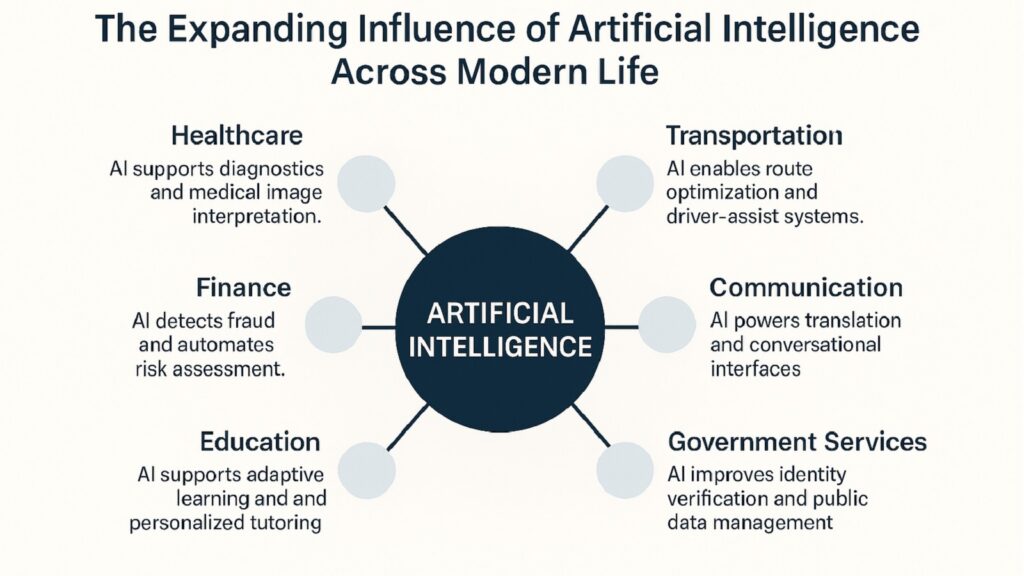
Artificial Intelligence has moved from laboratory experiments to everyday life faster than most predicted. It now guides medical diagnoses, approves loans, drives vehicles, translates languages, and recommends what we watch or buy. The technology that once lived in science fiction has become the invisible infrastructure supporting modern society. Understanding how AI works is no longer optional for those who want to navigate this century with clarity.
This article breaks down eight powerful insights about Artificial Intelligence that shape our present and future. Each insight reveals a different dimension of how AI systems function, evolve, and impact the world around us. From the fundamental types of AI to the ethical frameworks governing its deployment, these insights provide a foundation for anyone seeking to understand this transformative technology.
The pace of AI development continues to accelerate. Systems that seemed impossible five years ago now operate at scale across industries. Healthcare professionals use Artificial Intelligence to detect diseases earlier than human observation alone allows. Financial institutions deploy machine learning models to identify fraud in milliseconds. Transportation networks optimize traffic flow using real-time data analysis. Communication platforms translate between languages with growing accuracy. Each advancement brings new possibilities and new questions about how we build, deploy, and govern these systems responsibly.
8 Major Types of Artificial Intelligence Tools and Their Sub-Categories
| Various Types of Artificial Intelligence Tools | Sub-Categories |
|---|---|
| 1. Generative AI Tools | 1) Image generation 2) Video generation 3) Text generation 4) Audio/voice generation 5) Music generation 6) 3D model generation |
| 2. Predictive AI Tools | 1) Classification systems 2) Regression models 3) Risk scoring engines 4) Forecasting tools 5) Recommendation engines |
| 3. Conversational AI Tools | 1) Chatbots 2) Voice assistants 3) Customer support AI 4) Dialogue systems 5) Multilingual conversational engines |
| 4. Robotics & Autonomous AI Systems | 1) Industrial robots 2) Service robots 3) Autonomous vehicles 4) Drones 5) Warehouse automation systems |
| 5. Computer Vision AI Tools | 1) Object detection 2) Image classification 3) Facial recognition 4) OCR tools 5) Medical imaging analysis |
| 6. Natural Language Processing (NLP) Tools | 1) Translation engines 2) Sentiment analysis tools 3) Summarization tools 4) Entity extraction 5) Document classification |
| 7. Specialized Domain AI Tools | 1) Healthcare diagnostic AI 2) Algorithmic trading tools 3) Cybersecurity threat detection 4) Educational AI tutors 5) Legal document analysis |
| 8. Agentic AI Tools (Autonomous AI Agents) | 1) Task automation agents 2) Research agents 3) Coding agents 4) Planning agents 5) Workflow orchestration agents |
1. Types of Artificial Intelligence: From Narrow AI to Emergent AI
Artificial Intelligence exists in many forms, each with different capabilities and purposes. Researchers classify AI systems in two main ways: by what they can do and by how they process information. Understanding these classifications helps separate reality from science fiction and shows where the technology stands today.
The eight major types of Artificial Intelligence form a spectrum from simple reactive systems to theoretical superintelligence. Narrow AI, also called weak AI, performs specific tasks without genuine understanding. This category includes almost every Artificial Intelligence system in use today. Your smartphone assistant, recommendation algorithm, and spam filter all operate as narrow AI. They excel at defined tasks but cannot transfer knowledge between domains.
General AI, sometimes called strong AI, would match human cognitive abilities across any intellectual task. No system today achieves this level. Researchers debate whether current approaches will lead to general AI or whether fundamentally new breakthroughs are needed. The timeline for achieving AGI remains uncertain, with estimates ranging from decades to never.
Superintelligence represents AI that surpasses human intelligence across all domains. This remains purely theoretical. Reactive machines respond to inputs without memory or learning capability. IBM’s Deep Blue operated this way, evaluating chess positions without learning from past games. Limited memory AI learns from historical data to improve performance. Self-driving cars use this approach, processing sensor data and past driving scenarios to navigate roads.
The Theory of Mind AI could, in principle, be able to comprehend human emotions, beliefs, and intentions.. Current systems lack this capability despite advances in sentiment analysis. Self-aware AI would possess consciousness and self-understanding. This remains speculative and philosophically complex. Emergent AI describes systems that develop unexpected capabilities through training. Large language models have shown emergent abilities in reasoning and task completion that weren’t explicitly programmed.
Eight Types of Artificial Intelligence Classification
| Types of Artificial Intelligence | Description |
|---|---|
| Narrow AI | Systems designed for specific tasks like image recognition or language translation |
| General AI | Hypothetical systems matching human cognitive flexibility across all domains |
| Superintelligence | Theoretical AI exceeding human intelligence in every field |
| Reactive Machines | Systems responding to inputs without memory or learning |
| Limited Memory AI | Systems learning from historical data to improve decisions |
| Theory of Mind AI | Future systems understanding human mental states and emotions |
| Self-Aware AI | Speculative systems possessing consciousness and self-knowledge |
| Emergent AI | Systems developing unexpected capabilities through training processes |
2. Core Components of Artificial Intelligence: From Data to Deployment
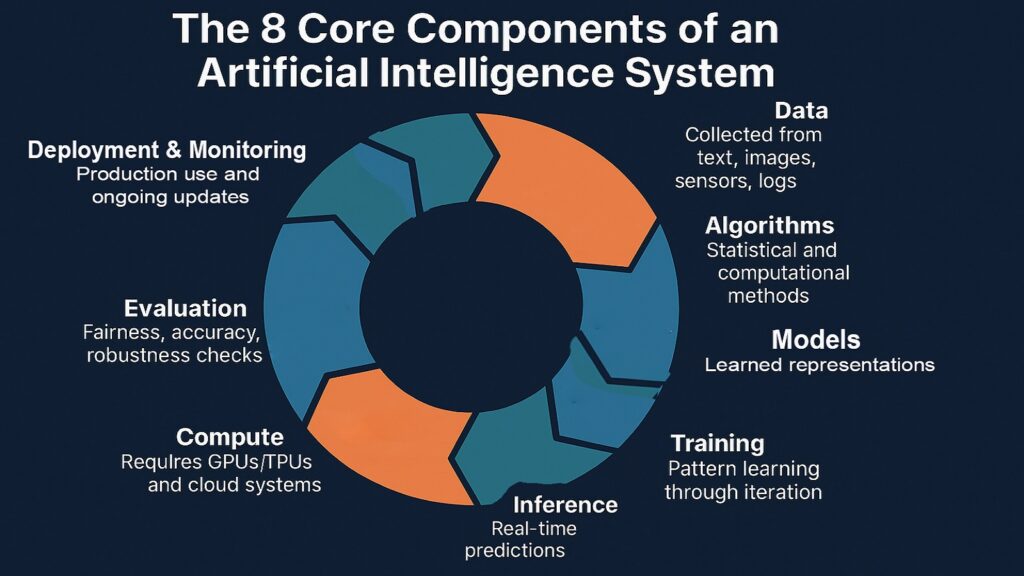
Every Artificial Intelligence system relies on eight essential components working together like instruments in an orchestra. Each component plays a specific role in transforming raw information into intelligent behavior. Understanding these building blocks reveals how AI systems function beneath their surface complexity.
Data forms the foundation. AI systems learn patterns from examples rather than following explicitly programmed rules. A medical diagnosis system needs thousands of labeled patient records. A speech recognition system requires hours of transcribed audio. The quality and quantity of training data directly impact system performance. Biased or incomplete data produces flawed AI systems.
Algorithms provide the mathematical recipes that process data. Different algorithms suit different problems. Gradient descent optimizes neural networks. Random forests make predictions through decision trees. Clustering algorithms group similar items without labels. The algorithm choice depends on the task, data type, and performance requirements.
Models represent learned patterns in a usable form. After training, a model encodes relationships discovered in the data. A spam detection model captures patterns distinguishing legitimate email from junk. Models range from simple linear equations to neural networks with billions of parameters.
Training converts algorithms and data into functional models. The system modifies inner frameworks to reduce forecasting errors. Training contemporary AI models necessitates significant computational resources and time. Large language models undergo rigorous training on thousands of GPUs for a long period of time, ranging from weeks to months.
Inference applies trained models to new situations. When you ask a voice assistant a question, inference processes your speech and generates a response. Inference must happen quickly enough for real-time applications. Edge devices like smartphones perform inference locally to reduce latency.
Compute power enables modern AI. Graphics processing units originally designed for video games now train neural networks efficiently. Tensor processing units optimize specific AI operations. Cloud platforms provide scalable infrastructure for organizations without dedicated hardware.
Evaluation metrics measure system performance. Accuracy counts correct predictions. Precision and recall balance false positives against false negatives. Mean squared error quantifies prediction distances. Choosing appropriate metrics ensures models meet real-world requirements.
Deployment and monitoring bring models into production. Deployed systems face data different from training examples. Performance monitoring detects degradation over time. Regular updates maintain accuracy as conditions change.
Eight Core Components of Artificial Intelligence Systems
| Component of Artificial Intelligence | Function |
|---|---|
| Data | Raw information providing examples for learning patterns |
| Algorithms | Mathematical procedures processing data and learning rules |
| Models | Learned representations encoding discovered patterns |
| Training | Process optimizing model parameters on example data |
| Inference | Applying trained models to make real-time predictions |
| Compute | Processing power enabling training and inference operations |
| Evaluation Metrics | Measurements assessing model performance and quality |
| Deployment & Monitoring | Production operation and ongoing performance tracking |
3. Major Artificial Intelligence Subfields: From Machine Learning to Knowledge Representation
Artificial Intelligence encompasses eight major subfields, each addressing different aspects of intelligent behavior. These disciplines developed independently but increasingly interconnect as AI systems grow more sophisticated. Together, they form the complete landscape of modern AI research and application.
Machine learning enables systems to improve through experience without explicit programming. This subfield dominates current AI development. Supervised learning trains on labeled examples. Unsupervised learning discovers hidden patterns. Self-supervised learning generates its own training signals from the data structure.
Natural language processing gives machines the ability to understand and generate human language. Voice assistants interpret spoken commands. Translation systems convert between languages. Sentiment analysis extracts emotional tone from text. Large language models combine multiple NLP capabilities in unified systems.
Robotics integrates Artificial Intelligence with physical systems that perceive and manipulate the world. Industrial robots assemble products with precision. Warehouse robots navigate facilities autonomously. Surgical robots assist in delicate procedures. Humanoid robots attempt increasingly complex physical tasks.
Computer vision enables machines to interpret visual information. Facial recognition identifies individuals in photos. Medical imaging systems detect tumors in scans. Autonomous vehicles perceive roads, obstacles, and traffic signs. Satellite imagery analysis monitors environmental changes.
Reinforcement learning trains agents through trial and error using rewards and penalties. Game-playing systems master complex strategy games. Robots learn manipulation skills through practice. Recommendation systems optimize for user engagement. Industrial control systems tune manufacturing processes.
Expert systems encode specialist knowledge in rule-based formats. Medical diagnosis systems apply clinical guidelines. Financial planning tools implement investment strategies. These systems dominated early AI but declined as machine learning advanced.
Planning and optimization find efficient solutions to complex problems. Route planning algorithms minimize travel time. Supply chain systems optimize inventory and logistics. Scheduling tools allocate resources efficiently. These methods combine classical algorithms with modern learning approaches.
Knowledge representation and reasoning structures information for logical inference. Semantic networks capture relationships between concepts. Ontologies define formal vocabularies for domains. Knowledge graphs connect entities and facts. These techniques help AI systems understand context and draw conclusions.
Eight Major Subfields of Artificial Intelligence
| Subfield | Focus Area |
|---|---|
| Machine Learning | Systems learning patterns from data without explicit programming |
| Natural Language Processing | Understanding and generating human language in text and speech |
| Intelligent Robotics | Physical systems integrating perception, planning, and manipulation |
| Computer Vision | Interpreting visual information from images and video |
| Reinforcement Learning | Agents learning through trial and error with reward feedback |
| Expert Systems | Rule-based systems encoding specialist domain knowledge |
| Planning & Optimization | Finding efficient solutions to complex scheduling and routing problems |
| Knowledge Representation | Structuring information for reasoning and logical inference |
4. The Artificial Intelligence Development Lifecycle: From Problem Definition to Monitoring
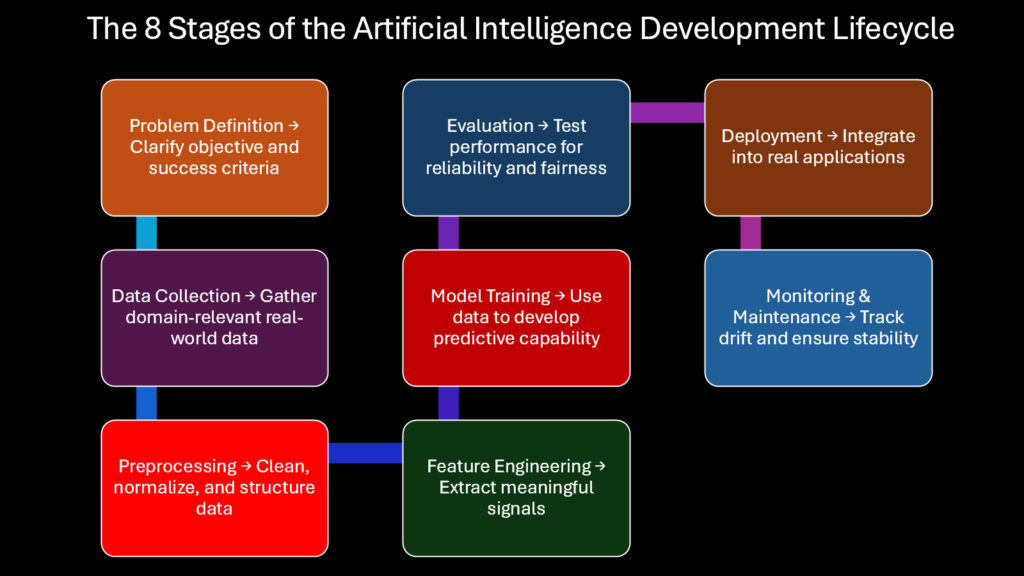
Building Artificial Intelligence systems follows a structured lifecycle with eight distinct stages. Each stage addresses specific challenges in transforming business needs into deployed solutions. Understanding this lifecycle helps organizations implement AI successfully and avoid common pitfalls.
Problem definition clarifies what the AI system should accomplish. This stage identifies success metrics, constraints, and requirements. A fraud detection system might aim for high recall while minimizing false alarms. A recommendation engine might optimize for engagement or diversity. Clear problem definition prevents wasted effort on misaligned solutions.
Data collection gathers information needed for training. Sources might include databases, sensors, user interactions, or purchased datasets. Collection strategies balance cost, quality, and quantity. Privacy regulations affect what data can be gathered and how it must be handled.
Preprocessing cleans and prepares raw data for analysis. This stage removes errors, handles missing values, and standardizes formats. Text preprocessing might include tokenization and normalization. Image preprocessing might involve resizing and augmentation. Quality preprocessing significantly impacts final model performance.
Feature engineering transforms raw inputs into informative representations. For tabular data, this might create ratios or interactions between variables. For images, it might extract edges or textures. Deep learning has automated much feature engineering, but domain knowledge still provides value.
Model training optimizes algorithms on prepared data. This stage selects architectures, tunes hyperparameters, and iterates toward better performance. Training modern models requires experimentation across multiple candidates. Practitioners balance accuracy against complexity and computational cost.
Evaluation tests trained models on held-out data to estimate real-world performance. This stage checks multiple metrics and examines errors to identify weaknesses. Fairness testing ensures models don’t discriminate against protected groups. Robustness testing verifies behavior on edge cases.
Deployment integrates models into production systems. This stage involves packaging models, setting up infrastructure, and implementing monitoring. Deployment strategies range from replacing existing systems to gradual rollouts. API design affects how applications interact with models.
Monitoring and maintenance tracks deployed systems over time. Performance metrics detect degradation from data drift or changing conditions. User feedback identifies problems missed during testing. Regular retraining keeps models current as patterns evolve.
Eight Stages of Artificial Intelligence Development Lifecycle
| Stage | Key Activities |
|---|---|
| Problem Definition | Clarifying objectives, success metrics, and system requirements |
| Data Collection | Gathering relevant information from databases, sensors, and sources |
| Preprocessing | Cleaning data, handling missing values, and standardizing formats |
| Feature Engineering | Transforming raw inputs into informative model representations |
| Model Training | Optimizing algorithms through iterative parameter adjustment |
| Evaluation | Testing performance on held-out data with multiple metrics |
| Deployment | Integrating trained models into production infrastructure |
| Monitoring & Maintenance | Tracking performance and updating models as conditions change |
5. Artificial Intelligence Models and Architectures: From Linear Models to Reinforcement Learning
Artificial Intelligence draws on eight major model families, each suited to different problem types. These architectures evolved over decades as researchers discovered new ways to represent patterns and make predictions. Modern AI systems often combine multiple model types to leverage their complementary strengths.
Linear and statistical models use simple mathematical relationships to make predictions. Logistic regression estimates probabilities for binary outcomes. Linear regression predicts continuous values. These models remain popular for their interpretability and efficiency. Banks use logistic regression for credit scoring. Healthcare providers apply it to risk assessment.
Tree-based models make decisions through branching logic. Decision trees split data based on feature values. Random forests combine many trees to reduce overfitting. Gradient boosting creates strong predictors from weak ones. These models handle mixed data types and reveal feature importance naturally.
Kernel-based models transform data into higher dimensions where patterns become separable. Support vector machines find optimal decision boundaries. These models work well with limited data and avoid some overfitting issues. They excel in text classification and bioinformatics applications.
Shallow neural networks contain one or two hidden layers between inputs and outputs. These models learn nonlinear patterns through interconnected artificial neurons. They dominated AI research in the 1980s and remain useful for moderately complex problems.
Deep neural networks stack many layers to learn hierarchical representations. Convolutional networks process images through learned filters. Recurrent networks handle sequential data with internal memory. These architectures powered the AI revolution of the 2010s.
Transformers use attention mechanisms to process sequences in parallel rather than sequentially. This architecture enables training on massive text corpora. GPT, BERT, and similar models demonstrate unprecedented language understanding. Transformers now extend beyond text to vision, audio, and multimodal tasks.
Probabilistic and graph models represent uncertainty and relationships explicitly. Bayesian networks encode conditional dependencies. Hidden Markov models capture temporal patterns. Graph neural networks process data with network structure. These models suit domains requiring interpretable reasoning.
Reinforcement learning models learn policies mapping situations to actions. Q-learning estimates action values. Policy gradient methods optimize decision strategies directly. Actor-critic architectures combine value and policy learning. These models excel in sequential decision problems.
Eight Major Artificial Intelligence Models and Architectures
| Model Family | Primary Use Cases |
|---|---|
| Linear & Statistical Models | Risk scoring, trend analysis, and basic prediction tasks |
| Tree-Based Models | Tabular data classification, ranking, and feature importance analysis |
| Kernel-Based Models | Text classification, bioinformatics, and small dataset problems |
| Shallow Neural Networks | Moderate complexity pattern recognition and function approximation |
| Deep Neural Networks | Image recognition, speech processing, and complex pattern learning |
| Transformers | Language understanding, generation, and multimodal learning |
| Probabilistic & Graph Models | Uncertainty reasoning, relationship modeling, and network analysis |
| Reinforcement Learning Models | Game playing, robotics control, and sequential decision optimization |
6. Real-World Artificial Intelligence Applications Across Industries
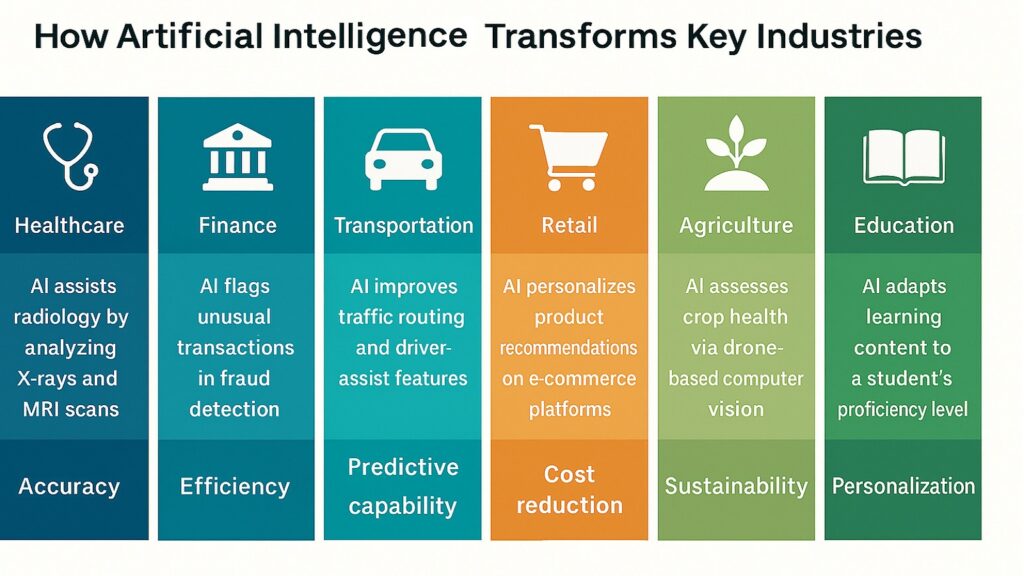
Artificial Intelligence transforms industries through measurable improvements in accuracy, efficiency, and capability. Real deployments demonstrate the technology’s practical impact across healthcare, finance, transportation, retail, manufacturing, agriculture, education, and energy sectors.
Healthcare applications save lives through earlier disease detection and personalized treatment. Artificial Intelligence analyzes medical images to identify cancers, fractures, and other abnormalities. Studies show that Artificial Intelligence is matching or exceeding specialist performance in specific diagnostic tasks. Drug discovery platforms use machine learning to identify promising compounds faster than traditional methods. Hospitals deploy predictive models to anticipate patient deterioration and allocate resources efficiently.
Financial institutions rely on Artificial Intelligence for fraud detection, risk assessment, and trading. Machine learning models analyze transaction patterns to flag suspicious activity in real time. Banks process loan applications using algorithms that evaluate creditworthiness from alternative data sources. Algorithmic trading systems execute orders based on market signals at speeds humans cannot match.
Transportation systems use Artificial Intelligence for route optimization, traffic management, and autonomous operation. Ride-sharing platforms match drivers with passengers to minimize wait times and empty miles. Public transit agencies use demand forecasting to optimize schedules. Autonomous vehicle companies have logged millions of test miles developing self-driving technology.
Retail companies enhance customer experiences and streamline operations using artificial intelligence. Recommendation systems propose products according to browsing and purchasing history. Dynamic pricing adapts to demand, competition, and inventory status. Computer vision technologies facilitate cashierless stores, allowing customers to take items and exit without traditional checkout procedures.
Manufacturing plants increase efficiency and quality through AI-powered automation and monitoring. Predictive maintenance models anticipate equipment failures before they occur, reducing downtime. Computer vision inspects products for defects faster and more consistently than human workers. Robotic systems handle complex assembly tasks with precision.
Agriculture adopts AI for crop monitoring, yield prediction, and resource optimization. Satellite imagery analysis detects disease and stress in crops early. Precision agriculture systems apply water, fertilizer, and pesticides only where needed. Harvesting robots identify ripe produce and pick it without damage.
Education platforms adapt to individual learning needs through AI tutoring systems. These platforms identify knowledge gaps and adjust difficulty accordingly. Automated grading handles routine assessment tasks, freeing teachers for direct instruction. Language learning apps use speech recognition to provide pronunciation feedback.
Energy systems optimize generation, distribution, and consumption with AI forecasting and control. Smart grids balance supply and demand across distributed sources. Renewable energy forecasting predicts solar and wind generation hours ahead. Building management systems reduce energy waste through intelligent climate control.
Artificial Intelligence Applications Across Eight Industries
| Industry | Key Application |
|---|---|
| Healthcare | Medical image analysis achieving diagnostic accuracy comparable to specialists |
| Finance | Fraud detection systems processing millions of transactions in real time |
| Transportation | Route optimization reducing delivery times and fuel consumption |
| Retail | Personalized recommendations increasing customer engagement and sales |
| Manufacturing | Predictive maintenance reducing equipment downtime by 30-50 percent |
| Agriculture | Precision farming optimizing water usage and increasing crop yields |
| Education | Adaptive learning platforms personalizing instruction for student needs |
| Energy | Smart grid management balancing renewable sources with demand patterns |
7. Artificial Intelligence Ethics, Safety, and Governance Principles
Artificial Intelligence raises complex ethical questions as systems gain influence over consequential decisions. Responsible development requires attention to fairness, transparency, accountability, privacy, safety, and societal impact. Organizations and governments worldwide are establishing frameworks to guide AI governance.
Fairness addresses whether AI systems treat all groups equitably. Biased training data can lead to discriminatory outcomes in hiring, lending, criminal justice, and other domains. Research has documented racial bias in facial recognition, gender bias in resume screening, and socioeconomic bias in predictive policing. Addressing fairness requires diverse datasets, careful metric selection, and ongoing monitoring.
Transparency helps users understand how AI systems reach decisions. Black-box models provide little insight into their reasoning. Explainable AI techniques generate human-readable justifications for predictions. Regulations increasingly require transparency, especially for high-stakes applications. The tension between performance and interpretability challenges developers.
Accountability clarifies responsibility when AI systems cause harm. As systems grow more autonomous, traditional liability frameworks strain. Should developers, deployers, or users bear responsibility for AI failures? Clear accountability mechanisms encourage responsible deployment and provide recourse for affected parties.
Privacy protection grows more critical as AI systems process vast personal data. Machine learning models can memorize training examples, creating leakage risks. Differential privacy adds mathematical guarantees limiting what can be inferred about individuals. Federated learning trains models without centralizing sensitive data.
Safety ensures AI systems behave reliably and avoid catastrophic failures. Robustness testing evaluates performance on unusual inputs. Adversarial training hardens models against malicious manipulation. Red teaming identifies potential misuse scenarios. Safety considerations increase with system autonomy and deployment scale.
Regulatory frameworks establish legal requirements for AI development and deployment. The European Union’s Artificial Intelligence Act classifies systems by risk level and imposes corresponding obligations. High-risk applications face strict requirements for documentation, testing, and human oversight. The United States pursues sector-specific regulation alongside voluntary standards.
The NIST AI Risk Management Framework provides guidance for identifying and mitigating AI risks. It emphasizes governance, mapping risks to context, measuring impact, and managing through the system lifecycle. This framework helps organizations implement responsible AI practices systematically.
Research on Artificial Intelligence alignment seeks to ensure advanced systems pursue intended goals. Value learning attempts to infer human preferences from behavior. Reward modeling addresses specification problems in reinforcement learning. Constitutional AI trains models to follow high-level principles. These approaches aim to maintain human control as capabilities increase.
Eight Artificial Intelligence Ethics and Governance Principles
| Principle | Implementation Approach |
|---|---|
| Fairness | Testing for bias across demographic groups and mitigating discrimination |
| Transparency | Providing explanations for decisions and documenting system capabilities |
| Accountability | Establishing clear responsibility chains for AI system outcomes |
| Privacy | Protecting personal data through encryption and access controls |
| Safety | Testing robustness and implementing fail-safes for critical applications |
| Human Oversight | Maintaining meaningful human control over consequential decisions |
| Regulatory Compliance | Following EU AI Act, sector regulations, and voluntary standards |
| Societal Impact | Assessing broader consequences including labor displacement and power concentration |
8. The Future of Artificial Intelligence: Key Trends, Predictions, and Emerging Technologies
Artificial Intelligence development accelerates across multiple fronts. Current trends suggest where the technology heads in coming years. These predictions draw from research roadmaps, industry investments, and demonstrated technical progress rather than speculation.
Generative models continue expanding capabilities beyond text and images. Video generation systems produce increasingly realistic footage from descriptions. Audio synthesis creates natural-sounding speech in any voice. Code generation assists programmers with routine tasks. 3D model generation supports design and simulation. These systems become more controllable and reliable for professional applications.
Multimodal models integrate vision, language, and other modalities in unified architectures. Understanding connections between modalities enables richer comprehension. A system analyzing a video understands both visual content and spoken narration. Document understanding combines text recognition with layout analysis. Robotics benefits from models that process both camera feeds and verbal instructions.
Edge AI deployment brings intelligence to devices without constant cloud connectivity. Smartphones run large language models locally for privacy and latency. Autonomous vehicles process sensor data in real time. Industrial equipment makes control decisions at the edge. Efficient model architectures and specialized hardware enable this trend.
AI-enhanced scientific discovery accelerates research across disciplines. AlphaFold predicted protein structures with revolutionary accuracy. Machine learning identifies promising drug candidates and materials. Pattern recognition in astronomical data finds new phenomena. These applications demonstrate Artificial Intelligence as a scientific tool rather than just a product feature.
Autonomous agents combine reasoning, planning, and tool use to accomplish complex tasks. Rather than responding to single prompts, agents break down goals and take iterative steps. Research assistants gather information across sources and synthesize findings. Software engineering agents write and debug code over extended sessions. The boundary between narrow tools and general-purpose assistants blurs.
Healthcare AI advances toward clinical integration. Diagnostic systems gain regulatory approval for specific applications. Personalized medicine uses genetic and lifestyle data to tailor treatments. Remote monitoring systems track patient health between visits. Electronic health record systems deploy AI for clinical decision support.
Robotics capabilities improve through better perception, control, and learning. Warehouse robots handle more diverse objects. Surgical robots assist in additional procedure types. Humanoid robots demonstrate improved dexterity and adaptability. Simulation advances enable training before physical deployment.
Regulation and governance frameworks mature as governments respond to the growing influence of Artificial Intelligence. International coordination attempts to harmonize standards across borders. Industry develops best practices and safety testing protocols. Academic research informs policy through empirical studies of the impact of Artificial Intelligence. Balancing innovation with protection remains challenging.
Eight Future Trends in Artificial Intelligence Development
| Trend | Expected Impact |
|---|---|
| Generative Models | Creating professional-quality content across video, audio, and 3D media |
| Multimodal Integration | Systems understanding connections between vision, language, and other modalities |
| Edge AI | Running sophisticated models locally on devices for privacy and speed |
| Scientific Discovery | Accelerating research in biology, chemistry, physics, and materials science |
| Autonomous Agents | Systems accomplishing complex multi-step tasks with minimal supervision |
| Healthcare Integration | AI-assisted diagnosis and treatment becoming standard clinical practice |
| Advanced Robotics | Physical systems achieving human-level dexterity in manipulation tasks |
| Regulatory Maturity | Comprehensive frameworks governing development and deployment across sectors |
Conclusion: The Lasting Impact of Artificial Intelligence on Society and Innovation
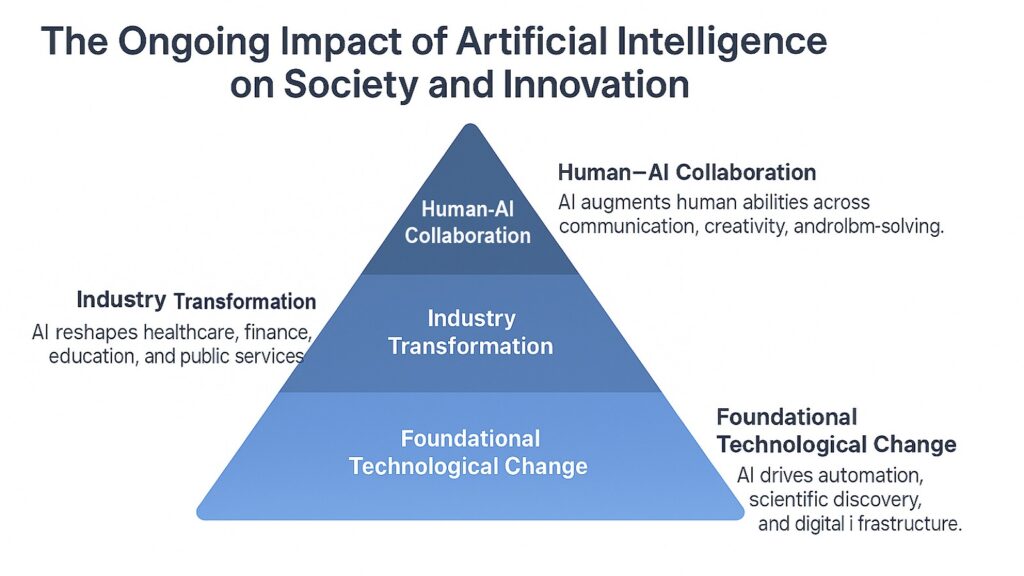
Artificial Intelligence represents the most significant technological shift since the Internet revolutionized communication and commerce. The eight insights explored here provide a foundation for understanding how AI systems work, where they apply, and how they shape the future. From classification schemes to development lifecycles, from model architectures to ethical frameworks, each dimension reveals part of the larger picture.
The technology continues evolving rapidly. Systems considered state-of-the-art today will seem primitive within years. Yet core principles remain stable. AI systems learn from data, optimize for objectives, and operate within constraints that their developers establish. Understanding these fundamentals helps navigate ongoing changes.
Every industry faces transformation as AI capabilities expand. Healthcare providers diagnose diseases more accurately. Financial institutions detect fraud more effectively. Manufacturers optimize production more efficiently. Retailers personalize experiences more precisely. Agriculture uses resources more sustainably. The pattern repeats across domains: AI augments human capabilities and creates new possibilities.
Responsible development requires ongoing attention. Technical excellence alone doesn’t ensure beneficial outcomes. Fairness, transparency, accountability, and safety must be built into systems from inception. Regulatory frameworks provide guardrails while allowing innovation. The balance between opportunity and risk demands careful navigation.
Human-AI collaboration defines the path forward rather than replacement or autonomy. Artificial Intelligence systems excel at processing vast data and finding patterns. Humans provide judgment, creativity, and ethical reasoning. Combining these strengths produces better outcomes than either achieves alone. The future belongs to those who learn to work effectively with intelligent systems.
The pace of change can feel overwhelming. New models, techniques, and applications emerge constantly. Yet the fundamentals covered here provide stable ground for understanding. Whether you develop AI, deploy it in organizations, or simply encounter it daily, these insights offer a framework for making sense of this transformative technology.
Artificial Intelligence will continue shaping society in ways both expected and surprising. Staying informed and engaged helps ensure that development proceeds responsibly and benefits reach broadly. The journey from narrow task automation toward more general intelligence continues. What comes next depends on choices made today about how to build, deploy, and govern these powerful systems.
Eight Dimensions of Artificial Intelligence’s Societal Impact
| Dimension | Current State and Trajectory |
|---|---|
| Economic Productivity | Automation increasing efficiency while displacing routine jobs |
| Healthcare Access | AI-powered diagnostics expanding reach of specialist expertise |
| Educational Equity | Adaptive learning systems personalizing instruction at scale |
| Scientific Progress | Accelerated discovery in drug development and materials research |
| Environmental Sustainability | Optimization reducing energy use and improving resource management |
| Creative Expression | Generative tools augmenting human creativity across media types |
| Democratic Processes | Concerns about misinformation balanced against enhanced civic engagement |
| Global Competitiveness | Nations investing heavily in AI research and deployment capabilities |
Read More Tech Articles
- Quantum Computing: 6 Powerful Concepts Driving Innovation
- 8 Powerful Smart Devices To Brighten Your Life
- Canva Magic Media Review: 8 Reasons Why It is Unique
- 8 Big Ways Aged People Are Benefitting From Smartphones
- 8 Big Ways Female Entrepreneurs Are Benefiting From FinTechs
- 8 Best AI Image Generators That You Must Know About
- AI Images: 8 Simple Steps To Create Images Using AI
- Lenovo ThinkBook Plus Gen 5: Disrupting The Tech World
- Top 12 Windows Laptops of 2023: Power, Beauty and Agility
- How to Buy a Laptop: 10 Important Steps to Follow