Table of Contents
Introduction: Aspiring Entrepreneur and the Quiet Meaning of Real Success
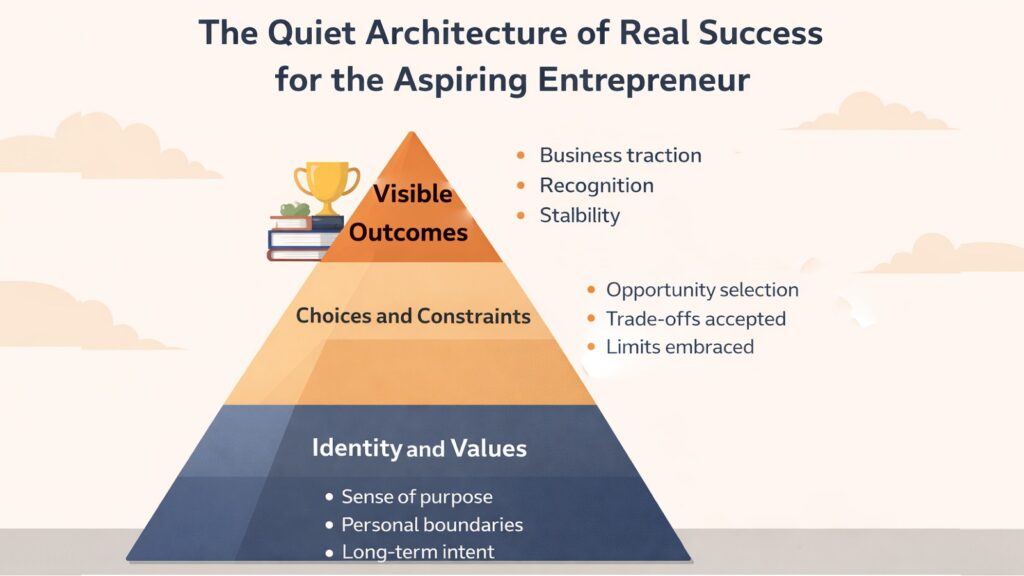
The internet shouts a particular story about entrepreneurship. It’s loud with promises of overnight wins, viral launches, and shortcuts that compress years into weeks. Against this noise stands the aspiring entrepreneur who faces something else entirely. The journey here isn’t packaged in motivational posts or wrapped in the mythology of instant breakthroughs. It’s messy. It’s uncertain. And it unfolds through choices that often feel small in the moment.
Real success doesn’t announce itself with fanfare. It accumulates quietly through constraints navigated, decisions tested, and learning curves endured. The aspiring entrepreneur builds through trial and reflection rather than hype and momentum. This person knows that meaningful progress happens behind closed doors long before anyone else notices. The problem with most mainstream advice is its tendency to oversimplify. It offers formulas where none exist and certainty where ambiguity reigns.
When nearly half of all new businesses close within five years, according to U.S. Bureau of Labor Statistics data, the aspiring entrepreneur deserves more than tactics and tools. The reality check comes from understanding that direction matters more than speed, that uncertainty becomes a companion rather than an obstacle, and that identity grounds every decision worth making. This isn’t about rejecting ambition. It’s about redefining what success looks like when you’re building something that lasts.
The aspiring entrepreneur operates in a space between what exists and what could be. That space demands patience, clarity, and a willingness to question the prevailing narratives about how businesses grow. The work ahead isn’t glamorous. But it’s real. And it’s built on principles that withstand the test of time better than any trending strategy ever could.
Aspiring Entrepreneur Reality Check: Common Myths vs. Actual Experience
| Common Myth | Actual Reality |
|---|---|
| Overnight success stories define entrepreneurship | According to 2024 Bureau of Labor Statistics data, 79.6% of businesses survive their first year through sustained effort |
| Confidence precedes action in successful ventures | Global Entrepreneurship Monitor 2024/2025 reports that 49% of potential entrepreneurs hesitate due to fear of failure, yet successful founders act despite doubt |
| More funding guarantees better outcomes | CB Insights research shows 42% of startups fail due to lack of market need, not capital constraints |
| Speed and hustle outperform strategic patience | Harvard Business School research on entrepreneurship emphasizes that founders make decisions under uncertainty requiring careful decomposition of complex problems |
| Following trends creates competitive advantage | First-time founders have an 18% success rate while those with prior experience reach 30%, suggesting learned judgment matters more than timing |
| Large teams and resources ensure survival | Constraints force focus, with 63.3% of entrepreneurs using personal funds to start according to recent surveys |
1. Aspiring Entrepreneur Learns to Design Direction Before Chasing Speed
Movement feels productive. The aspiring entrepreneur knows this temptation well. There’s satisfaction in checking boxes, responding to messages, and filling calendars with activities that create the illusion of progress. But movement without direction wastes energy on paths that lead nowhere meaningful. Direction requires something different. It demands deliberate design rather than reactive momentum.
The aspiring entrepreneur faces endless opportunities. Some align with long-term vision while others promise quick wins that ultimately distract. Choosing what not to pursue becomes as critical as deciding what to build. This isn’t about perfectionism or overthinking. It’s about recognizing that every yes to one thing means no to ten others. When resources are limited and time is finite, clarity becomes the real competitive advantage.
Consider the entrepreneur who launches three projects simultaneously because each seems promising. Energy fragments across competing priorities. Focus never deepens. Compare this to the entrepreneur who deliberately chooses one direction, rejects adjacent opportunities, and commits fully to understanding a single problem. The second approach feels slower initially. It appears to sacrifice optionality. But it creates conditions for depth that shallow exploration never reaches.
Resisting trends requires confidence in your chosen direction. The aspiring entrepreneur watches others chase the latest platform, adopt the newest methodology, or pivot toward whatever garners attention. The pressure to follow intensifies when others seem to succeed. Yet most trends fade before delivering on their promise. Those who chase them end up perpetually behind, always adapting to someone else’s timeline instead of building on their own foundation.
Direction emerges from asking better questions. What problem do you understand better than most? What customer segment do you serve with unusual clarity? What constraint can you turn into an advantage? These questions don’t have obvious answers. They require reflection, testing, and a willingness to be wrong. But answering them creates a foundation that tactical decisions can build upon.
The aspiring entrepreneur designs direction by making trade-offs visible. Every strategy implies what you’re not doing. Every target market excludes others. Every feature built means features deferred. Making these choices explicit prevents drift. It creates a filter for evaluating opportunities as they arise. When someone suggests a partnership, a new product line, or a market expansion, you can assess it against your designed direction rather than reacting emotionally.
Aspiring Entrepreneur Direction Design Framework
| Design Element | Key Consideration |
|---|---|
| Problem Definition | Focus on one problem understood deeply rather than many understood superficially; research shows 42% of failed startups lacked market need |
| Customer Clarity | Serve a specific segment well before expanding broadly; narrow focus enables faster learning cycles |
| Constraint Acknowledgment | Name your limitations in time, capital, and expertise; these boundaries define strategic choices |
| Opportunity Filter | Create explicit criteria for what opportunities to pursue; prevents reactive decision-making |
| Trend Resistance | Evaluate new platforms and methods against your core direction rather than adopting by default |
| Trade-off Visibility | Document what you’re explicitly choosing not to do; clarifies strategic positioning |
2. Aspiring Entrepreneur Treats Uncertainty as a Skill, Not a Problem
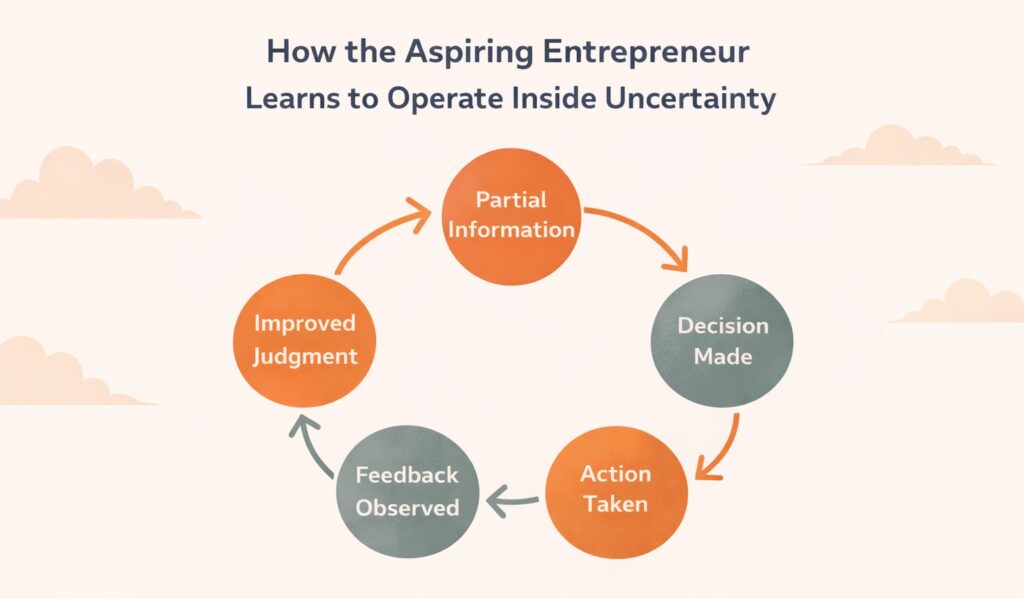
Certainty feels safe. The aspiring entrepreneur craves it as much as anyone. But entrepreneurship exists in a realm where certainty remains perpetually out of reach. You never have complete information. Timing is never perfect. Plans remain incomplete no matter how much preparation precedes action. The question isn’t whether uncertainty exists but how you respond to its constant presence.
Most advice treats uncertainty as a temporary condition. It suggests that with enough research, planning, or validation, you can eliminate ambiguity before committing. This framing creates paralysis. The aspiring entrepreneur waits for confidence that never arrives. Meanwhile, opportunities pass, and competitors act with partial information. The uncomfortable truth is that uncertainty doesn’t disappear. It transforms.
Building tolerance for ambiguity functions like developing a muscle. The first experience of acting without complete clarity feels terrifying. Your mind generates worst-case scenarios. Doubt creeps into every decision. But with repeated exposure, something shifts. You learn to distinguish between uncertainty that requires more information and uncertainty that demands action despite incomplete knowledge. This discrimination becomes invaluable.
The Global Entrepreneurship Monitor’s 2024/2025 report reveals that fear of failure has risen from 44% to 49% among potential entrepreneurs over recent years. This growing hesitation suggests that more people recognize entrepreneurship’s inherent risks. Yet those who succeed aren’t the ones who eliminate risk. They’re the ones who develop the capacity to operate within it. They act knowing they might be wrong. They commit to decisions while holding them lightly enough to adjust when new information emerges.
The aspiring entrepreneur practices uncertainty through small experiments. Rather than betting everything on one grand plan, you test assumptions incrementally. You launch imperfect versions. You gather feedback before finalizing direction. You treat early decisions as hypotheses to validate rather than conclusions to defend. This approach doesn’t eliminate uncertainty. It creates a relationship with uncertainty that enables progress.
Consider how uncertainty shows up in daily decisions. Which feature to build first? Which customer segment to prioritize? Which distribution channel to test? None of these choices comes with guarantees. The aspiring entrepreneur who waits for certainty makes no choices at all. The one who develops skill with uncertainty makes provisional choices, monitors outcomes, and adjusts course based on what emerges. The second approach feels uncomfortable but yields actual learning.
Aspiring Entrepreneur Uncertainty Navigation Guide
| Uncertainty Type | Skilled Response |
|---|---|
| Market Validation | Act with minimum viable tests rather than extensive research; learn from real customer behavior |
| Resource Allocation | Make reversible decisions when possible; preserve optionality while gathering information |
| Timing Decisions | Recognize that perfect timing doesn’t exist; focus on readiness within acceptable windows |
| Competitive Positioning | Acknowledge incomplete competitive intelligence; move based on customer needs rather than competitor actions |
| Strategic Direction | Treat early strategies as hypotheses to test; revise based on evidence rather than defending initial choices |
| Outcome Prediction | Accept that results are unknowable in advance; build feedback loops that enable rapid adjustment |
3. Aspiring Entrepreneur Builds Systems Before Needing Them
Hustle culture celebrates relentless action. The aspiring entrepreneur hears constant messages about grinding harder, working longer, and pushing through obstacles with sheer determination. This narrative sounds inspiring until you recognize its limitations. Hustle without structure leads to burnout. Effort without systems creates chaos that scales poorly. The alternative isn’t laziness. It’s the intentional design of how work gets done.
Systems thinking shifts attention from heroic effort to sustainable process. The aspiring entrepreneur benefits enormously from establishing simple systems early. These aren’t complicated software platforms or rigid procedures. They’re repeatable ways of handling recurring decisions, capturing learning, monitoring resources, and maintaining momentum. Systems conserve mental energy for decisions that actually require fresh thinking.
Consider feedback systems. The aspiring entrepreneur needs to know whether customer conversations reveal patterns or anomalies. Without a system for capturing and reviewing feedback, insights dissolve into vague impressions. A simple spreadsheet noting customer comments, pain points mentioned, and feature requests creates visibility. Reviewing it weekly reveals trends that individual conversations obscure. This isn’t sophisticated. But it’s systematic.
Cash flow awareness represents another critical system. Many aspiring entrepreneurs track revenue and expenses reactively. They know their bank balance but not their burn rate trajectory. They celebrate revenue without accounting for costs. A basic system for projecting cash position over the coming months prevents a crisis. It enables decisions about spending, hiring, or investment from a position of clarity rather than panic.
Learning systems matter equally. The aspiring entrepreneur makes dozens of small decisions daily. Some work. Others don’t. Without capturing what happened and why, lessons evaporate. A weekly practice of documenting what you tried, what resulted, and what you’d do differently creates institutional memory. When you’re a team of one, you are the institution. Your memory becomes the system.
Decision-making routines conserve energy. The aspiring entrepreneur who decides everything fresh exhausts mental capacity on repetitive choices. Creating default responses for common situations frees attention for situations that warrant it. This might mean establishing criteria for which customer requests to pursue, which partnership offers to decline, or how to allocate time between building and selling. Defaults don’t eliminate judgment. They make judgment more efficient.
Aspiring Entrepreneur Systems Framework
| System Category | Essential Function |
|---|---|
| Feedback Capture | Document customer conversations and pain points weekly; identify patterns that inform product decisions |
| Cash Flow Monitoring | Track weekly runway and burn rate; project viability horizon to enable proactive resource decisions |
| Learning Documentation | Record weekly experiments and outcomes; build institutional knowledge that prevents repeated mistakes |
| Decision Routines | Establish default criteria for common choices; reserve mental energy for novel situations |
| Time Allocation | Define how hours distribute across building, selling, and learning; prevent reactive scheduling |
| Progress Tracking | Measure leading indicators of traction; distinguish activity from meaningful advancement |
4. Aspiring Entrepreneur Measures Progress in Signal, Not Noise
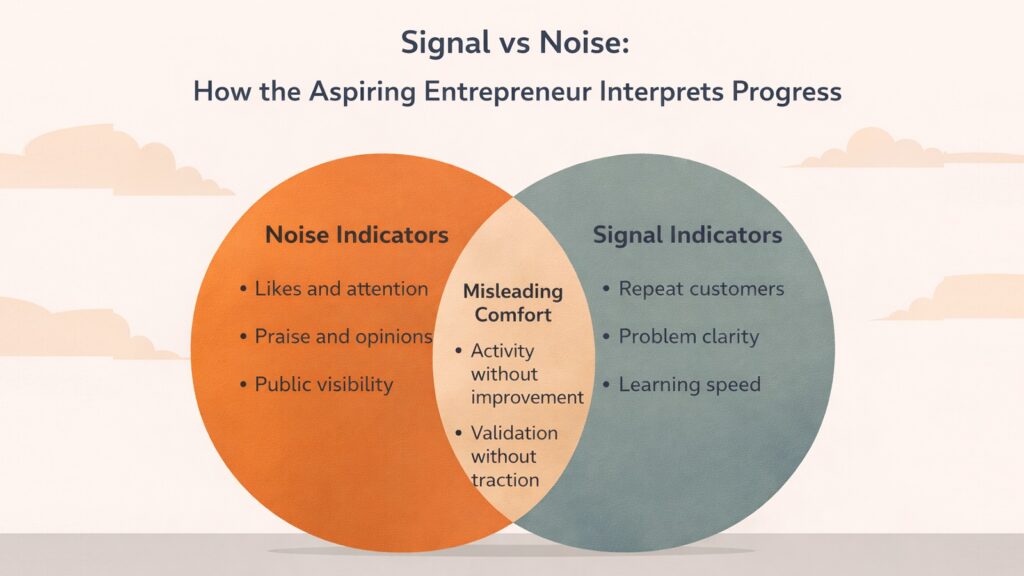
Attention feels like validation. The aspiring entrepreneur launches something new and watches for reactions. Likes accumulate. Comments arrive. People share and praise. These responses trigger dopamine. They feel like progress. But surface-level metrics often mislead more than they illuminate. Real progress hides beneath the noise of validation.
Signal and noise differ fundamentally. Noise consists of metrics that feel good but predict nothing about sustainable success. Followers who never buy. Praise that doesn’t convert to advocacy. Attention that evaporates without impact. Signal emerges from indicators that correlate with actual viability. Repeat customers who return voluntarily. Referrals that come unsolicited. Problem-solving clarity that deepens with each iteration.
The aspiring entrepreneur faces constant temptation to optimize for noise. Platforms reward engagement. Algorithms favor frequency. The mechanics of online attention push toward volume over substance. Fighting this current requires discipline. It means tracking different metrics. It demands asking whether today’s activity moves you closer to sustainable business or merely generates temporary visibility.
Consider two entrepreneurs with similar followings. One has ten thousand followers who occasionally engage. The other has five hundred people who repeatedly purchase and actively refer others. The first entrepreneur appears more successful by conventional metrics. The second has built something far more valuable. Signal appears in the concentration of value rather than the breadth of attention.
Learning speed functions as a powerful signal. The aspiring entrepreneur who rapidly iterates based on customer feedback develops an understanding that can’t be rushed. This shows up in how quickly you identify and solve problems. Can you articulate your customer’s pain point more clearly than they can? Do you understand why previous solutions failed? Can you predict which features matter and which don’t? These capabilities develop through cycles of building, testing, and incorporating feedback.
The challenge is that the signal often remains invisible to outside observers. Revenue from ten committed customers doesn’t photograph well. Deepening understanding of a problem doesn’t generate shares. The clarity that comes from rejecting bad opportunities doesn’t produce content. The aspiring entrepreneur must develop internal confidence in signal-based progress even when external validation lags.
Aspiring Entrepreneur Signal vs. Noise Indicators
| Noise Metric | Signal Metric |
|---|---|
| Total follower count or social media engagement | Repeat customer rate and unsolicited referrals from satisfied users |
| Generic praise and positive comments | Specific problem-solving feedback and feature requests |
| Traffic or downloads without conversion | Retention rate and actual usage patterns over time |
| Media mentions and press coverage | Customer willingness to pay and increasing transaction values |
| Number of partnership opportunities | Quality of strategic relationships that advance core business |
| Vanity metrics that feel good | Leading indicators that predict revenue and sustainability |
5. Aspiring Entrepreneur Uses Constraints as a Strategic Advantage
Limitations feel like handicaps. The aspiring entrepreneur looks at established competitors with their resources, teams, and market presence and sees every advantage they lack. Limited capital means slower growth. A small team means constrained capacity. An unknown brand means harder customer acquisition. These constraints appear to stack odds against success. But this framing misses a crucial insight.
Constraints force creativity in ways abundance never does. When you can’t outspend competitors, you must out-think them. When you can’t hire a large team, you must choose focus ruthlessly. When you can’t afford traditional marketing, you must find unconventional paths to customers. These pressures create conditions for originality. They prevent the lazy thinking that resources enable.
Consider product development under constraint. The aspiring entrepreneur can’t build everything. This limitation demands clarity about what matters most. You must identify the single feature that delivers core value. You must understand your customer deeply enough to know what they actually need versus what they say they want. This clarity often eludes well-funded competitors who can afford to build everything and hope something resonates.
Resource constraints shape strategic choices in valuable ways. The aspiring entrepreneur can’t compete on every front. You must choose the battlefield carefully. This might mean serving a narrow niche ignored by larger players. It might mean embracing business models that don’t scale in ways that attract venture capital. It might mean building slowly through customer revenue rather than racing toward growth metrics that require external funding.
Established companies carry legacy costs and assumptions that constrain their flexibility. The aspiring entrepreneur starts fresh. You can question industry conventions. You can serve customers in ways that seem uneconomical at scale but work perfectly at a small scale. You can experiment with approaches that larger competitors can’t pursue without disrupting existing revenue streams. Your constraints create opportunities they’ve systematically eliminated.
Many aspiring entrepreneurs fail by imitating large companies too early. They hire before establishing revenue. They invest in infrastructure before proving demand. They pursue growth before achieving profitability. These choices make sense for venture-backed companies optimizing for exit. They destroy bootstrapped ventures that need to reach viability first. Recognizing which playbook applies to your constraint profile matters enormously.
Aspiring Entrepreneur Constraint Advantages
| Constraint Type | Strategic Advantage |
|---|---|
| Limited Capital | Forces focus on viable business models; prevents premature scaling; demands capital-efficient customer acquisition |
| Small Team | Enables rapid decision-making; maintains direct customer connection; preserves organizational agility |
| Unknown Brand | Freedom to serve ignored niches; ability to experiment without reputation risk; opportunity to build from authentic relationships |
| Narrow Expertise | Deep problem understanding in specific domain; credibility with particular customer segment; differentiation through specialization |
| Time Limitations | Ruthless prioritization of essential activities; elimination of peripheral distractions; focus on high-leverage actions |
| Market Position | Willingness to challenge industry assumptions; ability to serve customers in unconventional ways; freedom from legacy commitments |
6. Aspiring Entrepreneur Builds Identity Before Building Scale
Growth feels like the goal. The aspiring entrepreneur measures progress in expanding revenue, larger teams, and increased market presence. These metrics matter. But they rest on something less visible and more fundamental. Identity provides the foundation that makes sustainable growth possible. Without clarity about values and boundaries, scale amplifies confusion rather than strength.
Identity in this context isn’t about personal brand or public image. It’s about knowing what you stand for and what you won’t compromise. The aspiring entrepreneur with a clear identity makes faster decisions because fewer options warrant consideration. Questions about partnerships, hiring, product direction, and growth opportunities filter through established principles. This clarity eliminates energy waste on decisions that don’t align with core values.
Consider the aspiring entrepreneur facing a lucrative opportunity that requires compromising on product quality. Without a clear identity, this decision triggers internal conflict. You weigh financial pressure against vague discomfort. With an established identity around quality standards, the decision is clarified instantly. The opportunity doesn’t fit. This doesn’t mean rigidity. It means having reference points that simplify complex choices.
Identity shapes hiring in profound ways. The aspiring entrepreneur who understands their values can articulate what matters beyond technical skills. You recognize cultural fit or its absence quickly. You avoid hires that would succeed in other contexts but struggle in yours. This prevents the expensive mistake of adding team members who perform well individually but erode organizational coherence.
Growth choices similarly depend on identity. Do you optimize for maximum revenue or sustainable pace? Do you prioritize innovation or reliability? Do you serve everyone adequately or specific customers exceptionally? These aren’t abstract questions. They determine which opportunities to pursue and which to decline. The aspiring entrepreneur without identity clarity bounces between contradictory strategies as circumstances shift.
Harvard Business School research on entrepreneurship emphasizes that founders must formulate a strategy rather than inherit it. This formulation requires understanding not just market opportunity but personal and organizational identity. What kind of company are you building? What experience do you want to create for customers? What culture do you want to sustain? These questions precede tactical decisions about product and market.
Identity prevents drift over time. The aspiring entrepreneur faces constant pressure to adapt, pivot, and chase emerging opportunities. Some adaptation makes sense. But without identity as an anchor, adaptation becomes a shapeless reaction. You lose coherence. Customers stop understanding what you represent. You stop recognizing yourself in the business you’ve built. Identity creates continuity through necessary changes.
Aspiring Entrepreneur Identity Foundation Elements
| Identity Dimension | Guiding Function |
|---|---|
| Core Values | Define non-negotiable principles; filter opportunities and partnerships; maintain consistency under pressure |
| Quality Standards | Establish minimum acceptable thresholds; guide product decisions; shape customer expectations and experience |
| Customer Philosophy | Clarify who you serve and why; inform pricing and positioning; determine acceptable trade-offs |
| Growth Approach | Choose between maximum scale and sustainable pace; align resource decisions with preferred trajectory |
| Cultural Priorities | Articulate what matters in how work happens; guide hiring and team development; shape operational norms |
| Boundary Recognition | Identify what you explicitly won’t do; prevent mission creep; maintain strategic focus over time |
Conclusion: Aspiring Entrepreneur and the Long Game of Building Real Success
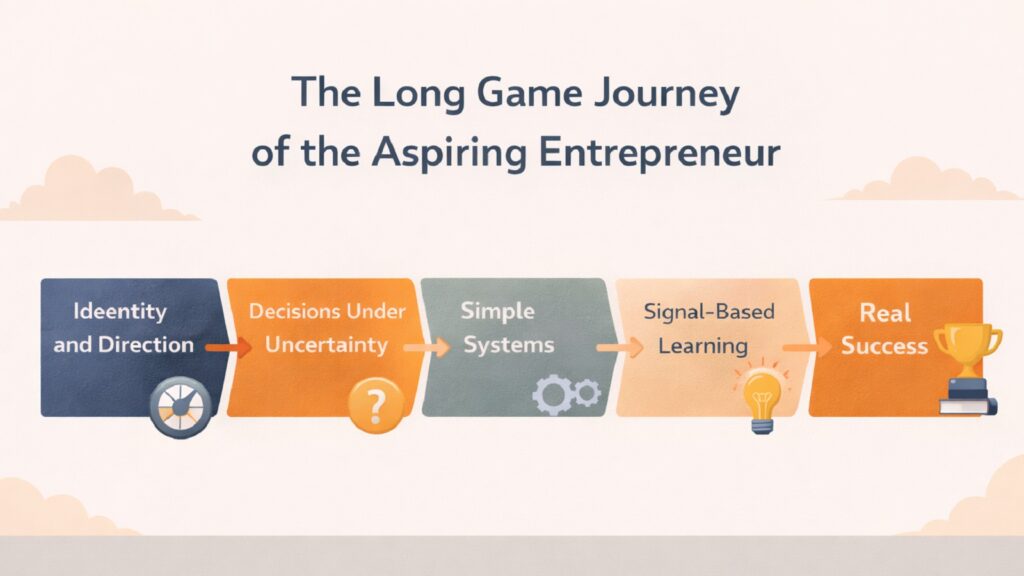
Success compounds quietly. The aspiring entrepreneur works for months without visible progress. Then something shifts. A customer returns and brings others. An insight crystallizes into an advantage. A capability developed slowly becomes differentiation. These moments don’t arrive through a sudden breakthrough. They emerge from the accumulation of small choices made consistently over time.
The journey differs dramatically from internet narratives about entrepreneurship. No viral moment changes everything. No single decision determines the outcome. No shortcut bypasses the work of understanding customers, solving problems, and building sustainable systems. What appears overnight to outside observers actually unfolded through years of invisible development. The aspiring entrepreneur knows this. Maintaining perspective amid noise becomes essential.
Direction, uncertainty, systems, signals, constraints, and identity weave together into coherent practice. The aspiring entrepreneur who designs direction avoids wasted motion. The one who develops skill with uncertainty acts despite incomplete information. Building systems prevents burnout. Measuring signal over noise maintains focus on what matters. Using constraints strategically creates advantages. Establishing identity provides the foundation for sustainable scale.
This path demands patience that feels countercultural. We live in an era celebrating speed and scale. The aspiring entrepreneur who chooses depth over breadth, sustainability over explosiveness, and coherence over opportunism swims against strong currents. The temptation to abandon long-term thinking for short-term gains never disappears. Resisting requires remembering why you started and what kind of business you want to build.
Meaningful progress often feels invisible before becoming obvious. The aspiring entrepreneur develops capabilities that don’t photograph well. Understanding deepens without external validation. Customer relationships strengthen without public announcement. Business fundamentals improve without generating news. Then, seemingly suddenly, others notice what you’ve been building. The overnight success actually took five years of daily practice.
Real success comes from playing a different game than most people recognize. It’s not about winning by conventional metrics or impressing observers. It’s about building something that sustains itself, serves customers genuinely, and reflects values you won’t compromise. The aspiring entrepreneur who commits to this path accepts loneliness, doubt, and obscurity as part of the process. You understand that recognition lags value creation often by years.
Aspiring Entrepreneur Long-Term Success Principles
| Success Principle | Long-Term Impact |
|---|---|
| Cumulative Progress | Small daily improvements compound over years; consistency matters more than intensity according to research on sustainable ventures |
| Invisible Development | Most valuable capabilities develop privately; external validation lags internal progress by substantial periods |
| Patient Iteration | Bureau of Labor Statistics data shows 79.6% of businesses survive year one through sustained effort rather than breakthrough moments |
| Values Alignment | Identity-driven decisions create coherent organizations; prevents drift and regret as scale increases |
| Learning Investment | Harvard research emphasizes founders with prior experience reach 30% success rate versus 18% for first-timers through accumulated judgment |
| Sustainable Pace | Choosing viability over hypergrowth enables longer runway; matches resource constraints to realistic timelines |
The aspiring entrepreneur walks a path few understand and fewer complete. Those who persist discover that real success feels different from imagined. It’s quieter. More satisfying. More sustainable. And it’s built on principles that withstand trends, economic cycles, and shifting attention. The work continues beyond any single milestone. But the foundation you build supports something worth maintaining. That’s the long game. That’s real success.
Read More Business and Economy Articles
- Global Trade Security Risks: 6 Forces Disrupting World Trade
- Share Market Basics: 8 Powerful Components Explained
- Global South Economies: 6 Powerful Forces Driving World Growth
- AI Job Growth: 6 Powerful Trends Fueling a Brighter Future
- AI Job Losses: 6 Devastating Impacts You Can’t Ignore
- 6 Powerful Ways Brand Management Wins Consumer Loyalty
- 6 Powerful Consumer Insights That Drive Global Brands
- Sovereign Debt: 6 Alarming Risks Wealthy Nations Ignore
- Market Research Secrets: 6 Powerful Ways to Decode Minds
- Marketing Mastery: 6 Proven Ways to Drive Success
- Business 360° Breakthrough: Unlock Powerful Growth Today
- Global Economy: 10 Essential Building Blocks Revealed