Table of Contents
Introduction: Big Bang as a Cosmic Force We Can Reimagine Today
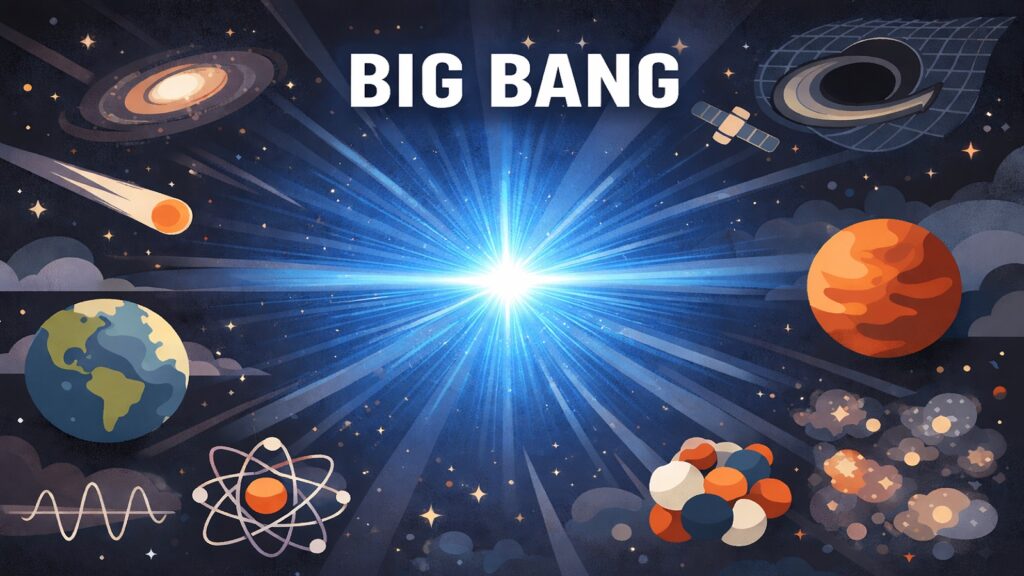
The Big Bang stands before us not as some distant memory locked in cosmic history but as a force still molding everything we see. When we look at stars or measure the temperature of empty space, we glimpse its fingerprints. This article takes the Big Bang and pulls it into the present, reimagining it through modern measurements and familiar references that make sense to us today.
Translating early universe physics into present-day analogies does something important. It transforms abstract numbers into experiences we can almost touch. The Big Bang becomes less about impossibly large figures and more about understanding why our universe behaves the way it does. We anchor everything here to established science, avoiding speculation or mystery for its own sake. The goal is clarity, not confusion wrapped in technical language.
Think of this exploration as a bridge between then and now. The energy that exploded into existence nearly fourteen billion years ago still flows through galaxies. The temperatures that once defined the infant cosmos set rules that particles follow today. By placing the Big Bang in contexts we recognize, we make the universe more knowable, not more distant. Each section that follows takes one aspect of the Big Bang and shows how it would manifest if we could observe it through today’s instruments and understanding.
Big Bang Compared to Other Cosmic Forces
| Cosmic Forces | Relationship to Big Bang |
|---|---|
| Big Bang | Initial singularity event that created space, time, matter, and energy from which all else emerged |
| Cosmic Inflation | Extremely rapid expansion phase occurring fractions of a second after Big Bang, stretching space exponentially |
| Space-Time | Fundamental fabric created at Big-Bang moment, defining how distances and durations exist |
| Gravity | One of four forces that separated from unified state shortly after Big-Bang began |
| Four Fundamental Forces | Electromagnetic, strong nuclear, weak nuclear, and gravity emerged as Big-Bang cooled and symmetry broke |
| Quantum Fluctuations | Tiny variations in early Big-Bang energy density that seeded structure formation across the universe |
| Quantum Fields | Underlying fields present at Big-Bang from which particles arose as excitations |
| Symmetry Breaking | Process during Big-Bang cooling where unified forces split into distinct interactions we observe today |
1. Big Bang Explained Through Modern Energy Output
The Big Bang released more energy in its first moments than all the stars that have ever existed could produce. To understand this scale, we need modern benchmarks. A large nuclear power plant generates about one gigawatt continuously. The entire sun pumps out roughly four hundred trillion trillion watts every second. Yet the energy density in the early Big Bang dwarfed even these staggering numbers.
Physicists estimate this by working backward from what we observe now. They measure the cosmic microwave background radiation and calculate how much energy must have existed when the universe was far denser and hotter. The math involves quantum field theory and general relativity, but the outcome is clear. The Big-Bang contained energy so concentrated that space itself became a seething cauldron of particles appearing and vanishing.
Consider global electricity consumption, which reaches about three trillion watts at any given moment. The Big Bang packed more energy into a region smaller than an atom than humanity uses in billions of years. This comparison breaks down quickly because we are talking about energy creating space itself, not just filling existing space. Every photon of light, every vibration of every field, traces back to that initial energy release.
What makes the Big Bang remarkable is not just the total amount but the density. Energy density determines what particles can exist and how forces behave. In those first fractions of a second, the universe was hot enough to forge particles we can barely create in our most powerful accelerators today. The Big-Bang set the energy framework that galaxies, stars, and planets would eventually inherit. This framework persists, governing nuclear reactions in stellar cores and the light that reaches our telescopes from distant galaxies.
The energy unleashed during the Big-Bang was not distributed evenly at the quantum level. Tiny fluctuations in density existed, stretched to cosmic proportions during expansion. These variations in energy concentration eventually became the seeds for the structure we see today. Without them, the universe would remain a uniform soup of particles with no stars, no galaxies, no planets.
Big Bang Energy Output Compared to Modern Sources
| Energy Source | Approximate Output |
|---|---|
| Large Nuclear Reactor | One thousand megawatts continuous power generation over years |
| Global Electricity Use | Three trillion watts total human consumption at any moment |
| The Sun’s Total Output | Four hundred trillion trillion watts radiated into space per second |
| Supernova Explosion | Ten billion trillion trillion watts released over several weeks |
| Particle Collider Peak | Fourteen trillion electron volts concentrated in microscopic collision points |
| Early Big Bang Density | Energy exceeding all above combined, compressed into subatomic volumes |
2. Big Bang Explained Using Today’s Temperature Extremes
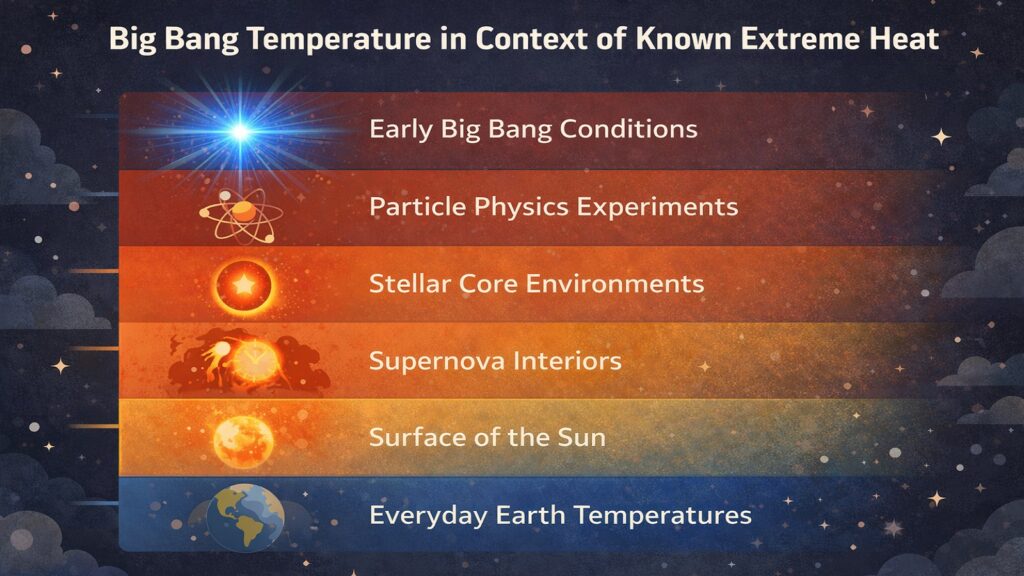
The temperature immediately after the Big Bang reached levels that obliterate any comparison we might attempt with earthly phenomena. The core of our sun burns at fifteen million degrees Celsius. Particle colliders like those at CERN briefly create temperatures exceeding five trillion degrees when protons smash together. Yet the Big-Bang started far hotter still, with temperatures climbing past ten trillion degrees in its opening microseconds.
Why does temperature matter so much? Because temperature determines which particles survive and which forces operate. At extreme heat, matter cannot hold together. Protons and neutrons cannot form. Even quarks swim freely in a plasma so energetic that familiar rules dissolve. As the Big-Bang cooled, particles began sticking together, forces separated into distinct types, and the universe transitioned from chaos into structure.
The cooling happened fast but not instantly. Within one second after the Big Bang, temperatures had dropped to about ten billion degrees. That sounds scorching, but it represented a monumental decrease from earlier moments. At this temperature, nuclear fusion could begin forming the first atomic nuclei. Hydrogen and helium emerged from the cooling plasma, setting the stage for everything that followed.
Modern experiments recreate these conditions on tiny scales. When heavy ions collide at near light speed, they briefly generate temperatures similar to those one microsecond after the Big Bang. These experiments show us a quark-gluon plasma, a state of matter that existed universally in those early moments. The Big Bang still defines cosmic temperature baselines because the universe continues cooling today, maintaining patterns established in those first instants.
Temperature acted as a cosmic filter during the Big Bang. Only particles that could survive at each temperature threshold persisted. As cooling progressed, new types of structures became stable. First quarks bound into protons and neutrons, then nuclei formed, and finally, atoms assembled when temperatures dropped below several thousand degrees. Each transition represented a phase change in the universe itself.
Big Bang Temperatures Versus Modern Extremes
| Temperature Context | Approximate Temperature |
|---|---|
| Earth’s Core | Six thousand degrees Celsius at the planet’s center |
| Sun’s Core | Fifteen million degrees Celsius sustaining fusion reactions |
| Supernova Core | One hundred billion degrees Celsius during collapse |
| CERN Collisions | Five trillion degrees Celsius in quark-gluon plasma state |
| Big Bang at One Second | Ten billion degrees Celsius when nuclei began forming |
| Big Bang at Start | Exceeding ten trillion degrees Celsius in first microseconds |
3. Big Bang Explained Through Scale and Size Analogies
The Big Bang did not explode into existing space. Instead, space itself expanded, carrying everything with it. This distinction matters because it prevents misleading imagery of a blast radiating outward from some center. There was no center. Every point in space moved away from every other point simultaneously as the fabric of space stretched.
To grasp the speed of this expansion, consider that within one trillionth of a second, the universe may have grown from subatomic size to perhaps the size of a marble. Cosmic inflation, a brief period of exponential expansion, drove this astonishing growth. By the time one second had passed, the observable universe had expanded to roughly several light-years across, larger than the distance to our nearest stars today.
Scale comparisons can be beneficial, yet they may also mislead if we are not vigilant. Consider a balloon with dots marked on its surface. As the balloon is inflated, each dot moves away from the others, but none remains at the center of the expansion. The Big Bang occurred similarly, though in three dimensions of space instead of a two-dimensional surface. Presently, scientists comprehend this expansion by observing measurements of distant galaxies receding from us in all directions.
The rapid growth during the Big Bang set the foundation for cosmic structure. Tiny quantum fluctuations in density got stretched to astronomical scales during inflation. These variations eventually became the seeds for galaxies and galaxy clusters. The Big Bang expansion continues today, though at a much slower rate, still pushing galaxies apart across billions of light-years.
Understanding scale helps us grasp why the universe looks smooth on large scales but clumpy on smaller ones. During the Big Bang, expansion smoothed out many irregularities while preserving others at specific wavelengths. These preserved fluctuations became the cosmic web of galaxy filaments we observe today. The Big-Bang essentially set the size scale for every structure in the cosmos.
Big Bang Expansion Scale Milestones
| Time After Big Bang | Approximate Scale |
|---|---|
| One trillionth of a second | Subatomic size to potentially marble-sized through inflation |
| One millionth of a second | Expanding universe larger than our solar system today |
| One second | Observable region several light-years across, exceeding nearest star distances |
| Three minutes | Expansion continuing with universe cooling enough for stable nuclei |
| Three hundred thousand years | Universe expanded to millions of light-years, becoming transparent to light |
| Present day | Observable universe ninety-three billion light-years across due to continued expansion |
4. Big Bang Explained Using Time Compression
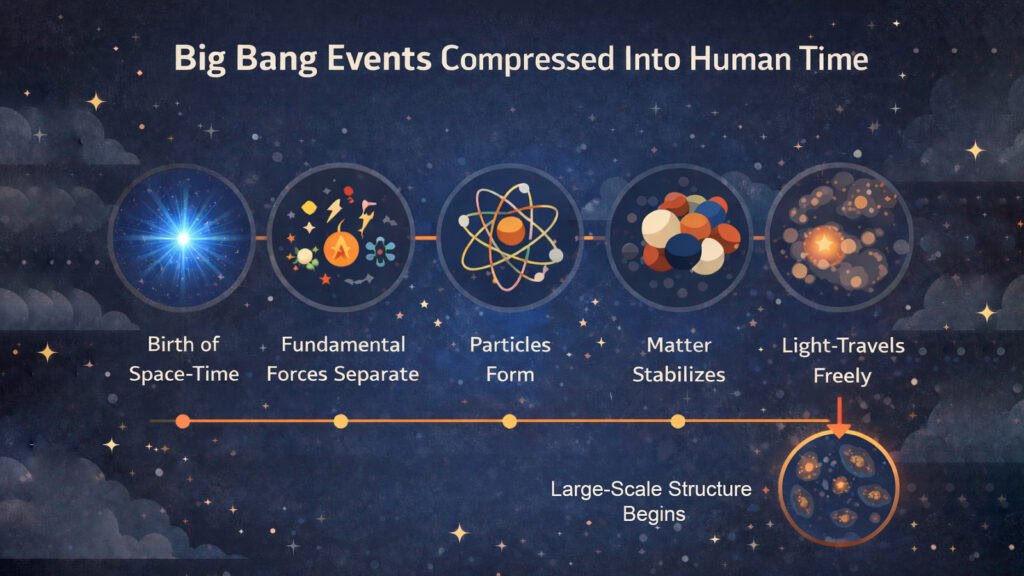
Events unfolded during the Big Bang at speeds that challenge comprehension. The entire sequence from the initial moment to stable atom formation took less time than a human heartbeat. To appreciate this velocity, we can compress cosmic history into more familiar timescales and see how the Big Bang dominated the opening fractions.
Consider the first second after the Big Bang. Within this single second, the universe cooled from incomprehensible temperatures to merely ten billion degrees. Forces separated from their unified state. Quarks bound together into protons and neutrons. Particles and antiparticles annihilated each other, leaving only a slight excess of matter. This single second contained more transformation than the following billions of years would see.
The first three minutes hold special importance. During this narrow window, nuclear fusion occurred throughout the universe, creating hydrogen and helium in ratios we still observe today. About seventy-five percent hydrogen and twenty-five percent helium emerged from this brief period. After three minutes, the universe had cooled too much for fusion to continue. The Big-Bang had set the elemental composition that would define stars billions of years later.
Particle formation happened even faster. In the first microsecond, quarks and gluons transitioned from a plasma state into bound particles. The weak and electromagnetic forces are separated from each other. All of this occurred before the universe was even one millionth of a second old. The Big Bang timeline shows us that stability came quickly after initial chaos, creating conditions that would persist for eons.
Time itself behaved differently during the Big Bang. The extreme curvature of space-time meant that our usual concepts of duration become slippery. What we measure as a microsecond contains entire epochs of particle physics. The compressed timeline of the Big-Bang demonstrates how much change can occur when conditions are extreme enough. Most of the universe’s fundamental character was decided before it was even a minute old.
Big Bang Timeline Compressed to Human Scale
| Actual Big Bang Time | Key Events |
|---|---|
| First trillionth of a second | Cosmic inflation exponentially expanded space; quantum fluctuations seeded structure |
| First microsecond | Quarks combined into protons and neutrons; forces separated into distinct types |
| First second | Universe cooled to ten billion degrees; particle-antiparticle annihilation concluded |
| First three minutes | Nuclear fusion created hydrogen and helium in cosmic proportions still observed |
| First three hundred thousand years | Atoms formed as electrons joined nuclei; universe became transparent to light |
| First billion years | Gravity condensed matter into first stars and galaxies from earlier seeds |
5. Big Bang Explained Through Matter Creation Today
Matter emerged from the Big Bang through processes that modern physics can recreate on tiny scales. When energy concentrations reach certain thresholds, particles spontaneously appear from what seems like nothing. This is not magic but quantum mechanics at work. The Big-Bang provided energy so abundant that particle creation happened everywhere simultaneously.
Particle accelerators like the Large Hadron Collider demonstrate these principles. When protons collide at extreme speeds, their kinetic energy converts into new particles that did not exist before the collision. These experiments show us the same physics that operated during the Big-Bang, just in miniature. Energy becomes matter following rules laid down in quantum field theory.
The dominance of hydrogen and helium in the universe links directly to Big Bang predictions. Theory suggested that three minutes after the beginning, about three-quarters of ordinary matter should be hydrogen and one-quarter helium. Observations confirm this ratio throughout the cosmos. Stars fuse heavier elements later, but the Big-Bang set the initial distribution that everything else builds upon.
Why did matter survive at all? During the Big Bang, particles and antiparticles appeared in nearly equal numbers. When they met, they annihilated back into energy. Yet somehow, about one extra matter particle existed for every billion particle-antiparticle pairs. This tiny imbalance meant that after annihilation finished, matter remained to form everything we see. The reason for this imbalance remains an active research question.
The Big Bang created matter in a specific way that determined what elements could form. Protons and neutrons existed in particular ratios based on their mass difference and the cooling rate. These ratios are locked in during the first few minutes, creating a cosmic recipe that has remained unchanged for billions of years. Every atom in our bodies traces its origins to processes that occurred during the Big-Bang.
Big Bang Matter Creation Compared to Modern Physics
| Matter Formation Context | Process Description |
|---|---|
| Big Bang Quark Epoch | Free quarks and gluons filled universe as plasma before binding |
| Big Bang Nucleosynthesis | Protons and neutrons fused into hydrogen and helium nuclei within three minutes |
| Particle Collider Experiments | High-energy collisions convert kinetic energy into new short-lived particles |
| Cosmic Ray Interactions | Atmosphere particles created when high-energy space radiation strikes molecules |
| Matter-Antimatter Asymmetry | Slight excess of matter over antimatter in Big-Bang left material universe |
| Primordial Element Ratios | Hydrogen seventy-five percent and helium twenty-five percent set by Big Bang |
6. Big Bang Explained Through Space-Time Behavior Today
The Big Bang did not just create matter and energy. It created the stage itself, the fabric of space and time that everything else moves through. General relativity tells us that space-time is not a passive background but an active participant in cosmic events. The Big-Bang shaped how distances are measured and how time flows.
GPS satellites demonstrate space-time effects in practical ways. These satellites experience time differently than clocks on Earth’s surface because they sit in a weaker gravitational field and move at high speeds. Engineers must account for these relativistic effects, or GPS coordinates would drift by kilometers each day. The same physics that makes GPS corrections necessary also governed the Big-Bang when space-time itself was being forged.
Gravitational waves offer another window into space-time behavior. When cosmic giants like black holes merge, they create ripples in space-time that propagate outward at light speed. Detectors on Earth measure these ripples as tiny distortions in the distance between mirrors. The Big-Bang likely generated gravitational waves too, though these primordial waves remain challenging to detect because they have weakened over billions of years.
The expansion of space continues today, a direct legacy of the Big Bang. Distant galaxies recede from us not because they move through space but because space itself grows between us. This expansion affects how we measure cosmic distances and how light stretches as it travels. The Big-Bang influences every measurement astronomers make when they look at the deep universe.
Space-time curvature from the Big Bang determines cosmic geometry. Whether the universe is flat, open, or closed depends on the energy density established during the Big-Bang. Current measurements suggest the universe is remarkably flat, meaning parallel lines remain parallel across cosmic distances. This flatness traces back to conditions set during those first moments of existence.
Big-Bang Space-Time Effects in Modern Context
| Space-Time Phenomenon | Connection to Big-Bang |
|---|---|
| GPS Time Corrections | Relativity effects predicted by same theory describing Big Bang space-time |
| Gravitational Lensing | Massive objects curve space-time, showing fabric created at Big Bang |
| Cosmic Expansion | Galaxies recede as space stretches, continuing Big Bang expansion today |
| Gravitational Waves | Ripples in space-time demonstrate its flexibility from Big Bang creation |
| Light Travel Time | Distant light shows universe younger and denser, revealing Big Bang history |
| Cosmic Microwave Background | Oldest light in universe shows space-time geometry set by Big Bang |
Conclusion: Big Bang as a Living Blueprint of the Universe
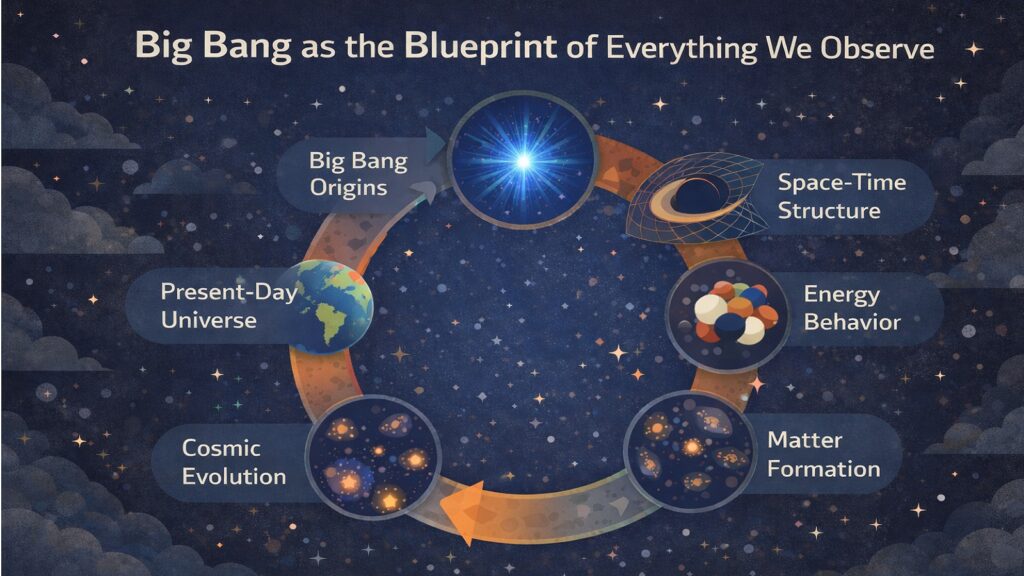
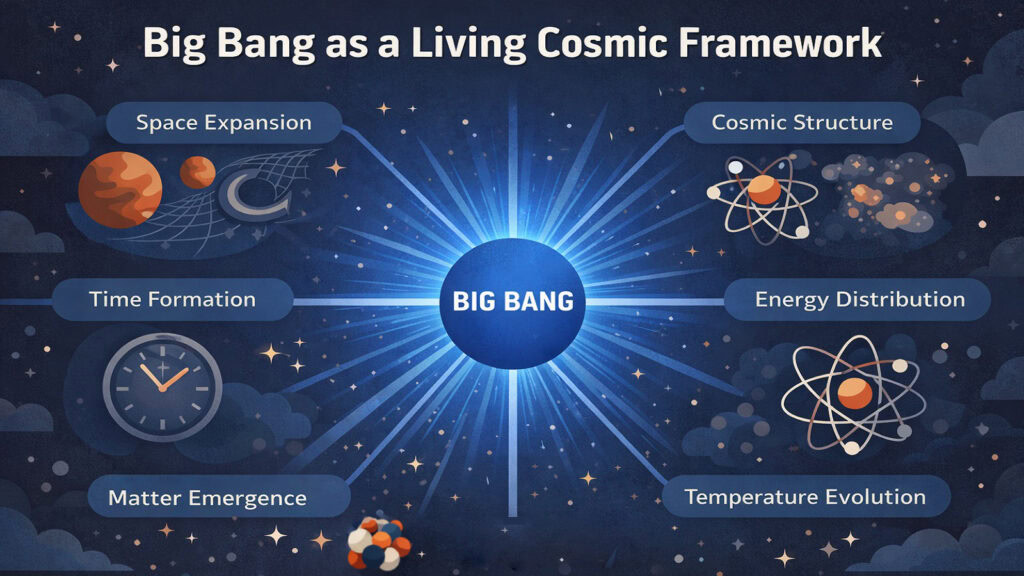
The Big Bang reaches forward through billions of years, still shaping what we measure and observe. It is not locked away in history but written into every atom, every force, every measurement of distance or time. When we translate the Big Bang into modern energy outputs, temperature extremes, scale comparisons, compressed timelines, matter creation, and space-time behavior, we see its ongoing influence.
Energy flows through stars because the Big-Bang released it. Temperatures in the cosmos trace back to cooling patterns established in those first moments. The scale of the universe reflects the expansion that began when everything was smaller than an atom. Time itself carries properties defined when the Big-Bang created duration alongside space. Matter exists because quantum processes during the Big Bang left a slight surplus. Space-time curves and expand according to rules set at the beginning.
Understanding the Big Bang through today’s lens makes the universe more accessible. We replace vast abstractions with concrete comparisons that ground cosmic history in familiar terms. The Big Bang becomes a blueprint we can read, showing us why galaxies cluster, why hydrogen dominates, why space expands, and why time flows as it does. Each observation astronomers make connects back to this fundamental event.
Nothing about this diminishes the wonder. If anything, seeing the Big Bang as an active cosmic force deepens appreciation for how interconnected everything remains. The universe does not hide its origins but displays them openly in every measurement scientists make. The Big-Bang explained is not the Big Bang domesticated, but the Big-Bang made knowable.
We live inside the Big-Bang’s aftermath, surrounded by evidence of its occurrence. The cosmic microwave background bathes us in light that has traveled for nearly fourteen billion years. The elements in our bodies were forged from hydrogen and helium created in the first three minutes. The expansion of space carries distant galaxies away while we watch. Understanding this connection transforms how we see our place in the cosmos.
Big Bang Legacy in Contemporary Observations
| Observable Phenomenon | Direct Big-Bang Connection |
|---|---|
| Cosmic Microwave Background | Oldest light showing temperature and density from three hundred thousand years after Big Bang |
| Hydrogen-Helium Ratio | Element abundances matching predictions from Big Bang nucleosynthesis models |
| Galaxy Recession Speeds | Expansion rate revealing Big-Bang started thirteen point eight billion years ago |
| Large-Scale Structure | Galaxy clusters distributed according to quantum fluctuations stretched during Big Bang |
| Neutrino Background | Relic particles from first second after Big-Bang, though not yet directly detected |
| Antimatter Scarcity | Matter dominance resulting from asymmetry established during Big Bang processes |
Read More Science and Space Articles
- Lifestyle Diseases: 8 Dangerous Threats to Global Health
- Sports Science Reveals 8 Powerful Ways Games Are Won
- Fundamental Physical Theories: 8 Powerful Laws of Nature
- STEM Learning Skills: 6 Powerful Secrets Behind Real Success
- STEM Subjects: 8 Essential Insights for a Brighter Future
- God: 6 Powerful Scientific Insights That Reveal Human Belief
- Hawking Radiation: 6 Powerful Clues to Quantum Gravity
- Human Cell Secrets: 6 Powerful Insights Shaping Life
- Black Hole Singularity: 6 Mind-Blowing Truths Explained
- 6 Incredible Ways Missiles Obey The Laws of Physics