Table of Contents
Introduction: Business Essentials for Modern Success
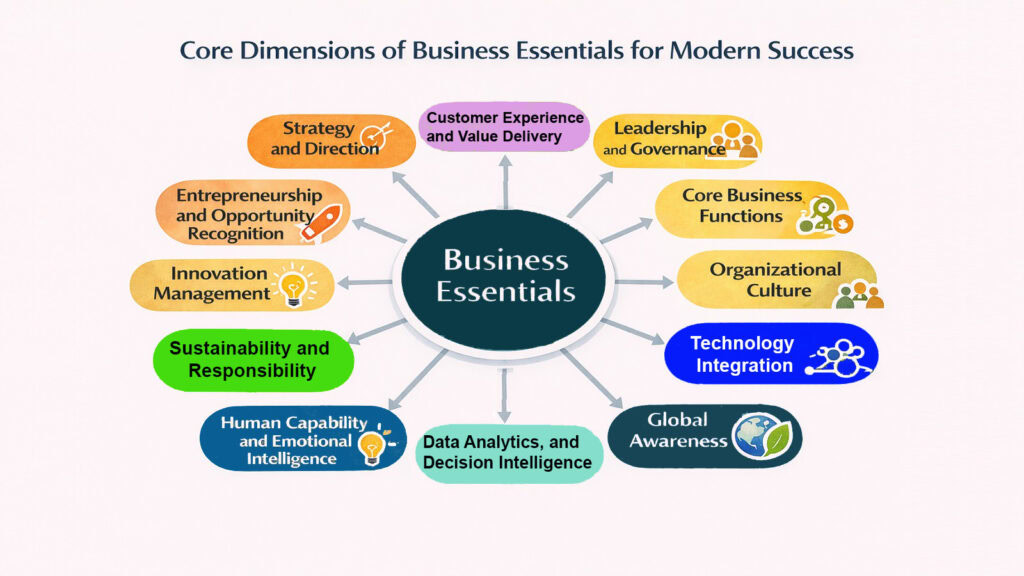

Business Essentials are the core ideas and steady practices that help companies move through a changing marketplace with clarity. They guide how leaders choose their direction, how teams turn plans into action, and how organizations respond when pressure builds. These business fundamentals act as a living framework that connects long-term vision with everyday reality, allowing businesses to stay grounded while still reaching for growth.
In today’s world, Business Essentials cover a wider field than before. They include growth planning, core functions, strategic thinking, leadership, technology, global understanding, sustainability and ethics, emotional intelligence, entrepreneurship, innovation, data literacy, and customer value. Each of these areas shapes how a company learns, adapts, and competes. Firms that build strength across these business essentials develop resilience in uncertain markets and create lasting value for employees, customers, and communities. They navigate complexity with steadier judgment and find progress even when conditions shift.
This article explores twelve connected paths that define modern Business Essentials. Each path supports the next, forming a quiet chain that holds a business together. Growth needs a strategy. Strategy needs leadership. Leadership shapes systems. Systems guide technology. Technology widens reach. Reach brings responsibility. Responsibility supports human depth. Human depth fuels new ventures. New ventures lead to innovation. Innovation is strengthened by data. Data helps deliver value to customers. Seeing these links clearly is the first step toward long-term stability and meaningful success.
Business Essentials Framework Overview
| Business Essentials | Core Focus |
|---|---|
| Growth Foundation | Business Essentials begin with steady, sustainable growth supported by financial discipline and operational strength. |
| Core Business Functions | Marketing, sales, operations, finance, and HR work best when aligned with clear priorities, structure, and accountability. |
| Strategic Direction | Strong strategy guides decisions, clarifies goals, and positions the organization for long-term progress. |
| Leadership and Management | Effective leadership builds trust, shapes culture, and supports consistent performance in changing conditions. |
| Technology Integration | Modern Business Essentials require technology as a core capability for speed, accuracy, and competitive adaptation. |
| Global Economy Awareness | Understanding global markets, capital flows, trade patterns, and geopolitical risks strengthens strategic judgment. |
| Sustainability, Ethics, and Responsibility | Long-term responsibility toward the environment, stakeholders, and ethical conduct supports resilience and reputation. |
| Human-Centered Principles | Emotional intelligence, engagement, and psychological safety strengthen collaboration, learning, and stability. |
| Entrepreneurship and Startups | Entrepreneurial thinking encourages opportunity discovery, lean execution, and scalable growth pathways. |
| Innovation Management | Structured innovation systems create differentiation, enhance value, and protect long-term business relevance. |
| Data, Analytics, and Decision Intelligence | Reliable data practices and analytical thinking help teams make clearer decisions and respond faster to market signals. |
| Customer Experience and Value Delivery | Strong customer experience systems ensure consistent value, deeper loyalty, and long-term relationship strength. |
1. Business Essentials in a Business 360° Growth Framework
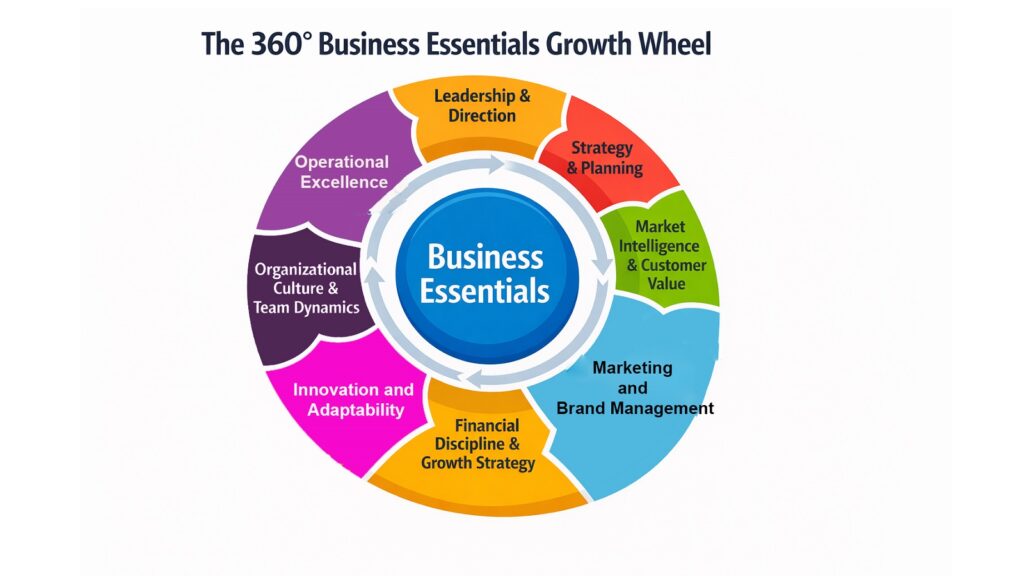
Growth is not a single metric but a constellation of improvements across revenue, capability, reputation, and stability. Business Essentials provide the framework for thinking about growth holistically. When leaders focus only on quarterly earnings, they miss opportunities to strengthen systems, develop talent, and build customer loyalty. A 360-degree growth mindset recognizes that financial results flow from operational excellence, strategic clarity, and organizational health. A fuller picture becomes clear when viewed through a Business 360° lens, which shows how growth depends on the combined strength of strategy, operations, technology, and people.
Consider how Business Essentials shape different growth levers. Leadership sets the tone for ambition and accountability. Management translates vision into action through clear processes. Marketing identifies customer needs and communicates value. Operations ensure consistent delivery. Finance allocates capital efficiently. Innovation explores new possibilities. Culture determines how people collaborate and solve problems. Each lever depends on foundational Business Essentials like transparency, discipline, and customer focus.
Organizations that master Business Essentials in their growth framework tend to outperform competitors over extended periods. They invest in capability building alongside revenue generation. They measure leading indicators like employee engagement and customer satisfaction, not just lagging indicators like profit margins. They understand that growth compounds when systems improve, when teams learn, and when processes become more efficient.
The 360-degree framework also highlights interdependencies. Strong marketing generates leads, but those leads convert only if sales processes are effective. Sales succeeds when operations delivers quality consistently. Quality depends on motivated employees. This circular reinforcement makes sustainable growth possible.
Business Essentials in Growth Dimensions
| Revenue Growth | Expanding income streams through market penetration, product development, and customer retention strategies that align with organizational capabilities |
| Operational Capacity | Building systems, processes, and infrastructure that enable the organization to scale efficiently without compromising quality or speed |
| Market Position | Strengthening brand recognition, competitive differentiation, and customer loyalty through consistent delivery of value |
| Strategic Capability | Developing the organizational ability to plan effectively, execute with discipline, and adapt quickly to changing market conditions |
| Talent Development | Investing in employee skills, leadership pipeline, and knowledge retention to ensure the organization can meet future challenges |
| Innovation Pipeline | Creating structures and incentives that encourage experimentation, learning from failure, and commercializing new ideas |
| Customer Value | Deepening understanding of customer needs, improving products and services, and building relationships that generate recurring revenue |
| Financial Health | Maintaining strong cash flow, manageable debt levels, and sufficient reserves to weather uncertainty while funding growth initiatives |
2. Business Essentials in Core Business Functions
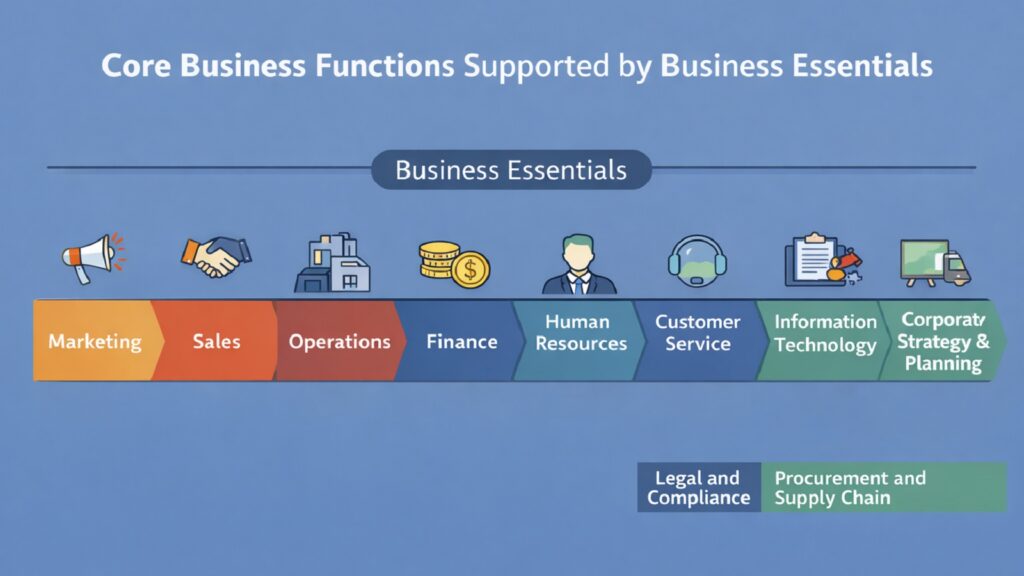
Every organization divides work into functions. Marketing attracts customers. Sales converts interest into revenue. Operations produces and delivers products. Finance manages resources. Human resources develops talent. These core business functions operate most effectively when they share common Business Essentials like clarity, accountability, and collaboration. Without these foundations, functional silos emerge, communication breaks down, and performance suffers.
Business Essentials create alignment across functions. When marketing and sales agree on target customers, campaigns generate qualified leads that convert efficiently. When operations and finance collaborate on capacity planning, companies avoid overinvestment. When human resources partners with leadership on succession planning, organizations maintain continuity. These connections matter more than functional excellence in isolation.
Each function contributes unique capabilities while depending on shared principles. Marketing requires creativity and data analysis. Sales demands relationship building. Operations needs process discipline. Finance relies on analytical rigor. Human resources combines psychology and administration. Customer service balances empathy with efficiency. Information technology merges technical expertise with business understanding. Legal and compliance protect while enabling transactions. Corporate strategy synthesizes information into plans. Procurement optimizes costs while ensuring supply reliability.
Business Essentials provide the common language enabling diverse functions to work together effectively. They establish expectations for communication, decision rights, and performance standards. They clarify how functions coordinate on initiatives like product launches or digital transformations, ensuring that functional goals ladder up to organizational objectives.
Business Essentials Across Core Functions
| Marketing | Identifies customer segments, develops positioning strategies, manages brand perception, and generates demand through integrated campaigns |
| Sales | Converts prospects into customers through relationship building, needs assessment, solution presentation, negotiation, and closing |
| Operations | Manages production, service delivery, quality control, inventory, and logistics to ensure consistent fulfillment of customer commitments |
| Finance | Oversees budgeting, financial reporting, capital allocation, cash management, and risk assessment to maintain organizational health |
| Human Resources | Recruits talent, manages compensation and benefits, facilitates training and development, and maintains employee relations |
| Customer Service | Provides support, resolves issues, gathers feedback, and builds loyalty through responsive and empathetic customer interactions |
| Information Technology | Develops and maintains systems, manages data security, enables digital capabilities, and supports technology-driven innovation |
| Legal and Compliance | Ensures regulatory adherence, manages contracts, protects intellectual property, and mitigates legal risks across business activities |
| Corporate Strategy | Synthesizes market intelligence, competitive analysis, and internal capabilities into coherent strategic plans and priorities |
| Procurement and Supply Chain | Sources materials and services, negotiates supplier contracts, manages inventory levels, and optimizes end-to-end supply networks |
3. Business Essentials in the Strategic Core
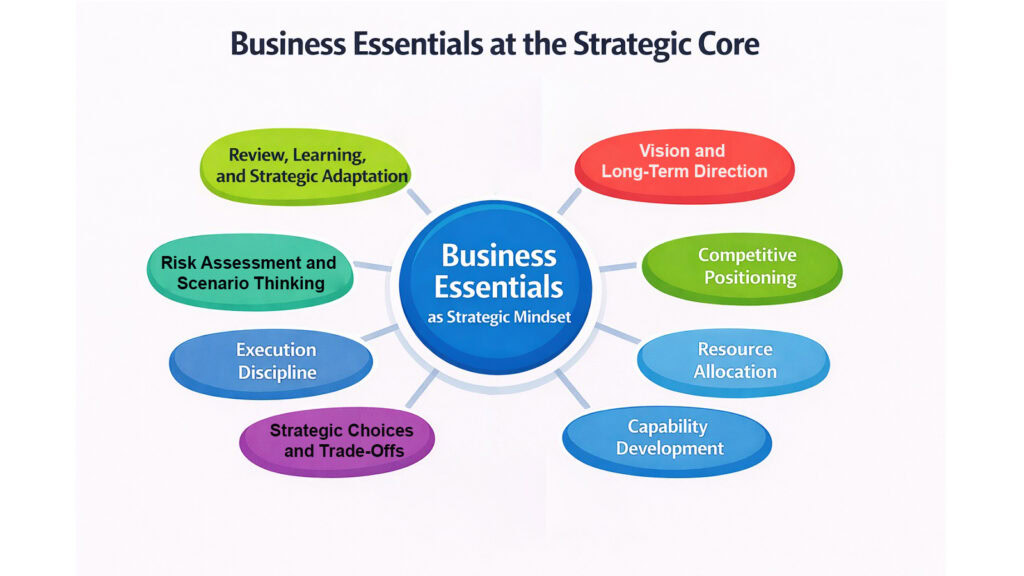
Business Strategy is the art of making choices. Organizations face countless opportunities and constraints. Business Essentials help leaders determine which paths to take and which to decline. Business Strategy provides direction by articulating what the organization will accomplish, how it will compete, and why its approach creates value. Without this clarity, companies drift, resources scatter, initiatives conflict, and performance stagnates.
Effective strategy emerges from deep understanding of Business Essentials. Leaders must assess competitive dynamics, customer preferences, technological trends, and internal capabilities. They must balance short-term pressures with long-term ambitions while allocating limited resources to maximize returns. This work requires analytical rigor, creative thinking, and honest assessment of strengths and weaknesses.
Business Essentials transform strategy from abstract planning into concrete execution. Strategic frameworks provide structured approaches to analysis and decision-making. Planning cycles create rhythms for review and adjustment. Performance metrics translate strategy into measurable outcomes. Communication plans ensure that teams understand priorities and their role in achieving them.
The strategic core also includes governance mechanisms that determine how leaders evaluate proposals and allocate funding. Business Essentials establish the disciplines that make strategy operational rather than aspirational, ensuring that strategic choices cascade through the organization and influence functional plans, team goals, and individual objectives.
Business Essentials in Strategic Elements
| Vision and Mission | Clear articulation of organizational purpose, aspirations, and values that guide decisions and inspire stakeholder commitment |
| Competitive Positioning | Deliberate choices about where to compete, how to differentiate, and which customer segments to prioritize for sustainable advantage |
| Resource Allocation | Systematic processes for evaluating opportunities, distributing capital and talent, and balancing investments across growth and maintenance |
| Strategic Planning | Structured cycles for environmental scanning, opportunity assessment, goal setting, and action planning that translate vision into execution |
| Performance Management | Metrics, dashboards, and review processes that track progress, identify variances, and enable rapid course correction |
| Risk Management | Identification and mitigation of threats to strategic objectives, including market shifts, operational failures, and external disruptions |
| Portfolio Management | Coordination of multiple initiatives, products, or business units to optimize collective performance and avoid resource conflicts |
| Strategic Communication | Clear and consistent messaging about direction, priorities, and progress that aligns stakeholders and maintains organizational focus |
4. Business Essentials in Leadership and Management
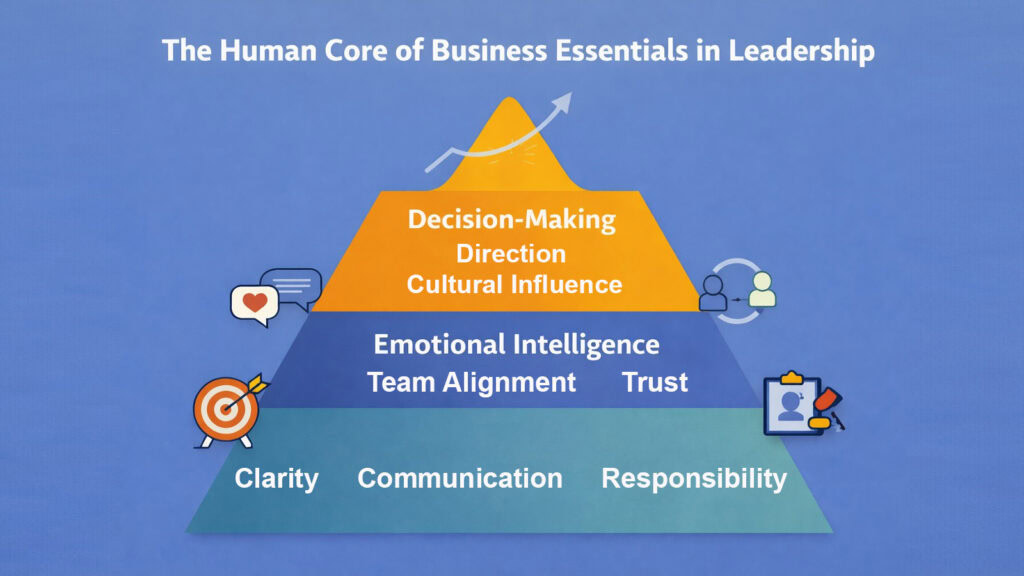
Leadership stands among the most critical Business Essentials. Leaders set direction, build culture, and inspire performance. They create environments where talented people choose to stay and contribute their best efforts. They navigate uncertainty with confidence and humility. They balance competing demands without losing sight of core values. Leadership and management together determine whether organizations thrive during challenges or stumble.
Business Essentials shape how leaders approach their responsibilities. Effective leaders understand that authority comes from expertise, integrity, and earned trust rather than titles alone. They communicate clearly and listen actively. They delegate appropriately while maintaining accountability. They develop successors systematically rather than hoping talent emerges spontaneously. They recognize that their decisions ripple through the organization, affecting morale, productivity, and retention.
Management translates leadership vision into daily operations. Managers coordinate work, solve problems, coach individuals, and remove obstacles. They apply Business Essentials like planning, organizing, monitoring, and adjusting. They create predictability through consistent processes while maintaining flexibility for exceptions. They balance standardization with adaptation. They measure what matters and use data to drive improvement.
The human dimension of leadership represents perhaps the deepest Business Essential. Leaders must understand motivation, manage conflict, build consensus, and navigate organizational politics. They need emotional maturity to remain calm under pressure, acknowledge mistakes, and maintain relationships during disagreements. They create psychological safety so teams feel comfortable taking risks and sharing concerns. These capabilities separate good leaders from great ones.
Business Essentials in Leadership Capabilities
| Leadership Capability | Description |
|---|---|
| Vision Setting | Articulating compelling pictures of the future that inspire commitment and provide directional clarity for strategic and operational decisions |
| Strategic Thinking | Analyzing long-term trends, evaluating competitive environments, and aligning organizational resources with future opportunities and risks |
| Decision Making | Balancing analysis with intuition, gathering diverse perspectives, and making timely choices even with incomplete information |
| Communication | Conveying messages clearly across multiple channels, adapting style to audience, and ensuring understanding through active listening |
| Team Building | Assembling diverse talents, fostering collaboration, resolving conflicts constructively, and creating shared accountability for results |
| Performance Coaching | Providing feedback that develops capabilities, recognizing achievements, addressing underperformance, and creating growth opportunities |
| Change Leadership | Guiding organizations through transitions, managing resistance, maintaining momentum, and reinforcing new behaviors until they become habits |
| Talent Development | Identifying high-potential individuals, providing stretch assignments, facilitating learning, and building robust leadership pipelines |
| Accountability and Execution | Translating strategies into action, defining clear responsibilities, tracking progress, and ensuring commitments lead to measurable outcomes |
| Cultural Stewardship | Modeling desired behaviors, reinforcing values through decisions and actions, and shaping norms that influence how work gets done |
5. Business Essentials in Business and Technology
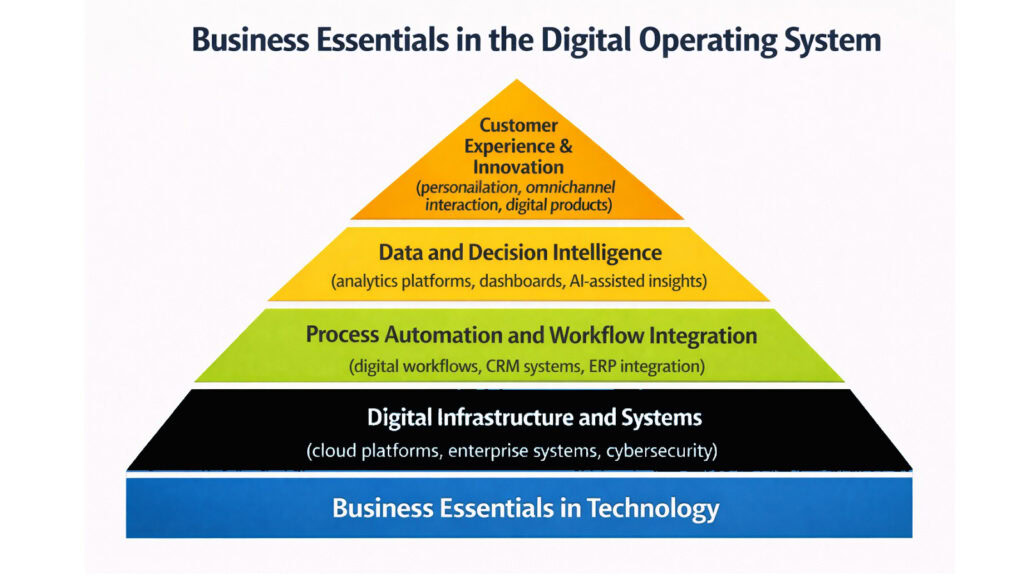
Technology has evolved from a support function to a core Business Essential. Organizations now compete on their ability to leverage digital tools, automate processes, analyze data, and serve customers through technology-enabled channels. Companies that treat technology as optional fall behind competitors who integrate it deeply into operations and strategy. Digital capability determines speed, accuracy, scalability, and customer experience.
Business Essentials guide how organizations adopt technology. Leaders must understand capabilities without becoming experts. They need frameworks for evaluating solutions, prioritizing investments, and managing risks. They should balance standardization with customization and incremental improvement with transformational change. These choices shape competitive position and operational efficiency.
Artificial intelligence, cloud computing, automation, and data analytics represent the current frontier. AI enables personalization at scale and predictive insights. Cloud platforms provide flexibility and cost efficiency. Automation eliminates repetitive tasks. Analytics transform information into insights. Organizations that master these capabilities create advantages that compound over time.
Technology integration requires cultural change. Teams must learn new tools and adapt workflows. Leaders need patience during transitions and commitment to training. Business Essentials include the change management disciplines that make technology adoption successful.
Business Essentials in Technology Domains
| Digital Infrastructure | Cloud platforms, networks, security systems, and computing resources that provide reliable and scalable foundations for applications |
| Data Management | Systems for collecting, storing, governing, and analyzing information to generate insights that inform decisions across the organization |
| Process Automation | Tools that streamline workflows, reduce manual effort, improve accuracy, and free employees for higher-value activities |
| Customer Technology | Digital channels, mobile applications, self-service portals, and communication platforms that enhance customer experience and accessibility |
| Artificial Intelligence | Machine learning algorithms, natural language processing, and predictive models that enable personalization, optimization, and intelligent automation |
| Cybersecurity | Policies, technologies, and practices that protect data, systems, and networks from unauthorized access, breaches, and cyber threats |
| Integration Architecture | Middleware, APIs, and integration patterns that enable different systems to share data and coordinate processes seamlessly |
| Technology Governance | Frameworks for selecting vendors, managing licenses, overseeing projects, and ensuring technology investments deliver expected returns |
6. Business Essentials in the Global Economy
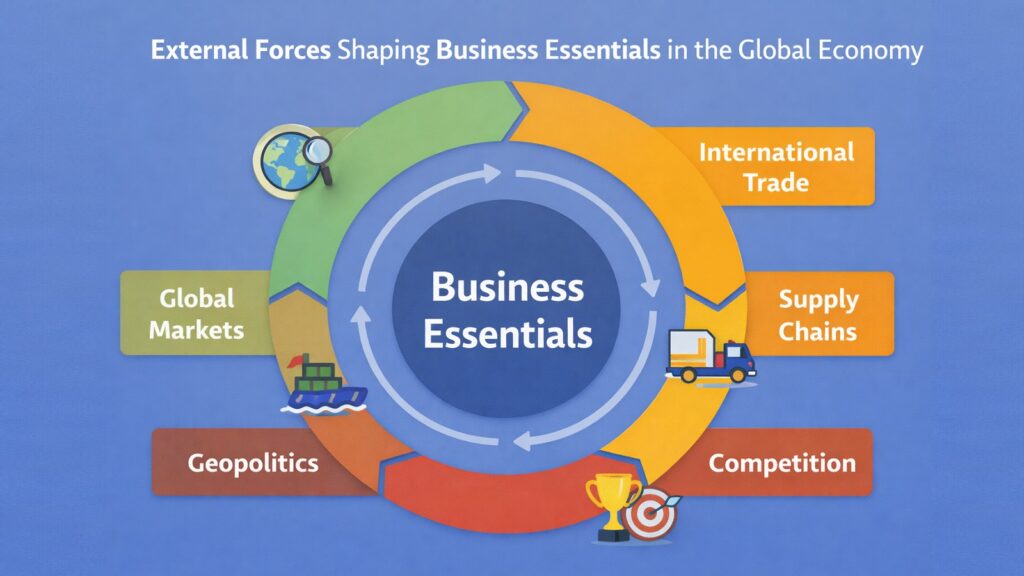
No organization operates in isolation. Global markets, international supply chains, cross-border competition, and geopolitical developments influence even domestic businesses. In the current time, Business Essentials include awareness of global economic patterns, currency fluctuations, trade policies, and political risks. Leaders who understand these external forces make better decisions about sourcing, pricing, expansion, and risk management. The global economy creates both opportunities and challenges. Companies can access larger markets, lower-cost suppliers, and diverse talent pools. However, global engagement also introduces complexity around different regulations, cultural expectations, and business practices. Organizations face currency risk, supply chain disruptions, and political uncertainty.
Business Essentials help leaders manage global complexity. Understanding trade agreements informs sourcing decisions. Monitoring geopolitical developments helps anticipate supply chain risks. Analyzing currency trends influences pricing strategies. Building relationships across cultures enables effective partnerships. Companies that develop these capabilities compete more effectively than those focused narrowly on domestic markets.
Global awareness also shapes long-term strategy. Emerging markets offer growth opportunities but require patient capital. Developed markets provide stability but feature intense competition. Regional trade blocs influence market access. Business Essentials include the frameworks that help leaders navigate this complexity and identify sustainable competitive positions.
Business Essentials in Global Dimensions
| International Markets | Understanding customer preferences, competitive dynamics, and growth potential across different geographic regions and economic zones |
| Supply Chain Networks | Managing global sourcing, logistics complexity, inventory positioning, and supplier relationships to ensure reliable and cost-effective operations |
| Trade and Tariffs | Navigating customs regulations, import duties, trade agreements, and compliance requirements that affect cross-border transactions |
| Currency Management | Monitoring exchange rate fluctuations, implementing hedging strategies, and pricing products appropriately across multiple currency zones |
| Geopolitical Risk | Assessing political stability, regulatory changes, sanctions, and conflicts that could disrupt operations or market access |
| Cultural Intelligence | Adapting business practices, communication styles, and management approaches to align with local norms and expectations |
| Global Competition | Analyzing competitive threats from international players, understanding their strategies, and developing responses that protect market position |
| Emerging Economies | Evaluating opportunities in rapidly developing markets while managing risks related to infrastructure, institutions, and volatility |
7. Business Essentials in Sustainability and Responsibility
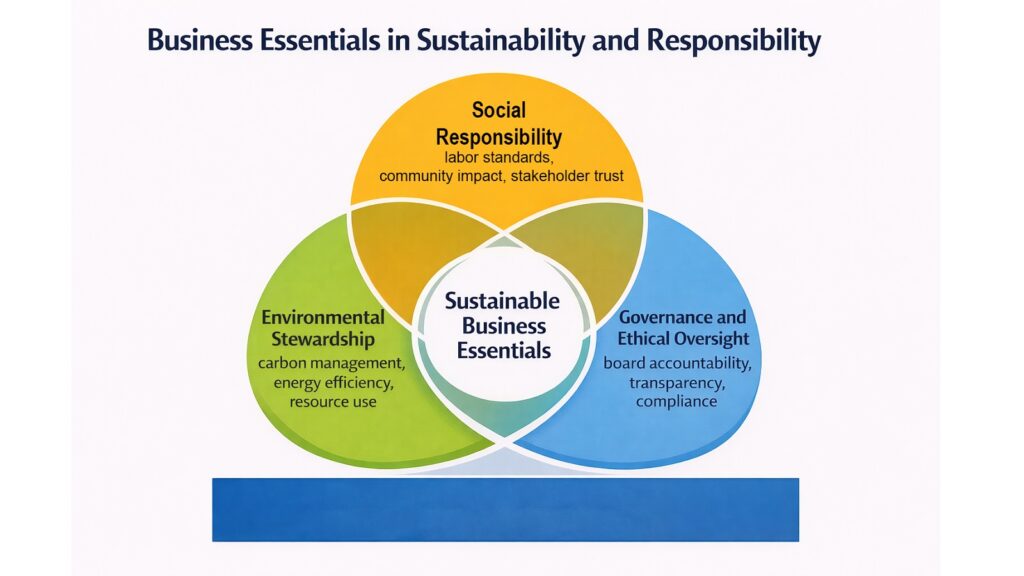
Sustainability has transitioned from optional corporate social responsibility to essential business strategy. Environmental pressures, regulatory requirements, investor expectations, and customer preferences now demand that organizations consider long-term ecological and social impacts. Business Essentials include understanding how sustainability influences reputation, operational costs, risk exposure, and competitive differentiation.
Companies face growing expectations to measure and reduce carbon emissions, minimize waste, conserve resources, and protect ecosystems. These commitments affect procurement, manufacturing, product design, and logistics. Organizations that embrace sustainability often discover cost savings through efficiency improvements, waste reduction, and energy conservation. They also build stronger relationships with environmentally conscious customers and employees.
Environmental, social, and governance frameworks provide structure for sustainability thinking. Environmental factors include carbon footprint and water usage. Social considerations encompass labor practices and community relations. Governance involves ethical leadership and transparent reporting. Business Essentials help leaders balance these dimensions with financial objectives.
Long-term thinking represents the core of sustainability as one of the most important Business Essentials. Leaders must consider how today’s decisions affect future generations and ecosystem health. They need frameworks for evaluating trade-offs between short-term profits and long-term resilience. This expanded perspective creates durability that purely financial optimization cannot achieve.
Business Essentials in Sustainability Areas
| Carbon Management | Measuring greenhouse gas emissions, setting reduction targets, implementing energy efficiency measures, and exploring renewable energy sources |
| Circular Economy | Designing products for longevity, repair, and recycling while minimizing waste through closed-loop material flows |
| Resource Efficiency | Optimizing water usage, reducing material consumption, and improving yields to lower environmental impact and operational costs |
| Supply Chain Ethics | Ensuring suppliers meet labor standards, environmental requirements, and ethical practices throughout the value chain |
| Stakeholder Engagement | Building relationships with communities, NGOs, regulators, and other groups affected by business operations |
| Climate Risk | Assessing physical risks from extreme weather and transition risks from policy changes that could affect assets, operations, and markets |
| Transparent Reporting | Disclosing environmental and social performance through standardized frameworks that enable stakeholder evaluation and comparison |
| Sustainable Innovation | Developing products and services that deliver customer value while reducing environmental footprint and advancing social goals |
8. Business Essentials in Human Elements and Emotional Intelligence
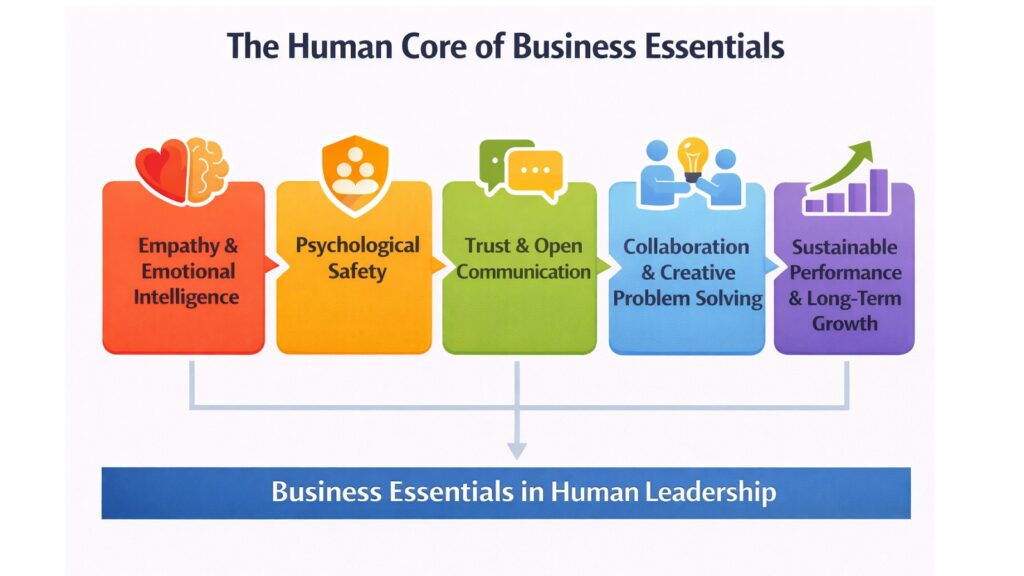
Organizations succeed through people. Technology amplifies capability, but humans provide creativity, judgment, empathy, and adaptability. Business Essentials increasingly emphasize emotional intelligence, psychological safety, work-life balance, and employee well-being. Companies that create supportive environments attract better talent, experience lower turnover, and generate higher productivity.
Emotional intelligence includes self-awareness, self-regulation, motivation, empathy, and social skills. Leaders possessing high emotional intelligence accurately interpret situations, manage their responses in a constructive manner, and foster strong relationships. They cultivate environments in which individuals feel acknowledged, appreciated, and supported. They tackle conflicts promptly and equitably. These skills constitute essential business fundamentals for contemporary leadership.
Psychological safety enables teams to perform at their highest level. When people feel safe taking risks, admitting mistakes, and offering dissenting opinions, organizations innovate faster and solve problems more effectively. Creating this safety requires consistent leadership behavior. Leaders must respond to bad news without anger, welcome challenges to their ideas, and acknowledge uncertainties.
Work-life balance and employee well-being represent increasingly important Business Essentials. Burnout reduces productivity and drives turnover. Organizations that respect boundaries, provide flexibility, and support mental health create sustainable performance. This understanding generates loyalty and commitment that financial incentives alone cannot match.
Business Essentials in Human-Centered Elements
| Emotional Awareness | Understanding one’s own emotions, recognizing how they influence decisions, and managing reactions to maintain effective relationships |
| Empathy and Compassion | Perceiving others’ feelings and perspectives, responding with care and understanding, and building trust through genuine concern |
| Psychological Safety | Creating environments where people feel comfortable taking interpersonal risks, speaking honestly, and learning from mistakes without fear |
| Inclusive Culture | Valuing diverse perspectives, ensuring equitable opportunities, and building teams where everyone feels respected and able to contribute |
| Work-Life Integration | Supporting flexibility, respecting boundaries, and recognizing that sustainable performance requires time for rest and personal priorities |
| Mental Health Support | Providing resources for stress management, offering counseling services, and de-stigmatizing conversations about psychological well-being |
| Feedback Culture | Encouraging regular, constructive conversations about performance that support growth while maintaining dignity and respect |
| Purpose and Meaning | Connecting individual work to organizational mission, helping people understand their impact, and fostering intrinsic motivation |
9. Business Essentials in Entrepreneurship and Startups
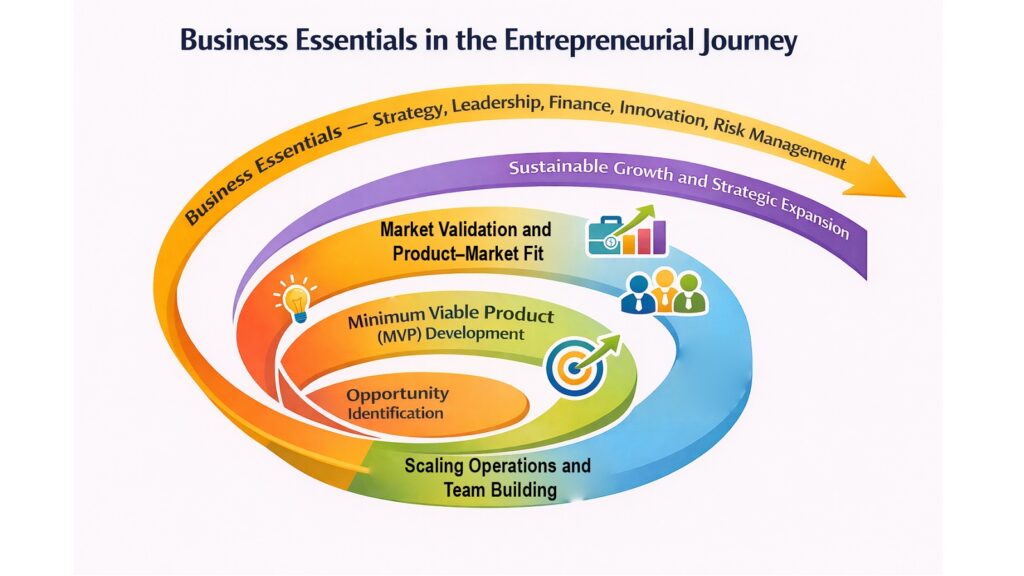
Entrepreneurship is the disciplined pursuit of opportunity in the face of uncertainty. It involves recognizing unmet market needs, gathering necessary resources, and building ventures that deliver measurable value where none existed before. Unlike established corporations with predictable revenue streams and structured hierarchies, startups operate in conditions of extreme resource scarcity and informational ambiguity.
Business Essentials take on distinct characteristics in these early-stage ventures because founders must validate assumptions rapidly while conserving capital. Eric Ries introduced the lean startup methodology to address this challenge by advocating for iterative experimentation over extensive upfront planning. The minimum viable product becomes a critical tool, allowing entrepreneurs to test core hypotheses with real customers before committing to full-scale development. This approach reduces waste and accelerates learning cycles in environments where traditional forecasting methods often fail.
The transition from product-market fit to sustainable growth presents operational challenges that require careful navigation of Business Essentials. Startups must balance the urgency of capturing market share against the discipline of unit economics and cash flow management. Scaling too quickly can exhaust runway before revenue models mature, while moving too cautiously risks ceding ground to competitors. Funding decisions compound this complexity, as equity dilution through venture capital must be weighed against bootstrap constraints or alternative financing mechanisms like revenue-based financing.
Successful entrepreneurs integrate strategic thinking with adaptive leadership, remaining responsive to market feedback while maintaining clarity of vision. Innovation becomes not merely a product feature but an organizational capability embedded in hiring practices, decision-making frameworks, and cultural norms. The application of Business Essentials in entrepreneurship ultimately determines whether promising ideas survive contact with commercial reality or join the majority of ventures that fail within their first five years.
Key Entrepreneurial Concepts and Their Strategic Applications as Important Business Essentials
| Concept | Application in Startup Context |
|---|---|
| Lean Startup Methodology | Reduces waste through build-measure-learn cycles that validate assumptions before scaling |
| Minimum Viable Product | Enables customer feedback collection with minimal resource expenditure during development |
| Product-Market Fit | Represents alignment between solution offering and genuine customer demand signals |
| Customer Development | Prioritizes direct interaction with target users to refine value propositions iteratively |
| Pivot Strategy | Allows fundamental business model changes based on validated learning without complete restart |
| Burn Rate Management | Controls monthly cash consumption to extend runway and preserve strategic optionality |
| Cap Table Structure | Governs ownership distribution and influences future fundraising flexibility and founder control |
| Growth Hacking | Employs data-driven experimentation to achieve rapid user acquisition within budget constraints |
10. Business Essentials in Innovation Management and Competitive Advantage
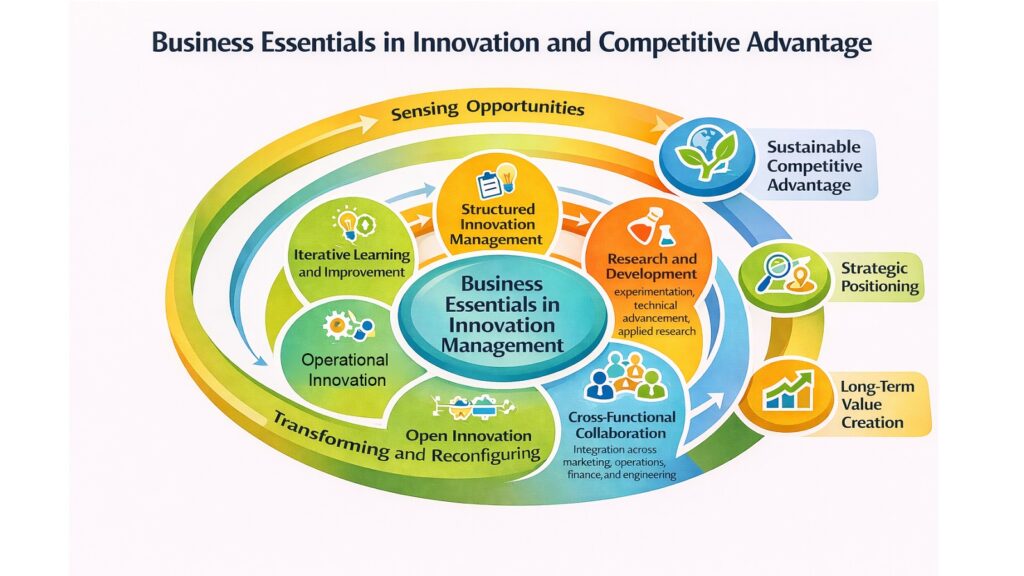
Innovation represents the systematic creation and deployment of novel approaches that generate economic or social value beyond existing norms. It extends far beyond isolated acts of invention to encompass organizational processes, cultural frameworks, and strategic commitments that transform ideas into market realities. David Teece conceptualized dynamic capabilities as the capacity to sense opportunities, seize resources, and reconfigure operations in response to shifting competitive landscapes. These capabilities form the foundation of sustained competitive advantage because they enable firms to adapt faster than rivals can imitate.
Business Essentials in innovation management involve establishing formal structures for research and development while simultaneously cultivating informal networks that encourage experimentation and cross-pollination of ideas across functional boundaries. Organizations that excel at innovation create psychological safety for failure, recognizing that breakthrough discoveries emerge from portfolios of attempts rather than single perfect initiatives.
The concept of open innovation, advanced by Henry Chesbrough, challenges traditional assumptions about intellectual property boundaries and internal research monopolies. Companies increasingly source ideas from external partners, customers, and even competitors through collaborative arrangements that distribute both risk and reward. This approach amplifies innovative capacity without proportional increases in fixed costs, a critical consideration for Business Essentials in resource-constrained environments.
Competitive advantage derived from innovation proves more durable than advantages based solely on cost or efficiency because it creates barriers through knowledge accumulation and network effects that competitors cannot easily replicate. Iterative improvement processes, whether manifested as kaizen in manufacturing or agile methodologies in software development, institutionalize continuous advancement as an operational norm rather than an exceptional event. Organizations that integrate innovation into their strategic positioning recognize that today’s differentiation becomes tomorrow’s baseline expectation. The disciplined application of Business Essentials in innovation management determines whether firms lead industry evolution or struggle to keep pace with transformations initiated by more adaptive competitors.
Innovation Frameworks and Competitive Mechanisms
| Framework or Mechanism | Strategic Function |
|---|---|
| Dynamic Capabilities | Enable sensing, seizing, and reconfiguring resources to maintain competitive relevance over time |
| Open Innovation | Expands ideation sources beyond internal boundaries through partnerships and external collaboration |
| Ambidextrous Organization | Balances exploitation of existing capabilities with exploration of emerging opportunities simultaneously |
| Stage-Gate Process | Provides structured decision points for resource allocation across innovation project portfolios |
| Absorptive Capacity | Measures ability to recognize, assimilate, and apply external knowledge for commercial purposes |
| Disruptive Innovation | Targets overlooked market segments with simpler solutions that eventually reshape industry standards |
| Core Competencies | Represent difficult-to-imitate bundles of skills and technologies that underpin competitive positioning |
| Innovation Ecosystem | Creates network effects through complementary relationships with suppliers, customers, and institutions |
11. Business Essentials in Data, Analytics, and Decision Intelligence
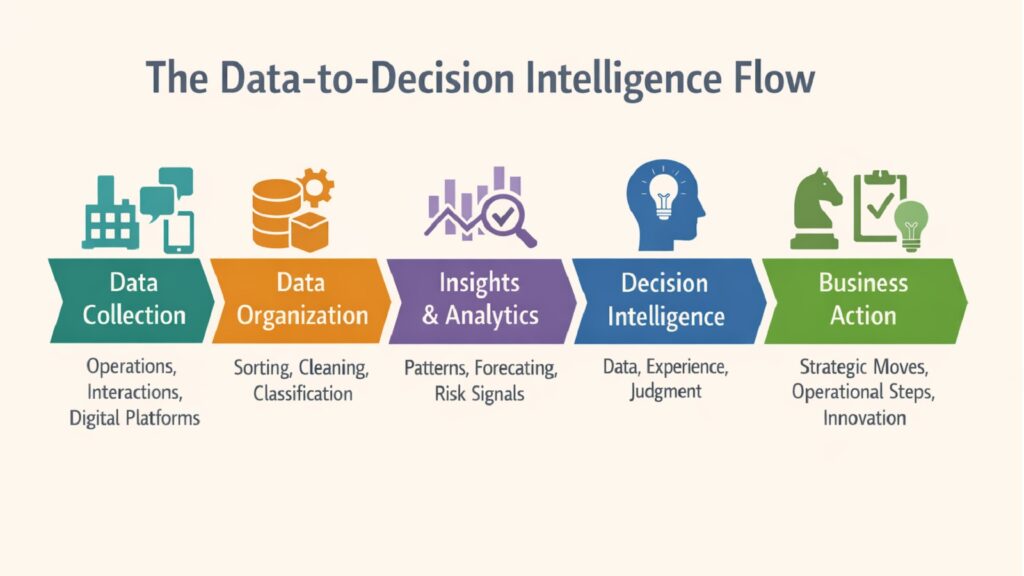
Data has become a steady force in modern business, shaping decisions that once depended mainly on instinct. As digital operations expanded, organizations began to rely on signals drawn from everyday activity—customer behavior, supply chain patterns, and internal workflows. This shift grew stronger as teams discovered that structured information often reveals issues long before they become visible on the surface. What was once optional has become a quiet requirement for operating with clarity.
Data, analytics, and decision intelligence form a chain. Data starts as raw material pulled from transactions, feedback, and digital tools. It gains meaning only after it is cleaned, organized, and placed into systems where teams can read it. Analytics moves through this organized data, looking for patterns and early warnings that human eyes often miss. Decision intelligence rises from this work. It blends data with judgment, helping leaders see more clearly without replacing their experience or intuition.
Across the broader business landscape, data touches every major lever. Strategy draws strength from understanding markets rather than guessing at them. Operations improve when teams forecast delays and shortages before they disrupt customers. Innovation becomes more focused when companies identify unmet needs instead of waiting for complaints. Customer experience becomes steadier when organizations watch sentiment, feedback, and behavior with honest attention.
Decision intelligence is a slow discipline. It comes from reading signals consistently and resisting the urge to act before the facts form a clear picture. Organizations that follow this path tend to move with quieter confidence, seeing challenges earlier and responding with fewer surprises.
Data and Decision Intelligence at a Glance
| Concept | What It Means in Practice |
|---|---|
| Data Collection | Information comes from transactions, logistics activity, customer interactions, and digital behavior. |
| Data Organization | Raw data is cleaned and structured so teams can understand it without technical expertise. |
| Descriptive Analytics | Reviews past activity to create a shared understanding of what actually happened. |
| Predictive Analytics | Uses past patterns to estimate likely outcomes and spot early signs of change. |
| Decision Intelligence | Combines human judgment with evidence drawn from organized data. |
| Data Literacy | Teams across departments learn to read and interpret data, not just specialists. |
| Signal Detection | Early-warning indicators reveal problems before they escalate. |
12. Business Essentials in Customer Experience and Value Delivery
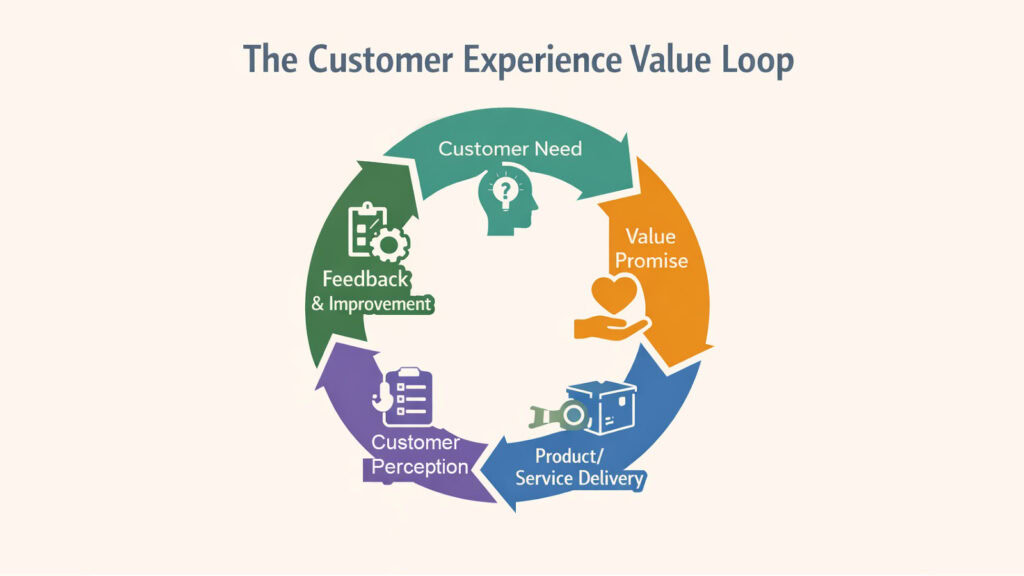
Customers rarely choose a business for one reason alone. They return to the places that feel steady, clear, and respectful of their time. In markets crowded with options, the experience surrounding a product often shapes loyalty more than the product itself. Customer experience unfolds across many moments, each one building or weakening trust. These moments begin at the first impression—an ad, a search result, a recommendation—and continue as the customer moves from curiosity to decision.
During the consideration stage, customers weigh choices and look for clarity. Simple communication and honest pricing do silent but powerful work here. The purchase moment carries its own weight. A smooth checkout builds confidence, while friction creates doubt. After the sale, the experience continues in support interactions, returns, or small questions that customers bring forward. Many service studies have shown the same pattern: customers often remember how a problem was handled more than the problem itself.
Touchpoints appear everywhere. Some are digital—websites, apps, automated messages. Some are human—store staff, support agents, delivery workers. Others are built into the product itself through ease of use and clarity of design. Each moment leaves an impression that shapes long-term loyalty. Feelings like trust, ease, and responsiveness tend to define the companies customers speak well of.
Strong customer experience depends on the rest of the business working with rhythm and consistency. Strategy defines what the customer should feel. Operations keep that feeling stable from day to day. Technology supports smoother service. Culture shapes how employees treat people. Data reveals where customers hesitate or drift away. And value delivery is the final test—whether the company keeps its promises when it matters.
Customer experience becomes an advantage through small, steady acts: the package that arrives when expected, the simple solution to a problem, the clear answer to a question. Over time, these moments shape memory, and memory shapes loyalty.
Customer Experience Elements at a Glance
| Element | How It Works in Practice |
|---|---|
| Awareness Stage | First contact forms expectations that guide the rest of the journey. |
| Consideration Stage | Clear information and simple choices help customers compare options with confidence. |
| Purchase Moment | A smooth transaction reduces hesitation and strengthens trust. |
| Post-Purchase Support | Quick, respectful problem-solving builds long-term loyalty. |
| Digital Touchpoints | Websites and apps must be fast, clear, and easy to navigate. |
| Human Touchpoints | Support and frontline staff influence how customers feel about the brand. |
| Cultural Influence | Internal values shape the consistency of customer interactions. |
| Consistency Across Channels | Customers expect the same experience whether online, by phone, or in person. |
Conclusion: Business Essentials for Long-Term Growth
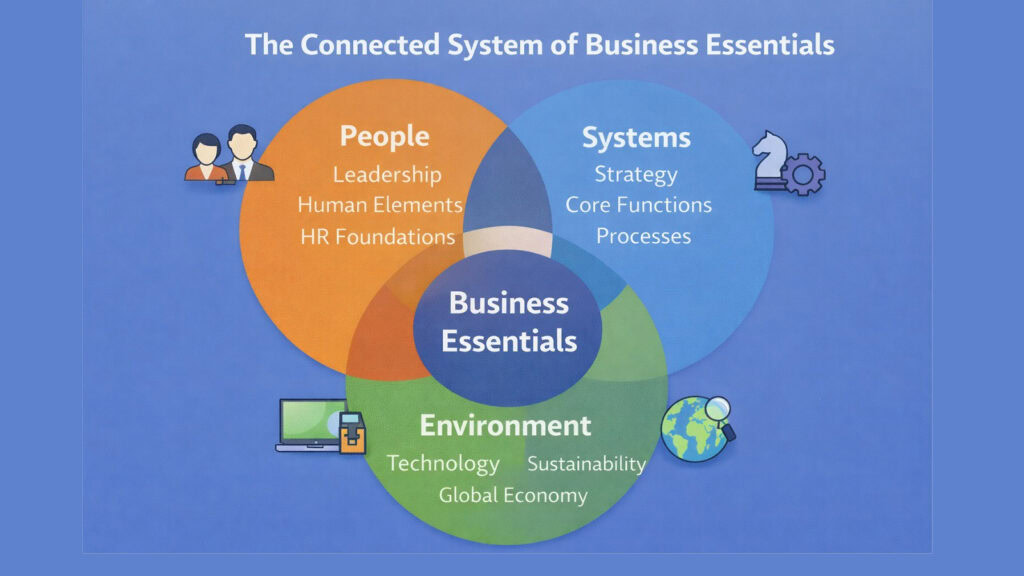
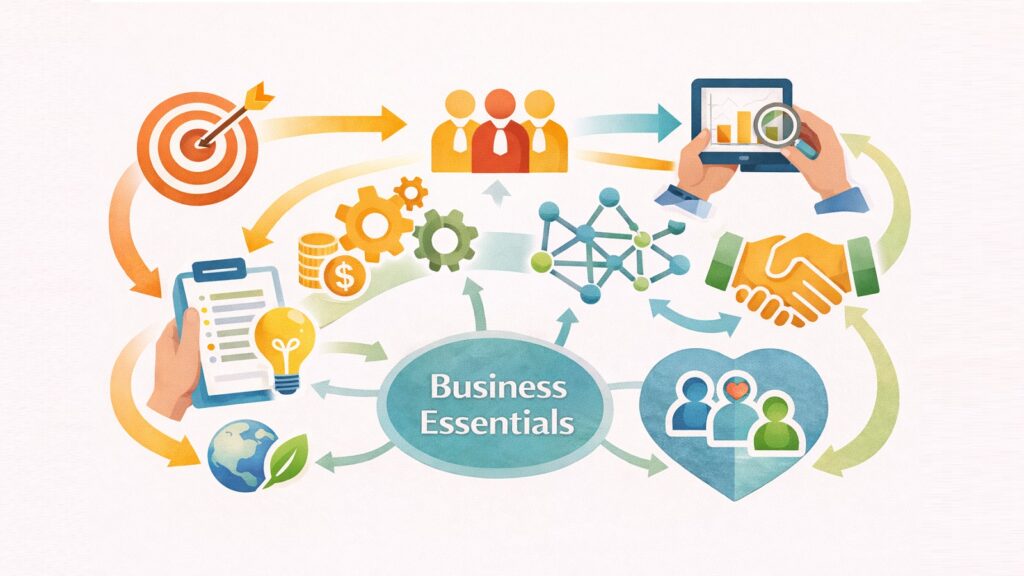
Business Essentials form the groundwork for stability and progress in a world shaped by constant change. The twelve pillars explored here show how fundamental ideas connect across growth planning, core functions, strategic thinking, leadership, technology, global awareness, sustainability and ethics, human well-being, entrepreneurship, innovation, data literacy, and customer value. Organizations that build strength in these areas develop resilience, adapt to new conditions with less friction, and balance competing demands without losing their sense of purpose.
Growth rises from this blend of capability and clarity. When strategy aligns with real strengths, when leadership builds trust, when technology supports people, when global insight guides decisions, when responsibility shapes behavior, when emotional depth supports teamwork, when data sharpens judgment, and when customer experience anchors value, companies create advantages that last beyond short cycles.
The work of mastering Business Essentials is ongoing. Markets shift, technologies advance, customer needs change, and regulations tighten or loosen. Yet the steady principles remain the same. Clarity cuts through confusion. Collaboration breaks down silos. Purpose holds an organization together. Trust allows decisions to move with speed. These simple but enduring ideas help leaders move through uncertainty with calm intent.
Apply these Business Essentials with patience and honesty. Begin with a clear look at current strengths. Identify gaps between where the organization stands and where it needs to go. Focus on improvements that create real value. Track progress with discipline and adjust when needed. Excellence in Business Essentials grows through steady practice, not sudden leaps.
Business Essentials Integration Framework
| Integrated Dimension | Strategic Outcome |
|---|---|
| Strategic Clarity | Clear direction aligns capital, talent, and execution with defined business priorities. |
| Leadership Strength | Capable leaders shape culture, develop people, and support steady performance across the organization. |
| Operational Excellence | Efficient systems and disciplined processes ensure consistent, reliable value delivery. |
| Technology Enablement | Digital tools and automation enhance speed, agility, and informed decision-making. |
| Global Perspective | Awareness of global markets, trade patterns, and economic forces improves strategic resilience. |
| Sustainable Growth | Responsible practices and ethical conduct strengthen long-term competitiveness and stakeholder trust. |
| Human Capital Development | Engagement, well-being, and emotional intelligence unlock productivity, creativity, and team stability. |
| Entrepreneurial Discipline | Opportunity validation, capital efficiency, and scalable models support new venture success. |
| Innovation Capability | Continuous innovation reinforces differentiation and long-term market relevance. |
| Data and Decision Intelligence | Strong data practices improve forecasting, sharpen judgment, and support evidence-based action. |
| Customer Value Systems | Consistent customer experience strengthens loyalty, retention, and lifetime value. |
| Unified Execution | Integrated Business Essentials convert principles into measurable growth and durable advantage. |