Table of Contents
Introduction: Business Technology as a Powerful Growth Engine

There was a time when technology was just a department inside a company. It sat in a corner, fixed things when they broke, and mostly stayed out of the way. That time is gone. Business technology today is one of the most important business essentials. It is the thing that holds everything else together. Without it, even the best business idea runs into walls it cannot climb.
Business technology is the collection of systems, tools, platforms, and practices that a company uses to operate, compete, and grow. It covers how data moves, how customers are reached, how decisions are made, and how work gets done. In that sense, it is not just technology. It is the nervous system of a modern business.
What makes business technology feel different now is scale. Small companies can run the same cloud tools that large ones use. A startup with three people can automate tasks that once needed a full team. This has changed the rules. A business that does not use technology well does not just fall behind. It becomes invisible.
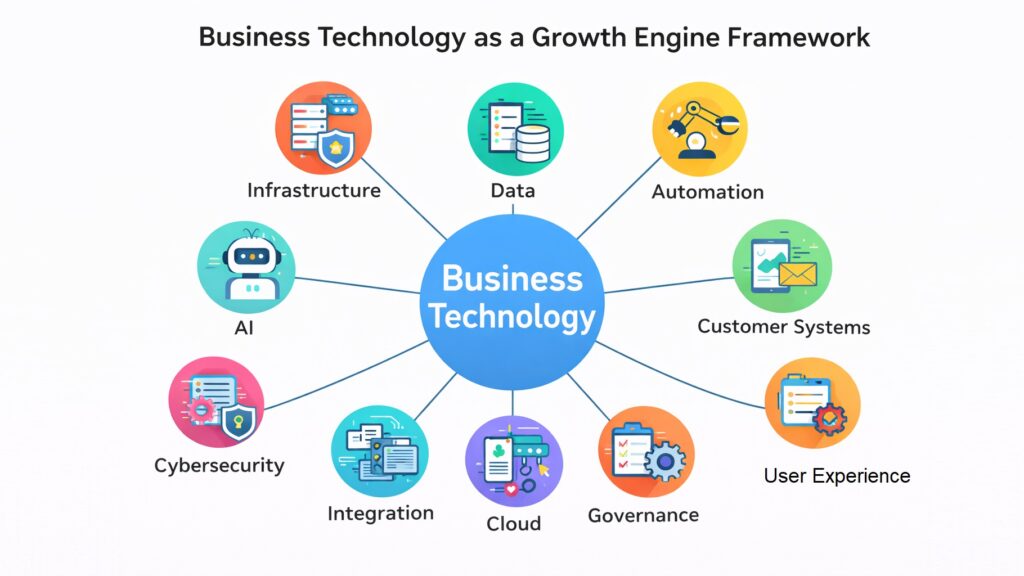
This article looks at business technology through ten growth systems. Each one plays a specific role. Together, they form something bigger than the sum of their parts. Think of it as a framework, not a checklist. Understanding how each system works, and how they connect, is what separates businesses that survive from those that scale.
Business Technology: 10 Growth Systems at a Glance
| Growth System | What It Does for Your Business |
| Digital Infrastructure | Provides the stable technical base for all operations |
| Data Management | Organizes and activates information for better decisions |
| Process Automation | Removes repetitive manual work and speeds up workflows |
| Customer Technology | Builds stronger, more personal customer relationships |
| Artificial Intelligence | Adds predictive power and intelligent automation |
| Cybersecurity | Protects data, systems, and business continuity |
| Integration Architecture | Connects all systems so data flows without friction |
| Technology Governance | Creates rules and oversight for responsible technology use |
| Cloud Computing | Delivers flexible, cost-effective scalable infrastructure |
| Digital Experience | Makes technology easy, fast, and pleasant to use |
1. Business Technology in Digital Infrastructure for Stable Foundations
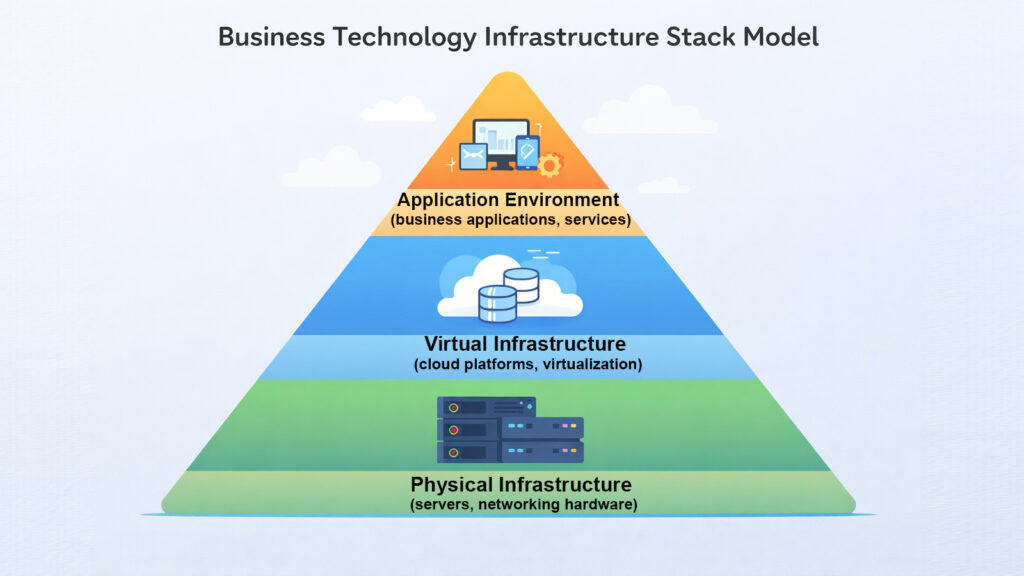
Everything in business technology runs on infrastructure. It is the foundation layer, the part you rarely think about until something breaks. Servers, networks, storage systems, and cloud environments make up this layer. When they work well, the whole operation moves smoothly. When they fail, the cost shows up fast.
Uptime is the most basic measure of infrastructure health. A server that goes down for an hour does not just cost that hour of productivity. It costs customer trust, missed orders, and delayed decisions. Businesses that treat infrastructure as a one-time investment and then forget it often find out the hard way how expensive that mindset is.
Scalability matters just as much. A business that grows quickly needs infrastructure that grows with it. Cloud environments have made this easier by allowing companies to add capacity without buying new hardware. But the architecture still needs planning. Random tool additions create complexity without adding strength.
Strong digital infrastructure also reduces friction across all other business technology systems. When your network is stable and your servers are reliable, everything from data management to customer platforms runs better. Infrastructure is not glamorous work, but it is the kind of work that makes everything else possible.
Business Technology in Digital Infrastructure: Key Facts
| Aspect | Key Fact or Insight |
| Average Downtime Cost | Large enterprises lose around $300,000 per hour of unplanned downtime on average |
| Cloud Adoption | Over 90% of enterprises now use at least one cloud service for core operations |
| Network Performance | Latency above 100ms measurably reduces application usability and user productivity |
| Server Virtualization | Virtualization can reduce physical hardware needs by up to 70% while maintaining capacity |
| Hybrid Infrastructure | Hybrid cloud setups are used by over 70% of organizations globally as of recent surveys |
| Redundancy Planning | Businesses with redundant systems recover from outages 4x faster than those without |
| Edge Computing Growth | Edge computing reduces data travel time by processing information closer to the source |
| Infrastructure Spending | Global IT infrastructure spending exceeded $200 billion annually in recent years |
2. Business Technology in Data Management for Smarter Decisions
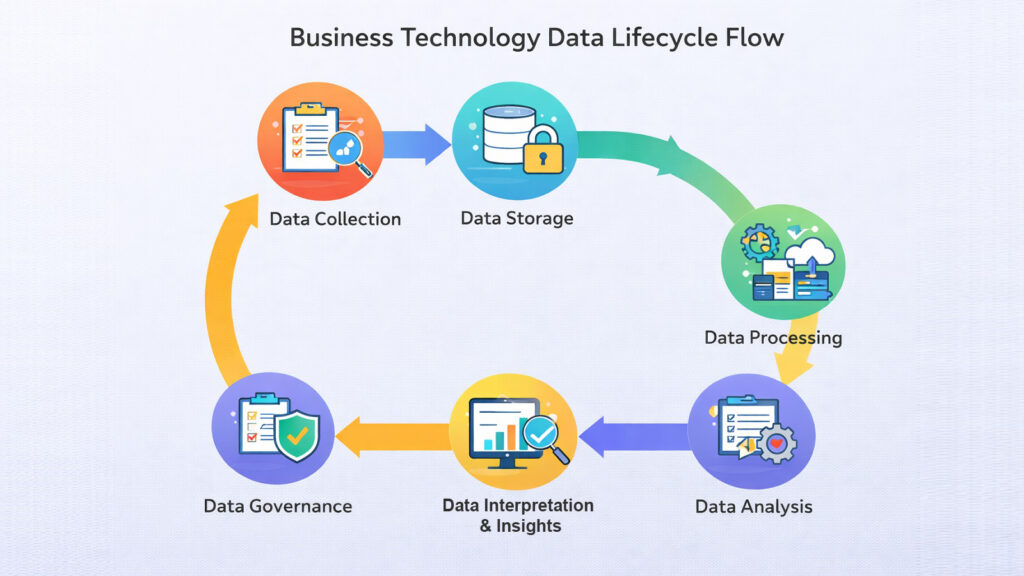
Data is one of those words that gets used so often it stops meaning anything. But in business technology, data management is a real discipline with real consequences. It is about how information is collected, stored, organized, and used. Do it poorly, and your decisions are based on noise. Do it well, and the whole organization sees more clearly.
Data quality is the starting point. Duplicate records, outdated entries, and inconsistent formats create confusion at every level. A sales team working with bad customer data wastes calls. A finance team working with unreliable numbers makes wrong projections. Cleaning and maintaining data is not exciting work, but it is foundational.
Accessibility matters almost as much as quality. Data that exists but cannot be reached quickly is nearly as useless as data that does not exist at all. Business technology systems that centralize data and make it easy to query and report are worth the investment. They save time and reduce the guesswork that creeps into decisions when information is scattered.
Governance rounds it out. Someone needs to own the data, decide who can see what, and ensure compliance with legal requirements. Privacy regulations like GDPR have made governance not just a best practice but a legal obligation. Companies that treat data governance seriously tend to build more trust with customers and avoid costly penalties.
Business Technology in Data Management: Key Facts
| Aspect | Key Fact or Insight |
| Data Growth Rate | The global data sphere is expected to reach 175 zettabytes by 2025, per IDC estimates |
| Poor Data Costs | IBM estimated that poor data quality costs the US economy around $3.1 trillion per year |
| Data Governance | Organizations with formal data governance report 20% fewer compliance violations |
| Structured vs Unstructured | Around 80% of enterprise data is unstructured, making management more complex |
| Real-Time Data Use | Companies using real-time data analytics report faster response times to market changes |
| Data Accessibility | Employees spend an average of 30% of their time searching for information across systems |
| Master Data Management | MDM programs reduce data redundancy and improve reporting accuracy across departments |
| GDPR Impact | Since GDPR enforcement began, over 1,000 fines have been issued across European businesses |
3. Business Technology in Process Automation for Efficiency Gains
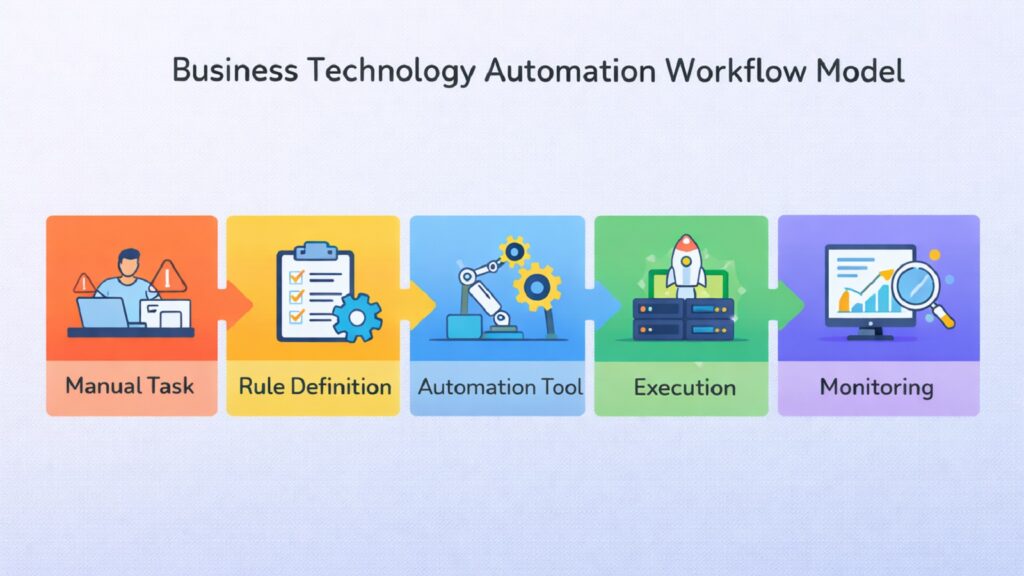
Manual work has a cost that most businesses underestimate. Every task done by hand takes time, introduces the possibility of error, and uses human attention that could go somewhere more valuable. Business technology addresses this through process automation, the practice of using software to handle repetitive tasks that do not require human judgment.
The most common starting point is workflow automation. Think about invoice processing, employee onboarding, customer follow-up emails, or inventory updates. These are tasks with defined steps and predictable outcomes. They are perfect candidates for automation. When a system handles them consistently, errors drop and speed increases.
The savings are real. Research from McKinsey has estimated that roughly 45% of tasks people are currently paid to do can be automated using existing technology. That does not mean mass job loss. It means that workers can focus on the parts of their jobs that require judgment, creativity, and relationship-building, things that software still handles poorly.
Speed is another benefit worth noting. Automated processes do not sleep, do not take breaks, and do not slow down when volume spikes. A customer who submits a form at midnight can receive a confirmation instantly rather than waiting until the next business day. That kind of responsiveness builds trust without adding headcount.
Business Technology in Process Automation: Key Facts
| Aspect | Key Fact or Insight |
| Automatable Work | McKinsey estimates around 45% of current work tasks could be automated with existing technology |
| RPA Market Size | The robotic process automation market surpassed $2.9 billion globally in recent years |
| Error Reduction | Automated data entry reduces errors by up to 80% compared to manual input |
| Cost Savings | Automation can reduce operational costs by 20-35% for processes with high transaction volume |
| Time on Repetitive Tasks | Employees spend up to 40% of their time on routine, low-value tasks that could be automated |
| Invoice Automation | Automated invoice processing is 5x faster and significantly cheaper than manual processing |
| Customer Response Time | Automated workflows reduce average customer response times from hours to minutes |
| Adoption Growth | Over 50% of enterprises have deployed some form of workflow automation technology |
4. Business Technology in Customer Technology for Better Engagement
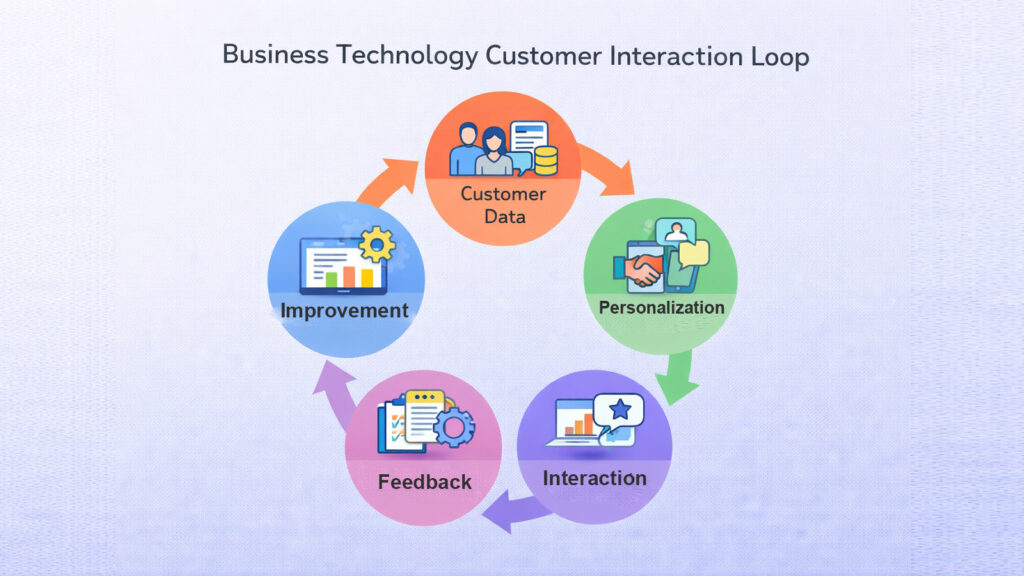
Customers have more choices than they have ever had before. They also have less patience. Business technology meets this reality through a set of customer-facing tools that improve how companies interact, respond, and build loyalty. At the center of this is the CRM, the customer relationship management platform.
A CRM does more than store contact information. It tracks every interaction, logs purchase history, flags follow-up opportunities, and gives a complete picture of the customer relationship. Salespeople who use CRM platforms well do not just manage more customers. They serve them better because they remember what matters.
Personalization is where customer technology has moved in recent years. Customers now expect businesses to know their preferences, remember their last purchase, and offer relevant suggestions. This kind of experience used to be limited to big companies with large budgets. Business technology has made it accessible at every scale.
Digital platforms, live chat tools, and customer portals have also changed what service looks like. A customer who can resolve an issue without waiting on hold is a happier customer. One who gets a timely, relevant email feels noticed rather than spammed. These experiences do not happen by accident. They happen because the right technology is in place and configured well.
Business Technology in Customer Technology: Key Facts
| Aspect | Key Fact or Insight |
| CRM Market Value | The global CRM market was valued at over $60 billion and continues to grow annually |
| Personalization Impact | 80% of consumers say they are more likely to buy from companies that offer personalized experiences |
| Customer Retention | Increasing customer retention by 5% can increase profits by 25% to 95% per Bain research |
| Omnichannel Expectation | Over 75% of customers expect consistent service across phone, chat, email, and in-person channels |
| Self-Service Preference | 67% of customers prefer self-service over speaking with a company representative for simple issues |
| CRM Adoption ROI | Companies report an average ROI of $8.71 for every dollar spent on CRM implementation |
| Churn Reduction | Proactive CRM use can reduce customer churn by identifying at-risk accounts early |
| Live Chat Usage | Businesses using live chat see up to a 40% increase in conversion rates over email-only support |
5. Business Technology in Artificial Intelligence for Intelligent Growth
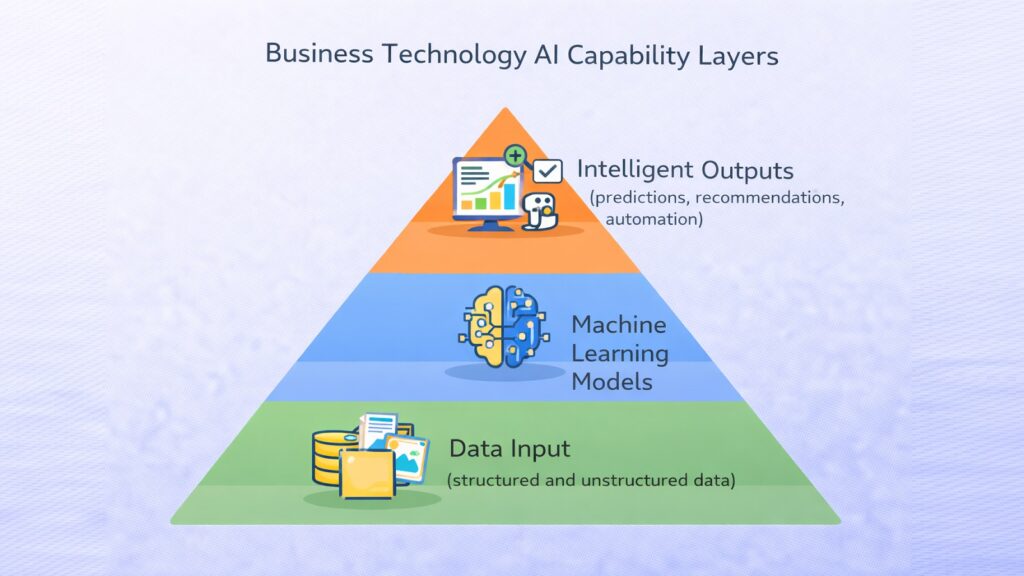
Artificial intelligence is not a single thing. It is a family of techniques that give software the ability to learn from data, recognize patterns, and make predictions. In business technology, AI shows up in ways that range from simple to sophisticated, and most of them are more accessible today than they were just five years ago.
Chatbots are the most visible example. A well-built chatbot can handle common customer questions around the clock, reducing the load on support teams without reducing the quality of service for customers with straightforward needs. The key word is well-built. Poorly designed chatbots frustrate customers more than they help.
Recommendation systems are another strong use case. Platforms like Amazon and Netflix use AI to suggest products and content based on what a user has engaged with before. This is not magic. It is pattern matching at scale. Smaller businesses can now access similar tools through cloud-based AI services without building anything from scratch.
Where AI really earns its place in business technology is in analytics. Forecasting demand, detecting fraud, scoring leads, and identifying operational inefficiencies all benefit from machine learning models that process far more data than any human analyst could. The decisions that come out of these systems tend to be more consistent and less prone to the biases that creep into human judgment.
Business Technology in Artificial Intelligence: Key Facts
| Aspect | Key Fact or Insight |
| AI Market Growth | The global AI market is projected to exceed $1.8 trillion by 2030 per various forecasts |
| Chatbot Handling Rate | AI chatbots can resolve up to 80% of routine customer queries without human involvement |
| Fraud Detection | AI-based fraud detection systems reduce false positives by up to 50% versus rule-based systems |
| Lead Scoring | AI-powered lead scoring improves sales conversion rates by helping teams focus on the best prospects |
| Demand Forecasting | Retailers using AI forecasting report inventory reductions of 20-50% while maintaining fill rates |
| Recommendation Revenue | Amazon attributes roughly 35% of its revenue to its AI recommendation engine |
| AI Adoption Rate | Over 50% of organizations globally report using AI in at least one business function |
| Cost of AI Errors | Poorly trained AI models can amplify bias and produce decisions that damage customer trust |
6. Business Technology in Cybersecurity for Risk Protection
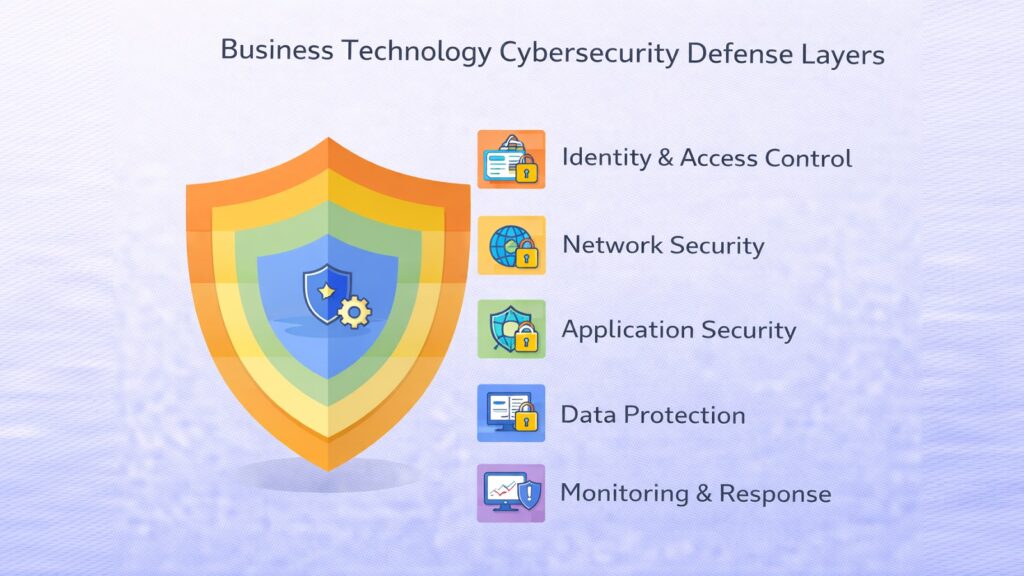
Every system linked to the internet represents a possible target. This statement once seemed alarmist. Now, it merely describes the current reality. Business technology lacking robust cybersecurity measures is akin to a building without locks. It may appear secure until an individual chooses to test the doors.
The threat landscape has grown more complex. Ransomware, phishing attacks, and data breaches have become common enough that most companies will experience some form of security incident if they operate long enough. The question is not whether a threat will come. It is whether the business is prepared to limit the damage.
Basic security practices go a long way. Multi-factor authentication, regular software updates, employee training, and access controls together prevent the majority of successful attacks. Most breaches do not happen because attackers found some exotic vulnerability. They happen because a door was left open that should have been locked.
Trust is the real asset that cybersecurity protects. A customer whose data is compromised does not just lose confidence in that one company. They become more cautious about every digital interaction. For businesses, a breach can mean regulatory fines, legal liability, and a reputation that takes years to rebuild. Investing in security before an incident is far cheaper than recovering after one.
Business Technology in Cybersecurity: Key Facts
| Aspect | Key Fact or Insight |
| Average Breach Cost | IBM’s 2023 Cost of a Data Breach report put the global average at $4.45 million per incident |
| Phishing Prevalence | Over 90% of successful cyberattacks begin with a phishing email targeting employees |
| Ransomware Frequency | Ransomware attacks occur approximately every 11 seconds globally, per Cybersecurity Ventures |
| MFA Effectiveness | Multi-factor authentication blocks over 99% of automated account takeover attacks |
| Breach Detection Time | On average, organizations take 204 days to detect a data breach after it occurs |
| Employee Risk | Human error contributes to around 82% of data breaches, per Verizon’s annual data breach report |
| SMB Vulnerability | 43% of cyberattacks target small businesses, yet many lack dedicated security resources |
| Security Investment ROI | Organizations with strong security postures reduce breach costs by an average of $1.49 million |
7. Business Technology in Integration Architecture for System Connectivity
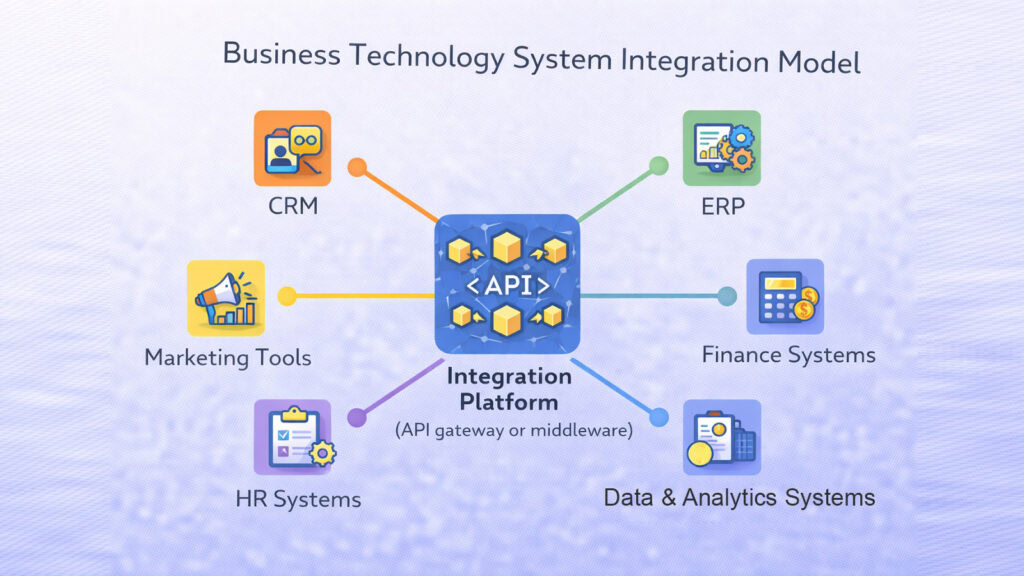
Most businesses do not run on one system. They run on many. There is an accounting platform over here, a CRM over there, an inventory tool somewhere else, and a handful of other applications filling gaps. When those systems do not talk to each other, information gets stuck in pockets. Decisions get made with incomplete pictures. Work gets duplicated.
Integration architecture is the part of business technology that solves this problem. It is the design of how systems connect and how data flows between them. APIs, the application programming interfaces that let one piece of software communicate with another, are the basic building blocks. When APIs are well-designed and well-maintained, integration becomes manageable.
Platforms like Zapier, MuleSoft, and Microsoft Azure Integration Services have made it easier for businesses to connect tools without writing complex custom code. These middleware platforms act as translators, taking data from one system and delivering it to another in the right format. They reduce the need for expensive custom development and speed up the time it takes to get systems working together.
The business benefit of good integration is a single source of truth. When your CRM, accounting system, and inventory platform all share the same customer and order data, everyone works from the same reality. That alignment reduces mistakes, speeds up reporting, and makes it easier to spot problems before they grow.
Business Technology in Integration Architecture: Key Facts
| Aspect | Key Fact or Insight |
| API Economy Growth | The global API management market is growing at over 25% annually as integration demand rises |
| Data Silos Cost | Disconnected systems cost businesses an estimated 20-30% in reduced efficiency per year |
| Integration Platform Use | Over 60% of enterprises now use an iPaaS solution to manage cross-system integrations |
| Average Systems per Company | Mid-sized companies run an average of 137 SaaS applications, many of which need integration |
| API Failure Impact | A poorly maintained API can cause cascading failures across multiple dependent systems |
| Custom vs Platform | Platform-based integration reduces implementation time by 40-60% versus custom development |
| Data Sync Frequency | Real-time data sync across systems reduces decision lag and improves operational accuracy |
| ROI of Integration | Companies report significant improvements in reporting speed after investing in integration architecture |
8. Business Technology in Technology Governance for Strategic Control
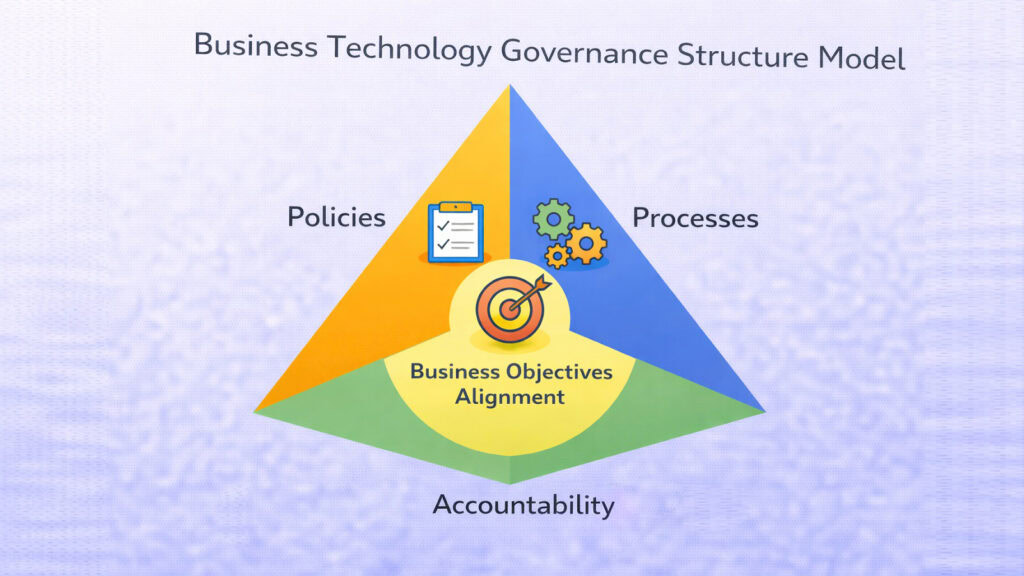
Technology without governance is like a vehicle without a steering wheel. It may move fast, but there is no guarantee it goes where you want. Business technology governance is the set of policies, roles, and decision-making processes that determine how technology is chosen, deployed, and monitored inside an organization.
At its most basic, governance answers three questions. Who decides which technology gets adopted? Who is responsible when something goes wrong? And how does technology investment align with business goals? When these questions have clear answers, technology serves the organization. When they do not, technology tends to sprawl, duplicate, and eventually become a source of cost rather than value.
Shadow IT is one of the clearest signs of poor governance. This is when employees adopt their own tools and platforms outside of official channels because the sanctioned options are too slow, too rigid, or just not good enough. Shadow IT is a symptom. The underlying problem is usually that governance processes are too slow or disconnected from real needs.
Good governance does not mean heavy bureaucracy. It means clear ownership, regular review, and honest alignment between what the technology budget buys and what the business actually needs. Frameworks like COBIT and ITIL offer structured approaches that many organizations use as starting points. The goal is not to slow things down. It is to make sure things go in the right direction.
Business Technology in Technology Governance: Key Facts
| Aspect | Key Fact or Insight |
| Shadow IT Prevalence | Gartner estimates that shadow IT accounts for 30-40% of total IT spending in large enterprises |
| Governance Framework Use | COBIT and ITIL are among the most widely adopted IT governance frameworks globally |
| Wasted IT Spend | Companies waste an estimated 30% of their technology budgets on underused or redundant tools |
| Board-Level IT Oversight | Only 44% of boards regularly review IT risk and governance, per global surveys |
| Policy Compliance | Organizations with clear IT policies report fewer security incidents and audit findings |
| Vendor Management | Poor vendor governance leads to contract overruns, missed SLAs, and service disruptions |
| Technology Lifecycle | Without governance, technology assets age without review, creating compatibility and security risks |
| Decision Clarity | Defined governance structures reduce technology decision cycles by providing clear authority |
9. Business Technology in Cloud Computing for Scalable Growth
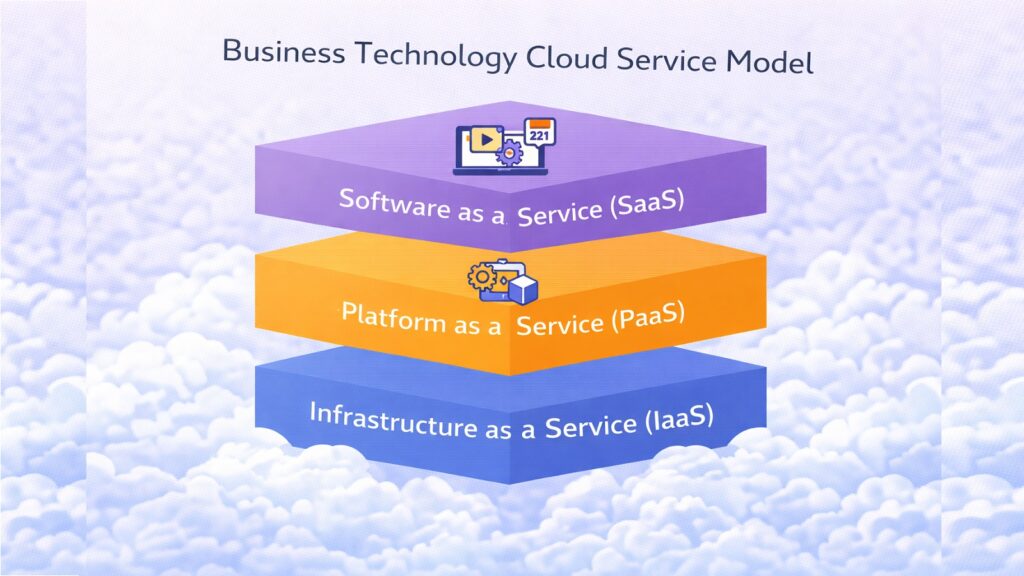
Cloud computing changed what it means to start a business. Before the cloud, setting up a serious business technology environment meant buying servers, hiring specialists, and spending months getting ready. Today, a new business can be fully operational with enterprise-grade tools in a matter of days. That shift is not small. It is transformational.
The three big cloud providers, Amazon Web Services, Microsoft Azure, and Google Cloud, together hold the majority of the global cloud market. But the real story is not the providers. It is what businesses can do because of them. Storage, computing power, databases, machine learning services, and communication tools are all available on demand, priced by use.
Flexibility is the cloud’s most practical benefit. A business that has a busy season can scale up computing resources for that period and scale back down when it ends. No waste, no idle hardware, no upfront capital expenditure. This kind of elasticity used to be available only to companies with massive budgets. The cloud made it standard.
Remote access is another benefit that became critical during the global pandemic. Teams distributed across cities and countries can collaborate on the same platforms, access the same files, and operate as a coherent unit because the infrastructure lives in the cloud rather than in a single physical location. Business technology built on cloud systems is simply more resilient.
Business Technology in Cloud Computing: Key Facts
| Aspect | Key Fact or Insight |
| Global Cloud Market | The global cloud computing market exceeded $600 billion in value in recent years |
| AWS Market Share | Amazon Web Services holds roughly 31% of the global cloud infrastructure market |
| Cost Savings | Organizations migrating to the cloud report average infrastructure cost reductions of 15-40% |
| Remote Work Enablement | Cloud adoption was the key enabler of the rapid shift to remote work during the 2020 pandemic |
| Deployment Speed | Cloud-based deployments reduce time-to-market for new services by an average of 40% |
| SaaS Growth | The software-as-a-service segment of the cloud market grows at over 18% annually |
| Multi-Cloud Strategy | Over 85% of organizations now use a multi-cloud strategy to avoid vendor lock-in |
| Security Concerns | Despite concerns, cloud providers invest billions annually in security, often exceeding on-premise standards |
10. Business Technology in Digital Experience for User-Centric Design
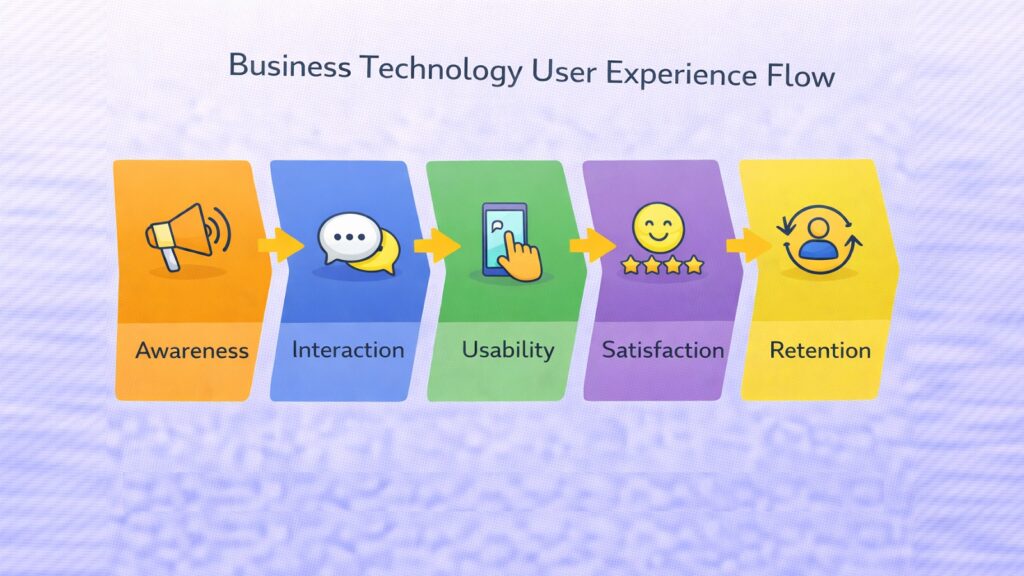
Technology that frustrates users does not get used. That sounds obvious, but a surprising number of business technology investments fail not because the system does not work, but because the people who need to use it find it confusing, slow, or unpleasant. Digital experience is about closing that gap between what a system can do and what users actually want to do with it.
UX and UI design are the disciplines that shape digital experience. UX, or user experience design, is about how a system feels to use, the logic of navigation, the clarity of options, and the smoothness of completing a task. UI, or user interface design, is about how it looks, the visual layout, typography, and interactive elements. Both matter.
Speed is a dimension of experience that often gets underestimated. Research from Google has shown that the probability of a user bouncing from a mobile page increases sharply as load time goes from one second to five seconds. A system that works perfectly but takes ten seconds to respond trains users to avoid it. Performance is not a technical concern separate from experience. It is experience.
For internal business technology, poor digital experience creates hidden costs. Employees who find a system hard to use either avoid it, work around it, or spend longer on tasks than they should. Training costs go up. Error rates go up. Adoption falls below the levels needed for the technology to deliver its promised value. Investing in experience is not just for customer-facing systems. It matters just as much inside the organization.
Business Technology in Digital Experience: Key Facts
| Aspect | Key Fact or Insight |
| Page Load Impact | Google research shows that a 1-second delay in mobile load time reduces conversions by up to 20% |
| UX Investment ROI | Every dollar invested in UX design returns between $2 and $100 depending on the application context |
| Accessibility Compliance | WCAG accessibility standards are required by law for many government and public-sector digital systems |
| Mobile Usage Share | Over 55% of global web traffic now comes from mobile devices, making responsive design essential |
| Poor UX Abandonment | 88% of online users say they will not return to a website after a bad digital experience |
| Internal System Adoption | Systems with high usability scores see adoption rates 3x higher than those with poor interfaces |
| Design System Use | Organizations using consistent design systems reduce UI development time by 30-50% |
| Employee Experience | Good internal digital experience reduces onboarding time and increases productivity from day one |
Conclusion: Business Technology as the Core of Sustainable Growth
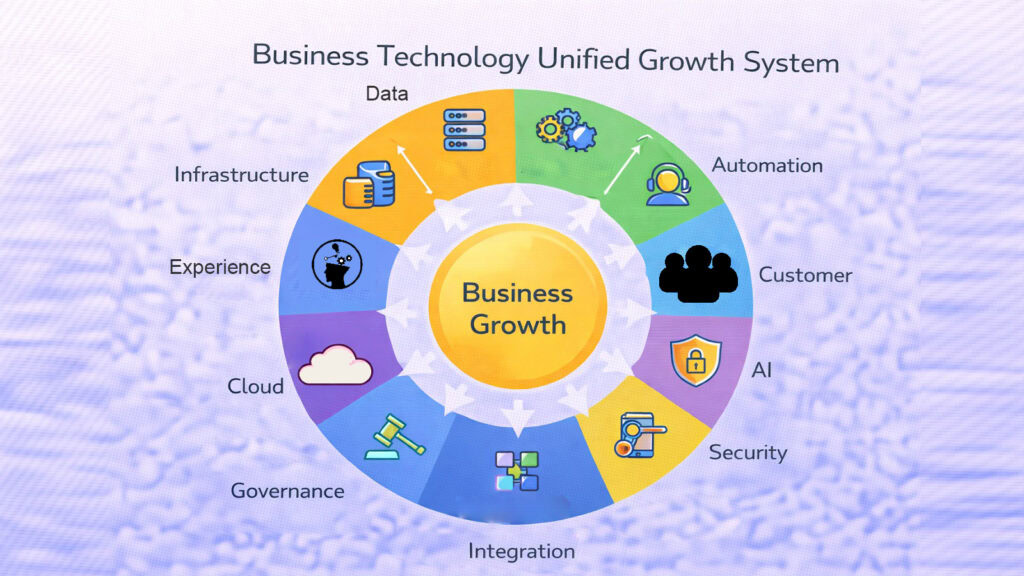

Ten systems. Ten different angles. But really, one story. Business technology is what ties modern business operations together. It is the infrastructure that carries data, the automation that frees up people, the security that keeps things safe, the cloud that makes scaling possible, and the experience that makes all of it usable. Each system matters. None of them works as well alone as they do together.
The businesses that grow consistently tend to treat technology as a strategic asset rather than a cost center. They invest in getting their foundations right. They build data practices that support real decisions. They automate where it makes sense and govern what they invest in. They think about the experience of using their systems, not just the features those systems offer.
This is not a story about big budgets. Many of the most powerful business technology tools available today are accessible to companies of almost any size. The cloud has equalized access to infrastructure. Open-source software has equalized access to powerful development tools. SaaS platforms have made enterprise-grade capabilities affordable on a subscription basis.
The gap that remains is not about access. It is about intent and integration. Businesses that approach technology with a clear sense of what they are trying to achieve, and that take the time to connect their systems thoughtfully, will continue to find advantages that others miss. The future belongs to those who treat business technology not as a tool they use, but as a system they build.
Business Technology: 10 Growth Systems and Their Core Impact
| Growth System | Core Business Impact |
| Digital Infrastructure | Reduces downtime and supports every other system with a reliable technical base |
| Data Management | Converts raw information into decisions that are faster, cleaner, and more reliable |
| Process Automation | Reduces manual effort, cuts errors, and frees teams to focus on higher-value work |
| Customer Technology | Deepens relationships, improves satisfaction, and increases retention over time |
| Artificial Intelligence | Adds predictive capability and handles complex analysis at a scale humans cannot match |
| Cybersecurity | Protects revenue, reputation, and trust from a threat environment that never stops growing |
| Integration Architecture | Eliminates data silos and creates a single, coherent view of operations |
| Technology Governance | Ensures technology investment stays aligned with business strategy and avoids waste |
| Cloud Computing | Delivers flexibility, speed, and cost efficiency for businesses of every size |
| Digital Experience | Makes technology actually useful by ensuring people want to engage with it |