Table of Contents
Introduction: Digital Ecosystem – The Backbone of Modern Technology
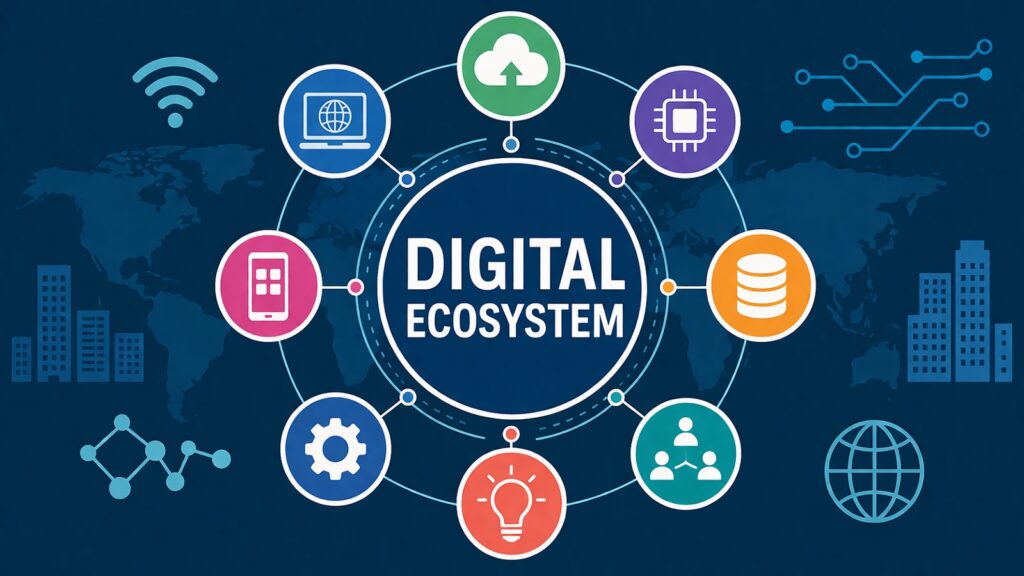
Technology today does not live in separate boxes. It moves through systems that talk to each other, share information, and depend on each other to function. That connected web of tools, platforms, services, and people is what we call a digital ecosystem. It is not a single product or a specific company. It is the entire environment in which digital activity takes place.
Think of it like a forest. Each tree, plant, insect, and animal plays a role. Remove one part, and the rest feels the change. A digital ecosystem works the same way. Every application, data pipeline, cloud service, and user interaction shapes the overall experience. When one part improves or fails, the effects ripple outward.
Modern technology has made isolation almost impossible. A smartphone app needs a backend server. That server needs a cloud provider. The cloud provider depends on a network of data centers. Data centers rely on software frameworks built by dozens of teams. All of this happens quietly, in the background, while the user just taps a screen.
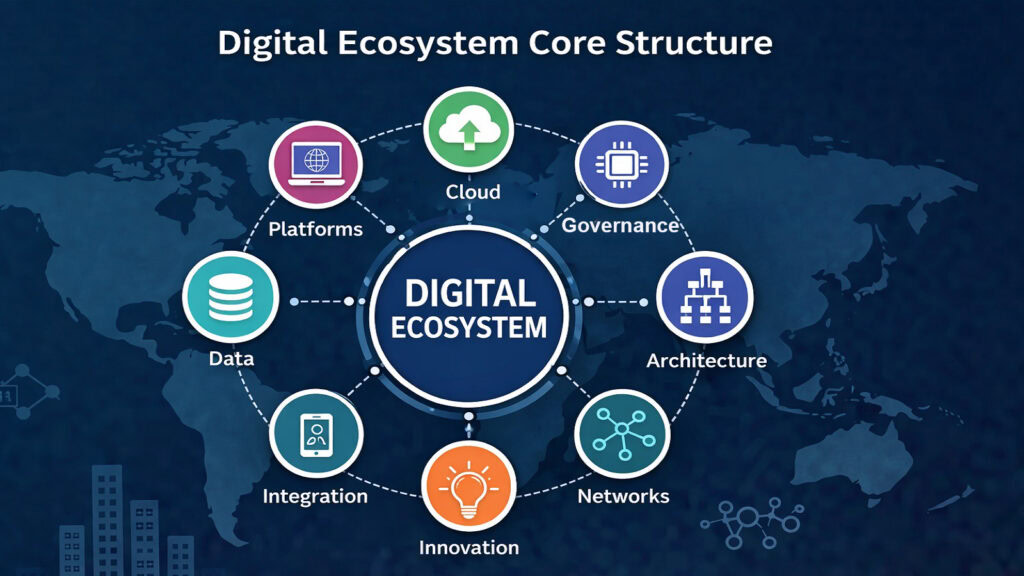
The digital ecosystem is now the foundation on which modern technology builds everything. It is not just a trend or a buzzword. It is the operating reality of how digital systems grow and survive. And its strength does not come from one single element. It comes from eight key drivers working together, each supporting the others in ways that are practical, measurable, and deeply connected.
This article walks through those eight drivers. It shows how each one shapes the digital ecosystem, and why understanding them matters for anyone who works with, builds on, or simply lives inside modern technology.
Table 1: Digital Ecosystem — 8 Aspects Covered in This Article
| Aspects of Digital Ecosystems | Core Role in the Digital Ecosystem |
| Platform Integration | Connects systems and removes silos so data and services flow without friction |
| Data Intelligence | Converts raw data into actionable insights that guide decisions across the ecosystem |
| Cloud Infrastructure | Provides scalable and reliable computing power that keeps the ecosystem always available |
| System Architecture | Defines the structural design that allows components to grow and interact without failure |
| Data Governance | Ensures data quality, consistency, and ownership across all parts of the ecosystem |
| Digital Governance | Sets policies and compliance rules that keep the entire ecosystem aligned and secure |
| Network Effects | Increases the ecosystem’s value as more users and participants join over time |
| Digital Innovation | Drives continuous evolution by introducing new technologies and approaches into the ecosystem |
1. Digital Ecosystem and Platform Integration
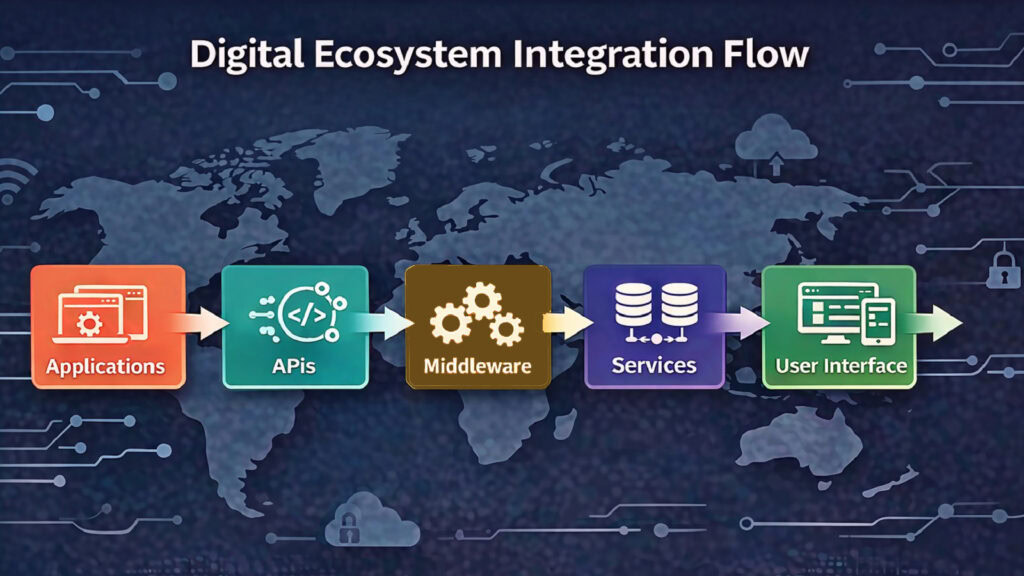
Every digital ecosystem starts with connection. Platforms do not work in isolation. They need to speak to other platforms, share data across systems, and let different services operate as a single experience for the user. This is what platform integration means. It is the act of linking separate systems so they behave as one.
APIs, or application programming interfaces, are the most common tools for this. They allow one system to request information or action from another without needing to know how the other system works internally. A travel booking site, for example, pulls real-time flight data from airlines, hotel availability from property systems, and payment processing from a financial gateway. None of these systems were built together. But through integration, they feel seamless to the traveler.
Enterprise platforms show this even more clearly. A large company might use one system for customer relationships, another for inventory, and a third for finance. Integration ties these together so that when a sale is made, inventory updates automatically and the finance system records the revenue without manual input. The digital ecosystem runs on that kind of quiet, continuous coordination.
Without integration, every system becomes an island. Data stays locked inside separate tools. Teams duplicate work. Mistakes multiply when numbers from one system do not match another. Integration removes these silos, and when the silos fall, the digital ecosystem gains coherence. Information flows where it needs to go, and decisions become faster and more accurate.
The true strength of integration extends beyond mere technical aspects. It generates business value. Organizations that effectively integrate their systems can respond to customer inquiries more swiftly, identify issues sooner, and develop new services by innovatively combining existing ones. Integration transforms a set of tools into a genuine digital ecosystem.
Table 2: Digital Ecosystem Platform Integration Overview
| Aspect | Description |
|---|---|
| System Connectivity | Links multiple platforms into one unified Digital Ecosystem |
| API Usage | Enables communication between independent systems |
| Data Sharing | Allows real-time exchange of information across platforms |
| Service Coordination | Aligns different services into a seamless workflow |
| User Experience Flow | Creates smooth, uninterrupted user interactions |
| Enterprise Integration | Connects CRM, finance, and inventory systems |
| Silo Reduction | Eliminates isolated systems and duplicated efforts |
| Business Value | Improves speed, accuracy, and service innovation |
2. Digital Ecosystem and Data Intelligence
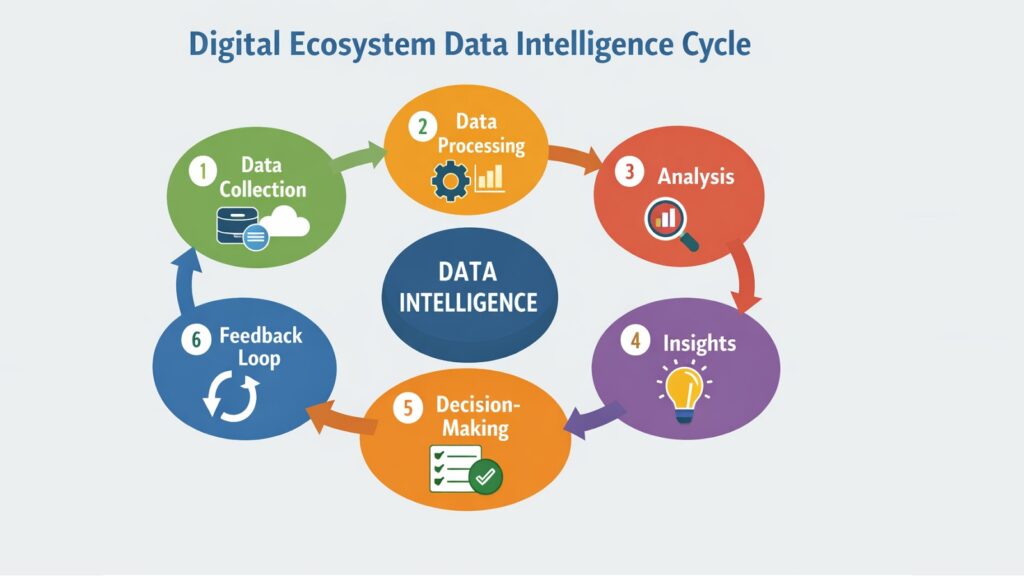
A digital ecosystem generates enormous amounts of data every second. Clicks, transactions, sensor readings, search queries, location signals — all of it accumulates in streams that never really stop. The question is never whether enough data exists. The question is whether the ecosystem can turn that data into something useful.
Data intelligence is the capacity to do exactly that. It covers how data is collected, how it moves through the system, how it gets cleaned and organized, and how it is analyzed to produce insights. Those insights then drive decisions, from product recommendations to fraud detection to infrastructure scaling.
Modern analytics tools have made this process faster than it ever was before. Real-time dashboards can show a business what is happening in its systems right now, not hours or days later. Machine learning models can detect patterns that no human analyst would spot by examining tables of numbers. Predictive analytics can estimate what is likely to happen next, giving teams a chance to act before problems become crises.
The digital ecosystem becomes smarter over time because of this feedback loop. More data leads to better models. Better models produce better decisions. Better decisions generate more data. Over time, a well-managed ecosystem develops a kind of institutional memory, knowing what worked, what did not, and where attention is most needed.
Without data intelligence, the ecosystem runs blind. It might still function, but it cannot learn, cannot adapt, and cannot grow in a deliberate direction. Data intelligence is what gives the digital ecosystem its sense of purpose and direction.
Table 3: Digital Ecosystem and Data Intelligence — Key Facts
| Aspect | Detail |
| Volume of data generated | The world generates over 2.5 quintillion bytes of data every day across digital systems |
| Real-time analytics | Platforms like Amazon process millions of data points per second to adjust recommendations instantly |
| Machine learning role | ML models trained on ecosystem data improve accuracy over time through continuous feedback loops |
| Data-driven decisions | Organizations using data analytics are significantly more likely to outperform competitors financially |
| Predictive analytics use | Retail ecosystems use predictive models to forecast inventory needs and reduce waste |
| Data latency impact | High latency in data processing can lead to outdated decisions in fast-moving digital environments |
| Business intelligence tools | Platforms like Tableau, Power BI, and Looker help teams visualize ecosystem data at scale |
| Customer behavior insight | Data intelligence allows ecosystems to personalize experiences based on individual usage patterns |
3. Digital Ecosystem and Cloud Infrastructure
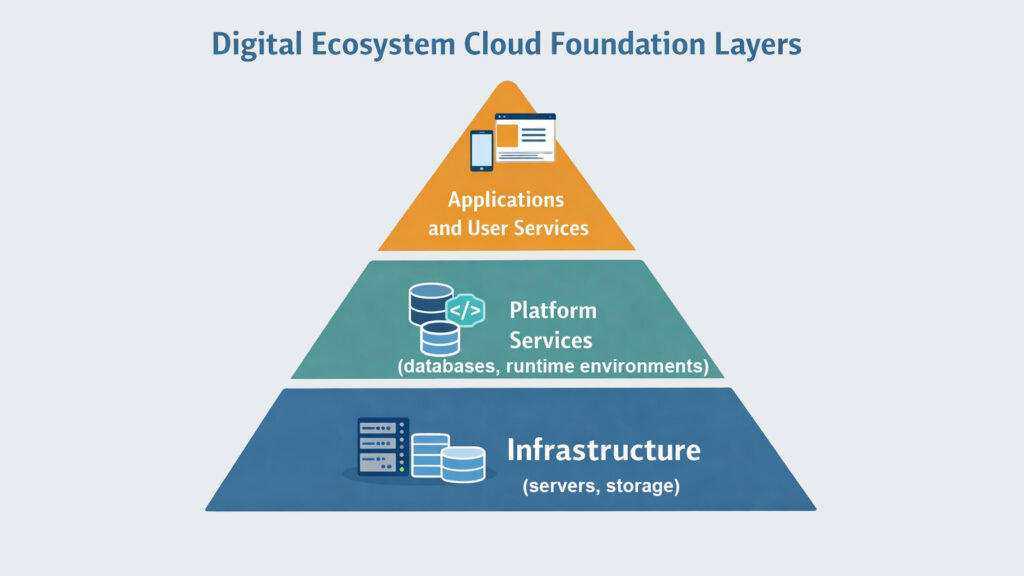
No digital ecosystem can exist at scale without somewhere to live. Cloud infrastructure provides the physical and virtual foundation that keeps all the pieces running. It is a network of servers, storage systems, and networking tools that operate across data centers worldwide, available on demand to anyone who needs them.
Before cloud computing became common, companies built their own data centers. Those data centers were expensive, slow to expand, and geographically limited. If demand suddenly spiked, the system could not handle it. Cloud infrastructure changed that. Now a platform can scale its computing power up in minutes if it suddenly gets ten times more traffic, and scale back down just as fast when the surge passes.
Amazon Web Services, Microsoft Azure, and Google Cloud are the largest providers of this infrastructure. Between them, they support millions of applications and digital ecosystems around the world. They offer storage, databases, processing power, machine learning tools, networking, and security services, all available through a browser or an API.
For the digital ecosystem, cloud infrastructure means reliability. Systems stay online because cloud providers build redundancy into every layer. If one server fails, another takes over. If one data center goes offline, traffic routes to another region. This is called high availability, and it is one of the most important qualities a digital ecosystem can have.
Accessibility is another benefit. Cloud infrastructure makes it possible for a startup in one country to serve users in fifty countries without needing physical offices in each one. The ecosystem extends everywhere the internet reaches, and cloud infrastructure is what makes that possible.
Table 4: Digital Ecosystem and Cloud Infrastructure — Key Facts
| Aspect | Detail |
| Market size | The global cloud infrastructure market was valued at over $200 billion and continues to grow each year |
| AWS global reach | Amazon Web Services operates data centers across 31 geographic regions globally as of recent reports |
| Scalability benefit | Cloud systems can scale computing resources up or down within minutes based on demand changes |
| High availability design | Major cloud providers guarantee uptime rates of 99.99% through redundant architecture design |
| Cost model | Cloud infrastructure uses a pay-as-you-go model that reduces capital expenditure for businesses |
| Hybrid cloud adoption | Many enterprises combine private and public clouds to balance control, security, and scalability |
| Disaster recovery | Cloud providers offer automated backup and recovery tools that protect ecosystem data from loss |
| Edge computing growth | Edge computing extends cloud infrastructure closer to users, reducing latency for real-time applications |
4. Digital Ecosystem and System Architecture
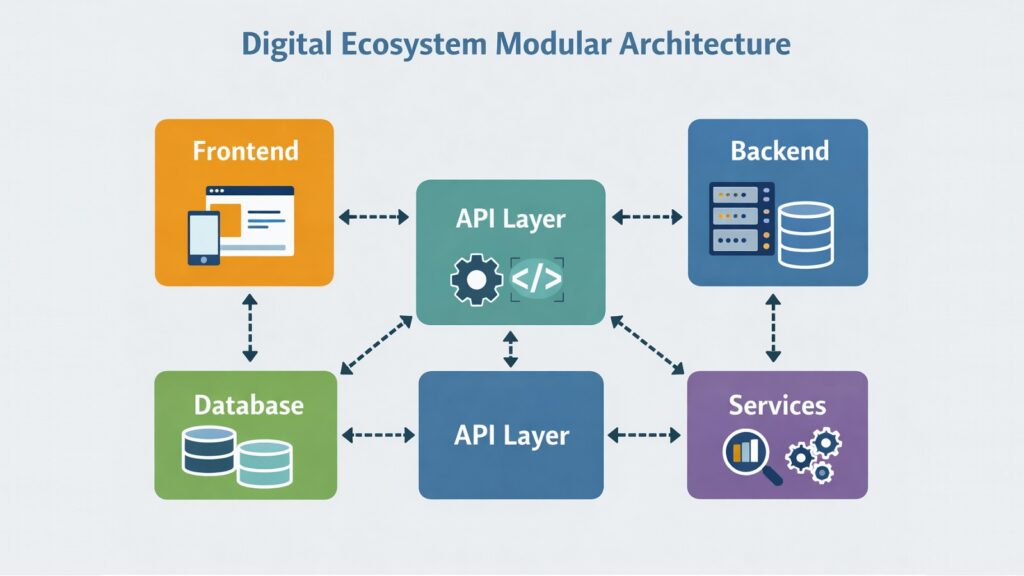
How a digital ecosystem is built matters as much as what it contains. System architecture is the design blueprint. It determines how components are arranged, how they communicate, and how the whole structure holds together under pressure. A poorly designed architecture will crack when the system grows. A well-designed one will absorb that growth without failing.
Modular design is one of the most important principles here. Rather than building one giant, interconnected application where everything depends on everything else, modular design breaks the system into smaller, independent units. Each unit does one job well. It can be updated, replaced, or scaled without disrupting the others. This is sometimes called a microservices architecture, and it is widely used in large digital ecosystems like Netflix, Uber, and LinkedIn.
Layered systems are another structural principle. A layered architecture organizes the system into distinct levels, such as a presentation layer, a business logic layer, and a data layer. Each layer handles its own responsibilities and communicates only with the layers directly above or below it. This separation keeps complexity manageable and makes the system easier to debug and maintain.
The way components interact also matters. Well-designed systems use standardized interfaces and contracts so that any component can be swapped or upgraded without requiring changes to every other component. This loose coupling is what gives a digital ecosystem its flexibility over time.
When the architecture is sound, the digital ecosystem can grow without becoming fragile. New features can be added in new modules. Old systems can be retired without breaking everything that depends on them. The structure supports change rather than resisting it.
Table 5: Digital Ecosystem and System Architecture — Key Facts
| Aspect | Detail |
| Microservices definition | An approach where applications are built as small, independent services that each handle a specific function |
| Netflix architecture | Netflix uses over 700 microservices to run its streaming platform, enabling independent scaling of each part |
| Monolith vs microservices | Monolithic systems are simpler to start but harder to scale; microservices are complex to manage but more flexible |
| API gateway role | An API gateway acts as the single entry point that routes requests to the correct microservice in the ecosystem |
| Layered architecture benefit | Separation of concerns in layered systems reduces the risk that a change in one layer breaks another |
| Event-driven design | Many modern ecosystems use event-driven architecture where actions trigger automated responses across services |
| Containerization | Technologies like Docker and Kubernetes allow system components to run consistently across different environments |
| Technical debt risk | Poor architectural decisions accumulate technical debt that slows future development and increases failure risk |
5. Digital Ecosystem and Data Governance
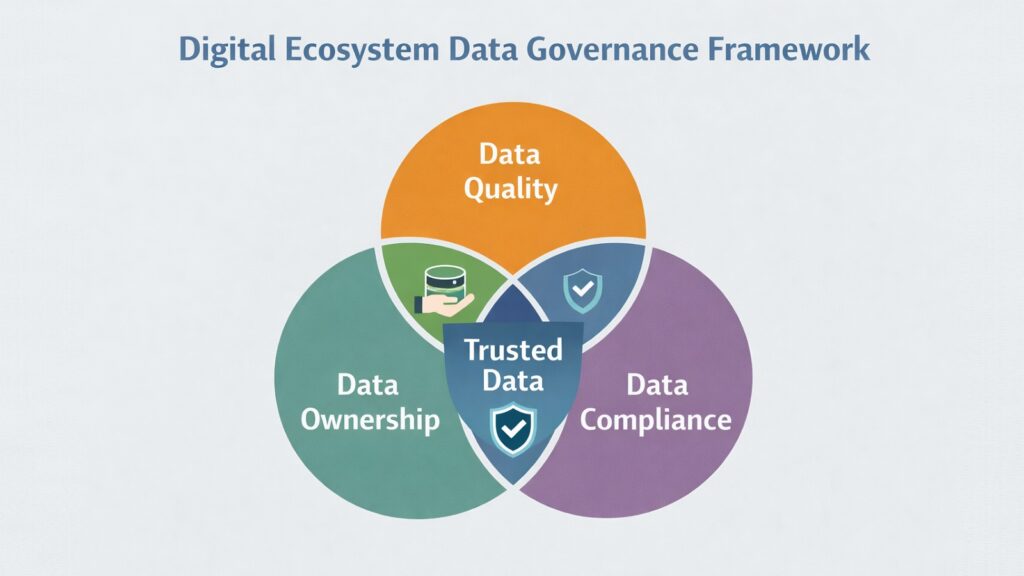
A digital ecosystem handles enormous volumes of data. That data touches many systems, many users, and many purposes. Without a clear framework for managing it, things go wrong quickly. Data gets duplicated. Records become inconsistent. Old, inaccurate data gets used in decisions that should rely on fresh information. Data governance is the system that prevents all of that.
At its essence, data governance revolves around ownership and accountability. Who possesses a specific dataset? Who bears the responsibility for maintaining its accuracy? Who is authorized to access it, and under what circumstances? Although these inquiries may appear straightforward, in a vast ecosystem comprising numerous teams and countless systems, the responses are far from clear without a well-defined governance framework.
Data quality is another central concern. Governance frameworks define standards for what good data looks like. They set rules for how data is formatted, validated, and updated. When data enters the ecosystem from an external source, governance processes check it against those standards before it enters the main systems. This keeps the ecosystem’s data clean and trustworthy.
Lifecycle management is the third pillar. Data has a life cycle. It is created, used, archived, and eventually deleted. Governance policies define how long data should be retained and when it should be removed. This matters for both operational efficiency and regulatory compliance, especially in industries governed by laws like GDPR in Europe or HIPAA in the United States.
In the absence of governance, the digital ecosystem becomes unreliable. Decisions based on flawed data result in poor outcomes. Trust diminishes, both within the organization and among customers. Data governance is essential for ensuring that the information assets of the ecosystem serve genuine objectives rather than generating confusion.
Table 6: Digital Ecosystem and Data Governance — Key Facts
| Aspect | Detail |
| GDPR compliance | The EU’s GDPR regulation requires strict data governance practices for any ecosystem handling European user data |
| Data stewardship | Data stewards are designated roles responsible for maintaining the accuracy of specific datasets |
| Master data management | MDM systems create a single source of truth for key entities like customers, products, and locations |
| Data catalog tools | Tools like Alation and Collibra help organizations document, discover, and govern datasets across ecosystems |
| Data lineage tracking | Tracking where data originated and how it has changed helps diagnose errors and ensure compliance |
| Retention policies | Governance frameworks define how long data is kept, reducing storage costs and legal exposure |
| Access control | Role-based access control limits who can view or modify sensitive data within the ecosystem |
| Data quality metrics | Teams measure completeness, accuracy, consistency, and timeliness as the four core dimensions of data quality |
6. Digital Ecosystem and Digital Governance
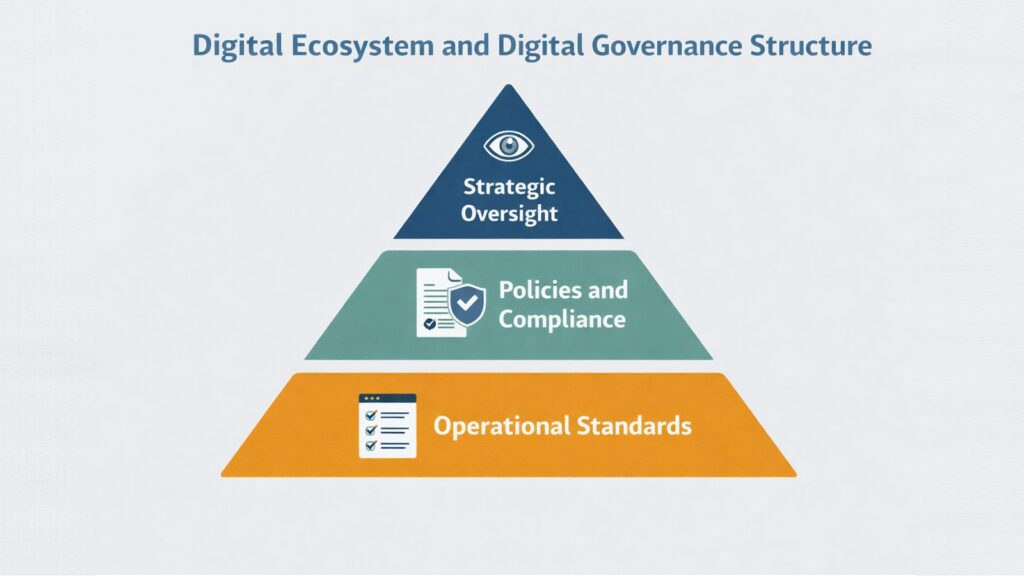
Data governance focuses on data. Digital governance focuses on everything. It is the broader framework of policies, rules, and standards that guide how the entire digital ecosystem operates, not just how data is handled, but how systems are managed, how risks are controlled, how decisions get made, and how the ecosystem stays aligned with legal and ethical expectations.
Digital governance operates at the level of the organization and sometimes at the level of entire industries or nations. A company might have internal digital governance policies that define how new systems are approved, how security standards are enforced, and how changes to the ecosystem are reviewed before deployment. Governments add another layer through regulations that govern everything from data privacy to cybersecurity to artificial intelligence.
Compliance is a major part of digital governance. Organizations operating digital ecosystems must navigate a complex web of regulations that vary by country, industry, and type of data. Financial ecosystems face strict rules about transaction records and fraud prevention. Healthcare ecosystems must meet stringent standards for protecting patient information. Digital governance provides the structure to meet those requirements consistently.
Operational standards are equally important. Governance frameworks define how incidents are reported and resolved, how vendors are evaluated and monitored, and how technology investments align with organizational strategy. Without these standards, the ecosystem risks becoming a patchwork of systems with no coherent direction.
Perhaps most importantly, digital governance creates accountability. When something goes wrong in the ecosystem, governance structures define who is responsible and how the situation will be addressed. That accountability builds trust, both internally among teams and externally among customers and regulators. It is the rule of law applied to the digital world.
Table 7: Digital Ecosystem and Digital Governance — Key Facts
| Aspect | Detail |
| Scope of digital governance | Covers policies for security, compliance, operations, risk management, and technology strategy |
| ISO 38500 | International standard that provides a framework for the corporate governance of information technology |
| Regulatory landscape | Digital ecosystems may need to comply with GDPR, CCPA, SOX, HIPAA, and other regional regulations |
| IT governance frameworks | COBIT and ITIL are widely used frameworks for structuring governance in large digital environments |
| Risk management role | Digital governance includes risk assessment processes that identify and mitigate threats to the ecosystem |
| Vendor governance | Organizations must govern third-party vendors whose systems and services form part of their digital ecosystem |
| Incident response policy | Governance frameworks define procedures for detecting, reporting, and recovering from digital incidents |
| Board-level responsibility | In many organizations, digital governance is now a board-level concern due to the scale of technology risk |
7. Digital Ecosystem and Network Effects
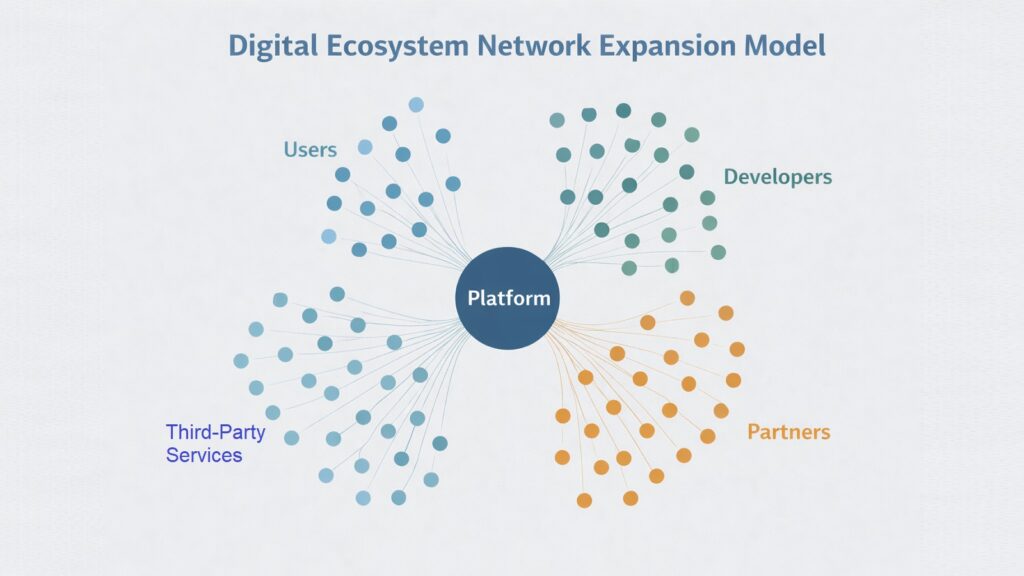
Some systems become more valuable the more people use them. A telephone is useless alone but becomes worth having when everyone has one. Social media platforms are empty until users join and start creating content. Marketplaces attract more buyers when they have more sellers, and more sellers when they have more buyers. This dynamic is called the network effect, and it is one of the most powerful forces in any digital ecosystem.
The network effect changes the economics of digital platforms in a fundamental way. The cost of adding one more user is usually very small, but the value that user adds to the ecosystem can be significant. They bring their own connections, content, transactions, and data. Every new participant makes the ecosystem more useful for everyone already there.
This is why digital ecosystems that achieve a certain scale become very hard to displace. Once a platform has millions of users, a new competitor would need to start with an empty network and convince users to leave a place where all their connections already exist. The established ecosystem benefits from its own history and the habits of its users.
Marketplaces illustrate this clearly. eBay became dominant in online auctions because it had the most buyers and sellers. Amazon’s marketplace grows because merchants want access to its enormous customer base, and customers come because the selection is unmatched. LinkedIn holds professional networks because it is where professionals already are.
For a digital ecosystem, network effects represent both an opportunity and a responsibility. The opportunity is sustainable growth fueled by the ecosystem’s own momentum. The responsibility is ensuring that growth remains open and fair, and that the ecosystem continues to serve its participants rather than extracting value from them. When that balance is maintained, network effects become a long-term engine for the entire system.
Table 8: Digital Ecosystem and Network Effects — Key Facts
| Aspect | Detail |
| Definition | Network effects occur when a product or platform becomes more valuable as more people use it |
| Metcalfe’s Law | States that a network’s value grows proportionally to the square of the number of connected users |
| WhatsApp growth | WhatsApp grew to over 2 billion users largely through word-of-mouth driven by existing user networks |
| Two-sided markets | Platforms like Uber and Airbnb benefit from two-sided network effects involving both supply and demand sides |
| Switching costs | Strong network effects raise switching costs, making users reluctant to leave for competitor platforms |
| Negative network effects | Congestion and information overload can create negative network effects as ecosystems scale too fast |
| Platform lock-in | Ecosystems with strong network effects tend to create lock-in that reinforces market dominance over time |
| Developer ecosystems | App stores benefit from network effects among developers whose apps attract more users to the platform |
8. Digital Ecosystem and Digital Innovation
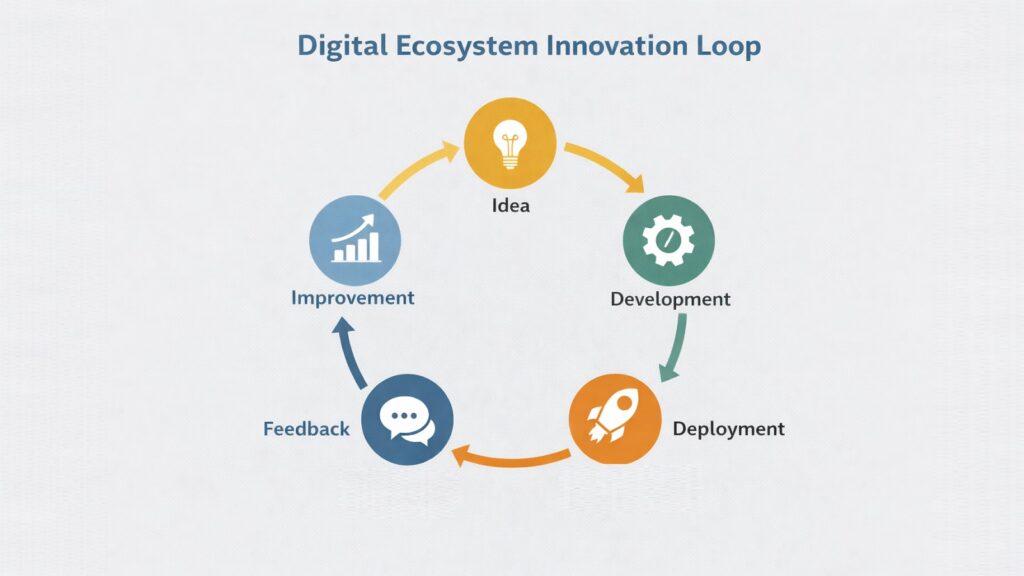
A digital ecosystem that stops changing is an ecosystem in decline. Technology does not stay still. User expectations shift. New tools emerge. Competitors find better approaches. Regulations evolve. The only way a digital ecosystem remains relevant is by continuously adapting, and that adaptation comes from digital innovation.
Digital innovation is not just about introducing shiny new technology. It is about finding ways to do things better, whether that means serving users more effectively, processing data more efficiently, or connecting systems that previously could not communicate. Sometimes innovation is dramatic, like the shift from desktop software to cloud applications. More often, it is incremental, a steady stream of improvements that compound over time.
Artificial intelligence is reshaping digital ecosystems right now. Machine learning models are being woven into everything from search algorithms to customer support systems to medical diagnostics. Generative AI is opening up new ways to create content and automate tasks that previously required human creativity. These are not distant possibilities. They are already running inside the ecosystems that most people use every day.
Internet of Things (IoT) technology is extending the digital ecosystem into the physical world. Sensors in factories, cities, vehicles, and homes are generating data that flows back into digital systems. The boundary between the physical and digital is becoming thinner with each passing year.
The digital ecosystem that embraces innovation builds resilience into its future. It learns from new ideas, tests them carefully, and adopts what works. It retires what no longer serves its purpose. It stays curious about what comes next rather than defending what already exists. That posture is what separates ecosystems that last from those that fade.
Table 9: Digital Ecosystem and Digital Innovation — Key Facts
| Aspect | Detail |
| AI integration | AI is embedded in digital ecosystems for personalization, fraud detection, automation, and predictive analytics |
| IoT scale | There were over 15 billion connected IoT devices globally by 2023, all feeding data into digital ecosystems |
| Generative AI adoption | Tools like ChatGPT and Copilot are being integrated into enterprise digital ecosystems for productivity gains |
| Blockchain use | Blockchain technology adds trust and transparency to digital ecosystems in finance, supply chain, and identity |
| 5G impact | 5G networks increase the speed and capacity of digital ecosystems, enabling new real-time applications |
| Open innovation model | Many digital ecosystems use open APIs and developer programs to invite external innovation into their platforms |
| Startup integration | Large ecosystem owners often acquire or partner with startups to absorb innovative capabilities quickly |
| Continuous deployment | Modern digital ecosystems use CI/CD pipelines to release innovations incrementally rather than in large batches |
Conclusion: Digital Ecosystem as a Unified Engine of Innovation
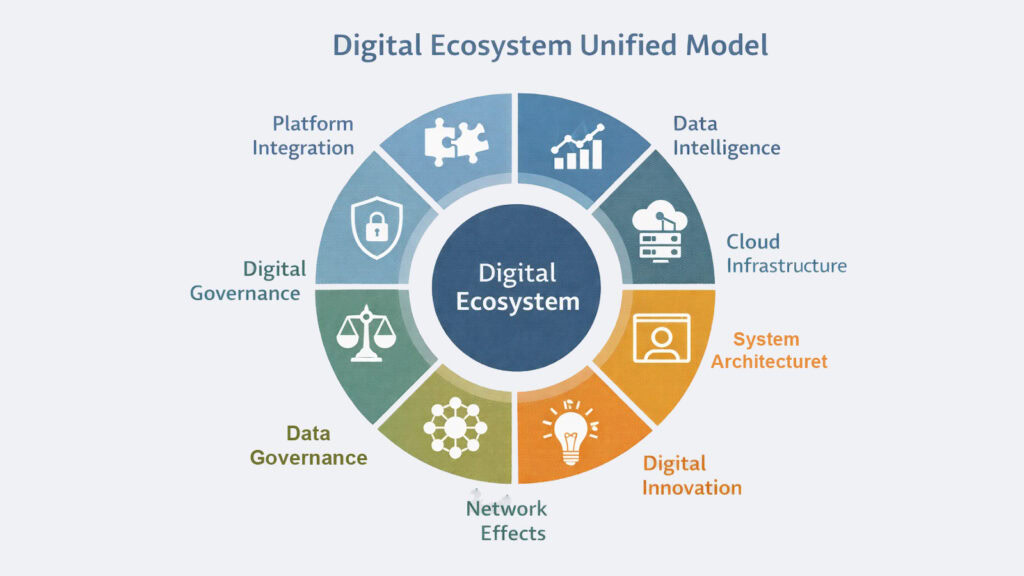
All eight of these drivers exist in the same space. They do not take turns. They work at the same time, influencing each other in ways that are sometimes direct and sometimes quiet. Platform integration creates the connections. Data intelligence draws meaning from the flow. Cloud infrastructure keeps the entire structure running. System architecture gives it shape. Data governance keeps the information honest. Digital governance keeps the behavior principled. Network effects give the whole thing momentum. Digital innovation ensures it never stops becoming something better.
None of these drivers can carry the digital ecosystem alone. Platform integration without data governance creates a well-connected but unreliable system. Cloud infrastructure without system architecture creates a powerful but chaotic environment. Network effects without digital governance can produce growth that turns harmful. The eight drivers depend on each other. Their strength comes from how they interact, not from any single one working in isolation.
This is what makes the digital ecosystem such a compelling idea. It is not a product you can buy or a feature you can switch on. It is a living arrangement of people, systems, and processes that builds value through relationships and coordination. Every organization that operates in the digital world is already part of one or several ecosystems, whether they have named it that way or not.
Understanding these drivers helps anyone who works with technology, manages systems, or makes decisions about digital investment to see the whole picture rather than just the part directly in front of them. The digital ecosystem will keep changing. New technologies will add new drivers and reshape the ones already here. But the underlying logic, that connected systems thrive through balance, coordination, and continuous learning, is unlikely to change any time soon.
The eight aspects covered in this article are not the end of the conversation. They are a way into it. The digital ecosystem is still being written, and every organization, developer, regulator, and user has a part in how that story unfolds.
Table 10: Digital Ecosystem — 8 Drivers and Their Long-Term Impact
| Drivers Of Digital Ecosystem | Long-Term Impact on the Digital Ecosystem |
| Platform Integration | Creates a unified experience across services, making the ecosystem more useful and harder to fragment |
| Data Intelligence | Builds institutional knowledge over time, making the ecosystem progressively smarter and more adaptive |
| Cloud Infrastructure | Enables global reach and elastic capacity, ensuring the ecosystem scales without degrading performance |
| System Architecture | Determines how well the ecosystem absorbs growth and change without becoming structurally fragile |
| Data Governance | Protects the integrity of the ecosystem’s information assets and maintains trust across all participants |
| Digital Governance | Aligns the ecosystem with legal, ethical, and operational standards that protect its long-term legitimacy |
| Network Effects | Compounds the ecosystem’s value over time, creating a durable competitive advantage through scale |
| Digital Innovation | Ensures the ecosystem remains relevant by continuously evolving in response to new technologies and user needs |