Table of Contents
Introduction: Franco Belgian Comics and the Art of Timeless Storytelling
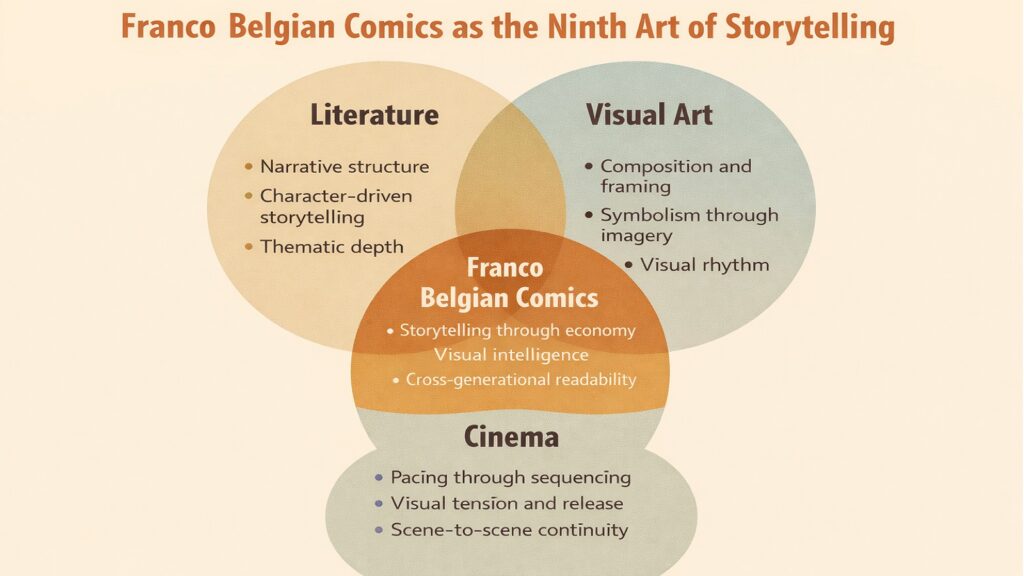
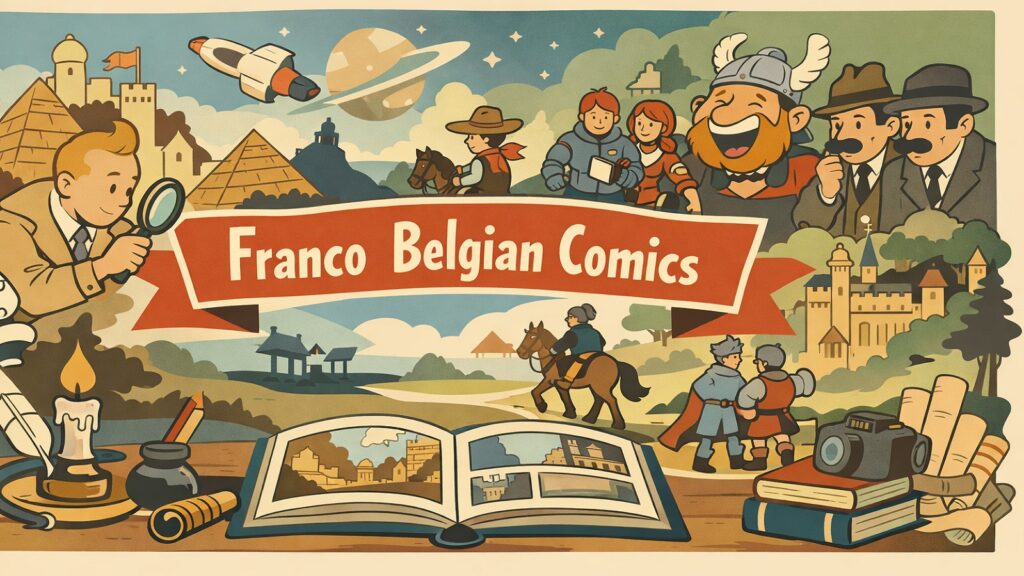
Franco Belgian Comics occupy a unique place in European culture. They are not merely entertainment for children or passing diversions for adults. In France and Belgium, these works are called the ninth art, standing alongside cinema, literature, and theater as legitimate cultural achievements. This designation carries weight. It suggests that comics from this tradition deserve the same critical attention we give to novels or films.
What makes Franco Belgian Comics worthy of such study? The answer lies in their approach to storytelling. These comics teach lessons about narrative structure that prose writers spend years trying to master. They demonstrate how to build tension without excessive explanation. They show how to reveal character through action rather than internal monologue. They prove that visual intelligence can carry as much meaning as carefully chosen words.
The storytelling principles found in Franco Belgian Comics emerged from decades of careful refinement. Series like Tintin began in the 1930s. Asterix appeared in the 1950s. These works were not created in isolation. They developed within a publishing culture that valued clarity, craftsmanship, and respect for the reader. Writers and artists worked together, page by page, to create stories that could be understood immediately yet rewarded repeated reading.
This article explores six storytelling lessons from Franco Belgian Comics. Each lesson reveals something fundamental about how narratives work. Whether you write novels, screenplays, or stories of any kind, these principles apply. They teach economy, pacing, silence, layering, character consistency, and disciplined world-building. These are not theoretical concepts. They are practical techniques visible in every well-crafted album.
Franco Belgian Comics: Notable Series and Their Core Storytelling Strengths
| Franco Belgian Comic | Core Storytelling Strength |
|---|---|
| Tintin | Clarity through visual investigation |
| Asterix | Rhythm through repetition and variation |
| Lucky Luke | Comedic timing via panel progression |
| Valérian and Laureline | Imaginative world-building with narrative focus |
| Spirou et Fantasio | Balance of adventure and emotional warmth |
| Yoko Tsuno | Scientific logic grounding fantastic scenarios |
| Blake and Mortimer | Deliberate pacing for suspense accumulation |
| Alix | Historical detail serving character journey |
| Gaston Lagaffe | Visual gags building through sequential logic |
| Johan et Pirlouit | Moral clarity through action-driven plot |
1. Franco Belgian Comics and Narrative Economy
Narrative economy means saying more with less. Franco Belgian Comics excel at this principle. A single panel can establish setting, mood, character relationship, and forward momentum. This efficiency comes from understanding what to show and what to omit. Every element on the page earns its place.
Consider how Tintin operates. Hergé developed the ligne claire style, which emphasized clean lines and precise composition. Nothing in the frame was accidental. When Tintin arrives in a new location, a single establishing shot conveys everything the reader needs. The architecture tells us the culture. The weather suggests the tone. The body language of background figures hints at social dynamics. All of this happens without narration boxes or lengthy dialogue.
This approach contrasts sharply with how novels handle similar moments. A novelist might spend three paragraphs describing a foreign city. They would detail the light, the sounds, the smells, and the impression. Some of this description enriches the experience. But much of it serves a functional purpose: establishing place. Franco Belgian Comics achieve this establishment instantly through visual composition.
Lucky Luke demonstrates narrative economy through dialogue. The series uses minimal speech. Characters speak only when words add something that images cannot convey. Much of the humor comes from visual gags that require no explanation. When Luke draws his gun faster than his shadow, the joke needs no caption. The image contains the entire narrative beat.
Alix, Roger Leloup’s historical adventure series, shows economy through research integration. The comics take place in ancient Rome and incorporate extensive historical detail. Yet this detail never overwhelms the story. Architecture, clothing, and social customs appear naturally within the action. Readers absorb historical knowledge without realizing they are being educated. The information serves the narrative rather than interrupting it.
This economy teaches an essential lesson for all storytellers. Every sentence, every scene, and every element must justify itself. If something can be removed without loss, it should be removed. Franco Belgian Comics prove that restraint strengthens rather than weakens narrative impact.
Franco Belgian Comics: Techniques for Achieving Narrative Economy
| Technique | Application in Franco Belgian Comics |
|---|---|
| Visual Compression | Single panels establish setting and mood simultaneously |
| Selective Dialogue | Characters speak only when images cannot convey meaning |
| Meaningful Detail | Every background element serves narrative or thematic purpose |
| Action Over Explanation | Plot advances through visible choices rather than narration |
| Panel Transitions | Scene changes communicate time and space shifts efficiently |
| Character Design | Visual appearance conveys personality without introduction |
2. Franco Belgian Comics and Mastery of Pacing

Pacing in Franco Belgian Comics works differently than in prose. Novels control rhythm through sentence length, paragraph breaks, and chapter structure. Comics add another dimension: the physical act of reading panels and turning pages. This physicality creates unique opportunities for timing suspense, humor, and revelation.
Asterix demonstrates comedic pacing brilliantly. René Goscinny and Albert Uderzo understood that comedy depends on rhythm. The series uses repeated patterns that readers recognize, then subverts those patterns at precisely the right moment. A typical Asterix battle sequence builds through escalating absurdity. Romans attack. Asterix and Obelix fight. The action intensifies. Then, at the peak of chaos, a single quiet panel breaks the rhythm. This pause makes the next escalation even funnier.
The page turn becomes a storytelling device in Asterix. Goscinny would often place a setup on one page and the punchline after the turn. This forced pause, created by the physical act of turning the page, functions like comedic timing in spoken performance. The reader completes the joke through their own action. This technique cannot exist in prose the same way.
Blake and Mortimer takes the opposite approach to pacing. Edgar P. Jacobs created dense, methodical stories that unfolded slowly. Panels are packed with detail. Dialogue is extensive compared to other Franco Belgian Comics. Yet the pacing never feels sluggish because Jacobs understood how to build tension through accumulation. Each panel adds one more piece to the puzzle. The reader feels the mystery deepening with every turn.
Silent panels control pacing in ways unique to comics. A full-page image without text forces the reader to slow down. Their eye travels across the composition, taking in details. This creates a pause in the narrative rhythm. When dialogue resumes, the reader feels the shift. Spirou et Fantasio uses these silent moments to mark transitions between comedy and drama. The absence of words signals that something important is happening.
Franco Belgian Comics teach that pacing is not just about speed. It is about variation, about knowing when to accelerate and when to let the reader breathe. This lesson applies to any narrative form. Prose writers who master sentence rhythm understand this instinctively. But comics make the principle visible in a way that illuminates its universal importance.
Franco Belgian Comics: Methods of Pacing Control
| Pacing Method | Effect on Reader Experience |
|---|---|
| Panel Size Variation | Larger panels slow reading; smaller panels accelerate |
| Page Turn Placement | Suspense or humor delayed by physical reading action |
| Silent Sequences | Force reader to interpret visually, creating pauses |
| Repetitive Patterns | Establish rhythm that can be broken for emphasis |
| Dense vs. Sparse Panels | Information density controls processing speed |
| Double-Page Spreads | Dramatic reveals demand full visual attention |
3. Franco Belgian Comics and the Power of Visual Silence
Silence in storytelling does not mean absence. It means space for the reader to think, feel, and interpret. Franco Belgian Comics use visual silence as a primary narrative tool. These are moments when no one speaks, when the story pauses, when emotion emerges from stillness rather than action.
Hergé mastered this technique in Tintin. Some of the most powerful moments in the series contain no dialogue. When Tintin stands on a cliff overlooking a vast landscape, the image speaks volumes. It communicates isolation, determination, and the scale of the challenge ahead. A novelist would need to enter the character’s mind to convey these feelings. Hergé simply draws the scene and trusts the reader to understand.
Facial expressions carry extraordinary weight in these silent moments. André Franquin, creator of Spirou et Fantasio and Gaston Lagaffe, was a master of expressive character work. His characters displayed subtle emotional shifts through tiny changes in eyes, mouth, and posture. A raised eyebrow could convey skepticism. A slight frown could reveal worry. These micro-expressions communicated internal states that prose would need entire sentences to describe.
Background details in silent panels create atmosphere and subtext. When Blake and Mortimer walk through an empty corridor, the shadows on the walls suggest danger. The reader feels tension without any character stating that danger exists. This visual storytelling respects the reader’s intelligence. It allows them to perceive and interpret rather than being told what to feel.
The ligne claire style that defines many Franco-Belgian comics might seem incompatible with subtle emotion. Clean lines and clear colors appear too simple for a complex feeling. Yet this apparent simplicity actually enhances emotional communication. There is nowhere to hide in ligne claire. Every line must do its work. Artists cannot rely on atmospheric rendering to create mood. They must achieve it through composition, gesture, and the precise placement of visual elements.
Visual silence teaches a lesson about restraint. Not every emotion needs articulation. Not every thought requires internal monologue. Sometimes the most powerful moments come from what remains unsaid. Franco Belgian Comics prove that showing a character in contemplation can be more moving than explaining what they contemplate.
Franco Belgian Comics: Elements of Visual Silence
| Visual Element | Function in Silent Storytelling |
|---|---|
| Facial Micro-expressions | Convey subtle emotional shifts without dialogue |
| Character Posture | Body language reveals internal state and intention |
| Environmental Atmosphere | Settings establish mood through visual composition |
| Panel Composition | Space around characters suggests isolation or connection |
| Sequential Silence | Multiple wordless panels create emotional rhythm |
| Background Activity | Life continuing around characters implies normalcy or contrast |
4. Franco Belgian Comics and Layered Storytelling Across Ages
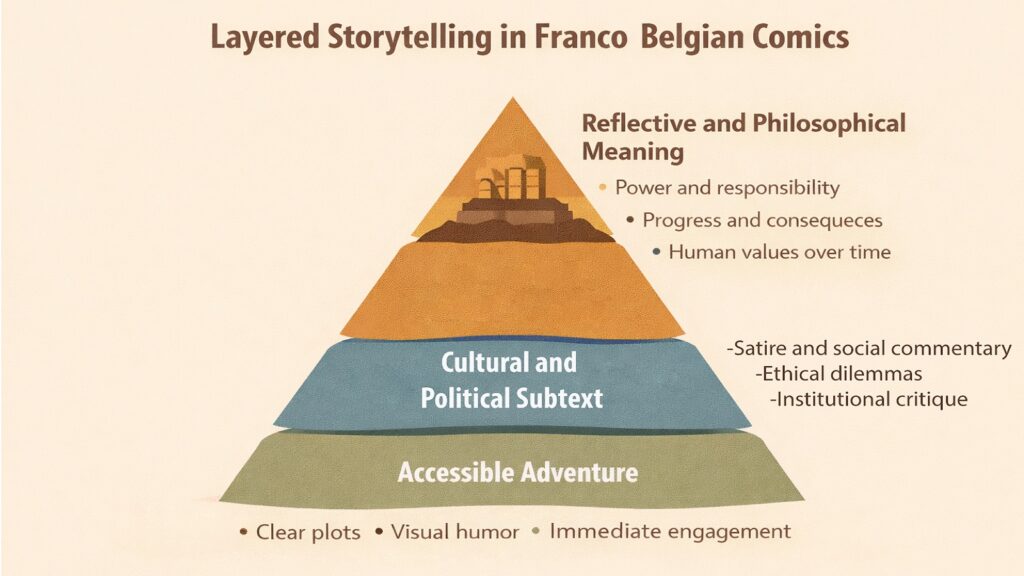
The best Franco Belgian Comics can be read at eight years old and again at thirty-five, with entirely different experiences each time. This layered storytelling is not accidental. Writers deliberately embedded multiple levels of meaning into stories that appear straightforward on the surface. A child reads for adventure. An adult reads for satire, political commentary, or philosophical depth.
Asterix exemplifies this approach perfectly. Young readers enjoy the slapstick violence and colorful characters. They follow the plot without difficulty. Adults recognize the historical references, appreciate the linguistic wordplay, and understand the satirical targets. Goscinny wove contemporary political commentary into ancient settings. Roman bureaucracy mirrors modern government inefficiency. Foreign stereotypes are both employed and mocked simultaneously. None of this complexity prevents children from enjoying the story.
Valérian and Laureline operates on similar principles. Pierre Christin and Jean-Claude Mézières created science fiction adventures that worked as pure entertainment. Children could follow Valérian and Laureline through space and time without understanding the deeper themes. But those themes existed. The series explored colonialism, environmentalism, and political corruption decades before such topics became mainstream in genre fiction. Adult readers found sophisticated speculation about power structures and social organization.
Yoko Tsuno, created by Roger Leloup, embeds ethical questions within scientific adventures. Young readers see a brilliant engineer solving problems. Adult readers notice how the stories consistently present technology as morally neutral. Human choice determines whether inventions help or harm. This philosophical position never becomes preachy. It emerges naturally from the plots. The stories teach without lecturing.
This layered approach respects both child and adult readers. It refuses to condescend. It assumes that children can handle adventure and complexity simultaneously. It trusts that adults will appreciate accessible stories that still contain substance. The result is work that entire families can read together, each member finding appropriate meaning.
The lesson here extends beyond comics. Any storyteller can learn from this technique. Surface clarity combined with optional depth creates work that reaches wider audiences. It proves that complexity need not be obscure and accessibility need not be simple-minded.
Franco Belgian Comics: Layers of Meaning Across Reader Ages
| Narrative Layer | How It Functions Across Ages |
|---|---|
| Plot Adventure | Children follow action; adults recognize structure |
| Character Behavior | Children identify with heroes; adults see archetypes |
| Historical Context | Children see exotic settings; adults read cultural commentary |
| Social Satire | Children enjoy humor; adults grasp political critique |
| Ethical Dilemmas | Children see clear morality; adults explore nuance |
| Visual References | Children enjoy imagery; adults recognize artistic homages |
5. Franco Belgian Comics and Character as Moral Anchor
Recurring characters define Franco Belgian Comics. Unlike American superhero comics that shift between creative teams, Franco-Belgian series typically maintain creative continuity. The same writers and artists develop characters over decades. This consistency allows characters to function as moral and narrative anchors. Readers know these figures. They understand how they will respond to challenges.
Tintin embodies this principle completely. His character never wavers across twenty-four albums. He is brave, curious, decent, and incorruptible. These qualities do not make him boring. They make him reliable. Readers trust Tintin to do the right thing even when the right thing is difficult. This trust creates a foundation that allows Hergé to explore complex political and ethical situations without moral ambiguity overwhelming the narrative.
Character consistency in Franco Belgian Comics differs from character development in novels. Novel characters typically undergo transformation. They learn, change, and evolve. Comic series characters remain fundamentally the same while facing various new situations. This stability serves an important function. It teaches readers about values through repeated demonstration rather than explicit instruction.
Alix, Jacques Martin’s historical hero, exemplifies principled action. Set in ancient Rome, the series could easily indulge in casual violence or moral relativism justified by historical distance. Instead, Alix maintains clear ethical standards. He opposes slavery, tyranny, and cruelty regardless of historical context. Young readers absorb these values through identification with the character. They learn that principles should remain constant even when circumstances change.
Johan et Pirlouit, created by Peyo before he developed the Smurfs, functions similarly in a medieval fantasy setting. Johan is a noble page who becomes a knight. His journey demonstrates courage, loyalty, and justice. Pirlouit provides comic relief while also showing that humor and integrity can coexist. The characters model behavior without preaching. Children understand what makes someone admirable by watching these figures act consistently across many adventures.
This approach contrasts with how novels typically convey moral lessons. Prose fiction often uses internal monologue to reveal a character’s ethical reasoning. We read their thoughts as they struggle with decisions. Franco Belgian Comics rarely use thought bubbles. Characters reveal their values through choices. This external focus makes morality visible and understandable. Readers see what a good person does, not just what they think.
Franco Belgian Comics: Character Traits as Narrative Anchors
| Character Traits as Narrative Anchors | How It Anchors the Narrative |
|---|---|
| Unwavering Integrity | Provides moral certainty in complex situations |
| Consistent Courage | Demonstrates principled action across contexts |
| Reliable Humor | Maintains tone while exploring serious themes |
| Intellectual Curiosity | Drives investigation and discovery forward |
| Protective Loyalty | Shows friendship as action rather than statement |
| Technical Competence | Links problem-solving with ethical responsibility |
6. Franco Belgian Comics and World-Building Without Excess
World-building in Franco Belgian Comics demonstrates remarkable discipline. These stories create believable, complex worlds without drowning readers in unnecessary detail. This restraint distinguishes them from much contemporary fantasy and science fiction, which often mistakes exhaustive description for immersive storytelling.
Valérian and Laureline stands as the supreme example of disciplined world-building in comics. Christin and Mézières created hundreds of alien worlds, future cities, and temporal paradoxes across the series. Each location feels distinct and fully realized. Yet the stories never stop to explain everything. We see an alien marketplace with dozens of species trading exotic goods. The image conveys the essential information: this is a cosmopolitan future where many cultures interact. We do not need a paragraph describing each species’ biology or trading practices. The visual does that work instantly.
The key principle is selective revelation. Franco Belgian Comics show readers what matters to the immediate story. Background elements suggest a larger world without requiring explanation. When Blake and Mortimer investigate a scientific conspiracy, we see laboratories, mysterious devices, and complex machinery. Jacobs drew these elements with meticulous detail. But the story never pauses to explain how everything works. The detail creates atmosphere and credibility. The narrative keeps moving.
This approach trusts visual logic. If a world looks coherent, readers accept it. The ligne claire style reinforces this trust through visual consistency. Everything in the frame belongs to the same reality. Colors follow logical rules. Scale remains accurate. Architecture matches the culture. This internal consistency allows readers to believe in fantastic premises without demanding justification for every element.
Blake and Mortimer also demonstrates world-building through recurring locations. Professor Mortimer’s laboratory appears regularly across albums. Readers become familiar with its layout and equipment. This familiarity grounds even the most outlandish adventures. We return to known spaces between extraordinary events. This rhythm of familiar and fantastic prevents sensory overload.
The world-building in Franco Belgian Comics also relies on visual shorthand developed over decades. Certain architectural styles signal certain cultures. Color palettes establish mood immediately. Character design reveals personality before dialogue begins. These visual conventions work because the tradition has refined them through constant use. New readers absorb these conventions quickly because they are consistent and clear.
The lesson here is invaluable for any world-builder. More detail does not mean better immersion. Selective, purposeful detail creates believability. Consistency matters more than comprehensiveness. Readers will accept and enjoy complex worlds if those worlds follow internal logic and reveal themselves progressively rather than all at once.
Franco Belgian Comics: World-Building Techniques
| Technique | How It Builds Worlds Effectively |
|---|---|
| Selective Detail | Shows only elements relevant to immediate narrative |
| Visual Consistency | Maintains coherent style across different settings |
| Background Suggestion | Implies larger world through glimpsed elements |
| Recurring Locations | Returns to familiar places between adventures |
| Cultural Visual Shorthand | Uses design conventions that signal meaning instantly |
| Functional Architecture | Depicts buildings that reflect culture and purpose visibly |
Conclusion: What Franco Belgian Comics Ultimately Teach Us About Storytelling
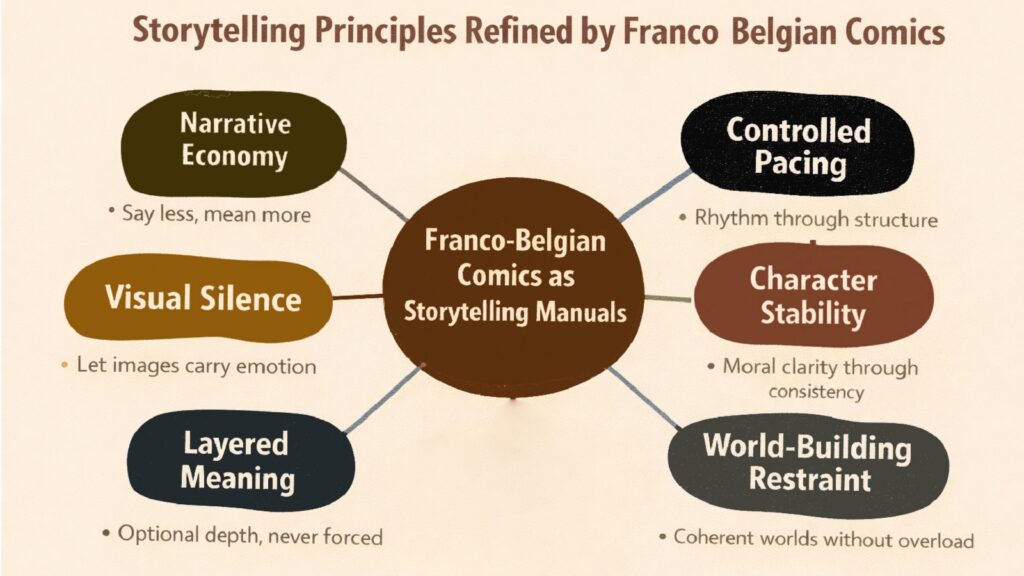
Franco Belgian Comics represent refinement, not simplification. The lessons they teach emerged from decades of artists and writers working within a tradition that valued clarity and craft. These are not lesser works made easy for children. They are sophisticated narratives that achieve complexity through discipline rather than excess.
The six lessons explored here form a coherent philosophy of storytelling. Narrative economy teaches that less can be more. Pacing mastery shows how rhythm shapes reader experience. Visual silence proves that meaning can exist in gaps and pauses. Layered storytelling demonstrates how to reach multiple audiences simultaneously. Character consistency reveals values through action rather than explanation. Disciplined world-building creates immersive realities without overwhelming detail.
These principles apply far beyond comics. Novelists struggle with exposition, wondering how much to tell and when. Screenwriters debate how to convey internal states through external action. Anyone crafting narratives faces questions about pacing, clarity, and audience engagement. Franco Belgian Comics provide working examples of solutions to these universal problems.
The tradition also teaches respect for the reader. These comics never condescend. They assume intelligence and attentiveness. They reward careful reading while remaining accessible on first encounter. This balance between accessibility and depth represents perhaps the most important lesson of all. Good storytelling serves both the casual reader and the devoted student.
In an age of content overload, the restraint of Franco Belgian Comics feels increasingly valuable. We live surrounded by stories that compete for attention through volume and intensity. Against this noise, the clarity and craft of these comics stand out. They prove that quiet confidence often communicates more effectively than desperate novelty.
These lessons remain relevant because they address fundamental aspects of how humans process narrative. We respond to rhythm, to image, to silence, to consistency. We appreciate stories that respect our intelligence while welcoming our engagement. We return to narratives that reveal new layers upon rereading. Franco Belgian Comics have understood these truths for nearly a century. Modern storytellers would do well to study what this tradition has perfected.
Franco Belgian Comics: Enduring Storytelling Principles
| Storytelling Principle | How It Applies to Modern Narratives |
|---|---|
| Purposeful Restraint | Every element must earn its presence in the story |
| Visual Intelligence | Images carry as much meaning as written text |
| Strategic Silence | Pauses create space for emotional resonance |
| Accessible Complexity | Surface clarity coexists with deeper meaning |
| Character Integrity | Consistent values provide narrative stability |
| Logical Coherence | Internal consistency matters more than comprehensiveness |
Read More Storytelling Articles
- Storytelling Themes: 8 Powerful Ideas Readers Love
- 6 Powerful Story Archetypes That Inspire Creativity
- 8 Storytelling Psychologies to Elevate Creative Edge
- Explore Mahabharata’s 6 Genius Storytelling Techniques
- Iliad’s 6 Bold Storytelling Techniques That Grip You
- Heike Monogatari: 6 Vivid Techniques for Epic Storytelling
- 6 Amazing Ways Plot Structure Mirrors Human Memory
- 6 Incredible Ways Narrative Introduction Herald The End
- 6 Amazing Ways Narrative Point of View Invokes Emotions
- 6 Ways Narrative Resolution Brings Psychological Closure