Table of Contents
Introduction: Fundamental Physical Theories – How Eight Laws Explain the Natural World
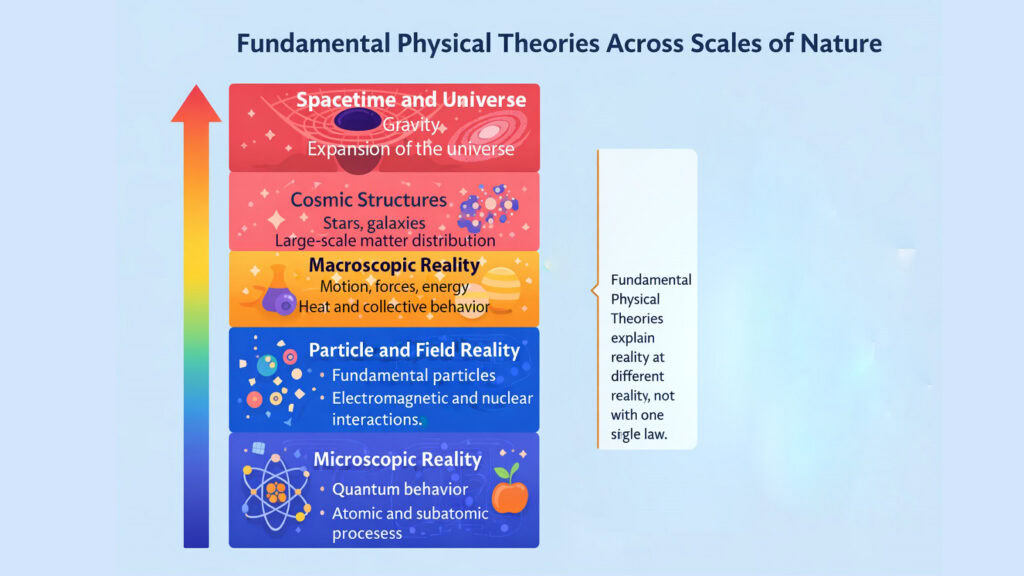
Fundamental Physical Theories are the deep frameworks that explain how reality operates across different scales. They are not merely mathematical equations or technical shortcuts. Instead, they represent our most reliable understanding of nature’s behavior, from the tiniest particles to the vastness of cosmic space. Each theory addresses specific phenomena with remarkable precision, yet no single framework captures everything.
The universe reveals itself differently depending on where we look. At atomic scales, quantum uncertainty dominates. At cosmic distances, spacetime itself bends and stretches. Between these extremes, familiar mechanical laws govern everyday motion. Science does not rely on one grand theory because nature itself operates through distinct principles at different levels. These frameworks complement rather than contradict each other, forming a layered picture of reality.
This article examines eight foundational theories that together explain the natural world. We move from the smallest quantum scales upward through everyday mechanics, electromagnetic phenomena, thermodynamic principles, and ultimately to the structure of the entire cosmos. Each theory occupies its proper domain while connecting to others at boundary conditions. Understanding these frameworks means understanding how the physical world truly works.
Table 1: Fundamental Physical Theories and Their Domains of Application
| Theory | Primary Domain |
|---|---|
| Quantum Theory | Atomic and subatomic scales, energy quantization |
| General Relativity | Gravity, massive objects, curved spacetime |
| Classical Mechanics | Everyday motion, forces, momentum |
| Electromagnetism | Light, electricity, magnetism, charged particles |
| Thermodynamics | Energy flow, heat, entropy, efficiency |
| Statistical Mechanics | Emergent properties from particle collections |
| Standard Model | Elementary particles, fundamental forces |
| Cosmological Model | Universe-scale structure, expansion, evolution |
1. Fundamental Physical Theories and Quantum Theory: Laws of the Microscopic World
Quantum theory stands among Fundamental Physical Theories as the framework governing atoms, electrons, photons, and all microscopic phenomena. Reality at small scales defies everyday intuition. Particles exist in probability clouds rather than definite locations. Energy arrives in discrete packets called quanta rather than smooth flows. Measurement itself alters what we observe, creating fundamental limits on simultaneous knowledge of position and momentum.
Wave-particle duality represents one of quantum theory’s most striking features. Light behaves as waves when spreading through space but acts like particles when absorbed or emitted. Electrons show interference patterns like waves yet strike detectors at specific points like bullets. This dual nature is not a flaw in our understanding but reflects how nature actually operates at fundamental levels.
Classical physics assumes we can know everything about a system if we measure carefully enough. Quantum theory overturns this assumption through the uncertainty principle. The more precisely we determine a particle’s position, the less we can know about its momentum, and vice versa. This limitation is not technological but fundamental to nature itself.
Quantum theory enables modern technology in ways classical physics never could. Semiconductors, lasers, magnetic resonance imaging, and atomic clocks all depend on quantum principles. Chemistry itself emerges from quantum rules governing electron behavior in atoms and molecules. Without quantum theory, we could not explain why matter is stable or how the sun generates energy through nuclear fusion.
The theory also introduces superposition, where particles exist in multiple states simultaneously until measured. This strange property underlies quantum computing efforts and explains phenomena like radioactive decay. Nature at quantum scales operates probabilistically, giving only odds for different outcomes rather than deterministic predictions.
Quantum theory represents a fundamental break from classical thinking. It works not because nature follows our intuitions but because nature follows its own rules. The theory’s success across atomic physics, particle physics, and condensed matter physics establishes it as genuinely foundational rather than merely useful.
Table 2: Fundamental Physical Theories – Key Quantum Concepts
| Concept | Significance |
|---|---|
| Quantization | Energy and angular momentum come in discrete units |
| Wave-particle duality | Matter and light exhibit both wave and particle properties |
| Uncertainty principle | Position and momentum cannot both be precisely known |
| Superposition | Systems exist in multiple states until measurement |
| Probability interpretation | Predictions give likelihoods rather than certainties |
| Quantum entanglement | Particles can share correlated properties across distance |
| Measurement problem | Observation affects quantum systems fundamentally |
| Tunneling | Particles can pass through barriers classically forbidden |
2. Fundamental Physical Theories and General Relativity: Gravity as Spacetime Law
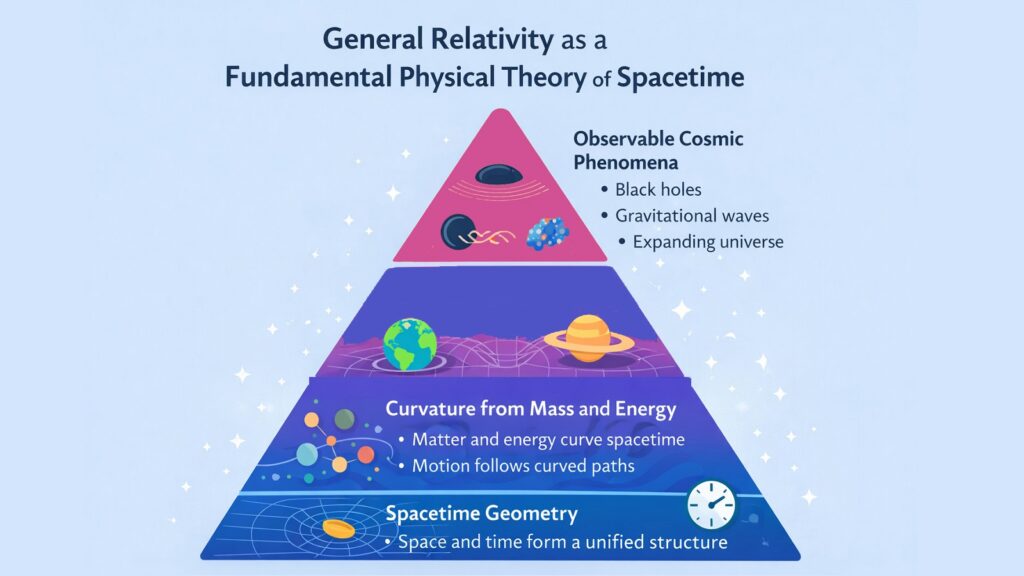
General relativity ranks among the most profound Fundamental Physical Theories by reimagining gravity itself. Rather than treating gravity as an invisible force pulling objects together, Einstein showed that massive bodies curve the fabric of spacetime. Objects then move along the straightest possible paths through this curved geometry. What appears as gravitational attraction actually reflects motion through warped space and time.
This geometric view of gravity transforms our understanding of the cosmos. Near massive objects like stars, spacetime curves sharply. Light bends when passing close to the sun, confirming that even massless photons follow spacetime curvature. Time itself runs slower in strong gravitational fields, a prediction verified by precise atomic clocks at different altitudes.
Black holes represent general relativity’s most extreme prediction. In black holes, matter compresses beyond a critical density, creating a black hole singularity. Here, the spacetime curves so severely that nothing, not even light, can escape from within a boundary called the event horizon. These objects exist throughout the universe, including supermassive versions at galactic centers. Their detection through gravitational waves in recent years provided spectacular confirmation of Einstein’s century-old theory.
Gravitational waves themselves ripple through spacetime when massive objects accelerate. The collision of black holes, pulsars, or neutron stars sends these ripples outward at light speed. Detecting them required measuring spacetime distortions smaller than an atomic nucleus across kilometers, yet observations match theoretical predictions with remarkable precision.
The expanding universe also follows from general relativity. Galaxies recede from each other not by moving through space but because space itself expands. This expansion started with the Big Bang and continues today, with distant galaxies moving faster due to more intervening space. General relativity provides the mathematical framework describing this cosmic evolution.
The theory also predicts time dilation effects crucial for GPS satellites. Clocks in orbit run faster than those on Earth’s surface because they experience weaker gravity. Without corrections based on general relativity, GPS navigation would accumulate errors of kilometers per day. The theory thus proves essential not just for understanding the cosmos but for modern technology.
Table 3: Fundamental Physical Theories – General Relativity Phenomena
| Phenomenon | Description |
|---|---|
| Spacetime curvature | Mass and energy warp the geometry of space and time |
| Gravitational lensing | Light bends around massive objects |
| Time dilation | Clocks run slower in stronger gravitational fields |
| Black holes | Regions where spacetime curves into inescapable wells |
| Gravitational waves | Ripples in spacetime from accelerating masses |
| Cosmic expansion | Space itself grows, carrying galaxies apart |
| Frame dragging | Rotating masses twist spacetime around them |
| Equivalence principle | Gravity and acceleration are locally indistinguishable |
3. Fundamental Physical Theories and Classical Mechanics: Order in Everyday Motion
Classical mechanics occupies a central position among Fundamental Physical Theories as the framework describing motion, forces, and energy at everyday scales. Developed by Newton and refined over centuries, it predicts how objects move under applied forces with extraordinary accuracy for speeds much slower than light and masses much larger than atoms.
The theory rests on three laws of motion that govern everything from thrown baseballs to planetary orbits. Objects maintain constant velocity unless forces act upon them. Force equals mass times acceleration, quantifying how motion changes. Every action produces an equal and opposite reaction, ensuring momentum conservation. These simple principles generate predictions of stunning precision.
Classical mechanics also introduces conservation laws that prove even more fundamental than the specific force equations. Energy transforms between kinetic and potential forms but never disappears. Momentum remains constant in isolated systems. Angular momentum persists for rotating objects unless external torques intervene. These conservation principles reflect deep symmetries in nature and hold even where classical mechanics breaks down.
Engineers rely on classical mechanics for designing everything from bridges to spacecraft. The theory accurately predicts stresses in materials, trajectories of projectiles, and orbital mechanics. Rockets reach distant planets using calculations rooted in Newtonian physics. The precision required for landing spacecraft on Mars or inserting satellites into specific orbits depends entirely on classical mechanical predictions.
The theory fails only under extreme conditions. Near light speed, relativistic effects become important. At atomic scales, quantum uncertainty dominates. Near black holes, spacetime curvature matters. Yet within its domain, classical mechanics remains exact, not approximate. It represents the limiting case of deeper theories rather than a superseded framework.
This limiting relationship proves crucial for understanding how theories relate. Quantum mechanics reduces to classical mechanics for large objects where quantum effects average out. General relativity simplifies to Newtonian gravity when gravitational fields are weak and speeds are slow. Classical mechanics thus serves as the bridge connecting more fundamental theories to everyday experience.
The theory also provides the conceptual foundation for more advanced physics. Ideas like phase space, Hamiltonian dynamics, and variational principles developed within classical mechanics carry over to quantum theory and relativity. Understanding classical mechanics remains essential for grasping how physical theories work at all scales.
Table 4: Fundamental Physical Theories – Classical Mechanics Principles
| Principle | Application |
|---|---|
| Newton’s laws | Relating forces to acceleration and motion |
| Conservation of energy | Total energy remains constant in isolated systems |
| Conservation of momentum | Total momentum persists without external forces |
| Conservation of angular momentum | Rotational motion maintains without external torques |
| Determinism | Future states follow uniquely from initial conditions |
| Galilean relativity | Physics laws identical in all uniformly moving frames |
| Action-reaction pairs | Forces always occur in equal opposite pairs |
| Superposition of forces | Multiple forces combine by vector addition |
4. Fundamental Physical Theories and Electromagnetism: Unified Forces of Light and Energy
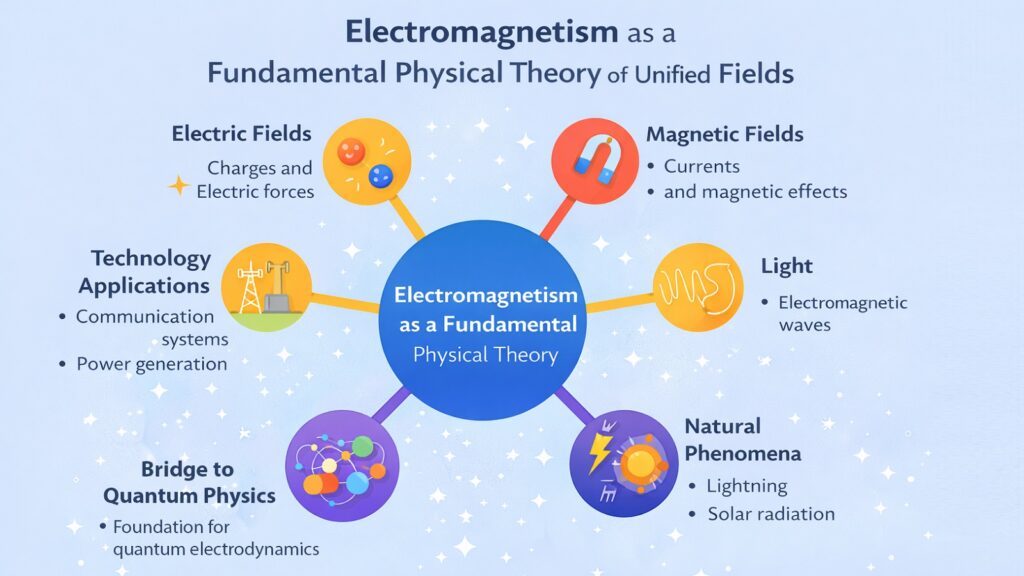
Electromagnetism stands among Fundamental Physical Theories as the unified framework explaining electricity, magnetism, and light itself. Before Maxwell’s work in the nineteenth century, these seemed like separate phenomena. His equations revealed them as aspects of a single electromagnetic field permeating space. This unification ranks among the greatest achievements in physics.
Electric charges create fields that exert forces on other charges. Moving charges generate magnetic fields. Changing magnetic fields induce electric fields. These interwoven relationships produce electromagnetic waves that propagate through empty space at light speed. Light itself is such a wave, with color determined by wavelength and frequency.
The electromagnetic spectrum extends far beyond visible light. Radio waves, microwaves, infrared radiation, ultraviolet rays, X-rays, and gamma rays all represent electromagnetic waves at different frequencies. Despite their diverse properties, the same fundamental equations govern all of them. This universality underscores electromagnetism’s foundational character.
Modern technology depends overwhelmingly on electromagnetic theory. Electric motors convert electromagnetic energy to mechanical work. Generators perform the reverse transformation. Radio communication, television, WiFi, and cell phones all exploit electromagnetic waves at different frequencies. Computers process information through controlled electric currents in semiconductor circuits.
Electromagnetism also bridges classical and quantum physics. Maxwell’s equations belong to classical field theory, yet light exhibits quantum properties like photons. Quantum electrodynamics extends classical electromagnetism into the quantum realm, describing how light and matter interact at fundamental levels. This quantum version represents one of the most precisely tested theories in all of science.
The theory reveals deep connections between electricity and magnetism through relativity. What appears as a pure electric field in one reference frame looks partly magnetic in a moving frame. Magnetism emerges as a relativistic effect of moving electric charges. This relationship hints at the unity underlying apparently different phenomena.
Electromagnetic forces also hold matter together. Chemical bonds form through electromagnetic interactions between electrons and nuclei. The structure of atoms, molecules, and all condensed matter reflects electromagnetic forces. Without electromagnetism, matter would collapse or fly apart, incapable of forming the rich structures we observe.
Table 5: Fundamental Physical Theories – Electromagnetic Phenomena
| Phenomenon | Nature |
|---|---|
| Electric fields | Regions where charges experience forces |
| Magnetic fields | Regions affecting moving charges and magnetic materials |
| Electromagnetic waves | Self-propagating oscillations of electric and magnetic fields |
| Light | Electromagnetic waves visible to human eyes |
| Electromagnetic induction | Changing magnetic fields generate electric currents |
| Maxwell’s equations | Four fundamental laws governing electromagnetic fields |
| Lorentz force | Force on charged particles in electromagnetic fields |
| Electromagnetic spectrum | Full range of electromagnetic waves by frequency |
5. Fundamental Physical Theories and Thermodynamics: Laws Governing Energy and Entropy
Thermodynamics ranks among the most universal Fundamental Physical Theories, applying to systems regardless of their microscopic details. Its laws govern energy flow, heat transfer, efficiency limits, and the direction of natural processes. From engines to stars to climate systems, thermodynamic principles shape behavior at every scale.
The first law establishes energy conservation. Energy transforms between different forms but never appears or vanishes. Heat flowing into a system increases its internal energy or performs work, with the total accounting always balanced. This principle extends beyond mechanics to include thermal, chemical, and nuclear energy.
The second law introduces entropy, a measure of disorder or dispersed energy. In isolated systems, entropy never decreases. Heat flows spontaneously from hot to cold, gases expand to fill containers, and ordered structures tend toward disorder. This law gives time a direction, distinguishing past from future in ways other physical laws do not.
The second law also limits efficiency. No heat engine can convert thermal energy completely into work. Some waste heat must always flow to a colder reservoir. This fundamental constraint affects power plants, automobile engines, and any device extracting work from heat. Even perfect engineering cannot circumvent this thermodynamic limit.
The third law states that absolute zero temperature cannot be reached through any finite process. As systems cool toward zero, further cooling becomes progressively harder. This law has profound implications for low-temperature physics and sets fundamental limits on refrigeration.
Thermodynamics applies universally because it depends only on bulk properties like temperature and pressure, not on microscopic details. Whether a gas consists of atoms, molecules, or exotic particles, the same thermodynamic laws hold. This independence from underlying mechanisms gives thermodynamics extraordinary breadth.
The theory also explains irreversibility in nature. While microscopic laws work equally well forward or backward in time, macroscopic processes show clear directionality. Broken eggs don’t reassemble, mixed fluids don’t spontaneously separate, and heat doesn’t flow from cold to hot. Entropy increase underlies all these irreversible changes.
Stars burn through thermodynamic processes. Nuclear fusion releases energy that flows outward, preventing gravitational collapse. The sun’s lifetime depends on thermodynamic limits to energy extraction. Even cosmic giants like black holes radiate thermally (through Hawking radiation), linking thermodynamics to the most extreme gravitational phenomena.
Table 6: Fundamental Physical Theories – Thermodynamic Laws and Concepts
| Law or Concept | Principle |
|---|---|
| Zeroth law | Systems in thermal equilibrium share the same temperature |
| First law | Energy is conserved in all processes |
| Second law | Entropy of isolated systems never decreases |
| Third law | Absolute zero temperature is unattainable |
| Entropy | Measure of energy dispersal or disorder |
| Irreversibility | Natural processes favor increased entropy |
| Carnot efficiency | Maximum possible efficiency for heat engines |
| Free energy | Energy available to perform useful work |
6. Fundamental Physical Theories and Statistical Mechanics: From Particles to Patterns
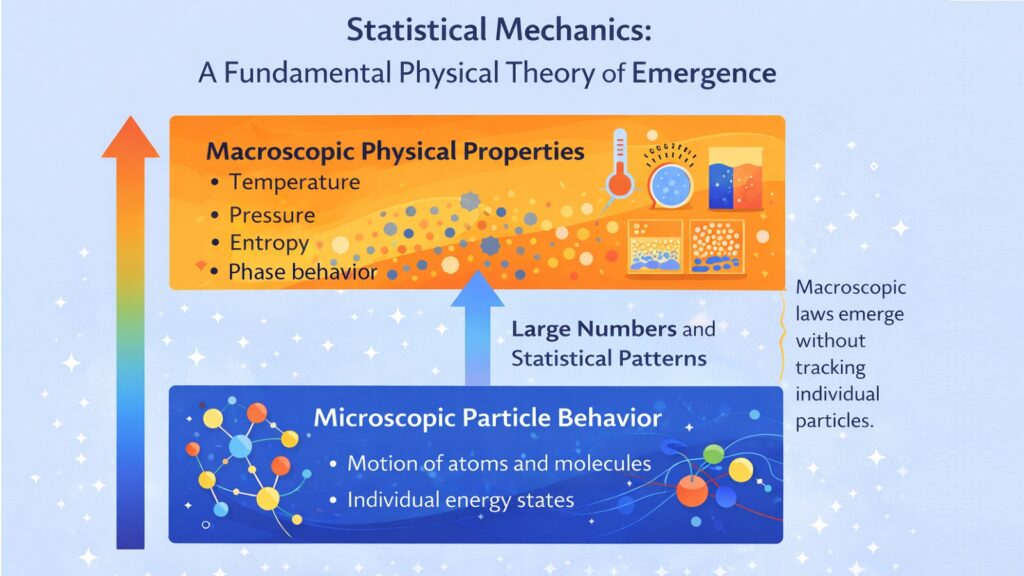
Statistical mechanics serves as the bridge within Fundamental Physical Theories connecting microscopic laws to macroscopic behavior. Individual molecules follow quantum or classical mechanics, but bulk properties like temperature and pressure emerge only when considering vast numbers of particles statistically. This framework explains how simple component behavior produces complex collective phenomena.
Temperature, in itself, holds no significance for individual particles. It arises from the average kinetic energy of vast collections of particles. A gas at an elevated temperature merely consists of molecules that, on average, are moving more rapidly. Pressure is generated by the innumerable collisions of molecules with the walls of their container. These well-known concepts are only applicable at the statistical level.
Statistical mechanics explains why thermodynamic laws hold. Entropy increases not because of any fundamental prohibition but because disordered states vastly outnumber ordered ones. When a gas expands, molecules spread out because far more arrangements exist with particles dispersed than concentrated. Probability alone drives entropy increase.
Phase transitions illustrate statistical mechanics’ power. Water freezes not because individual molecules decide to lock into crystals but because ice represents the lowest energy arrangement at low temperatures. Magnetism appears in iron when atomic magnetic moments align, a collective effect impossible for isolated atoms. These transitions emerge purely from interactions among many particles.
The theory also addresses fluctuations. Even in equilibrium, properties like density vary slightly from moment to moment. Statistical mechanics quantifies these fluctuations, explaining phenomena from Brownian motion to why the sky is blue. Light scatters from air density variations, giving us azure skies and red sunsets.
Critical phenomena reveal how microscopic interactions create macroscopic patterns. Near phase transitions, systems exhibit scale-invariant behavior where properties look similar at different magnifications. This universality appears in diverse systems from magnets to fluids to neutron stars, suggesting deep principles governing collective behavior.
Statistical mechanics connects to information theory through entropy. The same mathematical quantity measuring physical disorder also quantifies information content. This relationship hints at profound links between physics, computation, and the nature of knowledge itself.
The framework remains essential for understanding materials, chemical reactions, biological systems, and even black hole thermodynamics. Any phenomenon involving many interacting components requires statistical mechanical analysis.
Table 7: Fundamental Physical Theories – Statistical Mechanics Concepts
| Concept | Meaning |
|---|---|
| Ensemble | Collection of possible system states with probabilities |
| Partition function | Mathematical object encoding thermodynamic properties |
| Boltzmann distribution | Probability distribution for system energies |
| Fluctuations | Spontaneous variations around average values |
| Phase transitions | Abrupt changes in macroscopic properties |
| Critical phenomena | Universal behavior near phase transitions |
| Emergence | Macroscopic properties absent in individual components |
| Ergodicity | Time averages equal ensemble averages |
7. Fundamental Physical Theories and the Standard Model: Structure of Matter
The Standard Model represents one of the most experimentally successful Fundamental Physical Theories ever developed. It classifies all known elementary particles and describes three of the four fundamental forces. Decades of particle accelerator experiments have confirmed its predictions to extraordinary precision, establishing it as our deepest understanding of matter’s basic constituents.
Matter consists of two types of fundamental particles. Quarks combine in groups of three to form protons and neutrons. Leptons include electrons and neutrinos. Each type comes in three generations, with heavier versions of the familiar particles. This organizational structure explains the diversity of matter from simple building blocks.
Forces arise from exchanging force-carrier particles. Photons mediate electromagnetism, gluons carry the strong nuclear force, and W and Z bosons transmit the weak nuclear force. These carriers themselves qualify as fundamental particles, blurring the distinction between matter and force.
The strong force binds quarks into protons and neutrons, and binds those into atomic nuclei. It operates only at extremely short ranges but overwhelms electromagnetism’s tendency to push protons apart. Without the strong force, atomic nuclei could not exist and matter would look nothing like we observe.
The weak force governs radioactive decay and nuclear reactions powering the sun. Though weaker than electromagnetism and the strong force, it plays crucial roles in stellar energy generation and supernova explosions. Neutrinos interact only through weak force and gravity, making them extraordinarily difficult to detect despite their abundance.
The Higgs mechanism gives particles their masses through interaction with a field permeating all space. The Higgs boson, discovered in 2012, confirms this mechanism’s reality. Without it, fundamental particles would be massless and the universe unrecognizable.
The Standard Model omits gravity, which remains outside its framework. Integrating gravity with quantum mechanics and the Standard Model represents one of physics’ greatest unsolved problems. Despite this gap, the Standard Model accurately describes particle behavior across energy scales accessible to current experiments.
Experimental verification includes predicting particle properties before detection. The top quark, tau neutrino, and Higgs boson were all predicted by the Standard Model and later discovered precisely where expected. Such predictive success establishes the theory’s validity within its domain.
Table 8: Fundamental Physical Theories – Standard Model Components
| Component | Role |
|---|---|
| Quarks | Fundamental particles forming protons and neutrons |
| Leptons | Electrons, muons, taus, and neutrinos |
| Photons | Carriers of electromagnetic force |
| Gluons | Carriers of strong nuclear force |
| W and Z bosons | Carriers of weak nuclear force |
| Higgs boson | Gives particles mass through field interaction |
| Three generations | Repeated pattern of particle families |
| Antimatter | Particles with opposite charge and quantum numbers |
8. Fundamental Physical Theories and the Cosmological Model: Laws of the Universe
The ΛCDM cosmological model applies Fundamental Physical Theories at the largest scales, describing the universe’s structure, composition, and evolution. Lambda represents one of the most important and yet mysterious cosmic forces – dark energy, which drives accelerated expansion in the Universe. CDM stands for cold dark matter, providing gravitational scaffolding for galaxies. This framework synthesizes observations into a coherent cosmic history.
The universe expands everywhere simultaneously. Galaxies recede from each other because space itself grows. This expansion stretches light to longer wavelengths, redshifting distant galaxies. The farther away a galaxy sits, the faster it recedes, following the Hubble law. This relationship provides the foundation for measuring cosmic distances and the expansion rate.
The cosmic microwave background fills space with radiation left over from the early universe. When the cosmos was 380,000 years old, cooling allowed electrons and protons to combine into neutral atoms, making the universe transparent. Light from that era has traveled through expanding space for nearly 14 billion years, now appearing as microwave radiation. Its temperature variations map density fluctuations that seeded galaxy formation.
Dark matter comprises about 85 percent of the universe’s matter content. Though invisible and detectible only through gravitational effects, dark matter shapes galaxy rotation, cluster dynamics, and large-scale structure. Multiple independent observations require dark matter’s existence, though its particle nature remains mysterious.
Dark energy dominates the universe’s total energy density, driving accelerating expansion. Distant supernovae appear dimmer than expected, revealing that cosmic expansion speeds up rather than slows down. This acceleration emerged relatively recently in cosmic history. Dark energy’s nature represents one of cosmology’s deepest puzzles.
The model traces cosmic evolution from an initial hot dense state through expansion and cooling. Light elements formed in the first few minutes. Stars and galaxies assembled from density variations. Heavy elements cooked in stellar cores scattered through space by supernova explosions. This cosmic history fits observations ranging from element abundances to galaxy distributions.
Observations constrain the model’s parameters with increasing precision. The universe’s age, geometry, matter content, and expansion history all emerge from combining diverse measurements. Multiple independent techniques produce consistent results, confirming the framework’s validity.
The model leaves fundamental questions open. What caused the Big Bang? What is dark matter made of? What generates dark energy? These uncertainties highlight how even our most successful theories expose deeper mysteries.
Table 9: Fundamental Physical Theories – Cosmological Model Features
| Feature | Description |
|---|---|
| Cosmic expansion | Space itself grows, carrying galaxies apart |
| Dark matter | Invisible matter providing gravitational structure |
| Dark energy | Mysterious component accelerating expansion |
| Cosmic microwave background | Relic radiation from early universe |
| Big Bang | Initial hot dense state roughly 13.8 billion years ago |
| Hubble law | Galaxy recession velocity proportional to distance |
| Nucleosynthesis | Formation of light elements in early universe |
| Large-scale structure | Cosmic web of galaxies, clusters, and voids |
Conclusion: Fundamental Physical Theories – How Eight Laws Form One Coherent Reality
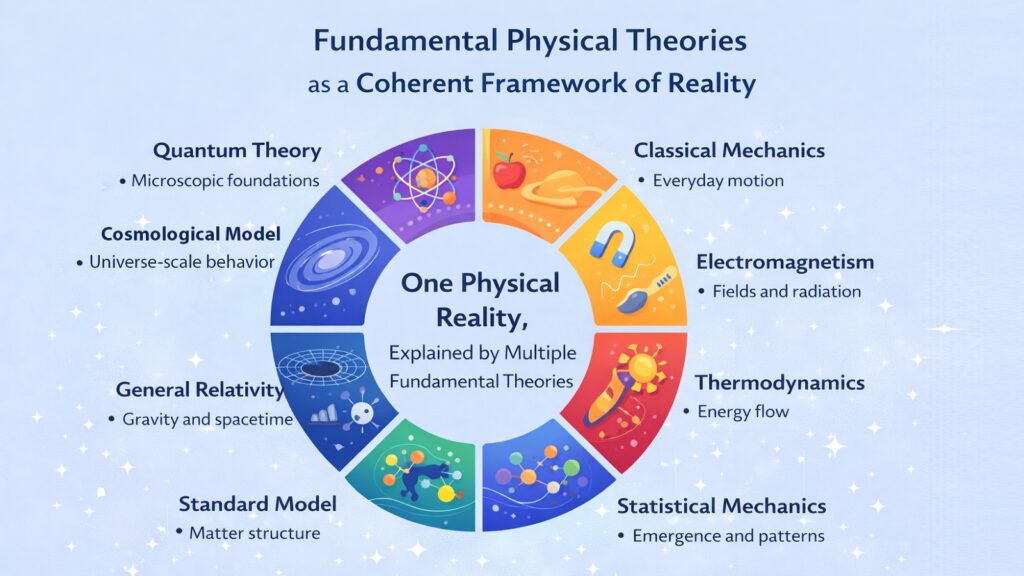
These eight Fundamental Physical Theories operate together rather than competing for dominance. Each addresses specific scales and phenomena with remarkable success. Quantum theory governs atoms and particles. General relativity shapes cosmic structure and gravity. Classical mechanics describes everyday motion. Electromagnetism unifies light and force. Thermodynamics constrains energy flow. Statistical mechanics bridges microscopic and macroscopic realms. The Standard Model maps matter’s fundamental structure. Cosmology applies these principles across the universe.
Scale-dependence explains why multiple fundamental physical theories are necessary to explain our physical world. Physics at subatomic scales follows different rules than physics at human scales or cosmic distances. These differences reflect nature’s actual organization rather than deficiencies in our understanding. Theories connect at boundary conditions where their domains meet, ensuring coherent predictions across scales.
Each of these fundamental physical theories has limits beyond which it breaks down or requires modification. Classical mechanics fails near light speed. Quantum theory’s probabilistic nature conflicts with general relativity’s smooth spacetime. The Standard Model omits gravity. Recognizing these limits drives progress toward deeper understanding without invalidating what each theory accomplishes within its domain.
Modern physics advances by refining these frameworks rather than discarding them. General relativity extends but includes Newtonian gravity as a special case. Quantum field theory encompasses both quantum mechanics and special relativity. Future theories will likely extend current frameworks while preserving their successful predictions.
Unification of these Fundamental Physical Theories remains an active goal. Physicists seek theories combining quantum mechanics with gravity, or unifying all forces into a single framework. String theory and loop quantum gravity represent attempts at quantum gravity. Grand unified theories aim to merge Standard Model forces. Whether nature permits complete unification remains uncertain.
These Fundamental Physical Theories represent humanity’s deepest understanding of physical reality. They work not because they are convenient but because they capture genuine aspects of how nature operates. From quantum uncertainty to cosmic expansion, from thermodynamic irreversibility to electromagnetic waves, these frameworks reveal an interconnected reality governed by discoverable laws.
The success of these 8 Fundamental Physical Theories inspires confidence that nature operates through comprehensible principles. Though mysteries remain, the progress from Newton to Einstein to the Standard Model demonstrates that persistent investigation reveals nature’s patterns. The eight theories examined here form our current foundation, pointing toward whatever deeper understanding awaits discovery.
Table 10: Fundamental Physical Theories – Future Directions and Open Questions
| Theory | Unresolved Challenge |
|---|---|
| Quantum Theory | Reconciling measurement with objective reality |
| General Relativity | Unifying with quantum mechanics at extreme scales |
| Classical Mechanics | Explaining emergence from quantum foundations |
| Electromagnetism | Understanding charge quantization origins |
| Thermodynamics | Deriving arrow of time from reversible laws |
| Statistical Mechanics | Predicting behavior far from equilibrium |
| Standard Model | Incorporating gravity and explaining mass hierarchy |
| Cosmological Model | Identifying dark matter and dark energy nature |