Table of Contents
Introduction: Understanding the Key Elements of Business Strategy
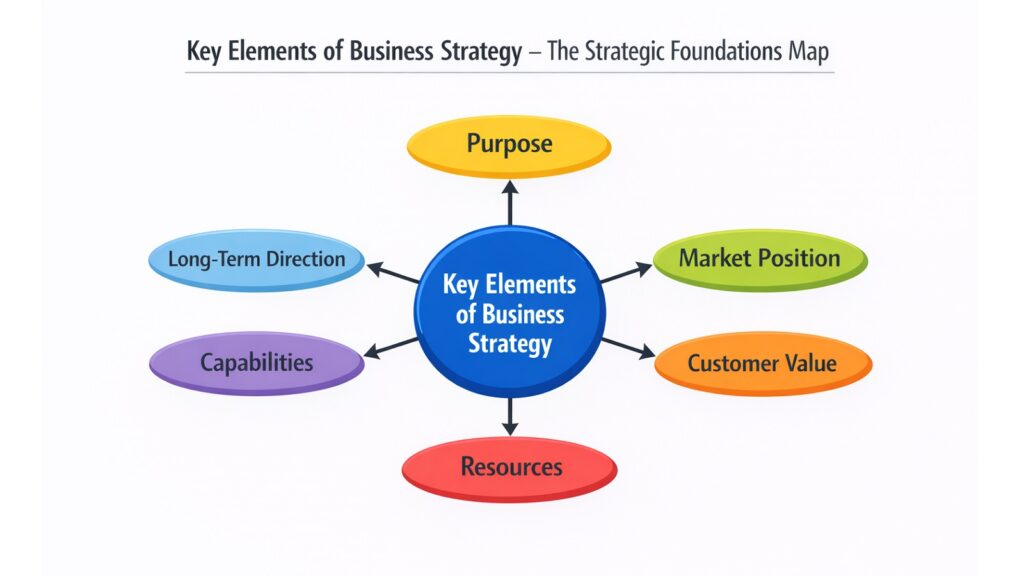
Business strategy is one of the most important business essentials any company can invest in. Without it, organizations drift. They react instead of act. They spend energy in all directions without gaining real ground. The key elements of business strategy are the building blocks that give a business its shape, its purpose, and its forward direction.
In the broader context of business essentials, strategy sits at the top. It connects vision to execution. It links what a company believes in to how it actually behaves in the market. When companies get these elements right, everything else follows with more ease and clarity.
The key elements of business strategy guide four important outcomes. First, they create clarity. Everyone inside the organization knows what the company is trying to do and why. Second, they set a competitive direction. A company without a strategic direction cannot make good choices about where to compete or how to win. Third, they drive customer value. A strong strategy always puts the customer’s needs at its center. Fourth, they enable long-term decision-making. Without strategic grounding, short-term pressures tend to override what really matters.
This article covers twelve growth moves that form the core of business strategy. Each one builds on the others. Together, they give companies the foundation they need to grow, adapt, and endure.
Key Elements of Business Strategy: Overview of 12 Strategic Pillars
| Key Elements of Business Strategy | Role in Business Strategy |
| Vision and Mission Strategy | Sets the long-term direction and explains the company’s core purpose |
| Competitive Positioning Strategy | Defines where and how a company competes for customer preference |
| Value Proposition Design | Articulates the specific benefit customers receive from the company |
| Strategic Planning Models | Frameworks like OKR and Balanced Scorecard translate goals into action |
| Core Competencies and Capabilities | The unique strengths a company leverages to outperform rivals |
| Market Landscape and Industry Analysis | Examines external forces, trends, and competitive dynamics |
| Business Model Strategy | Determines how a company creates, delivers, and captures value |
| Risk Strategy and Scenario Planning | Prepares the business for uncertainty and disruption |
| Resource Allocation Strategy | Directs financial, human, and operational resources to top priorities |
| Organizational Strategy and Structure | Aligns roles, teams, and processes with strategic goals |
| Innovation Strategy | Drives renewal, experimentation, and the development of new value |
| Long-Term Growth Strategy | Guides expansion, sustainability, and continuous improvement |
1. Key Elements of Business Strategy and the Power of Vision and Mission Strategy
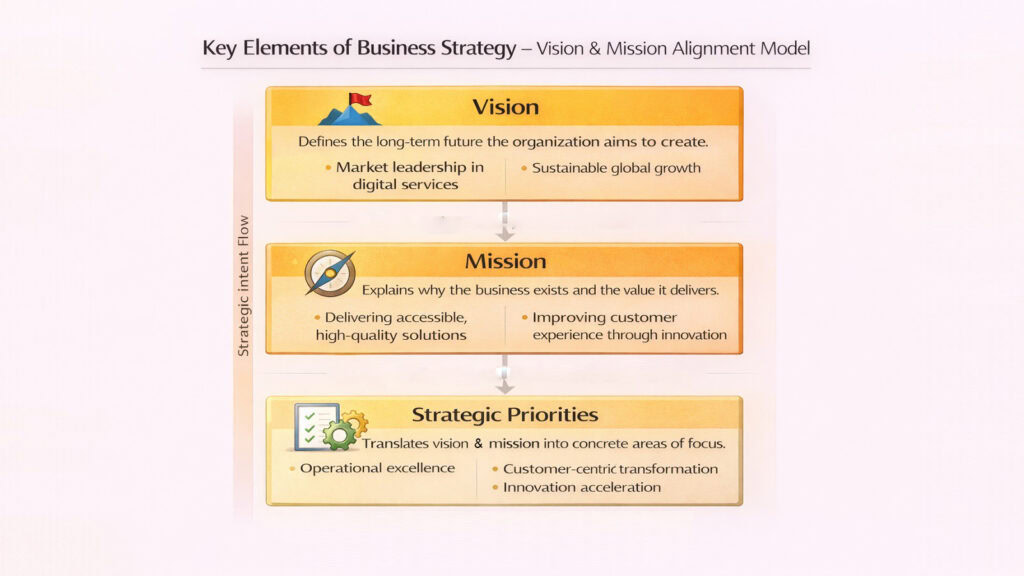
Every company starts somewhere. But the ones that endure usually start with a clear picture of where they want to go. That picture is vision. It defines the future state the company is working toward. It tells people inside the company what success looks like in the long run. Tesla’s early vision of accelerating the world’s transition to sustainable energy was not just inspiring. It was directional. Every product decision, every hiring choice, every investment could be tested against that single statement.
Mission is different from vision, though people often confuse the two. Mission explains why a company exists right now. It describes the purpose the company serves today, not just tomorrow. Google’s mission to organize the world’s information and make it universally accessible and useful is a present-tense commitment. It keeps the company focused on what it does, not just what it dreams about.
These two statements anchor the key elements of business strategy fundamentally. Culture flows from them. When employees understand the vision and mission, they make better decisions without needing constant supervision. They know what matters. They know how their daily work connects to something larger.
Strategic alignment also depends on vision and mission. When a company considers entering a new market or launching a new product, the clearest filter available is whether it fits the vision and serves the mission. Companies that drift from these anchors often find themselves scattered and confused. Those who hold firm to them tend to move with purpose.
Jim Collins, who spent decades studying companies that outperformed their peers, found that enduring organizations share a sense of core purpose that goes beyond profit. That purpose is what mission statements are meant to capture. Strategy without mission is just planning. Strategy with mission is conviction.
Key Elements of Business Strategy: Vision and Mission Strategy at Leading Companies
| Company | Vision or Mission Focus |
| Amazon | Vision focuses on being Earth’s most customer-centric company across every product and service |
| Microsoft | Mission to empower every person and organization on the planet to achieve more |
| Patagonia | Mission centers on using business to protect the environment and inspire environmental solutions |
| Disney | Vision of being the world’s leading producer of entertainment and information guides creative decisions |
| Starbucks | Mission to inspire and nurture the human spirit, one person and one cup at a time |
| Nike | Mission to bring inspiration and innovation to every athlete in the world, broadly defined |
| IKEA | Vision of creating a better everyday life for as many people as possible, emphasizing affordability |
| Apple | Vision of making the best products on earth while leaving the world better than they found it |
2. Key Elements of Business Strategy Applied to Competitive Positioning Strategy
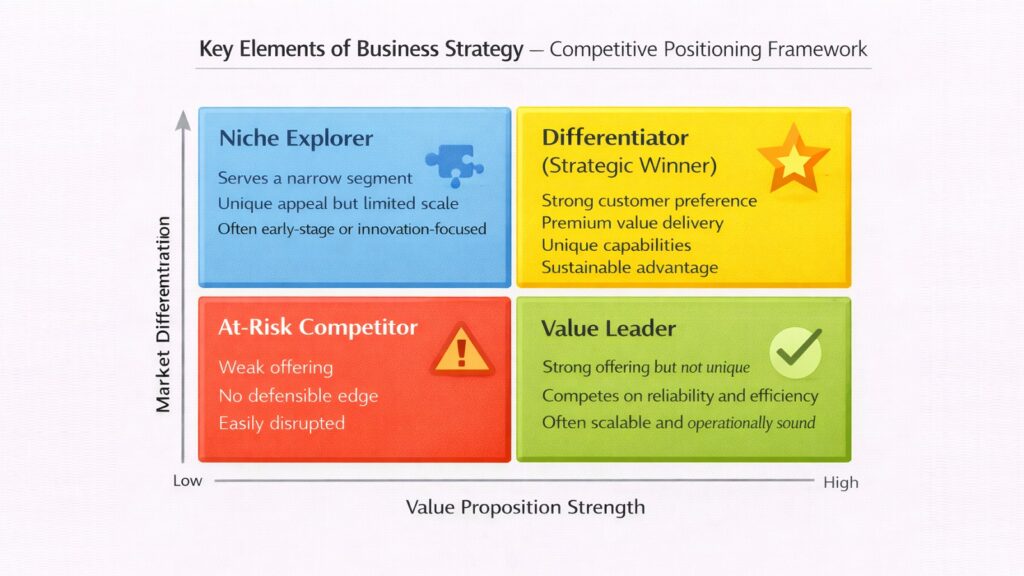
Competitive positioning is the art of choosing your ground. It answers the question: where does this company compete, and why would a customer choose us over anyone else? Without a deliberate answer to these questions, a company ends up competing everywhere and winning nowhere.
Michael Porter’s foundational work on competitive advantage identified three basic positions: cost leadership, differentiation, and focus. Cost leaders like Walmart win on price. Differentiators like Apple win on uniqueness. Focused players win by serving a narrow segment better than any generalist can. Each path requires different resources, different skills, and different tradeoffs.
The key elements of business strategy depend on competitive positioning because it shapes where resources go. A company cannot fund everything equally and still win. Positioning forces choices. It says: here is where we are strongest, and here is where we will concentrate our efforts. That discipline is what keeps strategy from becoming a wishlist.
Customer preference is also built through positioning. When customers know what a brand stands for, trust becomes easier. Volvo built decades of preference by standing for safety. When the market asked what car was safest, Volvo already owned the answer. That kind of positioning is not accidental. It results from strategic clarity sustained over time.
Competitive positioning also affects hiring, pricing, partnership decisions, and communication. When a company knows its position, every one of these choices becomes easier. When it does not, every choice becomes a negotiation with itself.
Key Elements of Business Strategy: Competitive Positioning Examples Across Industries
| Company | Positioning Strategy |
| Walmart | Cost leadership strategy based on supply chain efficiency and everyday low prices |
| Apple | Differentiation through premium design, ecosystem integration, and brand identity |
| Southwest Airlines | Cost focus with strong culture, no baggage fees, and point-to-point routes |
| Rolex | Luxury differentiation through craftsmanship, heritage, and exclusivity |
| Dollar General | Focused cost strategy targeting rural and low-income communities |
| Tesla | Differentiation through electric technology, software updates, and direct sales model |
| Costco | Membership-based cost leadership with high volume and limited SKU selection |
| Dyson | Premium differentiation through engineering innovation and distinctive product design |
3. Key Elements of Business Strategy Shaping Value Proposition Design
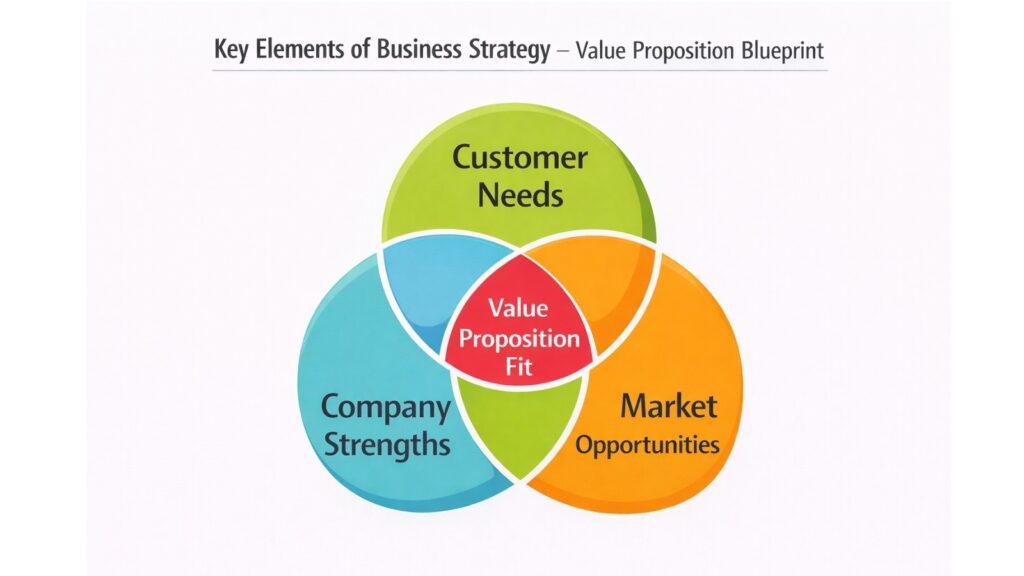
A value proposition is a promise. It tells the customer what they will gain by choosing your company, product, or service over any other option available to them. If a business cannot state its value proposition clearly, it is likely that customers cannot feel it either.
The key elements of business strategy depend heavily on how well a company designs its value proposition. A strategy without a compelling promise to customers is incomplete. The value proposition sits at the intersection of what the company does well, what the customer truly needs, and what competitors fail to deliver. That intersection is where strategic advantage becomes visible to the people who pay for it.
Customer insight drives strong value proposition design. Companies that spend time understanding what jobs customers are trying to get done, what frustrations they face, and what gains they hope for, can create offers that resonate in a much deeper way. Clayton Christensen’s jobs-to-be-done framework is useful here. It asks not what a customer is buying but what problem they are hiring the product to solve.
Product relevance is the next layer. Even if a company understands the customer, the product must actually solve the problem. Many companies fall into the trap of building solutions that are technically impressive but functionally disconnected from what the customer experiences. Relevance requires ongoing listening and a willingness to adapt.
Competitive value ties the proposition together. If a competitor already offers the same thing at a better price or with more convenience, the value proposition is weak. Strength comes from offering something the market genuinely wants and cannot find elsewhere at the same level of quality, speed, or reliability.
Key Elements of Business Strategy: Value Proposition Design Across Market Leaders
| Company | Core Value Proposition |
| Slack | Reduces workplace email and centralizes team communication in one searchable platform |
| Airbnb | Offers travelers unique, local accommodations at competitive prices worldwide |
| Zoom | Provides reliable, simple video communication for businesses and individuals |
| Spotify | Delivers personalized music discovery and unlimited streaming for one monthly price |
| Stripe | Makes online payment processing fast, simple, and accessible for developers |
| Uber | Connects riders to affordable transport within minutes, available around the clock |
| Netflix | Offers unlimited entertainment on demand with no ads and easy cancellation |
| Shopify | Enables any entrepreneur to build, manage, and grow an e-commerce business quickly |
4. Key Elements of Business Strategy Strengthened by Strategic Planning Models
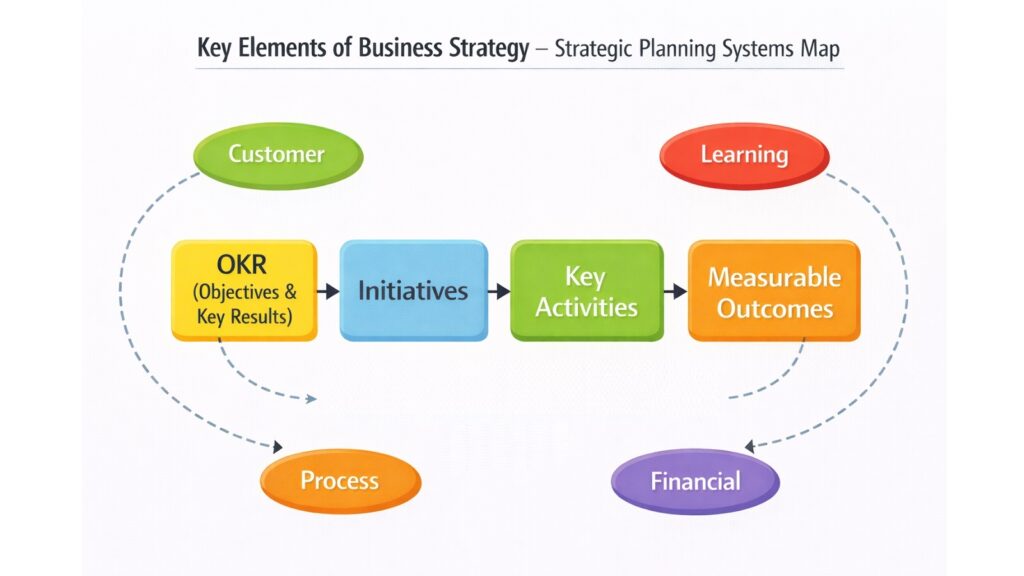
A strategy is only as good as the system that turns it into action. That is where strategic planning models come in. They provide structure, accountability, and a shared language for moving from ideas to outcomes. Without a planning model, even a brilliant strategy tends to stay on paper.
The OKR framework, developed at Intel and popularized by Google, is one of the most widely used models today. OKR stands for Objectives and Key Results. The objective is the qualitative ambition, written in clear and inspiring language. The key results are quantitative measures that tell you whether you achieved it. Google used OKRs to scale from a startup to one of the world’s largest companies while keeping everyone aligned.
The Balanced Scorecard, introduced by Robert Kaplan and David Norton in 1992, takes a broader view. It tracks performance across four dimensions: financial results, customer satisfaction, internal processes, and learning and growth. The insight behind it is that financial results alone are lagging indicators. By the time numbers look bad, the underlying problems are already old. The Balanced Scorecard forces companies to monitor the leading indicators that predict future financial health.
These planning models connect the key elements of business strategy to measurable execution. They stop strategy from becoming vague aspiration. They hold leaders accountable for progress and surface problems before they become crises. Companies that use formal planning models tend to show stronger alignment between what leadership intends and what teams actually do.
Research from the Project Management Institute found that organizations with mature project and portfolio management practices waste significantly less money on failed initiatives. Planning models reduce waste because they force specificity. When teams must define success in measurable terms, they make better decisions about how to spend time and money.
Key Elements of Business Strategy: Comparison of Strategic Planning Models
| Planning Model | Strategic Function |
| OKR (Objectives and Key Results) | Aligns teams around ambitious goals with measurable quarterly outcomes |
| Balanced Scorecard | Tracks financial, customer, internal, and learning metrics together |
| SWOT Analysis | Evaluates internal strengths and weaknesses alongside external opportunities and threats |
| PEST Analysis | Examines political, economic, social, and technological external factors |
| Porter’s Five Forces | Analyzes industry competitiveness through five structural forces |
| Blue Ocean Strategy | Seeks uncontested market space instead of competing in crowded industries |
| McKinsey 7S Framework | Aligns seven internal elements: strategy, structure, systems, staff, skills, style, values |
| Hoshin Kanri | Japanese planning method aligning company goals with departmental actions |
5. Key Elements of Business Strategy Built on Core Competencies and Capabilities
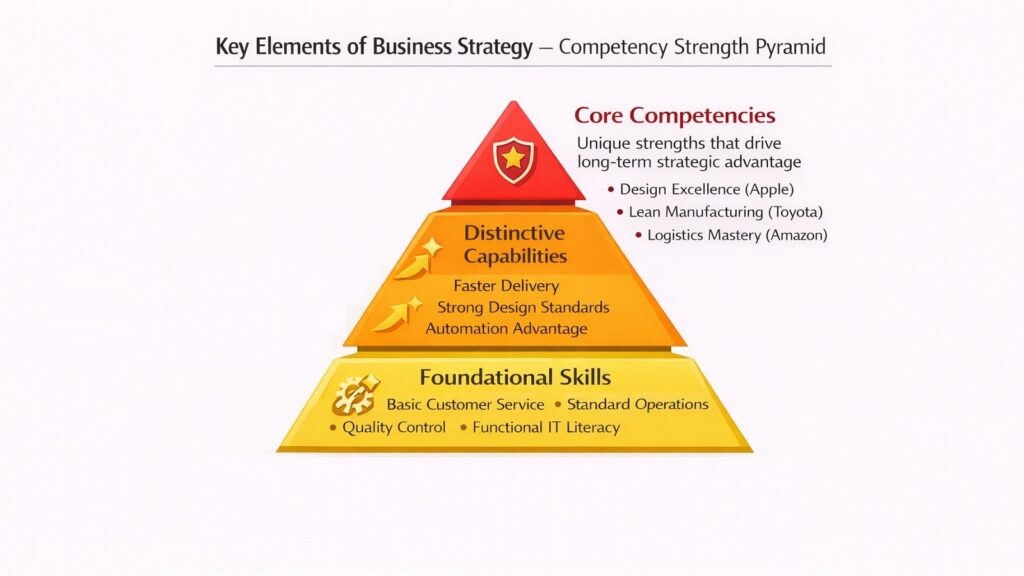
Not every company can do everything well. The ones that understand this truth and build strategy around what they genuinely do best tend to outperform those that try to be everything to everyone. Core competencies are the deep, often hard-to-imitate capabilities that give a company a competitive edge.
C.K. Prahalad and Gary Hamel introduced the concept of core competence in a landmark 1990 article in the Harvard Business Review. They described core competencies as the collective learning of an organization, especially how to coordinate diverse production skills and integrate multiple streams of technology. Honda’s deep expertise in engine design allowed it to extend from motorcycles to cars to lawnmowers to generators. The competency was transferable even across very different products.
The key elements of business strategy depend on honest self-assessment of capabilities. Strategy that ignores what a company is actually good at tends to be aspirational in a dangerous way. It sets goals the organization lacks the means to achieve. Strategy that builds from genuine strength has a much better foundation.
Leveraging capabilities also creates barriers to competition. When a capability is deeply embedded in people, processes, and culture, it is extremely difficult for rivals to replicate quickly. Amazon’s logistics capability is a good example. It took decades and enormous investment to build. Competitors cannot simply buy the same outcome. That depth is what makes it strategic.
Identifying core competencies also guides innovation. When a company knows what it does best, it can ask: what new products or markets could benefit from this strength? That question often points toward growth opportunities that are natural extensions rather than risky leaps into unfamiliar territory.
Key Elements of Business Strategy: Core Competencies of Leading Global Companies
| Company | Core Competency |
| Amazon | Logistics, cloud infrastructure, and data-driven customer personalization |
| Search algorithms, machine learning, and large-scale data analysis | |
| Toyota | Lean manufacturing, quality control, and continuous improvement culture |
| Samsung | Semiconductor design, vertical supply chain integration, and hardware manufacturing |
| LVMH | Brand management, artisan craftsmanship, and luxury retail expertise |
| 3M | Materials science, innovation culture, and cross-functional product development |
| Berkshire Hathaway | Capital allocation, long-term investment discipline, and acquisition judgment |
| Procter and Gamble | Consumer research, brand marketing, and global retail distribution |
6. Key Elements of Business Strategy Guided by Market Landscape and Industry Analysis
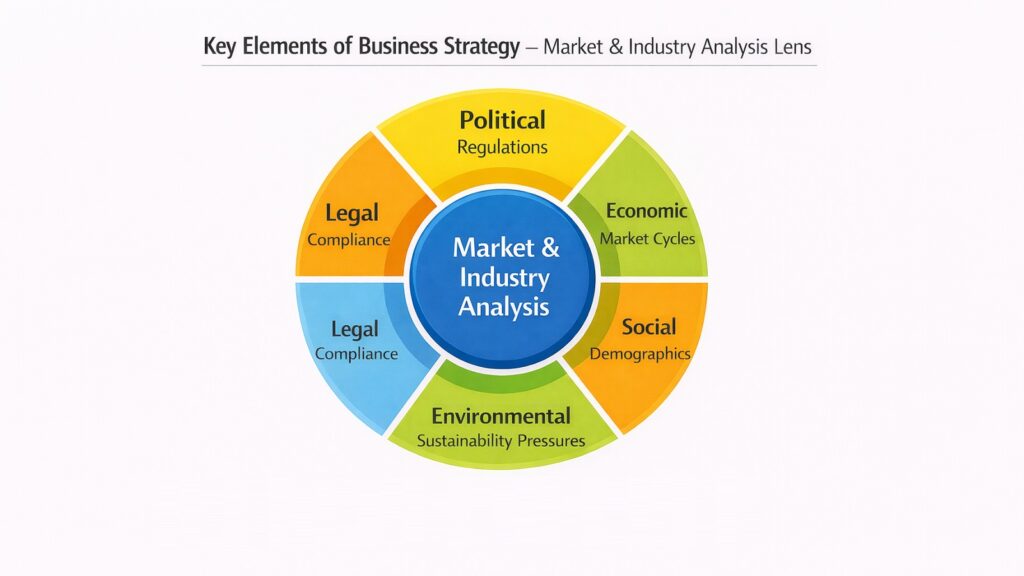
No business exists in isolation. Every company operates within a market shaped by forces it does not fully control. Understanding those forces is not optional. It is essential. Market landscape and industry analysis is the element of strategy that keeps a company grounded in external reality.
Porter’s Five Forces model remains one of the most useful tools for industry analysis. It evaluates the threat of new entrants, the bargaining power of suppliers, the bargaining power of buyers, the threat of substitute products, and the intensity of rivalry among existing competitors. Each force shapes the profitability potential of an industry. Companies that understand these forces can position themselves to minimize exposure to unfavorable ones.
Market landscape analysis goes further by examining demographic shifts, technology trends, regulatory changes, and macroeconomic forces. These external factors often move slowly but hit hard when they arrive. Companies that anticipate them can adapt ahead of time. Those that ignore them often find themselves reacting when it is already too late.
The key elements of business strategy are sharpened by external analysis because it reveals where real opportunities exist and where hidden threats are growing. Internal strengths only matter if there is a market that values them. External analysis connects internal capability to external demand.
According to McKinsey research, companies that regularly scan and respond to their competitive environment make faster and better strategic decisions than those that rely on internal projections alone. External awareness is not a luxury for large corporations. It is a basic discipline for any company that wants to grow.
Key Elements of Business Strategy: Market and Industry Analysis Tools
| Analysis Tool | Strategic Function |
| Porter’s Five Forces | Evaluates industry profitability by analyzing five competitive forces |
| PEST Analysis | Reviews political, economic, social, and technological macro-level trends |
| Market Segmentation Analysis | Divides the total market into distinct groups with similar needs |
| Competitor Benchmarking | Measures performance and strategy relative to direct rivals |
| Consumer Trend Research | Tracks changing customer preferences and behavioral shifts |
| Regulatory Environment Review | Identifies legal and compliance factors affecting the industry |
| Technology Disruption Mapping | Identifies emerging technologies that could reshape the market |
| Value Chain Analysis | Examines each step of production and delivery to find competitive advantage |
7. Key Elements of Business Strategy Driving Effective Business Model Strategy
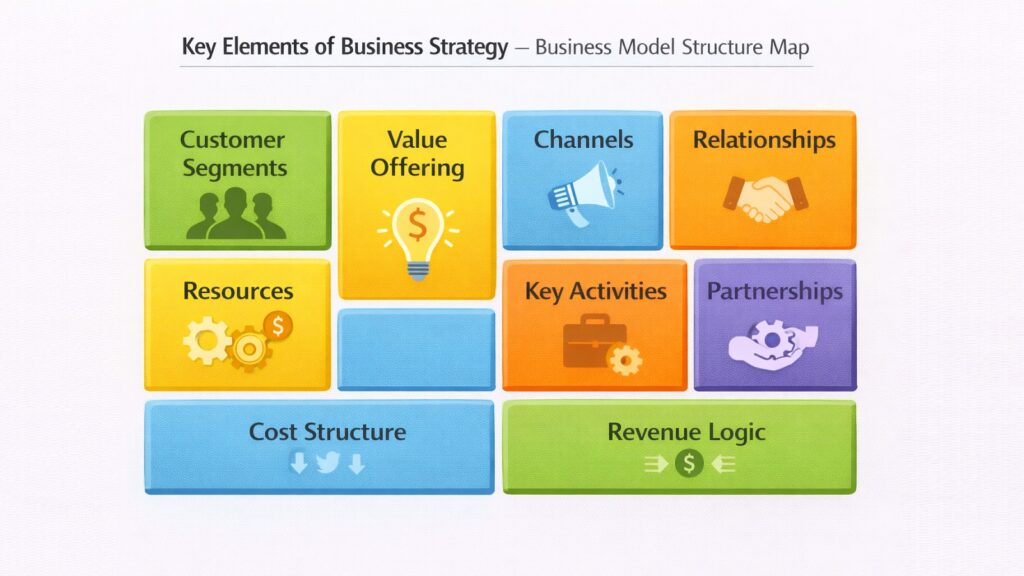
A business model is the logic of how a company makes money. It answers three fundamental questions: how does the company create value, how does it deliver that value, and how does it capture value in return. The key elements of business strategy are incomplete without a clear business model to anchor them.
Alexander Osterwalder’s Business Model Canvas provides a visual tool for mapping this logic across nine building blocks: customer segments, value propositions, channels, customer relationships, revenue streams, key resources, key activities, key partnerships, and cost structure. Used widely in business schools and corporations alike, it forces strategic clarity about every dimension of how value flows through the organization.
Revenue streams are a critical component. Many companies generate revenue in multiple ways. Amazon earns from product sales, third-party seller fees, advertising, and Amazon Web Services. Each stream adds resilience and reduces dependence on any single source. That diversity makes the company more stable in downturns.
Cost structure shapes the economics of the business model. Companies that find ways to reduce costs without sacrificing quality enjoy a structural advantage. Those that allow cost structures to balloon without discipline tend to find margins shrinking and options narrowing.
Channel strategy is also part of the business model. How does the company reach customers? Direct sales, retail partners, digital platforms, and distributors all carry different economics and relationship qualities. The channel choice shapes the customer experience, the cost base, and the company’s ability to gather market feedback in real time.
Key Elements of Business Strategy: Business Model Approaches Across Sectors
| Business Model Type | Description and Example |
| Subscription Model | Recurring revenue from customers paying regularly for access, used by Netflix and Spotify |
| Marketplace Model | Platform connecting buyers and sellers, taking a fee, used by Amazon and Airbnb |
| Freemium Model | Free basic service with paid premium tiers, used by Slack, Dropbox, and LinkedIn |
| Franchise Model | Standardized business format licensed to operators, used by McDonald’s and Subway |
| Direct-to-Consumer | Selling directly without intermediaries for higher margins and customer data access |
| Razor and Blade Model | Low-cost core product with high-margin consumables, used by Gillette and HP printers |
| Platform Ecosystem | Building a core platform others build on top of, used by Apple and Salesforce |
| Asset-Light Model | Revenue without owning physical assets, used by Uber, Airbnb, and hotel brands |
8. Key Elements of Business Strategy Strengthened by Risk Strategy and Scenario Planning
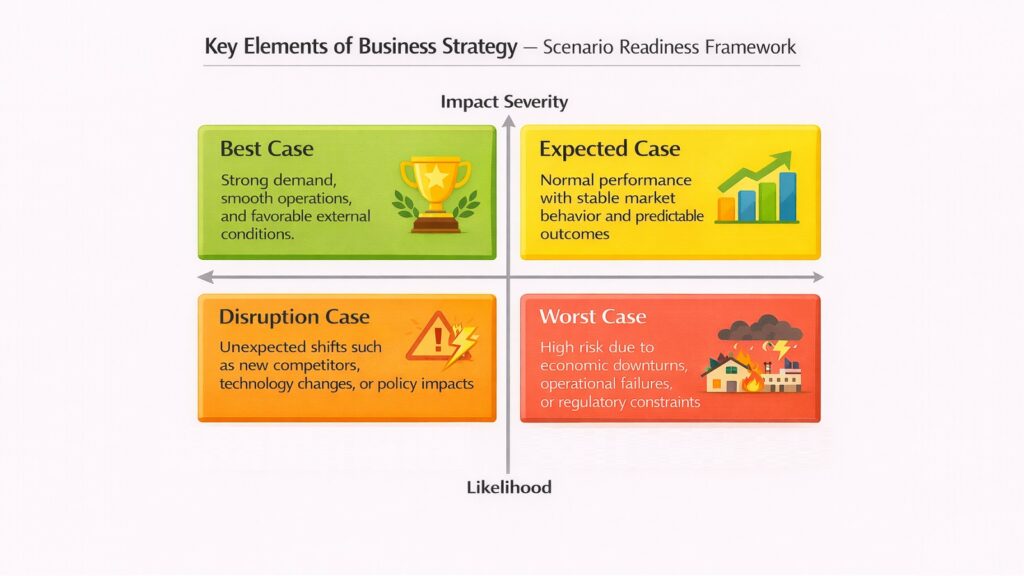
Strategy is always built for a future that has not happened yet. That means every strategy carries uncertainty. The companies that manage uncertainty best are not the ones that avoid risk. They are the ones that understand it, prepare for it, and build resilience into their operations before problems arrive.
Risk strategy begins with identification. Companies must look honestly at what could go wrong, from supply chain disruption to technology failure, from regulatory change to geopolitical instability. Each risk category carries different probability and different potential impact. A basic risk matrix plots these on two axes, allowing leadership to prioritize where mitigation efforts should focus.
Scenario planning is a complementary discipline. Shell Oil made scenario planning famous in the 1970s when it imagined possible futures for the global energy market and prepared strategies for each one. When the 1973 oil crisis struck, Shell was better prepared than its competitors because it had already thought through what that scenario would require. Scenario planning does not predict the future. It makes a company faster and more confident when the future arrives unexpectedly.
The key elements of business strategy are strengthened by risk thinking because strategy without it is fragile. A growth plan that assumes smooth execution and favorable conditions will fail the first time reality pushes back. Companies that build contingency into their strategy are more adaptive, more stable, and more trusted by investors and partners.
Risk strategy also includes knowing what risks are worth taking. Not all uncertainty is threat. Some is opportunity. Companies that can distinguish between manageable risk and existential risk make bolder moves when conditions favor boldness and more cautious moves when they do not.
Key Elements of Business Strategy: Risk Types and Mitigation Approaches
| Risk Type | Mitigation Strategy |
| Market Risk | Demand fluctuations managed through diversified product lines and customer segments |
| Operational Risk | Process failures reduced through redundancy, quality control, and staff training |
| Financial Risk | Cash flow problems addressed through reserves, credit lines, and cost discipline |
| Regulatory Risk | Compliance disruption mitigated through legal monitoring and government relations |
| Reputational Risk | Brand damage controlled through transparent communication and ethical conduct |
| Technology Risk | Obsolescence addressed through ongoing R and D investment and vendor management |
| Geopolitical Risk | Supply chain disruption reduced through geographic diversification of sourcing |
| Cybersecurity Risk | Data breaches prevented through security protocols, audits, and employee training |
9. Key Elements of Business Strategy for Smarter Resource Allocation Strategy
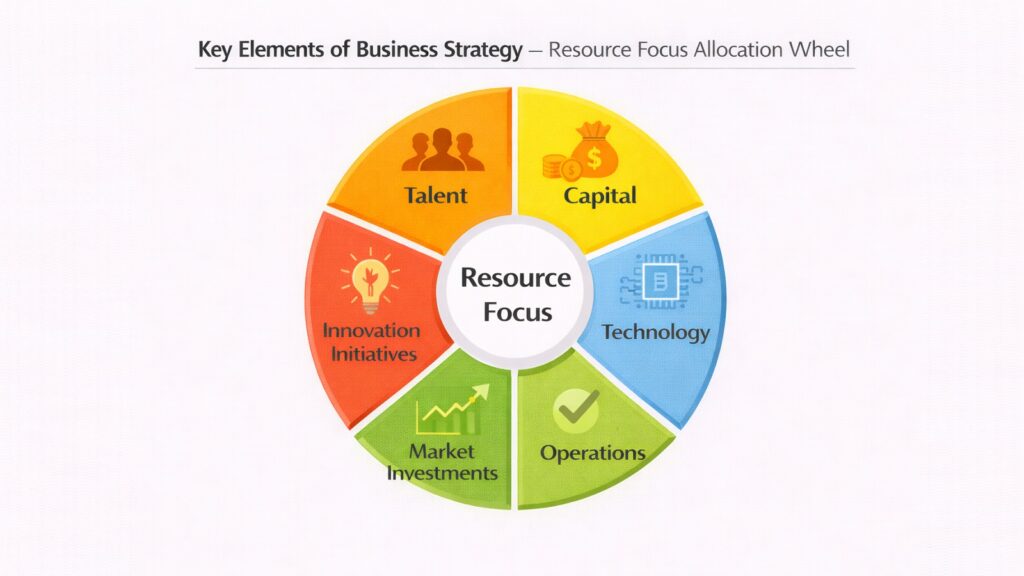
Every organization has limited resources. Time, money, and people are always finite. The difference between companies that grow and those that stagnate often comes down to how well they allocate what they have. Resource allocation strategy is not just a financial exercise. It is a strategic one.
Research from McKinsey found that companies that actively reallocate resources, moving money and people toward higher-priority opportunities each year, generate significantly better returns than those that keep budgets static. Static allocation tends to fund yesterday’s priorities. Dynamic allocation funds tomorrow’s opportunities.
The key elements of business strategy depend on resource discipline because every strategic priority requires investment. A company cannot pursue competitive positioning, innovation, and expansion simultaneously without making choices about which one gets more support in any given period. Those choices are resource allocation decisions, and they define what the strategy actually is in practice.
Capital allocation is one dimension. Where does the company invest its financial resources? Organic growth initiatives, acquisitions, technology upgrades, talent development, and shareholder returns all compete for the same pool of capital. Leaders who make those choices well build compounding advantage. Those who spread capital too thinly often see nothing grow.
Human resource allocation is equally important. Putting the right people on the highest-priority projects accelerates outcomes. Many companies waste talent by assigning strong performers to low-impact work. Strategy requires that talent goes where it can move the needle most.
Key Elements of Business Strategy: Dimensions of Resource Allocation Strategy
| Allocation Dimension | Strategic Purpose |
| Capital Budgeting | Deciding which projects and investments receive financial resources each period |
| Talent Deployment | Matching the strongest people to the highest-priority strategic initiatives |
| R and D Investment | Directing innovation spending toward areas with largest growth potential |
| Marketing Spend | Allocating promotional budgets to channels and segments with best return |
| Technology Investment | Funding digital tools and systems that improve execution and efficiency |
| Operational Capacity | Expanding or reducing physical and human capacity based on demand forecasts |
| Geographic Expansion | Deciding which markets receive new investment and in what sequence |
| Portfolio Pruning | Cutting underperforming products or divisions to free resources for growth |
10. Key Elements of Business Strategy Reinforced by Organizational Strategy and Structure
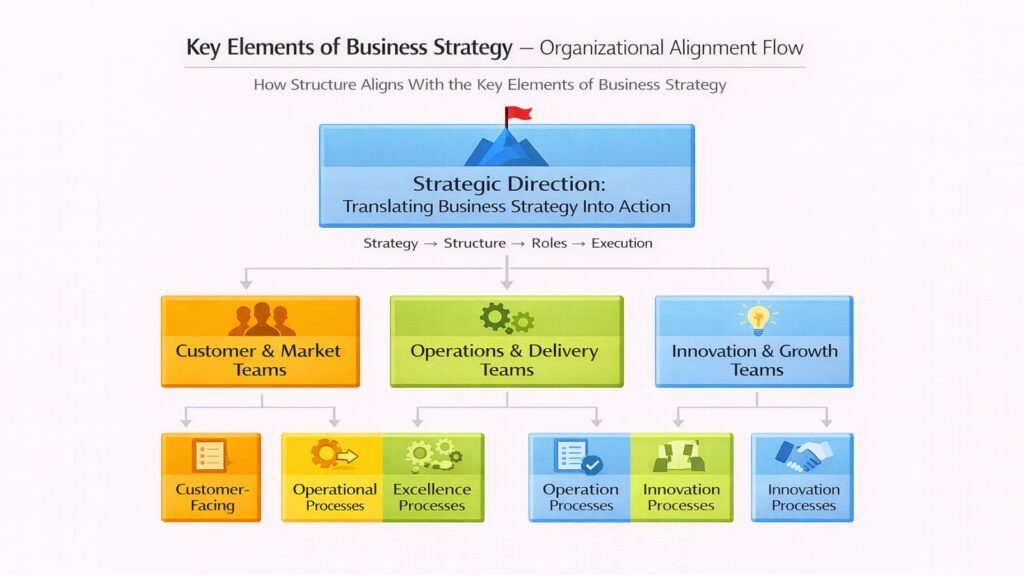
A strategy is only as strong as the organization built to execute it. Roles, processes, communication patterns, and reporting lines all influence how fast and how well a company can move. Organizational strategy is the element that aligns human systems with strategic intent.
Alfred Chandler, one of the most influential business historians of the twentieth century, observed that structure follows strategy. When a company changes what it wants to do, its organization must change too. Companies that try to execute a new strategy through an old structure tend to struggle because the old structure was designed for different priorities and different flows of information.
The key elements of business strategy require organizational alignment to produce results. If strategy says the company will compete on innovation, but the structure rewards caution and punishes failure, the organization will not innovate regardless of what the strategy document says. Structure, incentives, and processes must reinforce the strategy or they will quietly undermine it.
Speed is another organizational dimension. Flat structures with delegated authority make faster decisions than hierarchical ones that require approval at many levels. In fast-moving markets, the ability to decide quickly is itself a competitive advantage. Amazon famously uses the two-pizza rule: if a team cannot be fed by two pizzas, it is too large. Small teams move faster and feel more accountable.
Communication patterns also matter. When information flows freely across functions, coordination improves and problems surface faster. When silos prevent collaboration, strategies that require cross-functional execution fall apart. Organizational design must enable the information flows that strategy depends on.
Key Elements of Business Strategy: Organizational Structure Types and Characteristics
| Structure Type | Strategic Benefit |
| Functional Structure | Organized by department such as finance, marketing, and operations for efficiency |
| Divisional Structure | Organized by product, geography, or customer segment for accountability |
| Matrix Structure | Dual reporting lines combining functional and project-based management |
| Flat Structure | Minimal management layers enabling fast decisions and direct communication |
| Network Structure | Core team with outsourced or partnered functions for flexibility and speed |
| Holacracy | Self-organizing teams with distributed authority, used by some startups |
| Agile Structure | Cross-functional teams organized around rapid iteration and customer feedback |
| Hybrid Structure | Combination of centralized and decentralized elements for context-specific needs |
11. Key Elements of Business Strategy in Action Through Innovation Strategy
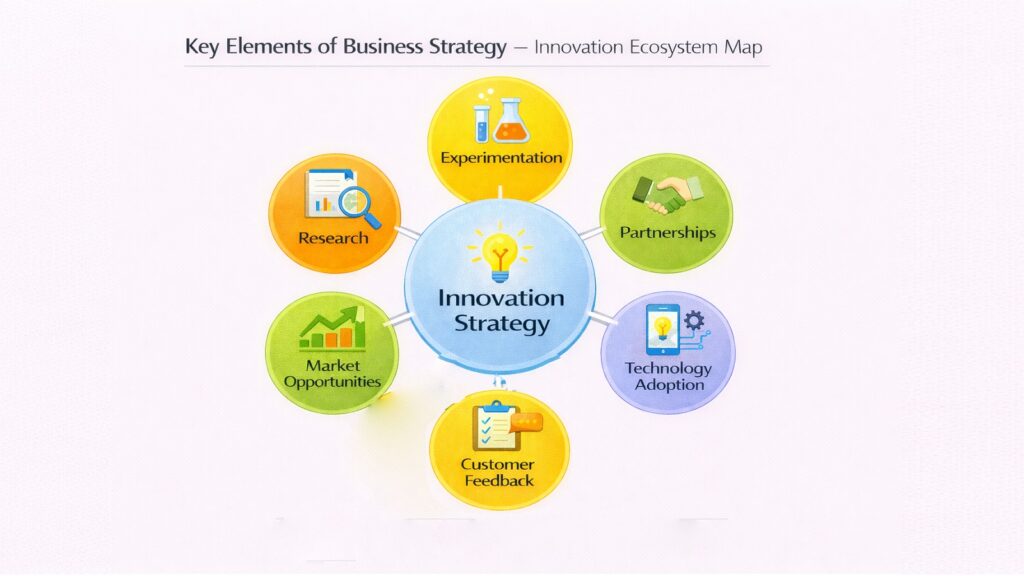
Markets never stand still. Competitors evolve. Customer expectations rise. Technology reshapes what is possible. Companies that cannot innovate eventually lose relevance, regardless of how strong they once were. Innovation strategy is what keeps a business competitive over time and gives the key elements of business strategy their capacity for renewal.
Innovation takes different forms. Sustaining innovation improves existing products and processes for current customers. Disruptive innovation, a concept developed by Clayton Christensen, creates simpler and cheaper alternatives that initially appeal to underserved customers before moving upmarket and displacing incumbents. Both matter. Sustaining innovation maintains the current position. Disruptive innovation defines future markets.
The key elements of business strategy depend on innovation because standing still is not a neutral act. It is a retreat. Competitors who invest in R and D, experiment with new business models, and recruit creative talent gain ground on those who do not. Innovation strategy ensures the company keeps moving even as its current strengths continue to generate returns.
A company’s innovation culture is as important as its innovation budget. Google famously allowed engineers to spend twenty percent of their time on personal projects, a policy that produced Gmail and Google News. That cultural permission to experiment sends a powerful signal: new ideas are valued here. Without that permission, even well-funded innovation programs tend to produce incremental results.
According to PwC’s annual innovation survey, the companies that consistently outperform their peers in innovation share three traits: they align innovation directly to business strategy, they invest in a diverse pipeline of ideas across short and long time horizons, and they build clear processes to move ideas from concept to market. Innovation is not random. It is disciplined creativity.
Key Elements of Business Strategy: Innovation Strategy Dimensions and Examples
| Innovation Type | Description |
| Product Innovation | Developing new or improved products that meet emerging customer needs |
| Process Innovation | Redesigning internal operations for greater speed, quality, or cost efficiency |
| Business Model Innovation | Finding new ways to create, deliver, or capture value in the market |
| Technology Innovation | Adopting or developing new technologies to gain competitive advantage |
| Customer Experience Innovation | Redesigning the customer journey to increase satisfaction and loyalty |
| Open Innovation | Partnering with external organizations, startups, or universities for new ideas |
| Incremental Innovation | Continuous small improvements to existing products and processes |
| Disruptive Innovation | Creating simpler, more affordable alternatives that redefine market expectations |
12. Key Elements of Business Strategy Powering Long-Term Growth Strategy
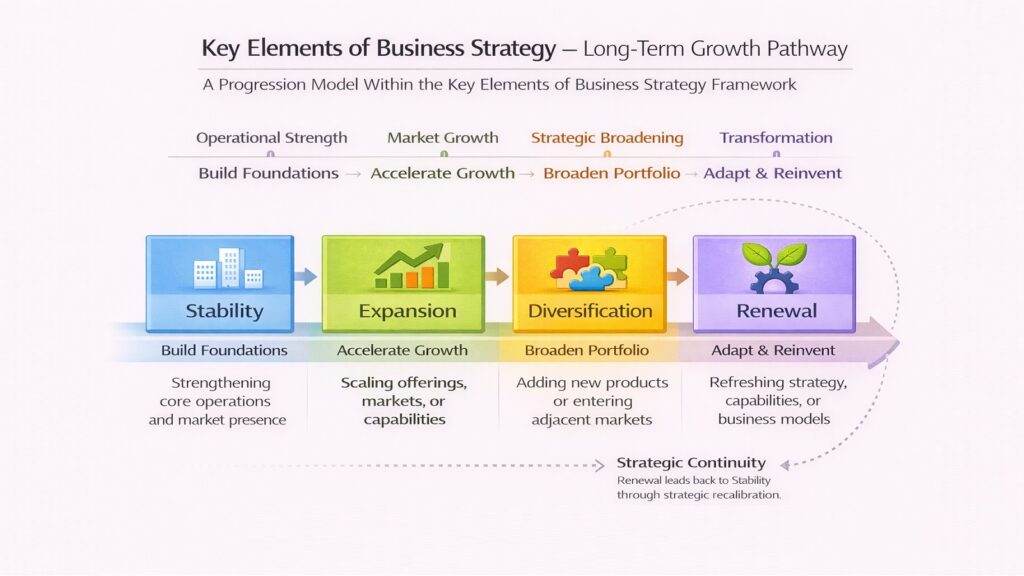
Short-term results matter. But companies built only for short-term results tend to sacrifice the investments that create sustainable, long-term strength. Long-term growth strategy is the element that keeps a company’s ambitions aimed at the horizon rather than just the next quarter.
Long-term growth requires expansion planning. That means deciding which new markets to enter, when to enter them, and with what resources. It means thinking about geographic expansion, product line extension, and strategic acquisitions. Each decision must be weighed against the company’s core strengths and strategic priorities to ensure growth adds capability rather than complexity.
Sustainability is increasingly central to long-term strategy. Companies that ignore environmental, social, and governance factors face growing pressure from investors, regulators, and customers alike. Unilever’s Sustainable Living Plan showed that brands embedded in sustainability often grow faster than those that are not. Long-term thinking and responsible practice are not in conflict. They reinforce each other.
The key elements of business strategy converge in long-term growth planning because all of them must work together to support enduring expansion. Vision provides direction. Core competencies provide the engine. Resource allocation provides the fuel. Organizational structure provides the vehicle. Innovation ensures the engine does not run out of power. Long-term growth is the destination all of these elements are driving toward.
Continuous improvement is another feature of durable growth strategy. Toyota’s kaizen philosophy treats every process as improvable. That mindset means the company is always slightly better tomorrow than it was today. Over years and decades, small improvements compound into enormous advantage. Long-term strategy that includes a culture of continuous improvement tends to stay competitive across changing conditions.
Key Elements of Business Strategy: Long-Term Growth Pathways and Approaches
| Growth Pathway | Description |
| Organic Growth | Building revenue through existing operations, sales expansion, and new products |
| Strategic Acquisition | Growing capabilities and market share through targeted company purchases |
| Geographic Expansion | Entering new international markets with adapted products and strategies |
| Product Diversification | Launching new product lines that leverage existing capabilities and brand |
| Partnership and Alliance | Forming joint ventures or strategic agreements to access new markets |
| Platform Scaling | Growing the user base and transaction volume of an existing digital platform |
| Talent and Culture Investment | Building human capital and organizational capability for future growth |
| Sustainability Integration | Embedding environmental and social responsibility into growth planning |
Conclusion: Bringing the Key Elements of Business Strategy Together for Powerful Growth
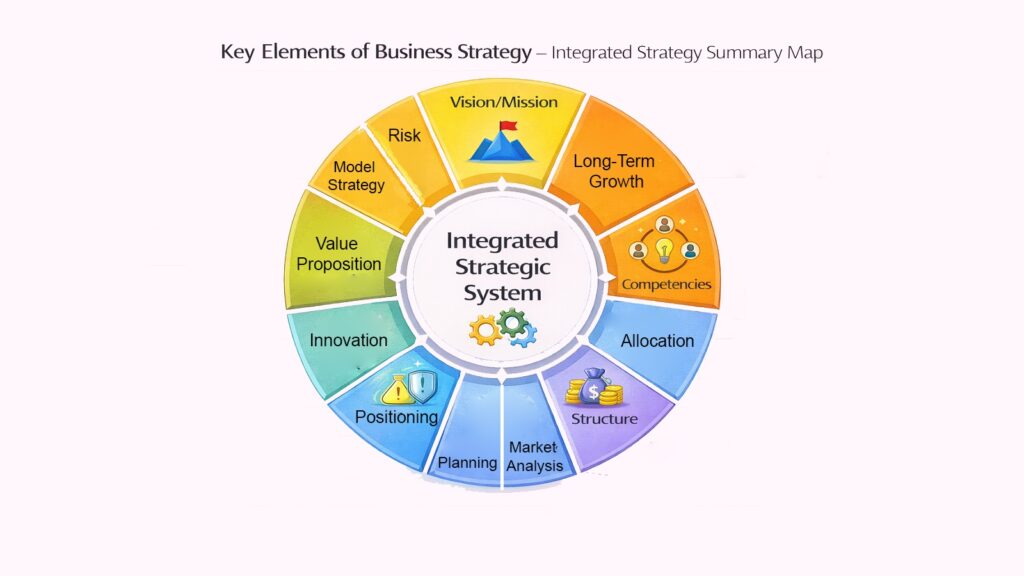
The twelve growth moves covered in this article are not independent ideas. They are interconnected components of a complete strategic system. Vision and mission give the company its reason for existing and its direction of travel. Competitive positioning defines where the company will compete and how it will stand apart. Value proposition design ensures that the strategy is felt by customers in a meaningful way.
Strategic planning models turn intentions into measurable commitments. Core competencies ensure that strategy is built on genuine strength rather than wishful thinking. Market and industry analysis keeps the strategy honest about external reality. Business model strategy defines how value creation actually generates returns. Risk strategy ensures the company can absorb shocks without losing direction.
Resource allocation disciplines the company to invest where impact is greatest. Organizational structure aligns people and processes with strategic intent. Innovation strategy keeps the company relevant as markets evolve. And long-term growth strategy holds all of it together with a commitment to building something that endures.
The key elements of business strategy, taken together, provide four things every growing company needs. They provide clarity about what the company is and where it is going. They provide alignment across teams, processes, and investments. They provide adaptability to respond to change without losing direction. And they provide competitive strength that builds over time through discipline, learning, and renewal.
These key elements of business strategy deserve deeper exploration. The articles and frameworks that follow will take each one apart and show how it works in practice, how leading companies apply it, and what leaders can do to strengthen it inside their own organizations.
Key Elements of Business Strategy: How All 12 Elements Support Sustained Growth
| Strategic Element | Contribution to Sustained Growth |
| Vision and Mission Strategy | Provides the north star that keeps strategy coherent across time and leadership change |
| Competitive Positioning Strategy | Ensures the company knows where it fights, how it wins, and where not to waste energy |
| Value Proposition Design | Makes strategy visible and meaningful to the customers who fund the business |
| Strategic Planning Models | Converts ambition into measurable milestones that teams can pursue and track |
| Core Competencies and Capabilities | Grounds strategy in real organizational strengths that competitors cannot easily copy |
| Market Landscape and Industry Analysis | Keeps strategy responsive to external forces rather than disconnected from market reality |
| Business Model Strategy | Defines the economic logic that allows strategy to generate revenue and profit |
| Risk Strategy and Scenario Planning | Builds resilience so strategy survives disruption rather than collapsing under it |
| Resource Allocation Strategy | Ensures that strategic priorities receive the investment needed to produce results |
| Organizational Strategy and Structure | Aligns people, roles, and processes to execute strategy with speed and clarity |
| Innovation Strategy | Prevents strategic stagnation by continuously renewing products, processes, and models |
| Long-Term Growth Strategy | Integrates all elements into a coherent plan for sustainable, compounding expansion |