Table of Contents
Introduction: Why Leadership and Management Drive Modern Business Success
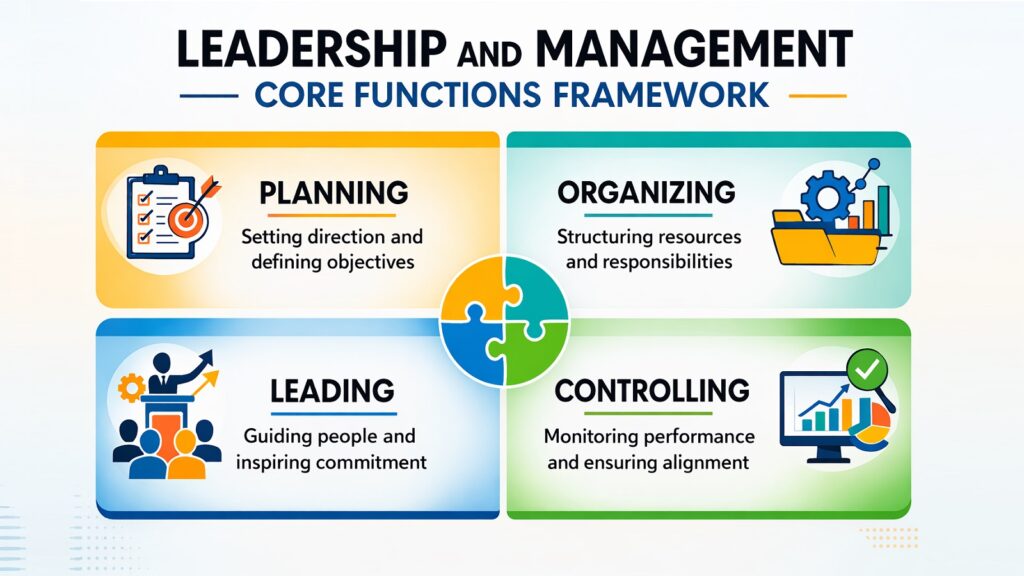
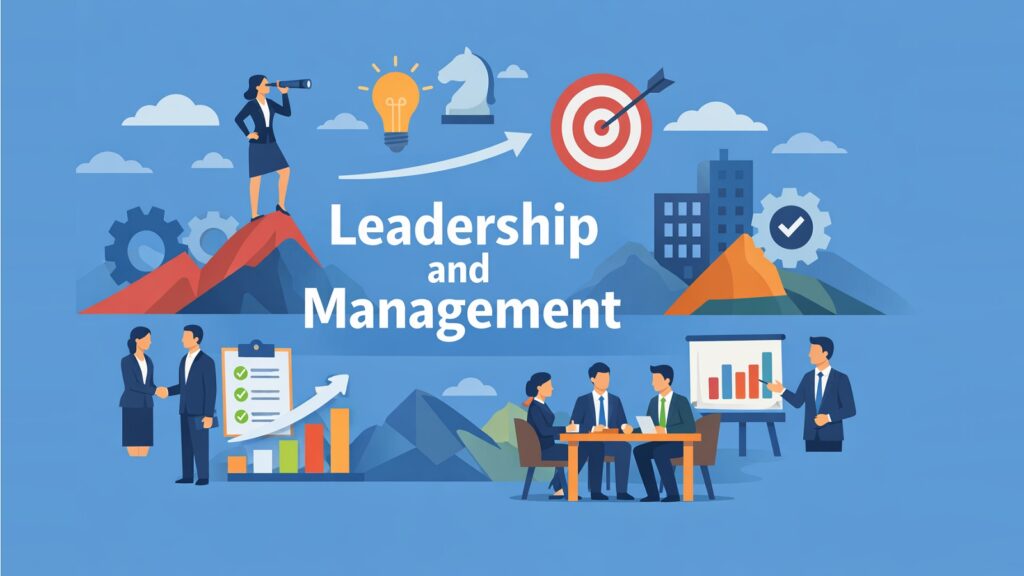
Leadership and management are not just corporate buzzwords. They are important business aspects that keep organizations alive, moving, and worth following. Without one or the other, companies drift or stall. Together, they form the backbone of everything that works in business.
Leadership gives people a reason to show up. It creates direction, meaning, and a sense of purpose that makes the effort feel worthwhile. Management, on the other hand, takes that purpose and builds the structure around it. It organizes people, allocates resources, tracks progress, and makes sure the work actually gets done. One inspires. The other executes. Both are necessary. In the broader landscape of business fundamentals, leadership and management stand out as critical business essentials.
In the broader landscape of modern business fundamentals, leadership and management stand out as critical business essentials. In current times, businesses face a pace of change that older generations of managers never encountered. Technology reshapes industries overnight. Economic conditions shift without warning. Consumer expectations evolve constantly. In this kind of environment, organizations that rely on outdated command-and-control models tend to fall behind. Those with strong leadership and management capabilities tend to adapt, grow, and endure.
Research from McKinsey and Company has consistently shown that organizations with effective leadership at multiple levels outperform their peers in financial results, employee satisfaction, and customer experience. This is not a coincidence. It reflects what happens when people know where they are going and how they are going to get there.
This article explores ten core skills that define strong leadership and management. These are not abstract ideals. They are practical capabilities that leaders and managers use every day to guide teams, build cultures, and turn strategy into results. Each skill reinforces the others. Together, they create organizations that are capable of handling whatever comes next.
Leadership and Management: 10 Core Capabilities at a Glance
| Leadership and Management Skill | Why It Matters |
| Vision Setting | Aligns teams around a shared destination and long-term purpose |
| Strategic Thinking | Helps organizations anticipate change and allocate resources wisely |
| Decision-Making | Translates analysis and judgment into clear, actionable choices |
| Communication | Ensures information, expectations, and direction flow clearly across teams |
| Team Building | Creates collaborative groups that perform reliably under pressure |
| Performance Coaching | Develops individual capability and sustains a culture of improvement |
| Change Leadership | Guides organizations through transitions without losing stability |
| Talent Development | Builds the internal pipeline that organizations need to grow and sustain |
| Accountability and Execution | Turns strategies into measurable results through discipline and follow-through |
| Cultural Stewardship | Shapes the values and behaviors that define how an organization operates |
1. Leadership and Management Through Vision Setting
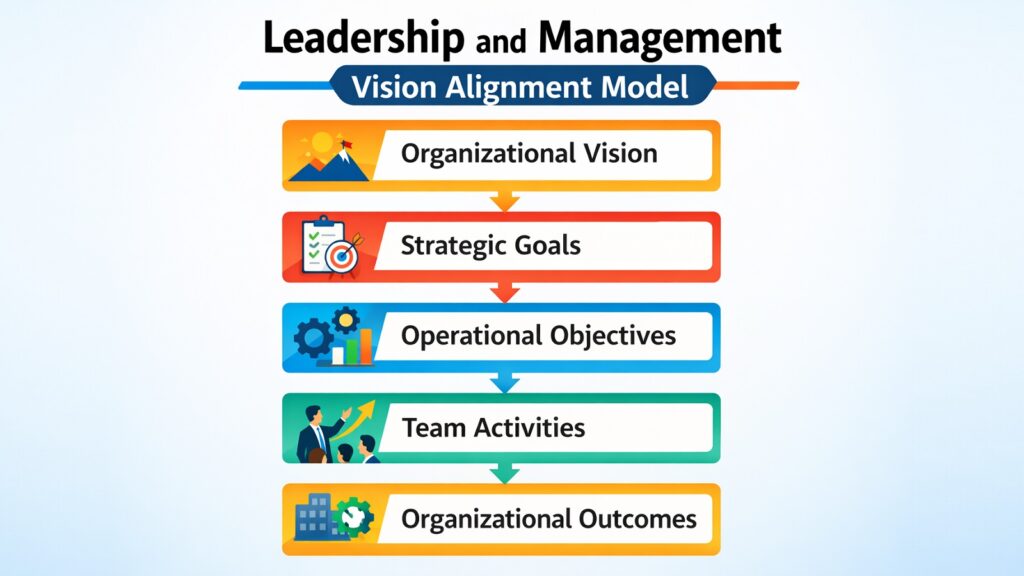
Every organization needs to know where it is going. Without a clear sense of direction, decisions become reactive, teams lose motivation, and resources get wasted on things that do not move the needle. Vision setting is what prevents this from happening.
Leadership plays the primary role here. It defines what the organization is working toward, painting a picture of a future that is both ambitious and believable. The best leaders understand that vision has to be more than a mission statement on a wall. It has to be something people can actually feel and relate to their own work.
Management then takes that vision and translates it into concrete goals, timelines, and plans. This translation work is critical. A vision without a plan is simply a wish. Management creates the structure that makes execution possible.
Research from the Harvard Business Review suggests that companies with clearly communicated strategic visions grow revenues significantly faster than those without one. Employees who understand the vision are more engaged and more likely to make decisions that align with organizational priorities. Vision setting, in this sense, is not just aspirational. It is deeply practical.
Leadership and Management: Vision Setting Principles and Practice
| Vision Setting Element | Description |
| Clarity of Direction | A strong vision answers where the organization is headed in simple, concrete terms |
| Emotional Resonance | Effective visions connect with people’s values and sense of purpose |
| Long-Term Orientation | Vision extends beyond quarterly targets, typically covering three to ten years |
| Strategic Alignment | Daily decisions and team goals should directly connect to the vision |
| Leadership Communication | Leaders must repeat and reinforce the vision consistently across all levels |
| Management Translation | Managers convert the vision into team-level goals, plans, and milestones |
| Adaptability | Visions must be updated when market conditions or organizational realities change significantly |
| Measurability | Progress toward the vision should be tracked through meaningful performance indicators |
2. Leadership and Management Through Strategic Thinking
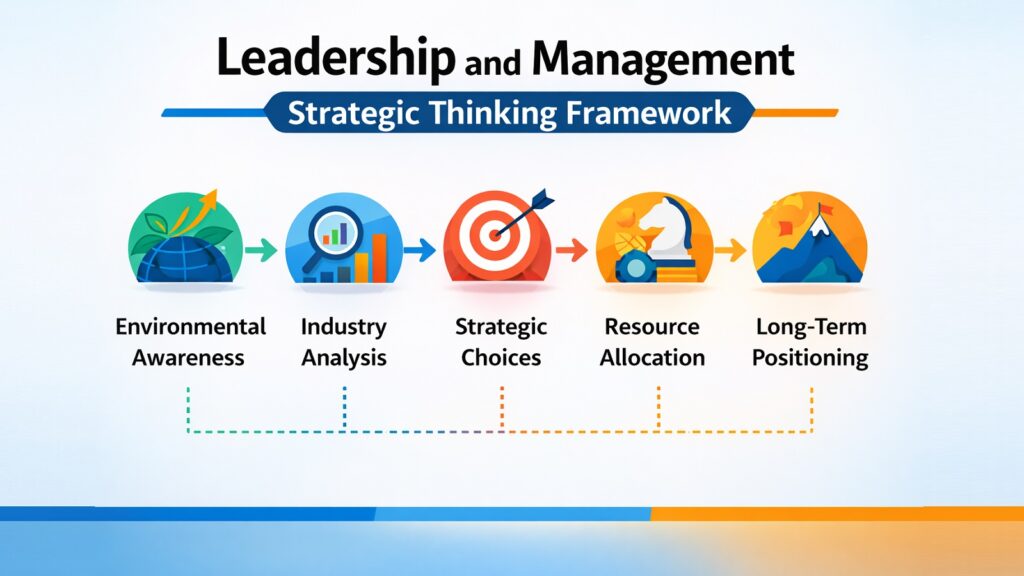
Strategic thinking is the ability to look beyond the immediate horizon. It is what separates leaders who react from leaders who prepare. In competitive environments, the organizations that think ahead consistently outperform those that wait to respond.
Leadership encourages people to ask bigger questions. What trends are shaping our industry? Where will demand be in five years? What do competitors do better than us, and what can we do that they cannot? These questions are not always comfortable, but they are necessary.
Management supports strategic thinking by building processes that analyze markets, evaluate options, and test assumptions. Without management discipline, strategic thinking can remain at the level of interesting conversation. With it, strategic thinking becomes actionable planning.
A study published in the MIT Sloan Management Review found that companies led by executives who scored high on strategic thinking indicators were significantly more likely to achieve above-average returns over a five-year period. The data confirms what experienced leaders already know: thinking clearly about the future is one of the highest-value activities in any organization.
Leadership and Management: Elements of Strategic Thinking
| Strategic Thinking Element | Description |
| Environmental Scanning | Monitoring trends, competitors, regulations, and technology shifts regularly |
| Opportunity Identification | Spotting gaps in the market that align with organizational strengths |
| Risk Assessment | Evaluating potential downsides and planning mitigations before committing resources |
| Scenario Planning | Building multiple future scenarios to prepare for different possible outcomes |
| Resource Allocation | Directing time, money, and talent toward the highest-priority strategic initiatives |
| Competitive Analysis | Understanding the strengths and weaknesses of rivals in the marketplace |
| Innovation Orientation | Encouraging exploration of new approaches rather than defending past practices |
| Long-Range Focus | Keeping attention on outcomes that matter over years, not just quarters |
3. Leadership and Management Through Effective Decision Making
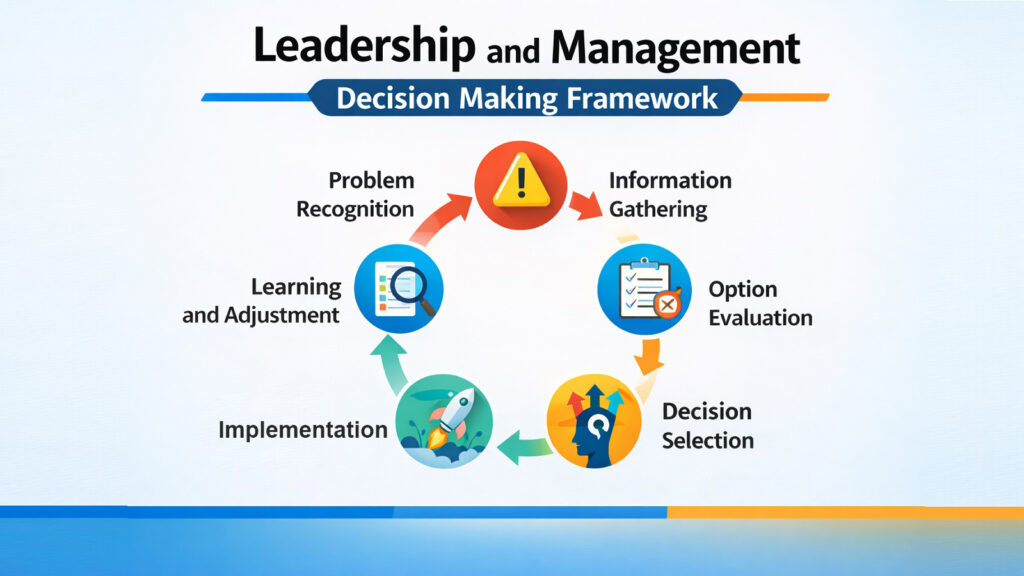
Decision making is where leadership and management become most visible. Every choice a leader makes sends a signal about what matters, what is acceptable, and where the organization is headed. Poor decisions erode trust. Good ones build it.
Leaders face decisions under conditions of uncertainty more often than not. They must weigh incomplete information, competing priorities, and unpredictable consequences. The skill lies in developing a process that is both rigorous and timely. Waiting too long for perfect information is itself a decision with real costs.
Management provides the analytical infrastructure that supports better decisions. Data systems, performance dashboards, financial models, and structured review processes all give leaders better inputs. But good decision making also requires judgment, which comes from experience and the willingness to learn from previous outcomes.
Research from the consulting firm Bain and Company found that organizations with strong decision-making capabilities are nearly six times more likely to report above-average financial performance than those with weak ones. Decision quality is not luck. It is a learnable, improvable skill.
Leadership and Management: Decision Making Practices That Drive Results
| Decision Making Practice | Description |
| Data-Informed Analysis | Using available evidence to evaluate options before committing to a course of action |
| Stakeholder Input | Gathering perspectives from those affected by or knowledgeable about the decision |
| Clear Decision Rights | Defining who is authorized to make which decisions at each organizational level |
| Timely Commitment | Avoiding prolonged indecision by setting deadlines for resolution on key issues |
| Bias Awareness | Recognizing cognitive shortcuts that distort judgment such as confirmation bias |
| Scenario Testing | Asking what happens under different conditions before finalizing a decision |
| Post-Decision Review | Evaluating outcomes after implementation to learn and improve future decisions |
| Transparent Rationale | Communicating the reasoning behind decisions to maintain trust and understanding |
4. Leadership and Management Through Clear Communication
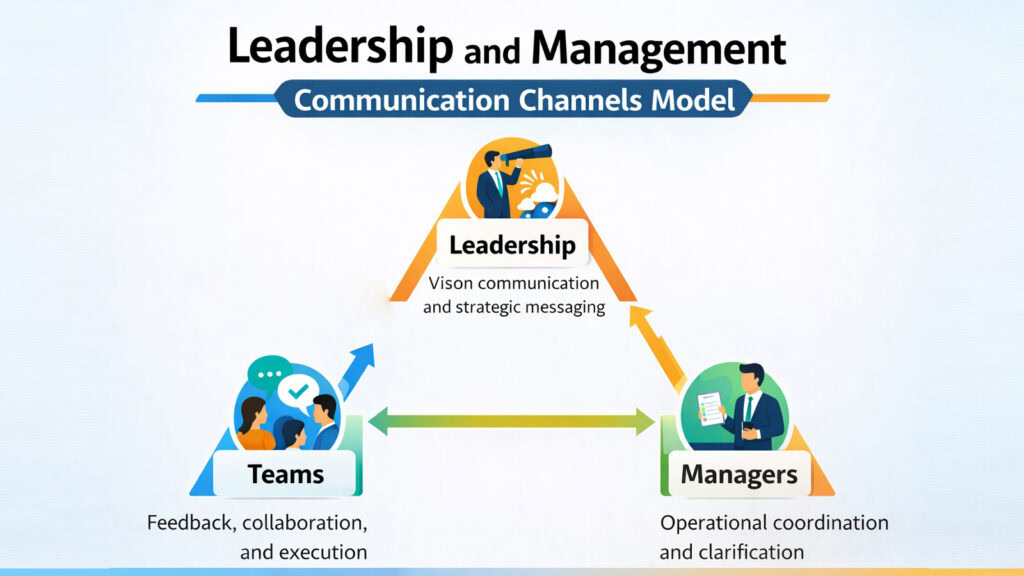
Organizations run on communication. When it works well, people know what is expected, collaboration flows, and trust builds steadily over time. When it breaks down, confusion spreads, effort gets duplicated, and morale erodes faster than most leaders anticipate.
Leadership communication is primarily about meaning and direction. Leaders must convey why the organization exists, where it is heading, and what values guide behavior. They also communicate in moments of uncertainty, when people most need clarity and reassurance.
Management communication focuses more on coordination and execution. It ensures that goals are clearly understood at every level, that feedback reaches the people who need it, and that problems get surfaced before they become crises.
A Gallup study of employee engagement found that workers who feel their manager communicates openly with them are nearly three times more likely to be engaged at work. Engagement, in turn, correlates directly with productivity, retention, and customer satisfaction. Clear communication, then, is not a soft skill. It is a business driver.
Leadership and Management: Communication Practices That Build Trust
| Communication Practice | Description |
| Active Listening | Giving full attention to others rather than waiting to speak or formulating responses early |
| Message Clarity | Using simple, direct language that people at all levels can understand and act on |
| Consistent Messaging | Repeating key priorities and values frequently so they become part of team culture |
| Two-Way Dialogue | Creating space for questions, concerns, and feedback rather than top-down broadcasting |
| Transparent Updates | Sharing organizational news, changes, and progress regularly and honestly |
| Audience Awareness | Adjusting communication style and depth for different teams, roles, and situations |
| Nonverbal Alignment | Ensuring body language and tone match the words being said in important conversations |
| Feedback Culture | Building an environment where honest, respectful feedback flows in all directions |
5. Leadership and Management Through Team Building
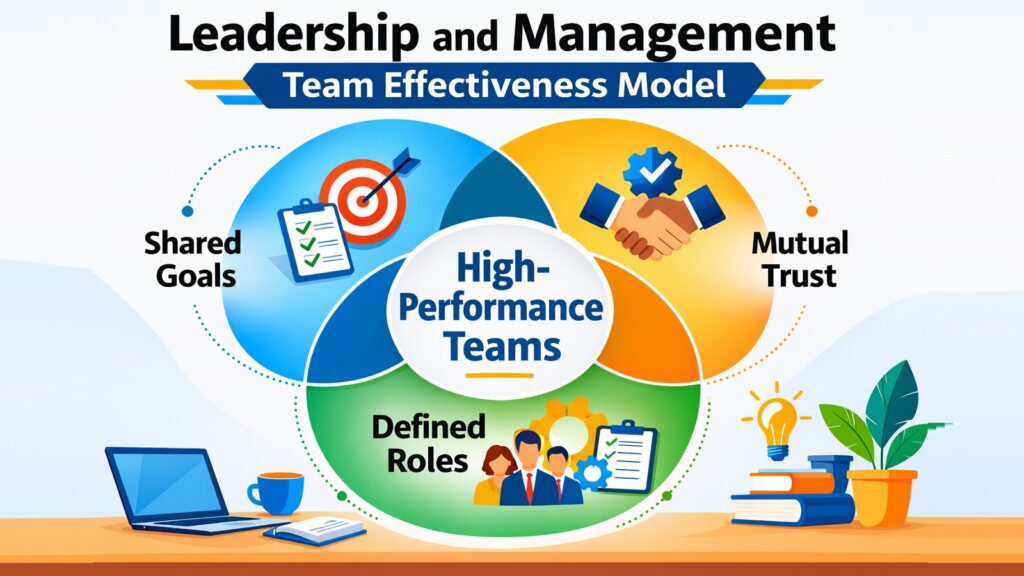
No leader or manager succeeds alone. The people around them determine what is actually possible. Team building is the practice of deliberately creating groups that are capable of doing more together than any individual could do separately.
Leadership contributes to team building by modeling the behaviors it wants to see. When leaders show vulnerability, collaborate openly, and give credit generously, teams tend to follow that example. Culture in a team almost always reflects the behavior of the person at the top.
Management structures the practical side of teamwork. Clear roles, defined processes, realistic workloads, and regular check-ins all make it easier for people to contribute their best work. Without this structure, even a talented group can become disorganized and frustrated.
Research from Google’s Project Aristotle, which studied hundreds of internal teams over several years, found that psychological safety was the single most important factor in team performance. Teams where people felt safe to take risks and speak honestly consistently outperformed those driven by fear or excessive competition.
Leadership and Management: Team Building Factors That Improve Performance
| Team Building Factor | Description |
| Psychological Safety | Creating an environment where people feel safe to speak, question, and take risks |
| Clear Role Definition | Ensuring every team member understands their responsibilities and boundaries |
| Shared Goals | Aligning the team around outcomes everyone understands and is committed to achieving |
| Diverse Perspectives | Bringing together people with different backgrounds, skills, and ways of thinking |
| Trust Building | Encouraging honesty, reliability, and mutual respect as core team behaviors |
| Conflict Resolution | Addressing disagreements constructively and quickly before they damage collaboration |
| Recognition Practices | Acknowledging individual and team contributions regularly and meaningfully |
| Team Rituals | Using regular check-ins, retrospectives, and shared routines to strengthen cohesion |
6. Leadership and Management Through Performance Coaching
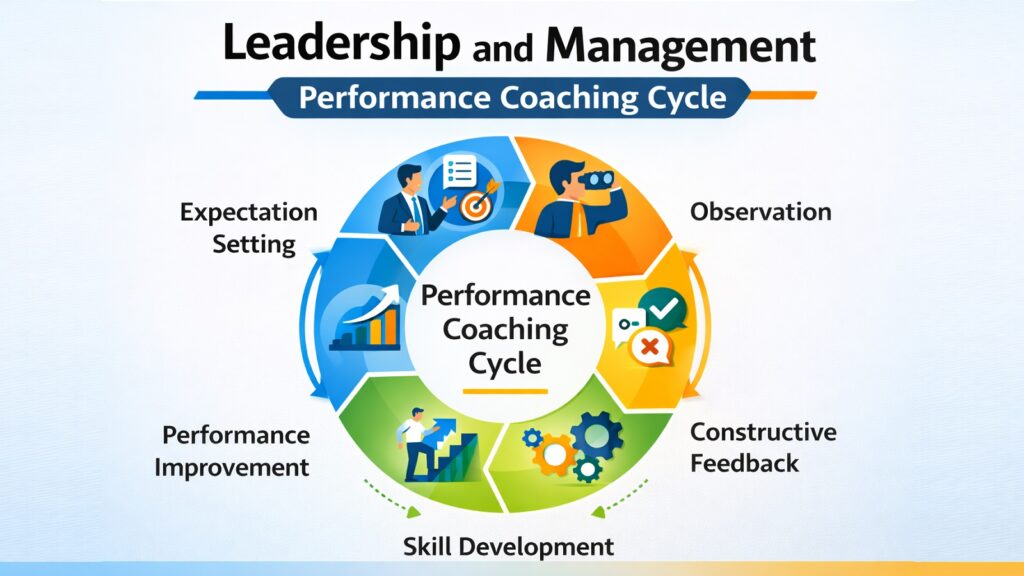
People grow when they receive honest feedback and genuine support. Performance coaching is the practice of helping individuals become better at their work through structured conversations, skill development, and consistent encouragement.
Leadership brings the mindset that coaching requires. A leader who coaches believes that people are capable of more than they currently demonstrate, and that the leader’s role includes drawing out that potential. This is different from simply telling people what to do.
Management creates the systems that make coaching sustainable at scale. Performance evaluations, development plans, goal-setting frameworks, and regular one-on-one meetings all give managers the structure to coach effectively without making it feel improvised or unpredictable.
The International Coaching Federation has reported that organizations that implement strong coaching cultures see measurably higher employee engagement scores and lower voluntary turnover. When people feel invested in, they tend to invest back. Coaching is one of the highest-return activities a manager can engage in.
Leadership and Management: Performance Coaching Practices That Develop People
| Coaching Practice | Description |
| Regular One-on-Ones | Scheduled individual conversations focused on development, progress, and challenges |
| Strengths-Based Feedback | Identifying what someone does well and building on those areas intentionally |
| Constructive Challenge | Pushing people beyond their comfort zone in ways that build skills, not anxiety |
| Goal Co-Creation | Setting development goals collaboratively so employees feel ownership over their growth |
| Observation and Specificity | Providing feedback based on direct observation rather than general impressions |
| Development Planning | Creating written plans that outline skills to build, actions to take, and timelines |
| Accountability Check-ins | Following up on previous commitments to reinforce consistency and growth |
| Recognition of Progress | Celebrating improvement and milestones to sustain motivation over time |
7. Leadership and Management Through Change Leadership
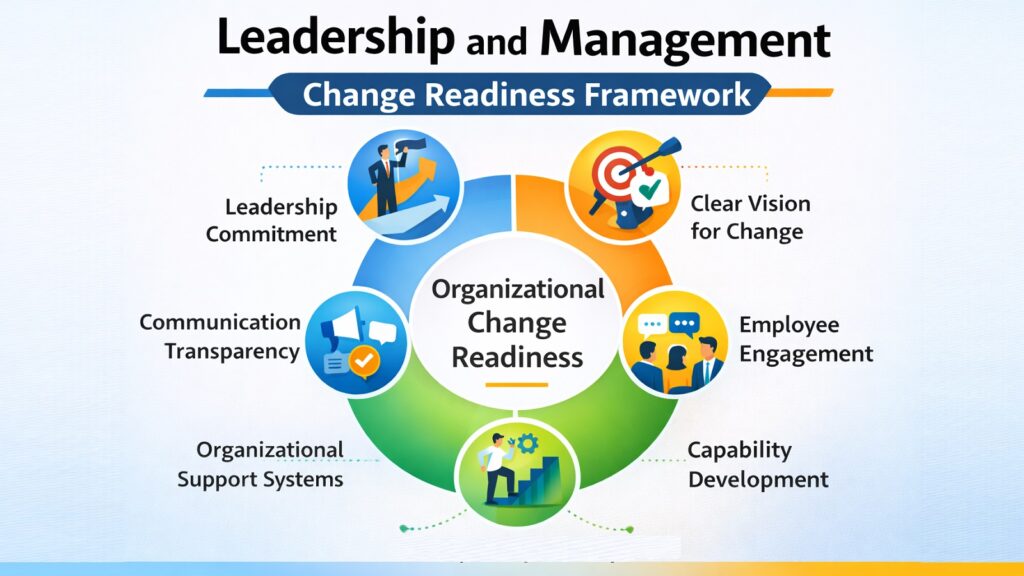
Change is not optional. Markets shift, technologies emerge, customer needs evolve, and organizations that refuse to adapt eventually become irrelevant. The question is never whether change will come. The question is how well an organization will handle it.
Leadership plays the most visible role during change. Leaders must communicate the reason for change clearly, acknowledge the difficulty it creates, and project enough confidence to give people faith in the journey. Fear and ambiguity are the enemies of successful transformation.
Management provides the discipline that keeps transitions from becoming chaos. Structured project plans, clear timelines, defined roles during transition, and regular status updates all reduce the uncertainty that makes change painful. Management turns a vision of change into a workable process.
John Kotter, a professor at Harvard Business School, developed one of the most widely referenced models of organizational change. His research, drawn from studying hundreds of change initiatives, found that most failures occur when organizations underestimate the need to build urgency and engage people early. Successful change requires both the inspiration that leadership provides and the structure that management delivers.
Leadership and Management: Change Leadership Principles for Smooth Transitions
| Change Leadership Principle | Description |
| Urgency Creation | Helping people understand why the change is necessary and why it cannot wait |
| Vision of Change | Communicating clearly where the organization will be after the transition is complete |
| Stakeholder Engagement | Involving affected groups in planning to reduce resistance and build ownership |
| Communication Frequency | Providing consistent updates before, during, and after major transitions |
| Structured Planning | Creating detailed implementation plans with milestones, owners, and deadlines |
| Resistance Management | Identifying and addressing concerns before they become obstacles to progress |
| Quick Wins | Achieving and celebrating small victories early to demonstrate momentum and possibility |
| Sustaining Momentum | Reinforcing new behaviors and practices until they become part of normal operations |
8. Leadership and Management Through Talent Development
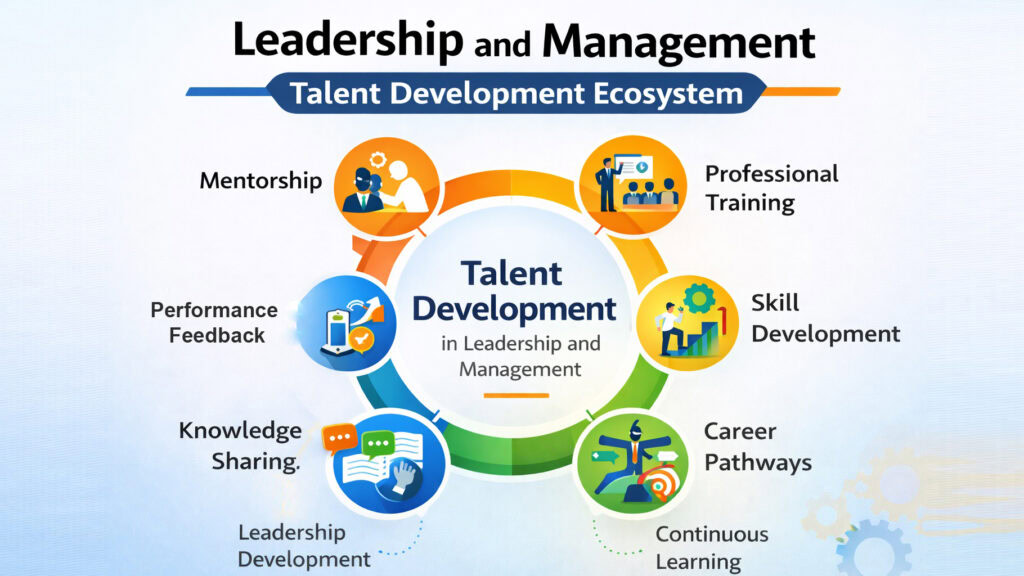
Organizations are only as capable as the people within them. Talent development is the deliberate practice of identifying, growing, and retaining individuals who have the potential to contribute more over time.
Leadership sets the tone for talent development by treating it as a strategic priority rather than an HR formality. Leaders who actively mentor others, sponsor high-potential employees, and advocate for development budgets signal that people matter to the organization’s future.
Management provides the infrastructure. Training programs, succession planning processes, mentorship structures, and career development frameworks all give talent a pathway to grow. Without this infrastructure, even the best intentions produce little result.
Deloitte’s Global Human Capital Trends research has consistently found that organizations with strong talent development practices report significantly higher levels of employee engagement and organizational agility. The logic is straightforward. When people see a future for themselves inside an organization, they commit more fully to its success. When they do not, they leave, taking capability and institutional knowledge with them.
Leadership and Management: Talent Development Strategies That Build Organizational Strength
| Talent Development Strategy | Description |
| High-Potential Identification | Recognizing employees who demonstrate both performance and future leadership capacity |
| Mentorship Programs | Pairing developing employees with experienced leaders for guidance and exposure |
| Structured Training | Providing role-relevant learning through internal programs, courses, and workshops |
| Stretch Assignments | Giving talented employees challenging projects that expand their skills and confidence |
| Succession Planning | Identifying internal candidates who can step into critical roles when vacancies arise |
| Career Pathing | Defining clear progression routes so employees can see how to grow within the organization |
| Learning Culture | Creating norms where continuous learning is expected, encouraged, and rewarded |
| Cross-Functional Exposure | Rotating talented employees across departments to broaden perspective and capability |
9. Leadership and Management Through Accountability and Execution
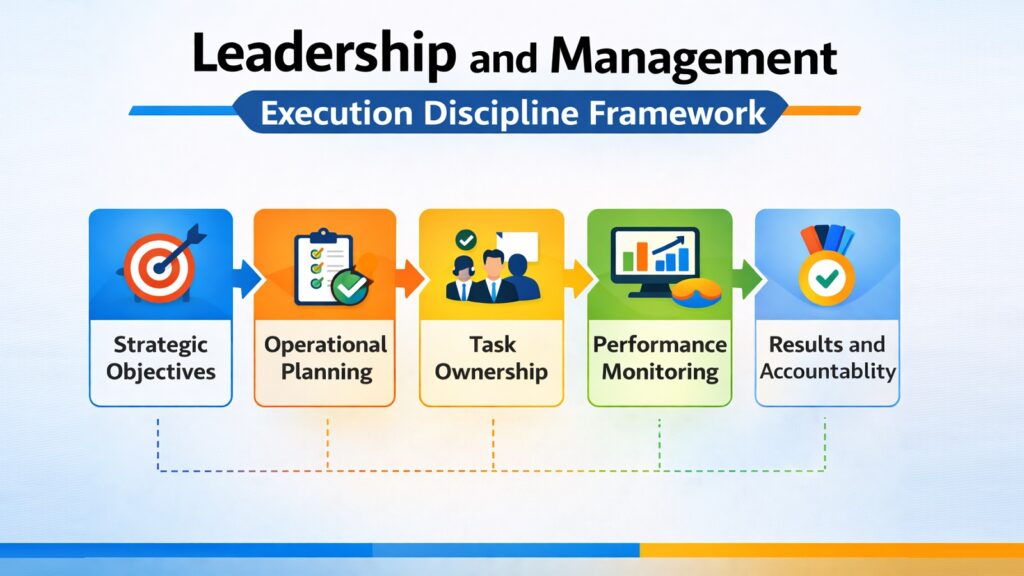
Strategies are only as good as their execution. Many organizations develop thoughtful plans that never fully materialize because accountability breaks down somewhere between vision and delivery. Leadership and management together must ensure that plans translate into real outcomes.
Leadership establishes accountability by setting clear expectations and holding people to them consistently. When leaders enforce standards fairly and transparently, teams learn that commitments are meant seriously. This creates a culture where follow-through becomes the norm rather than the exception.
Management builds the systems that make execution visible. Key performance indicators, progress reviews, project tracking tools, and performance conversations all help managers identify where things are on track and where intervention is needed. Without these systems, accountability depends entirely on individual initiative, which is unreliable at scale.
Research from the Project Management Institute has shown that organizations with mature project execution practices complete significantly more of their strategic initiatives on time and within budget compared to those without such practices. Execution discipline is not micromanagement. It is the scaffolding that keeps the strategy from collapsing under its own weight.
Leadership and Management: Accountability and Execution Practices That Deliver Results
| Execution Practice | Description |
| Clear Goal Setting | Defining specific, measurable outcomes with deadlines at individual and team levels |
| Performance Metrics | Using key indicators to track progress toward strategic and operational goals |
| Regular Progress Reviews | Holding structured check-ins to assess status, surface obstacles, and adjust plans |
| Ownership Assignment | Making sure every priority has a named individual responsible for its completion |
| Consequence Clarity | Communicating what happens when commitments are met and when they are not |
| Obstacle Removal | Identifying and eliminating barriers that prevent people from delivering on their goals |
| Celebration of Achievement | Recognizing when targets are met to reinforce the behaviors that led to success |
| Transparent Reporting | Sharing performance results openly so teams understand where the organization stands |
10. Leadership and Management Through Cultural Stewardship
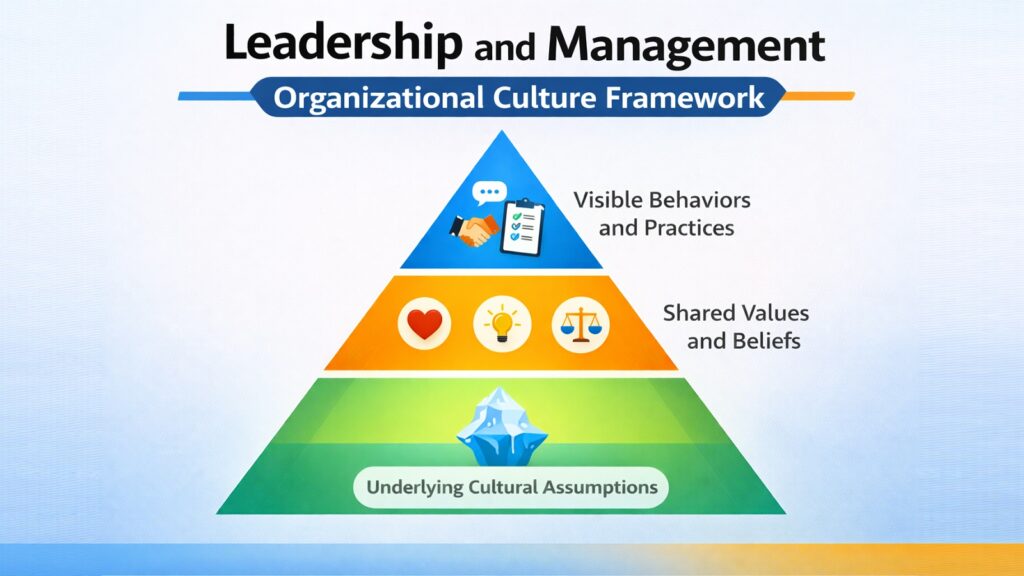
Culture is the invisible force that shapes how people behave when no one is watching. It determines how decisions get made, how conflict gets handled, how customers get treated, and how much people trust one another. Culture either supports organizational goals or quietly works against them.
Leadership influences culture more than any other factor. The values a leader demonstrates in daily behavior, the decisions they make under pressure, and the things they choose to reward or ignore all shape the culture of a team or organization. Edgar Schein, a widely respected organizational theorist who taught at MIT Sloan, wrote that culture is ultimately created and sustained by the behavior of leaders at the top. The behavior matters far more than what is written on value statements.
Management reinforces culture through policies, hiring practices, performance standards, and the expectations set in everyday interactions. When management practices align with stated values, culture feels authentic. When they contradict values, cynicism spreads.
Organizations with strong, positive cultures consistently outperform those without them. Research from the Great Place to Work Institute has found that companies listed among the best workplaces generate stock returns roughly three times higher than the broader market over the long term. Culture is not a peripheral concern. It is a source of competitive advantage.
Leadership and Management: Cultural Stewardship Practices That Shape Strong Organizations
| Cultural Stewardship Practice | Description |
| Values Modeling | Leaders demonstrating the organization’s stated values through consistent daily behavior |
| Hiring for Culture | Selecting candidates whose values and behaviors align with the organizational culture |
| Recognition Alignment | Rewarding behaviors that reflect desired cultural values rather than just outcomes |
| Inclusive Leadership | Creating environments where diverse voices are heard and valued consistently |
| Psychological Safety | Building conditions where honesty and transparency are welcomed, not penalized |
| Storytelling | Using examples and narratives to reinforce culture and remind people of what the organization stands for |
| Policy Alignment | Ensuring organizational policies are consistent with the values leadership espouses |
| Culture Assessment | Regularly measuring culture through surveys and feedback to track health and identify gaps |
Conclusion: How Leadership and Management Create Enduring Organizational Strength
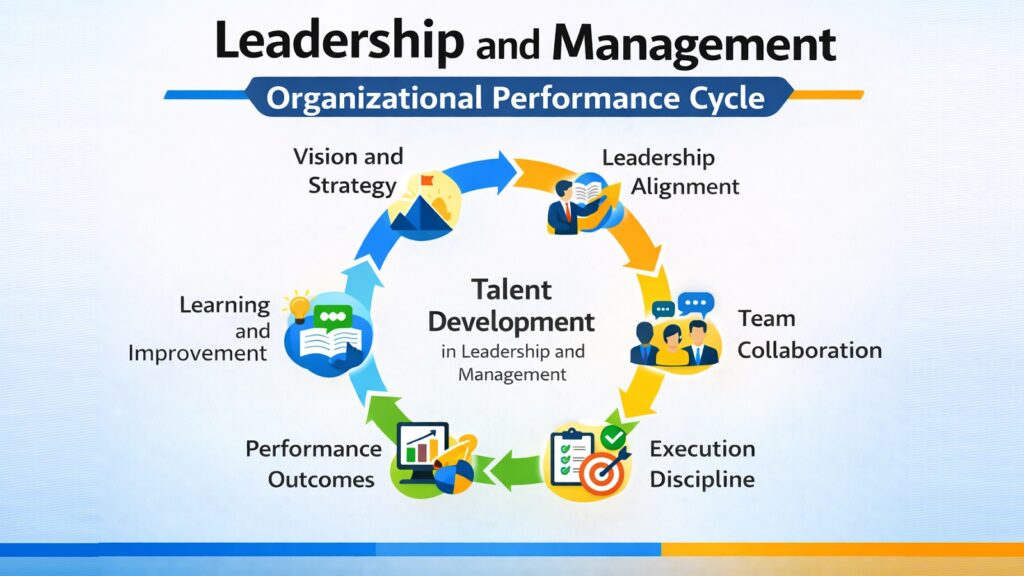
Leadership and management are not competing forces. They are partners in the ongoing work of building organizations that matter. Leadership supplies the direction, the inspiration, and the courage to move into uncertain territory. Management provides the structure, the discipline, and the processes that turn aspiration into achievement.
The ten leadership and management skills explored in this article represent the practical core of what it means to lead and manage effectively. Vision setting establishes where an organization is going. Strategic thinking ensures it prepares for what is coming. Decision-making keeps the organization moving forward with clarity. Communication ensures people understand and stay connected to what matters. Team building creates the collective strength that no individual leader can possess alone.
Performance coaching develops people continuously rather than leaving growth to chance. Change leadership helps organizations navigate transformation without losing cohesion. Talent development builds the human capability that sustains organizations across generations of leadership. Accountability and execution ensure that plans produce real results rather than remaining on paper. And cultural stewardship creates the invisible fabric that holds everything together across time and pressure.
None of these skills operates in isolation. They reinforce each other. A leader who sets a strong vision but fails to communicate it will find the team moving in different directions. A manager who builds strong execution systems but neglects culture will find those systems resisted from within. Sustainable organizational strength comes from developing all of these capabilities together, over time, with genuine commitment.
Leadership and management are not destinations. They are ongoing practices that require continuous attention, honest self-assessment, and a willingness to keep learning. Organizations that invest in developing these capabilities at every level build something more valuable than any single product or strategy: the enduring ability to grow, adapt, and succeed.
Leadership and Management: How Each Skill Contributes to Long-Term Organizational Success
| Leadership and Management Skill | Long-Term Organizational Impact |
| Vision Setting | Keeps organizations focused and aligned during periods of uncertainty and rapid change |
| Strategic Thinking | Positions organizations to seize emerging opportunities before competitors recognize them |
| Decision Making | Builds organizational credibility and speed of response through consistent, sound judgment |
| Communication | Creates the trust and clarity that sustain high engagement and cross-functional collaboration |
| Team Building | Develops collective resilience and shared accountability that outlast individual contributors |
| Performance Coaching | Produces a workforce that improves continuously and stays engaged over time |
| Change Leadership | Enables organizations to adapt to disruption without losing direction or people |
| Talent Development | Builds a pipeline of capable leaders and practitioners that fuels long-term growth |
| Accountability and Execution | Ensures strategic investments consistently translate into measurable business results |
| Cultural Stewardship | Sustains the values and behaviors that keep organizations healthy, ethical, and competitive |