Table of Contents
Introduction: Learn Physics Faster by Rethinking How Physics Is Learned
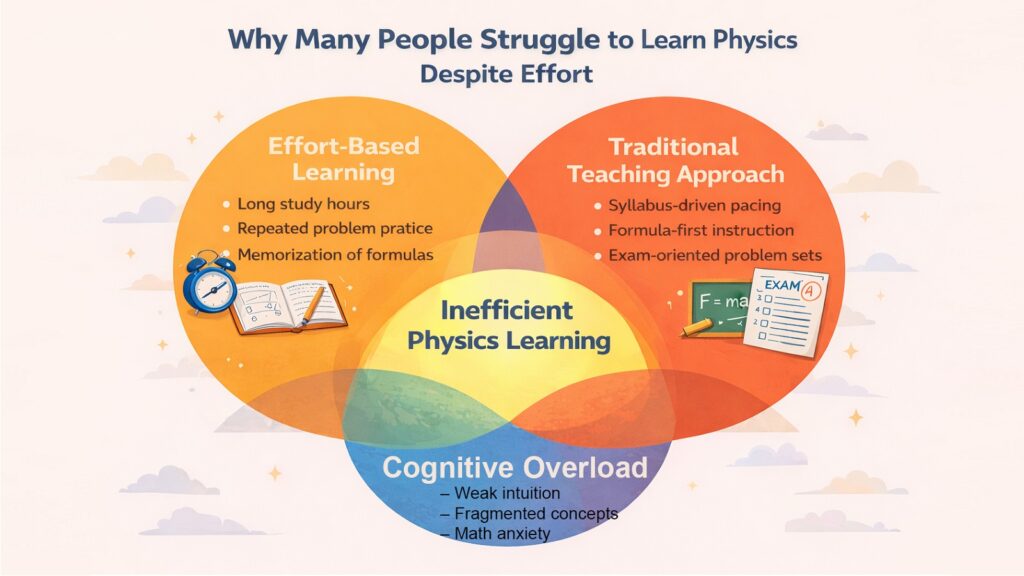
Physics stands among the most vital disciplines within STEM education. It explains everything from the smallest particles to the largest galaxies. Yet countless students and self-learners struggle with it. They spend hours memorizing formulas and grinding through problems. Still, progress feels slow. Understanding remains shallow.
The issue is not that physics is impossibly hard. The real problem lies in how most people approach it. Traditional methods emphasize memorization over comprehension. They prioritize calculation over intuition. This approach creates mental roadblocks that slow learning to a crawl.
Learning physics faster requires a shift in thinking. It demands new mental models that align with how the subject actually works. These models help learners see patterns instead of chaos. They build understanding that transfers across problems.
This article explores eight proven mental models that accelerate physics learning. These are not shortcuts or exam tricks. They are ways of thinking that help learners at every level build genuine understanding. When applied consistently, these models transform how quickly and deeply someone can learn physics.
Common Approaches and Their Impact When You Learn Physics
| Learning Approach | Impact on Understanding |
|---|---|
| Memorizing equations without context | Creates fragile knowledge that fails under new conditions |
| Solving problems without building intuition | Leads to mechanical calculation without real comprehension |
| Studying isolated topics separately | Prevents transfer of understanding across different areas |
| Focusing only on mathematical manipulation | Misses the physical meaning behind the symbols |
| Avoiding mistakes by staying comfortable | Slows identification of conceptual gaps |
| Relying exclusively on one representation | Creates blind spots in different problem types |
| Reading without explaining concepts | Hides gaps in understanding |
| Learning without real-world connections | Makes abstract ideas feel disconnected |
1. Learn Physics Faster by Seeing Physics as a Language, Not a Formula List
Most learners treat physics equations like magic spells to memorize. They see F=ma and think about passing the test. They miss what the equation actually says. This approach makes learning physics unnecessarily difficult.
Efficient learners think differently. They treat physics as a language that describes how nature behaves. Each equation tells a story about reality. The symbols represent real things that exist and interact. When you understand physics as a language, formulas stop being random. They become meaningful statements about the world.
Consider Newton’s second law. Most people see F=ma and memorize it. But this equation is actually a sentence. It says that force is the language we use to describe how motion changes. Mass tells us how resistant something is to that change. The equals sign shows a fundamental relationship.
This mental shift changes everything. When equations have meaning, they become easier to remember naturally. You understand what they express. You can reconstruct them from principles rather than pure recall. You can see when to use them because you know what they say about physical situations.
Energy conservation is not just a formula to plug numbers into. It is a statement that energy transforms but never disappears. Momentum conservation says that isolated systems keep their total motion unchanged. These are descriptions of how the universe actually operates.
Understanding Equations to Learn Physics More Effectively
| Physics Equation | What It Describes |
|---|---|
| F = ma | Force describes how and why motion changes |
| E = mc² | Mass and energy are different forms of same thing |
| W = Fd | Work measures energy transfer through force |
| P = mv | Momentum captures mass in motion |
| KE = ½mv² | Kinetic energy grows with velocity squared |
| U = mgh | Gravitational potential stores energy by position |
| v = fλ | Wave speed emerges from frequency and wavelength |
| Q = mcΔT | Heat transfer depends on mass and temperature change |
2. Learn Physics Faster by Building Intuition Before Solving Problems
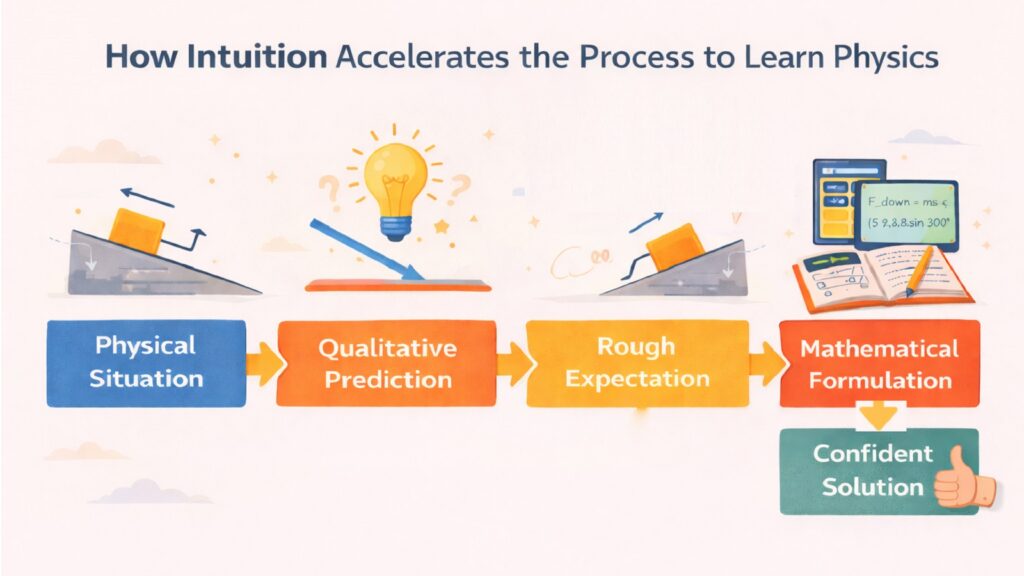
Many learners open their textbooks and immediately start calculating. They see a problem and reach for equations. But jumping straight to math actually slows down learning physics in the long run.
Strong learners pause before calculating. They ask what should happen physically. They build intuition about the situation first. Over time, this dramatically accelerates understanding. It prevents errors. It builds confidence. It makes problem-solving faster.
Intuition in physics means having a rough sense of what answer makes sense. If you drop a ball from a building, you should know it accelerates downward before calculating. If you push a heavy box, you should sense that it moves less than a light box with the same force.
Building intuition starts with simple questions. What forces act here? Which direction will things move? Should the answer be big or small? These questions engage your physical understanding before engaging your calculator.
This approach catches mistakes early. If your calculation says a car moving at fifty meters per second after a minor collision started at five, intuition flags the error. Without intuition, such mistakes go unnoticed.
Intuition also transfers across problems. Once you develop intuition about momentum, you recognize momentum situations quickly. Learning compounds. Each problem strengthens intuition for the next one.
Building Physical Intuition to Learn Physics Successfully
| Intuition Practice | How It Helps |
|---|---|
| Predicting outcomes before calculating | Creates mental models of physics behavior |
| Estimating answer magnitudes | Develops sense of scale and catches errors |
| Visualizing motion and forces | Builds spatial reasoning |
| Asking what happens in extreme cases | Tests whether understanding holds at limits |
| Comparing similar situations | Reveals patterns and builds recognition |
| Thinking about symmetry | Identifies shortcuts and confirms results |
| Questioning if answers make sense | Develops critical thinking about results |
| Noticing problem similarities | Accelerates solution of new problems |
3. Learn Physics Faster by Focusing on Relationships, Not Isolated Concepts
Physics textbooks are organized into chapters. Motion lives in chapter three. Energy appears in chapter six. This organization suggests that physics concepts exist separately. Nothing could be further from the truth.
Physics is fundamentally about relationships. Motion relates to force through Newton’s laws. Force connects to energy through work. Energy links to momentum through transformations. These relationships are the substance of physics itself.
Learners struggle when they treat topics as isolated chapters. They study kinematics and think they understand motion. Then the dynamics confuse them. Each new chapter feels like starting over. Learning physics becomes grinding repetition.
Efficient learners actively look for connections. They ask how new ideas relate to previous ones. They build a web of understanding where each concept supports others. This approach transforms learning from linear accumulation to networked growth.
Consider the relationship between force and energy. Force applied over distance transfers energy. This single relationship unlocks dozens of problems. Understanding their connection means you can check one perspective against another.
This relational thinking helps you learn physics across different levels. High school physics introduces basic mechanics. College physics adds sophistication. But relationships remain consistent. New levels add depth rather than replacement.
Key Relationships to Learn Physics Through Connections
| Relationship | How It Helps Understanding |
|---|---|
| Force and acceleration through mass | Links causes of motion to observed effects |
| Work and kinetic energy change | Connects force to speed changes |
| Potential and kinetic energy exchange | Explains speed changes during falling or rising |
| Momentum and impulse | Shows force over time creates motion changes |
| Electric field and force on charges | Relates abstract field to concrete forces |
| Current, voltage, and resistance | Unifies three electrical quantities |
| Frequency and period as inverses | Simplifies wave analysis |
| Pressure, force, and area | Explains penetration and weight distribution |
4. Learn Physics Faster by Respecting Assumptions and Limits
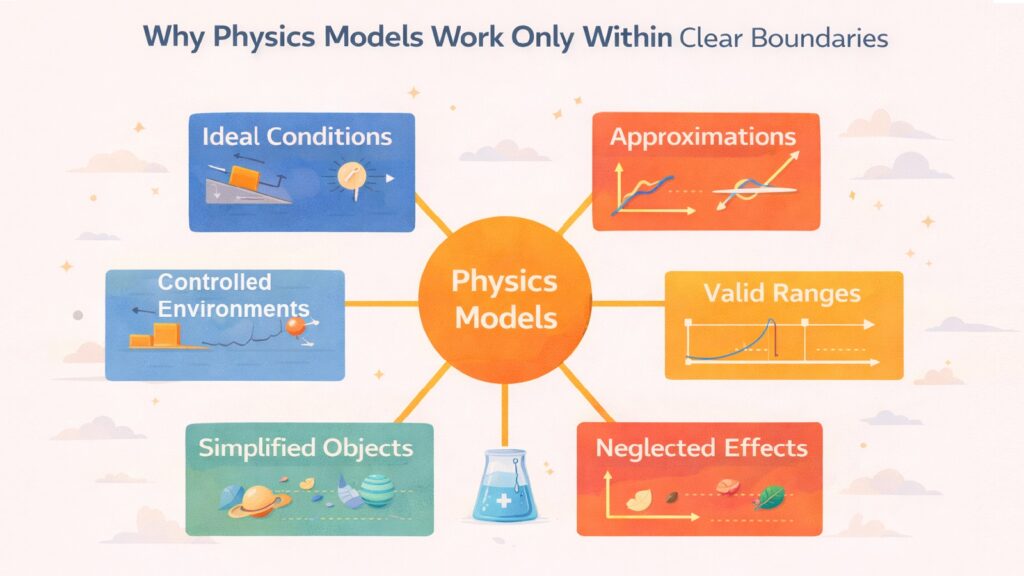
Every physics model comes with assumptions. Frictionless surfaces. Point masses. Ideal gases. These assumptions simplify reality so we can understand it. But they also create limits on when models apply.
Confusion in learning physics often traces back to ignoring assumptions. Students apply formulas where underlying assumptions break down. They get wrong answers and feel frustrated. But the physics works fine. The problem is applying models beyond their valid range.
Consider projectile motion. The standard model assumes constant gravity and no air resistance. Under these assumptions, trajectories are perfect parabolas. Students learn this and think they understand how things fly.
Then someone asks about a real baseball. The model gives wrong answers. The ball does not travel as far as predicted. Does this mean physics failed? No. It means the assumptions changed. Air resistance matters for real baseballs.
Efficient learners pay attention to assumptions from the start. They ask when each model applies. They develop a sense of model boundaries. This awareness prevents confusion and wrong answers.
Understanding limits also helps you learn physics more deeply. When you know why friction is ignored in introductory problems, you appreciate why it appears in advanced work. Each limitation points toward deeper physics waiting to be learned.
Model Assumptions and Limits
| Assumption | Application Context |
|---|---|
| Frictionless surface | Works for ideal short-time problems but fails for real sliding motion |
| Point mass | Works when objects are small compared to distances involved |
| Constant gravity | Works near Earth’s surface but fails for large altitude changes |
| Ideal spring | Works for small displacements but fails with large stretches |
| No air resistance | Works for dense objects at low speeds but fails otherwise |
| Rigid body | Works for slow accelerations but fails under high forces |
| Perfect insulator | Works for theoretical analysis but fails with real materials |
| Classical mechanics | Works at everyday scales but fails near light speed or atomic scales |
5. Learn Physics Faster by Treating Mistakes as Feedback, Not Failure
Fear of mistakes slows learning in every subject. In physics, this fear becomes especially harmful. Physics problems have definite answers. This binary outcome makes mistakes feel like failures. Many learners avoid challenging problems and stick to safe calculations.
This protective approach backfires. It prevents you from discovering where your understanding breaks down. It keeps gaps hidden. Real learning requires finding and fixing these gaps. Mistakes are the fastest way to locate them.
Efficient learners treat wrong answers differently. They see mistakes as valuable feedback. Each error reveals something about their mental model of physics. Maybe they misunderstood which forces act. Maybe they confused similar concepts. The mistake is diagnostic information.
Consider solving a momentum problem incorrectly. Most learners feel frustrated and move on. Better learners investigate. They ask why their approach failed. They identify the specific conceptual gap. This takes extra minutes but prevents the same mistake on future problems.
This feedback-driven mindset changes how you practice. Instead of doing similar problems for confidence, you actively seek challenges. You look for situations where intuition fails. Each mistake teaches something that correct answers cannot.
The emotional shift matters as much as the intellectual one. When mistakes feel like learning rather than failure, physics becomes less stressful. You can learn physics faster because you spend less energy protecting your ego.
Using Errors as Tools to Learn Physics Effectively
| Type of Mistake | What It Reveals |
|---|---|
| Wrong force diagram | Gaps in understanding which forces act |
| Sign error in equations | Confusion about direction or vectors |
| Units that do not match | Misunderstanding of dimensional analysis |
| Answer off by factor of two | Missed symmetry or double counting |
| Completely wrong magnitude | Fundamental misunderstanding of concept |
| Correct method but calculation error | Understanding solid but care needed |
| Right idea but wrong formula | Confusion between similar concepts |
| Solution violating physics principles | Need to strengthen physical intuition |
6. Learn Physics Faster by Moving Between Visual and Mathematical Thinking
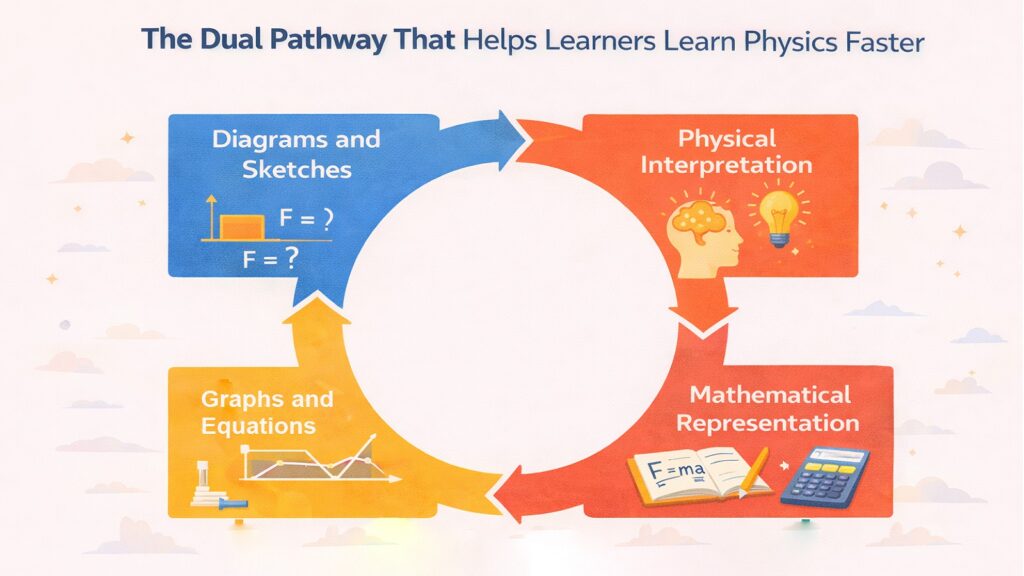
Physics exists at the intersection of visual and mathematical thinking. Diagrams show spatial relationships. Equations capture precise relationships. Neither perspective alone suffices. Real mastery requires moving fluidly between them.
Many learners lean heavily on one mode. Some visualize everything but struggle with quantitative problems. Others manipulate symbols skillfully but cannot draw a free-body diagram. Both approaches create blind spots. Learning physics efficiently requires balance.
Free-body diagrams illustrate this perfectly. These simple drawings show all forces acting on an object. A good diagram makes the physics visible. You see forces. You identify components. The mathematical work that follows becomes easier because the diagram organizes your thinking.
Graphs provide another powerful visual tool. Plotting position against time reveals motion patterns at a glance. Energy graphs demonstrate conservation principles visually. These representations complement equations.
The reverse direction matters equally. After drawing a diagram, translate it into mathematics. Write equations that capture what the picture shows. This translation builds deep connections between visual intuition and quantitative precision.
Switching between modes also catches errors. If your diagram shows forces pointing left but your equation gives rightward acceleration, something is wrong. The perspectives should agree.
Visual and Mathematical Tools to Learn Physics
| Visual Tool | How It Connects to Mathematics |
|---|---|
| Free-body diagram | Shows forces visually then quantifies them with F = ma in components |
| Position vs time graph | Reveals motion patterns that connect to kinematic equations algebraically |
| Energy bar charts | Visualizes energy transformations using conservation equations |
| Vector diagrams | Shows magnitude and direction through component equations |
| Electric field lines | Illustrates field strength calculated with Coulomb’s law |
| Circuit diagram | Maps electrical connections for current calculations using Ohm’s law |
| Wave interference pattern | Shows resulting wave from superposition principle addition |
| Ray diagrams for optics | Traces light paths that connect to lens and mirror equations |
7. Learn Physics Faster by Practicing Explanation, Not Just Problem Solving
The ability to explain physics clearly signals true understanding. Many learners can solve problems mechanically without really grasping concepts. They follow procedures and get the right answers. But when asked to explain the physics in plain words, they struggle.
Efficient learners practice explanation deliberately. They talk through concepts aloud. They write explanations in their own words. They teach ideas to others. This practice exposes gaps that problem-solving alone misses. If you cannot explain something simply, you do not understand it as well as you think.
Explanation forces clarity. When you solve a problem, you can hide confusion behind mathematical steps. But when you explain, every fuzzy concept becomes obvious. You cannot fake understanding when putting ideas into words.
This mental model works at every level of learning physics. Beginners benefit from explaining basic concepts like acceleration. Intermediate learners grow by explaining why energy is conserved. Advanced students develop mastery by explaining subtle ideas.
The act of explaining also deepens memory. Information rehearsed through explanation becomes more durable. The cognitive effort of converting concepts to language strengthens neural connections. Teaching a topic helps you learn physics better than almost any other activity.
Explaining also builds confidence. When you can articulate ideas fluently, physics feels less mysterious. You own the concepts rather than borrowing them from a textbook.
Explanation Methods to Learn Physics Through Articulation
| Explanation Method | How It Builds Understanding |
|---|---|
| Describing concepts in plain language | Exposes reliance on jargon without comprehension |
| Teaching someone else | Forces organization and anticipates questions |
| Writing out solution explanations | Creates permanent record and clarifies thinking |
| Talking through problems aloud | Catches logical gaps and assumptions |
| Creating everyday analogies | Tests understanding beyond formulas |
| Answering why questions | Moves beyond manipulation to meaning |
| Explaining parameter changes | Shows understanding of relationships |
| Describing multiple approaches | Demonstrates flexible understanding |
8. Learn Physics Faster by Connecting Physics to Real-World Signals
Abstract concepts are hard to learn and easy to forget. Physics taught purely through textbook problems feels disconnected. The equations seem arbitrary. Motivation drops. Understanding remains fragile.
Real-world connections change everything. When you notice physics in everyday life, abstract ideas become concrete. Equations describe things you observe. This grounding makes physics easier to understand and remember.
Physics surrounds us constantly. Every motion involves kinematics and dynamics. Every sound demonstrates wave behavior. Every warm surface illustrates thermal physics. These real-world signals are free learning opportunities.
Start noticing motion everywhere. A car accelerating shows force and acceleration. A basketball’s arc shows projectile motion. Ice skating reveals friction differences. Each observation strengthens your intuition about how motion works.
Energy appears everywhere. A roller coaster converts potential to kinetic energy visibly. A bouncing ball demonstrates energy loss. A hot cup cooling shows heat transfer. These examples make abstract energy conservation tangible.
This practice works best when you actively look for physics rather than waiting to notice it. Before learning a new topic, observe where it appears in daily life. After studying a concept, hunt for examples. This embeds physics deeply in memory.
Real-world connections also maintain motivation during difficult stretches. When learning physics feels hard, remembering why it matters helps. Physics is the description of reality itself.
Observable Phenomena to Learn Physics Through Daily Experience
| Observable Phenomenon | Physics Concept Demonstrated |
|---|---|
| Objects falling when dropped | Gravitational acceleration and constant force |
| Car feeling heavier when accelerating | Inertia and Newton’s first law |
| Echoes in empty rooms | Sound waves reflecting off surfaces |
| Rainbow after rain | Light separating by wavelength through refraction |
| Ice melting in warm room | Heat transfer from hot to cold |
| Pushing heavy furniture | Friction opposing motion |
| Ball bouncing lower each time | Energy dissipation through deformation |
| Stirring milk into coffee | Diffusion and molecular motion |
Conclusion: Learn Physics Faster by Thinking Like a Physicist, Not a Memorizer
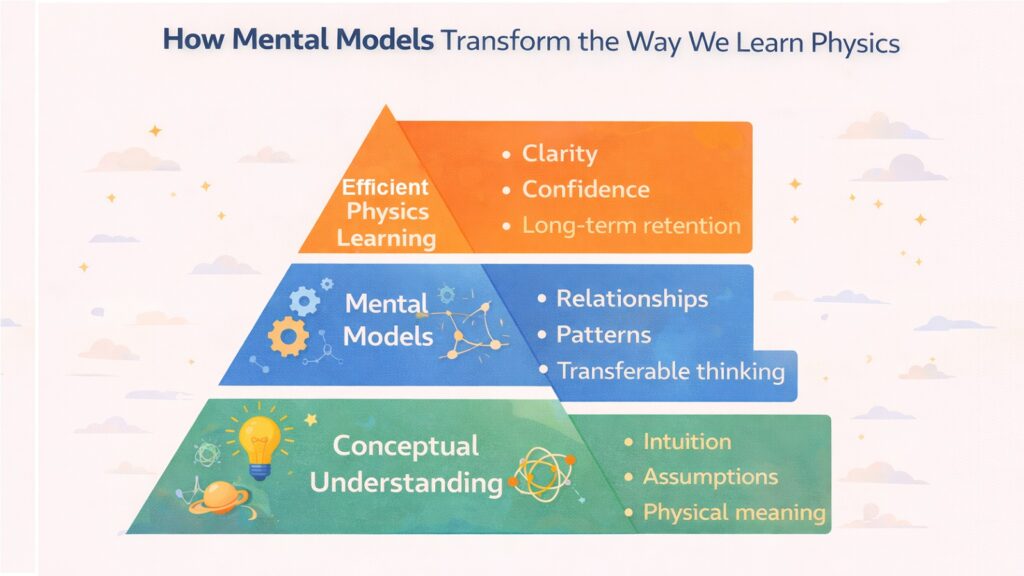
Learning physics faster is not about studying harder or longer. It is about thinking differently. The eight mental models in this article reshape how you approach the subject. They replace memorization with understanding. They transform confusion into clarity.
These models work because they align with how physics actually functions. Physics is a language that describes reality through relationships. It requires intuition alongside calculation. It connects concepts across boundaries. It operates within assumptions. It learns through feedback. It balances visual and mathematical thinking. It deepens through explanation. It is grounded in real-world observation.
When you adopt these ways of thinking, something shifts. Physics stops being a collection of random facts. It becomes a system that makes sense. Understanding builds on itself naturally. Progress accelerates without increased effort.
Start applying these mental models gradually. Pick one that resonates most. Practice it deliberately for a week. Notice how it changes your learning. Then add another model. Over time, these approaches become automatic.
The most important insight is this: anyone can learn physics efficiently with the right mental approach. Success does not require special intelligence or endless study hours. It requires thinking clearly about what physics is and how understanding develops.
Physics describes the universe we inhabit. Learning it opens doors to understanding reality at every scale. The mental models that help you learn physics faster are the same models that physicists use to make sense of nature. When you think like a physicist, learning becomes not just faster, but inevitable.
Core Mental Models to Learn Physics With Speed and Understanding
| Mental Models | Core Insight |
|---|---|
| Physics as language | Equations have meaning beyond symbols |
| Intuition before calculation | Physical sense catches errors and builds confidence |
| Focus on relationships | Concepts connect reducing total memorization |
| Respect assumptions | Models apply only where assumptions hold |
| Mistakes as feedback | Errors reveal gaps faster than correct answers |
| Visual and mathematical balance | Both perspectives needed for completeness |
| Practice explanation | Articulating ideas exposes comprehension gaps |
| Connect to real world | Observable phenomena make concepts concrete |
Read More Science and Space Articles
- Lifestyle Diseases: 8 Dangerous Threats to Global Health
- Sports Science Reveals 8 Powerful Ways Games Are Won
- Fundamental Physical Theories: 8 Powerful Laws of Nature
- STEM Learning Skills: 6 Powerful Secrets Behind Real Success
- STEM Subjects: 8 Essential Insights for a Brighter Future
- Universe Odyssey: 8 Essential Stages Of A Remarkable Journey
- Cosmic Giants: 8 Incredible Titans Shaping Our Universe
- Cosmic Forces: 8 Powerful Phenomena Shaping Our Universe