Table of Contents
Introduction: Why Personal Tech Devices Shape Modern Life
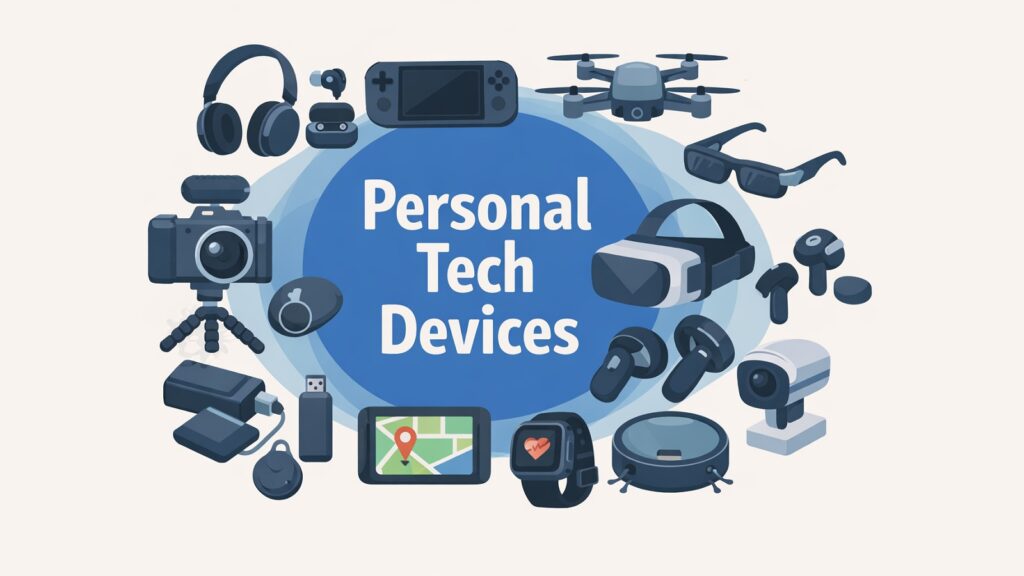
Personal tech devices have quietly become part of almost every moment of the day. People wake up to smart alarms, commute with noise-canceling earbuds, create content on compact cameras, and track their heart rate before bed. These personal tech devices are no longer luxuries; they have become one of the most important pillars of modern technology. For millions of people around the world, they are the tools that make life more manageable, more expressive, and more connected.
What makes this category so interesting is how broad it has become. A personal tech device is not just a smartphone or a laptop. It includes anything designed for individual use that brings intelligence, mobility, or utility into daily routines. Drones for aerial photography, smart glasses for hands-free navigation, VR headsets for immersive gaming, and Bluetooth trackers for finding lost keys all fall into this space. The range is enormous, and it keeps growing.
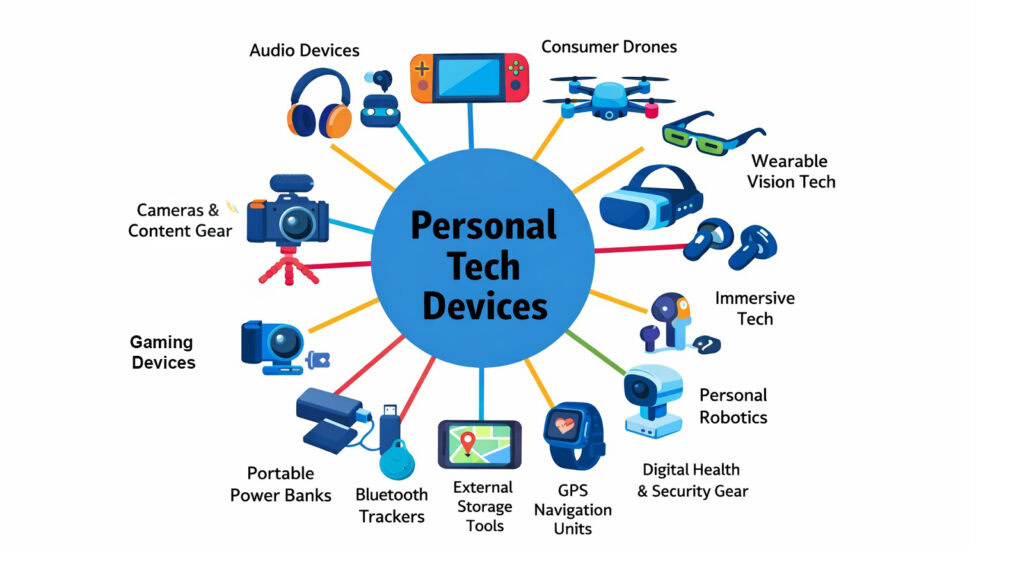
This article covers 12 categories of personal tech devices. Each one represents a different way that technology has found its way into individual life. From audio gear and gaming devices to portable power banks and personal robots, these tools reflect a shift in how people think about independence, creativity, and daily efficiency. Together, they paint a picture of a new era in personal technology.
Personal Tech Devices: Overview of 12 Categories
| Personal Tech Devices | What They Offers |
| Audio Devices | Portable sound quality, noise isolation, and audio enhancement |
| Gaming Devices | Handheld consoles and cloud gaming for entertainment anywhere |
| Cameras & Content Gear | Compact tools for vlogging, streaming, and visual storytelling |
| Consumer Drones | Aerial photography and travel exploration with stabilized video |
| Wearable Vision Tech | Smart glasses with HUD displays and hands-free info access |
| Immersive Tech | VR, AR, and MR headsets for gaming, training, and virtual travel |
| Portable Power Banks | Fast-charging battery packs to keep devices running all day |
| Bluetooth Trackers | Small tags that help locate keys, bags, and personal items |
| External Storage | Portable SSDs and drives for secure, fast data access anywhere |
| GPS Navigation Units | Standalone maps for cars, bikes, and outdoor adventure |
| Digital Health & Security | Wearable monitors and sensors for wellness and home safety |
| Personal Robotics | Cleaning, assistant, and companion robots for home automation |
1. Audio Devices as Personal Tech Devices That Elevate Daily Comfort
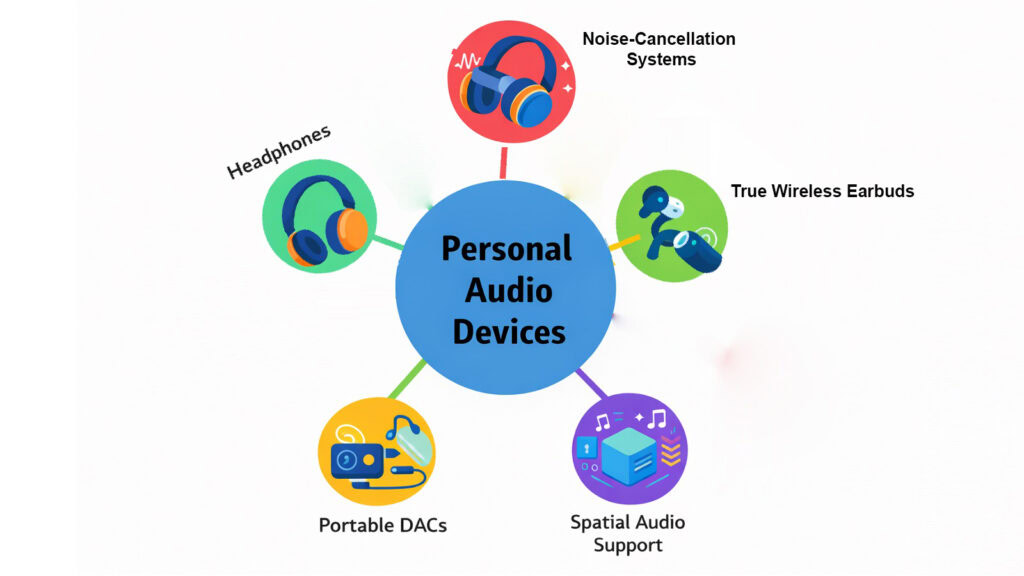
Audio devices are among the most personal of all tech tools. Whether it is a pair of over-ear headphones for deep listening sessions or a set of earbuds tucked into a gym bag, these devices create a private sound world in the middle of a noisy public one. That ability to control your acoustic environment has made audio gear one of the most widely adopted categories in personal tech.
Modern headphones offer active noise cancellation, which uses built-in microphones to detect ambient sound and produce opposing audio signals that cancel it out. This technology, once found only in aviation headsets, is now common in consumer earbuds under a hundred dollars. Portable digital-to-analog converters, known as DACs, are another growing part of this space. They convert digital audio files into analog signals with higher precision than most device headphone jacks can manage, improving clarity and warmth for serious listeners.
For commuters, audio devices reduce mental fatigue by blocking traffic and crowd noise. For remote workers, they provide focus and call clarity. For athletes, true wireless earbuds with secure fits and sweat resistance make exercise more enjoyable. The comfort, portability, and audio quality of today’s devices have turned listening into a richer, more personal experience for everyday users.
Personal Tech Devices: Audio Category Key Facts
| Feature / Fact | Details |
| Active Noise Cancellation (ANC) | Uses microphones and inverse sound waves to reduce ambient noise by up to 30dB |
| True Wireless Earbuds | No cable between earbuds; connect individually via Bluetooth to a paired device |
| Portable DAC Purpose | Converts digital audio to analog with greater precision than built-in phone hardware |
| Battery Life Range | Most wireless earbuds last 6-8 hours; cases extend total to 20-36 hours |
| Codec Support | aptX, LDAC, and AAC codecs reduce audio compression for better wireless quality |
| Bone Conduction Tech | Transmits sound through skull vibrations, keeping ear canals open for safety |
| Multipoint Connection | Allows one set of headphones to stay connected to two devices simultaneously |
| Spatial Audio | Simulates 3D soundstage, used in gaming, film, and premium music streaming |
2. Gaming Devices as Personal Tech Devices for Entertainment on the Go
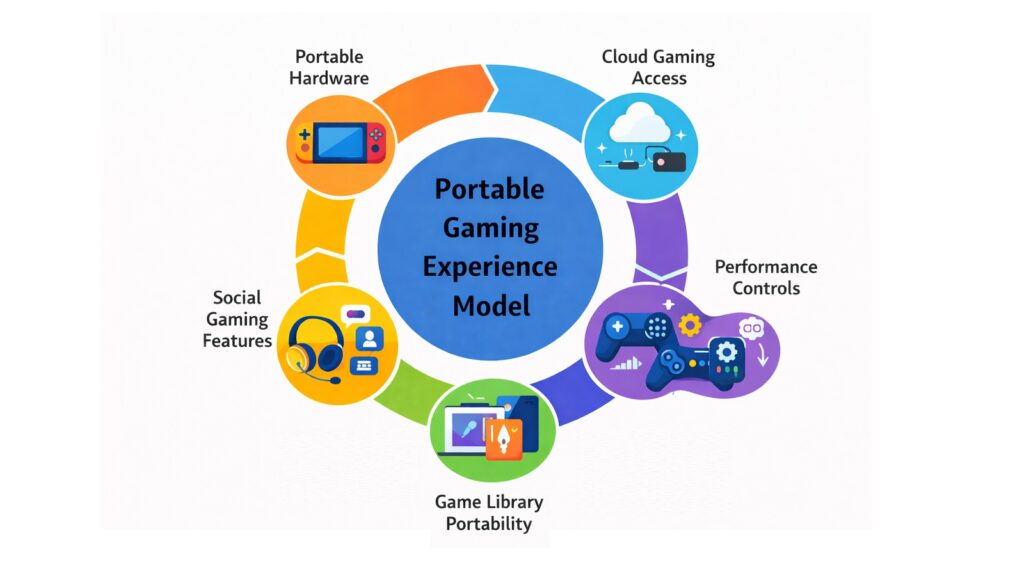
Handheld gaming consoles have gone through a remarkable transformation over the past decade. What once meant simple pixel games on a small screen now means playing the same titles available on home consoles, with high-resolution displays, responsive controls, and long battery life, all in a device that fits in a backpack. The Nintendo Switch made this mainstream, and the market has grown considerably since then.
Cloud gaming has added another dimension. Instead of relying on local processing power, cloud gaming streams gameplay from remote servers, which means even lightweight handheld devices can run demanding titles. Services like Xbox Cloud Gaming and NVIDIA GeForce Now let users access large game libraries without needing powerful hardware at home. This model lowers the barrier for casual and dedicated players alike.
Gaming is also increasingly recognized as more than entertainment. It builds problem-solving skills, supports creative thinking, and provides meaningful social connections through multiplayer experiences. Accessories like portable controllers, ergonomic grips, and cooling fans extend session comfort. For many people, handheld gaming devices are a genuine daily companion and a reliable outlet for relaxation and mental engagement.
Personal Tech Devices: Gaming Category Key Facts
| Feature / Fact | Details |
| Nintendo Switch Display | 7-inch OLED screen with 1280×720 resolution; docks for 1080p TV output |
| Steam Deck Processor | Uses AMD APU combining CPU and GPU for PC gaming in handheld form |
| Cloud Gaming Latency | Requires low-latency internet (under 20ms) for responsive gameplay experience |
| Average Session Length | Mobile and handheld gamers play an average of 30 minutes per session |
| Accessory Ecosystem | Includes portable stands, USB-C hubs, carry cases, and third-party grip attachments |
| Game Library Access | Cloud platforms like Xbox Game Pass give access to 100+ games for a monthly fee |
| Refresh Rate Options | Some handheld screens offer 60Hz to 90Hz refresh rates for smoother visuals |
| Stress Relief Value | Studies show casual gaming can reduce cortisol levels and lower perceived stress |
3. Cameras and Content Gear as Creative Personal Tech Devices
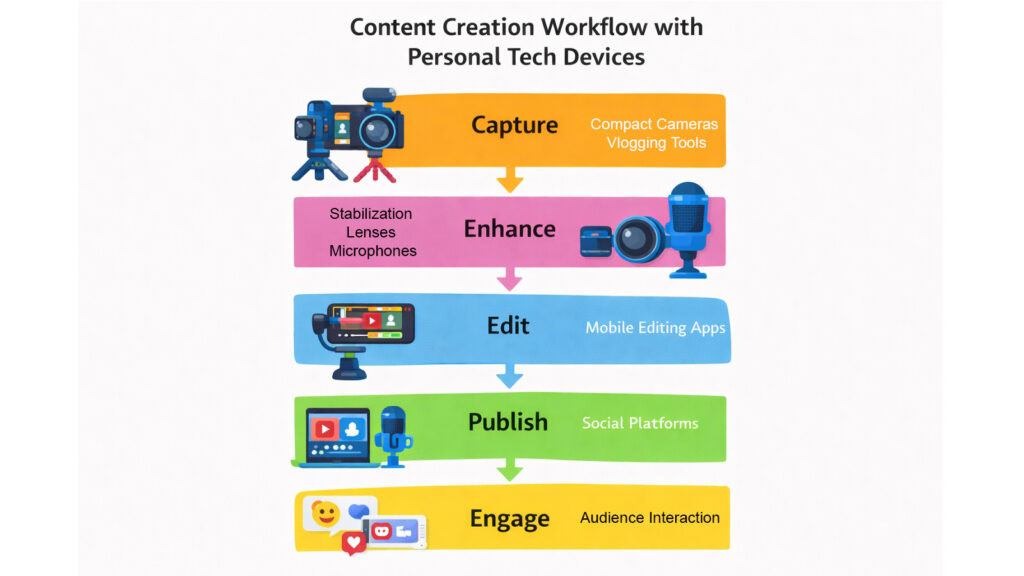
Compact cameras, vlogging rigs, and streaming setups have become core personal tech devices for anyone who creates content or documents life. The rise of YouTube, TikTok, Instagram, and podcasting platforms has driven enormous demand for affordable, high-quality gear that can be used by individuals without film crews or professional studios. A person with a compact camera, a small microphone, and a ring light can now produce content that rivals broadcast quality from a decade ago.
Cameras like the Sony ZV-1 and the Canon PowerShot G7X were designed specifically for vloggers. They are lightweight, have flip screens, and optimize autofocus to keep a moving person sharp in the frame. Streaming gear has followed a similar path. USB microphones from brands like Blue and Rode deliver studio-level audio through a simple plug-and-play connection. Capture cards let gamers and presenters add high-quality video sources to their streams without complex setups.
For individuals building personal brands or sharing their lives online, this gear is an investment in creative independence. The ability to shoot, edit, and publish from a single portable setup means content creation is no longer tied to a specific location or a large production budget. These devices put storytelling power directly in individual hands.
Personal Tech Devices: Cameras and Content Gear Key Facts
| Feature / Fact | Details |
| Vlog-Optimized Cameras | Sony ZV-1 and Canon G7X Mark III offer flip screens, face-tracking AF, and compact builds |
| USB Microphone Quality | Blue Yeti and Rode NT-USB deliver 24-bit/48kHz audio for clear vocal recording |
| Action Camera Stabilization | GoPro’s HyperSmooth uses electronic image stabilization for smooth handheld footage |
| 4K Video Standard | Most current compact cameras record 4K at 30fps; some reach 60fps for slow motion |
| Streaming Resolution | 1080p at 60fps is the current standard for high-quality live streaming on major platforms |
| Capture Card Function | Converts HDMI signal from cameras or consoles to a USB video feed for PC streaming |
| Content Platform Growth | YouTube has over 800 hours of video uploaded per minute globally as of recent reports |
| Lighting Impact | Soft-box and ring lights reduce shadows and improve on-camera skin tones significantly |
4. Consumer Drones as Personal Tech Devices for Aerial Perspective
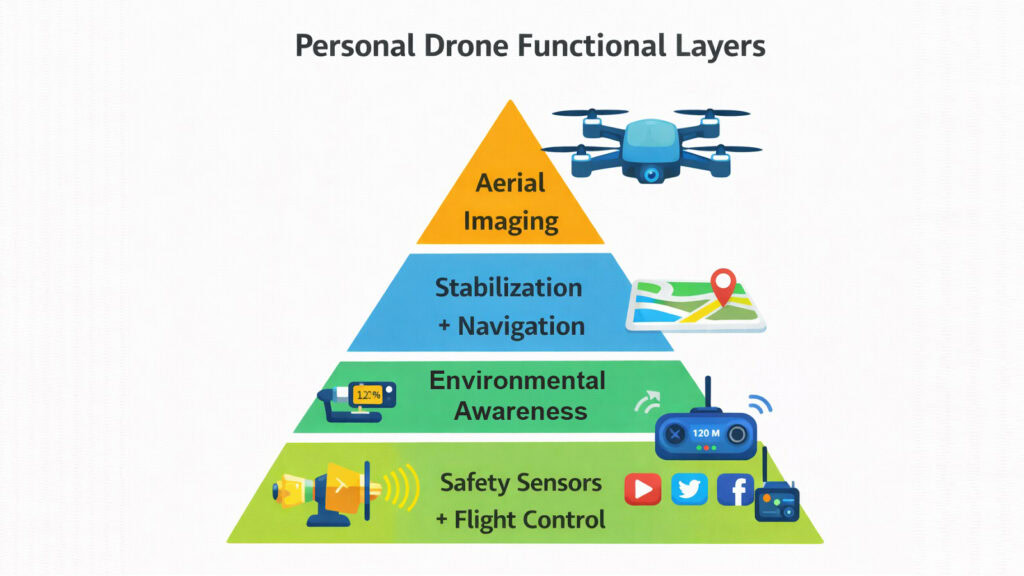
Consumer drones have opened a perspective that was once only available to filmmakers with helicopters or expensive equipment. A compact foldable drone can now lift off from a backpack and capture smooth aerial footage of landscapes, coastlines, or city skylines in minutes. For travelers and outdoor enthusiasts, that shift in visual access is genuinely meaningful. It changes the way people document journeys and experience places.
Modern personal drones use three-axis gimbal stabilization to keep footage smooth, even in moderate wind. Intelligent flight modes like Follow Me, Orbit, and Waypoint allow automated shots that would be impossible to execute manually. Obstacle avoidance sensors help prevent crashes during close-quarters flying. Many drones now return to their launch point automatically if the battery drops or the signal is lost, which reduces the risk of losing the device.
Regulations do apply. In most countries, recreational drones above a certain weight require registration and must stay below specific altitude limits. But within those rules, personal drones have become remarkably creative tools. For hobbyists who want to capture something beyond what a camera on the ground can offer, a quality consumer drone provides that aerial perspective at a fraction of the cost it once required.
Personal Tech Devices: Consumer Drone Key Facts
| Feature / Fact | Details |
| DJI Mini 4 Pro Weight | Weighs under 249g, placing it below the threshold for advanced registration in many countries |
| Gimbal Stabilization | 3-axis mechanical gimbals compensate for pitch, roll, and yaw to ensure smooth video |
| Max Flight Time | Consumer drones typically offer 20-40 minutes of flight time per battery charge |
| Follow Me Mode | GPS and vision sensors track a moving subject and keep the drone centered automatically |
| Obstacle Avoidance | APAS (Advanced Pilot Assistance System) detects and avoids obstacles in flight path |
| Video Resolution | Most current consumer drones capture 4K at 60fps with 10-bit color options |
| Return to Home | Automatically returns to launch point when battery is low or remote signal is lost |
| Range and Signal | High-end consumer drones use OcuSync or O3 transmission for 10-15km range |
5. Wearable Vision Tech as Forward-Looking Personal Tech Devices
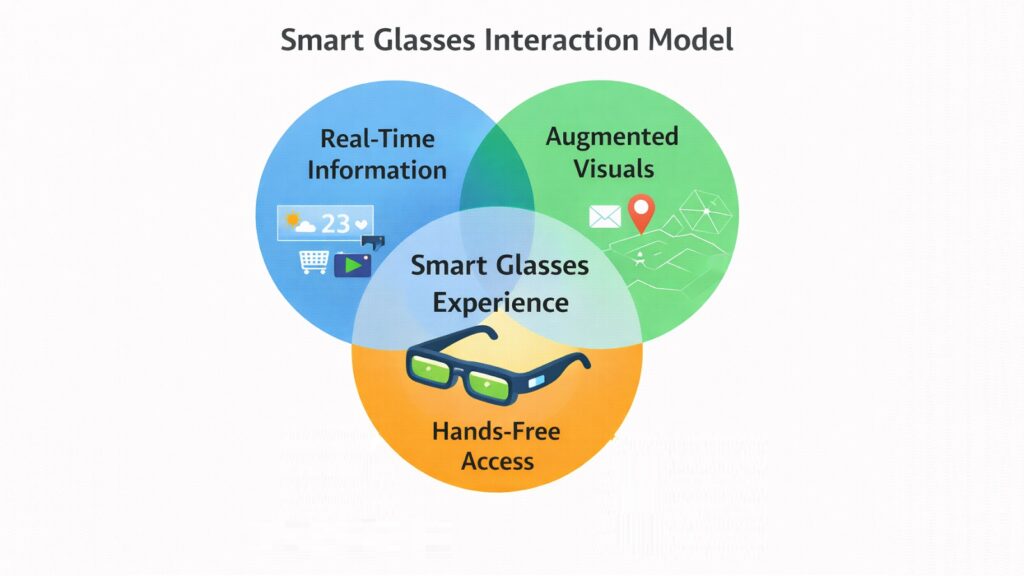
Smart glasses and heads-up display eyewear represent one of the more unusual categories in personal tech devices, but also one of the most promising. The idea is simple: put useful information in the wearer’s field of view without requiring them to look down at a phone or wrist. Navigation prompts, notifications, translation overlays, and AI-guided prompts can appear in the peripheral vision or directly in front of the eye, keeping the wearer’s hands free and attention forward.
Ray-Ban Meta smart glasses, developed in partnership between Meta and EssilorLuxottica, brought this category into mainstream consciousness. They offer hands-free photo and video capture, open-ear audio, and an AI assistant that responds to voice commands. The cameras sit in the frame temples, and the microphones pick up voice input cleanly in most environments. The design looks much like regular sunglasses, which solves the social awkwardness that plagued earlier smart glasses like Google Glass.
More specialized HUD eyewear is used in warehousing, field service, and logistics, where workers need both hands available while accessing instructions or data. As AI integration deepens and optical waveguide technology improves, wearable vision tech is moving toward becoming a genuine everyday computing platform for individual users who want information access without device dependency.
Personal Tech Devices: Wearable Vision Tech Key Facts
| Feature / Fact | Details |
| Ray-Ban Meta Features | Open-ear speakers, front-facing cameras, and Meta AI voice assistant built into frames |
| Optical Waveguide | Thin glass layers guide light from a tiny projector to the wearer’s eye as a HUD display |
| Google Glass History | Google Glass Enterprise Edition 2 targeted industrial use after consumer version was discontinued |
| Field of View (FoV) | Consumer HUD glasses typically offer a limited FoV of 20-40 degrees for overlay content |
| Battery Life | Most smart glasses offer 4-6 hours of mixed-use battery life before needing a recharge |
| AI Integration | Voice-commanded AI can answer questions, describe surroundings, and translate text |
| Enterprise Adoption | Vuzix and RealWear HMT-1 are widely used in manufacturing and field service sectors |
| Future Development | Companies like Apple and Meta are investing in lighter, more powerful AR lens systems |
6. Immersive Tech as Experiential Personal Tech Devices
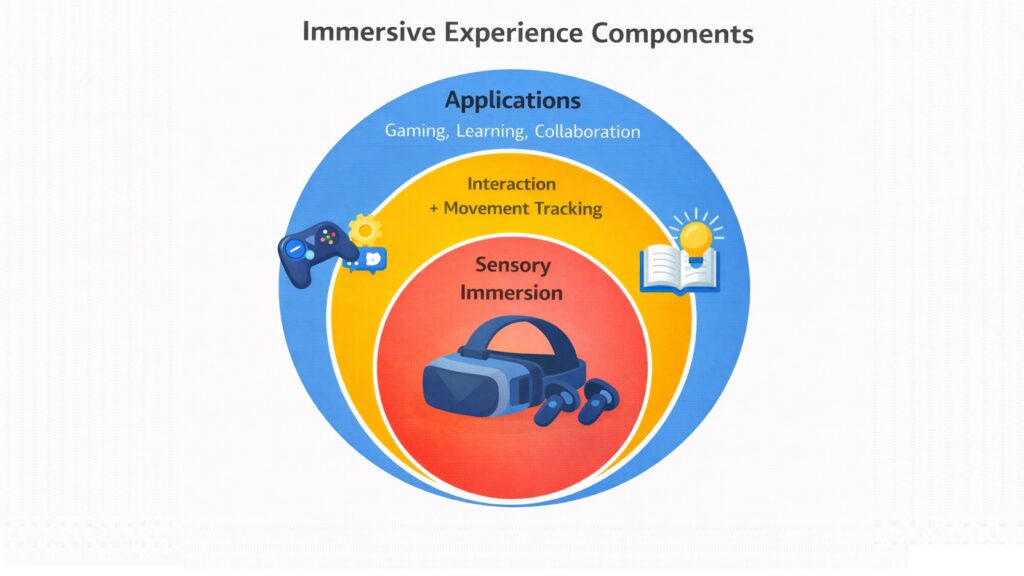
Virtual reality, augmented reality, and mixed reality headsets have matured from niche gaming peripherals into genuine personal tech platforms. These devices do more than run games. They host virtual fitness classes, simulate environments for professional training, allow virtual tourism, and provide collaborative workspaces where remote teams can meet as avatars in shared digital rooms. The category has expanded in ways that most early observers did not predict.
The Meta Quest 3 is one of the clearest examples of what standalone VR can now do. It runs without a connected PC, uses color passthrough cameras to blend real and digital environments, and supports a growing library of games, fitness apps, and productivity tools. Apple’s Vision Pro introduced spatial computing to a premium consumer audience, blending virtual and real-world content through high-resolution passthrough at a level of visual fidelity that earlier headsets could not match.
The appeal of immersive tech goes beyond novelty. VR fitness apps like Beat Saber and Supernatural have genuine exercise value. Virtual travel lets people experience landmarks that may be physically inaccessible to them. Training simulations in fields like surgery, military operations, and emergency response use VR to rehearse high-stakes scenarios safely. As display quality, comfort, and content libraries improve, immersive personal tech is finding a place in more daily routines.
Personal Tech Devices: Immersive Tech Key Facts
| Feature / Fact | Details |
| Meta Quest 3 Display | Pancake lens optics with 2064×2208 per eye resolution for sharper visuals than Quest 2 |
| Apple Vision Pro Price | Launched at $3,499 USD, positioning it as a premium productivity and spatial computing device |
| Standalone Operation | Standalone VR headsets run all processing onboard with no PC or console required |
| VR Fitness Impact | Studies show 30 minutes of VR fitness can match moderate-intensity treadmill exercise |
| Refresh Rate | Most consumer VR headsets operate at 90-120Hz to reduce motion sickness during use |
| Mixed Reality Definition | MR blends real-world camera passthrough with digital overlays in the same visual field |
| Content Library Size | Meta Quest store offered over 500 titles across gaming, fitness, and productivity categories |
| Enterprise VR Use | Industries like healthcare, aerospace, and military use VR for realistic training simulations |
7. Portable Power Banks as Supportive Personal Tech Devices
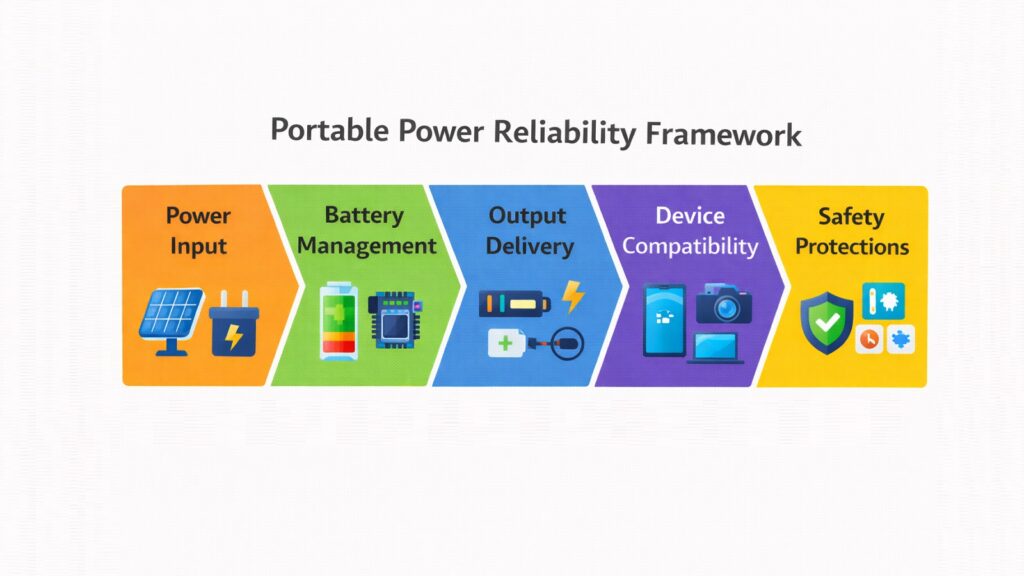
Every other device in this list depends on battery power, which makes portable power banks a quietly essential category. A drone running out of charge during a flight, a pair of wireless earbuds dying mid-commute, or a handheld console powering down before a long journey can all be solved with a well-chosen power bank in the bag. These devices have become the silent support layer behind modern personal tech.
Modern power banks are far more capable than early models. High-capacity options now hold 25,000mAh or more, enough to charge a smartphone several times over or top up a tablet and a wearable simultaneously. Fast-charging standards like USB Power Delivery and Qualcomm Quick Charge have made it possible to refill a phone to 50 percent in under 30 minutes. Some power banks include dual input ports, LED capacity indicators, and pass-through charging that allows the bank itself to charge while also charging another device.
Solar-integrated power banks add another layer of usefulness for outdoor use, particularly on long hikes or camping trips where mains power is unavailable. Wireless charging pads built into some power banks eliminate the need for cables when using compatible phones. For frequent travelers and daily commuters, a reliable, fast-charging power bank has become as essential as the devices it supports.
Personal Tech Devices: Portable Power Banks Key Facts
| Feature / Fact | Details |
| Capacity Range | Consumer power banks range from 5,000mAh for compact use to 26,800mAh for high capacity |
| USB Power Delivery (PD) | PD standard supports up to 100W output for charging laptops and fast-charging phones |
| Qualcomm Quick Charge | QC 4.0 can charge a compatible phone to 50% in approximately 15 minutes |
| Pass-Through Charging | Allows the power bank to charge incoming power while simultaneously outputting to devices |
| Solar Panel Efficiency | Built-in solar panels typically add 100-200mAh per hour in direct strong sunlight |
| Wireless Output | Some models offer 10-15W Qi wireless charging for compatible smartphones |
| Airline Regulations | Most airlines permit power banks up to 100Wh (roughly 27,000mAh at 3.7V) in carry-on |
| Indicator Design | LED dot or percentage indicators help users gauge remaining capacity at a glance |
8. Bluetooth Trackers as Protective Personal Tech Devices
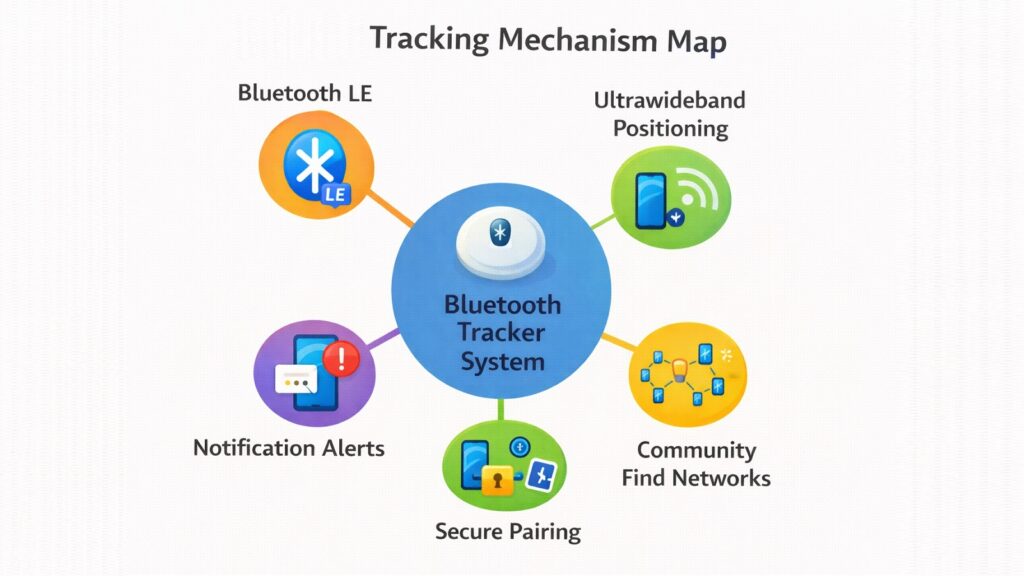
Bluetooth trackers occupy a small space in a bag or on a keyring but deliver a disproportionate amount of peace of mind. They are compact tags that communicate with smartphones via Bluetooth and, in some cases, through crowdsourced location networks. When a tracked item goes missing, the owner can open an app and see its last known location on a map, or trigger the tag to play a sound for close-range searching. For people who regularly misplace keys, wallets, or luggage, these devices reduce daily friction significantly.
Apple AirTags use the Find My network, which anonymously relays location data through hundreds of millions of Apple devices in the field. Tile uses its own crowdsourced network, which is now also integrated with devices using Android. Samsung Galaxy SmartTags work within the SmartThings ecosystem. Each platform has its strengths depending on which devices a user already owns, but the core function is similar across all of them.
Long battery life, simple setup, and small form factors make Bluetooth trackers easy to adopt without disrupting existing routines. Some models are designed to slip into a wallet. Others attach to luggage zippers, bicycles, or pet collars. Privacy considerations have also become part of the conversation, with manufacturers building in anti-stalking alerts that notify users when an unfamiliar tracker has been traveling with them.
Personal Tech Devices: Bluetooth Trackers Key Facts
| Feature / Fact | Details |
| Apple AirTag Battery | Uses a standard CR2032 coin cell battery lasting approximately one year with normal use |
| Find My Network Size | Apple’s Find My network leverages hundreds of millions of Apple devices for anonymous tracking |
| Tile Network | Tile’s community network uses other Tile users’ phones to relay location of missing items |
| Ultra-Wideband (UWB) | AirTag uses UWB for precise within-room direction-finding on compatible iPhone models |
| Anti-Stalking Alerts | AirTag, Tile, and Samsung SmartTag all alert users when an unknown tracker follows them |
| Water Resistance | Apple AirTag has IP67 rating; resists submersion in water up to 1 meter for 30 minutes |
| Wallet-Sized Trackers | Tile Slim and Samsung SmartTag Card are credit-card thickness for wallet placement |
| Sound Alert Range | Built-in speakers can be triggered remotely to help locate items within a small area |
9. External Storage Tools as Essential Personal Tech Devices for Data Freedom
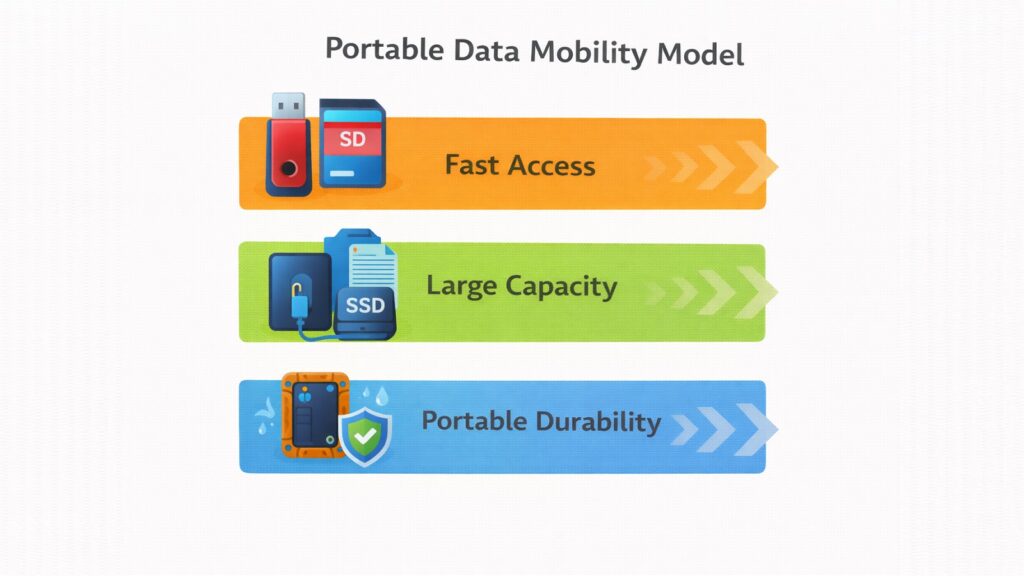
Data storage used to mean keeping files on a desktop hard drive and hoping it never failed. Portable SSDs, external hard drives, and USB flash drives have changed that equation entirely. Today, a creator can carry a terabyte of raw video footage in a device the size of a credit card. A student can keep their entire thesis, research, and media library on a thumb drive that fits on a keychain. For professionals, travelers, and everyday users, portable storage means data freedom.
The speed gap between flash storage types has become a major consideration. USB 3.2 and USB 4 drives deliver sequential read speeds of 1,000 megabytes per second or more, making file transfers that once took minutes happen in seconds. NVMe-based portable SSDs from brands like Samsung, SanDisk, and Western Digital now offer that performance in enclosures that weigh less than 100 grams. Some models include hardware encryption and dust or water resistance for added security and durability.
Backup reliability is perhaps the most underappreciated value of these devices. Camera systems fail. Cloud services experience outages. Local drives can corrupt. Having a second copy of important files on a portable SSD is a simple safeguard that prevents catastrophic data loss. For anyone who creates, works, or stores files digitally, external storage devices are not accessories. They are infrastructure.
Personal Tech Devices: External Storage Key Facts
| Feature / Fact | Details |
| USB 3.2 Gen 2 Speed | Delivers up to 1,000MB/s transfer speeds for fast file movement across devices |
| Samsung T7 SSD | Weighs 58g and offers read speeds up to 1,050MB/s with AES 256-bit encryption |
| USB 4 Standard | Supports up to 40Gbps bandwidth, enabling transfer of large video files in seconds |
| NVMe vs SATA | NVMe drives are significantly faster than SATA-based SSDs due to direct PCIe connection |
| Capacity Range | Portable SSDs are available from 250GB to 4TB; HDDs extend to 5TB in portable form |
| Drop Resistance | Many portable SSDs withstand drops of up to 3 meters without data loss |
| Hardware Encryption | AES 256-bit encryption protects data if the drive is lost or stolen |
| Cold Storage Use | USB flash drives are used for archival cold storage of infrequently accessed files |
10. GPS Navigation Units as Travel-Ready Personal Tech Devices
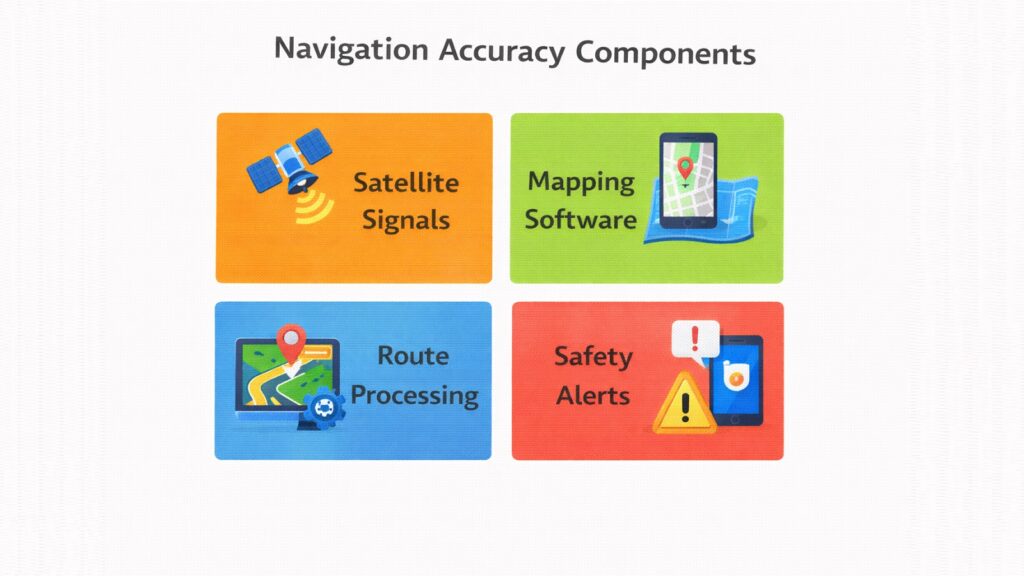
Smartphones have strong navigation apps, but standalone GPS devices still hold real advantages in several situations. For long road trips through areas with poor mobile signal, a dedicated GPS unit with offline maps provides reliable, uninterrupted turn-by-turn directions. For motorcyclists who need glove-friendly controls and a screen readable in bright sunlight, purpose-built units are more practical than phone mounts. For hikers and mountaineers, rugged GPS handhelds with topographic maps and satellite positioning work where no cellular signal exists.
Garmin remains the dominant name in this category. Their automotive units update maps automatically and include traffic alerts through connected services. Their outdoor handhelds, like the GPSMAP 67 series, support multiple global navigation systems simultaneously, including GPS, GLONASS, Galileo, and BeiDou, which improves accuracy and reduces positioning time in dense forests or canyon environments where satellite visibility is limited.
Speed alerts, lane guidance, school zone warnings, and points-of-interest databases are standard features on most current navigation units. For professionals like truck drivers or delivery fleets, specialized GPS devices offer routing optimized for vehicle dimensions and cargo restrictions. The category may seem mature, but for travel in remote areas, dedicated navigation devices remain the most dependable choice available.
Personal Tech Devices: GPS Navigation Key Facts
| Feature / Fact | Details |
| Multi-Constellation Support | Modern GPS units use GPS, GLONASS, Galileo, and BeiDou for better positioning accuracy |
| Garmin GPSMAP 67 | Supports six satellite systems and offers up to 165 hours of battery life in expedition mode |
| Offline Maps | Downloaded map data works without any mobile or cellular signal in remote areas |
| Traffic Integration | Some units use Bluetooth to receive live traffic data from a connected smartphone |
| Motorcycle GPS Units | Zumo XT2 and similar devices offer glove-friendly touchscreens and IPX7 water resistance |
| Lane Guidance Feature | Visual lane assist shows correct lane to use before complex highway interchanges |
| Screen Brightness | Automotive GPS screens reach 1000+ nits to remain readable in direct sunlight |
| Map Updates | Many Garmin units offer lifetime map updates free of charge after purchase |
11. Digital Health and Security Gear as Protective Personal Tech Devices
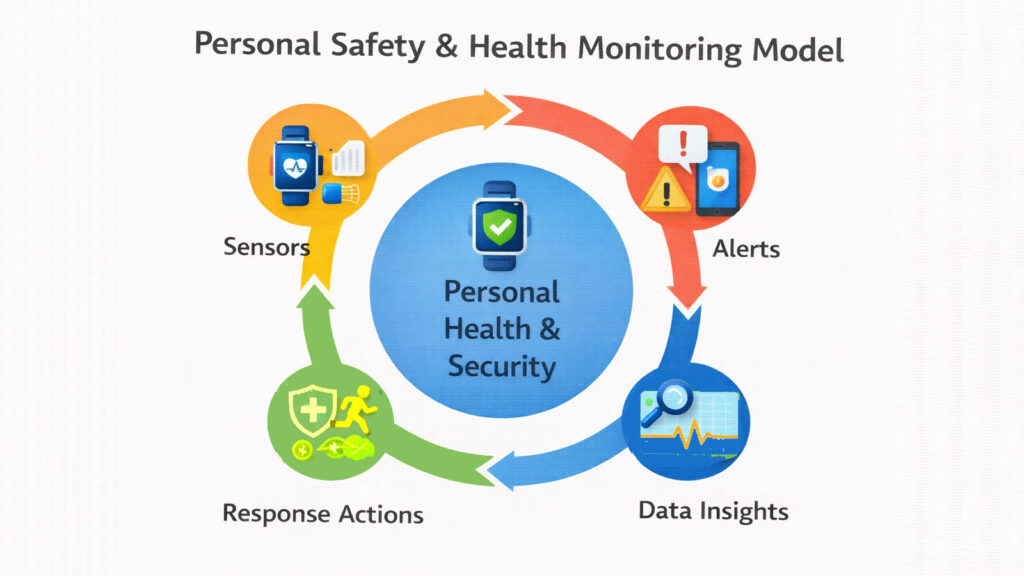
Health monitoring devices have expanded well beyond basic step counting. Today, wearable sensors can track blood oxygen saturation, skin temperature, electrocardiogram readings, sleep stages, stress levels estimated through heart rate variability, and even blood glucose patterns in some emerging devices. These tools help people catch warning signs early, understand their bodies more accurately, and make informed decisions about lifestyle and medical care without waiting for a clinic visit.
Personal security and surveillance devices have followed a parallel path into everyday homes. Smart video doorbells, motion-triggered outdoor cameras, indoor security sensors, and personal emergency buttons create a layered awareness system. Devices like the Apple Watch include fall detection and emergency SOS features that can automatically contact emergency services and share location information if a user becomes unresponsive. For elderly users and people living alone, these capabilities represent meaningful safety infrastructure.
The combination of health monitoring and personal security into a single device ecosystem is a defining direction for this category. Smartwatches that measure heart rhythms and immediately alert cardiologists, sensors that detect unusual household activity and notify family members, and emergency pendants that connect to monitoring centers are all part of how personal tech devices are becoming active participants in long-term health and safety management.
Personal Tech Devices: Digital Health and Security Key Facts
| Feature / Fact | Details |
| ECG Monitoring | Apple Watch Series 4 and later can generate a single-lead ECG to detect atrial fibrillation |
| SpO2 Measurement | Optical sensors on wearables estimate blood oxygen saturation between 95-100% in healthy adults |
| Fall Detection | Apple Watch and Garmin devices detect hard falls and send emergency alerts if no response |
| Smart Doorbell Function | Ring and Nest Hello doorbells offer 1080p+ video, two-way audio, and motion alerts |
| HRV Tracking | Heart rate variability measurement helps estimate stress, recovery, and nervous system state |
| Sleep Stage Monitoring | Devices like Fitbit and Oura Ring track REM, light, and deep sleep phases nightly |
| Glucose Monitoring | Continuous Glucose Monitors (CGMs) like Dexcom G7 send real-time data to a paired phone |
| Emergency SOS Feature | Satellite SOS on Apple Watch Ultra and Garmin can call for help without cellular coverage |
12. Personal Robotics as Next-Generation Personal Tech Devices
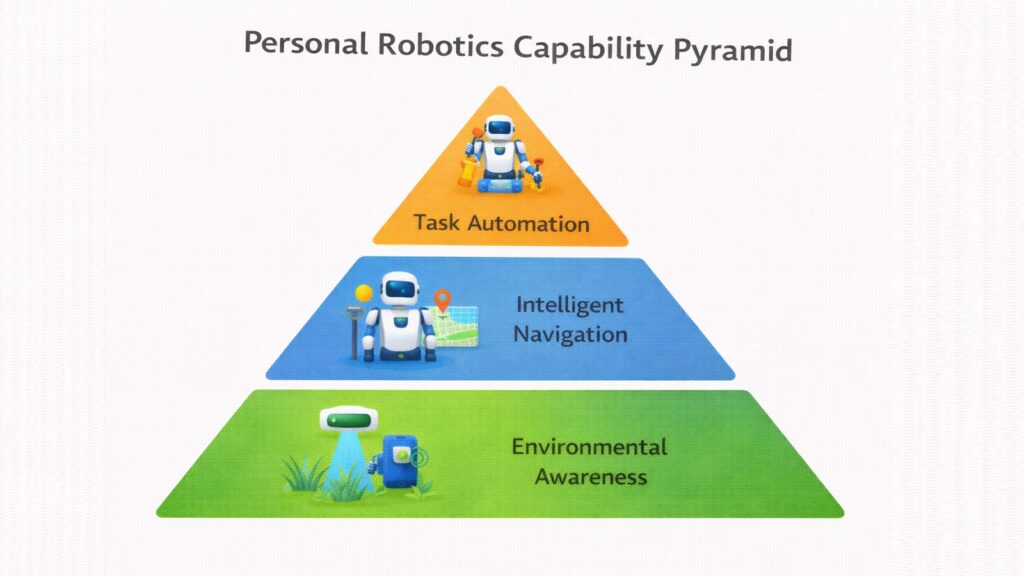
Robots have been a fixture of science fiction for generations, but the version that actually arrived in homes is far more practical and far less dramatic. Robot vacuum cleaners navigate floors using lidar and vision sensors. They map room layouts, avoid obstacles, empty their own dustbins, and return to charge automatically. They do not look like humanoids, but they do save real time and effort regularly, which is exactly what makes them successful personal tech devices.
The category is expanding beyond cleaning. Lawn mowing robots follow perimeter wires or GPS-defined boundaries to cut grass without human guidance. Companion robots like Lovot and Vector use camera-based facial recognition, motion sensors, and voice interaction to simulate emotional engagement. Amazon’s Astro robot moves around a home, monitors areas remotely via an app, and can carry small items using an on-board tray. These devices are navigating the early stages of making household robotics genuinely useful rather than merely impressive.
Voice assistant integration makes personal robots easier to command without dedicated apps. Models from iRobot, Roborock, and Ecovacs support Alexa and Google Assistant commands. As sensor technology improves and on-device AI processing grows more powerful, personal robots will become better at adapting to changing environments, handling unexpected obstacles, and learning the preferences of the people they share a home with.
Personal Tech Devices: Personal Robotics Key Facts
| Feature / Fact | Details |
| Lidar Navigation | Roborock and Ecovacs use lidar to create accurate room maps and plan efficient cleaning routes |
| Self-Empty Bases | Auto-empty stations collect dustbin contents for 30-60 days before needing manual disposal |
| Obstacle Avoidance AI | AI-powered cameras identify and avoid socks, cables, and pet waste on floors |
| Lawn Mowing Robots | Husqvarna Automower uses GPS RTK for boundary-free mowing without perimeter wire |
| Amazon Astro | Home robot with periscope camera, Alexa integration, and remote monitoring via app |
| Companion Robots | Lovot uses thermal cameras and motion sensors to simulate warmth and emotional bonding |
| Voice Integration | Most robot vacuums support Alexa and Google Assistant for hands-free commands |
| Mopping Capability | Many current robot vacuums include vibrating or rotating mop pads for hard floor washing |
Conclusion: How Personal Tech Devices Continue to Upgrade Life
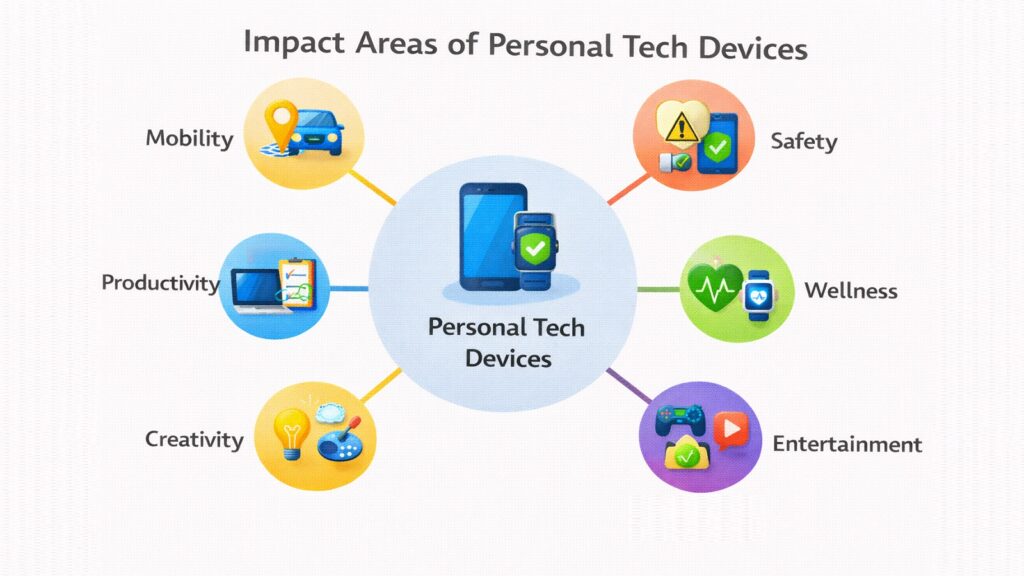
Looking across all 12 personal tech devices, a pattern becomes clear. Personal tech devices are not replacing human judgment or effort. They are removing friction from specific parts of life that used to take more time, attention, or physical presence than they needed to. Audio devices give back mental space on a commute. GPS units remove the anxiety of navigating unfamiliar terrain. Bluetooth trackers eliminate the panicked search for misplaced items. Power banks make every other device more reliable.
The most compelling thing about the current landscape is how these tools reinforce each other. A traveler might carry a drone for aerial shots, a portable SSD for storing footage, a power bank to keep both charged, and a compact camera for ground-level content. A remote worker might rely on noise-canceling headphones for calls, a wearable health monitor to track stress, and smart home security sensors for awareness of their surroundings. Personal tech has become a system, not just a collection of gadgets.
The direction ahead points toward greater integration, smaller form factors, and deeper AI involvement in personal devices. Smart glasses will get lighter and more capable. Health monitors will provide earlier and more accurate alerts. Personal robots will learn home layouts and preferences over time. VR and MR headsets will blur the line between physical and digital spaces in ways that feel natural rather than intrusive. The era of personal tech devices is not approaching a peak. It is still finding its shape, and the upgrades it promises for daily life are only beginning.
Personal Tech Devices: Innovation Trends by Category
| Personal Tech Devices | Key Innovation Direction |
| Audio Devices | Adaptive ANC that adjusts to real-time noise environments and hearing health monitoring |
| Gaming Devices | Cloud gaming reducing hardware barriers; AI-powered game content generation |
| Cameras & Content Gear | AI-assisted autofocus, real-time background removal, and automated editing tools |
| Consumer Drones | Longer flight times, obstacle-free autonomous flight, and AI subject tracking |
| Wearable Vision Tech | Lighter waveguide optics, AI context awareness, and real-time translation overlays |
| Immersive Tech | Higher-resolution displays, standalone processing, and haptic feedback accessories |
| Portable Power Banks | Bidirectional charging, graphene batteries with faster charge cycles, and solar integration |
| Bluetooth Trackers | Ultra-wideband precision, improved anti-stalking safeguards, and longer battery life |
| External Storage | Faster USB 4 drives, hardware encryption by default, and rugged shock-proof designs |
| GPS Navigation | Multi-constellation accuracy, live hazard alerts, and voice AI interaction |
| Digital Health & Security | Non-invasive glucose monitoring, passive ECG, and satellite emergency SOS |
| Personal Robotics | AI floor mapping, on-device learning, and multi-room autonomous task management |