Table of Contents
Introduction: Why Pricing Strategy Is the Most Underrated Marketing Function
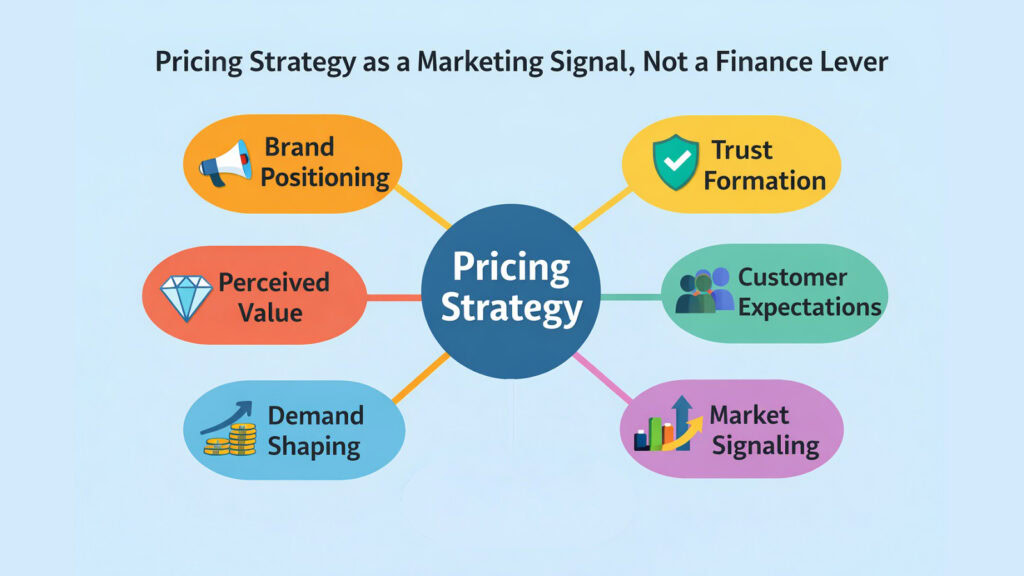
Most companies hand pricing decisions to finance teams and call it done. That approach misses something fundamental. Pricing strategy belongs to marketing because price communicates before any billboard goes up or ad runs. It signals value, builds trust, and shapes customer expectations long before prospects read a single word of copy.
The assumption that pricing lives in spreadsheets ignores how markets actually work. Customers use price as a proxy for quality, commitment, and brand intent. A premium price tells one story. A budget price tells another. Both are marketing messages, whether planned or accidental. Industries that treat pricing as a marketing function tend to build stronger positioning and attract better-fit customers. Those who treat it as a cost calculation often struggle with churn, misaligned audiences, and eroding brand equity.
This article draws from industries that succeeded by aligning pricing with marketing goals rather than just covering costs. The lessons span software, hospitality, consumer goods, education, and professional services. What connects them is simple. They used a pricing strategy to shape perception, filter customers, and build trust over time.
Table: Pricing Strategy and Core Marketing Functions
| Marketing Function | Relationship to Pricing Strategy |
|---|---|
| Marketing Research and Consumer Insights | Pricing research reveals willingness to pay, price sensitivity, and value perception across segments. Consumer insights guide whether to position as premium, competitive, or accessible. |
| Brand Management | Price reinforces brand identity. Luxury brands maintain high prices to preserve exclusivity. Mass brands use competitive pricing to signal accessibility and value. |
| Service Positioning | Service pricing reflects intangibility and expertise. Higher prices often indicate specialized knowledge, personalized attention, or guaranteed outcomes. |
| Product Positioning | Price anchors product tier within a category. Mid-tier pricing suggests quality without exclusivity. Premium pricing signals innovation or superior performance. |
| Promotion and Advertisement | Promotional pricing attracts trial but risks conditioning customers to wait for discounts. Stable pricing supports consistent brand messaging and long-term positioning. |
| Content Marketing | Educational content justifies premium pricing by demonstrating expertise and outcomes. Value-driven content supports higher price points through trust building. |
| Digital Marketing & Performance Analytics | A/B testing reveals optimal price points. Conversion data shows which prices maximize customer lifetime value versus short-term acquisition. |
| Sales Enablement & Lead Generation | Pricing tiers qualify leads by budget and intent. Higher tiers attract serious buyers. Entry tiers generate volume but may require more nurturing. |
| Customer Relationship Management (CRM) | Pricing affects retention and upsell patterns. Customers acquired through discounts show lower loyalty than those who paid full price initially. |
| Distribution & Channel Strategy | Channel partners require margin. Pricing must account for distributor cuts while maintaining brand positioning and end-customer value perception. |
1. Pricing Strategy Lesson One: Price Shapes Perception Before Promotion
A customer sees your price before reading your landing page. That number creates an instant frame. It suggests who the product serves, what problem it solves, and how serious the commitment should be. This happens unconsciously and immediately.
The hospitality industry demonstrates this clearly. Budget hotel chains price rooms between forty and seventy dollars per night. That range signals basic accommodation and functional stays. Boutique hotels are priced between two hundred and five hundred dollars. The gap communicates design, location, and experience. Both serve travelers, but the pricing strategy defines which travelers and what expectations they bring. Marketing campaigns can reinforce these signals, but rarely overcome them if pricing contradicts positioning.
Software companies learned this during the shift to subscription models. Enterprise tools priced per user per month created one perception. Freemium models with premium upgrades created another. The pricing structure itself became a marketing message about accessibility, scale, and target customer. Companies that chose enterprise pricing attracted corporate buyers expecting implementation support and dedicated account management. Those that chose freemium attracted individual users and small teams expecting self-service and community support.
The pattern holds across categories. Premium pricing positions products as investments. Budget pricing positions them as accessible solutions. Mid-tier pricing suggests balanced value. Each choice filters perception before any other marketing activity begins. This makes pricing strategy a foundational marketing decision rather than a downstream financial one.
Table: Pricing Strategy Across Industries and Perception
| Industry Example | Perception Created Through Pricing Strategy |
|---|---|
| Apple iPhones (Premium pricing $799-$1,599) | Innovation, status, ecosystem integration, superior build quality, technology leadership |
| IKEA Furniture (Value pricing below market average) | Functional design, self-assembly model, accessibility for young households, democratic design |
| Rolex Watches (Ultra-premium $5,000-$50,000+) | Craftsmanship, heritage, lifetime value, social signaling, investment quality |
| Costco Membership Model (Annual fee plus low margins) | Bulk value, membership exclusivity, trust through consistent savings, warehouse experience |
| Patagonia Outdoor Gear (Premium with repair services) | Environmental commitment, durability, ethical production, sustainable practices |
| Tesla Vehicles (Premium electric $40,000-$100,000+) | Technology leadership, sustainability, performance innovation, future-forward thinking |
2. Pricing Strategy Lesson Two: The Right Price Chooses the Right Customer
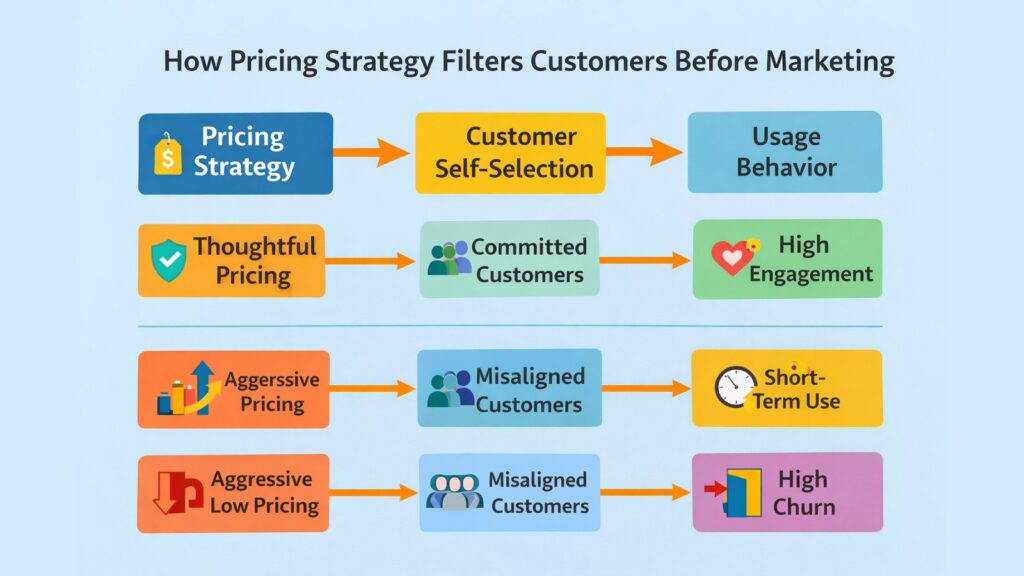
Pricing does more than generate revenue. It selects who shows up. A low price attracts bargain seekers and window shoppers. A high price attracts committed buyers with specific needs. The difference affects everything downstream, including retention, support costs, and word-of-mouth quality.
Professional services firms learned this through painful experience. Law firms and consulting groups that competed on hourly rates attracted price-sensitive clients who questioned every invoice and switched providers frequently. Firms that priced on value and outcomes attracted clients focused on results rather than costs. The second group generated higher lifetime value, fewer disputes, and stronger referrals. The pricing strategy itself acted as a filter before any sales conversation began.
Software-as-a-service companies see this pattern in churn data. Customers acquired through heavy discounts cancel at rates two to three times higher than those who paid standard prices. The discount attracted users to test options rather than committing to solutions. Full-price customers signaled intent through their willingness to pay, which correlated with deeper product adoption and longer retention.
The lesson applies beyond B2B contexts. Fitness studios using premium monthly memberships ($150-$300) attract members who attend regularly and value community. Budget gyms at fifteen dollars monthly attract casual users with inconsistent attendance. Neither model is wrong, but the pricing strategy determines customer behavior patterns and expectations. Marketing teams that understand this can align messaging, retention programs, and community building with the customers their pricing naturally attracts.
Table: Pricing Strategy as Customer Filter Across Sectors
| Sector and Pricing Approach | Customer Type Attracted Through Pricing Strategy |
|---|---|
| SaaS Tools Enterprise (High per-seat $50-$200/user/month) | Corporate teams with implementation budgets, dedicated admins, long-term commitments, serious adoption |
| Online Education Platforms (Mid-tier $29-$99/month) | Career-focused learners, skill upgraders, completion-oriented students, professional development seekers |
| Luxury Fitness like Equinox (Premium $200-$300/month) | Health-committed professionals, community seekers, consistent attendees, lifestyle-oriented members |
| Budget Airlines like Southwest (Unbundled base fares) | Price-sensitive leisure travelers, flexible schedulers, self-service preference, minimal frills acceptance |
| Whole Foods Market (Premium grocery pricing) | Health-conscious shoppers, organic preference, willingness to pay for quality, values-driven buyers |
| Amazon Prime Membership (Annual fee $139 plus benefits) | Frequent shoppers, streaming users, loyalty-oriented households, convenience-focused consumers |
3. Pricing Strategy Lesson Three: Value Beats Cost Across Every Industry
Cost-plus pricing builds from expenses outward. Value-based pricing starts with customer outcomes and works backward. The difference reshapes entire markets. Industries that anchor on costs compete in races to the bottom. Those that anchor on value create space for premium positioning and sustainable margins.
Management consulting provides a clear example. Firms charging hourly rates tie revenue to time spent. Clients perceive cost rather than value. Firms charging project-based fees or percentage-of-savings models tie revenue to outcomes. Clients perceive value and results. According to research from the Harvard Business Review, consulting firms using value-based pricing report twenty to thirty percent higher margins than hourly competitors while maintaining similar client satisfaction scores.
The pharmaceutical industry demonstrates this at scale. Generic drug manufacturers compete on cost because products deliver identical clinical outcomes. Brand-name drugs command premium prices when they offer improved efficacy, fewer side effects, or better delivery mechanisms. The price difference reflects value differentiation, not production costs. Marketing teams that communicate these advantages clearly justify higher pricing through outcome framing rather than ingredient lists.
Consumer technology follows the same logic. Premium headphone brands price products at three hundred to one thousand dollars despite manufacturing costs below one hundred dollars. The value comes from sound quality, noise cancellation, brand association, and user experience. Budget brands pricing at thirty to fifty dollars compete on basic functionality. Both serve the market, but pricing strategy determines whether customers evaluate based on cost or value delivered.
The shift from cost to value thinking requires marketing to own pricing conversations. Finance teams naturally gravitate toward cost recovery. Marketing teams understand perceived value and competitive positioning. When marketing drives pricing strategy, companies escape commodity competition and build defensible market positions.
Table: Pricing Strategy Focused on Value Over Cost
| Company and Value-Based Pricing Strategy | Value Justification Beyond Cost |
|---|---|
| Salesforce CRM ($25-$300+ per user monthly) | Business automation, sales pipeline visibility, ecosystem integrations, productivity gains, revenue growth |
| Nespresso Capsules (Retail $0.70-$1.30 vs cost $0.10-$0.20) | Convenience, consistency, machine ecosystem, brand experience, café-quality at home |
| Adobe Creative Cloud ($54.99/month for full suite) | Professional outcomes, industry standard, continuous updates, cloud collaboration, creative enablement |
| Dyson Vacuum Cleaners (Retail $400-$700 vs manufacturing $100-$150) | Engineering innovation, durability, design excellence, performance superiority, longevity |
| McKinsey Consulting (Project fees $500K-$5M+ vs hourly costs) | Strategic outcomes, implementation success, executive access, transformational results |
| Peloton Subscription ($44/month vs minimal content delivery cost) | Motivation, community connection, live classes, tracked progress, accountability |
4. Pricing Strategy Lesson Four: Discounting Is a Signal, Not a Shortcut
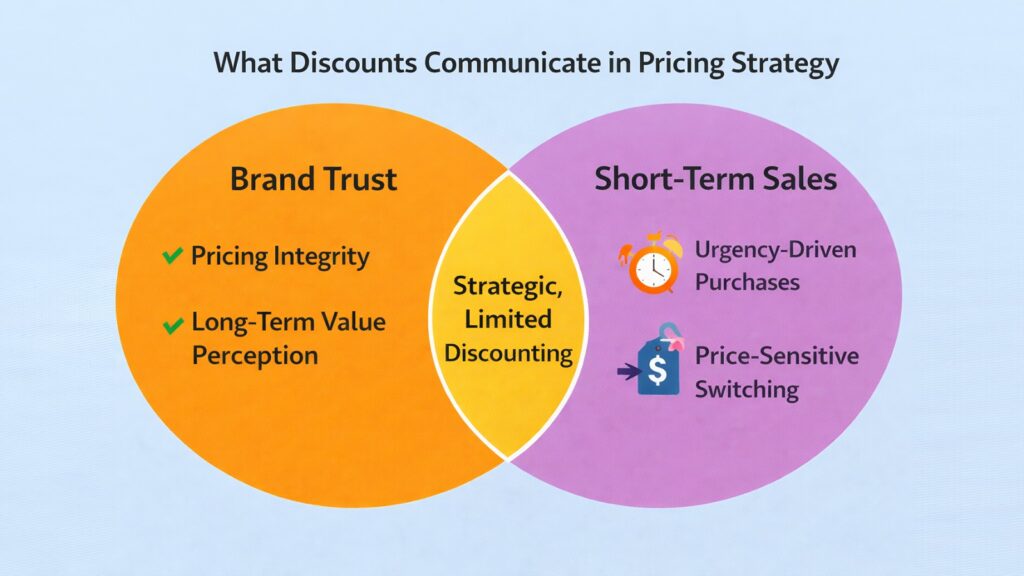
Discounts communicate. A twenty percent reduction says something about brand confidence, customer value, and pricing integrity. Industries that discount frequently train customers to wait. Those who discount strategically build urgency without eroding trust.
Retail provides the clearest contrast. Department stores that run perpetual sales condition customers to ignore list prices. According to analysis from Bain & Company, habitual discounters see average transaction values decline by fifteen to twenty percent annually as customers delay purchases until promotions arrive. Brands like Nordstrom and REI that discount selectively during anniversary sales maintain pricing power because customers know sales are rare and time-limited.
The software industry shows similar patterns. Companies offering discounts to close quarterly deals attract customers, optimizing for price rather than fit. These customers churn faster and negotiate harder on renewals. Companies maintaining stable pricing attract customers evaluating features and outcomes. Research from Price Intelligently shows that SaaS companies with stable pricing structures report customer lifetime values thirty to forty percent higher than competitors using frequent promotional discounting.
Luxury goods demonstrate the extreme end of this principle. Brands like Hermès and Chanel rarely discount. When they do, it happens through private sales to existing customers rather than public promotions. This restraint reinforces exclusivity and preserves brand equity. Customers understand that price reflects value rather than negotiation leverage.
The marketing implication is clear. Pricing strategy should treat discounts as rare signals rather than regular tactics. When discounts do occur, they should serve specific strategic purposes like acquiring new customer segments, clearing inventory, or rewarding loyalty. Random or frequent discounting undermines the pricing signal and trains customers to distrust list prices.
Table: Pricing Strategy and Discounting Approaches by Brand
| Brand and Discounting Strategy | Market Signal Sent Through Pricing Strategy |
|---|---|
| Costco (Minimal discounting, stable value pricing) | Everyday low prices, membership trust, consistent value, no gimmicks, shopping predictability |
| J.Crew Historical (Frequent sales 40-60% off) | Eroded pricing power, trained discount waiting, weakened brand perception, devalued products |
| Lululemon (Rare seasonal markdowns on limited items) | Quality confidence, scarcity messaging, premium positioning maintenance, brand strength |
| Spotify Premium (Student discount only, strategic targeting) | Segment-specific value without broad devaluation, future customer investment, selective accessibility |
| Trader Joe’s (No promotional discounts, everyday pricing) | Quality at fair prices, transparent value, reliable shopping experience, trust building |
| Apple Products (Minimal discounting except education/enterprise) | Innovation premium, resale value protection, brand strength, quality confidence |
5. Pricing Strategy Lesson Five: Pricing Evolves as Markets Mature
Static pricing fails because markets shift. Early-stage industries tolerate experimentation and premium pricing for innovation. Mature markets demand efficiency and competitive positioning. Pricing strategy must evolve through these phases or risk obsolescence.
The smartphone industry illustrates this progression. Early iPhones commanded premium prices because they created a new category. Customers paid for innovation and early access. As the market matured and competitors entered, the pricing strategy shifted. Apple maintained premium positioning while introducing mid-tier options like the iPhone SE. Samsung and Google positioned themselves on value and features. Xiaomi and OnePlus competed on aggressive pricing with flagship specs. Each approach reflected market maturity and competitive dynamics rather than production costs.
Streaming services show a similar evolution. Netflix launched at seven dollars a month when streaming was novel. As competition intensified with Disney+, HBO Max, and others, pricing became a strategic battlefield. Netflix raised prices to fund content while competitors undercut to gain share. The market moved from a growth phase, where pricing signaled early adoption, to a maturity phase where pricing reflected competitive positioning and content libraries.
Business-to-business software follows this pattern predictably. New categories start with premium pricing as vendors educate markets and prove value. As categories mature, competitors emerge and pricing compresses. Winners either maintain premium positioning through innovation and service or optimize efficiency to win on value. Companies that fail to evolve their pricing strategy get stuck between positions, unable to justify premium prices without innovation or compete on value without scale.
Marketing teams that understand market maturity cycles can adjust pricing strategy proactively rather than reactively. This means monitoring competitive moves, tracking customer price sensitivity, and recognizing when market dynamics require repositioning. Pricing becomes a dynamic marketing variable rather than a set-it-and-forget-it decision.
Table: Pricing Strategy Evolution Through Market Maturity Stages
| Market Stage and Industry Example | Approach and Rationale |
|---|---|
| Introduction (Tesla 2012-2015) | Premium pricing, innovation premium, category creation, early adopter targeting, market education |
| Early Growth (Electric vehicles 2018-2020) | Competitive entry, value positioning, multiple entrants, feature parity competition |
| Rapid Growth (Cloud computing AWS, Azure, GCP) | Segmentation, tiered pricing, usage-based models, customer choice optimization |
| Maturity (Personal computers market) | Efficiency focus, commoditization pressure, thin margins, volume competition, price wars |
| Decline (Digital cameras post-smartphone) | Discount positioning, exit strategies, clearance pricing, market contraction management |
| Reinvention (Nintendo Switch gaming segment) | Premium repositioning through innovation, created new segment, avoided commoditization |
6. Pricing Strategy Lesson Six: The Best Pricing Strategies Are Tested, Not Assumed
Assumptions about optimal pricing fail because customer behavior surprises even experienced marketers. Testing reveals what customers value and what they ignore. Industries that treat pricing as an experiment learn faster than those treating it as a decision.
Streaming platforms pioneered pricing experimentation. Netflix tested pricing tiers, content bundling, and regional variations continuously. According to their public investor communications, these tests revealed that customers valued content breadth over 4K resolution, leading to tier restructuring that improved both revenue and satisfaction. The experimentation mindset allowed rapid iteration based on behavioral signals rather than surveys or assumptions.
E-commerce companies test pricing through multiple mechanisms. Amazon varies prices by time, location, and user behavior. The company reportedly runs thousands of pricing tests simultaneously to optimize revenue and conversion. While controversial, this approach generates data about price elasticity and customer sensitivity that static pricing never reveals. The marketing insight extends beyond revenue to understanding which customers value convenience versus cost and how price framing affects purchasing decisions.
Software companies test pricing through packaging rather than price changes. Offering three tiers instead of one reveals which features customers value most. Changing tier definitions shows whether customers want more functionality or simpler solutions. These experiments generate learning without the risk of public price increases that damage trust.
The key principle is treating pricing as a source of customer insight rather than just revenue optimization. When marketing owns pricing experiments, the focus shifts from extracting maximum value to understanding customer priorities and building better positioning. Tests should measure engagement, retention, and satisfaction alongside conversion to ensure pricing strategy supports long-term brand building.
Table: Pricing Strategy Testing Methods Across Industries
| Testing Method and Industry Application | Learning Signals |
|---|---|
| A/B Price Testing (E-commerce, SaaS platforms) | Conversion rate by segment, price sensitivity thresholds, optimal entry points, elasticity patterns |
| Tier Restructuring (Software subscriptions, streaming) | Feature value perception, upgrade patterns, customer self-selection, willingness to pay signals |
| Geographic Pricing (Global consumer brands, digital services) | Willingness to pay by market, purchasing power differences, competitive positioning needs |
| Bundle Testing (Telecommunications, media packages) | Cross-product value perception, usage patterns, retention through bundling, package optimization |
| Time-Limited Offers (Retail, B2B software trials) | Urgency effectiveness, discount dependency risk, new customer quality assessment |
| Freemium Conversion Analysis (Mobile apps, productivity tools) | Conversion triggers, premium feature value, activation patterns, upgrade motivations |
Conclusion: Why Pricing Strategy Works Best When Marketing Owns It
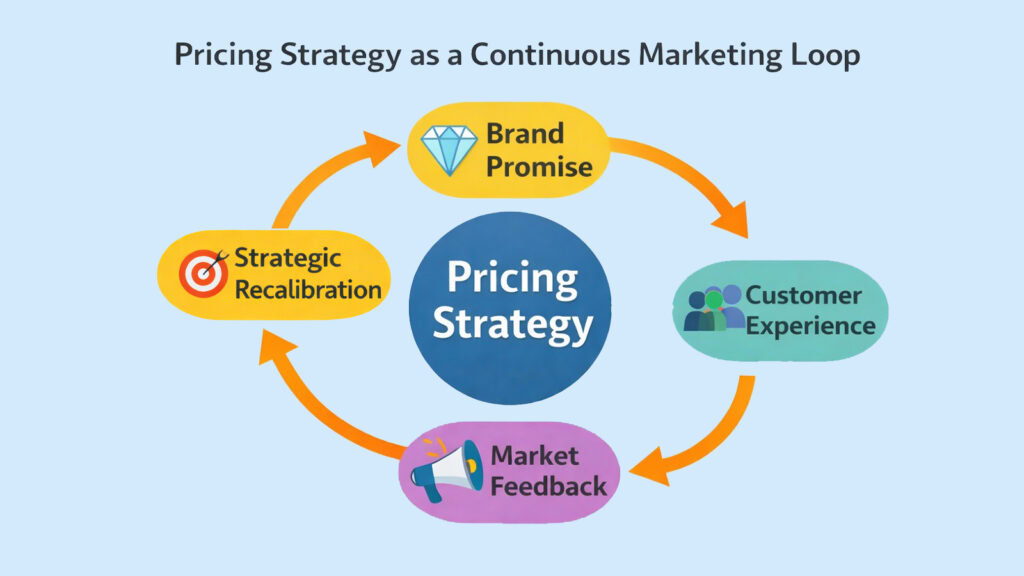
The six lessons point to a single truth. Pricing strategy succeeds when marketing drives it because marketing understands customers, positioning, and perception. Finance thinks in costs and margins. Marketing thinks in value and signals. Both matter, but customer decisions happen in the marketing domain.
Price shapes perception before any campaign launches. It filters customers before any sales conversation starts. It communicates value more clearly than any feature list. It signals brand intent through every transaction. When marketing owns these decisions, pricing becomes a tool for building sustainable competitive advantage rather than just covering costs.
The companies that excel at pricing strategy share common characteristics. They test rather than assume. They adjust as markets mature. They use discounts sparingly and strategically. They anchor on value instead of cost. They recognize that the right price attracts the right customers and the wrong price creates misalignment no matter how good the product.
Looking forward, pricing strategy will only grow more important as markets become more transparent and competitive. Customers compare prices instantly. Competitors adjust positioning quickly. The companies that treat pricing as a dynamic marketing function will build stronger brands and more loyal customer bases than those that treat it as a static financial calculation.
The opportunity for marketers is clear. Own pricing strategy. Use it to shape perception, select customers, and build trust over time. Treat it as seriously as brand positioning or product development. The results will show in customer quality, customer retention, and long-term profitability. Pricing strategy belongs to marketing because marketing belongs to customers, and customers ultimately decide what prices mean.
Table: Pricing Strategy Principles for Marketing Leadership
| Pricing Principle | Marketing Application and Expected Outcome |
|---|---|
| Price as Positioning Signal | Align price with brand promise and target segment for consistent market perception, reduced confusion |
| Customer Filtering Through Price | Set prices that attract ideal customer profiles for higher retention, lower support costs, stronger referrals |
| Value Framing Over Cost Justification | Communicate outcomes rather than features for premium pricing sustainability, competitor differentiation |
| Strategic Discount Discipline | Reserve discounts for specific objectives to preserve pricing power, reduce customer discount conditioning |
| Dynamic Pricing Adjustments | Monitor market maturity and adjust positioning for maintained competitiveness through evolution |
| Continuous Pricing Experimentation | Test tiers, bundles, and framing for data-driven decisions, reduced assumption risk, faster learning |
Read More Business and Economy Articles
- Global Market Indices: 6 powerful Forces Shaping Them
- Successful Business Owner: 6 Key Mindset Shifts That Work
- Aspiring Entrepreneur: 6 Powerful Ways to Build Real Success
- Share Market Basics: 8 Powerful Components Explained
- Global South Economies: 6 Powerful Forces Driving World Growth
- AI Job Growth: 6 Powerful Trends Fueling a Brighter Future
- AI Job Losses: 6 Devastating Impacts You Can’t Ignore
- Business 360° Breakthrough: Unlock Powerful Growth Today
- Global Economy: 10 Essential Building Blocks Revealed
- 6 Bold Human Resources Strategies To Boost Engagement