Table of Contents
Introduction: Why Quantum Computing Superposition Changes How Computers Think
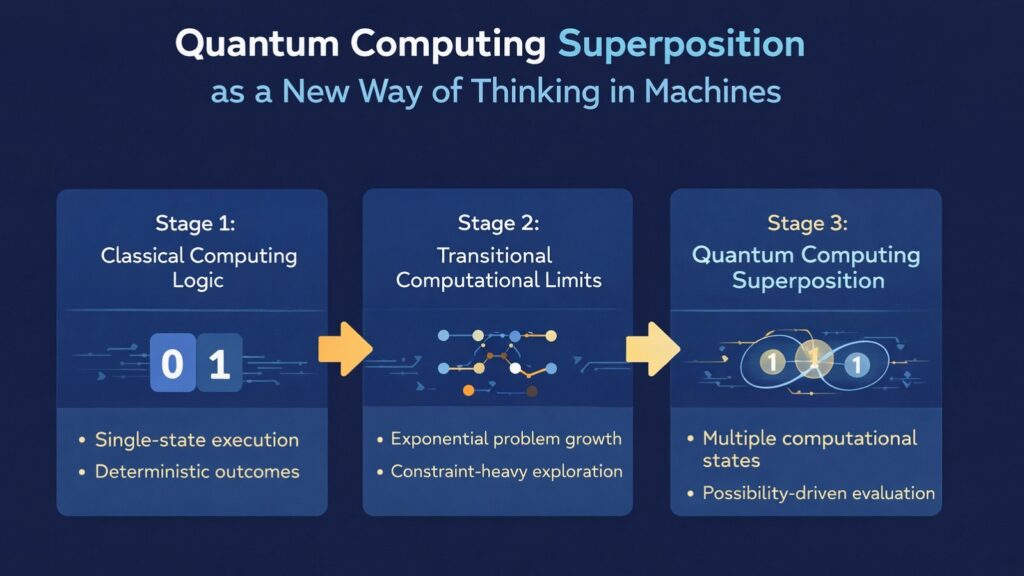
Computers have always worked by making decisions. One path or another. True or false. Zero or one. Every choice is locked in place before the next begins. But Quantum Computing Superposition breaks that rule entirely. It allows machines to hold multiple answers at once, exploring possibilities rather than committing to certainties. This changes everything about how computers represent information, how they process problems, and how they deliver results.
The shift feels strange at first. We’re used to computers that think in lines, following strict logic from start to finish. Quantum Computing Superposition introduces a different approach where information exists in layered states, where exploration happens across many pathways simultaneously, and where outcomes emerge through patterns rather than single answers. This isn’t just faster computing. It’s a different kind of thinking altogether.
This article examines six computing ideas that Quantum Computing Superposition makes possible. Each idea reveals how this concept reshapes system design, algorithm structure, and problem-solving methods. Together, they show why understanding Quantum Computing Superposition matters for anyone interested in where computing goes next. The question isn’t whether quantum systems will replace classical ones. The question is what becomes possible when machines can think in possibilities instead of certainties.
Quantum Computing Superposition and Core Quantum Concepts
| Quantum Computing Concept | Computing Impact |
|---|---|
| Superposition | Enables multi-state information representation, allowing computation across multiple possibilities simultaneously |
| Entanglement | Creates correlated information states across system components, enabling coordinated computational operations |
| Interference | Amplifies desired computational outcomes while canceling unwanted results through pattern reinforcement |
| Quantum Tunneling | Allows computational paths to bypass traditional barriers, finding solutions unreachable by classical methods |
| Quantum Measurement | Collapses probabilistic states into definite outputs, extracting computational results from quantum systems |
| Error Correction | Protects quantum information from degradation, maintaining computational integrity across complex operations |
1. Quantum Computing Superposition as a Shift From Binary Thinking
Classical computers lock information into place. Every bit holds either zero or one. Every calculation moves from one definite state to another. This binary approach works beautifully for tasks that require precision and repeatability. But it creates limitations when problems grow complex, when search spaces expand exponentially, or when multiple scenarios need simultaneous consideration.
Quantum Computing Superposition changes the fundamental assumption. Information no longer needs to choose between states. A quantum bit can represent both zero and one at the same time, weighted across possibilities rather than committed to a single answer. This isn’t vagueness or uncertainty in the classical sense. It’s a structured multiplicity, where computational states carry information about many configurations simultaneously.
The implications reach deeper than speed or capacity. When information exists in superposition, the entire problem-framing process changes. Questions that required multiple sequential checks in classical systems can be explored through parallel evaluation in quantum systems. The computer doesn’t ask “which answer is correct” and then test each option. Instead, it asks “what patterns emerge across all possibilities” and lets the answer reveal itself through the computational process.
This shift affects how inputs are interpreted. Classical systems convert real-world complexity into binary choices, losing nuance in the translation. Quantum systems using superposition can maintain that complexity longer, preserving relationships between possibilities throughout the computation. The translation to binary happens only at the end, when measurement forces the system to choose. Until then, the computation lives in a richer information space.
Outcomes get evaluated differently too. Classical computing delivers one answer at a time, requiring multiple runs to explore alternatives. Quantum Computing Superposition allows evaluation across the entire solution space within a single computational run. The results emerge as probability distributions rather than single points, providing insight into not just what the answer is but how confident the system is about it.
Quantum Computing Superposition Versus Classical Binary Computing
| Computing Aspect | Classical Binary Computing vs Quantum Computing Superposition |
|---|---|
| Information State | Classical computing represents information in a single, well-defined state, whereas quantum computing encodes information across a superposition of multiple states. |
| Problem Framing | Classical approaches frame problems through sequential evaluation of discrete alternatives, while quantum approaches enable simultaneous exploration of an entire solution space. |
| Input Processing | Classical systems reduce inputs to binary representations at the outset, whereas quantum systems maintain multi-state correlations throughout computation. |
| Computational Path | Classical computation proceeds through a deterministic and linear sequence of states, while quantum computation evolves in parallel across probabilistically weighted states. |
| Output Format | Classical systems yield a single deterministic outcome, whereas quantum systems produce a probability distribution over possible outcomes. |
2. Quantum Computing Superposition and Parallel Problem Exploration
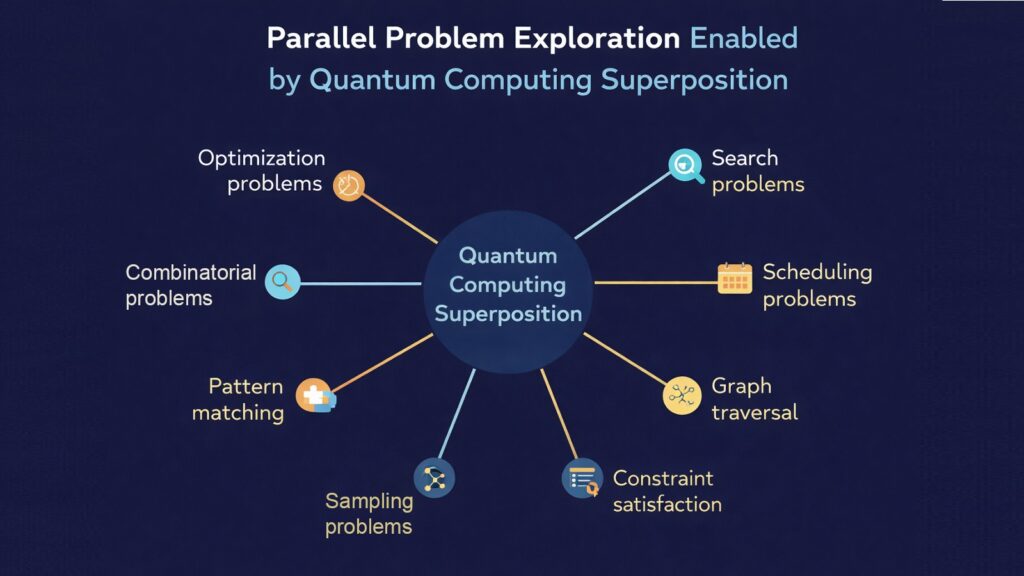
Search problems dominate computing. Finding the best route. Identifying optimal configurations. Locating patterns in massive datasets. Classical computers tackle these challenges by checking possibilities one at a time or by using clever shortcuts that reduce the search space. But many important problems resist these approaches because the number of possibilities grows too fast.
Quantum Computing Superposition introduces a different strategy. Instead of moving through the search space sequentially, the system explores many paths at once. This happens because superposition allows the quantum computer to encode multiple candidate solutions simultaneously. Each computational step operates on all these candidates in parallel, evaluating properties and relationships across the entire set rather than examining them individually.
The advantage isn’t raw speed in the traditional sense. It’s structural efficiency. Classical parallel computing splits a problem across multiple processors, each handling a portion of the work. Quantum Computing Superposition handles multiplicity within individual computational elements, allowing the same quantum resources to examine many scenarios at once. The parallelism emerges from how information is represented rather than from how hardware is distributed.
This changes workflow design fundamentally. Classical algorithms are built around iteration, refinement, and narrowing down options. Quantum algorithms using superposition are built around initialization of possibility spaces, evolution of all states together, and extraction of patterns that distinguish good solutions from poor ones. The emphasis shifts from searching through a space to shaping a space so the right answers stand out.
Complex optimization problems benefit particularly from this approach. When you need to balance multiple competing objectives, when constraints interact in complicated ways, or when the solution landscape contains many local peaks and valleys, Quantum Computing Superposition allows exploration across the entire terrain simultaneously. The system doesn’t get trapped in local optima as easily because it maintains awareness of multiple regions at once.
Quantum Computing Superposition in Problem Exploration Workflows
| Workflow Element | Impact of Superposition |
|---|---|
| Solution Space Encoding | Represents all candidate solutions as weighted quantum states instead of discrete items |
| Exploration Strategy | Evolves entire possibility space simultaneously rather than sampling individual points |
| Resource Utilization | Leverages single quantum elements to evaluate multiple scenarios instead of requiring distributed hardware |
| Algorithm Structure | Focuses on pattern amplification rather than iterative search and elimination |
| Constraint Handling | Evaluates competing objectives across full solution set rather than testing each configuration separately |
3. Quantum Computing Superposition as a New Information Design Layer
Every computing system makes choices about how to organize information. Classical systems use hierarchies, arrays, trees, and graphs. These structures work well because they mirror how binary logic operates, providing clear paths from inputs to outputs. But they also impose constraints, requiring information to be partitioned, categorized, and stored in ways that fit binary processing.
Quantum Computing Superposition adds a new organizational layer. Information can exist in distributed states where multiple configurations share the same computational resource. This isn’t just compression or clever encoding. It’s genuine multiplicity, where a single quantum element holds information about many classical states at once. The structure of this distribution matters as much as the information itself.
This capability changes how algorithms are designed. Classical algorithms move data through stages, transforming it step by step until the desired result emerges. Quantum algorithms using superposition can maintain multiple potential transformations simultaneously, allowing the system to explore different processing paths in parallel. The information architecture supports branching and recombination in ways that classical structures cannot.
Weighted states introduce another dimension. In superposition, different possibilities can have different amplitudes, effectively prioritizing some configurations over others without eliminating any completely. This weighting becomes a design tool, allowing algorithm creators to bias the computation toward more promising regions of the solution space while still keeping other options available. Classical systems either consider an option or they don’t. Quantum systems using superposition can consider it partially, dedicating more or less computational attention based on probability amplitudes.
The implications for handling complexity are substantial. Many real-world problems involve relationships between variables that resist clean decomposition. Quantum Computing Superposition allows these relationships to be encoded directly into the information structure rather than approximated through classical representations. The computation can work with the natural complexity of the problem rather than forcing it into simpler forms.
Results interpretation changes too. When information emerges from superposition through measurement, the distribution of outcomes carries meaning. Multiple measurements of the same quantum state produce different results, but the pattern across many measurements reveals the underlying probability structure. This provides richer feedback than single-answer classical outputs, showing not just what the answer is but how stable and confident that answer should be.
Quantum Computing Superposition Information Architecture Features
| Architecture Element | Description and Function |
|---|---|
| Multi-State Representation | Single computational elements encode multiple classical configurations simultaneously through quantum superposition |
| Weighted Distribution | Probability amplitudes create graduated importance across different states rather than binary inclusion or exclusion |
| Parallel Path Maintenance | Algorithm design supports simultaneous evolution of multiple processing pathways without requiring separate resources |
| Relationship Preservation | Complex interdependencies between variables remain intact throughout computation rather than requiring simplification |
| Pattern-Based Output | Measurement distributions reveal solution structure and confidence levels through repeated sampling |
4. Quantum Computing Superposition Inside Modern Quantum Algorithms
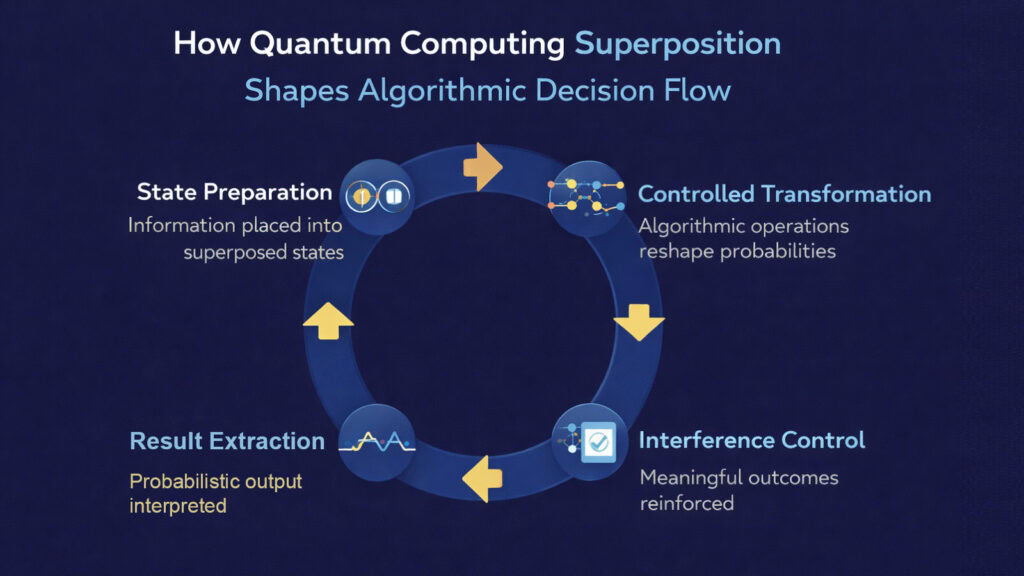
Algorithms are recipes for computation. They specify what steps to take, in what order, with what inputs. Classical algorithms assume that each step operates on definite information states. Quantum algorithms built around superposition work differently. They assume that information exists in multiplicity throughout most of the computation, collapsing to definite states only when results are needed.
This assumption shapes the entire algorithmic approach. The first phase typically initializes the system into superposition, creating a computational starting point that spans the entire problem space. This initialization doesn’t set up one configuration. It sets up all relevant configurations at once, weighted according to what the algorithm needs to accomplish. The system begins in a state of maximum possibility.
The middle phase evolves this superposition through operations that apply to all states simultaneously. These operations aren’t iterating through possibilities. They’re transforming the entire superposition structure, changing the relationships between different components and adjusting the probability amplitudes. Some possibilities gain weight, becoming more likely outcomes. Others lose weight, fading into background noise.
The key insight is that Quantum Computing Superposition enables constructive and destructive interference. Operations can be designed so that paths leading to correct answers reinforce each other while paths leading to incorrect answers cancel out. This interference happens across the entire superposition simultaneously, creating a shaping effect where the solution emerges naturally from the computational evolution rather than being explicitly calculated.
The final phase measures the quantum state, forcing it to choose. Because interference has amplified the correct answer and suppressed incorrect ones, measurement is likely to return the right result. Multiple measurements provide verification and confidence levels. The algorithm succeeds not by finding the answer through search but by sculpting the probability distribution so the answer becomes inevitable.
This pattern appears across many quantum algorithms designed for different purposes. Search algorithms use superposition to examine all possibilities while amplifying the marked item. Optimization algorithms use it to explore the fitness landscape while steering toward peaks. Simulation algorithms use it to represent multiple system configurations while tracking their evolution. The specific operations differ, but the reliance on Quantum Computing Superposition as the enabling foundation remains constant.
Quantum Computing Superposition in Algorithm Design Phases
| Algorithm Phase | Role of Superposition |
|---|---|
| Initialization | Creates spanning state across entire computational problem space rather than selecting starting configuration |
| State Evolution | Applies transformations to all superposed configurations simultaneously instead of sequential operations |
| Interference Management | Shapes probability distributions through reinforcement and cancellation across multiple computational paths |
| Solution Amplification | Increases likelihood of correct outcomes while decreasing probability of incorrect results through repeated interference |
| Measurement Strategy | Extracts definite answers from probability distributions through selective collapse of quantum states |
5. Quantum Computing Superposition and Probabilistic Decision Making
Classical computers deliver certainty. Ask a question, get an answer. Run the same calculation twice, get the same result both times. This determinism makes classical systems reliable and predictable. But many real-world problems don’t have certain answers. They involve incomplete information, changing conditions, or inherent randomness. Forcing deterministic answers onto these problems creates artificial precision that doesn’t reflect reality.
Quantum Computing Superposition embraces probability naturally. Because information exists in multiple states simultaneously, outcomes are inherently probabilistic until measurement occurs. This isn’t a limitation to overcome. It’s a feature that aligns better with problems involving uncertainty, variability, or complex scenarios where multiple valid answers exist.
Consider decision problems where you need to evaluate options under uncertain conditions. Classical approaches typically require assumptions about probability distributions, then run deterministic calculations based on those assumptions. Quantum approaches using superposition can represent the uncertainty directly within the computational structure. The system doesn’t assume a probability distribution and then calculate. It maintains probabilistic states throughout the computation, allowing uncertainty to propagate naturally through the problem.
This approach provides richer information about solutions. Instead of delivering a single recommended answer, quantum systems can deliver probability distributions showing which answers appear most frequently and with what confidence levels. Decision makers see not just what the optimal choice might be but how robust that choice is to variations in assumptions or conditions. The output format matches the problem’s inherent uncertainty rather than hiding it behind false precision.
Sampling and approximation tasks benefit particularly from this probabilistic framework. Many important computational problems don’t require exact answers. They need good estimates or representative samples from large possibility spaces. Quantum Computing Superposition allows efficient sampling because the quantum state naturally represents a distribution across possibilities. Measuring the state samples from that distribution provides information about the overall structure without exhaustively examining every option.
The shift also affects how we think about computational accuracy. In classical systems, accuracy means getting the exact right answer. In quantum systems using superposition, accuracy means correctly representing the probability distribution over answers. A quantum algorithm succeeds when repeated measurements produce the expected statistical pattern, even if individual measurements vary. This statistical perspective better matches problems where variability is inherent rather than an error to eliminate.
Quantum Computing Superposition in Probabilistic Computing
| Decision Making Aspect | Quantum Superposition Advantage |
|---|---|
| Uncertainty Representation | Maintains probabilistic states directly within computational structure rather than requiring external assumptions |
| Output Information | Provides complete probability distributions showing answer confidence and variability rather than single points |
| Sampling Efficiency | Generates representative samples from large spaces through quantum state measurement instead of exhaustive enumeration |
| Robustness Analysis | Reveals solution stability across varying conditions through distribution properties rather than requiring sensitivity testing |
| Accuracy Definition | Focuses on statistical correctness of distributions rather than deterministic precision of individual answers |
6. Quantum Computing Superposition as a Scalable Computing Advantage
Scalability determines whether computing approaches remain viable as problems grow larger. Classical systems scale by adding more processors, more memory, or more time. But many important problems grow exponentially. Doubling the problem size might require quadrupling or even squaring the computational resources. Eventually, no amount of classical hardware can keep up.
Quantum Computing Superposition changes the scaling relationship. Adding a single quantum bit doubles the number of states the system can represent in superposition. This exponential scaling of representational capacity creates a structural advantage for problems where the solution space grows exponentially with problem size. The quantum system’s capacity grows at the same rate as the problem complexity rather than falling behind.
This matters profoundly for future computing challenges. Molecular simulation, cryptographic analysis, financial modeling, and logistics optimization all involve problems where classical approaches hit exponential walls. Small instances remain manageable. Medium instances become expensive. Large instances become impossible regardless of hardware investments. Quantum Computing Superposition offers a path past these barriers by expanding computational capacity exponentially rather than linearly.
The advantage isn’t universal. Many problems don’t have exponentially growing solution spaces. Many can be approximated effectively with classical methods. But for the subset of problems where exponential scaling creates insurmountable classical barriers, Quantum Computing Superposition represents a different approach entirely. It’s not faster classical computing. It’s a different computational paradigm that matches the problem structure better.
Scalability also affects system design philosophy. Classical systems optimize by reducing waste, improving algorithms, and parallelizing work across hardware. These strategies help, but don’t change fundamental scaling relationships. Quantum systems built on superposition optimize by increasing state density, improving interference patterns, and reducing measurement noise. The design focus shifts from managing hardware resources to managing information representation.
The practical implications remain emerging. Current quantum systems are small and noisy, limiting their advantage to specialized problems. But the theoretical foundation is clear. As quantum hardware improves, the exponential scaling advantage of Quantum Computing Superposition will become increasingly relevant. Problems that currently seem intractable may become solvable not through better classical approaches but through fundamentally different quantum ones.
Quantum Computing Superposition and Computational Scalability
| Scalability Factor | Impact of Superposition |
|---|---|
| State Space Growth | Expands exponentially with each additional quantum element rather than linearly with classical resources |
| Problem Matching | Aligns naturally with exponentially complex problems where classical scaling creates insurmountable barriers |
| Resource Optimization | Focuses on information density and interference quality rather than hardware quantity and distribution |
| Practical Threshold | Becomes advantageous when problem exponential growth exceeds classical hardware improvement rates |
| Design Philosophy | Treats scalability as architectural feature rather than engineering challenge requiring resource expansion |
Conclusion: Why Quantum Computing Superposition Redefines Computing Itself
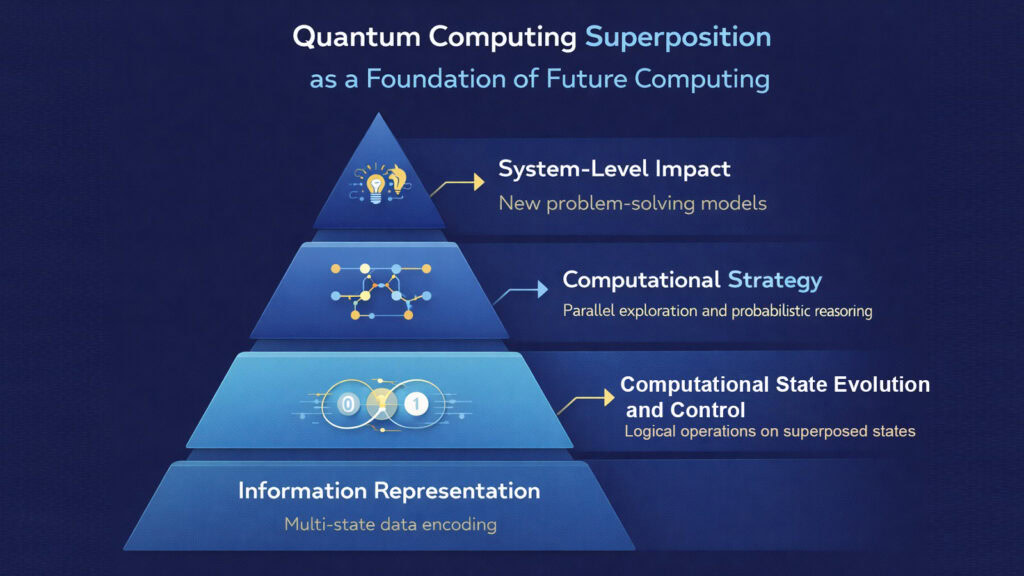
These six ideas together reveal something fundamental. Quantum Computing Superposition isn’t one feature among many. It’s a different way of thinking about what computation means. It changes how information gets represented, moving from fixed states to distributed possibilities. It changes how problems get explored, replacing sequential search with parallel evolution. It changes how systems organize complexity, adding layers of structure unavailable to classical approaches.
The shift runs deeper than hardware or algorithms. It touches the philosophical foundations of computing itself. Classical computers extend human logic, following rules we set with precision, and we enforce. Quantum computers using superposition operate in spaces we can specify but not fully visualize, following quantum mechanical principles that allow behaviors impossible in classical systems. They don’t think the way we think. They think in possibilities, probabilities, and interference patterns.
Understanding Quantum Computing Superposition matters for anyone considering computing’s future. The problems we need to solve keep growing more complex. Climate modeling requires simulating molecular interactions at massive scales. Drug discovery demands exploring vast chemical spaces. Artificial intelligence seeks to recognize patterns in high-dimensional data. Financial systems need to optimize under uncertainty. These challenges push classical computing toward its limits.
Quantum systems won’t replace classical ones entirely. But they will complement them, handling problem classes where superposition provides structural advantages. The future likely holds hybrid systems where classical computers manage deterministic operations while quantum computers tackle exponential complexity. The key is knowing which tool fits which problem, and that knowledge requires understanding what Quantum Computing Superposition makes possible.
The six ideas explored here provide that foundation. They show superposition as a shift from binary certainty to possibility-driven computation. They demonstrate how it enables parallel problem exploration and introduces new information architecture layers. They reveal its role in algorithm design, its alignment with probabilistic decision making, and its promise for scalable computing. Together, these ideas explain why Quantum Computing Superposition represents not just an improvement but a transformation in how machines process information and solve problems.
Quantum Computing Superposition Impact on Computing Dimensions
| Computing Dimension | Transformation Through Superposition |
|---|---|
| Information Representation | Shifts from single-state certainty to multi-state possibility distributions |
| Problem-Solving Approach | Moves from sequential exploration to simultaneous evaluation across solution spaces |
| Algorithmic Foundation | Transitions from iterative refinement to interference-based pattern emergence |
| Decision Framework | Changes from deterministic outputs to probabilistic distributions reflecting inherent uncertainty |
| Scalability Model | Grows exponentially through state density rather than linearly through hardware expansion |
Read More Tech Articles
- 6 Powerful Ways Dilution Refrigerator Shapes Quantum Design
- How Qubits Work: 6 Essential Secrets of Quantum Hardware
- Intelligent Robotics: 6 Powerful Ways AI Comes Alive
- Natural Language Processing: 6 Powerful Ways AI Reads
- Machine Learning in AI: 6 Powerful Ways AI Learns
- Artificial Intelligence: 8 Powerful Insights You Must Know
- 8 Powerful Smart Devices To Brighten Your Life
- Discover 8 Smart Speaker Brands As Motivational Speakers