Table of Contents
Introduction: Quantum Theory as the Foundation of Modern Scientific Thought
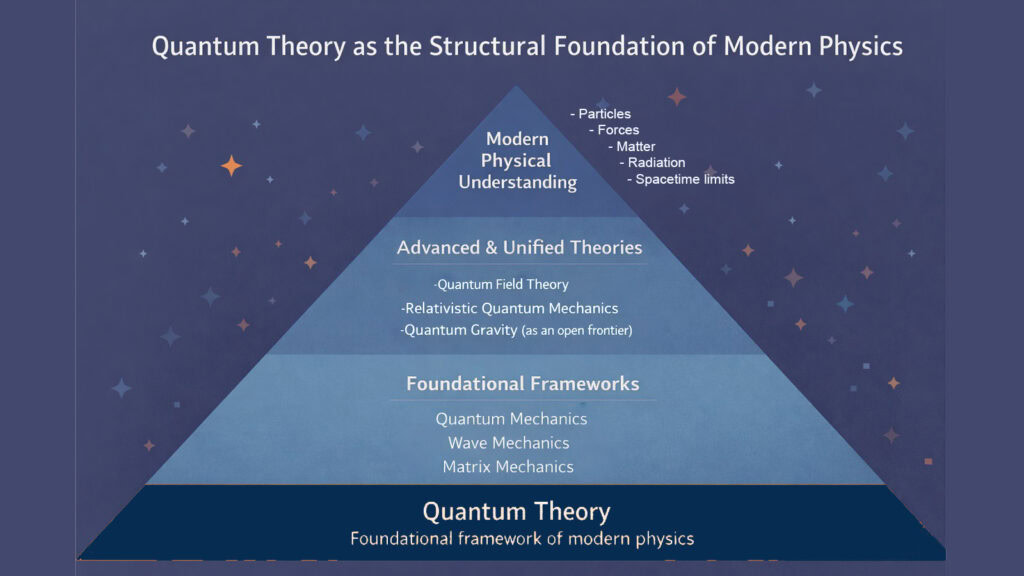
Quantum Theory is one of the most important fundamental physical theories. It stands as the blueprint upon which modern physics rests. It emerged from the rubble of early twentieth-century classical physics, when experiments revealed behaviors that defied every expectation. Blackbody radiation curves refused to match predictions. Atomic spectra showed discrete lines instead of continuous spreads. The photoelectric effect demanded that light behave as particles, not just waves. These puzzles forced physicists to abandon centuries of certainty and build something entirely new.
What began as isolated solutions to specific problems gradually merged into a unified framework. By the mid-1920s, physicists had forged Quantum Theory into a coherent structure that describes how matter and energy behave at the smallest scales. This framework does not merely add to classical physics. It replaces the deterministic worldview with probabilistic rules, where particles exist in superpositions and measurements alter reality itself.
This article does not catalog eight separate theories. Instead, it explores six fundamental ways Quantum Theory shapes modern physics. These include the foundational frameworks that define reality, the principles that govern measurements, the interpretations that give meaning to equations, the advanced theories that extend quantum rules to new domains, the experimental methods that test predictions, and the unification efforts that seek a complete understanding of nature. Each way reveals how deeply Quantum Theory has woven itself into the fabric of scientific thought.
Today, Quantum Theory serves as both a compass and a foundation. It guides physicists through particle accelerators and quantum computers, through cosmology and condensed matter research. Every major advance in modern physics either builds upon quantum principles or attempts to reconcile them with other forces. Understanding these six pathways shows how Quantum Theory transformed from a revolutionary idea into the dominant architecture of contemporary science.
Top 8 Foundational Frameworks of Quantum Theory
| Framework | Key Contribution |
|---|---|
| Quantum Mechanics | Established probabilistic description of atomic systems using wave functions |
| Matrix Mechanics | Developed by Heisenberg using matrices to represent observable quantities |
| Wave Mechanics | Introduced by Schrödinger using differential equations for quantum states |
| Dirac Formalism | Unified matrix and wave approaches through abstract vector spaces |
| Path Integral Formulation | Feynman’s approach summing all possible particle paths |
| Operator Theory | Mathematical framework using operators for physical observables |
| Canonical Quantization | Method converting classical systems to quantum descriptions |
| Second Quantization | Extended formalism to handle particle creation and annihilation |
1. Quantum Theory Redefines Reality Through Its Foundational Frameworks
The foundational frameworks of Quantum Theory shattered the classical notion of reality. Before quantum mechanics emerged, physicists assumed the universe operated like clockwork. Every particle had a definite position and momentum at every moment. Knowing initial conditions meant predicting the future with perfect accuracy. This certainty vanished when experiments forced a new perspective.
Matrix Mechanics arrived first, developed by Werner Heisenberg in 1925. He abandoned the idea of electron orbits and instead used mathematical matrices to represent observable quantities. These matrices did not track particles along paths. They captured transitions between energy states, reflecting only what measurements could reveal. The approach worked brilliantly for atomic spectra but seemed abstract and disconnected from physical intuition.
Wave Mechanics emerged soon after through Erwin Schrödinger’s work. He treated particles as wave functions governed by differential equations. These waves spread through space, representing the probability of finding a particle at different locations. When measured, the wave collapsed to a single point, giving a definite result. Schrödinger’s formulation felt more familiar to physicists trained in classical wave theory, yet it carried the same strange implications as Heisenberg’s matrices.
Paul Dirac proved these approaches were mathematically equivalent. His abstract formalism unified them into a single framework using vector spaces and operators. Later, Richard Feynman introduced the path integral method, imagining particles taking every possible route simultaneously. Each framework offered different tools for solving problems, but all agreed on predictions. Together, they formed the complete structure of Quantum Theory.
These frameworks forced physics to embrace probability at a fundamental level. Classical mechanics treated randomness as ignorance about hidden details. Quantum Theory made probability intrinsic to nature itself. A particle does not have a definite position until it is measured. Before measurement, it exists in a superposition of all possible positions. This shift redefined what reality means at the quantum scale.
Modern physics inherited this transformation. Today’s quantum field theories, condensed matter models, and quantum computing algorithms all rest on these foundational frameworks. They describe everything from semiconductor behavior to superconductivity to quantum entanglement in laboratory experiments. The frameworks that once seemed radical now form the bedrock of technological progress and theoretical exploration.
Top 8 Advanced and Unified Theories of Quantum Theory
| Theory | Description |
|---|---|
| Quantum Field Theory | Treats particles as excitations in underlying quantum fields |
| Relativistic Quantum Mechanics | Merges quantum mechanics with special relativity principles |
| Quantum Electrodynamics | Describes electromagnetic interactions between charged particles and photons |
| Quantum Chromodynamics | Explains strong force interactions between quarks and gluons |
| Electroweak Theory | Unifies electromagnetic and weak nuclear forces |
| Standard Model | Comprehensive framework describing fundamental particles and three forces |
| Quantum Gravity | Attempts to describe gravitational force using quantum principles |
| Supersymmetry | Proposes symmetry relating fermions and bosons |
2. Quantum Theory Establishes the Principles That Drive Modern Physics
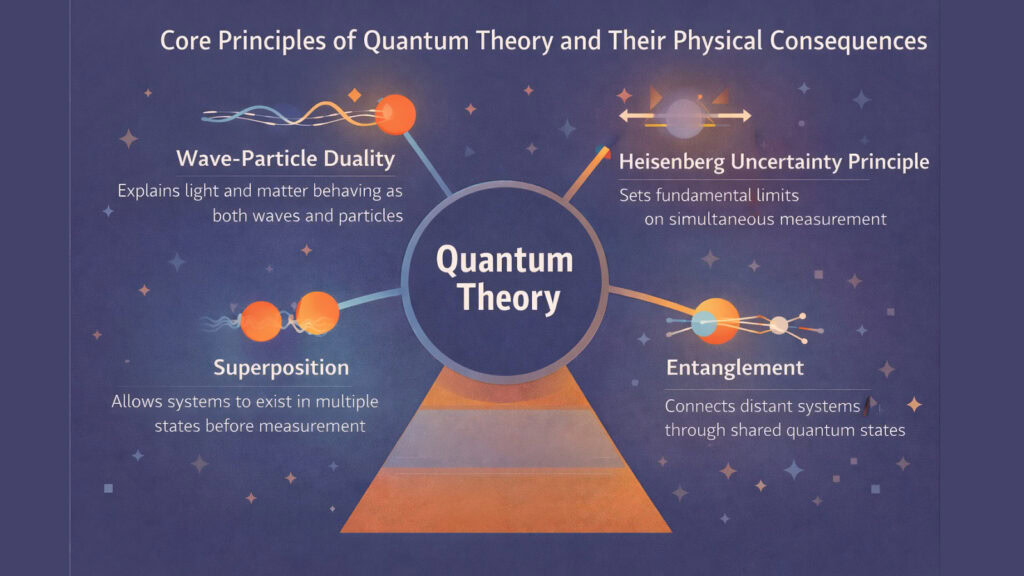
Quantum Theory introduced principles that transformed how physicists understand measurement, knowledge, and causality. These principles emerged from experimental puzzles and mathematical necessities. They now govern every aspect of modern physics, from particle collider experiments to quantum computing research.
Wave-particle duality revealed that light and matter behave as both waves and particles depending on how they are measured. Thomas Young’s double-slit experiment showed light creating interference patterns like water waves. Yet the photoelectric effect required light to arrive in discrete packets that Einstein called photons. Later experiments showed electrons producing the same dual behavior. This duality does not mean particles switch between forms. Rather, quantum objects transcend classical categories entirely.
The Heisenberg Uncertainty Principle sets fundamental limits on what can be known simultaneously. It states that measuring a particle’s position more precisely necessarily makes its momentum less certain, and vice versa. This limitation does not arise from instrument imperfection. It reflects the intrinsic nature of quantum systems. The principle constrains everything from microscope resolution to the stability of atoms, shaping how experiments must be designed.
Superposition allows quantum systems to exist in multiple states simultaneously until measured. A particle can be in two places at once, or an atom can occupy several energy levels together. This principle seems absurd from a classical viewpoint, yet experiments confirm it repeatedly. Quantum computers exploit superposition to process many calculations in parallel, offering computational power impossible with classical machines.
Entanglement establishes correlations between particles that endure over any distance. When two particles become entangled, measuring one immediately influences the other, irrespective of the distance separating them. Einstein referred to this phenomenon as “spooky action at a distance” and expressed skepticism regarding its existence. However, experiments conducted by Alain Aspect and others have unequivocally validated the reality of entanglement. Today, it serves as the foundation for quantum cryptography and quantum teleportation protocols.
These principles drive real technologies that shape modern life. Lasers rely on quantum transitions between energy levels. Magnetic resonance imaging uses quantum spin properties to visualize internal organs. Semiconductors in every electronic device depend on quantum mechanics governing electron behavior. Atomic clocks achieve unprecedented precision through quantum superposition states. Global positioning systems require corrections from both quantum mechanics and relativity to function accurately.
The principles also redefine scientific limits. They determine what questions can be answered, what measurements can be performed, and what predictions can be tested. Modern physics operates within boundaries set by Quantum Theory, accepting that some information remains fundamentally inaccessible. This acceptance marks a profound shift from classical optimism about complete knowledge.
Top 8 Specialized Branches of Quantum Theory
| Branch | Focus Area |
|---|---|
| Quantum Chemistry | Applies quantum mechanics to molecular structure and chemical reactions |
| Quantum Information Science | Studies information processing using quantum systems |
| Quantum Optics | Investigates light-matter interactions at quantum level |
| Quantum Statistics | Describes behavior of large quantum particle ensembles |
| Condensed Matter Physics | Examines quantum properties of solids and liquids |
| Quantum Thermodynamics | Explores heat and energy in quantum systems |
| Quantum Biology | Investigates quantum effects in biological processes |
| Quantum Cosmology | Applies quantum principles to universe origin and evolution |
3. Quantum Theory Shapes Interpretation and Meaning in Modern Physics
Quantum Theory’s mathematics makes stunning predictions, yet what those equations actually mean remains debated. Interpretations attempt to explain the relationship between quantum formalism and physical reality. These are not separate theories but different ways of understanding the same mathematical framework. The interpretational debates influence how physicists think about experiments, how they formulate new theories, and how they communicate science to broader audiences.
The Copenhagen Interpretation became the standard view through Niels Bohr and Werner Heisenberg’s influence. It treats the wave function as a tool for calculating probabilities, not a description of objective reality. Before measurement, asking where a particle is becomes meaningless. The act of observation causes the wave function to collapse, producing a definite result. This interpretation emphasizes the observer’s role and accepts fundamental randomness in nature.
Hugh Everett proposed the Many-Worlds Interpretation to avoid wave function collapse. According to this view, all possible measurement outcomes occur in separate, branching universes. When you measure a particle’s position, the universe splits into versions where the particle appears at each possible location. This interpretation eliminates randomness but multiplies reality itself, creating philosophical challenges about the nature of existence and probability.
The Pilot-Wave theory, developed by Louis de Broglie and later championed by David Bohm, restores determinism through hidden variables. Particles have definite positions at all times, guided by an accompanying wave field. The apparent randomness in quantum mechanics arises from incomplete knowledge about initial conditions. This interpretation recovers classical intuitions but requires nonlocal influences that seem to violate relativity’s spirit.
Decoherence offers a partial explanation for why quantum superpositions seem to disappear in everyday experience. When quantum systems interact with their environment, entanglement spreads rapidly, making superpositions effectively unobservable. This process explains the transition from quantum to classical behavior without invoking measurement or consciousness. Many physicists see decoherence as compatible with multiple interpretations while resolving practical questions about quantum-classical boundaries.
These interpretations matter because they shape research directions. Physicists working on quantum computing must understand decoherence to protect fragile superpositions. Those testing quantum gravity need interpretational clarity about spacetime measurement. Philosophers examining the nature of reality look to these interpretations for guidance. Even popular science communication carries interpretational baggage that affects public understanding.
Modern physics inherits these debates in every laboratory and equation. When experimenters design tests of quantum foundations, they often target specific interpretations. When theorists propose modifications to Quantum Theory, they build on interpretational preferences. The interpretations remind physicists that mathematical success does not automatically confer philosophical clarity. They keep alive questions about the nature of reality that pure calculation cannot answer.
Top 8 Key Interpretations and Principles of Quantum Theory
| Interpretation/Principle | Core Concept |
|---|---|
| Wave-Particle Duality | Quantum objects exhibit both wave and particle properties |
| Heisenberg Uncertainty Principle | Fundamental limits exist on simultaneous measurement precision |
| Superposition | Systems can exist in multiple states simultaneously |
| Entanglement | Particles can share correlated properties across distances |
| Copenhagen Interpretation | Wave function represents knowledge and collapses upon measurement |
| Many-Worlds Interpretation | All measurement outcomes occur in branching parallel universes |
| Pilot-Wave Theory | Particles have definite positions guided by wave fields |
| Decoherence | Environmental interaction explains quantum to classical transition |
4. Quantum Theory Drives the Evolution of Advanced and Unified Theories
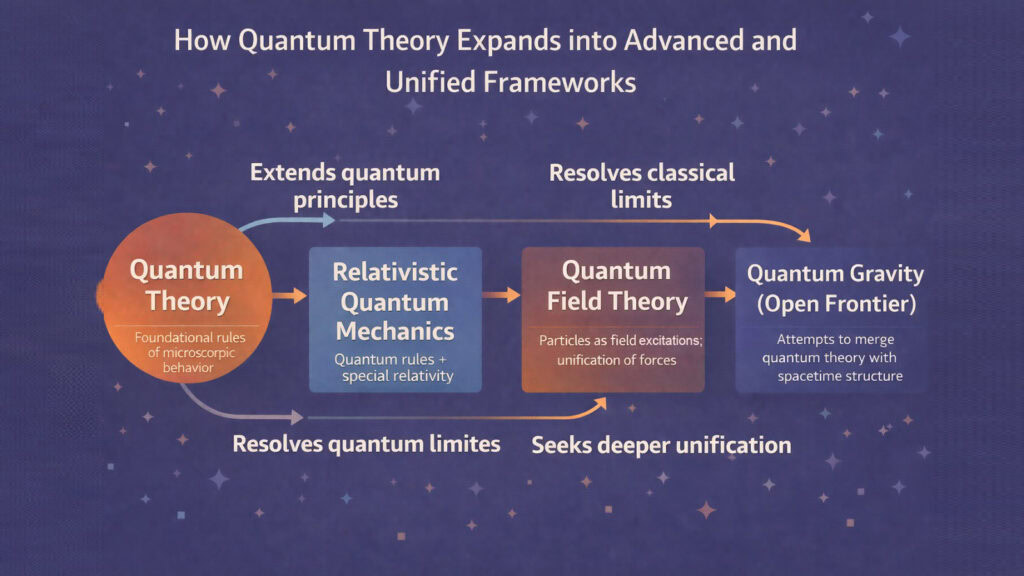
Quantum Theory did not stop at atomic physics. It expanded into domains that required merging quantum rules with other fundamental principles. These advanced theories extended quantum mechanics to high energies, relativistic speeds, and the unification of forces. Each extension revealed new phenomena while confirming Quantum Theory’s central role in modern physics.
Quantum Field Theory emerged when physicists applied quantum principles to fields rather than particles. In this framework, particles become excitations in underlying fields that permeate all space. An electron is a ripple in the electron field, a photon a vibration in the electromagnetic field. This perspective unifies particles and forces, treating both as field fluctuations. Quantum Field Theory forms the mathematical backbone of particle physics, describing how fundamental particles interact and transform.
Relativistic Quantum Mechanics merged quantum rules with Einstein’s special relativity. Dirac’s equation, which describes electrons at high speeds, predicted antimatter before experiments detected positrons. This success demonstrated that combining Quantum Theory with relativity was not just possible but necessary. The merger resolved contradictions and opened new theoretical territory, though challenges remained in formulating a complete relativistic quantum framework.
Quantum Electrodynamics became the first complete relativistic quantum field theory. It describes electromagnetic interactions between charged particles and photons with extraordinary precision. Calculations of the electron’s magnetic moment match experimental measurements to ten decimal places, making QED the most accurately tested theory in physics. Its success established the template for describing other forces.
The Standard Model extended this approach to the weak and strong nuclear forces. Quantum Chromodynamics explains how quarks bind through gluon exchange to form protons and neutrons. The electroweak theory unifies electromagnetism and the weak force, predicting the Higgs boson that experiments confirmed in 2012. Together, these quantum field theories describe all known particles and three of nature’s four fundamental forces with remarkable accuracy.
Quantum Gravity represents the remaining frontier. General relativity describes gravity through curved spacetime, a continuous geometric structure. Quantum Theory treats everything as discrete and probabilistic. Reconciling these frameworks has proven extraordinarily difficult. String theory proposes that fundamental objects are vibrating strings rather than point particles. Loop quantum gravity quantizes spacetime itself into discrete units. Neither approach has experimental confirmation, but both depend entirely on Quantum Theory’s mathematical machinery.
These advanced theories show Quantum Theory’s versatility and power. Each extension required profound mathematical innovation, yet the quantum core remained intact. The principles that govern atoms also govern particle colliders and potentially the fabric of spacetime. This universality makes Quantum Theory the essential foundation for understanding nature across all scales.
Advanced Theories Built on Quantum Theory Foundations
| Theory | Domain and Achievement |
|---|---|
| Quantum Field Theory | Describes particles as field excitations, unifying matter and forces |
| Quantum Electrodynamics | Predicts electromagnetic interactions with unprecedented precision |
| Standard Model | Unifies three fundamental forces and explains all known particles |
| String Theory | Proposes one-dimensional strings as fundamental objects in spacetime |
| Loop Quantum Gravity | Attempts to quantize spacetime geometry directly |
| Quantum Cosmology | Applies quantum principles to universe origin and evolution |
5. Quantum Theory Shapes How Experiments Are Designed and Interpreted
Quantum Theory determines what experiments can reveal and how results must be interpreted. It sets boundaries on measurement precision, defines observable quantities, and predicts interference effects that have no classical analogue. Modern experimental physics operates entirely within the framework that Quantum Theory provides.
The double-slit experiment remains the quintessential demonstration of quantum behavior. When particles pass through two slits, they create interference patterns characteristic of waves. Yet when detectors monitor which slit each particle traverses, the interference vanishes. This experiment shows how observation fundamentally alters quantum systems. Variations of this setup now test quantum principles with photons, electrons, atoms, and even large molecules, confirming predictions with ever-increasing precision.
The Stern-Gerlach experiment unveiled the concept of quantum spin and its inherent discreteness. As silver atoms traversed an inhomogeneous magnetic field, they separated into two separate beams instead of dispersing continuously. This observed discreteness validated that angular momentum exists in specific quantum units. Contemporary iterations of this experiment examine entanglement and quantum measurement, employing the same foundational principles that Stern and Gerlach identified in 1922.
Bell test experiments address Einstein’s doubts about quantum entanglement. John Bell derived mathematical inequalities that any local hidden variable theory must satisfy. Experiments by Alain Aspect, Anton Zeilinger, and John Clauser violated these inequalities, confirming that nature exhibits genuine quantum nonlocality. These tests required closing loopholes through careful experimental design, demonstrating how Quantum Theory guides both predictions and the methods needed to test them rigorously.
Particle accelerators embody Quantum Theory in massive experimental apparatus. The Large Hadron Collider smashes protons together at energies where quantum field effects dominate. Detectors must account for quantum tunneling, particle creation from vacuum fluctuations, and probabilistic decay processes. Every collision produces outcomes governed by quantum mechanical cross sections that physicists calculate using Feynman diagrams. The 2012 Higgs boson discovery validated decades of quantum field theory predictions.
Quantum computing laboratories manipulate individual quantum bits in carefully controlled environments. Superconducting circuits exploit quantum superposition and entanglement to perform calculations impossible for classical computers. Maintaining coherence requires isolating qubits from environmental decoherence, a challenge that Quantum Theory predicted and quantified. Each improvement in qubit lifetimes and gate fidelities demonstrates deeper understanding of quantum measurement and control.
Quantum Theory also defines what cannot be measured. The uncertainty principle limits simultaneous position and momentum measurements. The no-cloning theorem forbids copying unknown quantum states. These restrictions shape experimental possibilities, forcing physicists to work within quantum boundaries. Rather than hindering progress, these limits often inspire creative solutions that exploit quantum features for new technologies.
Key Experiments Shaped by Quantum Theory Principles
| Experiment | Quantum Principle Demonstrated |
|---|---|
| Double-Slit Experiment | Shows wave-particle duality and measurement effect on interference |
| Stern-Gerlach Experiment | Reveals discrete quantum spin states and measurement outcomes |
| Bell Test Experiments | Confirms quantum entanglement violates local realism |
| Particle Accelerator Collisions | Tests quantum field theory predictions at high energies |
| Quantum Computing Operations | Exploits superposition and entanglement for computation |
| Atomic Clock Precision | Uses quantum transitions for time measurement standards |
6. Quantum Theory Guides the Search for a Unified Understanding of Nature
The search for a complete theory of nature drives much of modern theoretical physics. Quantum Theory serves as the foundation and compass for these efforts. Every proposed unification must incorporate quantum principles while extending them to include gravity and potentially new cosmic forces beyond current knowledge.
String theory attempts unification by replacing point particles with one-dimensional vibrating strings. Different vibration modes correspond to different particles, potentially including the graviton that would carry gravitational force. The mathematics requires extra spatial dimensions beyond the familiar three, compactified to scales too small to observe. String theory depends completely on quantum mechanics applied to these extended objects. Its success or failure will determine whether Quantum Theory’s framework can truly encompass all forces.
Loop quantum gravity takes a different approach by quantizing spacetime itself. Instead of treating space as a smooth continuum, this theory proposes discrete quantum units of volume and area. General relativity emerges as an approximation when these quantum geometric elements are averaged over large scales. Like string theory, loop quantum gravity builds entirely on quantum foundations while attempting to resolve incompatibilities with classical descriptions of gravity.
Emergent spacetime theories suggest that space and time might not be fundamental but arise from more basic quantum information. Just as temperature emerges from molecular motion without being a property of individual molecules, spacetime might emerge from quantum entanglement patterns. These ideas push Quantum Theory into speculative territory, asking whether its principles apply to the universe’s deepest structure or whether something more fundamental lies beneath.
Quantum cosmology utilizes quantum mechanics to analyze the universe in its entirety. The Wheeler-DeWitt equation seeks to articulate the wave function of the universe, yet the interpretation of this idea presents significant difficulties. What implications arise from the universe existing in a superposition of states? Who or what conducts the measurement that leads to the collapse of this cosmic wave function? These inquiries illustrate how Quantum Theory compels physicists to reevaluate the very essence of the cosmos.
All unification efforts confront the problem of quantum gravity in curved spacetime. Black holes present particular challenges, where quantum effects near the event horizon seem to create paradoxes about information conservation. Hawking radiation suggests black holes evaporate through quantum processes, yet information about what fell in appears to be lost. Resolving this tension likely requires deeper understanding of how Quantum Theory and gravity interact.
These searches for unification reveal Quantum Theory’s scope and limitations. It has successfully described three fundamental forces with extraordinary precision. Yet incorporating gravity remains elusive, suggesting either that a deeper theory exists or that reconciling quantum mechanics with general relativity requires conceptual breakthroughs not yet imagined. Regardless of which path succeeds, Quantum Theory will remain central to any future understanding of nature.
Unification Approaches Grounded in Quantum Theory
| Approach | Unification Strategy |
|---|---|
| String Theory | Replaces particles with vibrating strings in higher dimensions |
| Loop Quantum Gravity | Quantizes spacetime geometry into discrete units |
| Emergent Spacetime | Derives space and time from quantum entanglement patterns |
| Quantum Cosmology | Applies quantum mechanics to universe evolution and origin |
| Black Hole Thermodynamics | Connects quantum mechanics with gravity through entropy |
| Holographic Principle | Encodes bulk spacetime information on lower-dimensional boundaries |
Conclusion: Quantum Theory as the Enduring Blueprint of Modern Physics
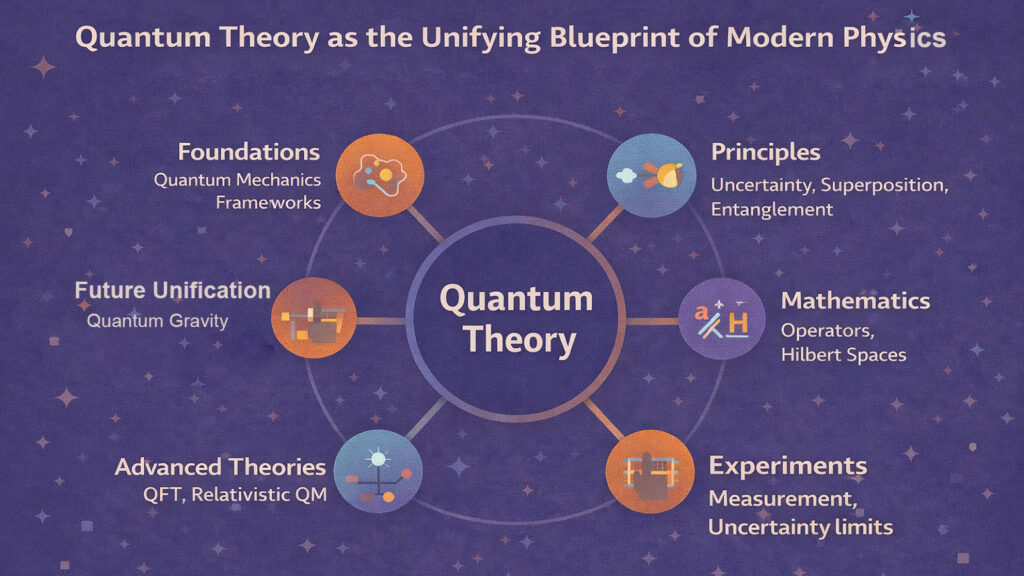
Quantum Theory has proven itself to be the most comprehensive framework ever developed for understanding physical reality. Its six pathways of influence reveal a structure far deeper than a collection of equations. It redefines reality through foundational frameworks that replaced classical certainty with probabilistic description. It establishes principles that govern measurement, technology, and the limits of knowledge. It shapes interpretation by forcing physicists to confront what mathematics means for the nature of existence.
The theory drives advanced unification efforts, from quantum field theories that describe particle interactions to speculative attempts at quantum gravity. It shapes experimental design by setting boundaries on what can be measured and predicting phenomena that experiments then confirm. It guides the search for ultimate unification, providing the mathematical tools and conceptual foundations for understanding nature at every scale.
This architecture extends beyond physics into chemistry, materials science, information theory, and even biology. Quantum chemistry explains molecular bonds and reaction rates. Quantum information science promises revolutionary computing and communication technologies. Condensed matter physics uses quantum principles to design new materials with exotic properties. Each application confirms that Quantum Theory describes not just atoms but the fundamental logic of the universe.
The theory’s success raises profound questions about reality, measurement, and the role of consciousness in physical law. Different interpretations offer competing answers while agreeing on experimental predictions. This philosophical openness keeps physics connected to broader questions about existence and knowledge. It reminds researchers that science combines mathematical precision with conceptual exploration.
Modern physics operates entirely within the framework Quantum Theory provides. Every particle accelerator experiment, every quantum computer operation, every test of fundamental principles assumes quantum mathematics and quantum logic. The theory has survived a century of rigorous testing, making predictions confirmed to extraordinary precision while opening new territories for exploration.
Looking forward, Quantum Theory will continue shaping physics for decades or centuries to come. Whether it represents the final word on physical law or a stepping stone to something deeper remains unknown. Yet its proven power, mathematical elegance, and explanatory range ensure its central role in any future understanding of nature. This article has mapped the territory Quantum Theory governs, showing how deeply it has transformed human knowledge of the physical world.
Summary of Quantum Theory’s Influence Across Modern Physics
| Domain | Quantum Theory Impact |
|---|---|
| Foundational Physics | Replaced determinism with probabilistic framework for reality |
| Measurement Science | Defined fundamental limits and measurement-induced state changes |
| Technological Development | Enabled lasers, semiconductors, MRI, atomic clocks, quantum computing |
| Particle Physics | Provided quantum field theory describing all known particles and forces |
| Cosmology | Applied quantum principles to universe origin and evolution |
| Materials Science | Explained superconductivity, semiconductors, and exotic quantum materials |
| Information Theory | Founded quantum information science and cryptography |
| Philosophical Inquiry | Transformed understanding of reality, causality, and knowledge limits |
Read More Science and Space Articles
- Winter Climate: 6 Powerful Ways Earth Self-Calibrates
- Plum Sugar Accumulation: 6 Essential Mechanisms That Work
- Lifestyle Diseases: 8 Dangerous Threats to Global Health
- Sports Science Reveals 8 Powerful Ways Games Are Won
- STEM Learning Skills: 6 Powerful Secrets Behind Real Success
- STEM Subjects: 8 Essential Insights for a Brighter Future
- Human Cell Secrets: 6 Powerful Insights Shaping Life
- Black Hole Singularity: 6 Mind-Blowing Truths Explained
- 6 Incredible Ways Missiles Obey The Laws of Physics
- Anthropomorphism: 6 Brilliant Benefits and Risks in AI