Table of Contents
Introduction: Software Systems as the Invisible Engines of Modern Tech
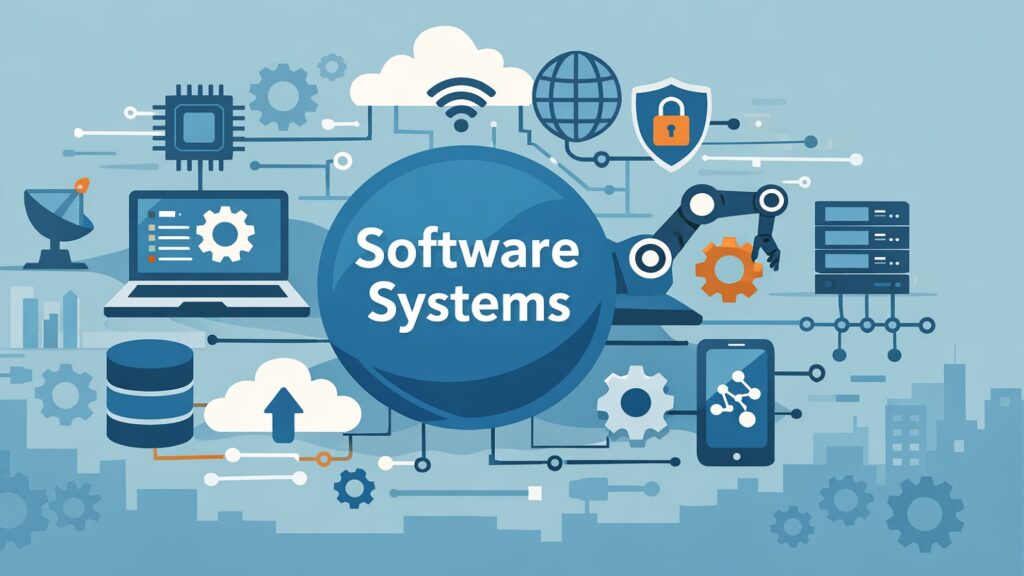
There is something quietly remarkable about the world we live in today. Every morning, millions of people wake up and reach for their phones, check their messages, stream a song, or open an app to order coffee. None of that happens without software systems working in the background, steady and mostly invisible.
Software systems are the organized collections of programs, code, and instructions that make digital devices do what we ask of them. They are the foundation beneath everything that runs on a computer, a phone, a smart TV, or a bank terminal. Without them, none of the modern conveniences that people take for granted would exist.
In business, software systems handle payroll, inventory, customer records, and communication. In medicine, they track patient histories and assist in diagnosis. In education, they power the platforms where people learn new skills every day. The reach of these systems is so wide that it has become almost impossible to spend a day without depending on them.
Understanding software systems matters now more than ever. Not just for engineers or developers, but for anyone who uses a smartphone, relies on online banking, or works in an office. These systems shape how we communicate, how we shop, and how we make decisions. The better we understand them, the better we understand the world we live in.
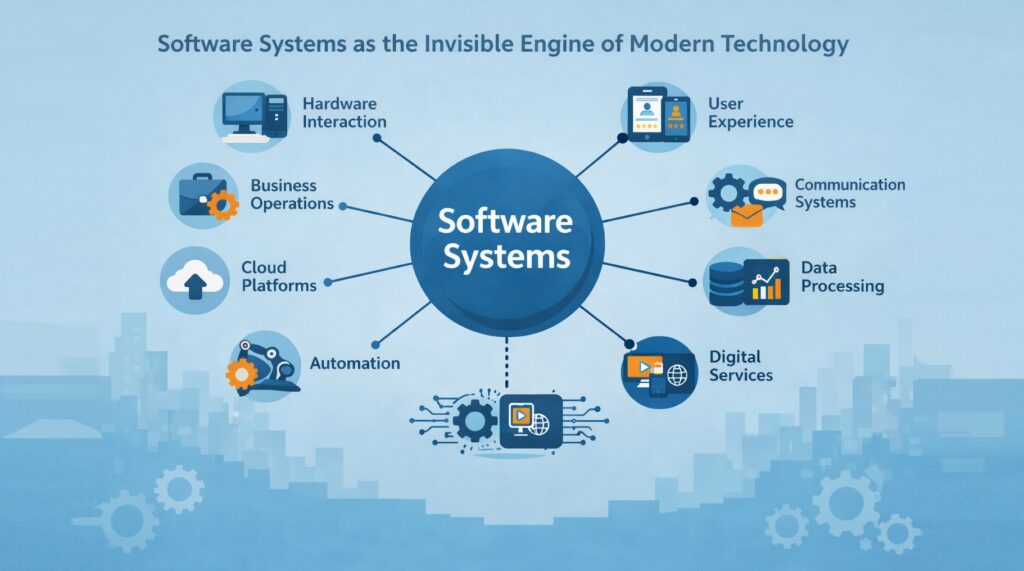
This article looks at eight key types of software systems that define modern technology. Each one plays a different role, but together they form the engine that drives the digital age forward.
Table 1: Overview of the 8 Software Systems Covered in This Article
| Software Systems | Primary Role in Modern Technology |
| System Software | Manages hardware resources and provides a platform for other software |
| Application Software | Delivers tools and services directly to end users |
| Software Development | Covers the processes and practices used to build software systems |
| Software Architecture | Defines the internal structure and design of software systems |
| Cloud Software | Enables delivery and access of software systems over the internet |
| Data-Driven Intelligence | Uses analytics and AI to enhance how software systems perform |
| Software Security | Protects software systems from threats and ensures reliability |
| Software Integration | Connects different software systems to create seamless workflows |
1. System Software as the Core Foundation of Software Systems
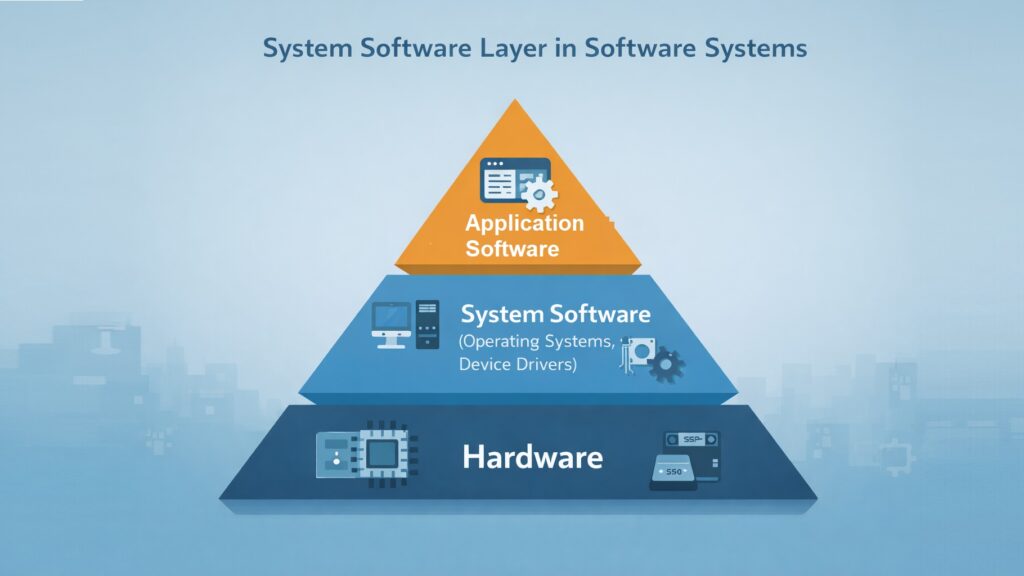
If you think of software systems as a building, system software is the foundation that everything else sits on. It is the layer of code that connects the physical hardware of a device to the programs people actually use. Without it, hardware is just metal and silicon with no purpose.
Operating systems like Windows, macOS, Linux, and Android are the most well-known examples of system software. They manage memory, control how the processor handles tasks, and decide which program gets access to resources at any given moment. When you open multiple applications at once and they all seem to work without crashing into each other, that is the operating system doing its job.
Device drivers are another key part of system software. They act as translators between the operating system and hardware components like printers, keyboards, and graphics cards. Without the right driver, a device simply does not work, even if it is physically connected.
System software also handles resource management. It decides how much memory each running program can use, when to swap data in and out of storage, and how to schedule processor time efficiently. This happens thousands of times per second, all without the user noticing.
The reliability of all other software systems depends directly on how well the system software performs. A well-designed operating system can make even modest hardware feel fast and responsive. That invisible efficiency is what keeps the entire digital experience feeling smooth.
Table 2: Key Facts About System Software in Software Systems
| Aspect | Detail |
| Linux market share (servers) | Linux powers over 96% of the world’s top one million web servers as of recent data |
| Windows PC dominance | Windows holds approximately 72% of global desktop operating system market share |
| Android global reach | Android runs on over 3.6 billion active devices worldwide |
| Kernel role | The kernel is the core of an operating system and manages CPU, memory, and device I/O |
| Driver dependency | Missing or outdated drivers are among the top causes of hardware failure in PCs |
| Real-time OS usage | Real-time operating systems are used in aircraft control, medical devices, and industrial systems |
| macOS base | macOS is built on a Unix foundation, giving it strong stability and security characteristics |
| System software updates | Operating system patches are released regularly to fix vulnerabilities and improve stability |
2. Application Software Driving Everyday Software Systems Usage
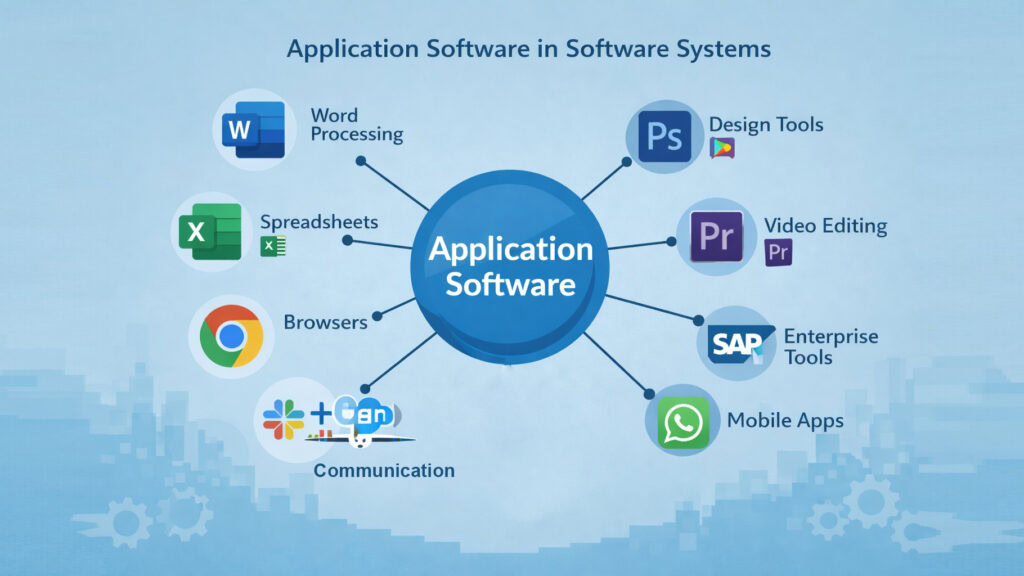
If system software is the foundation, application software is the front door. It is the part of software systems that people actually see, touch, and use every single day. Word processors, email clients, streaming apps, navigation tools, and social media platforms are all examples of application software.
Productivity applications like Microsoft Word, Google Docs, and Excel have changed how people work. Documents that once took hours to format can now be completed in minutes. Spreadsheets that used to require an accounting background can now be built by almost anyone with a basic understanding of what they need.
Creative platforms like Adobe Photoshop, Premiere Pro, and Canva have brought professional-grade tools to a much wider audience. A photographer in a small town and a designer at a large agency now use essentially the same software systems to produce their work.
Business applications go even further. Enterprise resource planning tools like SAP and Oracle manage entire organizations from a single platform. Customer relationship management software like Salesforce tracks every interaction a company has with its clients. These are not just tools. They are the nervous system of modern business operations.
What makes application software so powerful is how directly it connects people to outcomes. You do not need to understand how the software works underneath to use it effectively. That accessibility is what has made application software one of the most impactful categories in all of modern technology.
Table 3: Real-World Examples of Application Software in Software Systems
| Application Type | Example and Key Detail |
| Word Processing | Microsoft Word has over 1.2 billion users globally across personal and professional settings |
| Spreadsheet Tools | Google Sheets allows real-time collaboration, making it standard in remote work environments |
| Creative Design | Adobe Photoshop has been the industry standard for image editing since its launch in 1988 |
| Video Conferencing | Zoom grew from 10 million to over 300 million daily meeting participants during 2020 |
| CRM Software | Salesforce holds over 23% of the global CRM market, making it the category leader |
| Enterprise Planning | SAP serves over 440,000 businesses in more than 180 countries |
| Mobile Applications | The Apple App Store hosts over 1.8 million apps as of recent figures |
| Streaming Platforms | Netflix uses personalization software systems to recommend content to over 260 million subscribers |
3. Software Development Shaping Modern Software Systems
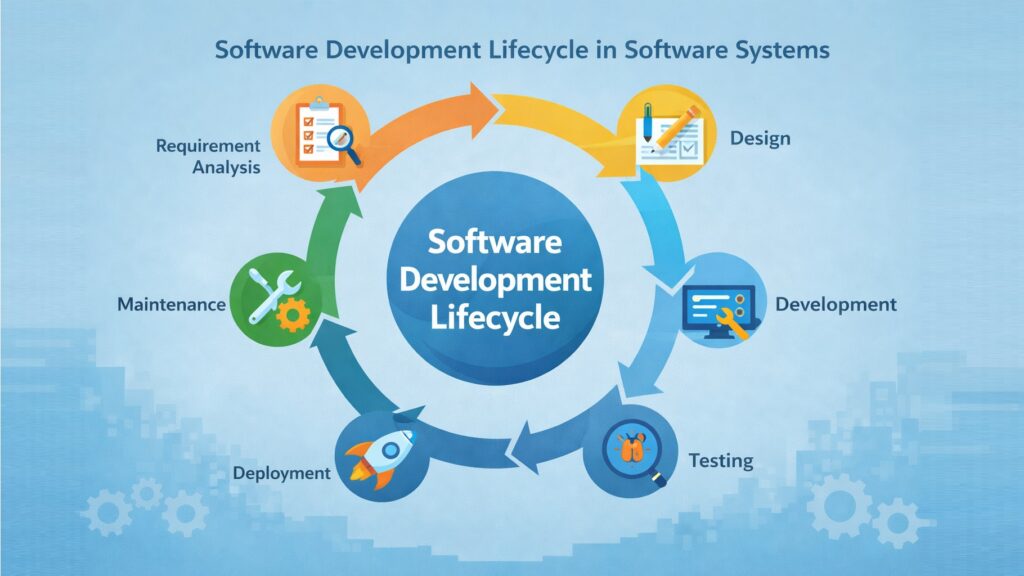
Software systems do not appear out of thin air. They are built, tested, refined, and rebuilt over time by teams of people who write code, catch bugs, and think hard about how users will actually experience their work. Software development is the process behind all of that.
In the early days of computing, development followed a rigid sequence. You designed the whole system, then built it, then tested it, then delivered it. This approach, sometimes called the waterfall model, worked in some cases but often led to long delays and products that did not quite fit what users actually needed.
Modern development has shifted toward more flexible approaches. Agile development breaks work into short cycles called sprints, usually lasting one to four weeks. At the end of each sprint, there is something working that can be reviewed and adjusted. This means problems get caught early instead of at the very end of a long project.
DevOps is another practice that has changed how software systems are built and maintained. It brings development teams and operations teams together, so the people writing code are closely connected to the people who keep software running in the real world. This reduces the gap between building something and making it available to users.
Software development is also increasingly reliant on version control tools like Git, which allow teams to track every change made to a codebase. This makes collaboration across large teams much more organized, and it means mistakes can be reversed without losing everything.
Table 4: Software Development Practices That Shape Software Systems
| Practice or Tool | Key Detail |
| Agile Development | Used by approximately 71% of organizations globally according to industry surveys |
| DevOps Adoption | Companies using DevOps report up to 60 times faster software deployment cycles |
| Version Control (Git) | Git is used by over 94% of professional developers, according to Stack Overflow surveys |
| Continuous Integration | CI tools automatically test code changes to detect issues before they reach production |
| Open Source Contributions | GitHub hosts over 420 million repositories, supporting global software collaboration |
| Code Review Practices | Peer code review reduces bug density in software systems by up to 60% |
| Test-Driven Development | TDD involves writing tests before writing code, improving reliability from the start |
| Scrum Framework | Scrum is the most widely used Agile framework, used in over 66% of Agile projects |
4. Software Architecture: Defining the Structure of Software Systems
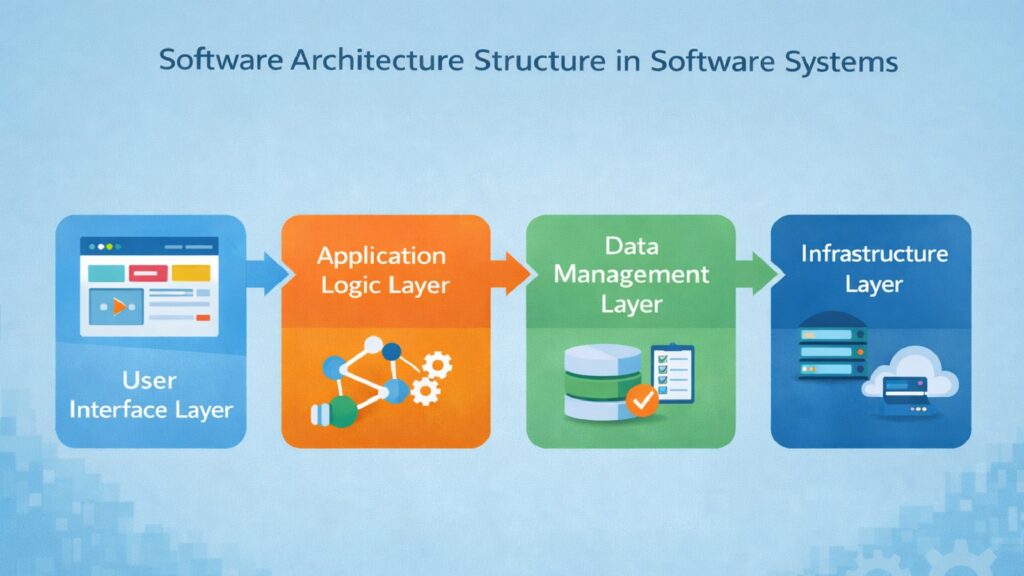
Every piece of software has a structure, whether it was planned carefully or grew in a more scattered way over time. Software architecture is the deliberate design of that structure. It decides how different parts of a system relate to each other, how data flows between components, and how the whole thing holds together under pressure.
One of the most important ideas in software architecture is modularity. This means breaking a large system into smaller, independent parts that each handle one specific job. When something goes wrong, you only need to look at the relevant module instead of the entire system. When something needs to be updated, you can change one piece without rebuilding everything else.
Scalability is another central concern in software architecture. A system that works well for a hundred users might collapse under the weight of a million. Good architectural decisions made early can allow a system to grow without requiring a complete redesign. Many large platforms like Netflix and Amazon were built with scalability in mind from the very beginning, and that investment paid off as they expanded.
The microservices architecture has gained significant popularity in recent years. Instead of constructing a single large application, this methodology focuses on creating numerous small services, each designed to perform a specific function and interact with one another. Each service can be developed, modified, and scaled independently, providing engineering teams with enhanced flexibility.
The choices made during software architecture have long-term consequences. A well-designed system is easier to maintain, cheaper to update, and more resilient to failure. A poorly designed one becomes harder and harder to work with over time, until eventually it has to be replaced entirely.
Table 5: Software Architecture Patterns in Modern Software Systems
| Architecture Pattern | Key Detail |
| Monolithic Architecture | A single unified codebase; simpler to develop initially but harder to scale over time |
| Microservices | Amazon migrated to microservices and now deploys to production thousands of times per day |
| Event-Driven Architecture | Used in real-time applications like stock trading platforms and ride-hailing services |
| Layered Architecture | Common in enterprise software; separates presentation, logic, and data layers |
| Serverless Architecture | Removes the need to manage infrastructure; AWS Lambda handles millions of events per day |
| API-First Design | Designing APIs before building features ensures better integration with other software systems |
| Modular Design Principle | Well-modularized systems reduce the cost of bug fixes and feature additions significantly |
| Fault Tolerance Design | Netflix’s Chaos Engineering approach deliberately tests system resilience under failure conditions |
5. Cloud Software Expanding the Reach of Software Systems
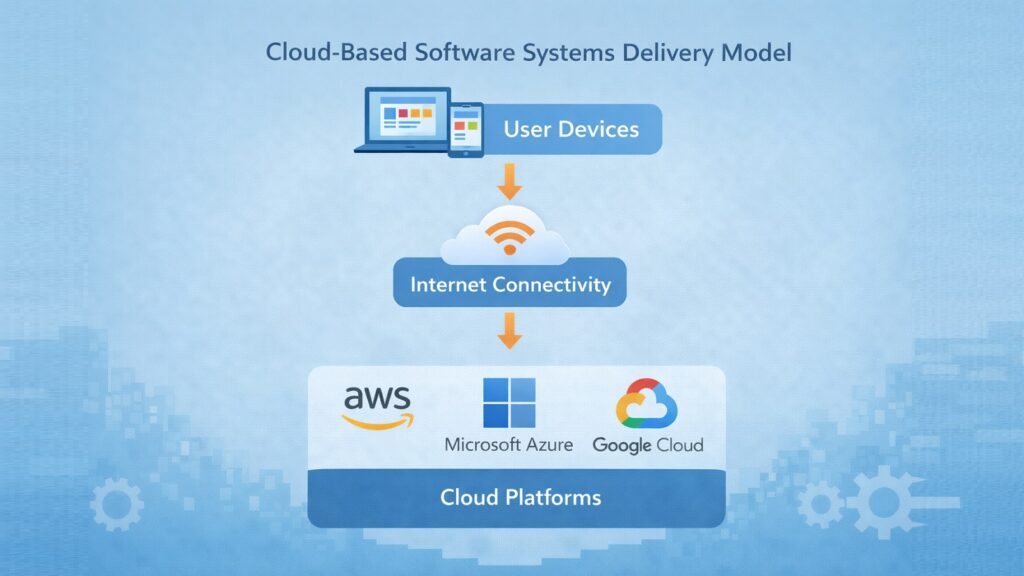
Not long ago, software lived on the device you were using. If you wanted to use a program, it had to be installed on your computer. If you wanted to share a file, you emailed it or carried it on a disk. That world feels distant now, and cloud software is the reason why.
Cloud software delivers applications and services over the internet rather than from a local machine. Software as a Service, or SaaS, is the most familiar form of this. Tools like Gmail, Dropbox, Slack, and Notion all run on remote servers and are accessed through a browser or app. You do not install them in the traditional sense, and your data lives in the cloud rather than on your hard drive.
The shift to cloud software has changed how businesses buy and use technology. Instead of purchasing expensive software licenses upfront, companies subscribe to services on a monthly or annual basis. This lowers the barrier to entry for smaller businesses and makes it easier for organizations to scale their software usage up or down as needed.
Cloud software also makes collaboration far easier. Multiple people can work on the same document at the same time from different parts of the world. Updates happen instantly and are available to everyone. There is no emailing of file versions, no confusion about which copy is the latest one.
The reliability of cloud software systems depends on massive infrastructure built and maintained by providers like Amazon Web Services, Microsoft Azure, and Google Cloud. These platforms run data centers around the world so that services stay available even when individual servers have problems.
Table 6: Cloud Software Facts Relevant to Modern Software Systems
| Cloud Metric | Detail |
| Global Cloud Market Size | The cloud computing market was valued at over $676 billion in 2024 and continues to grow |
| AWS Market Share | Amazon Web Services holds approximately 31% of the global cloud infrastructure market |
| SaaS Adoption | Over 70% of business software used by companies is now delivered as SaaS |
| Microsoft Azure Growth | Azure has grown to serve over 1 million businesses across 140 countries |
| Google Workspace Users | Google Workspace is used by over 9 million businesses and 3 billion individual users |
| Cloud Uptime Standards | Major cloud providers typically offer 99.9% or higher uptime guarantees in their service agreements |
| Data Center Energy Use | Global data centers consumed approximately 200 terawatt-hours of electricity in 2022 |
| Remote Work Acceleration | Cloud software adoption accelerated significantly during 2020 as remote work became widespread |
6. Data-Driven Intelligence Enhancing Software Systems
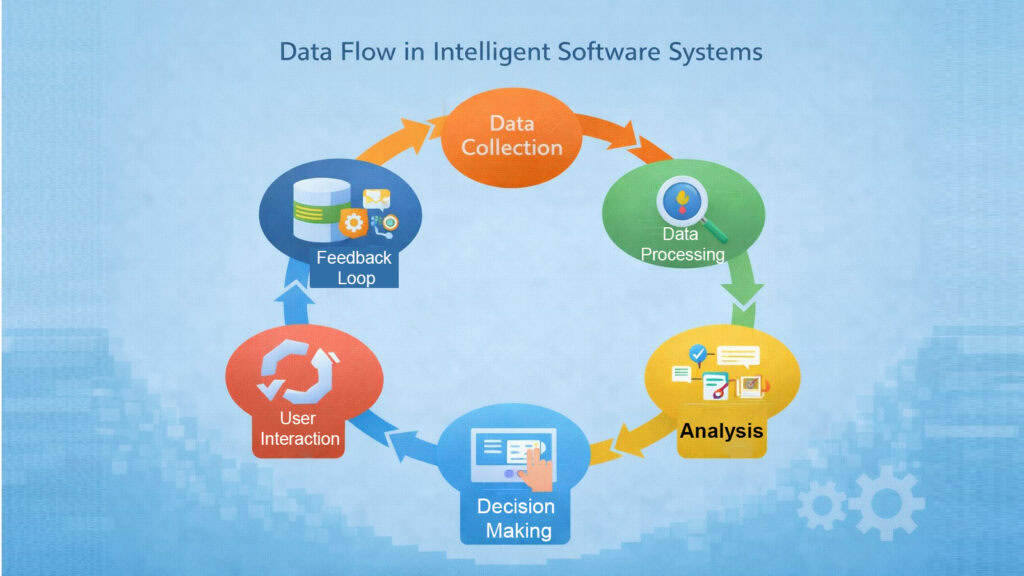
Modern software systems do not just respond to commands. Many of them learn, adapt, and improve over time based on the data they collect. This shift from static tools to intelligent systems has quietly changed what software can do for people.
Analytics is one of the most straightforward ways that data enhances software systems. A business can look at which products customers view most often, which pages cause people to leave a website, or which times of day see the highest activity. That information shapes decisions that once relied purely on instinct.
Automation takes this further. Software systems can now monitor conditions and take actions without waiting for a human to intervene. An email marketing platform can send personalized messages based on what a subscriber has clicked before. A warehouse management system can reorder stock automatically when levels fall below a certain threshold.
Artificial intelligence and machine learning have added another layer entirely. Recommendation systems on platforms like Spotify and YouTube analyze your behavior to suggest content you are more likely to enjoy. Fraud detection systems at banks scan millions of transactions every day and flag unusual patterns in real time. These are not rule-based programs running predetermined steps. They are systems that have learned patterns from enormous amounts of data.
The growing use of AI in software systems raises important questions about accuracy, bias, and transparency. But its practical impact is already visible in how much more responsive and personalized software has become over the past decade. The direction is clear, even if the full implications are still taking shape.
Table 7: Data and AI Facts That Are Reshaping Software Systems
| Data Intelligence Aspect | Key Detail |
| Global Data Generation | The world generates approximately 2.5 quintillion bytes of data every single day |
| AI Market Growth | The global AI software market is projected to surpass $300 billion by 2026 |
| Netflix Recommendation Value | Netflix estimates its recommendation system saves around $1 billion per year in reduced churn |
| Fraud Detection | AI-based fraud detection systems can process thousands of transactions per second in real time |
| Predictive Analytics Use | Over 50% of enterprises report using predictive analytics to guide business decisions |
| Machine Learning Adoption | Google, Amazon, and Meta use ML models across nearly every product they offer |
| Natural Language Processing | NLP is used in virtual assistants, search engines, and customer service software systems |
| Data Privacy Regulations | Laws like GDPR in Europe directly affect how software systems collect and store user data |
7. Software Security Ensuring Trust in Software Systems
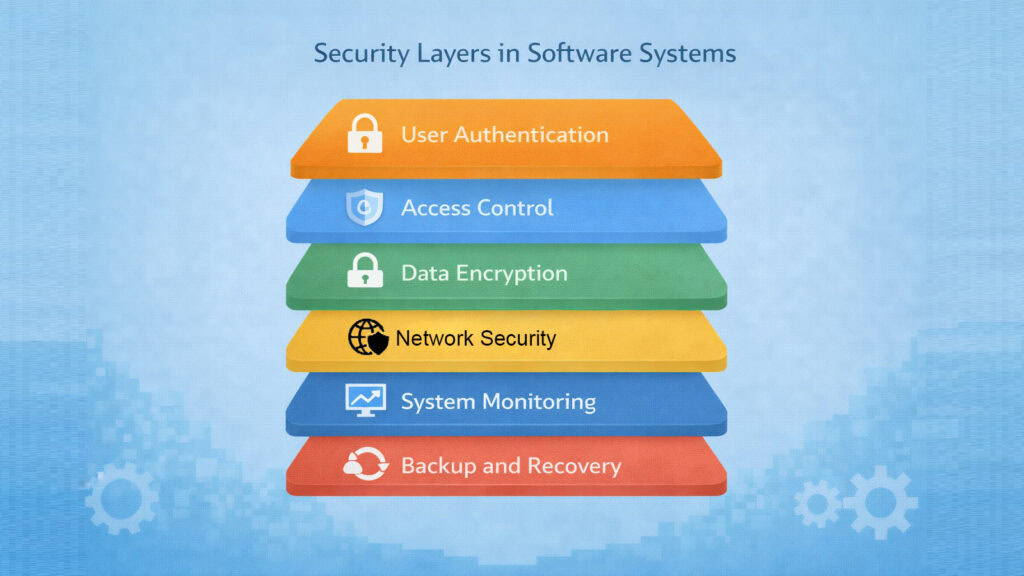
Trust is not a feature you can add to software at the end of a project. It has to be built in from the beginning. Software security is what makes people feel safe using their banking apps, sharing personal information online, and relying on digital services for things that really matter.
Cybersecurity threats are not hypothetical. They are constant and growing. Ransomware attacks lock organizations out of their own data and demand payment for its return. Phishing schemes trick users into handing over login credentials. Data breaches expose the private information of millions of people at a time. These are real events that happen regularly and affect businesses, governments, and individuals alike.
Encryption is one of the most important tools in software security. It converts data into a format that can only be read by someone with the right key. When you submit your credit card number to an online store, encryption ensures that the information cannot be read by anyone intercepting the connection. Almost every trustworthy website uses encryption through a protocol called HTTPS.
Software systems also need regular updates to stay secure. When a vulnerability is discovered in a program, developers release a patch to fix it. Users who do not apply updates leave their systems exposed to known weaknesses that attackers actively exploit.
Authentication systems add another layer of protection. Two-factor authentication, where a user must verify their identity through a second method after entering a password, significantly reduces the risk of unauthorized access. Many major platforms now offer or require this as a standard practice.
Table 8: Software Security Data Relevant to Modern Software Systems
| Security Topic | Key Detail |
| Annual Cost of Cybercrime | Global cybercrime is expected to cost the world over $10.5 trillion annually by 2025 |
| Ransomware Attacks | Ransomware attacks increased by over 95% in 2021 compared to the previous year |
| Data Breach Frequency | IBM’s 2023 Cost of a Data Breach Report found the average breach cost $4.45 million |
| HTTPS Adoption | Over 95% of pages loaded in Chrome globally are served over HTTPS as of recent data |
| Two-Factor Authentication | Enabling 2FA blocks over 99.9% of automated account compromise attacks, per Microsoft data |
| Zero-Day Vulnerabilities | Zero-day exploits target software flaws that developers have not yet discovered or patched |
| Software Patch Compliance | Unpatched vulnerabilities account for a significant majority of successful cyberattacks |
| Open Source Security | Over 90% of software contains open source components, many of which carry known vulnerabilities |
8. Software Integration Connecting Modern Software Systems
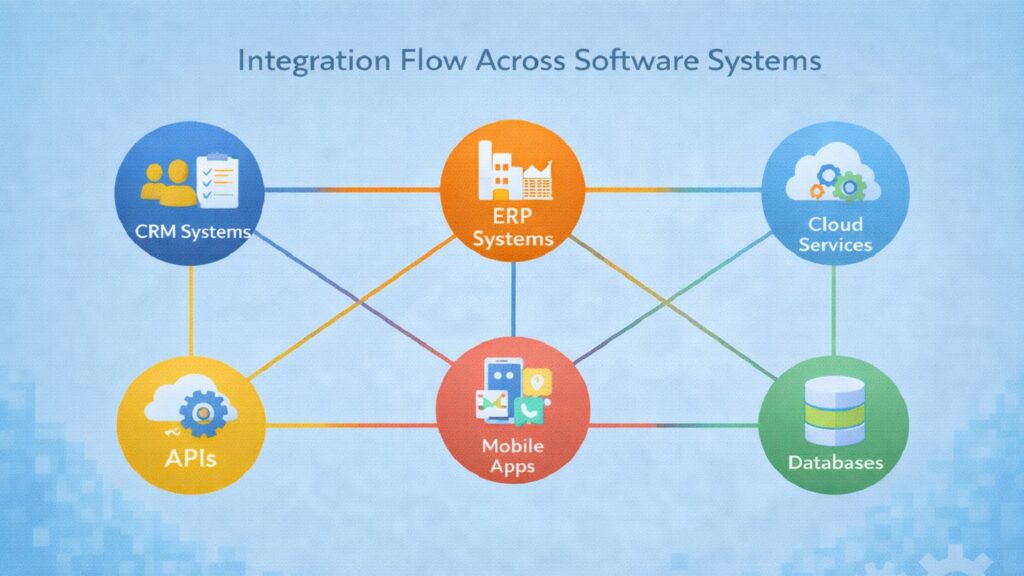
No software system works in complete isolation anymore. The platforms, tools, and services people use every day are connected to each other in ways that were not possible just a decade ago. Software integration is what makes that connectivity work.
Application programming interfaces, known as APIs, are the standard way that software systems communicate with each other. When you log into a third-party app using your Google or Facebook account, that is an API in action. When a travel booking site pulls up flight options from multiple airlines simultaneously, it is doing so through APIs that connect to each carrier’s reservation system.
Interoperability is the quality that allows different software systems to exchange information and work together without friction. A hospital system might pull patient data from a lab system, a pharmacy system, and a scheduling system all at once. For the doctor viewing that information, it appears as a single unified picture of the patient. The integration work that makes this possible happens entirely in the background.
Enterprise software environments are often the most complex examples of integration. A large company might use dozens of different software systems for payroll, inventory, sales, customer support, and compliance. Integration platforms called middleware help these systems exchange data without requiring each one to be rebuilt from scratch.
The goal of software integration is to make technology feel seamless. When it works well, users move between tools and platforms without noticing the complexity underneath. That smoothness is a design achievement, not an accident. It reflects serious technical work aimed at making software systems serve people rather than complicate their lives.
Table 9: Software Integration Facts for Modern Software Systems
| Integration Topic | Key Detail |
| API Economy Scale | The API economy is estimated to be worth over $2.2 trillion globally in business value |
| Zapier Automations | Zapier connects over 6,000 apps and processes billions of automated tasks each month |
| REST API Dominance | REST is the most widely used API architecture style, used in over 80% of public APIs |
| Healthcare Interoperability | The HL7 FHIR standard is the leading framework for health data exchange between software systems |
| Middleware Market | The global middleware market is projected to reach over $30 billion by the late 2020s |
| Microservices and APIs | Microservices-based architectures depend almost entirely on APIs for internal communication |
| Payment Integration | Stripe processes hundreds of billions of dollars in payments annually through its API platform |
| iPaaS Platforms | Integration Platform as a Service tools like MuleSoft and Dell Boomi are used by thousands of enterprises |
Conclusion: The Lasting Impact of Software Systems on Modern Technology
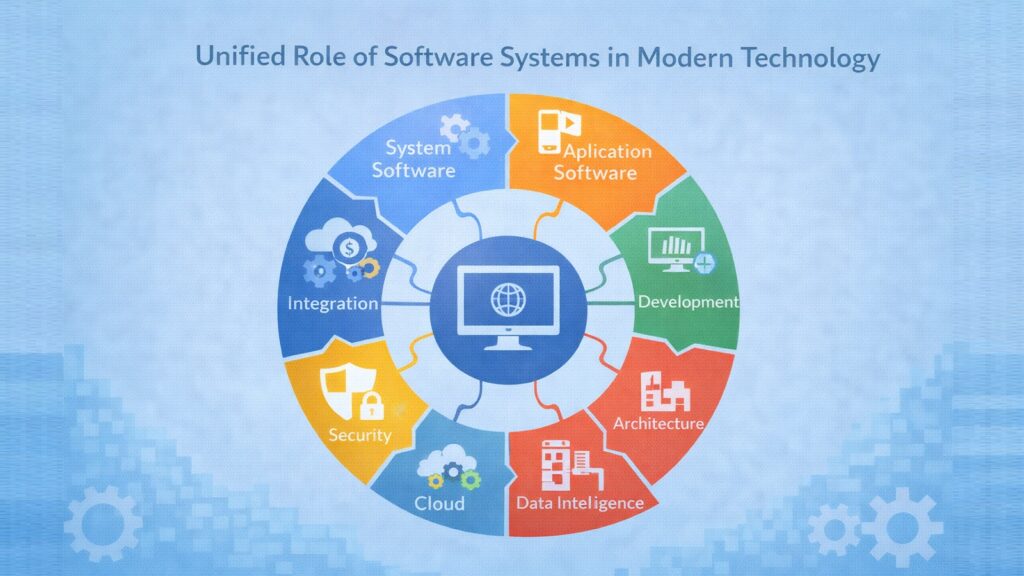
Looking across these eight areas, a clear picture emerges. Software systems are not a single thing. They are a collection of layered, interconnected disciplines that together make modern technology possible. From the operating system running quietly beneath your screen to the AI engine suggesting your next playlist, every layer plays a role.
What is easy to forget is how recent most of this is. The smartphone, cloud computing, machine learning at scale, and real-time software integration across global networks are all developments of the past two or three decades. In historical terms, that is barely a moment. And yet the world has changed more in that time than in many generations before it.
Software systems will keep evolving. Artificial intelligence is already transforming how software is written, how it behaves, and how it learns from the people using it. Cloud infrastructure is becoming more efficient and more geographically distributed. Security practices are adapting to threats that grow more sophisticated every year. Integration between systems is becoming tighter and more seamless.
For people who do not work in technology, the takeaway is not that they need to understand every technical detail. These systems are deeply woven into everyday life. The more familiar people become with how software systems work at a general level, the better they can make decisions about the tools they use, the services they trust, and the digital world they participate in.
Software systems will continue to be the quiet engines behind the things that matter most in modern life. They are worth paying attention to, not out of fascination with technology alone, but because they shape the world in ways that touch nearly everyone.
Table 10: The Lasting Contributions of the 8 Software Systems to Modern Technology
| Software System | Long-Term Contribution to Technology and Society |
| System Software | Provides the stable base that makes all other computing possible, from personal devices to global servers |
| Application Software | Brings digital tools into everyday life, raising productivity and access across all sectors |
| Software Development | Establishes the practices and culture that determine how quickly and reliably new software reaches users |
| Software Architecture | Shapes the longevity and scalability of systems, determining whether they grow or collapse under demand |
| Cloud Software | Removes geographic and financial barriers to technology access for individuals and businesses alike |
| Data-Driven Intelligence | Transforms software from static tools into adaptive systems that improve with use |
| Software Security | Maintains the trust that users must have in digital systems for technology to serve its full potential |
| Software Integration | Creates the connected digital environment where different systems work together as one coherent experience |