
Table of Contents
Introduction: Sports Science and the Hidden Forces That Decide Games
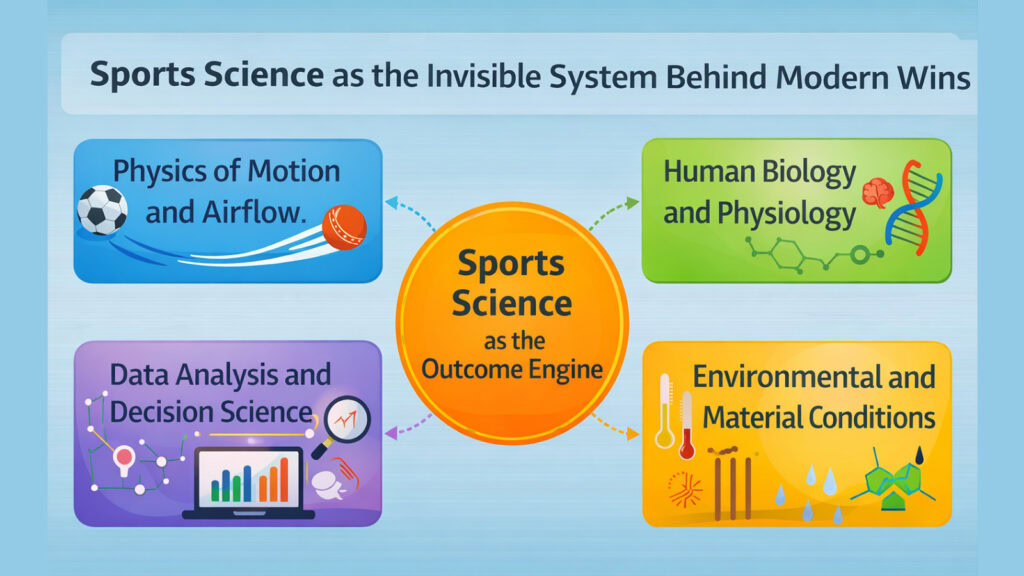
The ball curves when it should travel straight. The sprinter finds grip where others slip. The swimmer glides while competitors fight the water. These moments decide championships, yet few understand the invisible forces at work. Sports Science has transformed modern competition into something beyond raw talent. Physics governs every projectile. Biology determines which muscles fire. Data reveals patterns human eyes cannot detect. Environmental conditions shift outcomes in ways that seem like luck but follow strict natural laws.
Every sport operates within constraints that science can measure and predict. Cricket bowlers manipulate air pressure around a leather sphere. Football players bend kicks using principles discovered in wind tunnels. Tennis champions generate rotation that transforms court geometry. Formula 1 teams solve aerodynamic equations that separate podium finishes from midfield obscurity. Basketball shooters calculate trajectories most fans never consider. Sprinters compress time through engineered materials. Swimmers battle drag forces that steal fractions of seconds. Baseball pitchers create optical illusions through measured spin rates.
These eight sports represent battlegrounds where Sports Science has changed how games are won. Understanding these principles means seeing competition through a different lens. Victory belongs to those who harness invisible advantages. What follows are specific examples where scientific understanding translates directly into scoreboard changes.
Sports Science Foundations Across Eight Major Competitive Disciplines
| Sport | Primary Sports Science Factor |
|---|---|
| Cricket | Aerodynamics and atmospheric conditions |
| Football | Magnus effect and spin dynamics |
| Tennis | Topspin mechanics and ball physics |
| Formula 1 | Downforce and drag reduction |
| Basketball | Projectile motion and arc optimization |
| Athletics | Energy return and biomechanics |
| Swimming | Drag minimization strategies |
| Baseball | Spin rate and pitch movement |
1. Sports Science in Football: The Physics Behind Curved Free Kicks
A football sails toward the goal in a path that defies straight-line geometry. The wall blocks the direct route, yet the ball bends around it and drops into the corner. This spectacle follows principles that physicist Heinrich Magnus documented in the nineteenth century. When a spinning sphere moves through air, pressure differences push the ball sideways.
Spin rate determines how sharply the ball curves. Professional players generate between 500 and 600 revolutions per minute on powerful free kicks. More spin means more curve. Modern match balls feature textured coatings that grip air molecules more effectively than smooth leather. Wind tunnel tests show these surfaces increase the Magnus force by up to 15% compared to traditional designs.
Strike technique separates successful free kicks from blocked attempts. Players contact the ball off-center, typically on the lower half and to one side. The exact contact point determines curve direction and trajectory height. High-speed footage reveals that elite players maintain ball contact for approximately 10 milliseconds, during which foot speed can exceed 30 meters per second. Wall placement and goalkeeper positioning have evolved through Sports Science understanding. Defensive walls now account for expected curve paths based on the shooter’s approach angle and foot preference.
Sports Science Factors in Football Free Kick Trajectory Control
| Factor | Impact on Ball Flight |
|---|---|
| Spin rate 500 to 600 rpm | Creates lateral Magnus force |
| Contact duration 10 milliseconds | Determines energy transfer |
| Off-center contact point | Controls curve and height |
| Foot speed exceeding 30 m/s | Maximizes velocity and spin |
| Textured panel design | Enhances Magnus effect |
| Distance 18 to 25 meters | Optimal curve development range |
| Ball pressure 0.9 atmospheres | Affects deformation and stability |
| Approach angle 30 to 45 degrees | Enables maximum spin contact |
2. Sports Science in Cricket: How Swing Bowling Changes Match Results
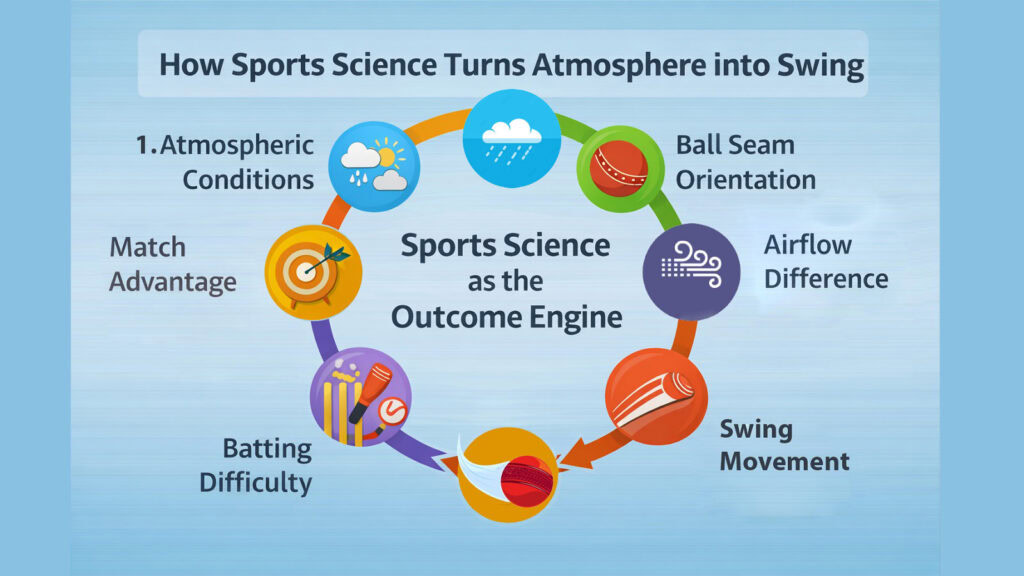
Cricket bowlers chase an elusive phenomenon that turns matches. The ball leaves the hand traveling straight, then curves sharply before reaching the batsman. This swing depends on factors most spectators never consider. Air flows differently over the two halves of a cricket ball. One side remains polished and smooth while the other grows rough. This asymmetry creates pressure differences that push the ball sideways during flight.
Humidity plays a decisive role that Sports Science has quantified. Moisture-laden air is less dense because water vapor molecules weigh less than nitrogen and oxygen. This lower density allows the cricket ball to swing more dramatically. Overcast conditions often accompany high humidity, which explains why bowlers perform better under cloud cover. Teams now check humidity levels before deciding whether to bat or bowl first.
Seam position determines swing direction with scientific precision. The raised stitching disturbs airflow. When the seam points toward slip, the ball swings away from a right-handed batsman. Bowlers spend years mastering the wrist position that keeps the seam upright. High-speed cameras reveal that elite bowlers maintain seam angles within two degrees of vertical throughout delivery. Modern teams employ analysts who calculate expected swing coefficients for each venue. These calculations influence team selection, with swing bowlers preferred in conducive conditions.
Sports Science Variables Affecting Cricket Ball Swing Behavior
| Variable | Effect on Swing |
|---|---|
| Humidity above 60 percent | Increases swing through lower air density |
| Seam angle within 2 degrees | Maintains pressure differential |
| Temperature below 15 Celsius | Enhances swing via denser air |
| Ball surface asymmetry | Creates turbulent airflow zones |
| Wind speed below 10 kph | Allows swing to dominate |
| Altitude above 1500 meters | Reduces swing from thin air |
| Ball age 10 to 40 overs | Optimal asymmetry range |
| Speed 130 to 145 kph | Ideal velocity for movement |
3. Sports Science in Tennis: Why Topspin Wins Longer Rallies
Tennis players strike the ball with an upward racket motion that seems counterintuitive. Yet topspin dominates modern baseline play because it solves a fundamental problem. Hard flat shots frequently sail beyond the baseline. Topspin creates a downward force that pulls the ball into the court despite high velocities. This allows aggressive play with built-in safety margins.
Racket head speed and swing path combine to generate rotation. Professional players accelerate the racket from below the ball to above it, with strings moving upward at speeds exceeding 100 kilometers per hour. This motion imparts spin rates between 2500 and 5000 revolutions per minute. The top of the ball moves forward faster than the bottom, creating higher pressure above the ball. This pressure difference pushes downward during flight. Heavy topspin allows players to clear the net by a meter while landing inside the baseline.
String technology has amplified topspin generation through Sports Science advances. Polyester strings grip the ball and snap back more rapidly than traditional materials. This snapback effect adds extra rotation. Modern string patterns with wider spacing allow more string movement. Players using these setups generate 20 to 30 percent more spin than equipment from the 1990s. The increased spin has changed rally patterns. Points last longer because players retrieve balls with aggressive counters that still drop safely in court.
Topspin Mechanics and Court Control
| Element | Role in Topspin Generation |
|---|---|
| Racket speed above 100 kph | Provides rotation energy |
| Spin rate 2500 to 5000 rpm | Creates downward Magnus force |
| String snapback effect | Adds extra rotation |
| Polyester string composition | Increases ball grip |
| Contact duration 4 to 5 ms | Window for energy transfer |
| Racket angle 5 to 15 degrees closed | Balances spin and trajectory |
| Low-to-high swing path | Imparts forward rotation |
| Net clearance exceeding 1 meter | Safety margin from topspin |
4. Sports Science in Formula 1: Aerodynamics That Decide Race Positions
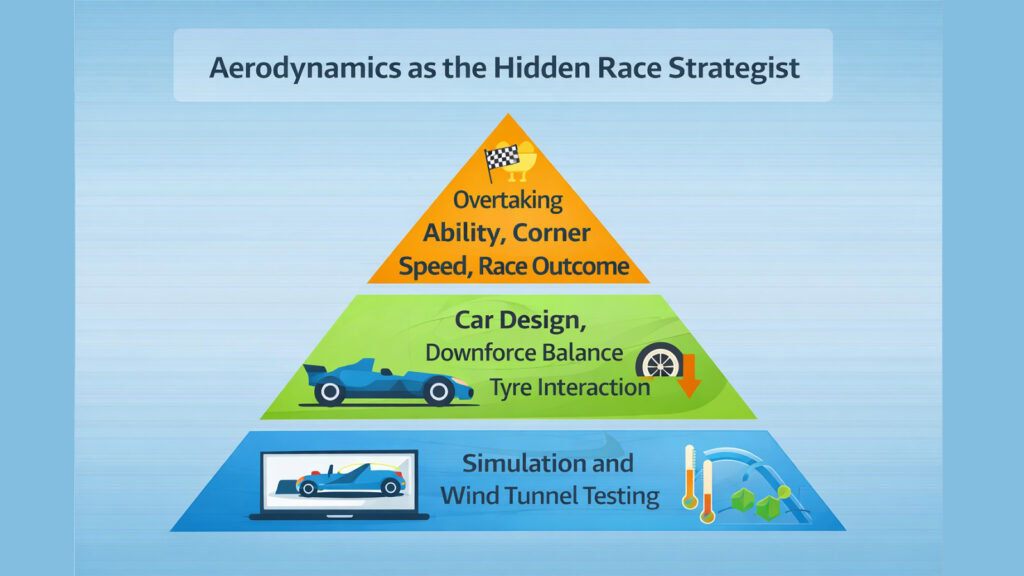
Formula 1 cars generate forces that defy casual observation. At racing speeds, the car pushes down on the track with a force exceeding its own weight. This downforce comes from shaped air channels underneath the car and wings, front and rear. Air flowing under the car accelerates through a narrowing gap, dropping the pressure below compared to above. This pressure difference literally sucks the car toward the asphalt. More downforce means higher cornering speeds because the tires can transfer more lateral force without sliding.
Teams spend millions optimizing the downforce-to-drag ratio using computational fluid dynamics. Wind tunnels and computer simulations test thousands of variations. Gaining one tenth of a second per lap through aerodynamic improvements can mean the difference between pole position and starting fifth. Over a race distance, these small gains compound. A car that’s two-tenths per lap faster will finish 12 seconds ahead after 60 laps.
Tire temperature management depends heavily on aerodynamic choices. More downforce loads the tires and generates heat. Optimal tire temperature ranges between 90 and 110 degrees Celsius. Teams adjust wing angles based on ambient temperature and track surface. Overtaking has become an aerodynamic chess match. Following another car reduces front downforce because the lead car disrupts airflow. But reduced front downforce also means less drag, giving a slight straight-line speed advantage. Understanding the physics determines both car design and race tactics.
Aerodynamic Principles in Formula 1 Performance
| Principle | Effect on Race Performance |
|---|---|
| Ground effect downforce | Creates suction exceeding car weight |
| Downforce-drag optimization | Balances cornering and speed |
| Tire temperature 90 to 110 C | Determines grip and degradation |
| Wing angle adjustment | Adapts to ambient conditions |
| Turbulent air effect | Reduces following car downforce |
| CFD modeling | Tests thousands of variations |
| 0.1 second per lap gain | Compounds to 6-second advantage |
| Wake minimization | Reduces turbulence behind |
5. Sports Science in Basketball: The Shot Arc That Improves Scoring Odds
Basketball players launch the ball toward a target that offers a limited margin. The rim measures 45 centimeters in diameter, while the ball measures 24 centimeters. This leaves roughly 10 centimeters of clearance on each side. Shot angle determines how much of that target remains accessible. A flat shot sees a smaller rim opening than a shot entering at 45 degrees. Sports Science has calculated that steeper entry angles increase the effective target size, directly improving scoring probability.
Release height and arc angle work together to create optimal trajectories. The ideal arc for most players falls between 45 and 52 degrees at the apex. This range maximizes target size while keeping ball speed manageable. Too steep and the ball arrives with excessive downward velocity that increases bounce-out risk. Too flat, and the effective rim size shrinks below the margin that accounts for minor release errors.
Backspin stabilizes flight and provides a cushion on rim contact. Players generate between 2 and 3 rotations per second by rolling the ball off their fingertips. This backspin creates a small Magnus force that fights gravity. More importantly, backspin causes the ball to grab the rim and drop through rather than bouncing away. Three-point shooting has evolved through Sports Science understanding. Teams now track shooting data that includes arc angle and make percentage from various court positions. Late-game decisions about shot selection increasingly rely on this scientific approach.
Sports Science Factors in Basketball Shooting Accuracy and Arc Optimization
| Factor | Influence on Shot Success |
|---|---|
| Entry angle 45 to 52 degrees | Maximizes effective rim size |
| Release height at 2.5 meters | Allows flatter trajectories |
| Backspin 2 to 3 rotations/second | Stabilizes flight and rim contact |
| Rim 45 cm versus ball 24 cm | Provides 10 cm clearance per side |
| Fingertip release | Creates consistent backspin |
| Three-point distance | Magnifies angular errors |
| Flat shots reduce target | Decreases error margin |
| Data tracking by position | Identifies optimal shot selection |
6. Sports Science in Athletics: How Track Design Shapes Sprint Results
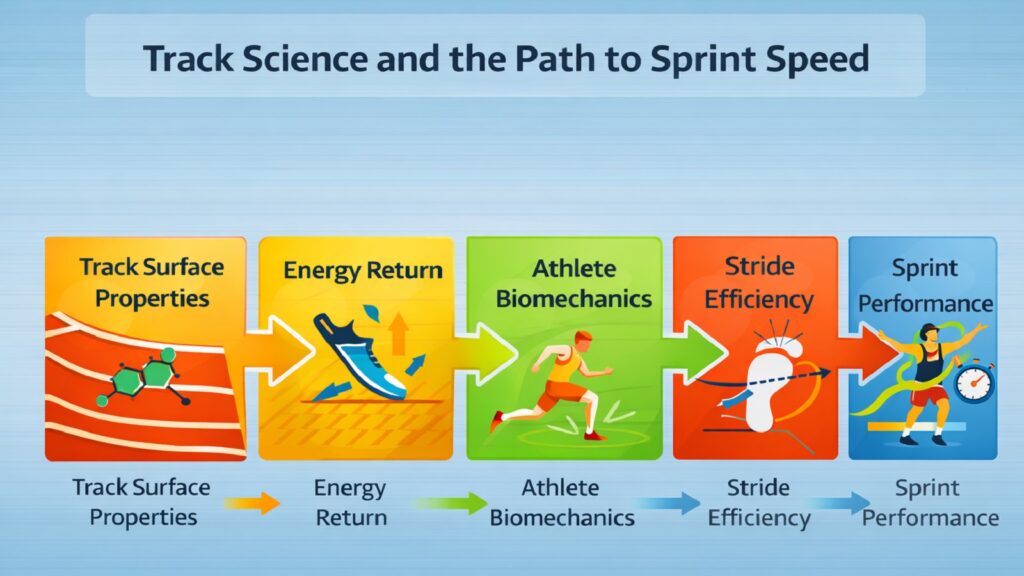
Sprint tracks have evolved from cinder to sophisticated synthetic surfaces that return energy with each footfall. Modern track materials consist of rubber granules bound in layers over a base structure. When a sprinter’s foot strikes the surface, the material compresses and stores elastic energy. As the foot pushes off, the material rebounds and returns a portion of that energy. This energy return reduces the muscular work required for each stride.
The molecular composition affects performance measurably. Polyurethane-bound rubber provides more energy return than older latex-bound systems. Testing shows energy return percentages ranging from 35 to 50 percent. A 50-percent energy return surface gives back half the impact energy, effectively reducing the metabolic cost of running. Over 100 meters, this advantage can translate to improvements of several hundredths of a second. World records frequently fall on tracks certified for optimal energy return properties.
Spike design interacts with track surfaces to maximize traction without excess penetration. Modern sprint spikes use rigid plates with short pins, typically 6 to 9 millimeters long. These pins bite into the surface enough to prevent slipping but don’t penetrate so deeply that they create friction during push-off. Athletes test different spike lengths during warmups to match the conditions. Acceleration phases benefit differently than top-speed phases from track properties. Some facilities engineer variable surface properties along the track length.
Sports Science Components of Track Surface Design for Sprint Performance
| Component | Effect on Sprint Speed |
|---|---|
| Polyurethane-bound rubber | Provides 35 to 50 percent energy return |
| Energy return efficiency | Decreases fatigue accumulation |
| Spike pins 6 to 9 mm | Balances traction and friction |
| Surface hardness variation | Requires spike adjustment |
| Softer starting zones | Enhances acceleration force |
| Firmer speed zones | Reduces ground contact time |
| Track quality certification | Enables record performances |
| Impact energy return | Reduces muscular work per stride |
7. Sports Science in Swimming: Reducing Drag to Gain Crucial Seconds
Swimmers fight an invisible opponent that grows stronger with speed. Water resists movement through drag forces that increase exponentially with velocity. Doubling swimming speed requires eight times more power. This relationship means that small drag reductions produce disproportionate performance benefits. Sports Science approaches drag reduction through body position, stroke mechanics, pool design, and equipment technology.
Body position in the water determines the frontal area exposed to resistance. A swimmer positioned horizontally near the surface minimizes this area. Head position controls body angle. Looking forward raises the head and drops the hips, increasing drag significantly. Elite swimmers look almost straight down, keeping the head in line with the spine. Core strength holds the body rigid, preventing undulations that increase drag. A 5-degree change in body angle can increase drag by 10 to 15 percent.
Stroke efficiency separates elite swimmers through Sports Science analysis. The hand and forearm should act as a paddle, pulling water backward. High-elbow catch positions maximize the effective paddle area. The recovery phase should swing the arm over the water rather than through it. Pool design affects performance through wave reflection and lane rope technology. Deep pools absorb turbulence rather than reflecting it. Olympic pools now reach 3 meters in depth. Lane ropes with wave-damping designs prevent turbulence from spreading. Swimwear technology continues evolving. Textured fabrics that mimic shark skin reduce turbulence in the boundary layer.
Sports Science Drag Reduction Strategies in Competitive Swimming
| Strategy | Impact on Swim Time |
|---|---|
| Horizontal body position | Minimizes frontal area |
| Head aligned with spine | Prevents hip drop |
| 5-degree angle change | Increases drag 10 to 15 percent |
| High-elbow catch | Maximizes paddle area |
| Pool depth 3 meters | Reduces wave reflection |
| Wave-damping lane ropes | Prevents turbulence spread |
| Textured suit fabrics | Reduces boundary turbulence |
| Exponential drag increase | Makes reductions highly valuable |
8. Sports Science in Baseball: Spin Rate and the Illusion of Speed
Baseball pitchers throw fastballs that appear to rise as they approach home plate. The ball does neither, yet batters consistently swing beneath pitches they expect to drop more. This illusion stems from backspin rates that fight gravity more than batters anticipate. A fastball thrown at 95 miles per hour with 2400 revolutions per minute of backspin drops less than a similar fastball with 2000 rpm. That difference of several inches determines whether the bat makes contact or swings through empty air.
Seam orientation during the pitch affects movement in ways that high-speed cameras have revealed. The four raised seams create turbulence as they rotate through the air. A four-seam fastball presents seams perpendicular to the direction of travel. This creates maximum drag and backspin efficiency. A two-seam fastball tumbles with seams aligned partially with travel direction. The reduced drag means less resistance to gravity, causing more drop. Pitchers choose which grip based on desired movement.
Air pressure and humidity influence baseball flight similarly to cricket. Higher altitude venues have thinner air that reduces drag on both pitched and batted balls. Pitches move less while home runs travel farther. Humidity creates denser air conditions that enhance pitch movement slightly. Pitch sequencing now incorporates spin rate data to exploit batter expectations. A pitcher who throws a high-spin fastball followed by a low-spin changeup creates maximum disruption. Both are illusions created by spin differentials and gravity. This battle between pitcher deception and batter recognition operates at a level invisible to spectators but decisive to outcomes.
Sports Science Analysis of Baseball Pitch Movement Through Spin Rate
| Factor | Effect on Pitch Behavior |
|---|---|
| Spin rate 2400 vs 2000 rpm | Creates inches difference in drop |
| Four-seam grip perpendicular | Maximizes drag and backspin |
| Two-seam aligned grip | Reduces drag increases drop |
| High-altitude venues | Decreases pitch movement |
| Humidity and air density | Enhances pitch movement |
| High-spin to low-spin sequence | Exploits batter expectations |
| Spin consistency correlation | Demonstrates release importance |
| Spin recognition window | Creates micro-second decisions |
Conclusion: Sports Science as the Silent Advantage That Wins Games
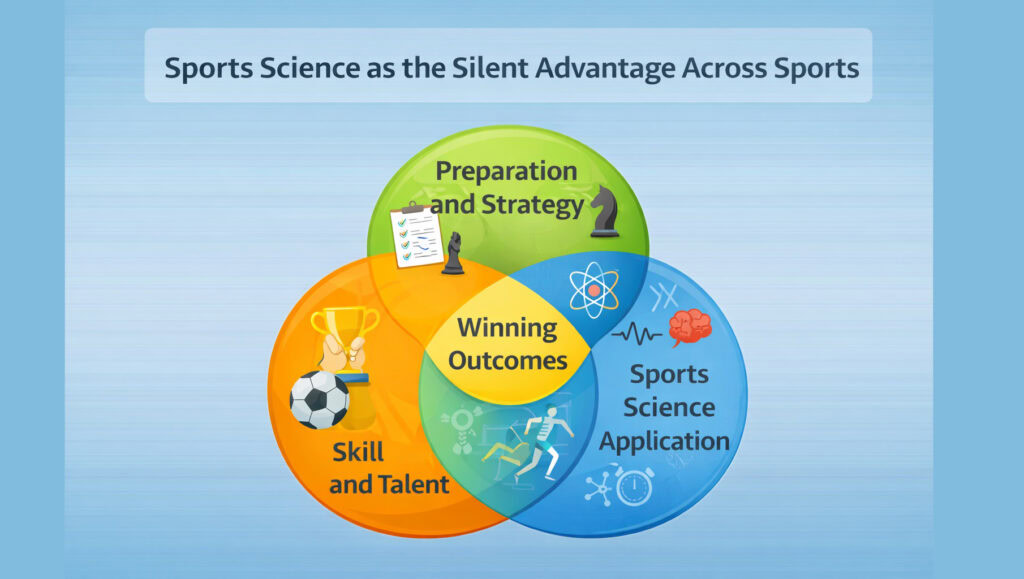
Eight sports reveal a pattern that extends across all competitive athletics. The rules remain constant while the understanding deepens. Cricket bowlers still deliver six balls per over, but now they know precisely why some overs produce wickets. Football players still bend free kicks, but they understand the exact contact points and spin rates. Tennis champions still rally from the baseline, but topspin has become a calculated weapon. Formula 1 teams still race 60 laps, but aerodynamic optimization determines positions before engines start.
Basketball shooters still aim at the same rim, but optimal arcs have become measurable. Sprinters still cover 100 meters, but track surfaces now return energy. Swimmers still battle resistance, but drag reduction strategies have become critical. Baseball pitchers still throw strikes, but spin rates create illusions that override batter instincts.
Sports Science does not replace physical talent or mental toughness. It amplifies both by removing inefficiency and exploiting natural laws. Raw ability provides the foundation, but scientific application builds the structure that wins championships. Future competitions will intensify this trend as measurement technology improves. Sensors embedded in equipment will provide real-time feedback. Athletes who understand why techniques work will adapt faster than those who simply repeat motions. Teams that employ scientific methods will find marginal gains that accumulate into decisive advantages.
The spectacle remains unchanged for those watching. A curving free kick still draws gasps. A perfectly placed tennis shot still earns applause. A record-breaking sprint still produces euphoria. But beneath these visible moments operates an invisible framework of physics, biology, and calculation. Understanding these mechanisms does not diminish the achievement. It reveals the sophistication required to perform at the highest level. Sports Science has made elite competition more complex while making the path to excellence more navigable. Those who learn these lessons will hold the trophies, while others wonder how games slipped away.
Sports Science Integration Across Eight Competitive Disciplines
| Sport | Key Scientific Advantage |
|---|---|
| Cricket | Humidity and seam position create swing conditions |
| Football | Magnus effect enables controlled free kick curves |
| Tennis | Topspin allows aggressive play with safety margins |
| Formula 1 | Downforce optimization determines race positions |
| Basketball | Optimal arc angles maximize scoring probability |
| Athletics | Track energy return enables faster sprint times |
| Swimming | Drag minimization creates crucial time advantages |
| Baseball | Spin rate manipulation generates pitch illusions |
Read More Science and Space Articles
- Fundamental Physical Theories: 8 Powerful Laws of Nature
- STEM Learning Skills: 6 Powerful Secrets Behind Real Success
- STEM Subjects: 8 Essential Insights for a Brighter Future
- Universe Odyssey: 8 Essential Stages Of A Remarkable Journey
- Cosmic Giants: 8 Incredible Titans Shaping Our Universe
- Cosmic Forces: 8 Powerful Phenomena Shaping Our Universe
- God: 6 Powerful Scientific Insights That Reveal Human Belief
- Hawking Radiation: 6 Powerful Clues to Quantum Gravity
- Human Cell Secrets: 6 Powerful Insights Shaping Life
- Black Hole Singularity: 6 Mind-Blowing Truths Explained