Table of Contents
Introduction: Sustainable Business as a Core Business Essential
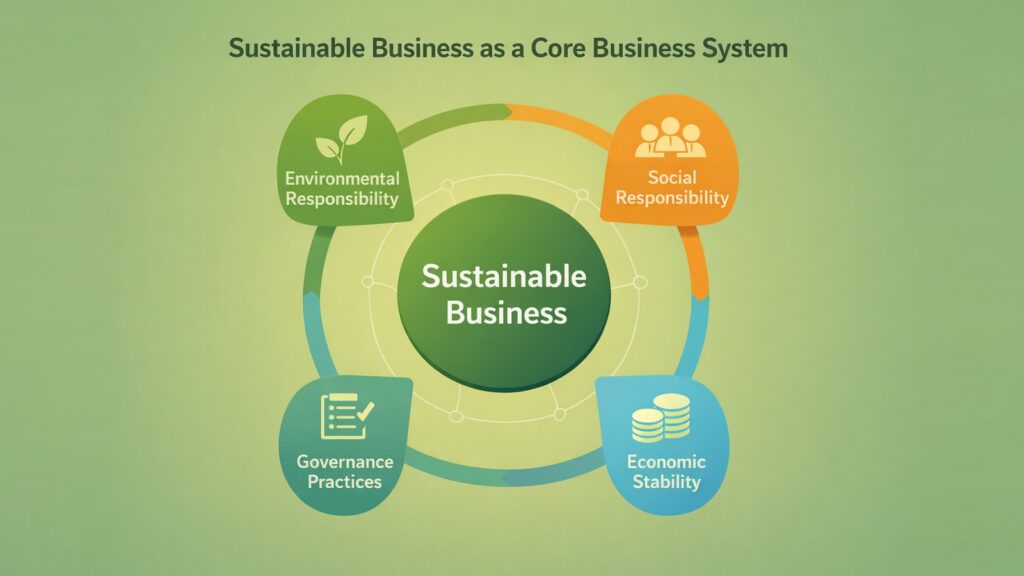
There was a time when running a responsible business felt like a choice. Something a company did after it had already secured profits. That time has passed. Today, sustainable business is no longer a side project. It is one of the most important business essentials and a condition for staying relevant and surviving long enough to matter.
Businesses face pressure from multiple directions at once. Climate events are disrupting supply chains and infrastructure. Regulators in major economies are tightening rules around carbon, waste, and labor. Investors are asking harder questions before committing capital. And customers, especially younger ones, are paying attention to how companies actually operate, not just what they say.
None of these forces are going away. If anything, they are becoming more intense. A business that ignores them is not just taking a reputational risk. It is exposing itself to real financial and operational vulnerabilities.
What makes sustainable business difficult to define is that it is not one action. It is not a single certification or a recycling program or a solar panel on the roof. It is a system of connected practices that runs through every part of how a business operates. From how it manages its carbon footprint to how it treats workers in its supply chain to how honestly it reports its performance.
This article looks at eight aspects of sustainable business that together form that system. They are not ranked in order of importance. They work together. Understanding each one is useful. Understanding how they connect is more useful still.
Table 1: 8 Aspects of Sustainable Business Discussed in This Article
| Aspect of Sustainable Business | What It Covers |
| Carbon Management | Tracking and reducing greenhouse gas emissions across operations |
| Circular Economy | Redesigning products and processes to reduce waste and reuse materials |
| Resource Efficiency | Cutting energy, water, and material use in daily operations |
| Ethical Supply Chain | Ensuring fair labor, responsible sourcing, and vendor accountability |
| Stakeholder Engagement | Building trust with employees, customers, communities, and investors |
| Climate Risk Awareness | Identifying and preparing for physical and regulatory climate risks |
| Transparent Reporting | Publishing honest ESG data that stakeholders can rely on |
| Innovation for Growth | Using sustainability as a driver for new products and business models |
1. Sustainable Business and Carbon Management for Measurable Impact
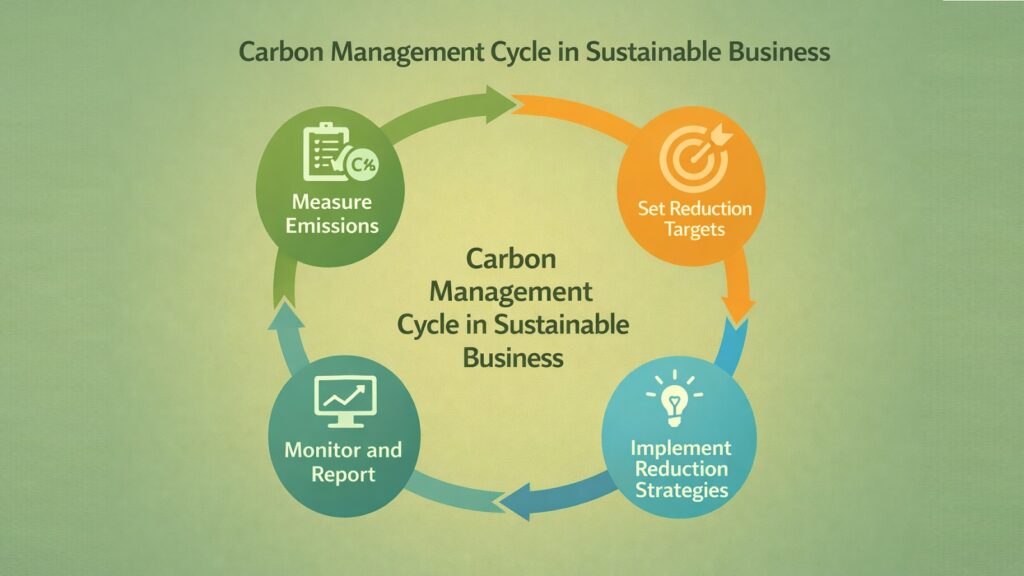
Carbon management is often where sustainable business begins, partly because carbon emissions are measurable, and anything measurable can be managed. A business cannot reduce what it has not tracked.
A carbon footprint covers all the greenhouse gases a business produces, directly and indirectly. Scope 1 emissions come from sources a company owns, like company vehicles or on-site boilers. Scope 2 comes from purchased electricity. Scope 3 covers everything else, including supplier activities, employee travel, and how customers use the product. Scope 3 is usually the largest and the hardest to control.
Why does this matter beyond the environment? Because carbon is increasingly tied to cost. Energy costs money. Waste costs money. When a business becomes more carbon efficient, it often becomes more cost efficient too. The two tend to move together.
Regulatory pressure is also mounting. The European Union’s Carbon Border Adjustment Mechanism, for example, charges importers based on the carbon intensity of their products. Businesses that have not worked on emissions may find themselves at a competitive disadvantage as such policies spread.
Practical steps include setting a baseline measurement, committing to reduction targets aligned with science-based standards, improving energy systems, and reporting progress annually. These are not abstract gestures. They are management decisions with financial consequences.
Table 2: Key Concepts in Sustainable Business Carbon Management
| Concept | Explanation |
| Scope 1 Emissions | Direct emissions from company-owned sources such as fuel combustion on site |
| Scope 2 Emissions | Indirect emissions from purchased electricity, heat, or steam |
| Scope 3 Emissions | All other indirect emissions across the full value chain, often the largest share |
| Science-Based Targets | Emission reduction goals aligned with climate science, set via the SBTi framework |
| Carbon Accounting | The process of measuring and recording greenhouse gas emissions systematically |
| Net Zero | Achieving a balance between emissions produced and emissions removed from the atmosphere |
| Carbon Border Adjustment | EU policy that prices carbon-intensive imports to level the playing field |
| Energy Audits | Structured reviews of energy consumption to identify efficiency opportunities |
2. Sustainable Business Through Circular Economy Thinking
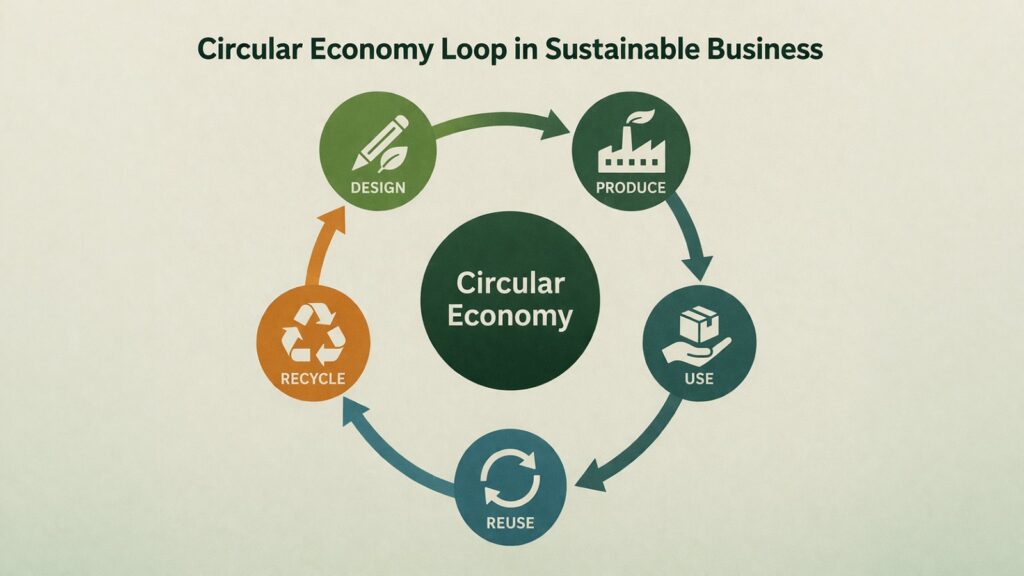
Most economies still operate on a straight line. Resources are extracted, made into products, used, and thrown away. This is called a linear economy. A circular economy works differently. It tries to keep materials in use for as long as possible, reducing the need to extract new resources and the amount of waste produced.
For a sustainable business, circular thinking means asking different questions during product design. Can this component be repaired rather than replaced? Can this packaging be returned and refilled? Can this material be recycled back into the same product rather than downcycled into something of lower value?
Some large companies have made real progress here. Renault, the French car manufacturer, runs a remanufacturing plant in Flins, France, where used car parts are restored to original specifications and resold. This saves energy and raw materials compared to making new parts. It is also a profitable operation.
The circular economy also opens new revenue streams. Product-as-a-service models, where companies lease rather than sell, create longer relationships with customers and ensure products are returned at end of life. Interface, the carpet company, offers a take-back program and recycles old carpet tiles into new ones.
Circular thinking is not only for manufacturers. Service businesses can apply it too, through reduced paper use, refurbished office equipment, and supplier partnerships that recover waste materials. The principle scales across industries.
Table 3: Sustainable Business Circular Economy Principles
| Principle | Practical Meaning |
| Design for Longevity | Creating products that last longer and are easier to repair |
| Remanufacturing | Restoring used products or components to original quality and reselling them |
| Product-as-a-Service | Leasing products to customers instead of selling, retaining material ownership |
| Reverse Logistics | Building systems to recover products or packaging at end of use |
| Industrial Symbiosis | Companies sharing waste streams so one business’s output feeds another’s input |
| Closed-Loop Recycling | Recycling materials back into the same product rather than lesser products |
| Material Passports | Digital records that track a product’s materials to support future recovery |
| Waste Hierarchy | Prioritizing prevention, reuse, recycling, recovery before disposal |
3. Sustainable Business and Resource Efficiency in Daily Operations
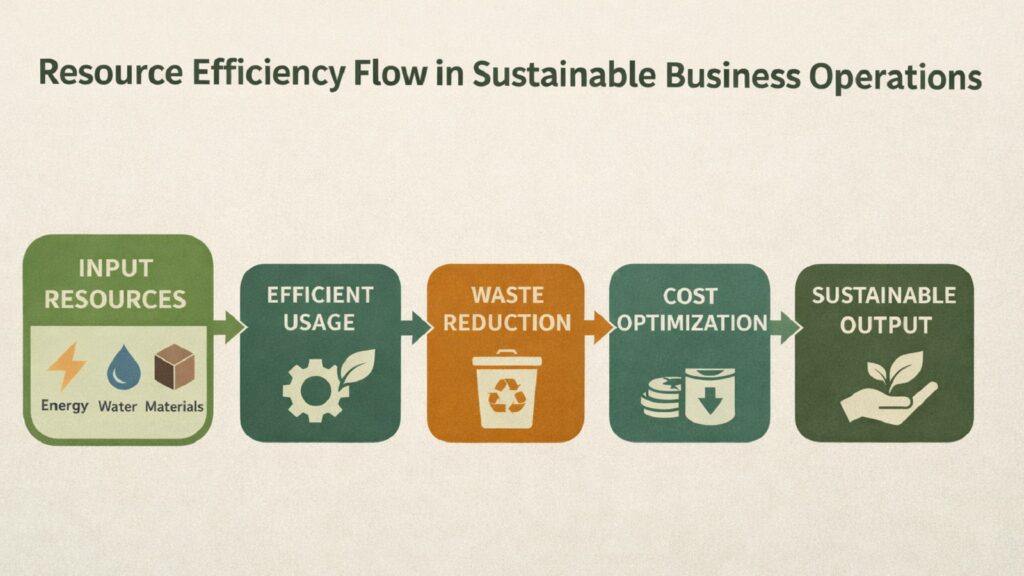
Resource efficiency is perhaps the most practical dimension of sustainable business. It lives in daily operations. It shows up in energy bills, water invoices, and material costs. And it rewards attention.
Energy is usually the biggest opportunity. The International Energy Agency has found that improving energy efficiency in buildings and industry is one of the most cost-effective ways to cut emissions globally. For a business, this might mean upgrading lighting to LED, improving insulation in warehouses, installing smart thermostats, or switching to more efficient industrial equipment.
Water is another area often overlooked until it becomes a problem. Businesses in water-stressed regions face operational risk if they depend heavily on local water supplies. Hotels, food processors, and textile manufacturers are among those most exposed. Reducing water use through recycling and process changes protects both costs and continuity.
Material efficiency matters too. Lean manufacturing principles reduce overproduction and scrap. Better inventory management reduces waste from spoilage or obsolescence. Packaging reduction cuts material costs and waste disposal fees at the same time.
The financial case for resource efficiency is often the easiest to make inside a company. It does not require selling sustainability as a value. It sells itself as cost reduction. That is why it tends to be the entry point for businesses just beginning to engage with sustainable practice.
Table 4: Sustainable Business Resource Efficiency Actions
| Resource Area | Efficiency Measure |
| Energy – Lighting | Switching to LED lighting can reduce lighting energy use by up to 75 percent |
| Energy – Equipment | Variable speed drives on motors can cut energy use by 20 to 50 percent |
| Water – Industrial | Closed-loop cooling systems recycle water instead of discharging it |
| Water – Buildings | Low-flow fixtures and leak detection programs reduce water bills significantly |
| Materials – Packaging | Lightweighting and right-sizing packaging reduces material and shipping costs |
| Materials – Production | Lean manufacturing reduces scrap and overproduction across assembly lines |
| Waste – Food Service | Food waste tracking and portion control reduce costs and disposal fees |
| Energy – Buildings | Insulation upgrades and building management systems improve heating efficiency |
4. Sustainable Business and Ethical Supply Chain Practices
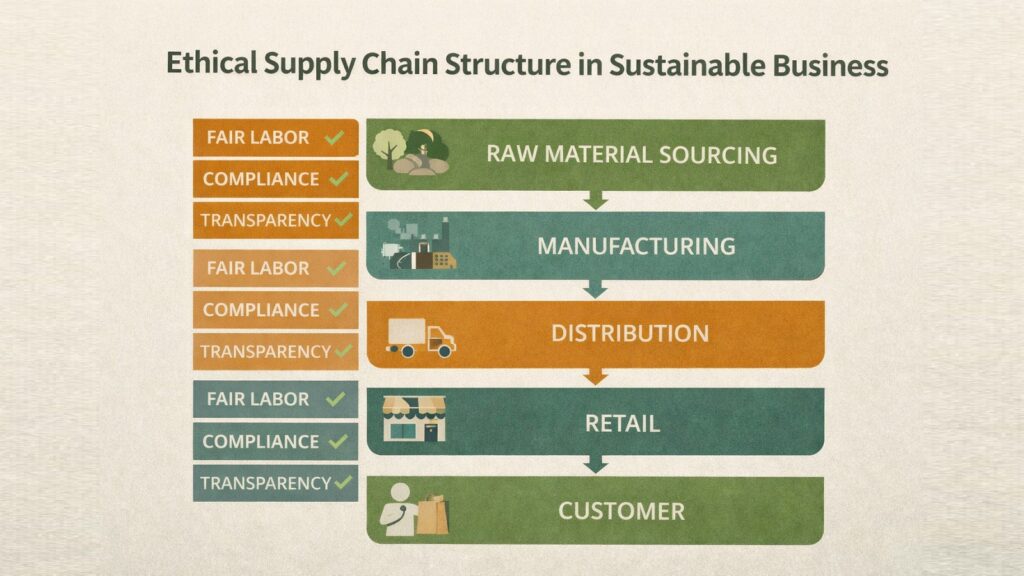
A business does not operate in isolation. It is connected to dozens or hundreds of suppliers, each with their own labor practices, environmental records, and risk profiles. When a supplier cuts corners, it can land on the buyer’s front page. Sustainable business means taking responsibility for what happens outside your own walls.
Ethical supply chains involve knowing where materials come from and how they were produced. This includes checking for fair wages, safe working conditions, and legal labor practices. It means avoiding suppliers who use forced labor or child labor, even when those suppliers are located in countries where enforcement is weak.
The business case is partly about risk. In 2013, the Rana Plaza building in Bangladesh collapsed, killing over 1,100 garment workers. The brands sourcing from factories in that building faced severe reputational damage. Some lost market share. The incident made it clear that supply chain ethics are not just a moral concern but a business continuity issue.
Practical tools include supplier codes of conduct, third-party audits, and supply chain mapping. Mapping means tracing a product back through multiple tiers of suppliers to identify risk. Many companies discover they have limited visibility beyond their first-tier suppliers.
Legislation is also pushing companies to take action. The UK Modern Slavery Act, Germany’s Supply Chain Due Diligence Act, and upcoming EU rules all require businesses to assess and address human rights risks in their supply chains. Compliance is becoming a baseline, not a virtue.
Table 5: Sustainable Business Ethical Supply Chain Practices
| Practice | Purpose |
| Supplier Code of Conduct | Sets minimum standards for labor, environment, and ethics across the supply chain |
| Supply Chain Mapping | Identifying all tiers of suppliers to understand where risks and exposures lie |
| Third-Party Audits | Independent checks of supplier facilities to verify compliance with standards |
| Conflict Minerals Policy | Avoiding minerals from sources linked to armed conflict or human rights abuses |
| Fair Wage Commitment | Ensuring workers in the supply chain receive wages that meet living wage benchmarks |
| Traceability Systems | Digital tools that track materials from origin to final product for transparency |
| Modern Slavery Reporting | UK legal requirement for large businesses to report on slavery and trafficking risks |
| Supplier Development | Working with suppliers to help them improve rather than simply dropping them |
5. Sustainable Business and Meaningful Stakeholder Engagement
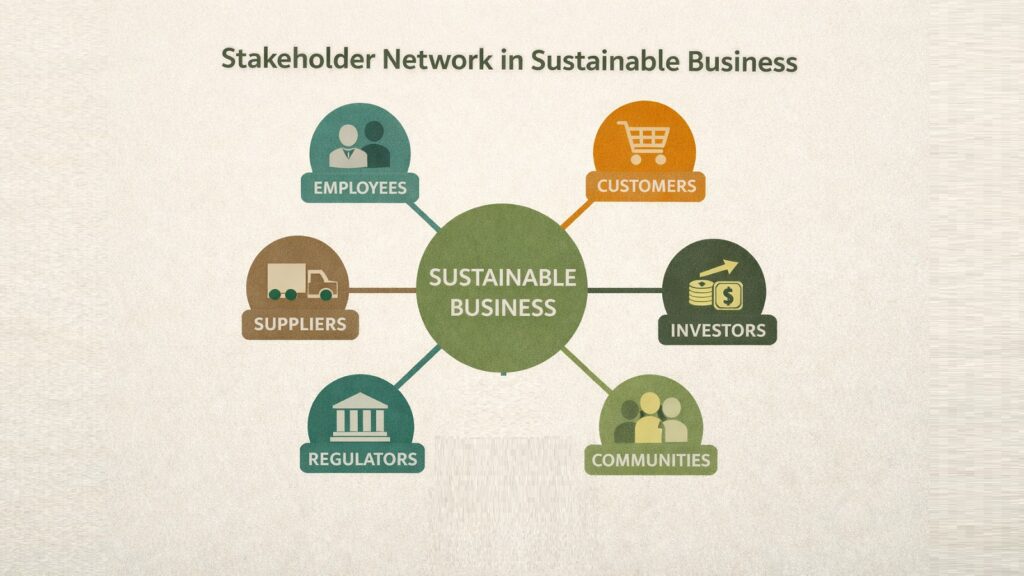
Sustainable business is not something a company does alone. It involves people. Employees, customers, communities, investors, and regulators all have a stake in how a business operates. Engaging these groups well is not just good manners. It is how sustainable strategies succeed or fail.
Employees are among the most important stakeholders. Research from Deloitte and others consistently shows that workers, especially younger ones, want to work for companies whose values they share. High turnover is expensive. A clear and honest sustainability commitment can help attract and retain people. But only if it is genuine. Employees are close enough to see through statements that do not match reality.
Customers increasingly factor sustainability into purchasing decisions. A 2023 survey by PwC found that 46 percent of global consumers had switched to more sustainable products in the prior six months. That share is growing. Businesses that communicate clearly about their practices, without overstating them, build trust that translates into loyalty.
Community engagement matters particularly for businesses that operate in specific locations. Mining companies, manufacturers, and property developers interact with local communities in direct ways. Transparent communication, local employment commitments, and genuine consultation processes reduce conflict and build a social license to operate.
Investors have moved furthest in formalizing their expectations. ESG criteria are now standard parts of many investment frameworks. Institutional investors representing trillions in assets have signed the UN Principles for Responsible Investment, which requires them to factor ESG into decisions. A business that cannot answer sustainability questions clearly may find its cost of capital rising.
Table 6: Sustainable Business Stakeholder Engagement Dimensions
| Stakeholder | Engagement Focus |
| Employees | Purpose-driven culture, transparency on sustainability goals, fair labor practices |
| Customers | Honest communication about environmental impact and product sustainability claims |
| Local Communities | Consultation, local hiring, and addressing environmental impacts near operations |
| Investors | ESG reporting, clear targets, and responsive investor relations on sustainability |
| Regulators | Proactive compliance, early engagement on policy changes, open data sharing |
| NGOs and Advocacy Groups | Dialogue on material issues, partnership on shared goals where appropriate |
| Suppliers | Shared sustainability standards, support for supplier improvement programs |
| Media and Public | Accurate public disclosures that avoid greenwashing and build credibility |
6. Sustainable Business and Climate Risk Awareness
Climate risk is not a distant threat. It is already affecting businesses in ways that show up on balance sheets. Understanding these risks is a core part of sustainable business, not because awareness feels responsible, but because ignoring risk is how companies get hurt.
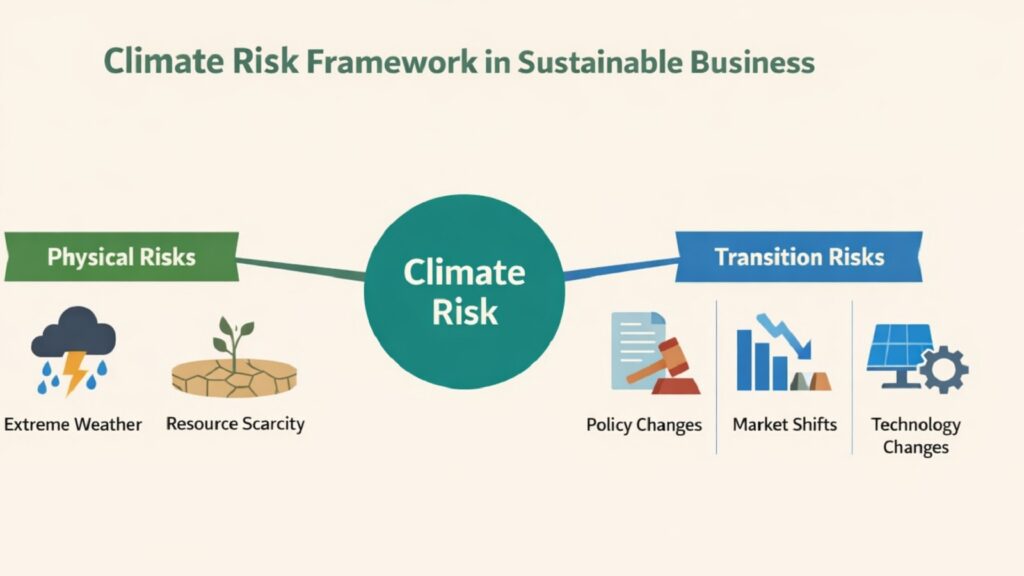
There are two main categories. Physical risks come from the changing climate itself. Floods damage facilities. Droughts reduce water availability. Heatwaves cut worker productivity and increase cooling costs. Hurricanes interrupt logistics. These events are becoming more frequent and more severe. A business operating near a coastline or in a water-stressed region is already exposed.
Transition risks emerge from the transition to a lower-carbon economy. This category includes carbon pricing, stricter emissions regulations, changes in consumer demand, and stranded assets in industries reliant on fossil fuels. A utility that depends on coal or a manufacturer of internal combustion engines encounters transition risk as policies and markets evolve.
The Task Force on Climate-related Financial Disclosures, known as TCFD, provides a widely used framework for identifying and reporting climate risks. Many regulators, including in the UK and the EU, now require TCFD-aligned reporting from large companies. The framework organizes risks into governance, strategy, risk management, and metrics.
Businesses that assess these risks early can take steps to reduce them. Relocating vulnerable facilities, diversifying supply chains, adapting product lines, and investing in resilient infrastructure are all practical responses. Awareness is the starting point, but it only creates value when it leads to action.
Table 7: Sustainable Business Climate Risk Categories
| Risk Type | Example |
| Physical – Acute | Hurricanes or floods damaging facilities, disrupting production or logistics |
| Physical – Chronic | Rising sea levels or long-term drought reducing operational viability in a region |
| Transition – Policy | Carbon taxes or stricter emissions standards raising operating costs |
| Transition – Technology | Rapid adoption of competing clean technologies making existing assets obsolete |
| Transition – Market | Declining demand for carbon-intensive products as customers shift preferences |
| Transition – Reputation | Loss of customer or investor trust due to perceived inaction on climate |
| Liability Risk | Legal action from investors or communities for failure to disclose climate risks |
| TCFD Framework | A global standard for identifying, assessing, and reporting climate-related risks |
7. Sustainable Business and Transparent Reporting Practices
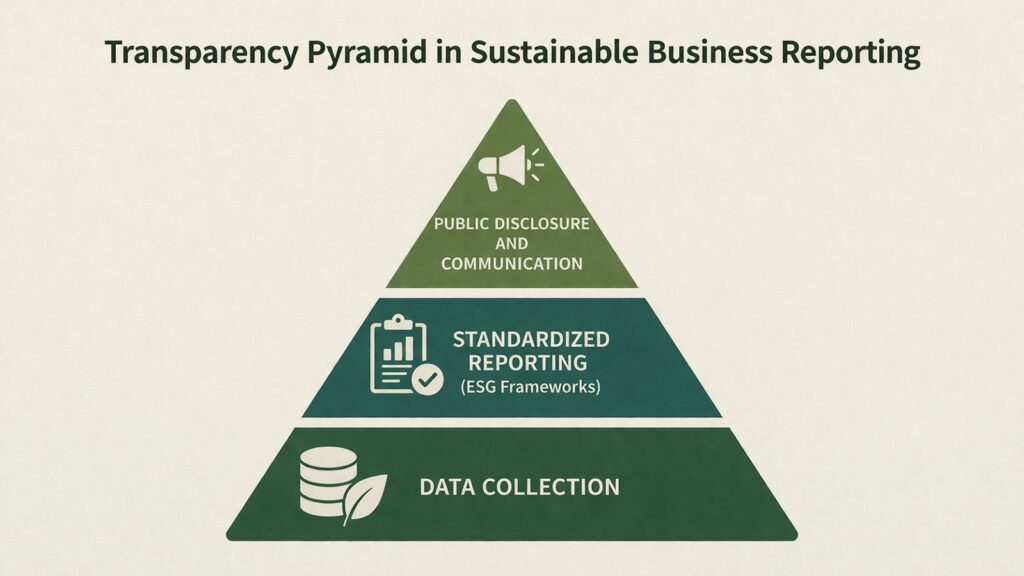
Building trust is a challenging endeavor, yet it can be easily lost. For a sustainable business, transparent reporting serves as a primary method for companies to show that their actions align with their statements. In the absence of such transparency, every assertion regarding sustainability remains merely an assertion.
ESG reporting refers to the disclosure of environmental, social, and governance performance. It covers things like carbon emissions, water use, employee safety records, board diversity, executive pay ratios, and anti-corruption policies. The idea is to give investors, customers, and other stakeholders a reliable picture of how a company manages non-financial risks.
Several frameworks exist for this reporting. The Global Reporting Initiative, or GRI, is the most widely used globally. The Sustainability Accounting Standards Board, or SASB, provides industry-specific standards. The International Sustainability Standards Board, or ISSB, has recently released global baseline standards that are being adopted by regulators in multiple countries.
Greenwashing remains a serious problem. This is the practice of making sustainability claims that are exaggerated or misleading. In 2023, the UK’s Competition and Markets Authority and the European Commission both launched investigations into misleading green claims by consumer brands. Regulators are getting more specific about what constitutes a credible claim and what does not.
For businesses, the direction is clear. Vague commitments are increasingly scrutinized. Quantified, time-bound, independently verified data is what builds credibility. The cost of honest reporting is real, but the cost of being caught in a misleading disclosure is higher.
Table 8: Sustainable Business Reporting Frameworks and Standards
| Framework or Standard | Key Focus |
| GRI (Global Reporting Initiative) | Most widely used global standard for broad ESG disclosure across all sectors |
| SASB (Sustainability Accounting Standards Board) | Industry-specific metrics for financially material sustainability issues |
| ISSB (International Sustainability Standards Board) | New global baseline standards for investor-focused sustainability disclosure |
| TCFD | Climate-specific risk disclosure framework now integrated into many regulations |
| CDP (Carbon Disclosure Project) | Annual company disclosure platform focused on climate, water, and forests |
| EU CSRD | European Corporate Sustainability Reporting Directive requiring detailed ESG reporting |
| UN SDGs | Seventeen global goals used by companies to frame and align sustainability contributions |
| B Corp Certification | Third-party certification assessing social and environmental performance standards |
8. Sustainable Business and Innovation for Future Growth
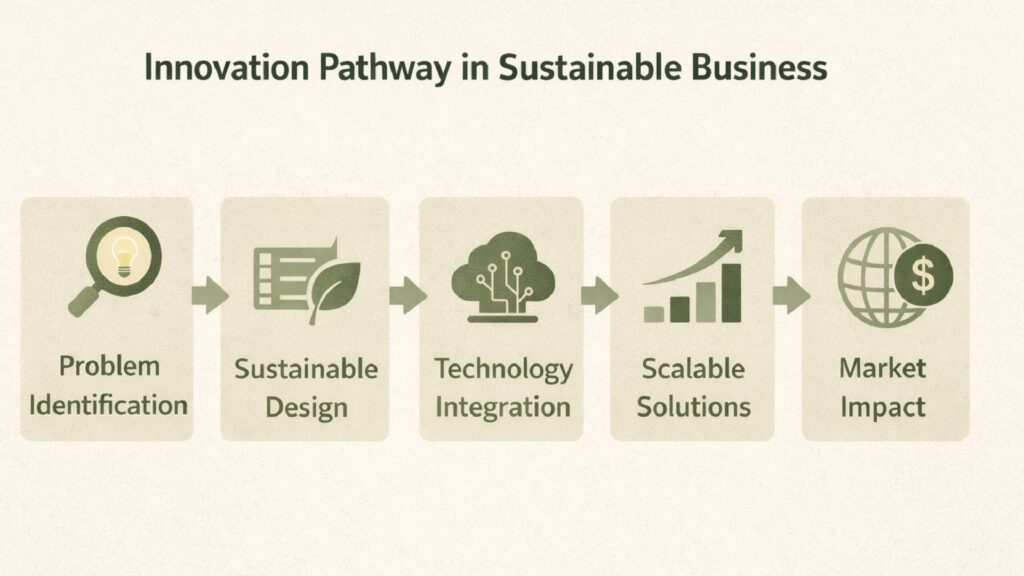
There is a version of sustainable business that is mostly defensive. Reduce risk. Stay compliant. Avoid bad headlines. That version is necessary but not sufficient. The most interesting part of sustainable business is what it creates, not just what it prevents.
Sustainability has become a driver of genuine innovation. New materials, new energy sources, new business models, and new markets have emerged from the pressure to operate more responsibly. Companies that treat sustainability as a design constraint tend to generate better solutions than those that treat it as a compliance exercise.
The renewable energy sector is a clear example. In 2010, solar power was expensive and niche. By 2023, it had become the cheapest source of electricity in history in many markets, according to the International Energy Agency. This transformation was driven partly by environmental policy, but mostly by relentless innovation in manufacturing, materials, and installation.
Electric vehicles offer another case. Tesla built a company by treating the clean energy transition as a growth opportunity rather than a constraint. Established manufacturers who were slow to respond found themselves scrambling to catch up. The market shifted faster than many traditional players had planned for.
Sustainable innovation also happens at smaller scales. A food company that reformulates a product to reduce packaging waste might discover it also cuts costs and improves shelf life. A logistics firm that optimizes routes to reduce fuel use might find that shorter delivery times improve customer satisfaction. Sustainability and commercial value align more often than the old framing of trade-offs suggested.
For businesses thinking about the next five to ten years, sustainability is not a constraint on growth. It is increasingly the direction growth is heading.
Table 9: Sustainable Business Innovation Examples by Sector
| Sector | Innovation Example |
| Energy | Solar and wind power have become cost-competitive with fossil fuels in most markets |
| Transport | Electric vehicles and battery storage are reshaping the global automotive industry |
| Construction | Low-carbon concrete and mass timber are reducing building sector emissions |
| Fashion | Bio-based and recycled fibers are replacing conventional synthetic and cotton materials |
| Food and Agriculture | Precision fermentation is producing proteins without conventional livestock farming |
| Chemicals | Green hydrogen and bio-based feedstocks are replacing fossil-derived raw materials |
| Packaging | Compostable and refillable packaging models are reducing single-use plastic waste |
| Finance | Green bonds and sustainability-linked loans are directing capital toward low-carbon projects |
Conclusion: Sustainable Business as a Long-Term Growth System
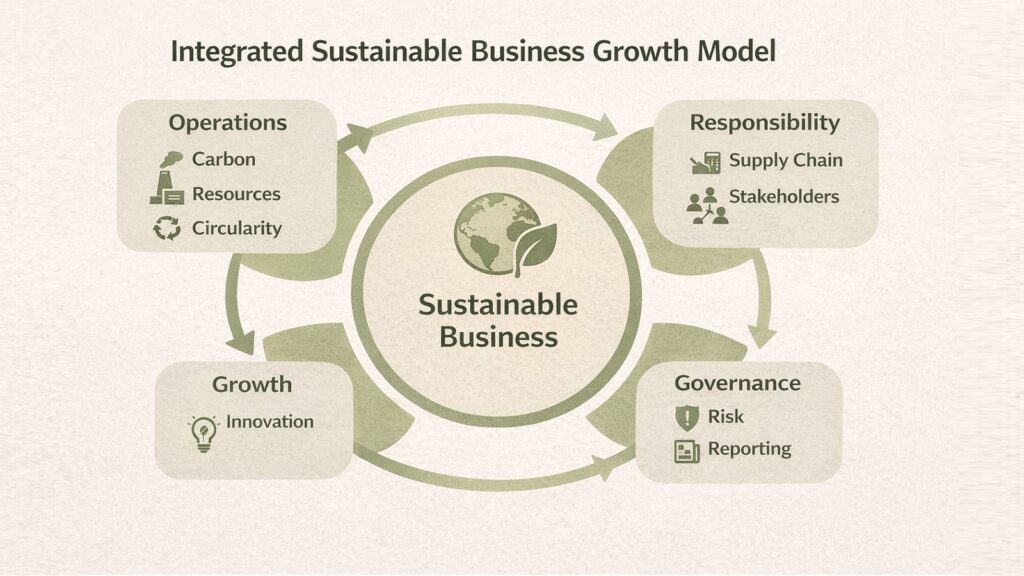
None of the eight aspects described in this article stands alone. Carbon management connects to resource efficiency. Ethical supply chains depend on stakeholder trust. Transparent reporting supports both investor confidence and climate risk awareness. Innovation draws from all the others. They are not a checklist. They are a system.
Businesses that treat sustainable practice as a system tend to build resilience that shows up when conditions change. And conditions always change. Regulations shift. Markets move. Extreme weather disrupts logistics. Consumer expectations evolve faster than product cycles. A company woven through with sustainable thinking is better positioned for each of these shifts than one that keeps sustainability at the edges.
It is also worth saying plainly that this is not easy work. It requires long-term commitment in an environment that often rewards short-term results. It requires honesty about performance when the numbers are not flattering. It requires engaging stakeholders who will push back and ask hard questions. None of that is comfortable.
But there is something steadying about it too. A business that knows why it operates the way it does, that can connect its daily decisions to a longer arc of purpose, tends to attract better people and make better decisions over time. Not every time. Not perfectly. But consistently enough to matter.
The companies that will endure the next several decades are not necessarily the largest or the most profitable today. They are the ones building practices that hold up under scrutiny, that create genuine value for the people around them, and that adapt without losing their direction. Sustainable business, understood properly, is not a constraint on that kind of company. It is a description of one.
Table 10: Sustainable Business — 8 Aspects and Their Long-Term Value
| Aspect | Long-Term Business Value |
| Carbon Management | Reduces regulatory exposure and energy costs while improving carbon competitiveness |
| Circular Economy | Lowers raw material dependency and creates new revenue through reuse models |
| Resource Efficiency | Cuts operating costs and reduces vulnerability to resource price volatility |
| Ethical Supply Chain | Reduces reputational and operational risk from supplier failures or scandals |
| Stakeholder Engagement | Builds trust that supports talent retention, customer loyalty, and investor confidence |
| Climate Risk Awareness | Enables proactive adaptation to physical and policy-driven disruptions |
| Transparent Reporting | Establishes credibility with investors and regulators, reducing cost of capital |
| Innovation for Growth | Positions the business to benefit from the transition to a lower-carbon economy |