Table of Contents
Introduction: Chaos vs Order – Why Stories Are Built on a Living Balance
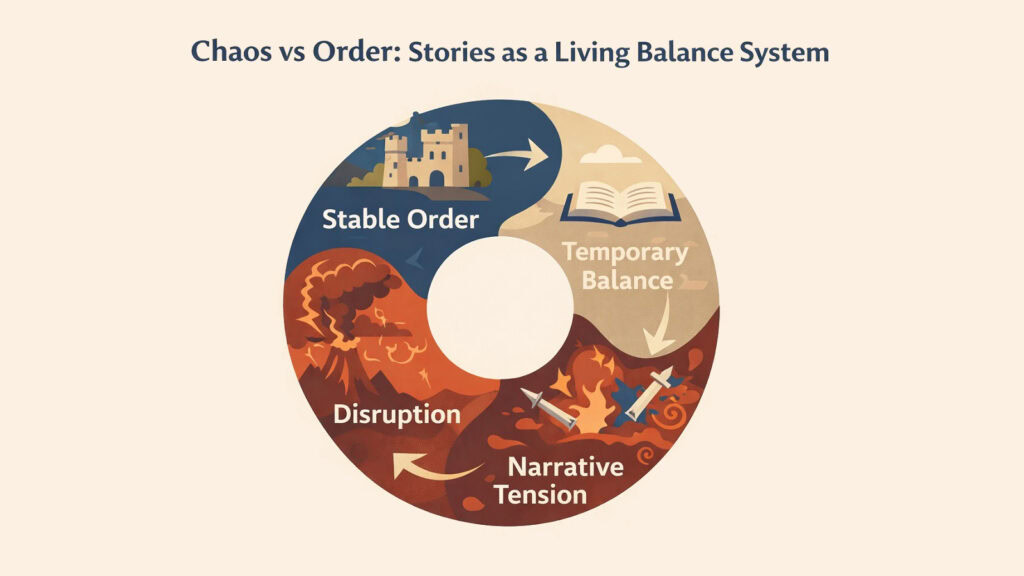
Stories exist because balance never lasts. The tension between Chaos vs Order is not a simple battle where one side wins and the other loses. It operates as something more fundamental, more alive. This tension shapes every plot twist that pulls us forward, every character who struggles between competing desires, and every ending that leaves us thinking long after the final page. When we talk about Chaos vs Order in storytelling, we are talking about the reason narratives move at all.
Perfect order creates a world where nothing happens. Complete chaos creates a world where nothing makes sense. Stories live in the space between these extremes, where equilibrium exists only to be disturbed. Chaos vs Order is not about defeating one force to establish the other. It is about recognizing that every moment of stability contains the seeds of disruption, and every moment of disruption seeks some form of pattern. This dynamic is what makes stories feel true to lived experience.
Across literature and narrative forms, Chaos vs Order appears in six recurring patterns. These patterns show how storytelling uses this tension to trigger action, sustain conflict, develop characters, complicate morality, build worlds, and shape endings. Understanding these patterns reveals why certain stories feel urgent, why others feel rich with ambiguity, and why the best endings rarely tie everything into a perfect bow. Each pattern demonstrates that Chaos vs Order is not something stories resolve but something they explore, test, and reveal.
Chaos vs Order Compared to Other Storytelling Themes
| Storytelling Themes | Core Function in Storytelling |
|---|---|
| Chaos vs Order | Creates narrative motion through unstable equilibrium and ongoing adjustment between structure and disruption |
| Love and Loss | Explores emotional vulnerability and the cost of connection through attachment and separation |
| Survival | Tests characters against extreme circumstances to reveal core values and primal drives |
| Good vs Evil | Establishes moral stakes through opposition between altruism and harm or corruption |
| Power and Corruption | Examines how authority changes those who hold it and challenges systems of control |
| Destiny vs Choice | Questions agency by contrasting predetermined paths with individual decision-making |
| Redemption and Forgiveness | Traces moral transformation through acknowledgment of harm and possibility of restoration |
| Sacrifice vs Duty | Weighs personal cost against obligation to explore what characters owe to others versus themselves |
1. Chaos vs Order as the Trigger That Starts Stories
Stories begin when something tilts. A murder disrupts a peaceful town. A letter arrives with unexpected news. A character makes a choice that cannot be undone. These moments are not random events but deliberate disruptions of equilibrium. The inciting incident in any narrative marks the moment when Chaos vs Order becomes unstable, and that instability demands a response. Without this tilt, there is no story because there is nothing to resolve, nothing to pursue, nothing to restore or reimagine.
Consider the opening of many classic narratives. In crime fiction, order exists as routine until a crime introduces chaos. In fantasy, a stable kingdom faces invasion or internal betrayal. In domestic drama, a family maintains its patterns until a secret surfaces or a relationship fractures. The pattern repeats because it reflects a truth about narrative motion: stories cannot begin in perfect balance. Perfect order is stasis. It may be peaceful, but it offers no tension, no questions, no stakes. Similarly, complete chaos offers no context for meaning. Events without pattern become noise rather than a story.
The inciting incident does not merely add a problem to solve. It reveals that the apparent order was always fragile, always built on assumptions or structures that could not hold indefinitely. A detective’s investigation begins when a body is found, but what the story explores is not just who committed the crime but what illusions of safety or certainty the crime has shattered. The same principle applies in stories of personal transformation, where a character’s carefully constructed life unravels when they encounter something that does not fit their understanding of the world.
This pattern explains why stories resist beginning in medias res without context. Even when a narrative opens in the middle of action, it quickly establishes what normal looked like before it broke. The reader needs to understand the equilibrium to feel the weight of its loss. Chaos vs Order as a storytelling trigger works because it mirrors how we experience change in our own lives. We notice when patterns shift. We feel when routines fail. Stories begin by making that shift undeniable.
Chaos vs Order as Narrative Triggers in Classic Stories
| Story Element | How Chaos vs Order Creates the Inciting Incident |
|---|---|
| Crime and Mystery | Murder or theft shatters social order and demands investigation to restore coherence |
| Epic Fantasy | Invasion or prophecy disrupts established kingdoms and forces heroes into motion |
| Coming-of-Age | Adolescence introduces internal chaos that challenges childhood structures and parental authority |
| Disaster Narratives | Natural or man-made catastrophe destroys systems and survivors must navigate absence of structure |
| Love Stories | Meeting the romantic interest disrupts emotional equilibrium and forces characters to choose |
| Revolution Plots | Oppression builds until a single event ignites widespread chaos that challenges ruling order |
2. Chaos vs Order as a Constant Correction, Not a Final Victory
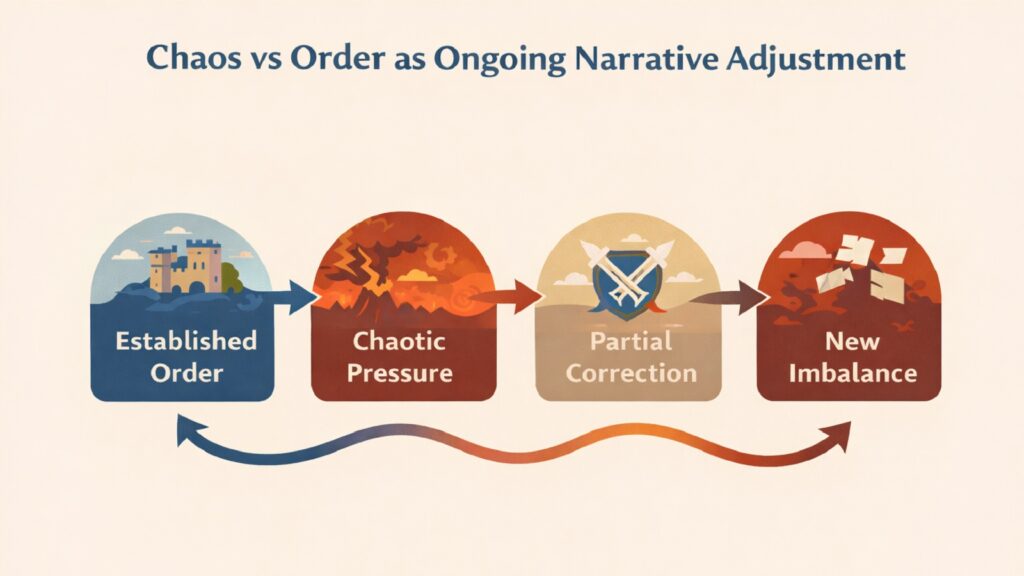
Stories do not move toward the elimination of chaos or the establishment of permanent order. They move through a series of adjustments, each one attempting to restore balance, only to encounter new complications. This pattern is why rising action feels like escalation rather than simple repetition. Each complication represents another tilt in the Chaos vs Order dynamic, and each response creates conditions for the next disruption. The tension persists because equilibrium is always temporary.
In traditional story structure, rising action builds through complications that prevent easy resolution. A character pursues a goal but encounters obstacles. Those obstacles are not arbitrary. They emerge from the world’s resistance to change or from the unintended consequences of previous actions. When a detective gathers evidence, the investigation disturbs people who want secrets kept. When a revolutionary challenges authority, the system adapts and retaliates. When a character tries to change their life, old patterns reassert themselves through habit or relationship. Each of these complications shows Chaos vs Order in motion.
What makes this pattern essential is that it prevents narrative stasis. If a single action could restore balance, the story would end immediately. But because every correction introduces new variables, the narrative continues. A hero defeats one enemy only to discover a larger conspiracy. A couple resolves one conflict only to face a deeper incompatibility. A society establishes new laws only to find that enforcement creates different injustices. The pattern holds across genres because it reflects how change actually works in complex systems.
This ongoing correction also creates the sense of momentum that distinguishes engaging stories from tedious ones. Each adjustment raises the stakes because the characters cannot simply return to the initial equilibrium. The world has changed. They have changed. The order they might restore at the story’s end will not be the same order that existed at the beginning. This is why sequels and series often feel forced when they try to repeat the original tension. The balance has shifted. New forms of Chaos vs Order emerge from what was resolved before.
The pattern teaches us that storytelling mirrors life in its refusal of permanent solutions. We do not solve problems once and then finish. We adjust, adapt, and encounter new challenges born from our previous choices. Stories that embrace this reality feel honest. They acknowledge that Chaos vs Order is not a war to be won but a dynamic to be navigated, again and again, with each navigation changing the terrain for the next.
Chaos vs Order as Ongoing Adjustment in Story Structure
| Narrative Stage | How Chaos vs Order Drives Continued Tension |
|---|---|
| Rising Action | Each attempt to restore order creates unintended consequences that reintroduce chaos |
| Midpoint Reversal | What seemed like progress reveals deeper disorder or a misunderstanding of the true problem |
| Complications | External systems resist change while internal doubts undermine character commitment |
| False Victory | Temporary success feels hollow because underlying tensions remain unaddressed |
| Dark Night | Total loss of control forces characters to abandon failed strategies for managing chaos |
| Climax Preparation | Final confrontation requires accepting that perfect order is impossible and balance is choice |
3. Chaos vs Order Inside Characters, Not Just the World
The most compelling characters embody Chaos vs Order as internal conflict. They want contradictory things. They hold values that cannot coexist without compromise. They fear both the rigidity of control and the vulnerability of surrender. Character arcs emerge from these internal tensions, as protagonists attempt to reconcile competing aspects of themselves. This inward focus shifts Chaos vs Order from backdrop to lived experience, making this narrative theme personal rather than abstract.
Consider characters who crave freedom but fear abandonment. They want the chaos of possibility but also the order of belonging. Or consider characters who maintain strict routines to manage trauma, only to discover that their protective structures have become prisons. These internal dynamics create the richest character development because they cannot be resolved through external action alone. A character might defeat the villain, win the love interest, or achieve their stated goal while still struggling with the Chaos vs Order inside them.
This pattern appears clearly in stories of personal transformation. A rigid character learns to embrace spontaneity. An impulsive character learns discipline. But the learning is never a complete replacement of one trait with another. It is integration, adjustment, and acceptance of complexity. The character who has lived by rules discovers that some rules strangle life. The character who has resisted all structure discovers that some structure enables rather than constrains. Both characters are learning to live with Chaos vs Order rather than choosing one absolutely.
Internal conflict also explains why characters make choices that readers find frustrating but psychologically true. A character might return to a destructive relationship because the chaos feels more familiar than the uncertainty of change. Another might sabotage a good opportunity because success threatens their identity as an outsider. These choices reflect the reality that people often choose known disorder over unknown order, or vice versa, not because they are self-destructive but because navigating Chaos vs Order internally is genuinely difficult.
The power of this pattern lies in its universality. Readers recognize themselves in characters wrestling with internal contradictions. We all contain multitudes. We all negotiate between structure and freedom, control and surrender, safety and growth. When stories explore Chaos vs Order as something inside characters rather than just around them, they become mirrors that help us see our own struggles more clearly.
Chaos vs Order as Internal Character Conflict
| Character Type | Internal Chaos vs Order Tension |
|---|---|
| Controlled Perfectionist | Fears that relaxing standards will lead to complete loss of self while rigid order suffocates authenticity |
| Traumatized Survivor | Uses chaos as protection against vulnerability while craving stability they cannot trust |
| Reluctant Leader | Resists authority’s structure because it contradicts personal freedom but recognizes need for coordination |
| Rebel Without Cause | Defines identity through opposition to order but lacks purpose when external structures collapse |
| Dutiful Child | Maintains family expectations to preserve connection while personal desires create internal rebellion |
| Reformed Criminal | Has integrated into lawful society but feels vital parts of self were left behind with old chaos |
4. Chaos vs Order and the Shape of Moral Ambiguity
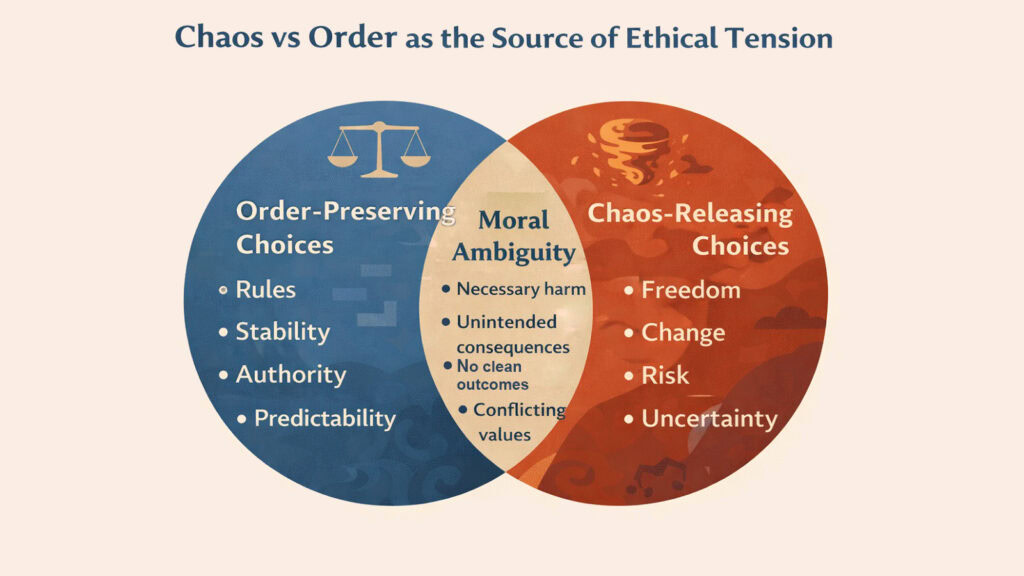
Stories become morally complex when Chaos vs Order cannot be cleanly separated into good and evil. Often, establishing one form of order requires unleashing another form of chaos. Preserving peace might demand sacrificing justice. Enforcing the law might require ignoring mercy. Protecting the family might mean betraying the larger community. These impossible choices emerge because Chaos vs Order operates across multiple scales simultaneously, and what brings balance to one system disrupts another.
Consider the moral complexity in stories about revolution. Overthrowing tyranny introduces chaos, often violent and unpredictable. But maintaining the tyrannical order perpetuates different violence, structured and systematic. Neither choice is clean. The revolutionary must accept responsibility for the chaos their actions unleash. The loyalist must accept responsibility for the order their inaction preserves. The story does not tell us which choice is right. It shows us that both choices carry weight, cost, and consequence.
This pattern appears in legal dramas where following procedure might let the guilty go free, while bending rules might convict the innocent. It appears in medical stories where saving one patient might mean triaging another. It appears in family stories where protecting a child’s innocence might mean lying about painful truths. In each case, the moral tension arises because order and chaos are not opposing forces but different arrangements of the same elements, and choosing between them means accepting trade-offs rather than achieving righteousness.
The pattern also explains why antagonists in sophisticated stories are not simply agents of chaos. They often represent a different vision of order, one that the protagonist finds unacceptable but that has its own internal logic. The antagonist who seeks control through surveillance believes they are preventing chaos. The antagonist who seeks freedom through destruction believes they are eliminating corrupt order. The conflict is not good versus evil but competing frameworks for managing Chaos vs Order, each with its own moral reasoning and blind spots.
This moral ambiguity feels truer to lived experience than simple binaries. Real ethical choices rarely pit absolute good against absolute evil. They pit competing goods, conflicting duties, and incompatible values. Stories that embrace Chaos vs Order as a source of moral complexity honor this reality. They do not offer easy answers but show us the full weight of difficult choices, trusting readers to engage with nuance rather than demanding certainty.
Chaos vs Order: Creating Moral Ambiguity in Narratives
| Narrative Situation | How Chaos vs Order Complicates Morality |
|---|---|
| Revolutionary Justice | Violence against oppressors creates chaos but preserving tyranny maintains structured harm |
| Vigilante Action | Individual enforcement of justice bypasses corrupt systems but undermines rule of law |
| Protective Lies | Deception maintains emotional order for loved ones but truth’s chaos might enable growth |
| Necessary Sacrifice | Killing one to save many follows utilitarian order but violates moral absolutes about life |
| Systemic Reform | Gradual change preserves stability but prolongs suffering under unjust order |
| Merciful Exception | Bending rules for compassion introduces unpredictability but rigid order can be inhumane |
5. Chaos vs Order as the Engine of Worldbuilding
Fictional worlds become believable through how they manage Chaos vs Order. Laws, traditions, magic systems, religions, technologies, and social hierarchies all represent attempts to impose structure on existence. But every system contains cracks, contradictions, or points of stress where chaos reasserts itself. These cracks drive large-scale conflict and give stories their sense of depth. A world feels real when we can see both the order it tries to maintain and the chaos pushing against that order.
In fantasy worldbuilding, magic systems often function as structured chaos. Magic introduces possibilities that defy normal causation, but most fantasy narratives impose rules that contain and channel that power. Wizards study for years. Spells require specific components. Magic use costs the user something. These limitations turn pure chaos into managed order. The story then explores what happens when those constraints break down, when forbidden magic is used, when the rules prove insufficient to the threat. The tension between magic’s potential and its regulation drives conflict.
Political worldbuilding works similarly. A society’s laws reveal what it fears and what it values. Harsh penalties for minor crimes suggest a culture desperate to maintain control. Elaborate bureaucracies suggest mistrust of individual judgment. Rigid hierarchies suggest the belief that chaos emerges from equality. But no system perfectly contains what it fears. Crime persists. Corruption spreads. Revolutions ignite. The gap between the official order and lived reality becomes the space where stories happen.
Even in realistic fiction, worldbuilding involves showing how systems manage chaos. A dysfunctional family maintains a facade of normalcy through unspoken rules about what can be discussed. A corporate culture enforces conformity through subtle social pressure. A small town preserves tradition by ostracizing those who challenge norms. These invisible structures feel as solid as fantasy magic systems until something tests them. Then the artificiality becomes visible, and the story explores what happens when characters must choose between maintaining comfortable fiction and facing the uncomfortable truth.
This pattern reminds us that worldbuilding is not just description but tension. A richly built world shows us order trying to hold, chaos finding cracks, and the energy generated by that friction. The worlds that feel most alive are those where we can sense both the weight of structure and the pressure of everything that structure excludes or suppresses.
Chaos vs Order: Shaping Fictional World Systems
| World System | How Chaos vs Order Creates Worldbuilding Depth |
|---|---|
| Magic Systems | Rules contain supernatural chaos but forbidden knowledge or desperate need breaks containment |
| Legal Codes | Laws impose uniform order but enforcement reveals bias and exceptions undermine authority |
| Social Hierarchies | Rigid class structures prevent mobility’s chaos but inequality breeds resentment and revolution |
| Religious Doctrine | Sacred texts provide moral order but interpretation disputes and heresy introduce theological chaos |
| Technology Regulation | Innovation control prevents disruption but restrictions create black markets and underground development |
| Cultural Traditions | Rituals preserve continuity against change but evolving needs make traditions oppressive or irrelevant |
6. Chaos vs Order in Endings That Refuse Perfect Closure
Satisfying endings rarely restore complete equilibrium. The best conclusions acknowledge that while immediate conflict may be resolved, the tension between Chaos vs Order continues. This pattern explains why modern storytelling increasingly favors ambiguous endings over neat resolutions. Perfect closure feels false because it suggests that balance, once achieved, can be permanent. Partial order feels truthful because it mirrors how we actually experience the end of chapters in our own lives.
Consider how many beloved stories end with qualified victories. The hero survives but loses something precious along the way. The lovers unite but face an uncertain future. The villain is defeated, but their ideology lingers. These endings work because they honor what the story has explored about Chaos vs Order. They do not pretend that one climactic action can permanently resolve tensions that have been building throughout the narrative. Instead, they show characters arriving at a new relationship with chaos and order, one that feels workable even if imperfect.
This pattern also explains the effectiveness of epilogues that show time passing. Years later, we see that the characters have built lives that incorporate both structure and spontaneity, both safety and risk. The specific crisis that drove the plot has ended, but the underlying dynamic between Chaos vs Order continues in different forms. A character who learned to embrace uncertainty still craves stability sometimes. A character who discovered the value of structure still feels confined by it occasionally. The growth is real but not absolute.
Endings that leave some Chaos vs Order tension unresolved also respect the reader. They trust us to sit with ambiguity rather than demanding simple answers. They acknowledge that stories are not instruction manuals but explorations, and that exploration does not require a destination as much as it requires honest observation. When a story ends without resolving every thread, it invites us to continue thinking about the tensions it has raised, to apply its insights to our own navigation of chaos and order.
The pattern connects to why sequels often disappoint. If the original story ended with a genuine but partial resolution, a sequel that introduces entirely new chaos can feel forced. But if the original story ended with a false perfect resolution, a sequel must undo that closure to create a new story, which undermines the first ending. The strongest serialized narratives maintain Chaos vs Order tension across installments without pretending any single resolution is final.
Chaos vs Order in Story Endings and Closure
| Ending Type | How Chaos vs Order Remains Present |
|---|---|
| Bittersweet Victory | Hero achieves goal but personal cost or sacrifice leaves emotional disorder unhealed |
| Ambiguous Resolution | Immediate threat ends but systemic problems or character flaws remain partially unaddressed |
| Cyclical Conclusion | Story ends where it began suggesting pattern will repeat with new characters or generations |
| Open Questions | Central plot resolves but secondary conflicts or moral ambiguities are left for reader interpretation |
| Pyrrhic Success | Order is restored through such destruction that the peace feels fragile and haunted by loss |
| New Equilibrium | Characters accept imperfect balance rather than achieving ideal state they originally sought |
Conclusion: Chaos vs Order – Why Stories End but the Tension Never Does
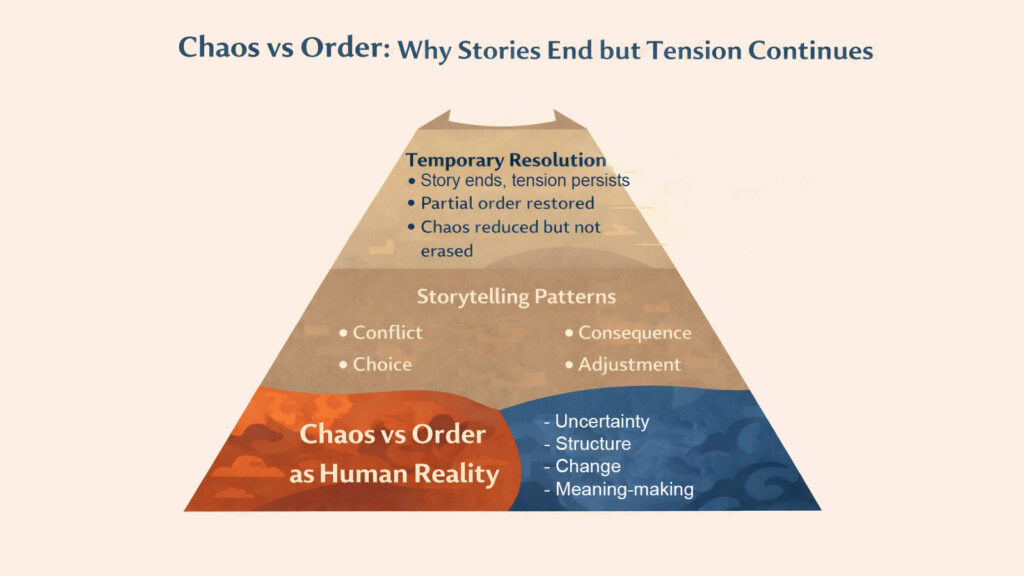
The six patterns explored here converge on a single insight: Chaos vs Order is not something stories solve but something they reveal. Stories begin when this tension becomes unstable, develop through ongoing adjustments between extremes, deepen by locating the tension inside characters, complicate through moral ambiguity, expand by showing how worlds manage the dynamic, and conclude by acknowledging that resolution is always partial.
Stories mirror human experience precisely because balance is always temporary in lived life. We build routines that eventually constrain us. We seek freedom that eventually overwhelms us. This oscillation does not represent failure. It represents being human in a world that is itself constantly adjusting between structure and flux.
The lasting power of stories comes from their honest engagement with this reality. When we read or watch or hear a story that truly moves us, we are often recognizing something we have felt but not named. We see characters struggling with the same tensions we struggle with. We watch them make choices between competing goods, between different visions of what balance might look like.
Chaos vs Order as a storytelling theme matters because it is both universal and personal. Every culture has stories about creation emerging from primordial chaos, about laws being established to govern society, and about individuals caught between duty and desire. But each story particularizes these tensions, showing us specific characters in specific circumstances making specific choices about how to navigate between structure and spontaneity.
Stories end because narratives require shape and limit. But the tension between Chaos vs Order never fully resolves because it is the engine of existence itself. Stories that honor this truth stay with us long after we have finished reading them. They continue to generate meaning, to raise new questions, to reveal new dimensions of the human experience each time we return to them. This is why Chaos vs Order remains one of the most important storytelling themes across all literature and narrative forms.
Chaos vs Order Across Storytelling Elements
| Story Element | Ongoing Presence of Chaos vs Order Tension |
|---|---|
| Character Development | Development integrates opposing traits rather than eliminating unwanted aspects completely |
| Plot Progression | Resolution of central narrative conflict creates conditions for future tensions even if not shown |
| Thematic Depth | Multiple interpretations remain valid because no single reading fully resolves ambiguity |
| Reader Impact | Stories continue generating insight after ending because tension reflects universal human experience |
| Genre Evolution | New narrative forms emerge from challenging previous era’s assumptions about proper balance |
| Cultural Resonance | Different societies emphasize different aspects revealing values about structure versus freedom |