Table of Contents
Introduction: Destiny vs Choice – Why This Storytelling Theme Shapes Stories Across Cultures
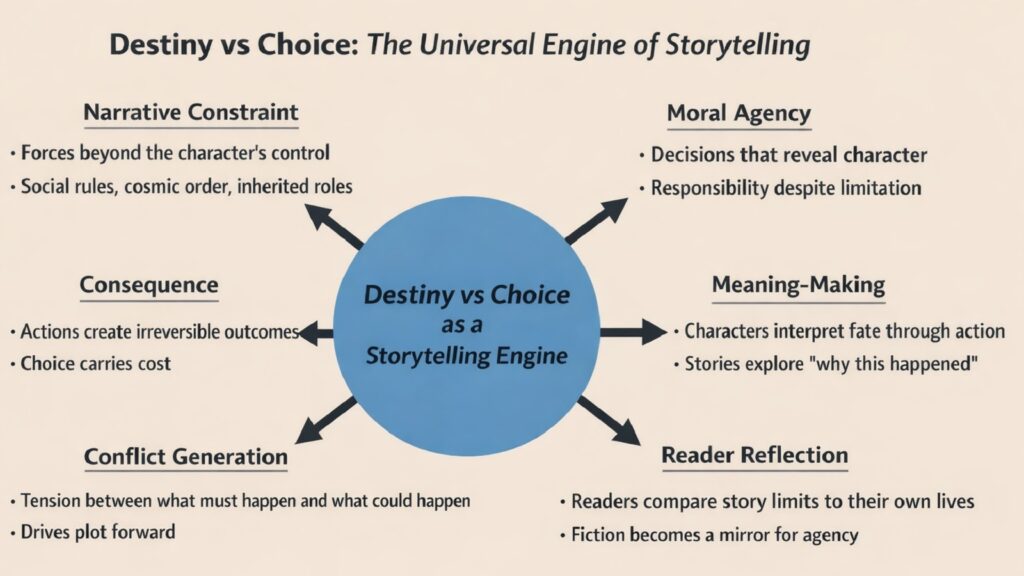
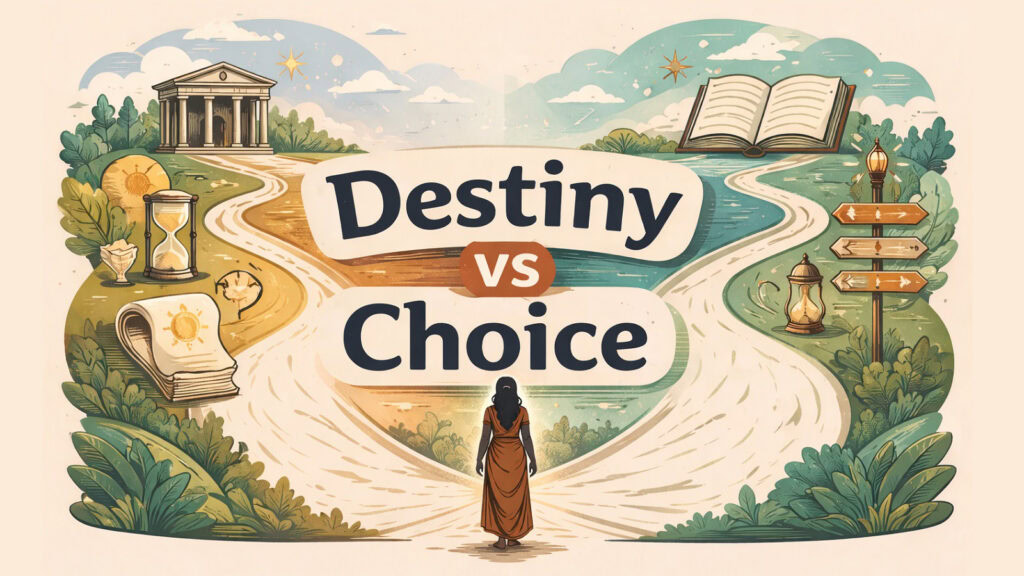
Stories need tension to live. Without conflict between what must happen and what could happen, narrative collapses into mere chronicle. Destiny vs Choice stands as one of the most enduring storytelling themes because it asks a question that never loses its edge: how much power do we really have over our lives? This tension appears in every culture that tells stories because it maps directly onto human experience. We feel the weight of circumstances we did not choose while simultaneously believing our decisions matter.
What makes Destiny vs Choice effective as a narrative engine is its refusal to offer easy answers. Stories exploring this theme rarely resolve whether fate or free will wins. Instead, they use the friction between these forces to reveal character, build suspense, and test moral boundaries. A character facing inevitable outcomes still makes choices that define who they are. A character with apparent freedom discovers hidden constraints shaping every decision.
This article examines six distinct storytelling traditions, each interpreting Destiny vs Choice through its own cultural lens. Greek tragedy shows us fate as an inescapable punishment. Indian epics frame it as a duty meeting karma. East Asian classics present it as harmony versus discord. African oral traditions root it in community bonds. South American literature embeds it in historical cycles. Modern global fiction transforms it into systemic oppression. Each tradition uses Destiny vs Choice differently, but all recognize its power to expose how humans understand responsibility, freedom, and meaning.
Destiny vs Choice Compared to Other Major Storytelling Themes
| Storytelling Themes | How It Differs from Destiny vs Choice |
|---|---|
| Destiny vs Choice | Centers on whether human actions meaningfully shape outcomes or merely fulfill an unavoidable path, keeping agency and inevitability in constant tension |
| Survival | Focuses on immediate physical threats rather than philosophical tension between predetermined fate and personal agency |
| Good vs. Evil | Centers on moral absolutes and external opposition instead of internal conflict between what is fated and what can be chosen |
| Power and Corruption | Examines how authority degrades character over time, not whether outcomes are predetermined or deliberately chosen |
| Love and Loss | Explores emotional arc and grief without questioning whether relationships are destined or freely chosen |
| Redemption and Forgiveness | Deals with moral recovery and second chances rather than whether past actions were inevitable or controllable |
| Chaos vs. Order | Addresses structural stability versus disruption without interrogating individual agency within predetermined circumstances |
| Sacrifice vs. Duty | Highlights cost of obligation without always questioning whether those obligations are chosen or imposed by fate |
1. Destiny vs Choice in Greek Tragedy: When Fate Condemns Action
Greek tragedy operates on a brutal principle: the outcome is already written, but the characters do not know it yet. This creates dramatic irony where the audience watches characters make choices that feel free but lead exactly where prophecy said they would go. Destiny vs Choice here does not mean characters lack agency. It means their agency becomes the instrument of their doom.
Consider how Oedipus receives a prophecy that he will kill his father and marry his mother. He flees to choose a different path, but that choice leads him directly to the parents he was separated from at birth. His intelligence and determination, the qualities making him a capable king, drive him toward the horror he tried to avoid. The story suggests that in his position, with his knowledge and character, those choices were inevitable.
The mechanics of Greek tragedy depend on prophecy serving as a narrative marker. The prophecy tells the audience where the story ends, allowing the playwright to focus entirely on how the character gets there. Suspense comes not from wondering what will happen but from watching the character realize what they have already done. By the time Oedipus discovers the truth, he has chosen every action leading to his downfall.
Greek tragedy uses Destiny vs Choice to explore moral responsibility under conditions of ignorance. Oedipus is guilty of patricide and incest, but he committed these acts without knowledge. Does that absolve him? The plays suggest it does not. This is a harsh view of the universe, one where being good with good intentions does not protect you from catastrophic consequences.
Destiny vs Choice Elements in Greek Tragic Structure
| Element | Function in Greek Tragedy |
|---|---|
| Prophecy | Establishes fated outcome early, creating dramatic irony and shifting focus to how rather than whether |
| Hamartia | The tragic flaw causing the hero to make choices fulfilling prophecy, often through strength misapplied |
| Peripeteia | The reversal where the hero discovers choices led to predicted disaster, collapsing illusion of control |
| Anagnorisis | Recognition scene where the hero understands they caused their own fate through decisions they thought were free |
| Catharsis | Audience release achieved by witnessing inevitable conclusion of flawed choices meeting predetermined fate |
| Moral Pollution | Guilt existing regardless of intent, suggesting fate operates beyond individual moral accountability |
2. Destiny vs Choice in Indian Epics: Duty, Karma, and Moral Choice
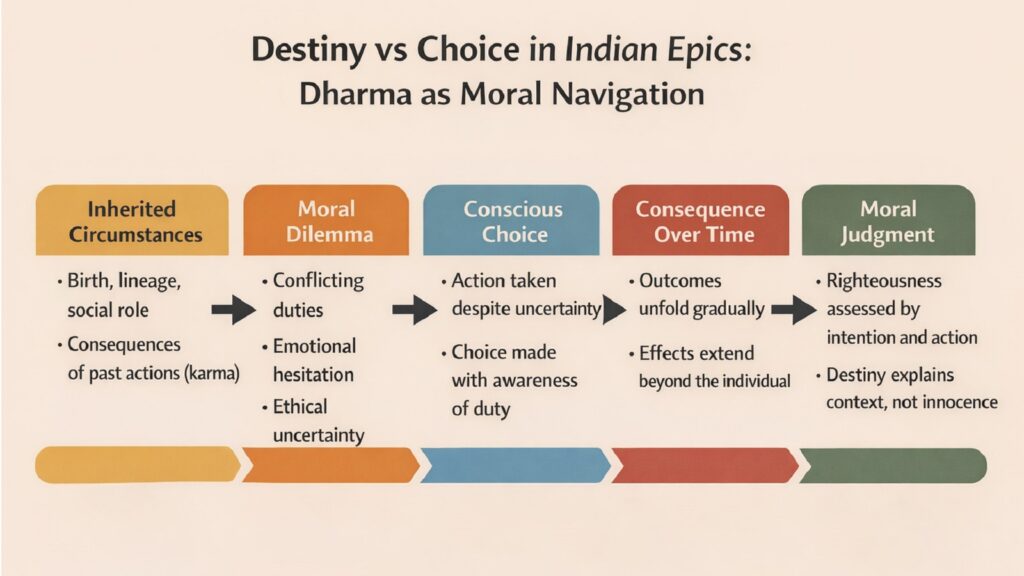
Indian epic storytelling frames Destiny vs Choice through dharma and karma, creating a structure where fate exists but righteousness determines its quality. Characters in the Mahabharata and Ramayana face predetermined roles and obligations, yet every choice generates consequences rippling across lifetimes. This is not crushing fatalism, but complex moral architecture where destiny provides circumstances and choice determines character.
The battlefield conversation between Arjuna and Krishna in the Bhagavad Gita illustrates this perfectly. Arjuna stands before an army containing relatives, teachers, and friends. His duty as a warrior demands that he fight. His compassion makes him hesitate. Krishna explains that Arjuna’s role was determined long before, but how he fulfills that role, his inner state while performing duty, remains entirely his choice.
What makes Indian epic storytelling distinct is its emphasis on long-term consequences. A single choice does not just affect the immediate situation but creates patterns persisting across generations or lifetimes. When Gandhari blindfolds herself to share her husband’s disability, that choice reflects her dharma as a wife. But it also means she cannot see her 100 sons clearly, contributing to their moral corruption and the dynasty’s destruction.
Indian epics test characters by placing them where every option violates some principle. Rama must choose between duty to his father and becoming a King. These moments reveal that destiny in Indian storytelling is not about avoiding difficult choices but about making them with full awareness of their weight.
Destiny vs Choice Framework in Indian Epic Narrative
| Narrative Element | Role in Indian Epic Storytelling |
|---|---|
| Dharma | Provides the fated role and social obligation each character must fulfill, setting stage for moral testing |
| Karma | Links past choices to present circumstances while ensuring current decisions shape future destiny |
| Ethical Dilemmas | Creates situations where duty conflicts with compassion, forcing characters to choose which principle to honor |
| Divine Guidance | Gods and sages offer counsel clarifying duty without removing the burden of choice from the character |
| Generational Consequences | Shows how choices affect descendants and future lives, extending moral responsibility across time |
| Detachment | Teaches that performing duty without attachment to outcomes allows right action within predetermined circumstances |
3. Destiny vs Choice in East Asian Classics: Harmony Over Defiance
East Asian storytelling approaches Destiny vs Choice through the lens of natural order and social balance. The tension is not between fate and freedom but between resistance and acceptance, between forcing outcomes and allowing them to unfold. Stories from Chinese, Japanese, and Korean traditions often reward characters who recognize patterns and align their choices with those patterns.
The Romance of the Three Kingdoms demonstrates this through military and political strategy. Characters who try to force outcomes against history’s momentum fail spectacularly. Those who read situations correctly and act in accordance with larger patterns succeed, at least temporarily. Liu Bei succeeds not by having more power but by understanding when to advance and when to retreat.
This creates a different narrative rhythm than Western storytelling. Instead of building toward climactic confrontation where the hero defeats fate through willpower, East Asian classics show characters achieving goals by not grasping for them directly. The Taoist principle of wu wei, or effortless action, appears repeatedly. A character who wants power too desperately loses it.
Japanese literature adds another layer through “Mono no Aware,” the poignant awareness of transience. Characters in works like The Tale of Genji make choices knowing that nothing lasts, that beauty fades, that power shifts. This awareness does not paralyze them but makes their choices more conscious and meaningful.
Destiny vs Choice Principles in East Asian Literary Tradition
| Principle | Application of Destiny vs Choice in Storytelling |
|---|---|
| Wu Wei | Characters succeed by aligning actions with natural flow rather than forcing outcomes through aggressive will |
| Harmony | Social and cosmic balance takes priority over individual triumph, making cooperation destiny and isolation choice |
| Cyclical Time | History repeats in patterns, allowing wise characters to choose when to act by recognizing cycle positions |
| Transience | Awareness that all conditions are temporary shapes choices toward acceptance rather than desperate grasping |
| Patience | Waiting for the right moment is presented as active choice rather than passive acceptance of fate |
| Self-Mastery | Internal discipline becomes primary choice, while external circumstances represent destiny one must navigate |
4. Destiny vs Choice in African Storytelling: Community as Fate
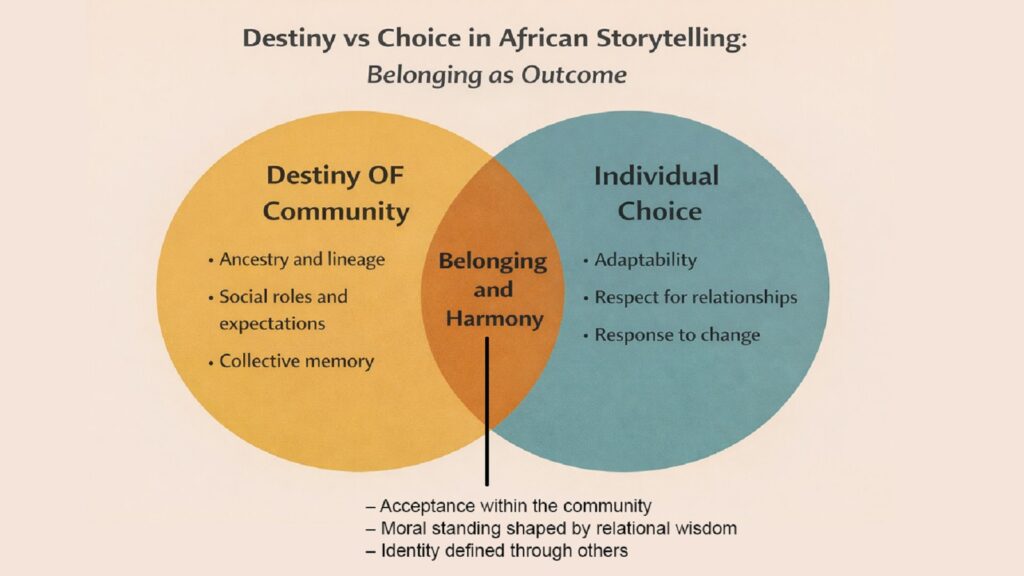
African oral traditions and written literature present Destiny vs Choice as fundamentally relational. Individual fate cannot be separated from community fate. A person’s destiny is woven into the destinies of their family, village, ancestors, and descendants. Choices are judged not by whether they assert individual freedom but by whether they strengthen or weaken social bonds.
Chinua Achebe’s Things Fall Apart shows this through Okonkwo, whose personal choices to define himself against his father’s legacy lead him away from community values. His destiny and choices become entangled in ways that harm both him and society. He makes deliberate decisions throughout, exercising clear agency, but those choices are shaped by social expectations and ancestral patterns he cannot escape.
The concept of ubuntu, the idea that a person is a person through other people, runs through many African stories. A character’s fate depends on relationships maintained or broken. Destiny means the web of obligations and connections into which a person is born. Choice means how one honors those connections or attempts to break them.
The trickster figure, common in African oral tradition, embodies a particular approach to Destiny vs Choice. Characters like Anansi or Eshu make choices disrupting established order, but these disruptions often reveal hidden truths or create necessary change. The trickster does not defeat fate but finds gaps in it, using cleverness to navigate around seemingly fixed outcomes.
Destiny vs Choice Dynamics in African Narrative Forms
| Narrative Dynamic | Destiny vs Choice in African Storytelling |
|---|---|
| Ubuntu | Individual fate cannot exist apart from community fate, making social harmony both destiny and moral imperative |
| Ancestral Authority | Past generations shape present circumstances, making heritage a form of destiny that demands respectful choices |
| Oral Tradition | Stories adapt with each telling, suggesting destiny itself has flexibility depending on who tells and who listens |
| Trickster Wisdom | Cleverness allows navigation around rigid fate, showing creative choices can find space within constraints |
| Proverbs | Condensed wisdom about fate and choice gets embedded in dialogue, guiding characters toward valued decisions |
| Collective Consequences | One person’s choices affect entire communities, making personal agency inseparable from social responsibility |
5. Destiny vs Choice in South American Literature: History as Fate
South American literature treats Destiny vs Choice as embedded in historical cycles that repeat with variations. Characters make choices that feel individual but mirror patterns established generations earlier. The narrative technique that Gabriel Garcia Marquez called magical realism blurs the line between what is fated and what is chosen by suggesting that history has gravitational pull, drawing people into familiar patterns regardless of intentions.
One Hundred Years of Solitude demonstrates this through the Buendia family, whose members repeatedly make choices echoing previous generations. Names repeat. Personalities recur. Tragedy cycles through the family line with minor variations. The characters have agency and make distinct decisions, but those decisions fit into larger patterns they cannot see or escape.
This approach reflects South America’s particular historical experience of colonialism, revolution, and repetitive political cycles. The literature often shows characters trying to break historical patterns only to find themselves enacting new versions of the same story. A revolutionary who fights dictatorship becomes a dictator himself.
Writers like Isabel Allende and Jorge Luis Borges explore how personal destiny intersects with national destiny. A character’s family history runs parallel to their country’s history, and the two cannot be separated. Political upheaval becomes personal fate. Personal choices have political consequences.
Destiny vs Choice Patterns in South American Literary Tradition
| Pattern | Narrative Function |
|---|---|
| Generational Repetition | Names, traits, and events recur across family lines, suggesting fate operates through bloodlines and memory |
| Magical Realism | Blending supernatural and mundane makes it unclear whether events are caused by choice or forces beyond control |
| Political Cycles | Characters watch history repeat through coups and revolutions mirroring previous generations regardless of intent |
| Prophetic Dreams | Visions of future events create ambiguity about whether destiny can be changed or only witnessed in advance |
| Family Curses | Multi-generational consequences of past choices become destiny for descendants inheriting problems they did not create |
| Historical Amnesia | Forgetting the past ensures repetition, making memory itself a form of choice that might alter predetermined patterns |
6. Destiny vs Choice in Modern Global Fiction: Fighting Invisible Systems
Modern fiction transforms Destiny vs Choice by replacing gods and fate with systems: economic structures, political institutions, technological networks, and social hierarchies. Characters in contemporary novels face destinies shaped by forces they cannot see or fully understand. They make choices within constraints that feel less like divine will and more like bureaucratic inevitability.
Franz Kafka’s work pioneered this approach, showing characters trapped in systems they cannot comprehend or escape. Joseph K in The Trial makes choices throughout the story, but every choice leads deeper into a nightmare of bureaucratic process. His destiny is not written by gods but by institutional logic operating independently of any individual’s will.
Dystopian fiction extends this by showing entire societies shaped by systemic forces. In stories like The Handmaid’s Tale or 1984, characters make small choices preserving their humanity, but the larger system continues regardless. These narratives explore what agency means when genuine structural change seems impossible.
Contemporary fiction also explores how technology becomes a form of destiny. Algorithms shape what people see, what they know, and what opportunities they encounter. Characters make choices based on information filtered and curated by processes they do not control.
Destiny vs Choice Mechanisms in Contemporary Global Storytelling
| Mechanism | Narrative Function |
|---|---|
| Institutional Systems | Bureaucracies and organizations replace divine fate as force constraining choice and determining outcomes |
| Economic Determinism | Class position and financial circumstances limit options available, making poverty a form of destiny requiring strategic choices |
| Surveillance Technology | Monitoring systems track and predict behavior, turning past choices into data that shapes future possibilities |
| Algorithmic Curation | Digital systems filter information and opportunities based on patterns, creating invisible destinies through code |
| Social Reproduction | Educational and professional structures perpetuate inequality across generations regardless of individual merit |
| Systemic Resistance | Small acts of defiance preserve agency without changing structures, redefining meaningful choice as internal rather than external |
Conclusion: Destiny vs Choice – Why Stories Never Resolve the Conflict
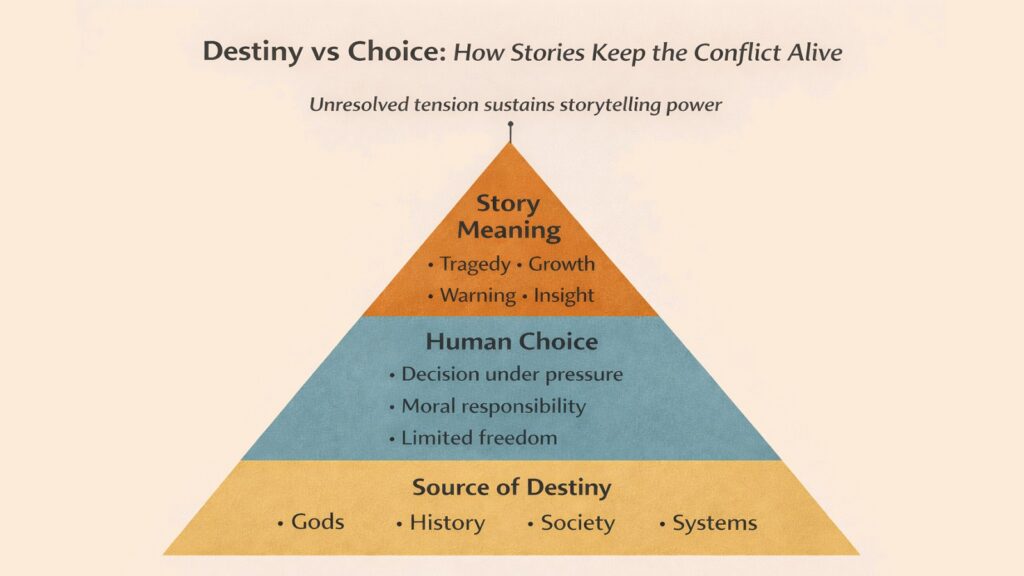
The six traditions examined here approach Destiny vs Choice from different angles, using different cultural vocabularies and narrative techniques, but they share a fundamental insight: stories do not resolve this tension because it cannot be resolved. The power of the theme comes from its persistent ambiguity. Every attempt to prove that fate determines everything or that choice controls everything falls apart when examined closely.
What changes across traditions is not whether Destiny vs Choice exists, but where destiny is located. Greek tragedy places it in cosmic forces and prophecy. Indian epics embed it in moral law and karmic consequence. East Asian literature finds it in natural patterns and social harmony. African storytelling roots it in community and ancestry. South American fiction sees it in historical cycles. Modern global writing locates it in systems and structures. The source changes, but the tension remains.
This adaptability explains why Destiny vs Choice survives as a storytelling theme. It is flexible enough to accommodate different worldviews while maintaining its essential structure. A character faces circumstances they did not choose and makes decisions within those circumstances. The story explores how much those decisions matter and what it means to act rightly when outcomes may already be determined.
Stories that explore Destiny vs Choice also tend to be stories about responsibility. If everything is fated, no one is responsible for anything. If everything is chosen, responsibility becomes overwhelming. Most stories stake out a middle position: characters are responsible for their choices even when those choices operate within severe constraints.
The reason stories never resolve the conflict is that resolution would kill the dramatic potential. Once you establish definitively that destiny wins or choice wins, there is no more tension. The richness comes from keeping both possibilities alive, from showing characters who might be fulfilling prophecy or might be writing their own story.
Readers return to stories about Destiny vs Choice because they mirror the uncertainty of lived experience. We cannot know how much of our lives was determined before we arrived and how much we are creating through our decisions. Stories let us explore that suspense in a contained space where the stakes are high, but the consequences are fictional.
Destiny vs Choice Across Six Global Storytelling Traditions
| Tradition | How Destiny vs Choice Operates |
|---|---|
| Greek Tragedy | Divine prophecy creates inevitable outcomes while moral choices accelerate doom rather than prevent it |
| Indian Epics | Dharma establishes duty as destiny while karma ensures choices shape future circumstances across lifetimes |
| East Asian Classics | Natural patterns represent destiny while wise choices align with flow rather than resist cosmic order |
| African Storytelling | Community bonds and ancestral authority create collective destiny while choices strengthen or weaken social fabric |
| South American Literature | Historical cycles repeat across generations while individual choices add new variations to inherited patterns |
| Modern Global Fiction | Systemic forces constrain options while small acts of resistance preserve internal agency despite external limits |