Table of Contents
Introduction: Four Act Structure as the Foundation of Inspired Stories
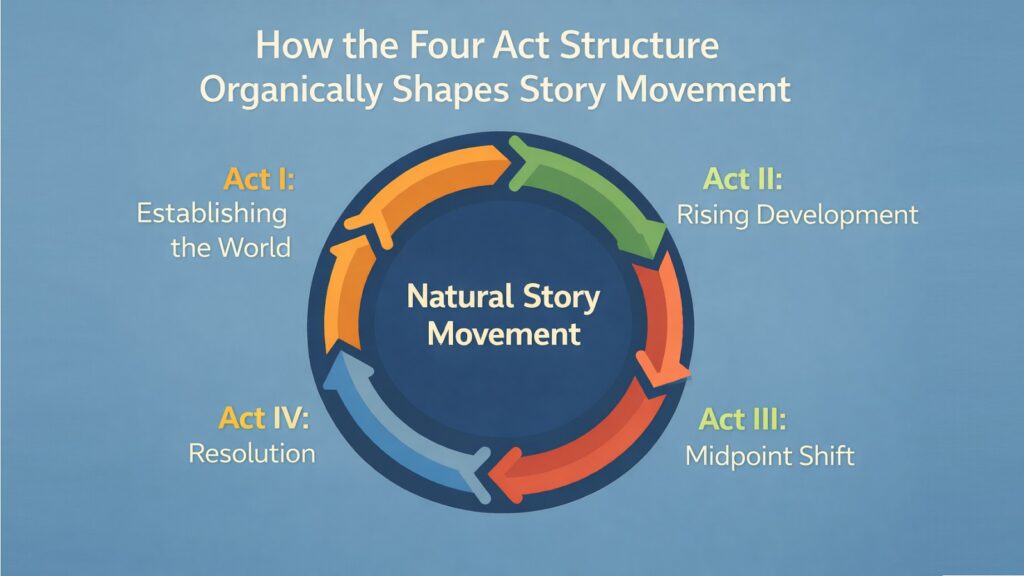
Stories breathe through movement. They rise and fall, shift and settle, carrying us from one emotional state to another. The Four Act Structure represents one of the most important narrative structures because it mirrors how meaning unfolds naturally in human experience. Unlike arbitrary divisions, this framework reflects the organic rhythm of change itself.
At its core, the Four Act Structure organizes narrative into four distinct movements. The first act establishes the world and introduces conflict. The second act develops complications and builds toward a critical turning point. The third act explores consequences and intensifies stakes. The fourth act resolves tensions and delivers meaning. Each movement serves a purpose, and together they create a complete journey.
This structure has shaped stories across centuries and cultures. From classical drama to contemporary cinema, writers have discovered that four movements provide enough space for complexity without losing coherence. The midpoint between the second and third acts becomes especially significant, marking where stories transform from setup into confrontation.
Understanding the Four Act Structure reveals how inspired stories sustain emotional depth. It shows why certain narratives feel inevitable yet surprising, why characters earn their transformations, and why resolutions satisfy even when they ache. The structure itself becomes invisible when executed well, leaving only the sensation of truth.
This article explores six powerful lessons drawn from timeless and modern storytelling. Each lesson illuminates how the Four Act Structure functions as both blueprint and breathing organism. By examining the midpoint shift, natural pacing, character evolution, classical roots, modern applications, and practical craft, we discover what makes stories endure.
Four Act Structure Compared with Other Narrative Frameworks
| Narrative Structures | Core Organizing Principle |
|---|---|
| Four Act Structure | Four distinct movements with midpoint as transformation hinge |
| Three Act Structure | Setup, confrontation, resolution in three-part progression |
| Five Act Structure (Freytag’s Pyramid) | Exposition, rising action, climax, falling action, denouement |
| Kishōtenketsu | Introduction, development, twist, and reconciliation without conflict emphasis |
| Dan Harmon’s Story Circle | Eight-stage circular journey based on mythic structure |
| Non-linear Timelines | Fragmented chronology arranged for thematic or emotional effect |
| Parallel Narratives | Multiple storylines developing simultaneously across shared themes |
| Nested Stories | Stories within stories creating layered meaning structures |
1. Four Act Structure and the Narrative Role of the Midpoint Shift
The midpoint holds extraordinary power in the Four Act Structure. It marks the moment when a story pivots from preparation into confrontation. Everything before this point builds the foundation. Everything after explores what that foundation supports or undermines. The shift feels like crossing a threshold from which no character can return unchanged.
Consider how the midpoint functions in classic literature. In Jane Austen’s Pride and Prejudice, the midpoint arrives with Darcy’s letter following his rejected proposal. Elizabeth Bennet’s entire understanding transforms. The first half established her prejudices and his pride. The second half dismantles both through consequence and revelation. The letter redirects the narrative from misunderstanding toward painful self-awareness.
Film narratives demonstrate this shift with particular clarity. In The Godfather, the midpoint occurs when Michael Corleone kills Sollozzo and McCluskey. Before this act, Michael remained separate from family criminality. Afterward, he becomes irreversibly entangled. The murder doesn’t just advance plot—it redefines character, theme, and trajectory. The story transforms from one about avoiding destiny into one about embracing it.
The midpoint shift operates differently from simple escalation. It introduces new information, perspective, or stakes that change how we understand everything preceding it. Dorothy discovers the Wizard’s deception. Luke learns Vader’s identity. Scout witnesses courtroom injustice. These moments don’t merely raise tension—they alter consciousness.
Writers working with the Four Act Structure recognize the midpoint as a narrative fulcrum. It creates symmetry without requiring mechanical balance. The first two acts ask questions and establish conditions. The final two acts answer questions and explore ramifications. The midpoint itself becomes the hinge where inquiry turns into reckoning.
Inspired stories feel intentional because their midpoints earn their weight. Nothing arbitrary marks this transition. Instead, accumulated pressure naturally forces revelation or decision. The structure supports meaning by ensuring the midpoint emerges from character and theme rather than imposed timing. When we sense a story shifting beneath us, we’re experiencing the Four Act Structure performing its essential work.
Four Act Structure Midpoint Shifts in Notable Works
| Literary or Cinematic Work | Midpoint Transformation |
|---|---|
| Pride and Prejudice | Darcy’s letter forces Elizabeth to confront her own prejudice |
| The Godfather | Michael’s murders transform him from outsider to family heir |
| The Wizard of Oz | Discovery of the Wizard’s fraud shifts quest inward |
| To Kill a Mockingbird | Trial reveals systemic injustice Scout cannot unsee |
| Casablanca | Rick’s reunion with Ilsa reopens buried emotional wounds |
| Breaking Bad | Walter White’s refusal to accept payment becomes point of no return |
2. Four Act Structure as a Framework for Natural Story Pacing
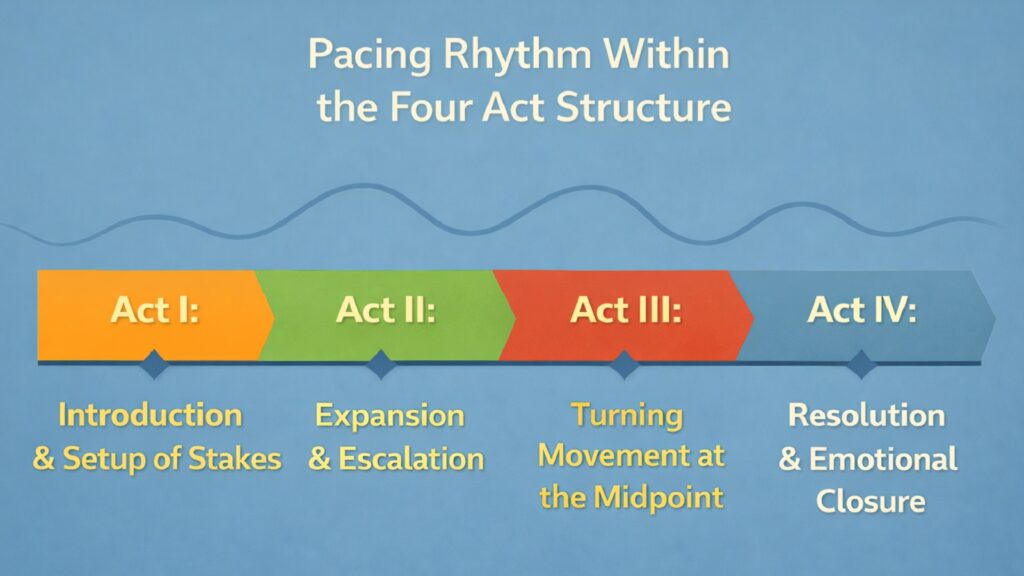
Pacing emerges from the Four Act Structure as naturally as breath follows rhythm. Each act carries distinct momentum appropriate to its narrative function. The first act introduces elements quickly enough to engage but slowly enough to establish. The second act deepens complications while building toward the midpoint shift. The third act intensifies consequences and narrows options. The fourth act releases accumulated tension while delivering earned resolution.
This distribution prevents the exhaustion of relentless escalation or the tedium of uniform progression. Stories need moments of expansion and contraction, acceleration and reflection. The Four Act Structure provides a framework for this breathing rhythm without dictating exact timing. A writer might compress Act One into swift pages or expand Act Three across extended sequences, as long as each movement fulfills its purpose.
Consider how Charles Dickens uses four-movement pacing in Great Expectations. The first act establishes Pip’s humble origins and mysterious benefactor. The second builds his London education while questioning its foundation. The midpoint reveals Magwitch as a benefactor, shattering Pip’s assumptions. The third act follows the consequences of this truth. The fourth resolves Pip’s identity beyond external expectations. Each section pulses with appropriate energy for its revelatory work.
Modern thrillers demonstrate similar structural pacing. Gillian Flynn’s Gone Girl moves through four distinct rhythms. The first act presents a missing wife and a confused husband. The second complicates their marriage through alternating perspectives. The midpoint reveals Amy’s orchestration, transforming mystery into psychological warfare. The third act escalates their deadly dance. The fourth delivers a disturbing resolution. The pacing feels breathless yet controlled because each act serves a clear purpose.
Tension and release function differently across the four movements. Act One introduces tension through questions and conflicts. Act Two increases pressure while developing complications. Act Three intensifies the stakes after the midpoint transformation. Act Four provides release through resolution, though not necessarily comfort. This pattern creates sustainable engagement because readers experience variation within progression.
The Four Act Structure prevents common pacing problems. Stories that sag in the middle often lack a strong midpoint shift, leaving Act Two and Act Three feeling indistinct. Stories that rush their endings often shortchange Act Four’s resolution work. Stories that lose readers early often fail to establish clear questions in Act One. Understanding the structure’s natural pacing reveals where narrative rhythm breaks down and how to restore it.
Four Act Structure Pacing Responsibilities
| Act Movement | Primary Pacing Function |
|---|---|
| Act One | Establish world, characters, and central questions with engaging momentum |
| Act Two | Deepen complications while building toward transformative midpoint |
| Act Three | Intensify consequences and narrow narrative possibilities after shift |
| Act Four | Release accumulated tension through earned resolution |
| Midpoint Transition | Pivot from setup into confrontation, redirecting narrative energy |
| Overall Rhythm | Create sustainable engagement through variation within progression |
3. Four Act Structure and Character Evolution Across Story Movements
Character transformation aligns with the Four Act Structure’s natural progression. People don’t change all at once. They move through stages of awareness, resistance, decision, and integration. The four-act framework provides space for this authentic development, preventing both rushed epiphanies and stagnant personalities.
Act One introduces characters in their familiar patterns. We see their beliefs, habits, fears, and desires operating within established boundaries. Elizabeth Bennet judges on first impressions. Michael Corleone maintains a separation from family crime. Pip dreams of rising above his station. These starting positions feel real because the first act doesn’t rush to dismantle them.
Act Two complicates these patterns through conflict and interaction. Characters encounter situations that challenge their assumptions without immediately breaking them. Resistance builds alongside pressure. Elizabeth defends her judgments while evidence mounts against them. Michael tries to maintain innocence while circumstances draw him deeper. This section honors how people cling to familiar identities even as those identities prove insufficient.
The midpoint shift marks where awareness crystallizes into a decision. Characters can no longer avoid what they’ve learned or ignore what they’ve become. This isn’t the final transformation but the commitment to it. Elizabeth reads Darcy’s letter and allows truth to penetrate pride. Michael pulls the trigger and accepts his path. The midpoint doesn’t complete a character change—it makes continuation impossible.
Act Three explores the consequences of decisions made at the midpoint. Characters live inside their choices, discovering what those choices demand and cost. This movement prevents transformation from feeling easy or abstract. We watch people struggle with new awareness, make mistakes despite growth, and face the ramifications of an altered perspective. The third act is where change becomes real through tested application.
Act Four integrates transformation into resolution. Characters demonstrate their evolution through final choices and understanding. They’re not identical to their starting selves, but the change feels earned through accumulated experience across all four movements. Pip accepts humble love over grand illusion. Elizabeth marries with clear eyes and an honest heart. These endings satisfy because we witnessed every step of the journey.
Inspired stories feel authentic because they honor the gradual nature of human change. The Four Act Structure prevents both instant revelation and static repetition. Characters evolve across movements, each phase building toward a transformation that feels inevitable yet hard-won. We believe the change because we experienced its cost.
Four Act Structure Character Development Stages
| Narrative Phase | Character Evolution Process |
|---|---|
| Act One | Introduction of existing beliefs, patterns, and self-concept |
| Act Two | Complication through challenges that pressure existing identity |
| Midpoint | Crystallization of awareness into decision or commitment |
| Act Three | Living consequences and discovering costs of transformation |
| Act Four | Integration of change into resolution and final choices |
| Complete Arc | Gradual development that honors authentic human change patterns |
4. Four Act Structure in Classical Literature and Dramatic Traditions
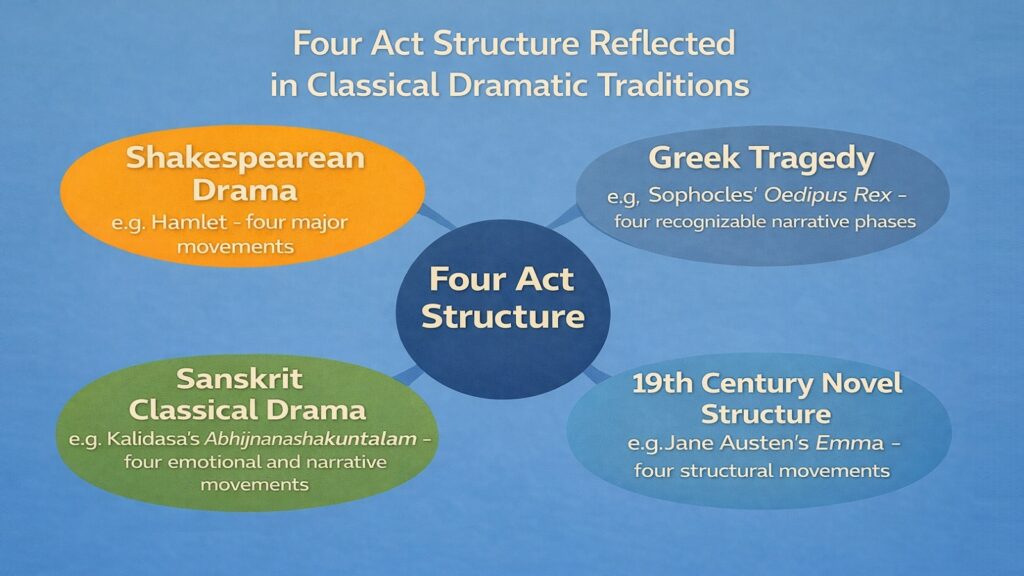
The Four Act Structure emerges from storytelling’s deep history. While scholars debate terminology, many classical works naturally organize into four distinct movements. This pattern appears across cultures and centuries, suggesting it reflects something fundamental about how narratives achieve completion and meaning.
Shakespeare’s plays demonstrate a four-movement structure even when published in five acts. Romeo and Juliet establishes the feuding families and young love in its opening movement. The second section develops their secret marriage and complications. The midpoint arrives with Mercutio’s death and Romeo’s banishment, transforming romance into tragedy. The third movement explores desperate attempts at reunion. The final section delivers a catastrophic resolution. The play breathes through these four narrative phases regardless of act divisions.
Greek tragedy often follows similar patterns. Sophocles’ Oedipus Rex begins with plague and prophecy. The investigation deepens through questioning and revelation. The midpoint occurs when Oedipus begins suspecting his own guilt. The third movement confirms the terrible truth through accumulated testimony. The final section shows Oedipus accepting consequence through self-blinding and exile. Four movements carry the narrative from mystery through horror to tragic knowledge.
Classical novels frequently employ four-part structures. Charlotte Brontë’s Jane Eyre moves through distinct phases. The first establishes Jane’s oppressed childhood and fierce spirit. The second develops her time at Thornfield and her growing love for Rochester. The midpoint reveals Bertha’s existence, shattering Jane’s hopes. The third movement follows Jane’s flight and recovery. The fourth section reunites the lovers on transformed terms. Each movement serves a clear narrative purpose while building toward emotional completion.
Epic poetry demonstrates the structure’s ancient roots. Homer’s Odyssey is organized around four major sections. The opening establishes Odysseus’s absence and Telemachus’s search. The second develops Odysseus’s wanderings and trials. The midpoint brings him to Phaeacia, where he reveals his identity and recounts his journey. The third movement chronicles his disguised return to Ithaca. The final section delivers recognition, revenge, and restoration. The four movements create satisfying symmetry across a vast narrative scope.
These classical examples strengthen the Four Act Structure’s authority as an enduring form. Writers across centuries discovered that four movements provide sufficient space for complexity while maintaining coherence. The structure serves tragedy and comedy, epic and domestic drama, verse and prose. Its persistence across tradition suggests alignment with fundamental patterns of meaning-making.
Understanding this historical depth helps contemporary writers recognize they’re working within an ancient conversation. The Four Act Structure isn’t a modern invention but a time-tested framework that has shaped narratives since stories began organizing experience into art.
Four Act Structure in Classical Literary Works
| Classical Work | Four-Movement Organization |
|---|---|
| Romeo and Juliet | Love, complication, transformation through death, tragic resolution |
| Oedipus Rex | Mystery, investigation, self-suspicion, tragic confirmation |
| Abhijnanashakuntalam (by Kalidasa) | Love and separation, curse and estrangement, recognition through revelation, emotional restoration |
| The Odyssey | Absence, wandering, revelation and return, restoration |
| Hamlet | Ghost and duty, complication and delay, action and consequence, tragic completion |
| Paradise Lost | Fall setup, temptation development, catastrophe, expulsion and hope |
5. Four Act Structure in Modern Storytelling and Visual Narratives
Contemporary storytelling continues to discover the Four Act Structure’s utility. Modern films, television series, and novels employ four-movement organization to achieve narrative clarity and emotional depth. The structure adapts smoothly to current needs without losing its essential character.
Cinema demonstrates the framework with particular visibility. The Shawshank Redemption moves through four clear phases. Act One introduces Andy’s imprisonment and friendship with Red. Act Two develops his prison projects and growing influence. The midpoint occurs when Andy emerges from solitary with renewed determination after learning Tommy’s information about his case. Act Three follows his secret tunnel work and careful planning. Act Four delivers escape, revelation, and reunion. Each movement builds emotional investment while advancing toward earned freedom.
Pixar animations employ the structure to balance spectacle with heart. In Finding Nemo, Act One establishes Marlin’s fearful overprotection and Nemo’s capture. Act Two develops Marlin’s ocean journey while Nemo plots tank escape. The midpoint brings father and son close, but separates them again through misunderstanding. Act Three intensifies both journeys as stakes escalate. Act Four reunites them with a transformed relationship. The four movements allow complex emotional development within an adventure framework.
Television series adapt the structure across episodes and seasons. Breaking Bad organizes its complete narrative through four major phases. The first establishes Walter White’s diagnosis and initial cooking. The second builds his empire and moral descent. The midpoint arrives when he chooses the name Heisenberg and commits to the path. The third movement explores the consequences of that choice. The final season delivers a tragic resolution. Even within this extended format, four movements provide structural coherence.
Modern novels continue employing the framework. Khaled Hosseini’s The Kite Runner establishes Amir’s childhood friendship and betrayal in Act One. Act Two develops his American life and guilt. The midpoint brings the phone call summoning him back to Afghanistan. Act Three follows his dangerous return and rescue mission. Act Four provides resolution through adoption and tentative redemption. The four movements create space for both plot and psychological depth.
These contemporary examples show how the Four Act Structure serves current storytelling without requiring outdated conventions. The framework supports character-driven narratives and plot-heavy adventures equally well. It provides enough structure to prevent meandering while allowing flexibility for creative innovation. Modern writers discover what classical artists knew—four movements offer natural progression from question through transformation to resolution.
Four Act Structure in Contemporary Narratives
| Modern Work | Four-Movement Progression |
|---|---|
| The Shawshank Redemption | Imprisonment, adaptation, transformation, escape and reunion |
| Finding Nemo | Separation, journey, near-reunion and setback, restoration |
| Breaking Bad | Diagnosis and entry, empire building, Heisenberg commitment, consequence |
| The Kite Runner | Betrayal, exile and guilt, return and rescue, redemption attempt |
| Eternal Sunshine of the Spotless Mind | Erasure decision, memory journey, core truth discovery, acceptance |
| Mad Max Fury Road | Capture and flight, alliance, midpoint battle, return and revolution |
6. Four Act Structure as a Practical Storytelling Engine for Writers
The Four Act Structure serves writers as both a planning tool and a revision framework. It provides enough guidance to prevent aimless wandering while maintaining flexibility for creative discovery. Understanding the structure helps writers diagnose problems, strengthen weak sections, and ensure narrative coherence without forcing formulaic results.
During planning stages, writers can sketch their story’s four movements before writing. What world and questions does Act One establish? What complications does Act Two develop? Where does the midpoint transformation occur? What consequences does Act Three explore? How does Act Four resolve accumulated tensions? These questions create a roadmap without dictating every turn.
Some writers prefer discovering structure through drafting. The Four Act Structure becomes a valuable revision tool when the first draft feels shapeless or saggy. By identifying where each movement begins and ends, writers see whether their midpoint carries transformative weight, whether Act Two builds sufficient pressure, and whether Act Four provides earned resolution. The structure reveals gaps and excesses that intuition alone might miss.
The framework adapts across genres and forms. Fiction writers use it to organize novels and short stories. Screenwriters employ it for feature films and television pilots. Narrative nonfiction authors apply it to memoirs and creative essays. The core principle remains constant—four movements that progress from setup through transformation to resolution—while specific application varies by medium and intent.
Flexibility matters more than rigid adherence. Not every story needs equal-length acts. Some narratives extend Act Two while compressing Act Four. Others linger in Act Three’s consequences. The Four-Act Structure provides an organizing principle, not a prison. Writers honor the framework by ensuring each movement serves its purpose rather than meeting arbitrary page counts.
Common problems often trace to structural weaknesses. Stories that lose momentum in the middle typically lack strong midpoint shifts. Stories with unsatisfying endings often rush Act Four’s resolution work. Stories that fail to engage early usually don’t establish clear questions in Act One. Recognizing these patterns helps writers strengthen specific movements rather than abandoning entire drafts.
The Four-Act Structure ultimately supports creativity by providing a coherent container for inspiration. It prevents both formlessness and formula by offering a framework that respects narrative logic while allowing artistic freedom. Writers who understand the structure internalize it, letting it guide choices without consciously following rules. The result feels organic because the structure itself mirrors natural patterns of change and meaning.
Four Act Structure Applications for Writers
| Writing Stage | Structural Application |
|---|---|
| Planning | Sketch four movements before drafting for narrative roadmap |
| Drafting | Allow structure to guide progress without forcing mechanical adherence |
| Revision | Identify act divisions to diagnose pacing and transformation problems |
| Problem-Solving | Trace issues to specific movements requiring strengthening |
| Genre Adaptation | Apply core four-movement principle across fiction, film, nonfiction |
| Creative Freedom | Use framework as support rather than constraint for organic development |
Conclusion: Four Act Structure as an Enduring Blueprint for Inspired Stories
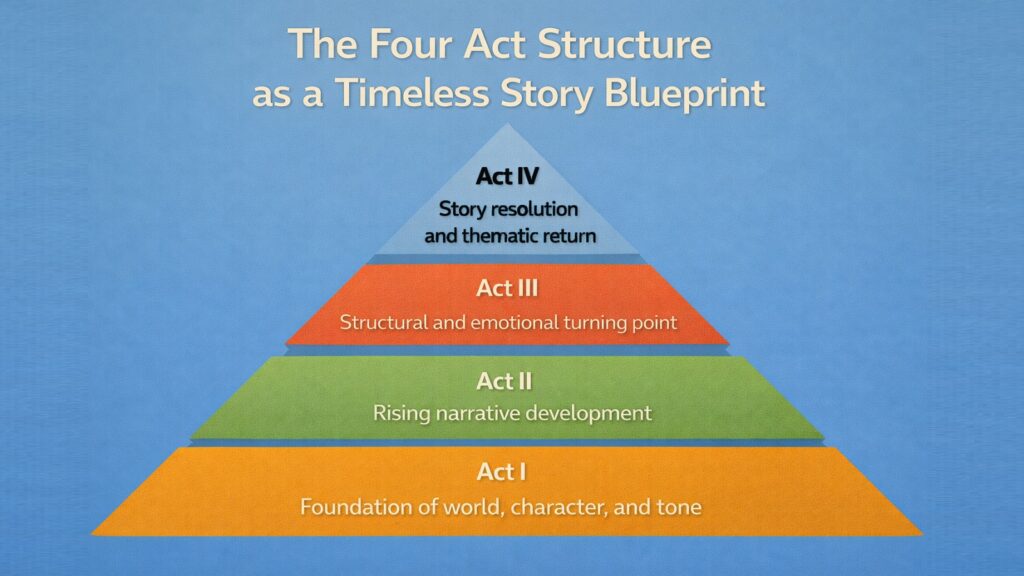
The Four Act Structure endures because it reflects how meaning naturally unfolds. Stories need space to establish, complicate, transform, and resolve. Four movements provide that space without excess or insufficiency. From classical drama to contemporary cinema, this framework has shaped narratives that move audiences across centuries and cultures.
The six lessons explored here reveal interconnected elements of a complete storytelling engine. The midpoint shift creates a transformation that gives stories depth and direction. Natural pacing sustains engagement through variation within progression. Character evolution honors authentic human change across movements. Classical roots ground the structure in time-tested tradition. Modern applications demonstrate continued relevance. Practical craft shows how writers use the framework without losing creative freedom.
Together, these lessons illuminate why the Four Act Structure continues to shape meaningful stories. It provides enough guidance to prevent chaos while allowing enough flexibility for art. It serves plot-driven adventures and character studies equally well. It adapts to new media while maintaining essential principles discovered through centuries of narrative tradition.
Understanding structure deepens storytelling craft by revealing the invisible architecture beneath effective narratives. Writers who internalize the Four Act Structure don’t think about acts while creating—they simply know when setup should yield to complication, when pressure should crystallize into decision, when consequence should give way to resolution. The structure becomes instinct, felt rather than calculated.
Stories shaped by this framework feel both inevitable and surprising. We sense their coherence without seeing the seams. We experience transformation without noticing the machinery. We reach endings that satisfy because every movement earned its place in the progression. This is the Four Act Structure performing its essential work—providinga foundation for inspired stories that endure.
The framework invites writers into an ancient conversation about how narratives create meaning. It connects contemporary storytellers with Shakespeare and Sophocles, with Austen and Brontë, with every artist who discovered that four movements offer natural progression from question through revelation to hard-won understanding. Stories will continue breathing through this structure because it mirrors the rhythm of change itself.
Four Act Structure Core Principles Summary
| Structural Element | Essential Function |
|---|---|
| Four Movements | Setup, complication, consequence, resolution as complete narrative cycle |
| Midpoint Transformation | Pivotal shift that redirects story from preparation into confrontation |
| Natural Pacing | Variation within progression sustaining engagement across movements |
| Character Evolution | Gradual authentic change aligned with narrative phases |
| Historical Continuity | Time-tested framework appearing across classical and modern works |
| Creative Flexibility | Guidance without formula supporting artistic freedom and coherence |
Read More Storytelling Articles
- Franco Belgian Comics: 6 Powerful Storytelling Lessons
- Storytelling Themes: 8 Powerful Ideas Readers Love
- 6 Powerful Story Archetypes That Inspire Creativity
- 8 Storytelling Psychologies to Elevate Creative Edge
- 6 Amazing Ways Interactive Narratives Rewire Our Brains
- 6 Amazing Ways Chekhov’s Gun Reloads Narrative Power
- Top 6 Ways ‘In Medias Res’ Rewires Narrative Gravity
- 6 Incredible Ways Hero’s Quest Defines Brokenness
- 6 Inspiring Ways Narrative Emotion Shape A Story
- Heike Monogatari: 6 Vivid Techniques for Epic Storytelling
- Iliad’s 6 Bold Storytelling Techniques That Grip You
- Explore Mahabharata’s 6 Genius Storytelling Techniques