Table of Contents
Introduction: How Qubits Work Beyond Theory and Hype
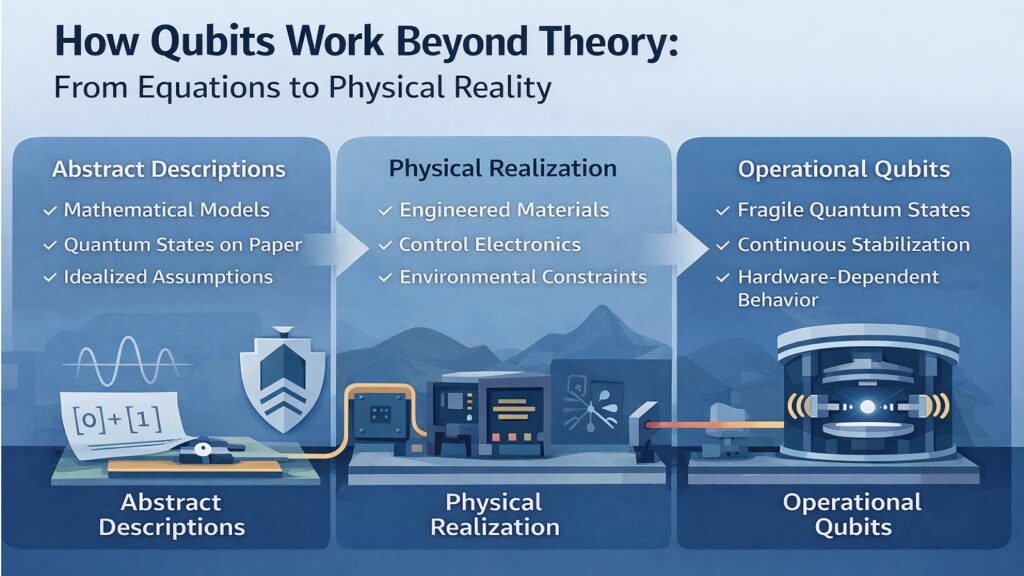
Most people learn about qubits through mathematics. They hear about superposition and entanglement. They see equations that describe quantum states. But this approach misses something fundamental. Real qubits exist in the physical world. They demand specific conditions to survive even a fraction of a second.
Understanding how qubits work starts with hardware, not theory. A qubit is not a stable object like a transistor. It is a carefully maintained state that exists only when everything around it cooperates. The temperature must drop to near absolute zero. Electromagnetic interference must vanish. Vibrations must stop. Even then, the quantum state lasts only milliseconds before it collapses.
This article explores the physical conditions that make qubits possible. Learning how qubits work means understanding the environments that protect them from immediate failure. Quantum computers are not just advanced circuits. They are elaborate systems built to fight the natural tendency of quantum states to disappear.
Understanding How Qubits Work Through Essential Quantum Computer Components
| Component | Role in Quantum Computing |
|---|---|
| Qubits | Physical systems that store quantum information through superposition and entanglement |
| Dilution Refrigerator | Cooling system that reaches temperatures below 15 millikelvin to maintain quantum states |
| Microwave Control Lines | Transmission channels that deliver precise electromagnetic pulses to manipulate qubit states |
| Processor Chip | Physical substrate where qubits are fabricated and quantum operations occur |
| Vacuum and Shielding Systems | Infrastructure that isolates qubits from electromagnetic interference and thermal radiation |
| Quantum Computer Gates | Operations that change qubit states through controlled electromagnetic interactions |
| Measurement Hardware | Devices that read out qubit states by detecting tiny electrical or optical signals |
| Classical Control Systems | Computers that orchestrate timing, calibration, and error correction for quantum operations |
1. How Qubits Work Only at Temperatures Near Absolute Zero
Superconducting qubits stop working when they get warm. This is not a design preference. It is a physical requirement. At room temperature, thermal energy destroys quantum behavior instantly. Heat causes particles to move randomly. This movement erases the delicate quantum states that qubits depend on.
Absolute zero sits at negative 273 degrees Celsius. Quantum computers operate at temperatures around 15 millikelvin. That is fifteen thousandths of a degree above absolute zero. At this temperature, thermal energy becomes almost nonexistent. Atoms barely vibrate. Electrons move in predictable patterns. Quantum effects can finally persist long enough to be useful.
The relationship between temperature and quantum coherence is direct. Higher temperatures mean more thermal energy. More thermal energy means more random particle motion. Random motion disrupts the precise quantum states that encode information. IBM and Google both use dilution refrigerators to reach these extreme temperatures. The refrigerators take hours to cool down and consume significant power just to maintain these conditions.
Why does superconductivity matter here? Below a specific critical temperature, certain materials completely lose their electrical resistance. Current flows without energy loss. This allows quantum circuits to maintain their states without being disturbed by heat from electrical resistance. Superconducting qubits exploit this property. They become stable enough to hold quantum information for brief periods.
But cooling alone is not enough. The entire quantum processor must be cold. Control lines that send signals to qubits must be specially designed to prevent heat from traveling down them. Every component introduces a potential path for warmth to enter. Engineers spend years refining thermal isolation techniques. Understanding how qubits work means recognizing that temperature control is not optional infrastructure. It is the foundation.
How Qubits Work at Cryogenic Temperatures: Key Temperature Dependencies
| Temperature Factor | Impact on How Qubits Work |
|---|---|
| Operating Temperature | Superconducting qubits require temperatures below 20 millikelvin to maintain quantum coherence |
| Thermal Noise Threshold | Temperatures above 100 millikelvin introduce enough thermal energy to destroy quantum states within microseconds |
| Cooling Stages | Dilution refrigerators use multiple cooling stages, progressively reducing temperature from 300 Kelvin to 0.015 Kelvin |
| Energy Scale Comparison | At 15 millikelvin, thermal energy is roughly 1 microelectronvolt, far below qubit energy gaps of 5-10 gigahertz |
| Heat Leak Management | Even nanowatt-level heat leaks can raise qubit temperature enough to reduce coherence time significantly |
| Material Phase Transitions | Superconducting materials like aluminum and niobium enter zero-resistance states only below specific critical temperatures |
2. How Qubits Work When the Environment Is Actively Suppressed
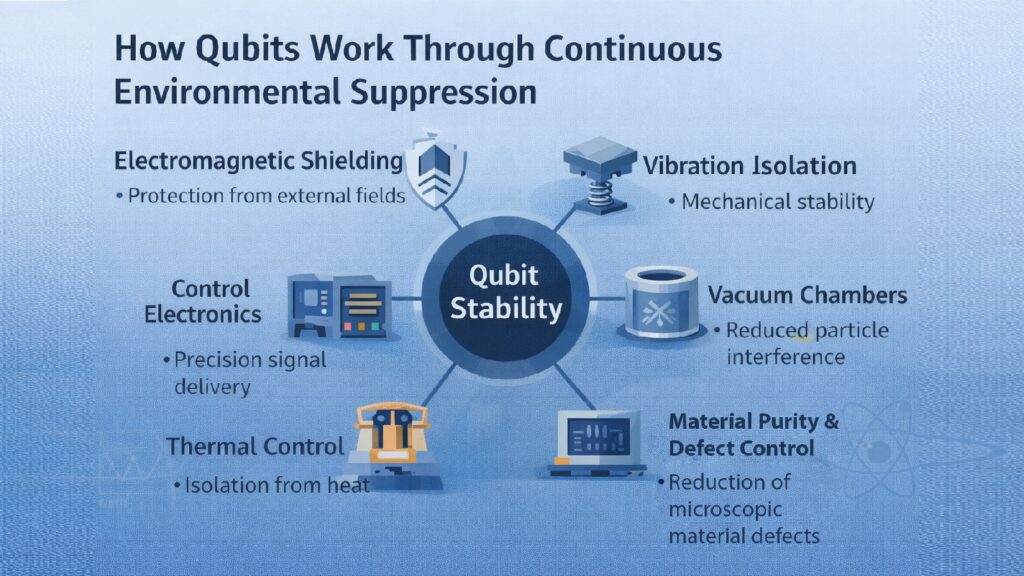
Quantum states do not survive passive isolation. They require constant active protection. Electromagnetic radiation fills the world. Radio waves, microwaves, and magnetic fields penetrate walls and standard shielding. Any of these can interfere with a qubit. Protection systems must actively block these disturbances.
Vacuum chambers remove air molecules. Even a single gas molecule hitting a qubit can transfer energy and destroy quantum coherence. Modern quantum computers operate in high-vacuum conditions. Pressure drops to levels found in outer space. This eliminates molecular collisions that would otherwise heat the qubits or introduce noise.
Electromagnetic shielding uses multiple layers of metal to block external fields. Superconducting shields can trap and redirect magnetic fields. Faraday cages block electric fields. These barriers must be nested and carefully grounded. A single gap or improper connection can let interference through. Rigetti Computing and other quantum hardware companies design custom shielding for every system.
Vibrations pose another threat. Mechanical movement can change the position of quantum circuit elements. Even nanometer-scale shifts affect qubit behavior. Quantum computers sit on vibration isolation platforms. These platforms use springs, dampers, and active feedback systems. They sense vibrations and counteract them in real time.
Environmental control is not a one-time setup. It requires continuous monitoring and adjustment. Magnetic field fluctuations from nearby equipment must be compensated. Temperature variations of even a few millikelvin demand correction. Power line noise at 50 or 60 hertz must be filtered out. How qubits work depends entirely on these systems running perfectly at all times.
The key insight is this: qubits exist only because their environment is being constantly suppressed. Turn off the shielding, and the quantum state vanishes. Stop the vibration isolation and coherence drops. These are not features that make qubits work better. These are the minimum requirements for qubits to work at all.
How Qubits Work Under Active Environmental Suppression Systems
| Suppression System | Protection Mechanism |
|---|---|
| Electromagnetic Shielding | Multiple nested metal layers block external radio frequency and microwave interference with attenuation exceeding 100 decibels |
| Vacuum Systems | High vacuum conditions below 0.0001 pascals eliminate molecular collisions that transfer thermal energy to qubits |
| Magnetic Field Control | Superconducting shields and active compensation coils reduce ambient magnetic field variations to below 1 microtesla |
| Vibration Isolation | Passive and active isolation platforms reduce mechanical vibrations to sub-nanometer amplitudes at qubit frequencies |
| Radiation Shielding | Lead and copper layers block cosmic rays and background radiation that can cause unwanted qubit state transitions |
| Acoustic Damping | Sound-absorbing materials and isolated mounting prevent acoustic energy from coupling to quantum circuits |
3. How Qubits Work While Fighting Noise at Every Moment
Noise is not an occasional problem. It is the default condition of the physical universe. Electrical circuits generate voltage fluctuations. Magnetic fields drift randomly. Materials contain impurities that create unpredictable disturbances. Qubits must resist all of this continuously.
Electrical noise comes from multiple sources. Thermal fluctuations in wires create voltage variations. Power supplies have small ripples in their output. Even quantum vacuum fluctuations generate noise at certain frequencies. These tiny disturbances add up. They can flip a qubit state or change its phase unpredictably.
Magnetic noise affects qubits differently depending on their design. Superconducting qubits are sensitive to magnetic field changes. Even Earth’s magnetic field must be compensated. Trapped ion qubits respond to electromagnetic field variations. Photonic qubits face different challenges but are not immune. Every qubit type has noise sensitivities built into its physical structure.
Material defects create a particularly stubborn form of noise. Every solid contains atoms that are not perfectly arranged. Some atoms are missing. Others are displaced. These defects act as tiny fluctuating electric and magnetic sources. They sit right next to the qubit, impossible to shield out completely. Researchers at MIT and elsewhere study these defects intensely because reducing them improves qubit performance dramatically.
How qubits work involves constant resistance to noise. Error rates in quantum computers reflect this battle. A typical superconducting qubit might have a gate error rate around one percent. This means one out of every hundred operations fails due to noise. That sounds small, but complex algorithms require thousands of operations. Errors accumulate quickly.
The solution involves multiple strategies. Better materials reduce intrinsic noise. Improved circuit designs minimize sensitivity. Faster operations give noise less time to interfere. Error correction protocols detect and fix errors using redundant qubits. None of these approaches eliminates noise. They just manage it well enough to allow computation.
Understanding noise reveals why scaling quantum computers is so difficult. Every additional qubit brings new noise sources. Every new connection creates new interference paths. The system becomes harder to control as it grows. Quantum hardware design is fundamentally about managing complexity while fighting an endless stream of disturbances.
How Qubits Work Against Different Noise Sources in Quantum Systems
| Noise Type | Effects on How Qubits Work |
|---|---|
| Thermal Noise | Random energy fluctuations cause unwanted transitions between qubit energy levels, limiting coherence below 100 microseconds at elevated temperatures |
| Electrical Noise | Voltage fluctuations in control electronics introduce phase errors and reduce gate fidelity by several tenths of a percent |
| Magnetic Field Noise | Fluctuating magnetic fields cause energy level shifts and decoherence, particularly affecting flux-tunable superconducting qubits |
| Material Defects | Two-level systems in dielectrics and substrate impurities create random telegraph noise that limits coherence times to milliseconds |
| Photon Shot Noise | Quantum fluctuations in electromagnetic fields introduce measurement errors and reduce readout fidelity below 99 percent |
| Control Line Crosstalk | Unintended coupling between control channels causes spurious operations on neighboring qubits during gate sequences |
4. How Qubits Work Differently Across Physical Implementations
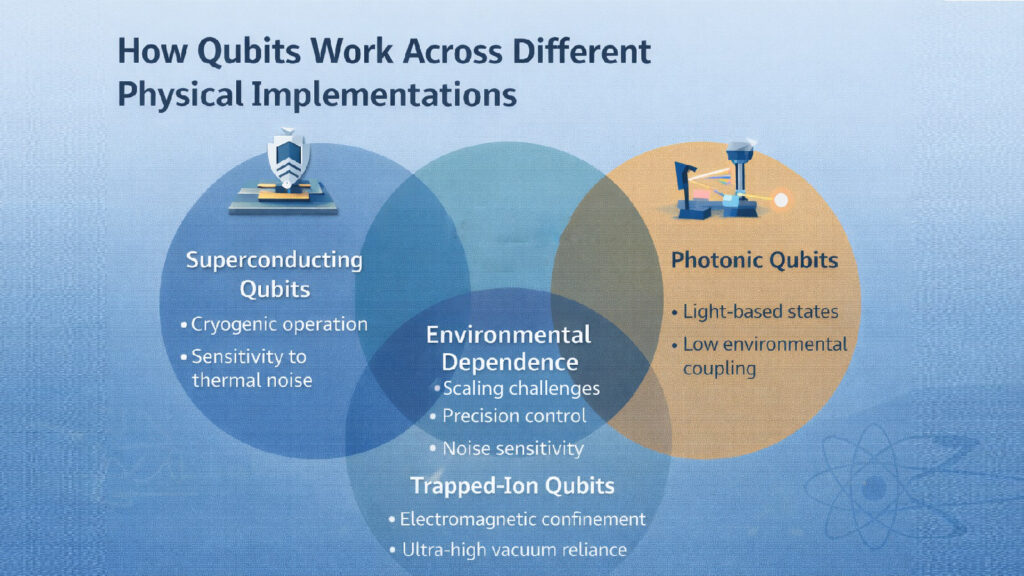
Not all qubits are built the same way. Different physical systems create different types of qubits. Each approach has distinct advantages and faces unique challenges. Understanding how qubits work requires seeing these differences clearly.
Superconducting qubits use circuits made from superconducting materials. They store quantum information in the flow of current through tiny loops. These qubits operate at millikelvin temperatures. They can be fabricated using techniques adapted from semiconductor manufacturing. Companies like IBM and Google have built quantum computers with over fifty superconducting qubits. The main challenge is that they require extreme cooling and have relatively short coherence times measured in hundreds of microseconds.
Trapped ion qubits utilize distinct atoms that are maintained in position by electromagnetic fields. The quantum information lives in the electronic energy levels of these ions. Lasers manipulate the qubit states with very high precision. IonQ and Honeywell work with this approach. Trapped ions have much longer coherence times, sometimes exceeding seconds. But they are harder to scale because each ion must be individually trapped and controlled with precise laser beams.
Photonic qubits encode information in properties of light particles. Polarization, path, or timing can represent quantum states. These qubits operate at room temperature, avoiding cryogenic requirements. Xanadu and PsiQuantum pursue photonic quantum computing. The advantage is easier environmental control. The challenge is that photons do not naturally interact with each other, making two-qubit gates difficult to implement reliably.
Each physical implementation faces different environmental threats. Superconducting qubits are vulnerable to magnetic noise and require extreme cooling. Trapped ions are sensitive to electromagnetic field fluctuations and laser stability. Photonic qubits must deal with optical losses and detector inefficiencies. How qubits work depends critically on which physical system is chosen.
Scaling presents different obstacles for each approach. Superconducting systems must manage crosstalk between increasingly dense circuits. Trapped ion systems must control larger numbers of laser beams with precision. Photonic systems must route photons through complex optical networks without excessive loss. No approach has solved the scaling problem completely.
The choice of qubit type shapes the entire computer design. Superconducting machines are dominated by dilution refrigerators. Trapped ion systems are built around vacuum chambers and laser systems. Photonic computers focus on optical components and single-photon detectors. Understanding how qubits work means recognizing that the hardware dictates everything else.
How Qubits Work Across Different Physical Implementation Technologies
| Qubit Type | Physical Basis and Operational Characteristics |
|---|---|
| Superconducting Qubits | Use Josephson junctions in superconducting circuits, operate at 15 millikelvin, achieve coherence times of 100-500 microseconds, gate speeds of 10-100 nanoseconds |
| Trapped Ion Qubits | Store information in electronic states of individual ions, operate at room temperature vacuum systems, coherence exceeds seconds, gate operations take microseconds |
| Photonic Qubits | Encode states in optical photon properties, operate without cryogenics, limited by photon loss and detection efficiency around 90 percent |
| Neutral Atom Qubits | Use laser-cooled atoms in optical tweezers, coherence times reach hundreds of milliseconds, reconfigurable qubit arrangements possible |
| Topological Qubits | Based on exotic quasiparticle states in specialized materials, theoretical noise immunity, experimental implementations remain at early research stages |
| Silicon Spin Qubits | Utilize electron spin in silicon quantum dots, compatible with semiconductor manufacturing, coherence times approaching milliseconds at millikelvin temperatures |
5. How Qubits Work Only Within Fragile Windows of Coherence
Coherence time defines how long a qubit maintains its quantum properties. This is not an abstract metric. It is the fundamental operational limit. A qubit with a coherence time of one millisecond must complete all its operations within that window. After that, quantum information degrades into random noise.
Environmental interactions cause decoherence. Every photon that hits a qubit can disturb it. Every fluctuating magnetic field changes the quantum state slightly. These interactions accumulate. Eventually, they destroy the quantum information completely. The process is irreversible. Once coherence is lost, the computation is ruined.
Different qubits have different coherence times. Early superconducting qubits lasted only nanoseconds. Modern ones reach hundreds of microseconds. This improvement came from better materials, improved fabrication, and refined designs. Researchers at Yale and other institutions have pushed coherence times higher through systematic engineering. But even the best superconducting qubits fade quickly compared to trapped ions.
The relationship between coherence time and computational capability is direct. Longer coherence allows more operations. A qubit with twice the coherence time can do twice as much work. This makes coherence time one of the most important figures of merit for quantum hardware. Publications from research groups worldwide report coherence times as key performance indicators.
Error correction demands especially long coherence times. To detect and fix errors, quantum computers must perform many measurements and corrections. These operations take time. If coherence time is too short, errors accumulate faster than they can be corrected. The computer fails. Current coherence times barely allow simple error correction protocols. More sophisticated codes require much longer coherence.
How qubits work is fundamentally limited by their coherence time. Every algorithm must race against decoherence. Every quantum circuit must finish before the qubits fade. This constraint shapes quantum algorithm design. Programmers must minimize circuit depth and optimize gate sequences. The physics enforces strict time budgets.
Extending coherence time remains a central goal of quantum hardware research. Improvements come slowly. Each doubling of coherence time typically requires years of work. New materials must be tested. Fabrication processes must be refined. Noise sources must be identified and eliminated one by one. Progress continues, but the fragility remains.
How Qubits Work Within Limited Coherence Time Windows
| Coherence Aspect | Operational Constraints of How Qubits Work |
|---|---|
| Coherence Time Definition | Duration during which a qubit maintains quantum superposition before environmental decoherence destroys the state |
| Superconducting Coherence | Current generation transmon qubits maintain coherence for 100-500 microseconds, limiting operation sequences to thousands of gates |
| Trapped Ion Coherence | Individual ion qubits can maintain coherence exceeding one second when properly isolated from magnetic field noise |
| Decoherence Mechanisms | Energy relaxation and dephasing processes cause exponential decay of quantum state fidelity over time |
| Operation Speed Requirements | Quantum gates must execute in nanoseconds to microseconds, ensuring hundreds to thousands of operations fit within coherence windows |
| Algorithm Design Impact | Quantum algorithms must minimize circuit depth to complete execution before coherence decay makes results unreliable |
6. How Qubits Work Until Measurement Ends the Quantum State
Measurement is not observation. It is a physical interaction. When a quantum computer measures a qubit, it couples that qubit to a detector. Energy flows between them. The quantum state collapses into a definite classical result. This process is irreversible and destructive.
Before measurement, a qubit exists in superposition. It holds multiple possible values simultaneously. This is what makes quantum computation powerful. Gates manipulate these superposed states, performing many calculations at once. But the final answer requires measurement. At that moment, the superposition vanishes. Only one outcome remains.
The measurement process itself introduces complications. Detectors are not perfect. They sometimes report the wrong result. This measurement error adds to the gate errors accumulated during computation. In superconducting systems, typical measurement fidelity reaches around 99%. One measurement in one hundred gives the wrong answer through no fault of the qubit itself.
Quantum algorithms must be designed around this constraint. All computation must finish before measurement. There is no way to check intermediate results without destroying them. Classical computers can save state, inspect it, and continue. Quantum computers cannot. Measurement represents a one-way door. Once you step through it, the quantum information is gone.
This shapes how quantum computers operate. Most algorithms proceed in stages. Prepare the qubits in an initial state. Apply a sequence of gates. Measure the result. Repeat many times to build up statistics. The quantum part happens between preparation and measurement. Everything else is classical processing.
Error correction protocols must work around the measurement problem. They measure special error syndromes without directly measuring the data qubits. This preserves the quantum information while detecting errors. The techniques are sophisticated and require many extra qubits. Researchers at Princeton and other institutions develop these methods carefully.
Understanding how qubits work means accepting that measurement fundamentally limits quantum computation. You cannot peek at the answer during calculation. You cannot gradually refine a solution. The quantum computer processes information in complete isolation, then delivers a final classical result. This constraint is built into quantum mechanics itself.
How Qubits Work Before and After Quantum Measurement Events
| Measurement Stage | Effect of Quantum State on How Qubits Work |
|---|---|
| Pre-Measurement State | Qubit exists in quantum superposition, simultaneously representing multiple computational outcomes with complex probability amplitudes |
| Measurement Coupling | Detector interaction forces qubit into definite classical state, collapsing superposition through exchange of energy and information |
| State Collapse Timing | Wavefunction collapse occurs within nanoseconds to microseconds depending on measurement coupling strength and detector response time |
| Measurement Fidelity | Detection errors occur in 0.1 to 2 percent of measurements due to finite detector efficiency and residual thermal noise |
| Non-Demolition Approaches | Certain measurement schemes preserve quantum state for one outcome, enabling mid-circuit measurements in error correction protocols |
| Readout Integration | Multiple measurement shots required to reconstruct quantum state probabilities, with uncertainty decreasing as square root of measurement count |
Conclusion: How Qubits Work – Revealing True Nature of Quantum Computers
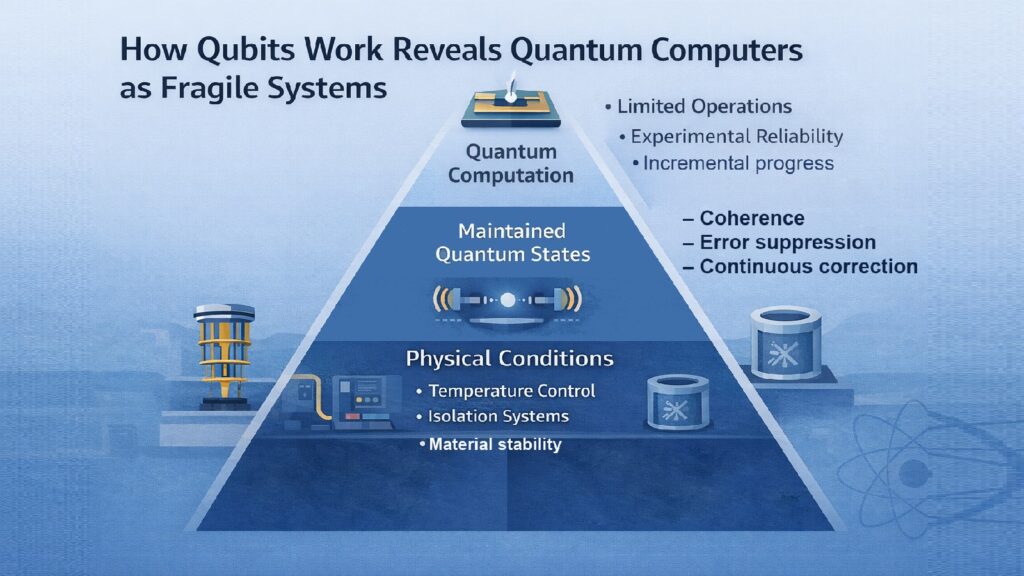
Qubits are not stable electronic components. They are carefully maintained physical states that fight constant threats. Temperature, electromagnetic fields, vibrations, material defects, and measurement itself all work against quantum information. Understanding how qubits work reveals why quantum computers remain so difficult to build and operate.
Each challenge connects to the others. Cooling requirements demand elaborate cryogenic systems. Environmental isolation needs complex shielding and vacuum chambers. Noise reduction shapes material choices and circuit designs. Coherence time limits what algorithms can run. Measurement constraints determine computational structure. These form an interconnected web of physical requirements.
Different physical implementations offer different tradeoffs. Superconducting qubits benefit from existing fabrication infrastructure but demand extreme cooling. Trapped ions achieve long coherence but scale slowly. Photonic approaches avoid cryogenics but struggle with gate implementations. Each continues advancing through incremental improvements.
The fragility of qubits explains why quantum computers scale so slowly. Adding more qubits brings more complexity exponentially. Control systems must coordinate more operations. Error rates compound across larger circuits. Progress requires solving hundreds of engineering challenges simultaneously.
Yet progress continues. Coherence times improve. Error rates drop. Qubit counts grow. IBM recently demonstrated quantum processors with over four hundred qubits. Google achieved computational tasks impossible for classical computers. These milestones prove the physics works even as practical applications remain distant.
Quantum computers represent something genuinely new. They harness physical phenomena that classical systems ignore. But the hardware must maintain conditions that nature actively opposes. This is the permanent price of quantum computation. The story of how qubits work is ultimately a story about fighting entropy. Quantum information is ordered, fragile, and brief. Quantum computers exist in the narrow space where humans can temporarily impose order through constant vigilance.
How Qubits Work: Critical Factors That Define Quantum Computing Progress
| Progress Factor | Current State and Future Direction |
|---|---|
| Coherence Time Extension | Improved materials and designs have increased coherence from microseconds to hundreds of microseconds, with trapped ions exceeding seconds |
| Error Rate Reduction | Gate fidelities approaching 99.9 percent enable error correction thresholds, requiring continued improvement for fault-tolerant quantum computation |
| Qubit Count Scaling | Systems have grown from single qubits to hundreds, with architectural challenges increasing as connectivity and control complexity multiply |
| Temperature Reduction | Operating temperatures below 15 millikelvin now standard for superconducting systems, with diminishing returns from further cooling alone |
| Environmental Control | Shielding and isolation systems have reached sophistication where residual noise comes primarily from material defects rather than external sources |
| Measurement Fidelity | Readout accuracy has improved to 99 percent or better, but remains a significant error source requiring continued attention in system design |
Read More Tech Articles
- Natural Language Processing: 6 Powerful Ways AI Reads
- Machine Learning in AI: 6 Powerful Ways AI Learns
- Artificial Intelligence: 8 Powerful Insights You Must Know
- 8 Powerful Smart Devices To Brighten Your Life
- 8 E-Readers: Epic Characters in a Library Adventure
- Smart TV Brands: 8 Epic Directors for Screen Magic
- Tablet Brands as Superheroes: 8 Amazing Tech Avengers
- Discover 8 Smart Speaker Brands As Motivational Speakers
- Laptop Brands as Celebrities: Meet 8 Alluring Stars
- Reimagine 10 Best Smartphone Brands As Real Personalities