
Table of Contents
Introduction: E-Readers and the Grand Library Adventure of Smart Reading
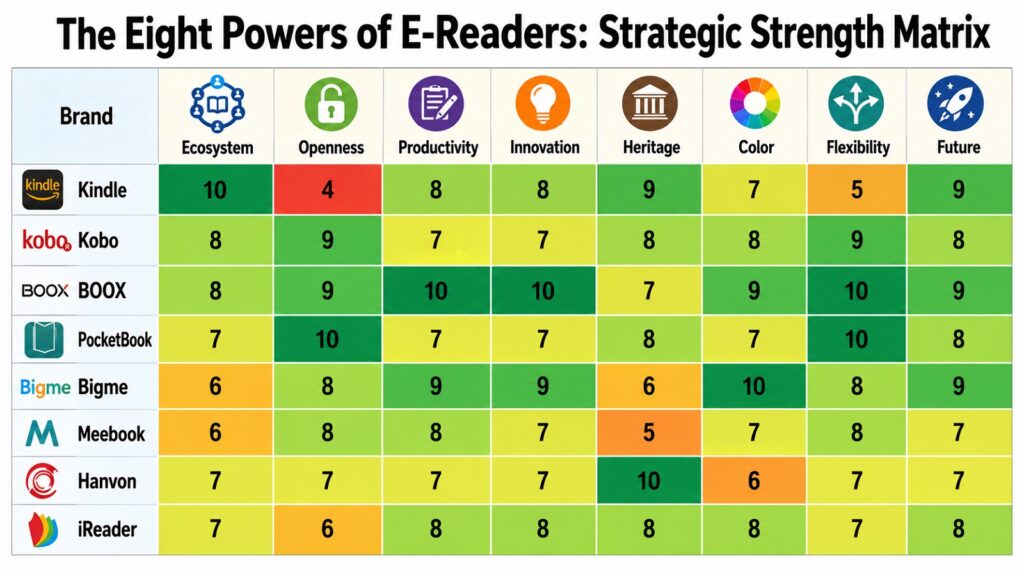
E-Readers are far more than mere gadgets. They serve as the quiet engines of a reading revolution that commenced nearly two decades ago and has continued to evolve. An E-Reader integrates a digital library, an energy-efficient E Ink display, tools for note-taking, and a battery life that can extend for weeks instead of mere hours. This unique combination has transformed the reading habits of millions, influenced how publishers approach distribution, and altered the flow of knowledge between individuals. This is not your standard buying guide. Rather, consider it a documentary-style narration in which each brand plays a role in a broader narrative about competition, technology, and human curiosity.
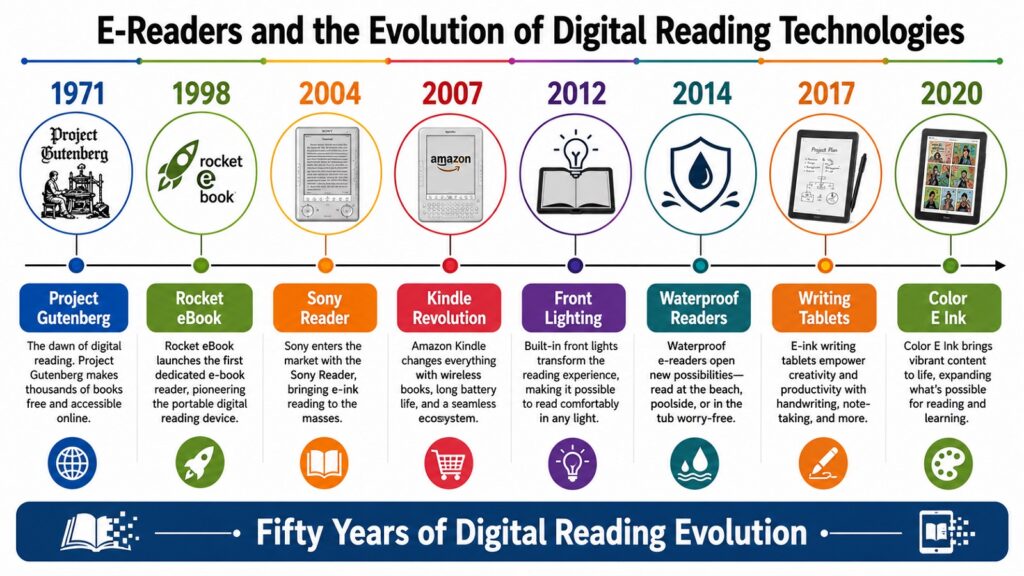
The history of E-Readers stretches back to the early 2000s, when E Ink technology first promised a screen that felt like paper but behaved like a computer. Sony took an early swing at the market, but Amazon turned the E-Reader into a cultural fixture. Since then, the landscape has filled with challengers, each carving out its own philosophy around open formats, color screens, or note-taking power.
To comprehend this landscape, envision a magnificent library where eight iconic figures coexist. Each character symbolizes a prominent E-Reader brand, governing a distinct realm of the reading universe. There exists a sagacious king who established a realm of convenience. A scholar dedicated to the pursuit of open knowledge also resides here. An inventor, fixated on innovative tools, makes his home in this library. An explorer, who refuses to be confined to a single format, adds to the diversity. A visionary is in pursuit of color and artificial intelligence. An apprentice, focused on affordability, is also present. An ancient sage, bearing decades of wisdom, contributes to the collective knowledge. Lastly, a guardian stands watch, quietly safeguarding the future of reading itself.
This adventure is not only about specifications and price tags. It is about understanding why ecosystems matter, why competition pushes innovation, and why digital reading has become a case study in consumer technology. Readers who only compare screen sizes miss the larger plot, since the real story is about strategy and habits shaping hundreds of millions of devices worldwide.
By the end of this journey, the goal is not just to know which E-Readers exist. The goal is to understand how they have become one of the most important smart devices. It is to fathom how they got here, what choices shaped their identities, and what their futures might look like as screens get smarter and reading habits keep changing. The table below offers a quick introduction to the eight characters in this library adventure before the deeper chapters begin.
E-Readers at a Glance: Eight Brands and Their Core Identity
| E-Readers | Primary Identity or Specialty |
| Kindle | Ecosystem leader, vast content library |
| Kobo | Open formats, library borrowing support |
| BOOX | Android E-Readers built for productivity |
| PocketBook | Wide format compatibility, many file types |
| Bigme | Color E Ink and AI features |
| Meebook | Affordable Android E-Readers, budget focus |
| Hanvon | Pioneer in handwriting and OCR |
| iReader | China-focused content ecosystem and hardware |
1. Kindle E-Readers: The Wise King Who Rules the Realm of Books
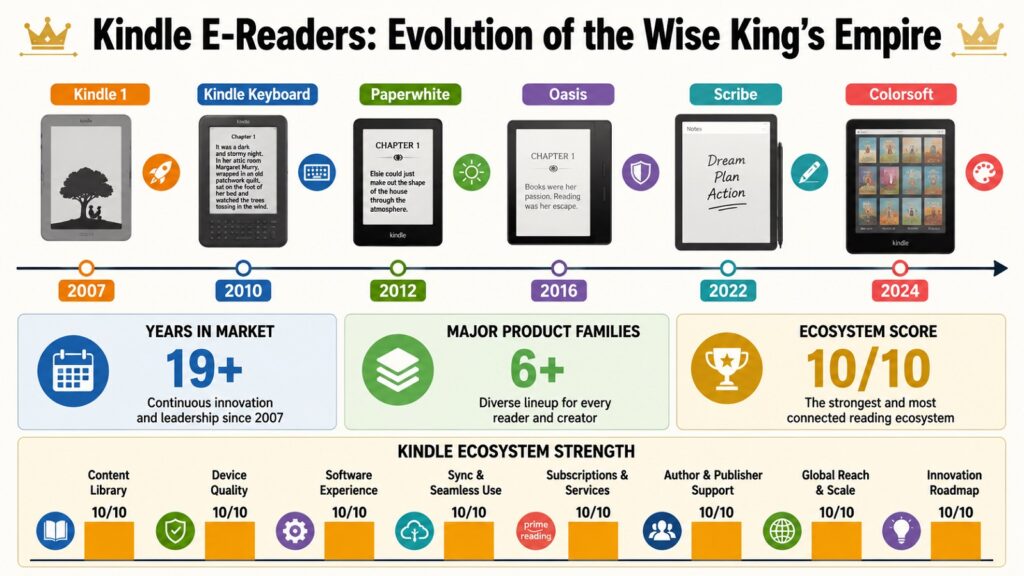
Every kingdom needs a ruler, and in the world of E-Readers, that ruler is Kindle. Amazon launched the first Kindle in 2007, and it sold out within hours. That moment marked the beginning of a new era for publishing. Kindle did not simply sell hardware. It built an entire kingdom of content and convenience that readers found hard to leave once they entered it.
The wise king metaphor fits Kindle well because the brand never tried to win through flashy features alone. Instead, Amazon focused on removing friction. Buying a book takes seconds. Storage holds thousands of titles. Battery life stretches across weeks rather than days. These small advantages added up into something larger: trust. Readers learned that Kindle would simply work, and that reliability became the foundation of an empire.
Kindle’s strategic genius lies in its ecosystem thinking. The Kindle Store offers millions of titles, and Amazon’s broader services like Kindle Unlimited and Audible widen the kingdom further. Whispersync lets readers switch between an e-book and its audiobook without losing their place, strengthening loyalty in a way pure specifications never could. Even as competitors offer cheaper devices or open formats, Kindle’s grip on convenience keeps the throne secure.
Over the years, Kindle expanded with models for different needs, from the simple entry-level reader to the Paperwhite, the Oasis, and the Scribe for note-taking. In 2024, Amazon introduced its first color E-Reader, the Kindle Colorsoft, finally answering years of requests for color displays after nearly two decades of black-and-white dominance. The Scribe line added stylus support, turning the Kindle from a reading tool into a broader productivity device for some users.
The practical lesson from Kindle’s rise is that ecosystems often beat specifications. Many readers do not choose Kindle because it has the best screen on paper. They choose it because the surrounding services make reading effortless. That strategic insight applies far beyond e-readers, reminding businesses that customer convenience often outweighs technical superiority. Kindle’s continued dominance, even decades after launch, proves that a well-built kingdom can outlast flashier rivals who never built the same depth of loyalty.
There is also a quieter lesson hidden in Kindle’s history, one about patience rather than dramatic reinvention. Amazon rarely rushes new technology to market, often waiting years and watching competitors experiment first before committing. This cautious approach sometimes draws criticism from enthusiasts wanting faster innovation, yet it has protected Kindle from costly missteps that have slowed smaller rivals.
E-Readers Milestones: Kindle’s Ecosystem Through the Years
| Year | Milestone or Feature |
| 2007 | First Kindle launches, sells out instantly |
| 2011 | Kindle Fire expands into tablets |
| 2013 | Paperwhite introduces front-lit screen |
| 2014 | Kindle Unlimited subscription launches |
| 2019 | Oasis adds adjustable warm lighting |
| 2022 | Scribe introduces stylus, note-taking |
| 2024 | Colorsoft becomes first color Kindle |
| 2025 | AI features added to newer models |
2. Kobo E-Readers: The Scholar Who Masters Many Languages
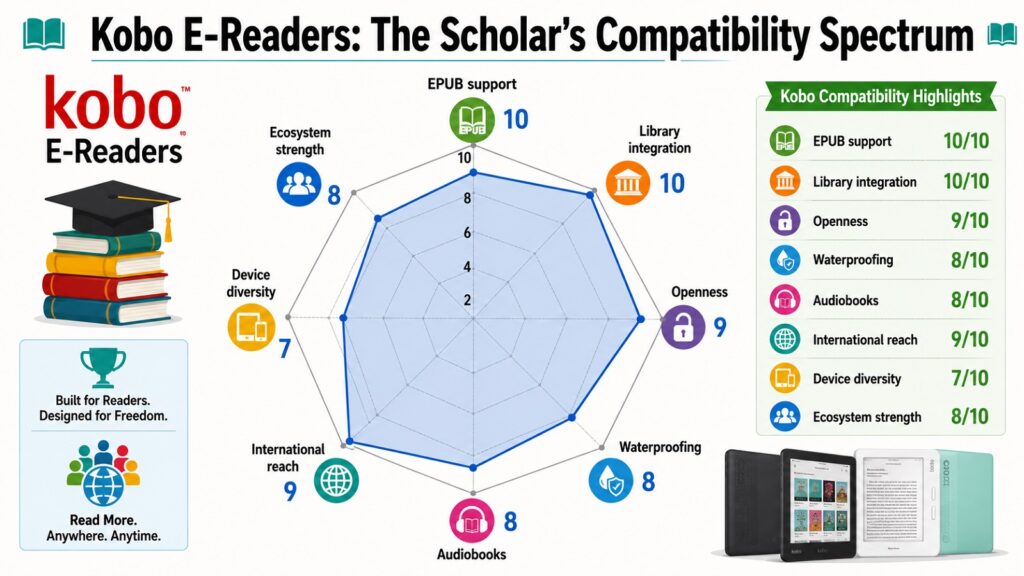
If Kindle is the king who built an empire of convenience, Kobo is the scholar who values open knowledge above all else. Founded in 2009 and based in Toronto, Kobo entered a market already dominated by Amazon, yet it carved out a loyal following by refusing to lock readers into one rigid format. That decision still defines the brand today.
Kobo’s defining strength is its support for EPUB, the most widely used open e-book format. While Kindle relies on proprietary formats, Kobo welcomes books from many sources, giving readers more freedom to shop outside one single ecosystem. This choice shaped Kobo’s entire identity as the scholar who studies many languages rather than committing to only one kingdom’s library.
Kobo also built early and consistent support for library borrowing through OverDrive integration, letting readers connect their library card directly to their device. Although this feature has faced some changes in recent years, including the loss of multiple library card support after OverDrive’s policies shifted, Kobo’s overall commitment to library access remains a meaningful differentiator from many competitors. The brand also added Pocket integration in the past for saving web articles, reflecting its broader vision of reading beyond just books.
Kobo’s hardware lineup spans budget-friendly models like the Kobo Clara line up to premium options such as the Kobo Libra and Kobo Sage. In 2024, Kobo released its first color E-Readers, the Kobo Libra Colour and Kobo Clara Colour, becoming one of the earliest mainstream brands to offer color E Ink screens to everyday readers. These devices use Kaleido color E Ink panels, which display a soft color palette suited for comics, magazines, and highlighted notes without sacrificing the paper-like reading experience that drew people to E-Readers in the first place.
The scholar’s lesson here is about differentiation through philosophy rather than pure competition on price. Kobo never tried to outspend Amazon’s marketing budget. Instead, it built trust with readers who valued openness, format flexibility, and a less commercial reading experience. That strategic patience allowed Kobo to survive in a market where many smaller competitors disappeared entirely, proving that a focused identity can be just as powerful as scale.
Kobo’s ownership by Rakuten, the Japanese e-commerce giant, gives the brand stability without chasing rapid expansion into every product category. This steady approach mirrors the scholar archetype, since true scholars build depth in one subject over time rather than chasing every trend. For readers uneasy about being locked into one retailer’s bookstore, Kobo remains the closest thing to an open library card in digital form.
E-Readers Spotlight: Kobo’s Key Devices and Features
| Device or Feature | Description |
| Kobo Clara | Affordable entry-level device |
| Kobo Libra | Ergonomic design, page-turn buttons |
| Kobo Sage | Larger screen, stylus support |
| Kobo Elipsa | Note-taking focused tablet |
| Libra Colour | First-generation color E Ink model |
| Clara Colour | Compact, affordable color reader |
| OverDrive | Built-in library borrowing access |
| EPUB support | Broad open-format compatibility |
3. BOOX E-Readers: The Inventor Who Harnesses Modern Magic
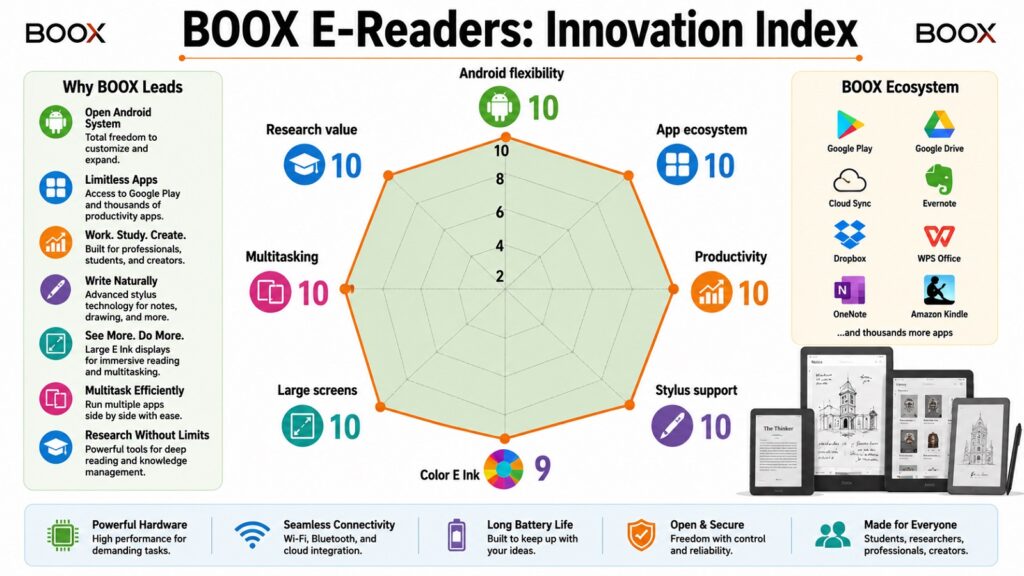
Some characters in this library adventure do not just read books. They build new tools entirely. BOOX, made by the Chinese company Onyx, plays the role of inventor, blending E Ink reading with full Android functionality. Since 2011, Onyx has quietly built devices that feel less like simple readers and more like experimental workshops for power users.
The defining choice behind BOOX is its commitment to Android as the core operating system. While Kindle and Kobo run closed software, BOOX devices give users access to the Google Play Store, meaning readers can install Kindle’s own app, library apps, and productivity tools side by side. This open approach attracts students, researchers, and professionals who want one E Ink device for multiple tasks rather than separate gadgets for each.
BOOX’s product range reflects this inventor mentality. The Palma series reimagines the e-reader in a smartphone-like form factor, complete with a SIM card slot for data connections. The Note Air and Tab lines target note-takers and digital artists with larger screens and stylus support. Many BOOX devices also include Kaleido color E Ink panels, letting users view comics, textbooks, and documents in color while keeping the paper-like comfort that makes E Ink screens easier on the eyes during long reading sessions.
What truly sets BOOX apart is multitasking. Most E-Readers function as single-purpose devices built around a single reading app. BOOX, by contrast, allows split-screen use, letting someone read a PDF while taking notes in a separate app at the same time. This functionality appeals strongly to graduate students annotating research papers and professionals reviewing long documents, since the productivity tools rival many traditional tablets while preserving the lower eye strain of E Ink technology.
The strategic lesson from BOOX is about specialization through openness. Rather than competing directly with Amazon’s content ecosystem, Onyx built a different kind of value proposition centered on flexibility and customization. This positioning carved out a profitable niche among readers who outgrow simple e-readers but still want the comfort of E Ink screens over backlit tablets, proving that innovation does not always require beating the market leader at its own game.
The journey of this inventor involves certain trade-offs. Devices utilizing Android with E Ink technology generally have a higher price point, and their slower screen refresh rates result in a less fluid experience for video playback and rapid scrolling compared to standard tablets. Additionally, older models may face challenges in running the latest applications as software advancements surpass firmware capabilities. Nevertheless, Onyx has consistently enhanced its standing among a loyal user community that is prepared to embrace these compromises in exchange for greater flexibility.
E-Readers Innovation: Notable BOOX Devices and Capabilities
| Device or Feature | Description |
| Palma series | Smartphone-shaped, SIM card slot |
| Note Air series | Large screen for notes |
| Tab Ultra | Productivity tablet with stylus |
| Go series | Compact readers, physical buttons |
| Android OS | Full Google Play Store access |
| Kaleido color | Color E Ink display option |
| Multitasking | Split-screen reading and notes |
| Pen support | Pressure-sensitive stylus writing |
4. PocketBook E-Readers: The Explorer Who Travels Across Countless Worlds
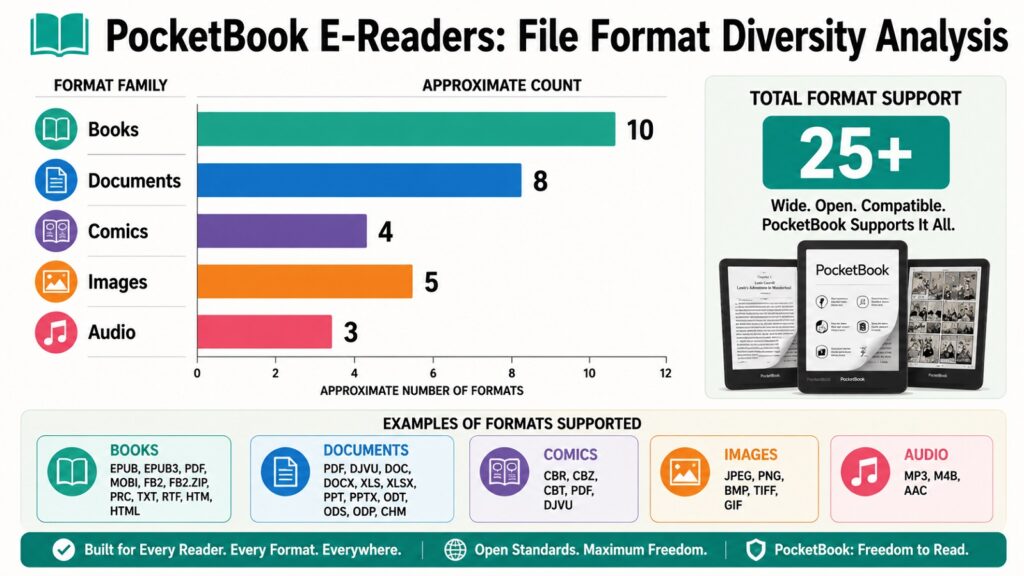
Every grand library adventure needs an explorer, someone who refuses to stay confined to one map. PocketBook fills that role among E-Readers. Founded in 2007 and now headquartered in Lugano, Switzerland, PocketBook built its identity on a simple promise: support nearly every file format readers might bring to the device, without forcing them into one narrow ecosystem.
PocketBook’s catalogue of supported formats is unusually wide. Beyond standard EPUB and PDF files, the brand supports formats like FB2, DJVU, MOBI, DOC, and DOCX, making it a favorite among readers who own files from many sources rather than one bookstore. This flexibility mirrors the explorer archetype, since explorers thrive by adapting to unfamiliar terrain instead of demanding the terrain adapt to them.
The company has released more than fifty E-Reader models over the years, ranging from compact six-inch devices to larger InkPad models designed for documents and textbooks. PocketBook also built its own cloud service and offers integration with Dropbox and Google Drive, giving readers multiple ways to load content onto their devices without relying solely on a single storefront. In recent years, the brand expanded library access further by adding support for Libby, the modern platform many public libraries use for digital lending, strengthening its reputation for openness even as some competitors faced friction with the same service.
PocketBook’s hardware often runs on a Linux-based operating system rather than Android, keeping devices lighter and more focused purely on reading rather than running a wide range of apps. This approach appeals to readers who want format freedom without the complexity that comes with a full Android interface. The trade-off is a smaller app ecosystem compared to BOOX, but for many readers that trade-off is worth the simplicity.
The practical lesson from PocketBook’s journey is that compatibility itself can become a competitive advantage. While larger brands push customers toward closed ecosystems to increase loyalty, PocketBook bets on the opposite strategy, trusting that flexibility will earn loyalty just as effectively. For readers who already own large digital libraries built across many platforms over the years, that explorer’s promise of broad compatibility often matters more than any single flashy feature a competitor might offer.
PocketBook’s European roots also shape its strategy. The brand has built strong distribution across Germany and Eastern Europe, where Kindle’s presence has historically been weaker, giving it a comfortable home territory rather than fighting Amazon everywhere at once. This regional focus echoes how a skilled explorer often masters certain territories deeply rather than spreading too thin across the entire map.
E-Readers Compatibility: PocketBook Products and Strengths
| Device or Feature | Description |
| InkPad series | Large-screen models for documents |
| Era | Compact reader, side buttons |
| Verse | Entry-level affordable device |
| Format support | EPUB, PDF, FB2, MOBI |
| Linux-based OS | Lightweight, reading-focused software |
| Cloud sync | PocketBook Cloud storage service |
| Libby access | Built-in library lending support |
| European base | Headquartered in Lugano, Switzerland |
5. Bigme E-Readers: The Visionary Who Sees Stories in Color
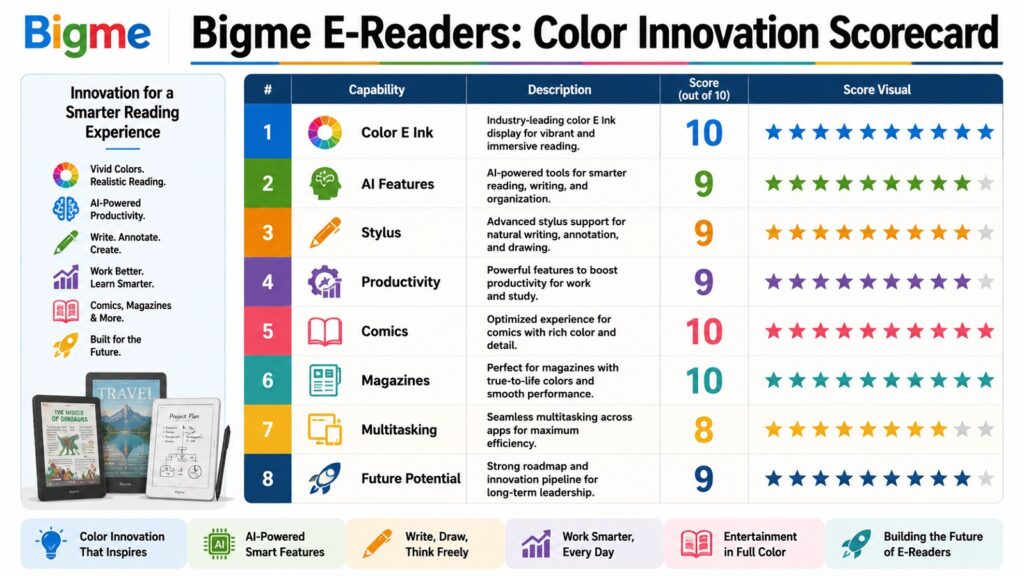
Every great adventure needs a visionary, someone who looks past the world as it exists and imagines what comes next. Among E-Readers, that role belongs to Bigme. Founded in 2008 and based in China, Bigme has spent over a decade focused almost entirely on E Ink technology, pushing into color displays and artificial intelligence features earlier and more aggressively than many larger rivals.
Bigme’s defining bet is color E Ink. While Kindle waited until 2024 to introduce its first color model, Bigme had already experimented with color panels for years across devices like the B6 Color and B751C. These screens use Kaleido technology, similar to Kobo’s color lineup, displaying a soft palette suited for comics and study notes rather than vivid photography. For readers who consume visual content alongside text, this color capability opens possibilities that black-and-white E-Readers cannot match.
Bigme has also leaned heavily into artificial intelligence integration, building devices that include voice transcription, translation tools, and AI-assisted writing features directly into the reading experience. Many Bigme devices run on Android, giving users access to the Google Play Store and a wide range of third-party applications, much like BOOX. This overlap places Bigme in direct competition with Onyx for power users, though Bigme tends to push color displays and AI tools more aggressively across its lineup.
The visionary path carries real risk. Early color E Ink technology produced noticeably dimmer screens compared to traditional black-and-white panels, and some AI features in early Bigme devices have been criticized as more gimmick than genuinely useful tool. Building ambitious technology before it fully matures often means accepting some rough edges along the way, and Bigme’s product reviews reflect that tension between genuine innovation and features still finding their footing.
The strategic lesson from Bigme is that being first carries both advantages and costs. Moving early into color E Ink and AI integration let Bigme establish a reputation for innovation well before larger competitors followed suit. At the same time, that same eagerness sometimes outpaces the polish that more cautious competitors achieve through patience. Readers drawn to genuinely new capabilities tend to forgive these rough edges, which has kept Bigme relevant as a smaller but ambitious player in a market increasingly shaped by color and intelligent features.
Bigme’s diverse product range also reflects its willingness to experiment beyond the standard e-reader format, releasing color E Ink monitors, productivity tablets, and even color E Ink smartphones. This breadth signals a company more interested in exploring what E Ink technology can become than refining one narrow product line.
E-Readers Vision: Bigme’s Devices and Innovations
| Device or Feature | Description |
| B6 Color | Compact color E Ink reader |
| B751C | Affordable color E-Reader model |
| B1051C Pro | Premium thin productivity device |
| B7 series | Android reader, 4G support |
| Kaleido color | Soft color E Ink display |
| AI transcription | Voice-to-text and translation |
| Android OS | Google Play Store access |
| Monitor line | Color E Ink desktop displays |
6. Meebook E-Readers: The Apprentice Who Learns with Endless Curiosity
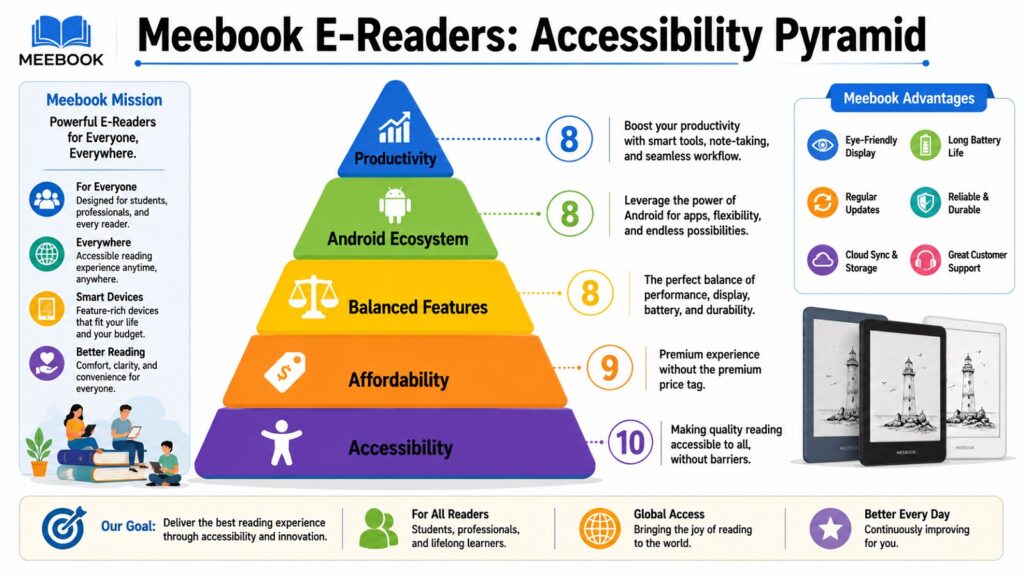
Not every character in this library adventure arrives as a fully formed master. Some begin as eager apprentices, learning their craft step by step. Meebook plays that role among E-Readers. The brand emerged from the team behind Boyue’s Likebook devices, building its own identity around affordability and steady, incremental improvement rather than bold reinvention.
Meebook’s approach focuses on providing Android-based E-Readers at significantly lower prices compared to high-end competitors like BOOX or Bigme. Models such as the Meebook M6 and M8 allow readers to access the Google Play Store, feature solid build quality, and offer satisfactory battery life, all while being priced similarly to entry-level Kindle and Kobo devices. This strategy appeals to cost-sensitive readers who desire the versatility of an open Android system instead of a completely closed device.
The apprentice metaphor fits well because Meebook’s product range often mirrors features already established by larger rivals rather than introducing entirely new concepts first. The brand has released color E Ink models, larger-screen note-taking devices, and various screen sizes, generally following trends that BOOX and Bigme popularized first. This is not necessarily a weakness. Many successful companies grow by refining proven ideas rather than chasing original invention, learning from the mistakes for which pioneers already paid the price.
Meebook does have some recognized limitations. The brand maintains a smaller online presence compared to competitors, and customer support has drawn criticism for being slower or less responsive than larger companies can offer. Firmware updates also tend to arrive less frequently, which can leave some users waiting longer for bug fixes or feature improvements. These growing pains are common among smaller manufacturers still building out their support infrastructure.
The practical lesson from Meebook’s approach is that affordability paired with genuine functionality can still carve out a real audience, even without dramatic innovation. Many readers do not need the most advanced E-Reader on the market. They need something reliable, reasonably priced, and flexible enough to read files from multiple sources. Meebook fills that gap effectively, proving that an eager apprentice willing to learn from established masters can still find a loyal audience within a crowded and competitive library.
Meebook’s continued presence in a crowded market also says something about niche survival. Rather than matching BOOX feature for feature, Meebook focuses narrowly on readers who simply want an affordable Android E-Reader without excessive complexity, keeping it relevant to a specific audience even with modest overall visibility.
E-Readers Growth: Meebook’s Lineup and Strengths
| Device or Feature | Description |
| Meebook M6 | Compact six-inch budget reader |
| Meebook M8 | Larger 7.8-inch screen |
| Meebook M6C | Color version of the M6 |
| Android OS | Google Play Store access |
| Affordable pricing | Lower cost than premium rivals |
| TF card slot | Expandable storage up to 1TB |
| Boyue heritage | Built by former Likebook team |
| Simple interface | Icon-based home screen |
7. Hanvon E-Readers: The Ancient Sage Who Preserves Timeless Wisdom
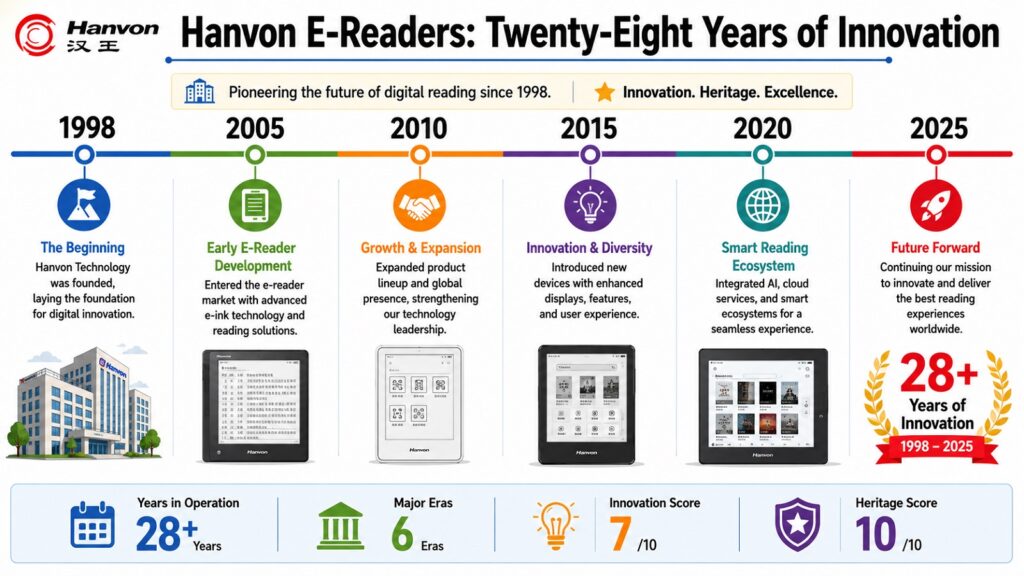
Some characters in a great adventure are old enough to remember a world before the story began. Hanvon plays that role among E-Readers. Founded in 1998, long before most current competitors existed, Hanvon began as a pioneer in handwriting recognition and optical character recognition technology in China, only later moving into dedicated E-Reader hardware as the category took shape.
Hanvon’s early history is closely tied to the very beginnings of E Ink adoption. The company released some of the first commercially available E-Readers in China, and at one point commanded most of that domestic market before competitors like iReader and BOOX gained ground. In 2010, Hanvon also introduced one of the earliest color E Ink displays at a major trade show, well before color screens became mainstream among Western brands like Kindle or Kobo.
The sage archetype is fitting for Hanvon, as the brand possesses decades of extensive technical knowledge, especially in the realm of handwriting recognition. Hanvon’s proficiency in transforming handwritten notes into digital text provides its note-taking devices, including the N10 and M10 series, with a significant edge for users who often annotate documents manually. This specialized expertise is a result of years of research that newer competitors have not yet had the opportunity to develop.
Hanvon’s journey has not been without struggle. The company’s prominence in the global e-reader market faded somewhat as Amazon’s Kindle expanded internationally and as newer Android-powered Chinese brands gained traction with younger consumers. Hanvon has had to adapt by focusing more on Android-based note-taking tablets and OCR-driven productivity tools rather than competing directly on price with budget-focused rivals. This pivot reflects the sage’s wisdom in choosing battles carefully rather than spreading resources too thin chasing every trend.
The strategic lesson from Hanvon’s long history is about resilience through specialization. Rather than disappearing when newer competitors emerged, the company leaned into its core technical strength, handwriting and character recognition, carving out continued relevance in note-taking and document-focused devices. That patient adaptation, built on decades of institutional knowledge, demonstrates how legacy expertise can still matter even in fast-moving technology markets where younger brands often dominate headlines.
Hanvon’s continued presence also offers a useful contrast against newer entrants lacking real operating history. While younger Chinese brands moved quickly into Android devices and color screens, Hanvon’s slower, research-driven approach reflects a company built on patents rather than rapid product cycles, a quiet endurance often overlooked in stories that favor fast disruption.
E-Readers Legacy: Hanvon’s History and Devices
| Device or Feature | Description |
| Founded 1998 | Early pioneer in OCR |
| N10 series | E-note device with stylus |
| M10 | Android tablet, handwriting input |
| Color E Ink | Early color display, 2010 |
| Clear7 Turbo | Oasis-style ergonomic design |
| Handwriting recognition | Core technical specialty |
| Long battery life | Standby lasting for months |
| China market | Once led domestic sales |
8. iReader E-Readers: The Guardian Who Protects the Future of Reading
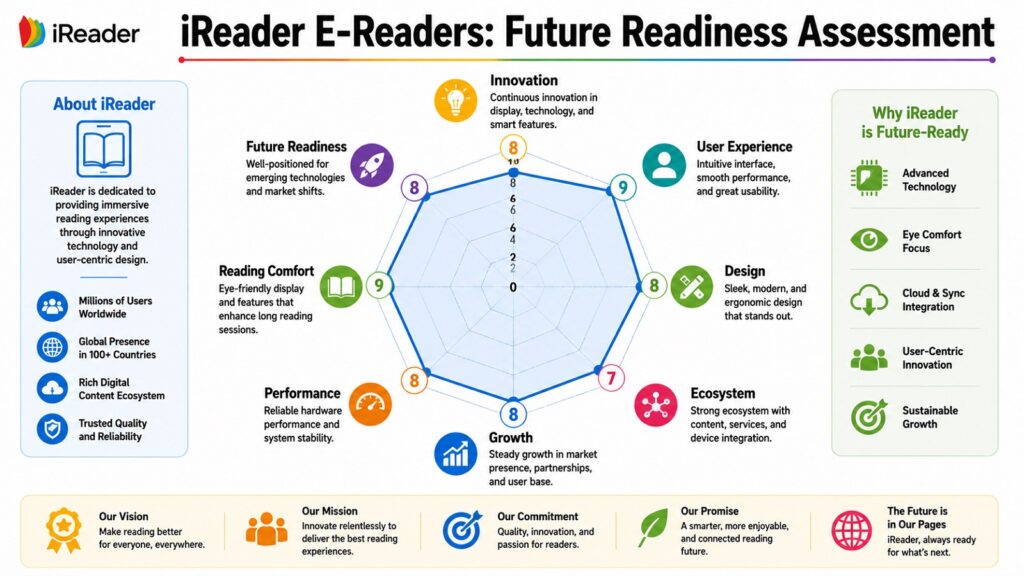
Every great library needs a guardian, someone responsible for protecting knowledge and ensuring it survives into the future. Among E-Readers, iReader fills that role within China’s vast reading market. Founded in 2008 in Beijing and also known by its Chinese name Zhangyue, iReader grew from a mobile reading app into one of the country’s most recognized E-Reader hardware brands and digital bookstores.
iReader’s strength lies in its deep content ecosystem within China. The company operates one of the country’s largest digital reading platforms, hosting novels, comics, magazines, and audiobooks through partnerships with publishers and authors. This content depth mirrors what Kindle built in Western markets, giving devices like the Smart 2 and Smart X immediate access to a massive local library without requiring readers to import files from outside sources.
The guardian metaphor fits because iReader’s devices often blend reading with serious productivity features, particularly note-taking and document annotation. The Smart X model, for example, includes a stylus and a larger screen aimed at users who want to mark up PDFs and academic papers rather than simply read novels casually. This focus on protecting and organizing knowledge, rather than just consuming entertainment, reflects a slightly different philosophy compared to more leisure-focused competitors.
iReader has also expanded its public presence by going public on the Shanghai Stock Exchange, giving the company a level of financial transparency and stability that many smaller E-Reader brands lack. This corporate structure allows iReader to invest steadily in both its content platform and hardware lineup, balancing innovation with the kind of sustainable growth that protects long-term company health rather than chasing short-term hardware sales spikes alone.
The strategic lesson from iReader’s growth is about balancing innovation with sustainability. Rather than expanding aggressively into international markets where Kindle and Kobo already hold strong positions, iReader has focused primarily on deepening its presence within China, where local content licensing and language support give it a natural advantage. This guardian-like patience, protecting its home territory while steadily refining its hardware, suggests a brand more interested in long-term resilience than rapid global expansion, a strategy that has kept it relevant even as competition intensifies.
Recent firmware updates have begun adding English-language support across newer devices, suggesting a gradual willingness to look beyond its domestic stronghold without abandoning the foundation that built its success. As reading habits shift toward hybrid formats blending text, audio, and visual content, iReader’s combination of content depth and document-focused hardware positions it well to keep guarding its share of the landscape for years to come.
E-Readers Stewardship: iReader’s Devices and Strengths
| Device or Feature | Description |
| Founded 2008 | Beijing-based, also called Zhangyue |
| Smart 2 | Note-taking device with stylus |
| Smart X | Larger screen for documents |
| Content platform | Large Chinese digital bookstore |
| Public listing | Shanghai Stock Exchange company |
| Local language | Built for Chinese readers |
| English firmware | Gradual international expansion |
| Document focus | Strong PDF annotation tools |
Conclusion: E-Readers and the Legendary Characters of a Timeless Library Adventure
Eight characters, eight philosophies, one shared mission: making reading better for the people who depend on it. Kindle ruled through ecosystem convenience. Kobo championed open formats and library access. BOOX invented new ways to blend reading with productivity. PocketBook explored compatibility across countless file types. Bigme envisioned a colorful, AI-assisted future. Meebook learned steadily through affordability. Hanvon preserved decades of handwriting expertise. iReader guarded a vast content library built specifically for its home market.
None of these E-Readers succeeded by copying another’s exact playbook. Each one studied the landscape, identified an underserved need, and built a strategy around that gap. This is the real lesson hidden inside the E-Reader story, one that extends well beyond gadgets and screens. Competition rarely rewards brands that simply imitate the market leader. It rewards brands that understand their own strengths clearly enough to build something genuinely different around them.
The future of E-Readers will likely continue this pattern of specialization rather than convergence into one dominant design. Color screens are becoming more common, artificial intelligence features are creeping into more devices, and the line between simple e-readers and full productivity tablets keeps blurring. Yet even as technology evolves, the core promise of an E-Reader remains unchanged: a device that protects long reading sessions from eye strain, battery anxiety, and the constant distraction of notifications that plague backlit screens.
This grand library adventure is far from finished. New chapters will be written as battery technology improves, as color E Ink matures, and as artificial intelligence finds genuinely useful roles inside the reading experience rather than gimmicky add-ons. Readers exploring this landscape today are not simply picking a device. They are choosing which philosophy of reading fits their own habits best. Understanding these eight E-Readers as legendary characters from the library offers a clearer map for that choice, one worth revisiting as the story of digital reading continues to unfold in the years ahead.
E-Readers Wisdom: One Lesson From Each Brand
| E-Readers | Defining Lesson |
| Kindle | Strong ecosystems build lasting loyalty |
| Kobo | Openness can be a competitive edge |
| BOOX | Innovation thrives through specialization |
| PocketBook | Compatibility earns trust over time |
| Bigme | Vision requires accepting rough edges |
| Meebook | Affordability still finds loyal audiences |
| Hanvon | Deep expertise outlasts passing trends |
| iReader | Patience protects long-term growth |