
Table of Contents
Introduction: Human-Centric Business as a Core Business Essential
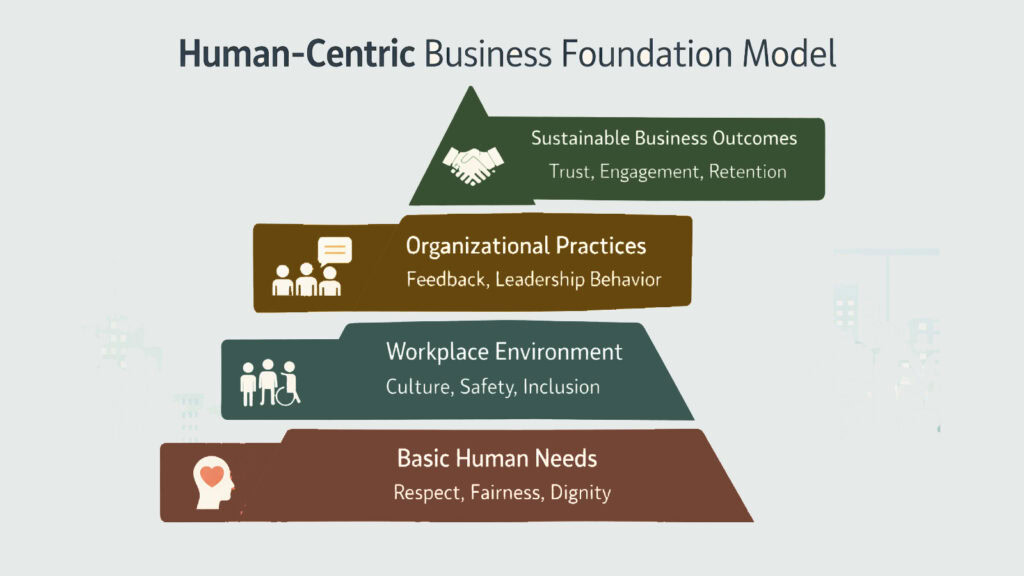
Most businesses spend enormous energy building systems. They track metrics, streamline processes, and chase efficiency targets. And yet, when things quietly go wrong — when morale slips or a team loses direction — the issue is rarely the system. It is almost always people. That gap between how a business is designed and how people actually experience it is where Human-Centric Business becomes one of the most important business essentials.
Human-Centric Business is not a trend or a rebranding exercise. It is a way of running an organization that treats human experience as a core input rather than a side concern. Research from Deloitte has found that organizations with highly engaged employees outperform their peers by around 147 percent in earnings per share. That is a significant number, and it has nothing to do with better software or smarter logistics. It comes from people.
When businesses ignore their human elements, the cost is rarely visible immediately. It builds slowly — in turnover rates, in quiet disengagement, in missed conversations, and in decisions made without enough perspective. By the time leadership notices, the damage is already embedded in the culture.
This article explores eight human elements that together define what Human-Centric Business looks like in practice. These are not abstract ideals. They are observable, everyday realities that shape how people work and how organizations sustain themselves over time.
Table 1: Human-Centric Business — Eight Elements at a Glance
| Human-Centric Business Element | Why It Matters |
| Emotional Awareness | Shapes how individuals respond under pressure and during conflict |
| Empathy and Compassion | Builds trust and improves how teams relate to one another |
| Psychological Safety | Enables honest communication and reduces hidden friction |
| Inclusive Culture | Ensures diverse perspectives are heard and respected consistently |
| Work-Life Integration | Supports sustainable performance without burning people out |
| Mental Health Support | Reduces absenteeism and creates a more stable workforce |
| Feedback Culture | Helps people grow and feel seen in their roles |
| Purpose and Meaning | Drives deeper motivation and long-term commitment |
1. Human-Centric Business and Emotional Awareness in Action
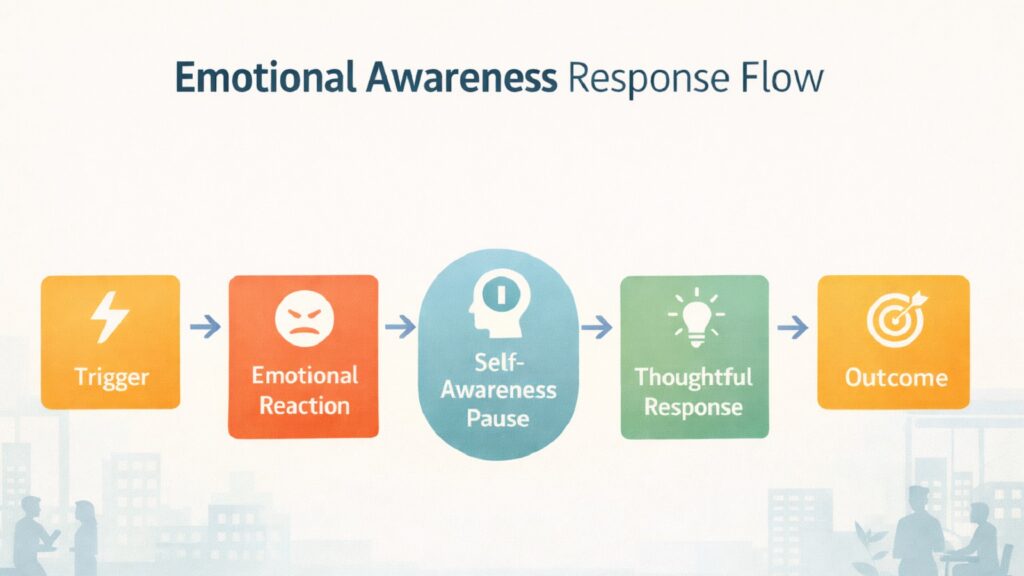
Emotional awareness is the ability to notice what you are feeling and understand how it is affecting your behavior. This sounds straightforward, but in most workplaces it is rarely encouraged or even acknowledged. People are expected to show up and perform, and the internal experience that shapes that performance is left unexamined.
Consider a simple example. A manager receives critical feedback from senior leadership just before a team meeting. Without emotional awareness, that frustration seeps into how the meeting is run — shorter patience, less listening, sharper tone. The team picks up on it but cannot name it, and a low-grade tension begins to form. Human-Centric Business recognizes that this pattern is not a character flaw. It is a signal that emotional awareness needs to be a conscious skill, not something people navigate alone.
Studies from the Yale Center for Emotional Intelligence have shown that people who score higher on emotional intelligence measures tend to have better work relationships and perform more consistently under stress. Emotional awareness is the foundation of that broader skill set. Without it, people react rather than respond, and those reactions create compounding friction over time.
In a Human-Centric Business, the goal is not to eliminate emotion from the workplace. It is to build enough awareness that emotion becomes information rather than interference. That shift is quiet but genuinely powerful.
Table 2: Human-Centric Business — Emotional Awareness in the Workplace
| Emotional Awareness Aspect | Workplace Impact |
| Recognizing personal triggers | Prevents reactive decisions during stressful moments |
| Naming emotional states accurately | Improves communication clarity and reduces misunderstanding |
| Pausing before responding | Reduces unnecessary conflict in team settings |
| Understanding emotional contagion | Leaders who manage emotions well stabilize team mood |
| Distinguishing mood from judgment | Prevents personal states from distorting professional assessments |
| Noticing others’ emotional cues | Builds stronger peer relationships and better collaboration |
| Reflecting after difficult interactions | Allows learning and gradual behavioral adjustment |
| Separating urgency from anxiety | Helps people prioritize more clearly under pressure |
2. Human-Centric Business Through Empathy and Compassion
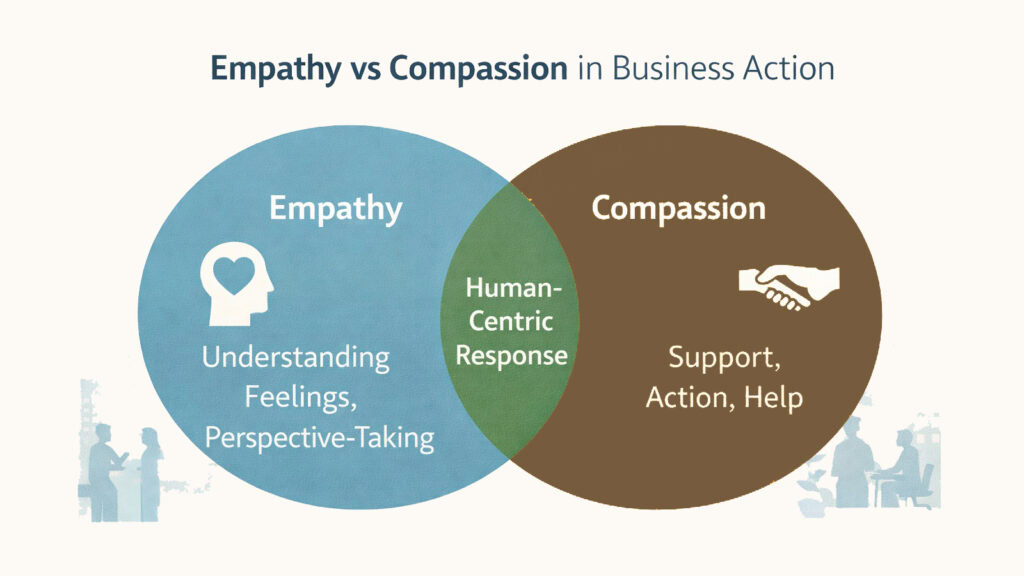
Empathy and compassion are frequently regarded as synonymous; however, they differ significantly in a crucial aspect. Empathy refers to the capacity to comprehend what another individual is going through. In contrast, compassion involves the readiness to take action in response. Both are essential in a Human-Centric Business, yet they function in distinct ways.
A manager might fully understand that a team member is overwhelmed — that is empathy. But if that understanding leads to adjusting deadlines, offering support, or simply having an honest conversation, that is compassion in action. Organizations that rely only on empathy without the follow-through create a culture where people feel seen but not helped.
Research published in the Harvard Business Review has noted that leaders perceived as compassionate create higher levels of employee wellbeing, trust, and loyalty. This is not about softness. It is about creating conditions where people do not have to perform their struggles in silence. When compassion is visible in leadership behavior, it normalizes support-seeking throughout the organization.
Human-Centric Business is built on the understanding that people are not just resources with outputs. They are individuals carrying full lives, and their capacity to contribute is directly shaped by how they are treated. Empathy opens the door to that understanding, and compassion is what makes it real.
Table 3: Human-Centric Business — Empathy and Compassion in Practice
| Empathy or Compassion | How It Shows Up at Work |
| Empathy — listening without judgment | Creates space for people to express concerns honestly |
| Compassion — adjusting workloads | Signals that the organization values people over output targets |
| Empathy — acknowledging difficulty | Reduces isolation during high-pressure periods |
| Compassion — checking in after setbacks | Builds trust and long-term loyalty |
| Empathy — understanding team frustration | Helps leaders respond constructively rather than defensively |
| Compassion — mentoring without hierarchy | Encourages growth at a human pace rather than a forced one |
| Empathy — recognizing quiet disengagement | Surfaces problems before they become exits |
| Compassion — acting on feedback received | Shows that listening leads to real change |
3. Human-Centric Business and the Power of Psychological Safety
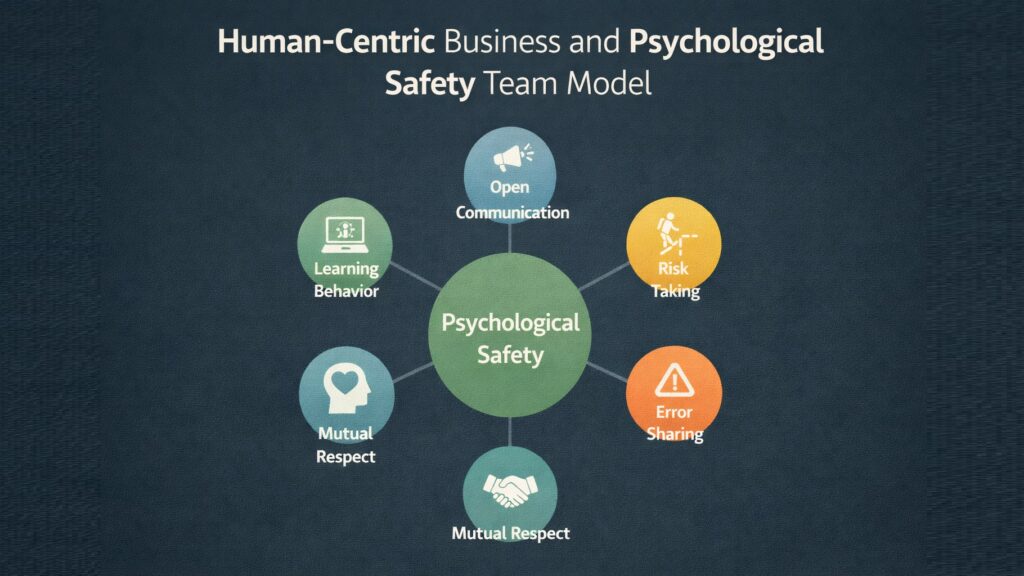
Psychological safety is the belief that you can speak up, ask questions, admit mistakes, or offer ideas without facing punishment or embarrassment. It sounds like a basic expectation, but in many workplaces it is genuinely rare. People learn quickly what is safe to say and what is not, and they adjust their behavior accordingly.
When psychological safety is absent, the signs are subtle. Meetings become performances. Mistakes get hidden until they become larger problems. Disagreement disappears, not because everyone agrees, but because disagreement feels risky. A Human-Centric Business cannot function well under these conditions because the information it needs most — honest input, early warnings, creative friction — never surfaces.
Google’s Project Aristotle, which studied team performance across hundreds of internal teams, found that psychological safety was the single most important factor in predicting team effectiveness. It ranked above skills, experience, and structure. That finding has been widely replicated and holds across industries and team sizes.
Establishing psychological safety does not entail allowing individuals to feel at ease with inadequate performance. Instead, it focuses on creating an environment where honesty is encouraged. This necessitates consistent behavior from leadership — addressing errors with curiosity instead of assigning blame, and viewing dissent as a valuable input rather than a threat.
Table 4: Human-Centric Business — Psychological Safety and Team Outcomes
| Psychological Safety Factor | Effect on Team Behavior |
| Leader responds to mistakes with curiosity | People report problems earlier, reducing overall damage |
| Dissenting views are welcomed in meetings | Better decisions emerge through genuine discussion |
| Admitting uncertainty is normalized | Reduces overconfidence errors and promotes collaboration |
| Blame is separated from learning | Teams recover from failure faster and with less resentment |
| Questions are treated as valuable | Knowledge gaps get addressed before they cause errors |
| Feedback flows in both directions | Trust increases across hierarchical levels |
| People feel heard even when overruled | Loyalty remains intact even during difficult decisions |
| New ideas are tested without mockery | Innovation becomes a natural part of team culture |
4. Human-Centric Business and Building an Inclusive Culture
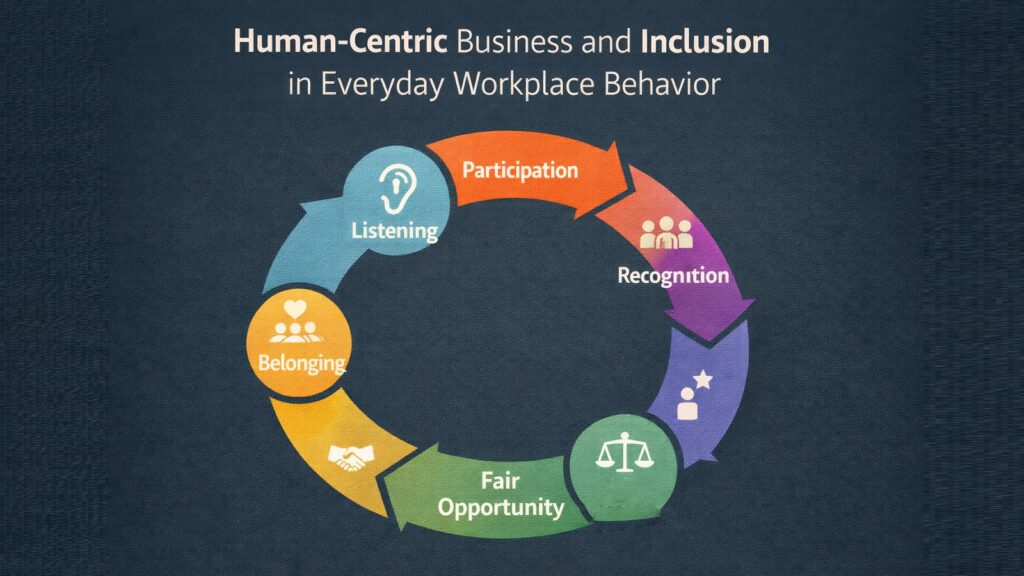
Inclusion is not a policy. It is an experience. A business can publish a diversity statement and still run meetings where certain voices are consistently overlooked. Inclusion is felt in small moments — who gets interrupted, who gets credit, who is asked for their opinion, and who has to fight to be heard.
A Human-Centric Business pays attention to these patterns because they have real consequences. When people feel excluded, they disengage. When they feel included, they contribute more fully, stay longer, and bring problems to leadership before they escalate. The day-to-day experience of belonging is what shapes those outcomes, not the annual statement or the diversity workshop.
McKinsey’s research across hundreds of companies has consistently shown that organizations in the top quartile for ethnic and gender diversity outperform those in the bottom quartile by significant margins — around 36 percent more likely to achieve above-average profitability. Inclusion is not separate from performance. It is a condition for it.
Building an inclusive culture requires consistent attention rather than periodic effort. It means reviewing who speaks in meetings, who is involved in decisions, and what behaviors get rewarded. These are everyday choices, and Human-Centric Business treats them as such.
Table 5: Human-Centric Business — Inclusion as Daily Practice
| Inclusive Behavior | What It Looks Like in Practice |
| Actively inviting quieter voices | Decisions draw on a wider range of experience and insight |
| Crediting ideas to the person who raised them | Reduces invisibility and builds a sense of belonging |
| Reviewing who is in key meetings | Prevents the same small group from making all major decisions |
| Addressing exclusionary language early | Sends a clear signal about what the culture expects |
| Providing equitable access to development opportunities | Prevents informal hierarchies from limiting careers |
| Checking assumptions about communication style | Reduces bias in how performance is evaluated |
| Making meetings accessible in format and timing | Ensures participation is not limited by circumstance |
| Measuring inclusion, not just diversity | Moves beyond headcounts to lived experience |
5. Human-Centric Business and Work-Life Integration Realities
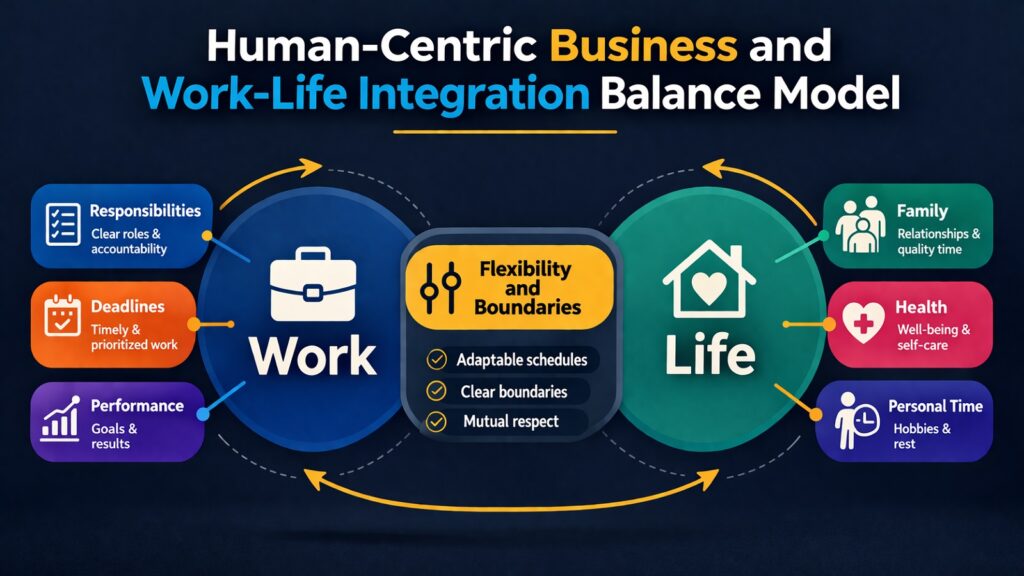
Work-life balance has always been a slightly aspirational idea. For most people, the line between work and personal life is not clean. Emails arrive in the evening. Stress from a difficult meeting follows a person home. A family situation affects concentration at work. Human-Centric Business does not pretend otherwise. It starts from a more honest place.
Work-life integration acknowledges that the two sides of life are always influencing each other and tries to create conditions where that tension is manageable rather than constant. This is different from expecting perfect separation or telling people to simply switch off. The pressure does not disappear because someone has been told to go home on time.
A survey by the American Psychological Association found that 64 percent of adults identified work as a significant source of stress. That number has remained high across multiple years of tracking. The stress does not stay at the office — it shows up in sleep quality, physical health, and relationships. Organizations that ignore this pay for it in turnover and healthcare costs long before they see it as a management issue.
Human-Centric Business approaches integration by respecting real boundaries — not calling people outside reasonable hours without genuine urgency, offering flexibility where the work genuinely allows it, and creating cultures where taking time off is supported rather than subtly penalized. These are imperfect solutions, but they matter.
Table 6: Human-Centric Business — Work-Life Integration in Real Settings
| Work-Life Integration Factor | Practical Reality for Employees |
| Flexible working hours | Helps people manage caregiving and personal needs more effectively |
| Clear boundaries on after-hours contact | Reduces chronic stress and allows genuine recovery time |
| Sustainable workload expectations | Prevents burnout that reduces both performance and retention |
| Normalized use of leave entitlements | Signals that rest is valued, not just tolerated |
| Remote work options where possible | Reduces commute burden and improves time autonomy |
| Manager modeling of healthy limits | Sets a cultural expectation that spreads through the team |
| Regular workload check-ins | Catches overload before it becomes a crisis |
| Recognition that integration is imperfect | Encourages honesty rather than silent endurance |
6. Human-Centric Business and Mental Health Support Systems
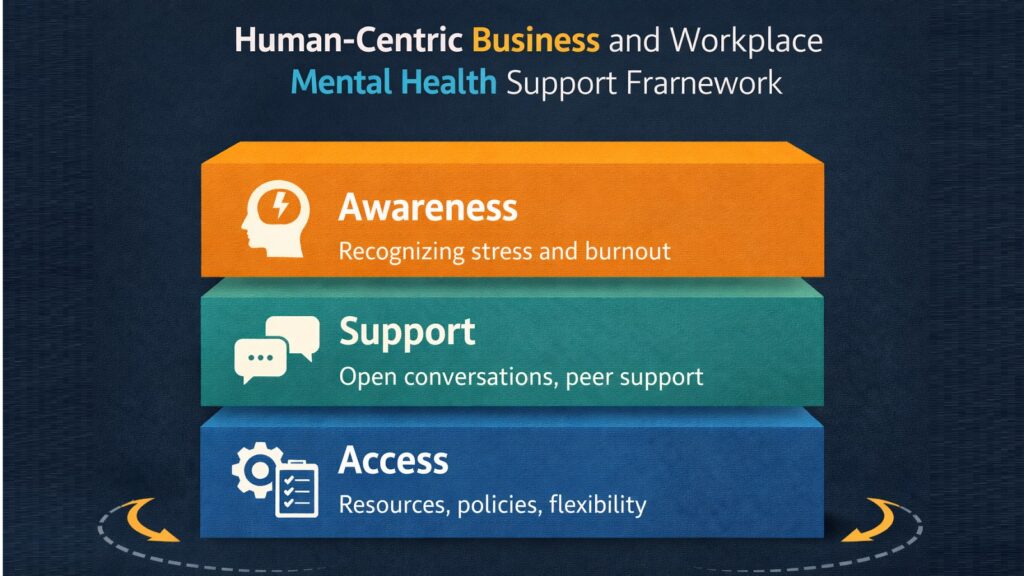
Mental health at work is still a topic that many organizations handle cautiously, sometimes with good intent but without real understanding. The language tends to become clinical or distant when the experience is everyday and close. Burnout, persistent stress, the quiet exhaustion of doing too much for too long — these are familiar to most working adults, and they do not require a diagnosis to be real.
A Human-Centric Business creates an environment where these experiences can be named without shame. That does not mean turning the office into a counseling center. It means building a culture where a manager can ask how someone is doing and actually mean it, where workloads are reviewed before breaking points, and where people know support exists before they are in crisis.
The World Health Organization estimates that depression and anxiety cost the global economy around one trillion US dollars per year in lost productivity. Studies have also shown that every dollar invested in mental health treatment returns four dollars in improved health and productivity. These are practical numbers, not just ethical ones.
Human-Centric Business does not eliminate stress. It recognizes that unmanaged stress compounds into something that neither the individual nor the organization can afford. Small, consistent signals — that asking for help is acceptable, that struggling does not mean failing — are what make the difference over time.
Table 7: Human-Centric Business — Mental Health Support Systems
| Mental Health Support Element | Effect on Organizational Health |
| Employee Assistance Programs (EAPs) | Provides confidential support that employees can access without disclosure |
| Manager training on mental health awareness | Enables earlier identification of distress and appropriate response |
| Reducing stigma through leadership openness | Encourages help-seeking before situations escalate |
| Workload review processes | Prevents the structural causes of burnout from building silently |
| Clear mental health leave policies | Ensures people can take needed time without fear of consequences |
| Peer support networks within teams | Creates informal but meaningful channels for connection |
| Regular wellbeing check-ins | Moves mental health from reactive to proactive territory |
| Access to external professional resources | Complements internal support with trained clinical expertise |
7. Human-Centric Business and a Strong Feedback Culture
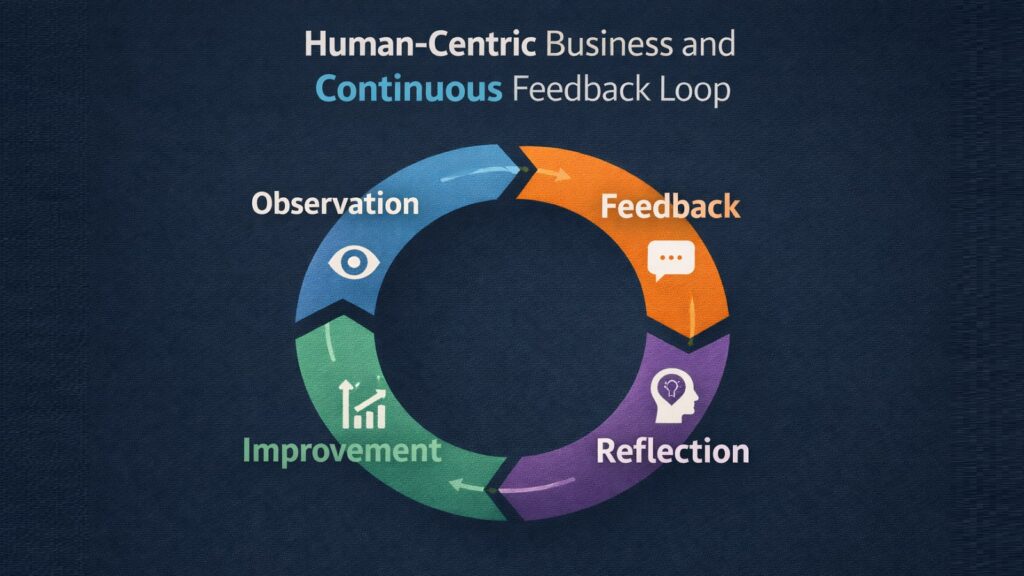
Feedback is one of those things that almost every organization says it values and few actually do well. The formal review process — annual or quarterly — gives feedback an official structure but often drains it of the honesty and timeliness that make it useful. By the time a performance review arrives, months of small opportunities have already passed.
A Human-Centric Business treats feedback as a continuous exchange rather than a scheduled event. This means a manager pointing out something directly and kindly after a meeting, rather than storing it for the end of the quarter. It means a team member feeling safe enough to say when a direction is not working. It means that feedback flows in multiple directions — not just downward.
Gallup research has found that employees who receive regular meaningful feedback are around three times more likely to be engaged at work. Engagement, in turn, connects to productivity, retention, and customer satisfaction. The relationship is well-established. The challenge is that useful feedback requires trust, and trust takes time to build and very little time to damage.
When feedback is absent or handled poorly, people fill the silence with assumption. They may assume their performance is fine when it is not, or that their efforts go unnoticed when they do. Human-Centric Business closes those gaps through consistent, honest, and respectful communication.
Table 8: Human-Centric Business — Building a Real Feedback Culture
| Feedback Culture Element | How It Shapes the Workplace |
| Frequent informal feedback | Prevents small issues from compounding into larger problems |
| Feedback tied to specific behavior | Makes improvement actionable rather than vague or personal |
| Two-way feedback channels | Builds mutual respect and a shared sense of accountability |
| Feedback delivered with care and clarity | Reduces defensiveness and increases receptiveness |
| Recognition as a form of feedback | Reinforces what good looks like and motivates repetition |
| Safe channels for upward feedback | Gives leadership real insight into team experience |
| Follow-through on feedback given | Shows that the exchange leads somewhere meaningful |
| Separating feedback from performance ratings | Allows honest conversations without high-stakes pressure |
8. Human-Centric Business and the Search for Purpose and Meaning
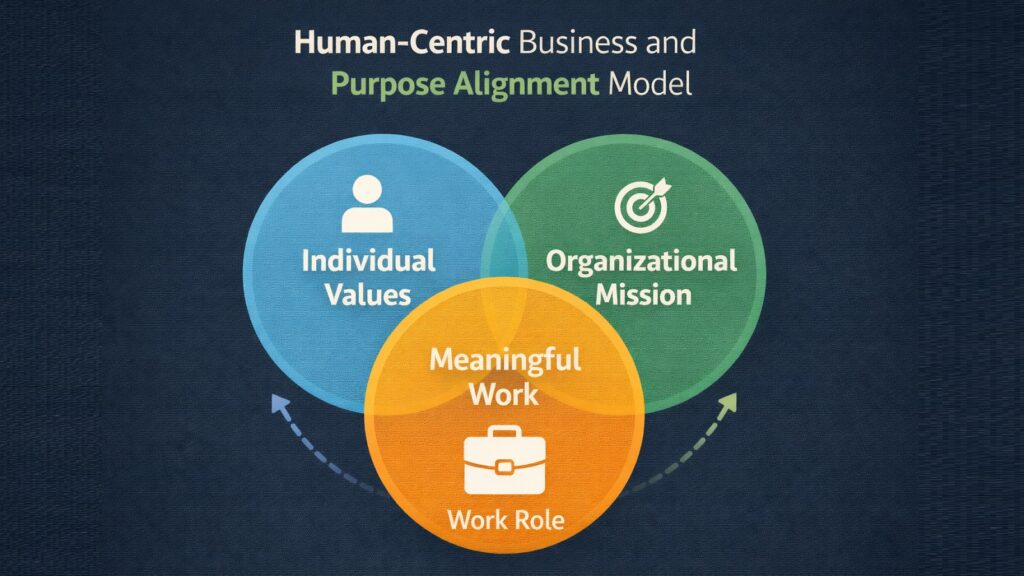
People rarely stay in a job solely for the salary. Most people, given a choice, want to feel that what they do matters — to the organization, to the people around them, or to something larger. This search for meaning is not idealistic. It is a documented feature of human motivation that has been studied for decades.
Psychologist Viktor Frankl observed that the drive to find meaning is one of the most fundamental human motivations. In the workplace, this shows up in how engaged people are, how much initiative they take, and how they handle difficulty. When work feels meaningful, people push through harder stretches. When it does not, even small frustrations become reasons to disengage.
A study by BetterUp found that employees who report a strong sense of purpose at work are 64 percent more likely to report high levels of fulfillment in their roles and demonstrate significantly higher performance ratings. Purpose is not something that can be manufactured through a mission statement. It is something people feel through the quality of their work, the people they work with, and the impact they can see.
Human-Centric Business creates conditions where purpose is possible rather than declaring it. That means connecting people’s work to its actual effects, giving individuals room to grow in the direction of their strengths, and treating the search for meaning as a legitimate part of how people relate to their roles.
Table 9: Human-Centric Business — Purpose, Meaning, and Engagement
| Purpose and Meaning Factor | What It Enables at Work |
| Connection between work and real impact | Increases motivation without relying on external incentives |
| Autonomy to pursue meaningful work | Builds intrinsic drive and reduces dependency on management |
| Alignment between personal and organizational values | Reduces cognitive dissonance and improves commitment |
| Recognition that contribution matters | Reinforces the sense that individual effort has real value |
| Space to pursue growth in meaningful areas | Deepens engagement and extends tenure voluntarily |
| Leadership that models purpose-driven decisions | Establishes a culture where meaning is taken seriously |
| Team relationships built on shared goals | Creates belonging that extends beyond job title |
| Honest communication about organizational direction | Maintains trust and reduces uncertainty that erodes meaning |
Conclusion: Human-Centric Business as the Foundation of Lasting Value
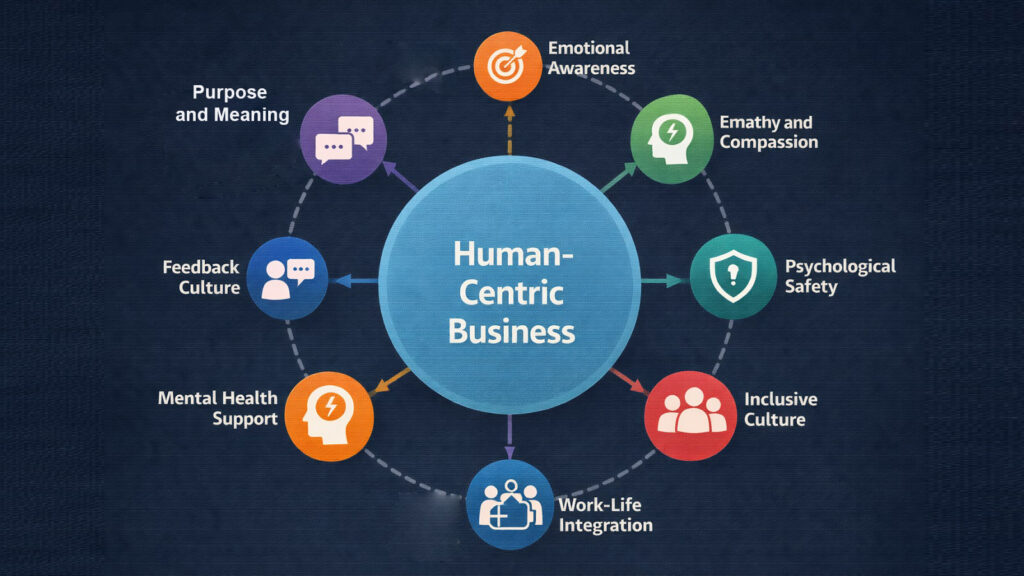
When you look at all eight of these elements together, something becomes clear. None of them exist in isolation. Emotional awareness informs how empathy is practiced. Psychological safety shapes whether feedback can be honest. Inclusion determines whether purpose is available to everyone or only to some. These elements are connected, and a business that works on one without attending to the others will find its progress limited.
Human-Centric Business is not a strategy that gets implemented once and then maintained passively. It is a way of operating that requires ongoing attention — to how people experience their work, to what the culture is quietly rewarding, and to whether the conditions for good work are actually in place. These are not grand organizational transformations. They are everyday choices made at every level of a business.
What Human-Centric Business ultimately builds is trust. Trust that the organization sees people as more than their output. Trust that honesty is safe. Trust that difficulty will be met with support rather than punishment. And trust, once genuinely established, is what allows businesses to move through hard periods without losing the people they need most.
The organizations that last are rarely those that optimized the hardest. They are the ones that understood something quieter and more durable — that the people doing the work are the work. And if that truth is taken seriously, everything else follows from it.
Table 10: Human-Centric Business — Eight Elements and Their Lasting Value
| Human-Centric Business Element | Long-Term Value It Creates |
| Emotional Awareness | Builds more stable leadership and reduces team friction over time |
| Empathy and Compassion | Strengthens trust and lowers voluntary turnover rates |
| Psychological Safety | Surfaces real issues early and supports a culture of honest contribution |
| Inclusive Culture | Expands the range of thinking available to the organization |
| Work-Life Integration | Sustains performance without the costly cycle of burnout and replacement |
| Mental Health Support | Reduces absenteeism and signals that people matter beyond their output |
| Feedback Culture | Accelerates individual growth and keeps communication open at all levels |
| Purpose and Meaning | Deepens commitment and connects daily effort to something larger |