Table of Contents
Introduction: Narrative Structures as the Hidden Architecture Behind Stories
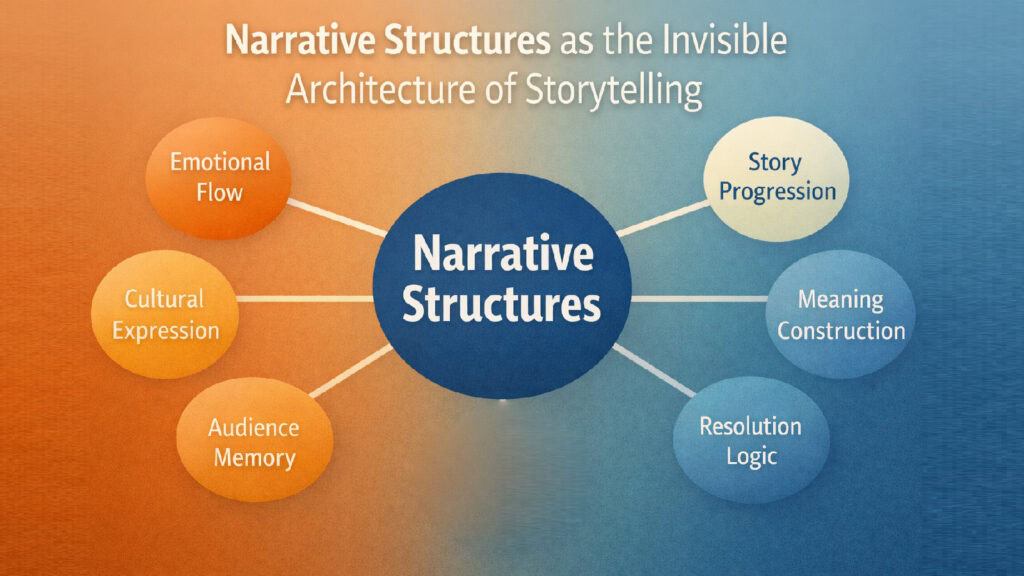
Stories stay with us long after we close the book or leave the theater. Characters fade into memory, dialogue becomes imprecise, but the feeling of a story lingers. That feeling comes from something deeper than plot or character. It comes from structure. Narrative structures are the invisible systems organizing how stories unfold across cultures, languages, and formats. They guide the flow of tension, the rhythm of revelation, and the shape of meaning itself.
These structures are not rigid formulas demanding obedience. They are flexible frameworks offering guidance. A narrative structure shapes how a story begins, how it builds momentum, and how it resolves. It determines what audiences expect and when those expectations should be fulfilled or defied. Understanding narrative structures means understanding why certain stories feel complete while others feel unfinished, why some narratives feel familiar while others feel startling.
This article explores eight powerful narrative structures that writers have used for centuries. Some are ancient, refined through oral tradition and classical drama. Others are modern, designed for television and serialized storytelling. Each structure offers a different way to organize time, tension, and transformation. Together, they reveal how stories create emotional impact through careful design.
Narrative Structures Comparison: Core Characteristics and Applications
| Narrative Structure | Primary Characteristic |
|---|---|
| Three-Act Structure | Sequential progression through setup, confrontation, and resolution |
| Four-Act Structure | Extended examination of consequences and escalating decisions |
| Five-Act Structure | Symmetrical dramatic arc with balanced buildup and resolution |
| Kishōtenketsu | Meaning emerges through contrast and reinterpretation without conflict |
| Dan Harmon’s Story Circle | Cyclical journey from comfort through change to transformation |
| Non-Linear Timelines | Chronology rearranged to reveal thematic patterns and emotional truth |
| Parallel Narratives | Multiple storylines create meaning through comparison and contrast |
| Nested Stories | Layered narratives where framing stories influence interpretation |
1. Narrative Structures and the Three-Act Structure of Setup, Conflict, and Resolution
The three-act structure is the most recognized narrative framework in Western storytelling. Its simplicity makes it powerful. The first act establishes the world and introduces characters. The second act disrupts that world through conflict or challenge. The third act resolves tension and delivers transformation. This structure feels instinctive because it mirrors how humans experience change in life.
Setup provides context. Audiences learn what is normal before that normalcy is threatened. Conflict introduces imbalance, raising questions that demand answers. Resolution closes the loop, providing either restoration or permanent change. The three-act structure manages audience expectations by promising that the setup will lead somewhere, that the conflict will intensify, and that the resolution will arrive.
This narrative structure influences nearly every other framework discussed in this article. It establishes the baseline pattern of equilibrium, disruption, and new equilibrium. Screenwriting teacher Syd Field popularized the three-act structure for film in the late twentieth century, emphasizing specific page counts and turning points. His work transformed how Hollywood approached narrative design, making structure explicit rather than intuitive.
The three-act framework succeeds because it balances predictability with surprise. Audiences know the general shape while remaining uncertain about specifics. The structure provides just enough guidance to feel coherent without becoming mechanical. It works for short stories, feature films, novels, and even single episodes of television. Its adaptability makes it foundational.
Narrative Structures in Three-Act Design: Structural Elements and Functions
| Element | Function in Structure |
|---|---|
| Act One Setup | Establishes world, characters, and stakes before disruption |
| Inciting Incident | Disrupts normalcy and launches central conflict |
| Act Two Confrontation | Escalates tension through obstacles and complications |
| Midpoint Reversal | Shifts direction or deepens understanding of conflict |
| Act Three Resolution | Delivers climax and resolves narrative tension |
| Structural Flexibility | Adapts to various lengths and formats without losing coherence |
2. Narrative Structures in the Four-Act Structure of Escalation and Consequence
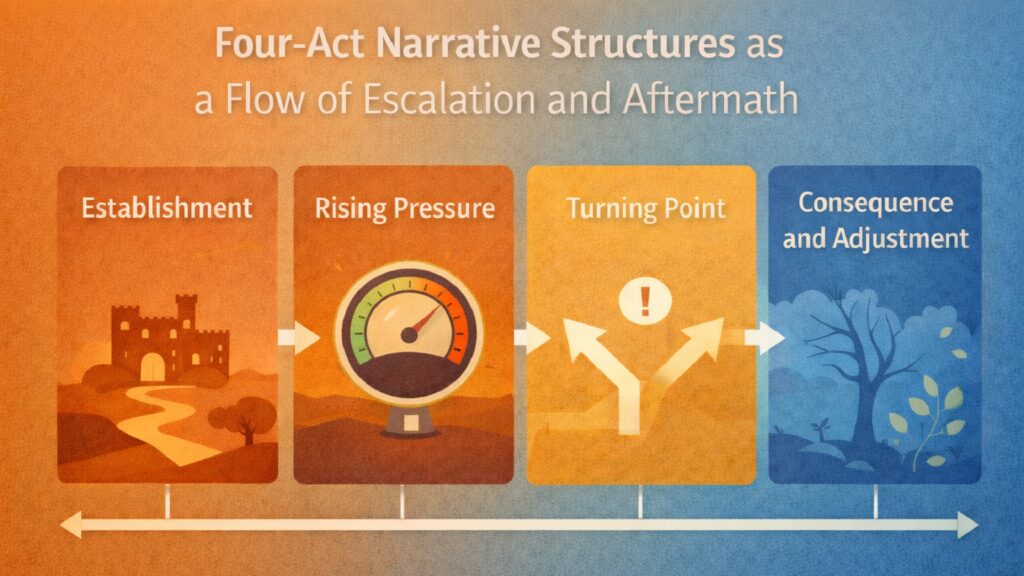
The four-act structure expands on the three-act model by separating rising tension from its aftermath. Where three acts move quickly from conflict to resolution, four acts linger on consequences. This additional act allows deeper exploration of how decisions unfold and what they cost. The structure reflects stories where change happens gradually rather than suddenly.
Act one still establishes the world. Act two introduces conflict and complicates it. Act three delivers the climax or major turning point. Act four examines the consequences, showing how the world has changed. This separation prevents stories from resolving too quickly, giving weight to the aftermath and reflection.
Television writing often favors four-act structures because commercial breaks naturally divide the narrative. Each act builds to a minor cliffhanger, sustaining momentum across interruptions. The structure also works for stories examining moral framing and moral complexity, where actions have ripple effects that deserve attention. It is less common in film but appears frequently in serialized formats.
The four-act model emphasizes progression. Each act feels distinct, with clear objectives and obstacles. The structure discourages meandering by demanding that every act advance the story meaningfully. By focusing on escalation and consequence, this framework suits stories about choice, responsibility, and transformation that unfolds in stages.
Narrative Structures in Four-Act Framework: Act Functions and Narrative Goals
| Act | Narrative Function |
|---|---|
| Act One | Establishes status quo and introduces protagonist’s world |
| Act Two | Introduces conflict and complicates initial situation |
| Act Three | Delivers major turning point or climactic confrontation |
| Act Four | Explores consequences and reveals lasting impact of events |
| Structural Rhythm | Creates sustained tension through distinct escalation stages |
| Application Strength | Ideal for episodic television and stories examining moral complexity |
3. Narrative Structures and the Five-Act Design of Dramatic Balance
The five-act structure, formalized by Gustav Freytag in the nineteenth century, organizes drama into exposition, rising action, climax, falling action, and resolution. This framework is built for emotional balance. It gives equal weight to buildup and aftermath, preventing stories from ending abruptly after the climax. The structure reflects classical dramatic theory, particularly Shakespearean tragedy.
Exposition introduces characters, setting, and initial conflict. Rising action builds tension through complications and obstacles. Climax delivers the moment of highest intensity, where the central question is answered or the main conflict reaches its peak. Falling action shows the immediate consequences, often including reversals or revelations. Resolution provides closure, whether through restoration, death, or transformation.
Freytag’s Pyramid, as this structure is often called, emphasizes that drama requires both ascent and descent. Climax alone does not complete a story. Audiences need time to process what happened and understand its implications. Falling action prevents the sense of rushing toward an ending. It allows reflection and adjustment.
This narrative structure suits stories exploring tragedy, moral dilemmas, or complex emotional arcs. It appears in classical theater, literary fiction, and prestige television. The five-act framework reminds writers that structure is not just about reaching the peak but about how you climb and how you descend.
Narrative Structures in Five-Act Design: Dramatic Phases and Emotional Functions
| Phase | Emotional Function |
|---|---|
| Exposition | Introduces world and plants seeds of future conflict |
| Rising Action | Builds tension through escalating obstacles and complications |
| Climax | Delivers peak emotional intensity and resolves central question |
| Falling Action | Reveals immediate consequences and unfolds final complications |
| Resolution | Provides closure and establishes new equilibrium |
| Structural Balance | Prevents abrupt endings by giving weight to aftermath and reflection |
4. Narrative Structures Without Conflict: Kishōtenketsu as Contrast-Based Design
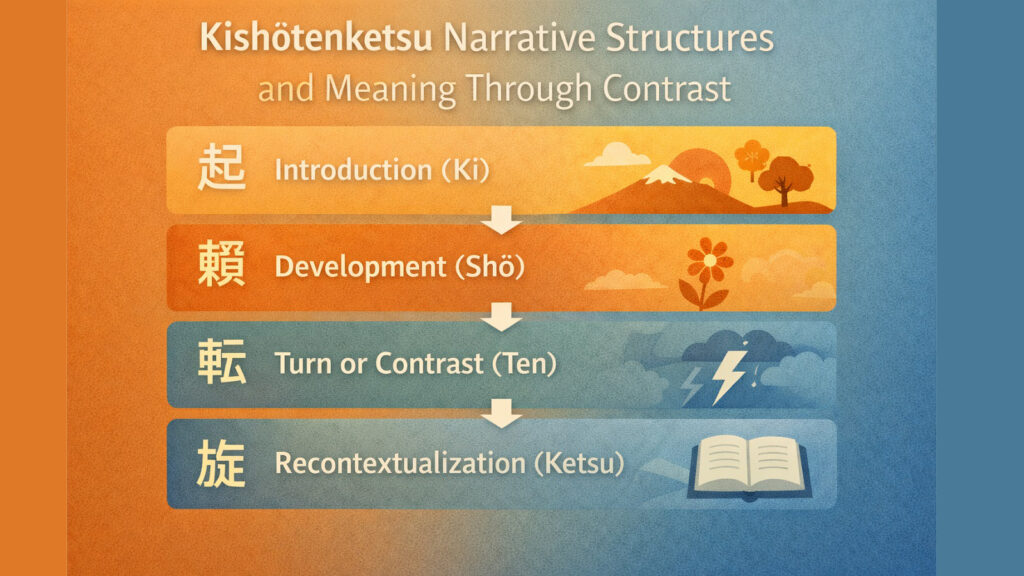
Kishōtenketsu is a narrative structure rooted in East Asian storytelling traditions, particularly Japanese and Chinese literature. It differs fundamentally from Western models because it does not require conflict. Instead, meaning emerges through contrast, surprise, and reinterpretation. The structure consists of four sections: introduction, development, twist, and reconciliation.
The introduction establishes a situation or observation. Development expands on that situation without introducing opposition. The twist presents something seemingly unrelated or unexpected, shifting perspective. Reconciliation reveals how the plot twist recontextualizes what came before, creating new meaning through comparison rather than confrontation.
This narrative structure challenges the assumption that stories need conflict to generate interest. Kishōtenketsu operates through observation and reflection. It values harmony and insight over struggle and victory. The structure appears in four-panel manga, poetry, and literary fiction that prioritizes atmosphere over action.
Writers using Kishōtenketsu focus on how elements relate to each other rather than how they oppose each other. The twist does not create a problem to solve but a new lens through which to view earlier material. This approach suits contemplative stories exploring mood, memory, or philosophical questions. It reminds audiences that narrative structures can organize meaning in ways beyond conflict and resolution.
Narrative Structures in Kishōtenketsu: Phases and Structural Principles
| Phase | Structural Principle |
|---|---|
| Ki (Introduction) | Establishes initial situation or observation without conflict |
| Shō (Development) | Expands on introduction through elaboration and detail |
| Ten (Twist) | Introduces unexpected element that shifts perspective |
| Ketsu (Reconciliation) | Reveals new meaning through contrast and reinterpretation |
| Core Mechanism | Creates meaning through comparison rather than confrontation |
| Cultural Context | Reflects East Asian storytelling values of harmony and insight |
5. Narrative Structures and Dan Harmon’s Circular Story Logic
Dan Harmon’s Story Circle adapts Joseph Campbell’s monomyth into a practical narrative structure for television. The circle consists of eight stages: a character is in a zone of comfort, they want something, they enter an unfamiliar situation, they adapt to it, they get what they want, they pay a heavy price, they return to their familiar situation, and they have changed. The structure is cyclical, ending where it began but with transformation embedded.
This narrative structure tightly links character growth to narrative motion. The protagonist cannot stay comfortable without stagnation. Desire propels them into unfamiliar territory where change becomes possible. The journey outward and return inward mirrors psychological development. The structure emphasizes that stories are fundamentally about transformation.
Harmon developed this framework for episodic television, where characters must change enough to feel dynamic but remain recognizable across seasons. The Story Circle allows for incremental growth while maintaining narrative momentum. Each episode can complete a circle while larger arcs span multiple circles. The structure works for sitcoms, dramas, and serialized storytelling.
The circular nature prevents stories from feeling aimless. The return to the familiar situation provides closure while the embedded change ensures progress. This narrative structure reminds writers that endings should resonate with beginnings, creating thematic coherence through transformation rather than simple restoration.
Narrative Structures in Story Circle: Stages and Character Movement
| Stage | Character Movement |
|---|---|
| Comfort Zone | Character exists in familiar situation without disruption |
| Desire Emerges | Character wants something beyond current circumstances |
| Unfamiliar Territory | Character crosses threshold into new situation |
| Adaptation | Character adjusts to challenges and learns new rules |
| Achievement | Character gets what they wanted or confronts central obstacle |
| Price Paid | Character suffers consequences or realizes cost of achievement |
| Return Journey | Character moves back toward familiar territory with new understanding |
| Transformation | Character has changed through the circular journey |
6. Narrative Structures Using Non-Linear Timelines to Reshape Meaning
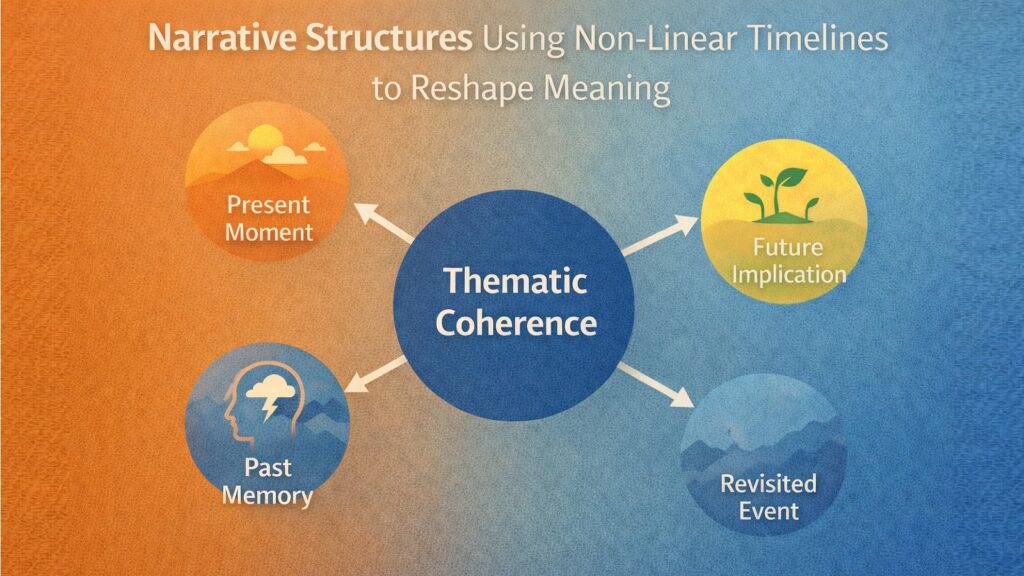
Non-linear narrative structures fragment chronology to reveal meaning through pattern rather than sequence. Events are rearranged to reflect memory, mystery, or emotional truth. Flashbacks, flashforwards, and fragmented timelines disrupt cause-and-effect logic, forcing audiences to construct meaning from pieces. The structure itself becomes a storytelling tool.
These narrative structures remain coherent through thematic repetition and motif. Even when time is scrambled, audiences recognize connections between scenes through recurring images, dialogue, or situations. The structure relies on the audience’s ability to assemble meaning from non-sequential information. This mirrors how memory actually works, with fragments organized by emotional significance rather than chronology.
Non-linear storytelling suits mysteries, psychological dramas, and stories about trauma or memory. Films by Christopher Nolan, novels by Kurt Vonnegut, and certain experimental fiction use fragmented timelines to control revelation. The structure allows writers to withhold information strategically, revealing it when emotional impact is maximized rather than when chronology dictates.
This approach challenges the assumption that narrative structures require linear progression. Meaning can emerge through juxtaposition, with scenes commenting on each other across temporal gaps. The structure demands more from audiences but rewards attention with deeper engagement. It proves that narrative structures are about organizing meaning, not just organizing time.
Narrative Structures in Non-Linear Timelines: Techniques and Narrative Effects
| Technique | Narrative Effect |
|---|---|
| Fragmented Chronology | Reveals information based on emotional impact rather than sequence |
| Flashback Integration | Provides context that reframes present-moment understanding |
| Flash-Forward Usage | Creates tension through knowledge of future events |
| Thematic Coherence | Maintains unity through recurring motifs instead of timeline |
| Mystery Construction | Withholds information strategically to control revelation |
| Memory Reflection | Mirrors how human consciousness organizes experience |
7. Narrative Structures in Parallel Narratives and Interwoven Storylines
Parallel narrative structures manage multiple storylines unfolding simultaneously. These storylines might occur in different times, places, or perspectives, but they create meaning through comparison and contrast. The structure relies on rhythm and balance, cutting between narratives at moments that create thematic resonance or dramatic tension.
This narrative structure appears in ensemble films, novels with multiple viewpoint characters, and television shows juggling various plot threads. The key challenge is preventing complexity from becoming confusion. Writers must ensure each storyline has clear stakes while the overall structure reveals connections between apparently separate events.
Parallel narratives create meaning through juxtaposition. One storyline comments on another, highlighting similarities or contrasts that deepen understanding. The structure allows exploration of how different characters respond to similar challenges or how different contexts shape similar events. It broadens perspective while maintaining narrative momentum.
The rhythm of cutting between storylines becomes a structural tool. Quick cuts create urgency and suggest connections. Longer stretches in one storyline allow depth before shifting. The structure demands careful pacing to ensure all threads feel equally vital. When executed well, parallel narratives prove that narrative structures can hold multiple stories without losing coherence.
Narrative Structures in Parallel Narratives: Organizational Principles and Functions
| Principle | Structural Function |
|---|---|
| Multiple Storylines | Creates complexity through simultaneous plot progression |
| Thematic Alignment | Connects separate narratives through shared concerns or motifs |
| Rhythm Control | Uses cutting patterns to manage pacing and tension |
| Comparative Meaning | Reveals insight through contrast between parallel situations |
| Balance Maintenance | Ensures all storylines receive adequate development and resolution |
| Unity Through Design | Prevents fragmentation by organizing threads around central storytelling theme |
8. Narrative Structures and the Layered Power of Nested Stories
Nested narrative structures place stories within stories, using framing devices to shape interpretation. A character tells a story to other characters, or a narrator recounts events from the past, or a manuscript is discovered and read. These layers add depth by making storytelling itself part of the narrative. The structure invites reflection on truth, perspective, and the act of narration.
The framing narrative influences how audiences interpret the embedded story. If the frame uses an unreliable narrator, everything in the nested story becomes suspect. If the frame shows the story being told for a specific purpose, that purpose colors the meaning. The structure creates distance that allows examination of how stories function and why they are told.
This narrative structure appears in frame tales like The Canterbury Tales, novels like Frankenstein, and films like The Princess Bride. The outer story provides context while the inner story delivers the main narrative. The structure can nest multiple layers, with stories inside stories inside stories, each adding complexity and perspective.
Nested narratives remind audiences that all stories are told from somewhere, by someone, for some reason. The structure makes those conditions visible, encouraging critical engagement. It proves that narrative structures can do more than organize events. They can examine storytelling itself, deepening meaning through layered perspective.
Narrative Structures in Nested Stories: Framing Techniques and Interpretive Effects
| Technique | Interpretive Effect |
|---|---|
| Frame Narrative | Provides context that shapes understanding of embedded story |
| Layered Perspective | Creates distance that allows examination of storytelling itself |
| Unreliable Narration | Uses frame to cast doubt on embedded story’s truth |
| Purpose Revelation | Shows why story is being told, coloring its meaning |
| Multiple Embedding | Increases complexity through stories within stories within stories |
| Reflective Depth | Encourages audiences to consider nature of narrative and truth |
Conclusion: Narrative Structures as the Frameworks That Make Stories Endure
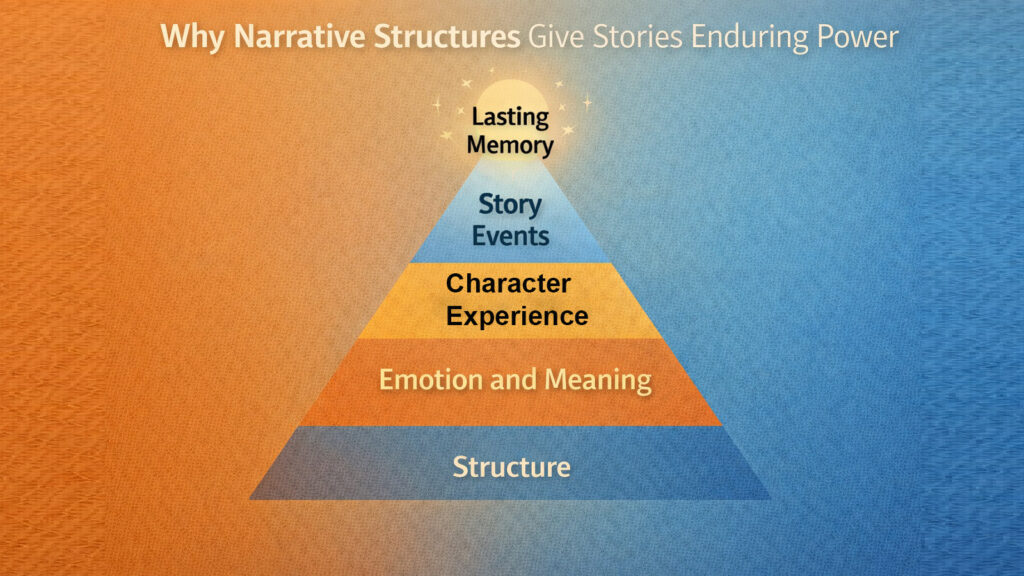
Narrative structures are not creative limits. They are stabilizing forces that allow meaning to emerge. Each structure explored here shapes emotion, attention, and understanding in distinct ways. The three-act framework provides intuitive progression. The four-act model examines consequences. The five-act design balances buildup with aftermath. Kishōtenketsu generates meaning through contrast. The Story Circle ties character growth to narrative motion. Non-linear timelines reshape how meaning is revealed. Parallel narratives create insight through juxtaposition. Nested stories add reflective depth.
These structures transcend culture, medium, and era because they respond to how humans process experience. We recognize patterns, anticipate outcomes, and find satisfaction in coherent design. Stories change endlessly in their content, but narrative structures provide continuity. They are the invisible architecture that makes stories feel complete rather than arbitrary.
Understanding narrative structures does not eliminate creativity. It channels it. Writers working within these frameworks make countless choices about character, language, detail, and tone. The structure simply ensures those choices cohere into something audiences can follow and remember. It is the difference between a pile of materials and a building.
Stories endure when they balance familiarity with surprise, when they manage expectations while delivering insight. Narrative structures make that balance possible. They are what readers remember long after details fade, the shape that lingers when the specifics blur. Structure is often what makes stories last in memory.
Narrative Structures: Applications and Enduring Strengths Across Formats
| Structure | Enduring Strength |
|---|---|
| Three-Act Structure | Intuitive progression that manages expectations across all formats |
| Four-Act Structure | Extended examination of consequences in episodic storytelling |
| Five-Act Structure | Emotional balance that prevents abrupt resolution |
| Kishōtenketsu | Meaning through observation rather than conflict |
| Story Circle | Character transformation linked to narrative journey |
| Non-Linear Timelines | Strategic revelation based on emotional impact |
| Parallel Narratives | Insight through comparison across multiple storylines |
| Nested Stories | Reflective depth through layered perspective on storytelling |