Table of Contents
Introduction: Storytelling Themes – Humanity’s Most Powerful Ideas
A mother holds her dying child in war-torn rubble. A lone traveler crosses frozen wasteland with nothing but willpower. A leader drowns in the corruption they once swore to fight. These moments live in our minds because they touch something deeper than plot. They reach the pulse of what makes us human.
Storytelling themes are the emotional and philosophical currents beneath every narrative worth remembering. They appear in cave paintings, ancient epics, modern films, and late-night conversations. Every culture shapes them differently, yet they remain constant. These themes act as emotional anchors, giving audiences something to hold when characters change and plots twist. They are psychological forces born from collective human experience.
Readers crave these storytelling themes because they reflect struggles we all face. Love leaves us vulnerable. Survival tests our limits. Power corrupts good intentions. Choice battles fate in every decision. These themes help us process our lives through the safety of fiction. They offer catharsis, insight, and connection.
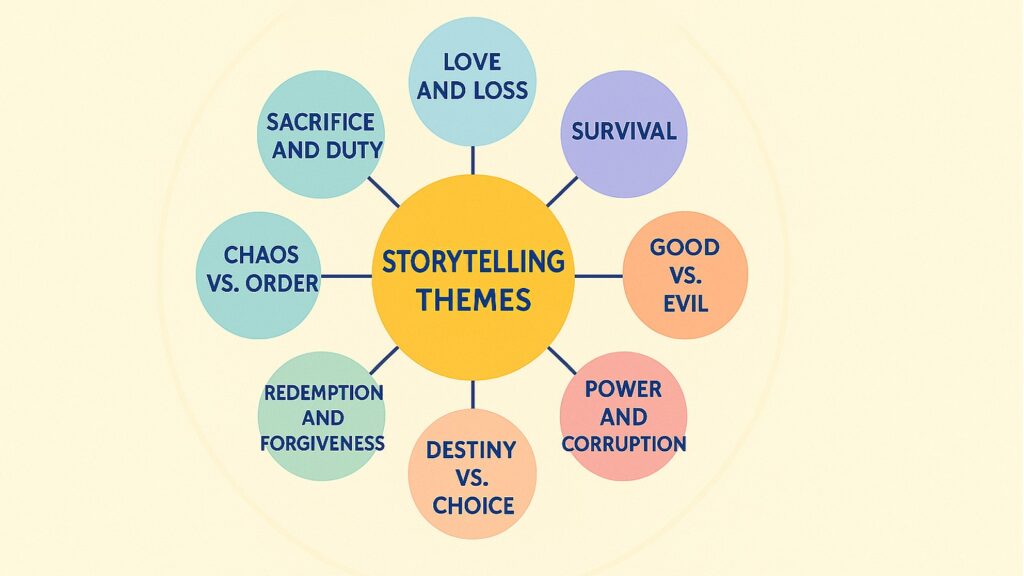
This article explores eight storytelling themes that shape narratives across every medium. Love and Loss shows the fragility of connection. Survival Against the Odds reveals resilience under pressure. Good vs. Evil provides moral frameworks. Power and Corruption exposes ambition’s dangers. Destiny vs. Choice questions our control. Redemption and Forgiveness offer healing paths. Chaos vs. Order frames the battle between structure and unpredictability. Sacrifice and Duty explores what we give up for something greater.
Overview of 8 Core Storytelling Themes
| Storytelling Themes | Core Appeal |
|---|---|
| Love and Loss | Explores emotional vulnerability and the transformative power of connection and separation |
| Survival Against the Odds | Taps into primal resilience through physical danger and psychological pressure |
| Good vs. Evil | Provides moral clarity exploring ethical conflicts reflecting societal values |
| Power and Corruption | Mirrors real systems examining how ambition and temptation erode integrity |
| Destiny vs. Choice | Questions human agency exploring tension between predetermined fate and free will |
| Redemption and Forgiveness | Offers emotional resolution through accountability, growth, and healing possibility |
| Chaos vs. Order | Frames conflict through opposing forces of unpredictability and structure |
| Sacrifice and Duty | Deepens moral stakes exploring the cost of loyalty and what characters surrender |
1. Storytelling Themes of Love and Loss: The Emotion That Shapes Every Tale
Love makes us vulnerable. It opens us to joy and devastation equally. This storytelling theme sits at the emotional core of human experience because attachment defines how we relate to the world. When a character loves, they create stakes. When they lose, they transform.
The theme works on multiple levels. Romantic love offers passion. Familial love provides belonging. Friendship creates loyalty. But loss arrives in many forms. Death takes loved ones permanently. Betrayal shatters trust. Distance erodes connection. Time changes people until they become strangers.
Romeo and Juliet uses love to create impossible choices and loss to deliver tragic catharsis. The Book Thief examines how love persists through unimaginable destruction. Modern films like Eternal Sunshine of the Spotless Mind question whether erasing painful memories makes us whole or hollow. The theme endures because everyone has loved something and everyone has lost.
Storytelling Themes: Notable Works Exploring Love and Loss
| Work | How the Theme Manifests |
|---|---|
| Romeo and Juliet | Forbidden love between feuding families leads to tragic deaths exposing hatred’s cost |
| The Book Thief | Young girl’s love for words and people endures despite losing everyone to war |
| Up | Widower’s journey to fulfill late wife’s dream explores moving forward after loss |
| Manchester by the Sea | Man paralyzed by grief faces his past loss while caring for orphaned nephew |
| Eternal Sunshine of the Spotless Mind | Characters attempt erasing lost love memories, questioning whether pain defines identity |
| Wuthering Heights | Obsessive love transcends death but creates destruction across generations |
2. Storytelling Themes of Survival Against The Odds: The Pulse of Human Resilience
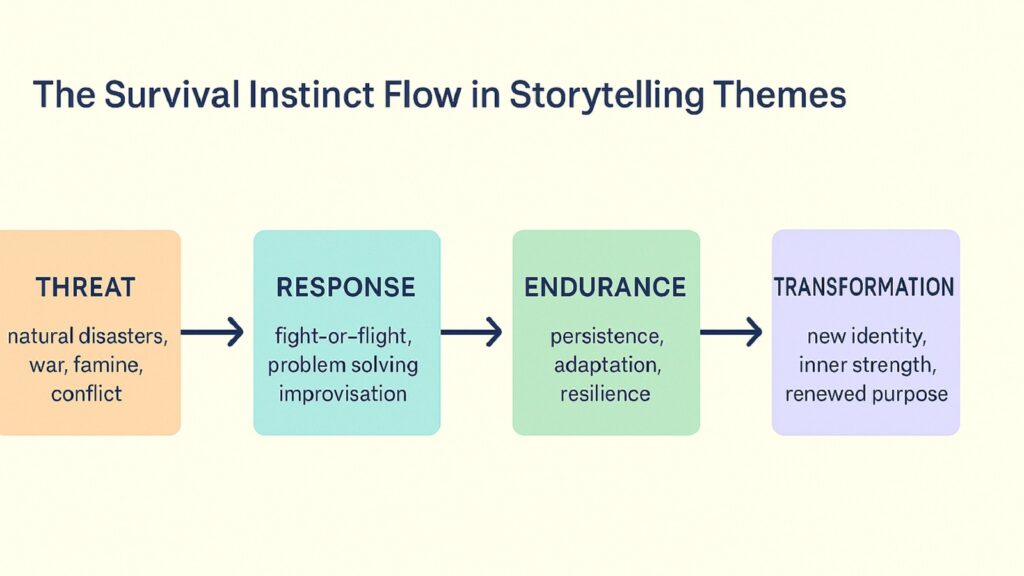
Strip away everything comfortable and watch what remains. The survival theme exposes human nature’s raw core under pressure. Danger sharpens focus. Scarcity reveals priorities. Uncertainty tests resolve. This theme forces characters to confront their most basic question: Will I endure?
Physical survival dominates many narratives. Natural disasters trap characters. War zones demand adaptation. Wilderness removes safety nets. The Revenant shows a man crawling through frozen wilderness, driven by revenge and the refusal to die. But survival extends beyond the physical. Characters fight to maintain identity in oppressive systems and preserve dignity when the world strips everything else.
Room explores a mother and son imprisoned in a shed for years. Their survival depends on creating meaning in a space designed to destroy them. The Martian blends physical and psychological survival as an astronaut stranded on Mars solves impossible problems. The Road presents a father and son crossing a post-apocalyptic wasteland where survival means preserving humanity itself.
Storytelling Themes: Survival Narratives Across Different Contexts
| Work | Survival Context |
|---|---|
| The Revenant | Frontiersman survives bear attack and brutal wilderness through sheer determination |
| 127 Hours | Hiker trapped by boulder amputates own arm testing physical and mental limits |
| Life of Pi | Boy survives 227 days adrift with Bengal tiger exploring faith and storytelling |
| The Road | Father and son traverse post-apocalyptic landscape preserving humanity and hope |
| Room | Mother and son imprisoned in shed develop resilience through routine and imagination |
| The Martian | Astronaut abandoned on Mars uses science and humor to survive impossible circumstances |
3. Storytelling Themes of Good vs. Evil: Crafting Moral Clarity in Complex Worlds
The battle between good and evil provides the clearest moral framework storytelling offers. This theme has evolved from stark contrasts to grey zones, but audiences still crave the underlying structure. Humans need ethical frameworks to navigate the world. Stories exploring good versus evil help us refine these categories.
Classic fairy tales used absolute clarity. Cinderella suffered under a cruel stepfamily before goodness was rewarded. Contemporary storytelling adds layers. The Dark Knight presents Batman and Joker as opposing philosophies rather than simple hero and villain. Batman believes in order within systems. Joker believes in exposing civilization’s chaos beneath.
Breaking Bad explores how good people become evil through incremental choices. Walter White’s descent happens gradually. Each choice seems justified alone. Together, they transform him completely. The story shows evil as a process rather than an inherent trait, making the theme more relevant to modern audiences who recognize morality’s shades of grey.
Storytelling Themes: Evolution of Good vs. Evil Across Eras
| Work | Moral Framework |
|---|---|
| Lord of the Rings | Clear battle between Sauron’s corrupting evil and diverse alliance fighting for freedom |
| Star Wars | Empire represents tyranny while rebels fight for justice and democracy |
| Harry Potter | Voldemort’s prejudice contrasts with Harry’s love and self-sacrifice |
| The Dark Knight | Batman and Joker represent order versus chaos questioning methods fighting evil |
| Breaking Bad | Good man transforms through incremental moral compromises and justifications |
| Schindler’s List | Flawed businessman becomes hero protecting Jews from Holocaust’s absolute evil |
4. Storytelling Themes of Power and Corruption: The Rise, the Fall, and the Cost
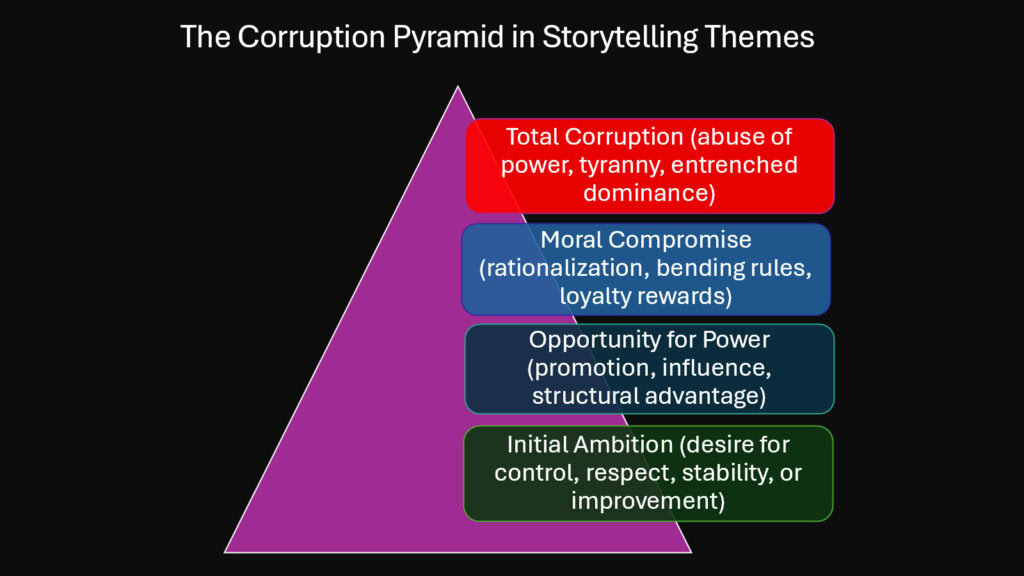
Power changes people. It amplifies flaws and creates new ones. This storytelling theme explores what happens when individuals or systems gain control and what they sacrifice to keep it. Ambition drives the climb. Temptation whispers during the reign. Moral erosion happens gradually. Downfall arrives inevitably.
Shakespeare’s Macbeth begins as a loyal general. Prophecy and ambition plant desire. His first murder costs him sleep and peace. Subsequent murders cost everything else. The play shows power as a corrosive force destroying from within. Modern narratives explore institutional corruption alongside individual failings. The Wire examines how power structures perpetuate themselves through politics, police, schools, and media.
The Godfather trilogy tracks how Michael Corleone transforms from war hero to crime lord. He takes power to protect his family, but loses them in the process. These stories resonate because they show power’s true cost. You might gain everything and lose what matters most.
Storytelling Themes: Power Dynamics and Corruption Across Narratives
| Work | Power and Corruption Arc |
|---|---|
| Macbeth | Loyal general becomes tyrannical king through prophecy, ambition, and escalating murder |
| The Godfather | War hero assumes crime empire gaining power while losing soul and relationships |
| House of Cards | Politician climbs to presidency through manipulation, betrayal, and ruthless pragmatism |
| Animal Farm | Revolutionary pigs become indistinguishable from oppressive humans they overthrew |
| The Wire | Baltimore institutions perpetuate corruption through self-interest across all power structures |
| Citizen Kane | Media mogul gains wealth and influence but dies alone betrayed by unchecked ambition |
5. Storytelling Themes of Destiny vs. Choice: The Battle Between Fate and Freedom
Are we authors of our lives or actors following a script written elsewhere? This storytelling theme explores human agency and its limits. Some narratives present destiny as inescapable. Others celebrate free will. Most interesting narratives exist in the tension between these extremes.
Greek tragedy used fate as an unstoppable force. Oedipus is given a prophecy stating that he will murder his father and wed his mother. Every choice to avoid this fate leads him directly toward it. His intelligence becomes a tool destiny uses against him. Contemporary storytelling brings modern anxieties. The Matrix presents reality as predetermined by machine algorithms. Neo must choose whether to accept this fate or fight for human freedom.
Arrival explores how knowing the future affects present choices. The protagonist gains the ability to see her entire timeline, but still chooses to live through painful events. This theme gains new relevance in an age of data prediction and algorithms. Stories exploring choice versus destiny help audiences think through how much freedom remains when systems predict and shape behavior.
Storytelling Themes: Destiny and Choice in Classic and Modern Works
| Work | Fate vs. Free Will Dynamic |
|---|---|
| Oedipus Rex | Protagonist’s attempts escaping prophecy lead directly to its fulfillment |
| The Matrix | Characters discover programmed reality but must choose between comfort and freedom |
| Arrival | Linguist gains ability seeing future but still chooses living through painful predetermined events |
| Harry Potter | Prophecy shapes expectations but Dumbledore emphasizes choices matter more than abilities |
| Dune | Paul Atreides sees multiple futures struggling with predestination versus personal agency |
| Groundhog Day | Man trapped repeating same day must choose growth over stagnation to break cycle |
6. Storytelling Themes of Redemption and Forgiveness: Healing the Wounds of a Story
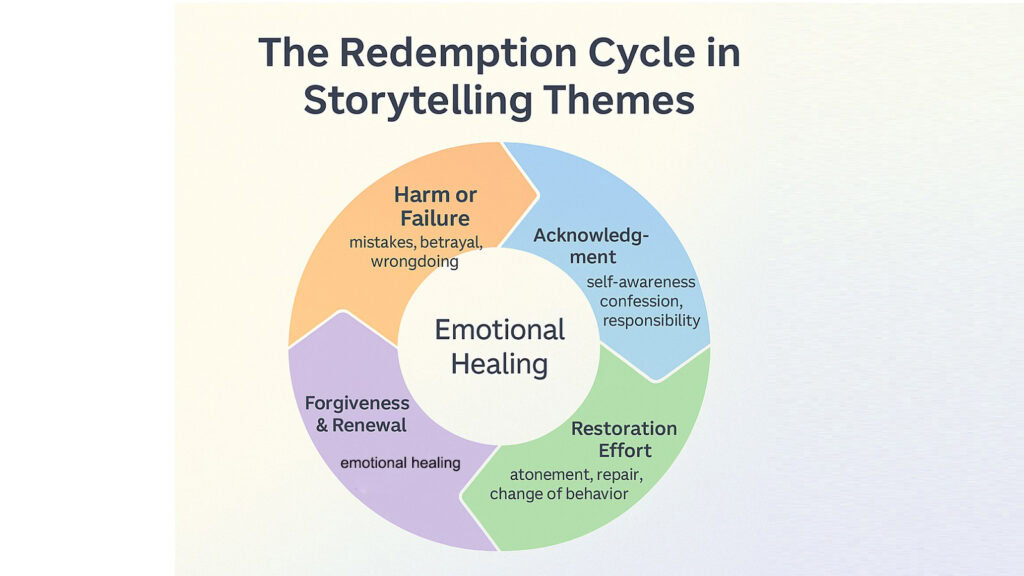
Can people change after doing terrible things? Should they be forgiven? This storytelling theme explores transformation possibility and the complex healing process. Redemption arcs trace how characters confront past mistakes and work toward becoming better. Forgiveness examines how those harmed choose to release resentment or withhold mercy.
Effective redemption requires several elements. The character must acknowledge wrongdoing honestly. They must accept consequences rather than evade them. They must demonstrate genuine change through actions. Scrooge in A Christmas Carol confronts the misery his greed caused. His transformation feels earned because he faces choices directly and commits to different behavior.
The Shawshank Redemption presents Red as a man who killed someone in his youth. His redemption happens through decades of small choices in prison. The film suggests redemption is not about erasing guilt but accepting it and choosing better. Avatar: The Last Airbender follows Prince Zuko’s redemption across three seasons. The story works because it shows redemption as messy, nonlinear, and requiring repeated choices.
Storytelling Themes: Redemption and Forgiveness Across Narratives
| Work | Redemption or Forgiveness Arc |
|---|---|
| A Christmas Carol | Miserly Scrooge confronts past, present, and future to transform into generous benefactor |
| Les Misérables | Ex-convict Jean Valjean receives mercy from bishop and spends life helping others |
| The Shawshank Redemption | Prisoners find redemption not through innocence but through hope and small dignities |
| Gran Torino | Racist veteran redeems himself by protecting immigrant family and sacrificing his life |
| The Kite Runner | Man returns to Afghanistan to rescue friend’s son seeking redemption for childhood betrayal |
| Avatar: The Last Airbender | Prince Zuko’s redemption unfolds through multiple betrayals and choices across seasons |
7. Storytelling Themes of Chaos vs. Order: The Struggle That Builds Worlds
The universe tends toward entropy. Humans build structures to resist it. This storytelling theme frames conflicts between opposing forces, shaping worlds and characters. Order represents law, stability, and control. Chaos represents freedom, wildness, and transformation. Most narratives position themselves along this spectrum, using the tension to drive plot and symbolism.
The theme works on multiple levels. Externally, it shapes worldbuilding. Civilizations create laws to impose order on a chaotic nature. Internally, it manifests in character psychology. Rational minds struggle against wild emotions. Lord of the Flies strips British schoolboys of civilization and watches order collapse into savagery. The conch shell represents democratic order. Its destruction symbolizes chaos’s triumph.
Blade Runner presents a future where corporate order towers above street-level chaos. The replicants represent chaos threatening artificial order. Modern superhero narratives often center on this theme. Batman represents order through justice. Joker represents pure chaos, seeking to prove that order is an illusion people abandon under pressure.
Storytelling Themes: Chaos and Order in World-Building and Character
| Work | Chaos vs. Order Dynamic |
|---|---|
| Lord of the Flies | Stranded boys’ democratic order collapses into tribal chaos and violence |
| The Dark Knight | Batman’s ordered justice confronts Joker’s nihilistic chaos and social experiments |
| Mad Max: Fury Road | Post-apocalyptic warlord’s brutal order challenged by rebels seeking freedom through chaos |
| 1984 | Totalitarian state imposes absolute order through surveillance eliminating individual chaos |
| Blade Runner | Corporate order towers over street chaos while replicants embody rebellion against programming |
| Princess Mononoke | Industrial civilization’s order conflicts with forest’s natural chaos seeking balance between forces |
8. Storytelling Themes of Sacrifice and Duty: The Weight That Creates Heroes
Heroes are defined not by what they gain but by what they give up. This storytelling theme explores the emotional weight of cost and obligation. Sacrifice means surrendering something valuable for a greater purpose. Duty means accepting responsibility regardless of personal desire. Together, these forces create moral complexity and emotional stakes that resonate deeply.
The theme works because life constantly demands sacrifice and duty from everyone. Parents sacrifice sleep and freedom for children. Soldiers accept a duty that might cost their lives. Caregivers surrender careers to tend to family members. These everyday sacrifices mirror grand gestures in epic narratives. The most powerful sacrifices are those characters make willingly, understanding the full cost.
In the Iliad, Hector fights for Troy despite knowing the city is doomed. His duty as a defender outweighs his desire to live peacefully with his wife and son. Harry Potter walks to his death to destroy Voldemort’s soul fragment within him. His willing sacrifice activates magic, protecting everyone else. The Lord of the Rings follows Frodo accepting the duty of carrying the Ring despite having no desire for heroism. His journey destroys him physically and emotionally.
Storytelling Themes: Sacrifice and Duty Across Heroic Narratives
| Work | Sacrifice and Duty Manifestation |
|---|---|
| The Lord of the Rings | Frodo accepts Ring burden despite having no desire for heroism sacrificing peace and health |
| A Tale of Two Cities | Sydney Carton sacrifices life for another man redeeming wasted existence through final noble act |
| Saving Private Ryan | Soldiers die fulfilling duty to rescue one man questioning whether mission justifies sacrifices |
| Harry Potter | Harry walks to death willingly to destroy Voldemort’s soul accepting ultimate sacrifice for others |
| Iliad | Hector defends doomed Troy from duty to city and family despite knowing he will die |
| Schindler’s List | Businessman sacrifices fortune to save Jewish workers transforming from profiteer to protector |
Conclusion: Storytelling Themes – What Makes These Ideas Immortal
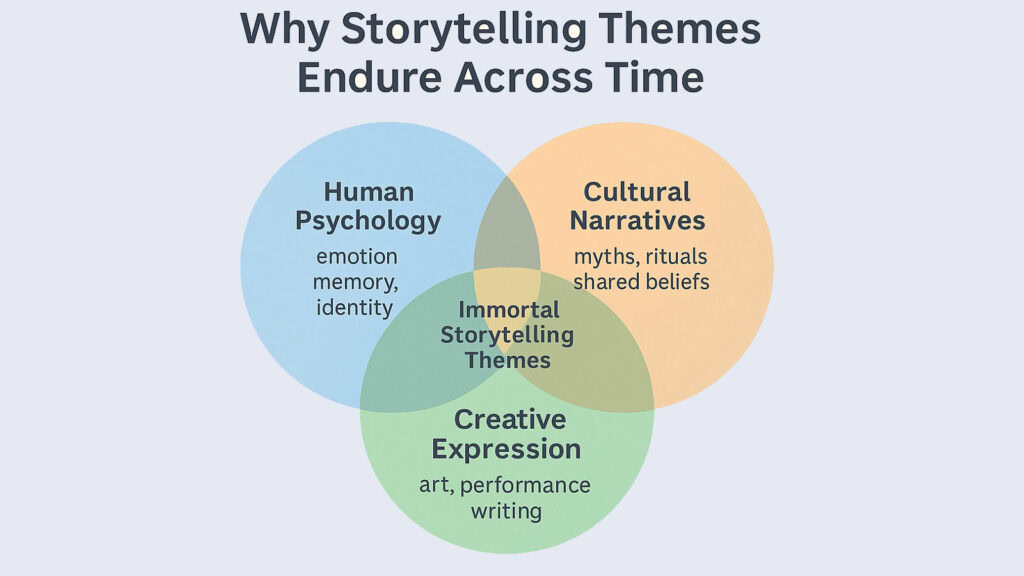
Stories fade, but these storytelling themes endure. Characters we loved decades ago blur in memory. Plot twists lose their power after the first telling. Yet fundamental themes continue shaping new narratives that feel as urgent as ancient myths. This endurance reveals something essential about human nature. We keep returning to the same conflicts because they reflect struggles we face in different forms.
These eight storytelling themes persist because they map human experience. Love and loss teach us about attachment and impermanence. Survival against odds shows resilience under pressure. Good versus evil provides a moral framework for navigating complexity. Power and corruption expose how ambition transforms people. Destiny versus choice questions our control. Redemption and forgiveness offer healing paths. Chaos versus order frames eternal tension between freedom and stability. Sacrifice and duty explore what we give up for something greater.
Audiences are drawn to these storytelling themes because they offer recognition and catharsis. When a story captures a theme authentically, we see ourselves reflected. The recognition provides comfort. We are not alone in our struggles. The catharsis comes from experiencing intense emotions safely. We feel grief without losing someone. We taste power’s corruption without sacrificing our integrity. Stories let us explore dangerous territory through narrative distance’s protection.
For creators, mastering these storytelling themes means understanding the emotional architecture that makes stories resonate. Surface plots can be infinitely varied. But the underlying theme provides emotional truth, making audiences care. When creators tap into these fundamental conflicts, they connect with something deeper than entertainment. They access collective human experience spanning cultures and centuries.
What makes these ideas immortal is simple. They are not inventions but discoveries. Storytellers did not create these themes. They recognized patterns in human life and reflected them back through narrative. As long as people love and lose, survive and struggle, choose and sacrifice, these themes will matter. They are immortal because we are mortal. They endure because they help us understand what it means to be human.
Storytelling Themes: Why These Universal Ideas Continue to Resonate
| Theme Quality | Why It Ensures Longevity |
|---|---|
| Universal Human Experience | Themes reflect conflicts and emotions everyone faces regardless of time or culture |
| Emotional Recognition | Audiences see themselves in themes finding comfort in shared struggles and safe exploration |
| Adaptable to Context | Themes transfer across genres, settings, and eras while maintaining emotional truth |
| Psychological Depth | Themes map fundamental psychology aspects remaining constant despite changing circumstances |
| Combinable and Layered | Themes interact and complement creating complex narratives rewarding repeated engagement |
| Reflect Life Patterns | Themes are discovered rather than invented mirroring actual patterns in human existence |
Read More Storytelling Articles
- 6 Powerful Story Archetypes That Inspire Creativity
- 8 Storytelling Psychologies to Elevate Creative Edge
- 6 Wild Ways the Unreliable Narrator Breaks Reality
- 6 Amazing Ways Chekhov’s Gun Reloads Narrative Power
- Top 6 Ways ‘In Medias Res’ Rewires Narrative Gravity
- Top 6 Ways ‘In Medias Res’ Rewires Narrative Gravity
- 6 Amazing Ways Narrative Tone Shapes Soul Of A Story
- 6 Ways Narrative Resolution Brings Psychological Closure