Table of Contents
Introduction: What a Successful Business Owner Must Grow Into
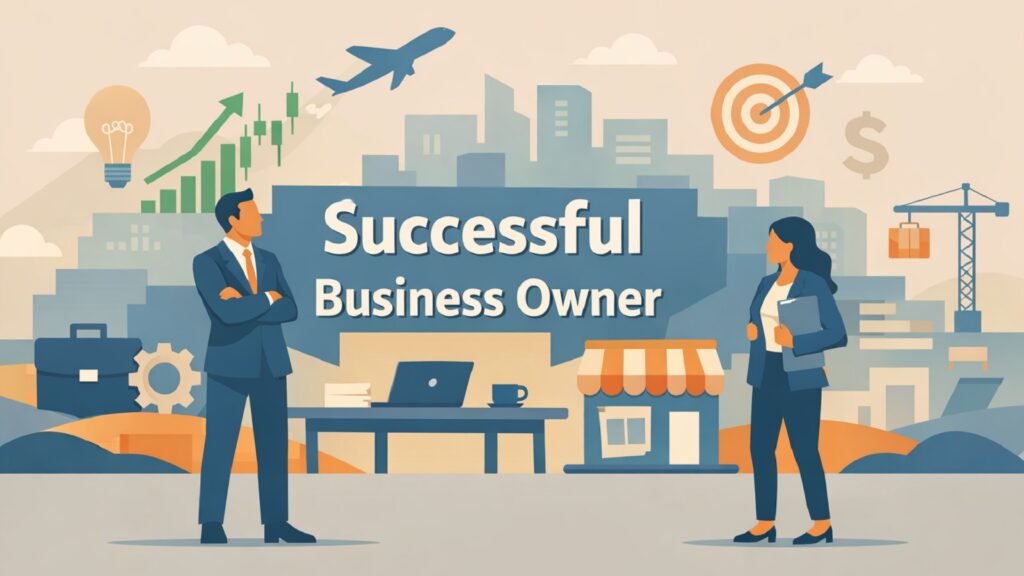
Success in business ownership is not a technique you master or a system you install. It is a series of internal changes that happen slowly, often painfully, and always through consequence. A successful business owner is not someone who found the right corporate strategy or read the right books. They are someone who changed how they think when everything felt uncertain.
Most writing about entrepreneurship focuses on what to build. This article focuses on who you must become to keep building. The business you own will demand things from you that no course prepared you for. It will ask you to decide when you do not have enough information. It will test whether you can lead when you are afraid. It will show you the difference between activity and progress, between motion and direction.
The mindset shifts that follow are not motivational. They are structural. They describe how thinking changes when responsibility becomes real and sustained. Each shift represents a move away from instinct and toward deliberate ownership. These are not traits you are born with. They are capacities you develop because the business forces you to.
What makes someone a successful business owner is not genius or luck. It is how they handle pressure over time. It is their ability to absorb uncertainty without losing clarity. It is their willingness to step back when stepping forward feels more natural. These shifts are hard-won and rarely celebrated. But they are what separate someone who runs a business from someone who owns one.
Successful Business Owner Mindset Foundations vs. Common Entrepreneur Assumptions
| Mindset Foundation | Common Assumption |
|---|---|
| Decision quality improves through repeated exposure to consequence and reflection on outcomes | Decisions improve through confidence and faster execution |
| Leadership emerges when personal execution becomes a constraint on organizational growth | Leadership means working harder and setting the example through personal output |
| Accountability means owning outcomes even when external factors played a role | Accountability means accepting blame when things go wrong |
| Long-term thinking requires making decisions today that create options tomorrow | Long-term thinking means having a vision and strategic planning |
| Emotional regulation is a learned skill developed through pattern recognition and self-awareness | Emotional control is a personality trait some people have naturally |
| Stepping back creates space for systems and people to reveal their actual capacity | Stepping back means delegating tasks you do not want to do |
1. Successful Business Owner Learns Decision Quality Under Pressure
The defining characteristic of a successful business owner is not how fast they decide or how confident they appear. It is the quality of their decisions when conditions are unclear and consequences are real. Pressure does not create poor thinking. It exposes thinking that was already shallow or reactive. What separates owners from operators is their ability to maintain decision-making quality when everything around them is moving.
Most people confuse decisiveness with good judgment. They believe that choosing quickly or committing fully is the same as choosing well. But speed without structure is just motion. A successful business owner learns to slow down internally even when external conditions demand speed. They create space between stimulus and response. They ask what they do not know before they act on what they think they know.
Decision quality under pressure requires recognizing when you are operating from fear, ego, or the need to appear in control. These forces distort judgment quietly. They make options seem binary when they are not. They make timing feel urgent when it is not. A successful business owner develops the ability to notice when their thinking is being compressed by emotion rather than informed by reality.
Incomplete information is the norm, not the exception. Owners who wait for certainty never move. Owners who move without reflection never improve. The skill is learning to decide with what you have while acknowledging what you do not have. This means understanding the difference between a reversible decision and an irreversible one. It means knowing when delay costs more than action, and when action costs more than patience.
Research from Harvard Business School examining decision-making patterns among business leaders found that high-performing owners consistently distinguished between decisions that could be undone and those that could not. They moved faster on reversible choices and slower on structural ones. This separation allowed them to maintain momentum without creating irreversible mistakes.
A successful business owner also learns to work with trade-offs rather than trying to eliminate them. Every decision has a cost. Choosing one path means closing another. Maturity shows up in how clearly you see what you are giving up, not in how optimistic you are about what you are gaining. When you can name the trade-off out loud, your thinking becomes more honest. When your thinking becomes more honest, your decisions improve.
Successful Business Owner Decision Framework Under Pressure
| Decision Dimension | Owner Approach |
|---|---|
| Information Completeness | Distinguishes between critical missing data and nice-to-have context before acting |
| Reversibility Assessment | Evaluates whether the decision can be undone or adjusted after implementation |
| Emotional State Awareness | Checks whether fear, ego, or urgency is compressing judgment before committing |
| Trade-Off Visibility | Names what is being sacrificed or delayed to make the chosen path possible |
| Consequence Horizon | Considers both immediate effects and second-order outcomes across time |
| Internal Calm Maintenance | Creates mental space between pressure and response to preserve thinking quality |
2. Successful Business Owner Transitions From Doer to Leader to Allocator
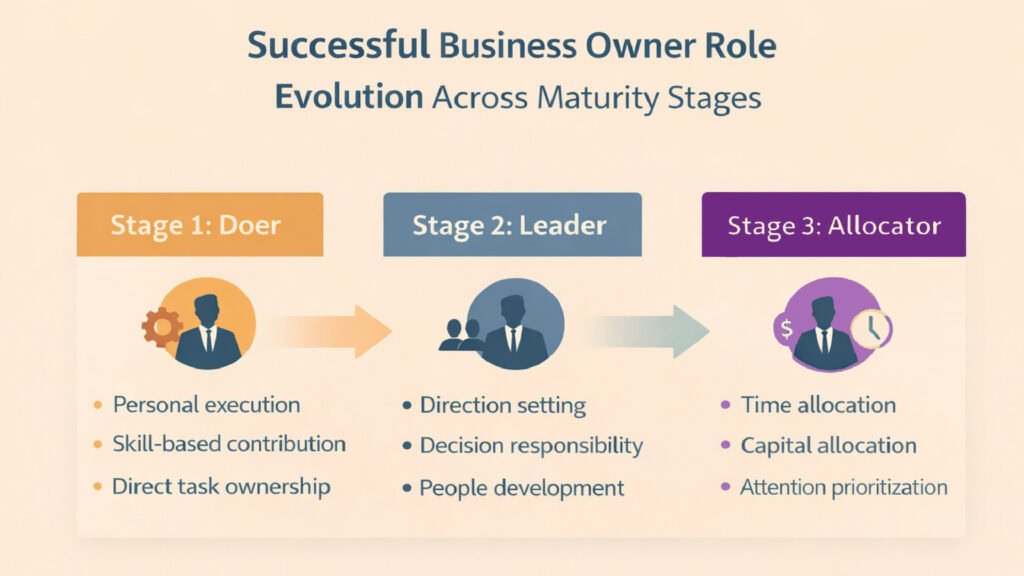
The hardest shift in ownership is moving away from being the person who does the work. Early in building a business, execution is everything. You survive by being good at the work itself. But a successful business owner eventually realizes that personal excellence becomes a ceiling. What got you here will not get you further. The identity that built the business can also trap it.
This transition happens in stages. First, you move from doer to leader. You learn to get work done through others instead of doing it yourself. This feels unnatural. You are often faster, better, or more thorough than the people you hire. Watching someone do your work less well than you would is painful. But staying excellent at execution means the business cannot grow past your personal capacity.
Leadership is not about charisma or inspiration. It is about creating conditions where others can perform without your direct involvement. A successful business owner learns to define outcomes clearly, provide context without micromanaging, and trust people to solve problems their own way. This requires letting go of how things get done and focusing on whether they get done.
Many aspiring entrepreneurs stall here. They build a business that runs on their effort and then wonder why it feels fragile. They hire people but cannot stop checking their work. They delegate tasks but not decisions. They say they want to scale but they optimize for control. A successful business owner recognizes this pattern and forces themselves to step back even when it feels risky.
The next stage is moving from leader to allocator. This means your primary job becomes deciding where time, money, and attention go. You are no longer leading projects. You are choosing which projects matter. You are not solving problems. You are deciding which problems to solve first. Your output is no longer tasks completed. It is leverage created.
Allocation is a different skill from leadership. It requires seeing the business as a system rather than a collection of tasks. It means understanding that your constraints are not time or energy but attention and capital. A successful business owner learns to ask whether adding more effort to something will produce meaningful returns or just create more activity. They learn to starve low-leverage work even when it feels productive.
This shift is about identity, not delegation. It is about accepting that your value comes from where you point the business, not from how hard you work inside it. Research from McKinsey on scaling businesses found that founders who successfully transitioned to allocator roles spent less than twenty percent of their time on execution and more than fifty percent on strategic resource decisions. Those who remained doers saw business growth plateau within three years.
Business Owner Role Evolution Across Growth Stages
| Ownership Stage | Primary Focus |
|---|---|
| Early Stage Doer | Executes tasks directly, solves immediate problems, generates revenue through personal effort |
| Emerging Leader | Trains others, sets standards, manages workflows, begins delegating execution |
| Established Leader | Builds systems, creates accountability structures, removes blockers for team performance |
| Transitioning Allocator | Evaluates competing priorities, assigns capital and attention, decides what not to do |
| Mature Allocator | Shapes business direction, identifies leverage points, creates optionality for future decisions |
| Ownership Sustainer | Protects organizational culture and values, ensures business can operate independently of founder |
3. Successful Business Owner Accepts Accountability Without Comfort
Accountability is not about blame. It is about owning outcomes even when factors outside your control played a role. A successful business owner absorbs consequences that others cannot or should not carry. This is not noble. It is structural. The person with the most control must also carry the most weight.
Many people confuse accountability with guilt. They think owning a mistake means feeling bad about it. But guilt is internal and backward-looking. Accountability is external and forward-focused. It means acknowledging that something went wrong, understanding why, and taking responsibility for what comes next. A successful business owner does not dwell on how they feel about failure. They focus on what they will do because of it.
There are moments in ownership where no option feels good. Every choice has a cost. Someone will be disappointed or hurt regardless of what you decide. Comfort cannot be the filter. A successful business owner learns to act on what is necessary rather than what feels right. This does not mean being cold. It means being clear about whose responsibility it is to carry the decision.
Accountability also means accepting that the business reflects your decisions over time. If the culture is toxic, you allowed it. If the team is underperforming, you built it. If the strategy is not working, you chose it. These are hard truths. A successful business owner does not deflect them. They use them to improve.
This mindset separates ownership from employment. Employees can point to external factors when things fail. Owners cannot. The business is yours. The results are yours. The consequences are yours. This is the cost of control. You get to decide what the business does, but you also own what the business becomes.
Research from Stanford on founder resilience found that business owners who maintained high accountability without self-blame recovered from setbacks forty percent faster than those who either deflected responsibility or personalized failure. Accountability without comfort created clarity. Clarity enabled faster adjustment.
A successful business owner also learns to communicate accountability to others without creating fear. When something goes wrong, they name it clearly, own their part, and focus the team on correction rather than blame. This creates a culture where problems surface early instead of being hidden. People trust leaders who absorb consequences instead of distributing them downward.
Accountability Principles in Practice
| Accountability Situation | Owner Response |
|---|---|
| Revenue Target Missed | Owns outcome publicly, analyzes structural causes, adjusts strategy without blaming external conditions |
| Key Employee Departure | Acknowledges role in hiring or culture fit, focuses on what system failed, improves retention approach |
| Product Failure in Market | Takes responsibility for decision to launch, examines assumptions that were wrong, communicates learning |
| Client Relationship Lost | Accepts that business did not deliver value, identifies service gaps, implements changes to prevent recurrence |
| Financial Stress Period | Recognizes spending or pricing decisions that created exposure, communicates transparently with stakeholders |
| Team Conflict Escalation | Owns failure to address early warning signs, takes action to resolve, creates clearer expectations going forward |
4. Successful Business Owner Thinks Long Term While Acting Today
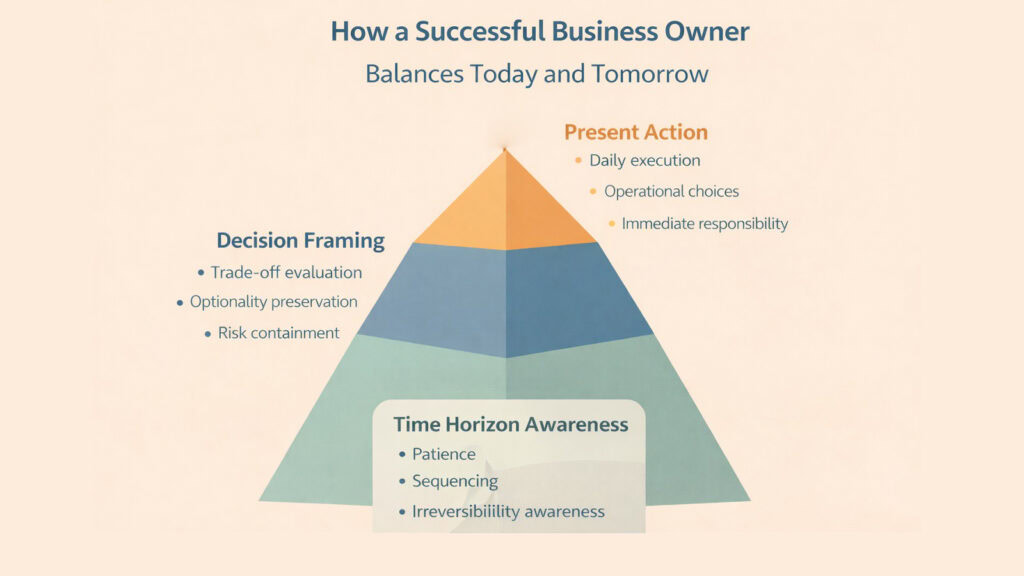
Long-term thinking is not about having a vision. It is about making decisions today that create options tomorrow. A successful business owner operates with a different time horizon than most people around them. They see the business as something that will outlast current conditions. This changes how they allocate resources, build relationships, and respond to short-term pressure.
The challenge is that long-term value rarely feels urgent. Immediate problems demand attention. Fires need to be put out. Opportunities need seizing. A successful business owner learns to protect long-term priorities even when short-term demands are screaming. This requires discipline. It requires saying no to things that would help now but hurt later.
Long-term thinking shows up in how you handle decisions that cannot be undone easily. Recruitment, partnerships, capital structure, and cultural norms compound over time. A bad hire today becomes a team problem in six months. A partnership formed for convenience today becomes an operational constraint in two years. A successful business owner evaluates these decisions differently. They ask what they are locking in, not just what they are gaining.
Delayed rewards are a test of ownership maturity. Building systems, developing people, and strengthening infrastructure all take time to pay off. They do not produce immediate results. Many entrepreneurs abandon these investments because the return feels too distant. A successful business owner understands that the most valuable things in business require patience. They invest in capacity even when it does not show up on this quarter’s numbers.
Research from the Journal of Business Venturing found that businesses with owners who maintained investment in internal capability during growth periods showed thirty-five percent higher resilience during market downturns compared to businesses optimized purely for short-term revenue. Long-term structure created flexibility when conditions changed.
A successful business owner also learns to sequence decisions based on what creates future optionality. Some choices open doors. Others close them. Some decisions are reversible. Others are not. Thinking long term means understanding which type of decision you are making and acting accordingly. It means preserving flexibility when you can and committing fully when you must.
This mindset also applies to how you handle success. Short-term wins can create long-term problems if they are not managed carefully. Rapid growth can mask structural weakness. A successful business owner tempers expansion with sustainability. They ask whether the business can handle what comes next, not just whether it can capture what is here now.
Business Owner Long-Term Decision Criteria
| Decision Type | Long-Term Consideration |
|---|---|
| Team Building | Evaluates whether hire improves organizational capability or just fills immediate gap |
| Strategic Partnership | Assesses whether relationship creates dependency or genuine mutual value over multiple years |
| Capital Allocation | Considers whether spending builds enduring asset or addresses temporary need |
| Market Positioning | Examines whether approach creates defensible differentiation or exploits short-term arbitrage |
| Systems Investment | Determines whether infrastructure enables scale or just automates current state |
| Cultural Decisions | Weighs whether choice reinforces desired long-term norms or solves immediate friction |
5. Successful Business Owner Regulates Emotion Before Scaling Action
Emotional regulation is not a personality trait. It is a performance requirement. As a business scales, the cost of emotional decision-making increases. Fear, ego, urgency, and the need for validation distort judgment in predictable ways. A successful business owner learns to create internal stability before pursuing external growth. This is not about suppressing emotion. It is about not letting emotion drive strategy.
Fear makes everything feel urgent. It compresses time horizons and makes bad options look necessary. A successful business owner learns to recognize fear-driven thinking and pause before acting on it. This does not mean ignoring real threats. It means distinguishing between fear as information and fear as distortion. Fear tells you something might matter. It does not tell you what to do about it.
Ego works differently. It makes you defend decisions you should reconsider. It makes criticism feel like an attack. It makes admitting mistakes feel like weakness. A successful business owner learns to separate their identity from their choices. The business is not you. A failed strategy does not make you a failure. This distance allows you to change course without feeling like you are betraying yourself.
Urgency is the most socially acceptable emotion in business. It feels like momentum. But urgency often hides the absence of clarity. When you do not know what to do, doing something fast feels better than doing nothing. A successful business owner learns to slow down when urgency spikes. They ask whether the speed is real or whether it is just discomfort with uncertainty.
Validation-seeking shows up as needing others to agree with your decisions before you trust them. It shows up as over-explaining choices or constantly checking whether people think you are doing well. A successful business owner learns to make decisions based on their own judgment and then communicate them clearly. They do not need a consensus to act. They need clarity.
Research from the Center for Creative Leadership found that business leaders with higher emotional regulation scores made decisions that were twenty-eight percent more consistent with stated strategic priorities compared to leaders with lower regulation. Emotional stability translated directly into strategic coherence.
Emotional regulation also affects how you lead others. Teams take cues from the owner. If you are reactive, they become reactive. If you are steady, they can be steady. A successful business owner understands that their internal state becomes the team’s external environment. This is not about performing calmly. It is about being calm enough to think clearly under pressure.
The skill is not eliminating emotion. It is creating space between feeling and action. You feel fear. You notice it. You decide whether to act on it. You feel excited about an opportunity. You notice it. You evaluate the opportunity based on fit, not feeling. A successful business owner learns to observe their own reactions without being controlled by them.
Business Owner Emotional Regulation Practices
| Emotional Trigger | Regulation Response |
|---|---|
| Sudden Market Threat | Pauses before reacting, separates actual risk from fear amplification, evaluates response options systematically |
| Competitor Success | Acknowledges ego response, focuses on own strategic path rather than reactive positioning |
| Internal Crisis Event | Maintains steady communication tone, addresses problem directly without panic signaling to team |
| Unexpected Opportunity | Delays commitment until excitement subsides, evaluates against existing priorities and resource reality |
| Critical Feedback Received | Creates space before responding, examines validity of criticism separate from emotional reaction |
| Pressure to Decide Quickly | Questions urgency source, determines whether speed serves strategy or just relieves discomfort |
6. Successful Business Owner Learns When to Step Back Instead of Doing More
Doing more work often hides structural problems. When revenue slows, the instinct is to work harder. When quality drops, the instinct is to check everything yourself. But more effort applied to a broken system just entrenches the problem. A successful business owner learns to step back and examine what is actually wrong before adding more activity.
Stepping back does not mean disengaging. It means creating space for others to operate, decide, and grow. Many owners say they want their team to take ownership but then insert themselves into every decision. They say they trust people, but then check their work constantly. A successful business owner learns the discipline of non-interference. They let people make mistakes that can be recovered from. They let problems surface instead of preventing them.
This is hard because stepping back feels like losing control. It feels like the business might drift without your constant input. But the opposite is true. Businesses become fragile when they depend entirely on the owner’s presence. A successful business owner builds systems and develops people specifically so the business can function without them always being involved.
The skill is knowing which problems require your involvement and which do not. Some decisions only you can make. Some problems only you should solve. But most of what happens in the business can and should be handled by others. A successful business owner learns to distinguish between their unique contribution and work that feels important but is not.
Stepping back also reveals what is actually working. When you are doing everything, you cannot see where the system is strong or weak. When you remove yourself, gaps become visible. People who cannot perform without supervision reveal themselves. Processes that only work when you oversee them reveal themselves. This information is valuable. It tells you where to build capacity rather than where to add effort.
Research from the MIT Sloan School of Management on organizational scalability found that businesses where founders successfully delegated operational authority grew revenue at twice the rate of businesses where founders remained operationally central. Stepping back created leverage. Staying involved created bottlenecks.
A successful business owner also learns that their presence can prevent growth in others. When you are always available to solve problems, people stop solving them. When you always have the answer, people stop thinking. Leadership development requires space. People grow into responsibility when they have no choice but to carry it.
This mindset shift is about sustainability. You cannot work at maximum capacity forever. A successful business owner builds a business that can endure their absence, whether temporary or permanent. This requires trust, systems, and the willingness to let the business be less perfect in exchange for being more resilient.
Successful Business Owner Strategic Withdrawal Framework
| Withdrawal Situation | Owner Action |
|---|---|
| Operational Decision | Defines decision framework and authority boundaries, then allows team to execute without approval |
| Performance Issue | Coaches team lead to address problem directly rather than stepping in to fix |
| Client Relationship | Transitions ownership of relationship to account manager while remaining available for escalation only |
| Process Improvement | Provides resources and direction, then lets team design and implement solution |
| Strategic Initiative | Sets objectives and success criteria, empowers leader to determine approach and tactics |
| Crisis Response | Clarifies non-negotiables and final accountability, delegates immediate action to appropriate team member |
Conclusion: Why a Successful Business Owner Is Built, Not Found
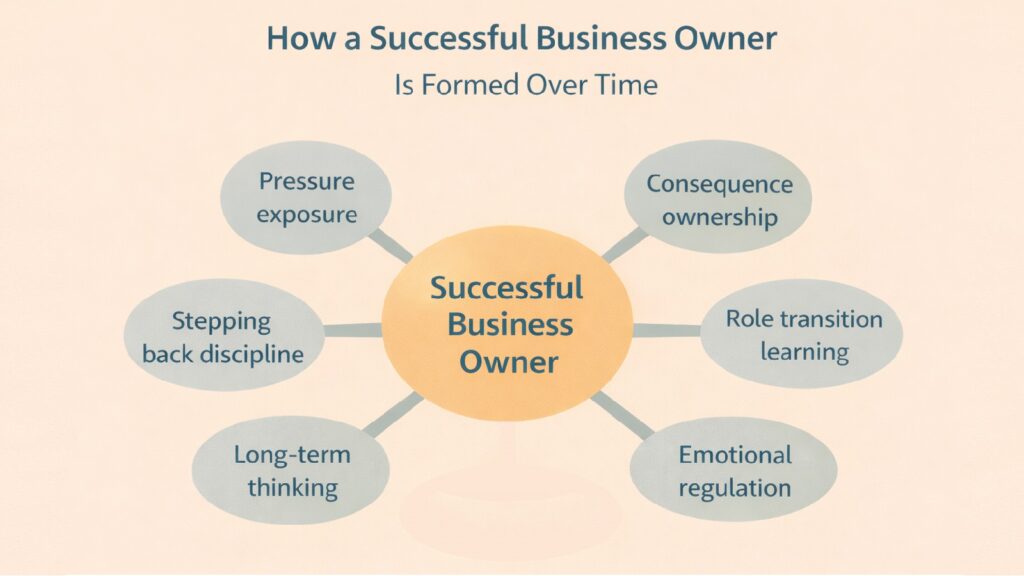
No one starts as a successful business owner. You become one through repeated exposure to consequence, responsibility, and resistance. The business itself is the training ground. It forces you to change or fail. Every decision that went wrong taught you something. Every crisis you survived made you steadier. Every time you had to step back, you learned what business leadership actually required.
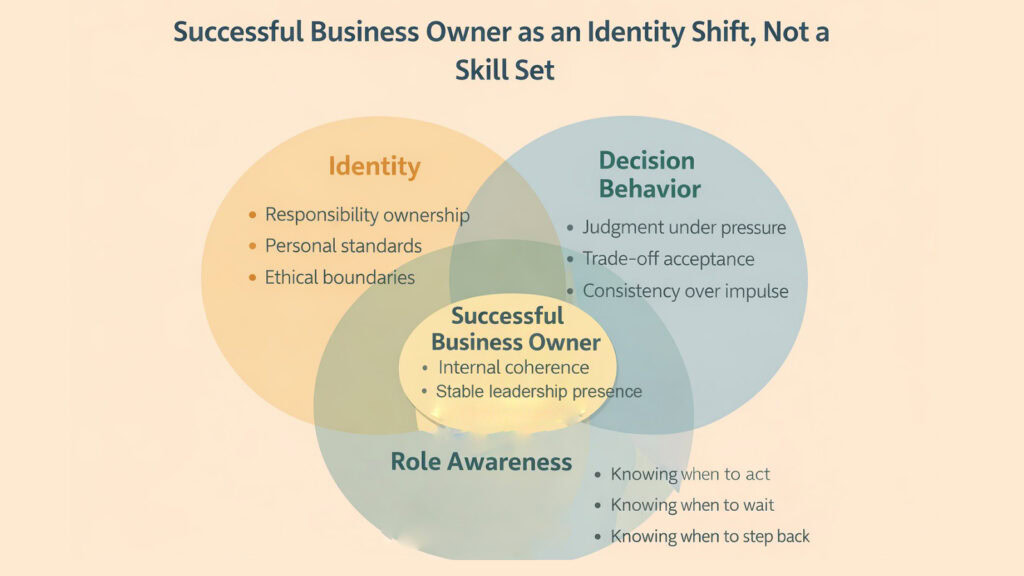
The six mindset shifts in this article are not separate habits. They form a coherent identity. Decision quality under pressure requires emotional regulation. Long-term thinking requires stepping back from urgency. Accountability without comfort requires transitioning from doer to allocator. These shifts reinforce each other. They build on each other. Together, they describe what ownership looks like when it matures.
Success is not something you achieve and then possess. It is something you maintain through continued evolution. The business will keep testing whether you can think clearly, lead steadily, and absorb uncertainty. Your job is to keep getting better at those things. Not perfect. Just better than you were.
A successful business owner is not defined by luck or talent. They are defined by how they handled the moments when everything felt uncertain. They are defined by their willingness to change how they think when their old thinking stops working. They are defined by their ability to own the business rather than just run it.
The business you are building reflects the owner you are becoming. If you want the business to be sustainable, you must be sustainable. If you want the business to be resilient, you must be resilient. If you want the business to grow, you must grow. This is not motivational language. This is a mechanical truth.
What separates someone who survives in business from someone who builds something lasting is not their initial idea or their market timing. It is their internal development over time. It is their capacity to absorb complexity without losing clarity. It is their willingness to step back when every instinct says to do more. It is their commitment to becoming the owner their business requires rather than staying the person they were comfortable being.
These shifts are not fast. They are not easy. But they are what make ownership real. You are not born a successful business owner. You are built into one by the business you chose to own.
Successful Business Owner Development Markers Across Ownership Journey
| Development Marker | Evolution Pattern |
|---|---|
| Decision Basis | Moves from intuition and urgency to pattern recognition and finally to systems thinking with long-term consequence awareness |
| Primary Value Add | Transitions from personal execution and technical skill to team leadership and eventually to resource allocation and strategic direction |
| Accountability Scope | Expands from personal results and immediate outcomes to team performance and ultimately to organizational health across multiple years |
| Time Horizon | Extends from this month and quarter to this year and next year and eventually to three to five years and beyond |
| Emotional Baseline | Progresses from reactive to conditions and feedback to increasingly stable with occasional spikes and finally to consistently regulated even under sustained pressure |
| Operational Involvement | Reduces from hands-on with most functions to selective involvement in critical areas and ultimately to primarily strategic with minimal daily operations |