Table of Contents
Introduction: Why Survival Against The Odds Shapes Our Deepest Stories
A man clings to a raft in the Pacific. A woman walks through frozen tundra with nothing but a lighter. A child hides in a cupboard while bombs fall outside. These moments pull us in because they touch something ancient in our bones. Survival Against The Odds is not just a theme. It is the heartbeat of storytelling itself. Before we had written language, we gathered around fires to share tales of hunters who faced wolves, travelers who crossed deserts, and families who endured winters that killed their neighbors.
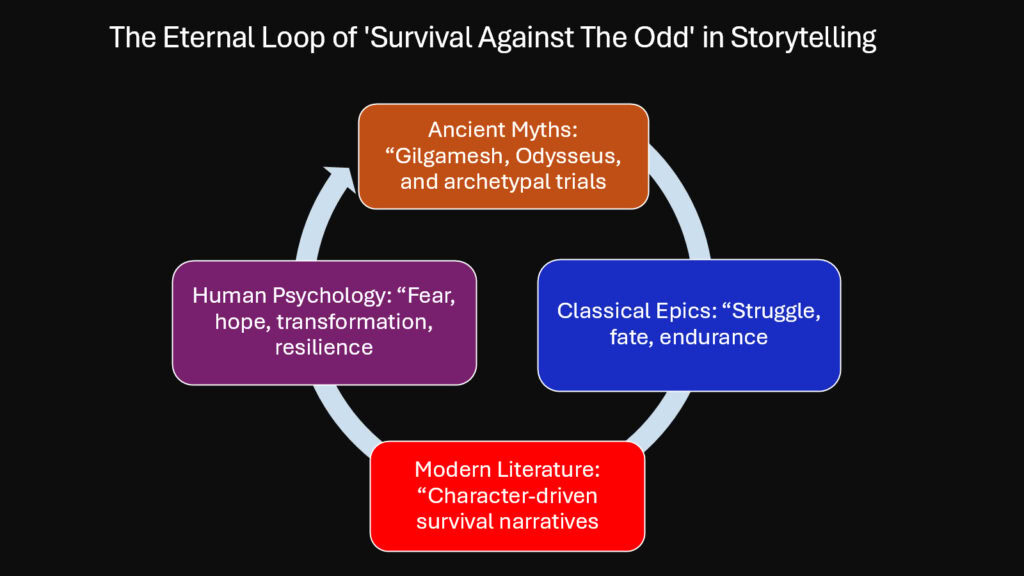
This theme appears everywhere in literature because it reflects our most fundamental question: what happens when everything falls apart? The Epic of Gilgamesh shows us a king confronting his mortality. Homer’s Odyssey follows a warrior trying to reach home against divine interference. Jack London’s stories place humans against brutal wilderness. Cormac McCarthy’s The Road imagines a father and son walking through ash and ruin. Each of these works uses Survival Against The Odds to explore fear, hope, resilience, and what it means to remain human when the world strips everything away.
Psychologists have found that survival stories activate our threat detection systems while also triggering hope and empathy. We read them to understand our own fears. We watch characters endure impossible situations and wonder if we could do the same. This theme transforms readers into participants. It asks them to consider their own breaking points and hidden strengths. That’s why Survival Against The Odds stories feel so urgent and personal.
This article offers six insights for writers who want to harness this primal storytelling engine. These insights go beyond action sequences and plot mechanics. They explore how instinct shapes tension, how emotion drives character change, how environments become antagonists, how impossible choices reveal truth, how symbols carry hope, and how the aftermath completes the narrative arc. Understanding these elements helps writers create stories that resonate across cultures and generations.
Survival Against The Odds Compared to Other Major Storytelling Themes
| Storytelling Themes | Core Narrative Function |
|---|---|
| Survival Against The Odds | Tests physical and psychological limits through external and internal threats |
| Love and Loss | Explores connection, vulnerability, and the pain of separation or death |
| Good vs. Evil | Examines moral absolutes and the conflict between opposing forces |
| Power and Corruption | Reveals how authority changes individuals and corrupts institutions |
| Destiny vs. Choice | Questions free will and whether our paths are predetermined |
| Redemption and Forgiveness | Follows characters seeking atonement or learning to release resentment |
| Chaos vs. Order | Investigates the tension between structure and unpredictability |
| Sacrifice vs. Duty | Explores what characters give up for loyalty, honor, or obligation |
1. Survival Against The Odds and the Power of Primal Human Instinct
When a character faces a life-threatening situation, their body responds before their mind catches up. Heart rate spikes. Pupils dilate. Muscles tense. This physiological response is millions of years old. Writers who understand how instinct works can create moments that feel visceral and true. Survival Against The Odds stories gain power when they tap into these automatic reactions rather than relying only on conscious decision-making.
Fight, flight, and freeze are not choices. They are reflexes. A character might run without thinking when they hear footsteps behind them. Another might freeze when confronted by a predator, not from cowardice but because their nervous system has chosen immobility as a survival strategy. A third might attack when cornered, driven by adrenaline and panic. These instinctive responses create natural story tension because they bypass rational thought. Characters act before they can second-guess themselves, which leads to mistakes, revelations, and unpredictable outcomes.
Ernest Hemingway understood this deeply. His short story “The Short Happy Life of Francis Macomber” shows a man’s instinctive fear during a lion hunt, then his transformation when instinct shifts from flight to fight. The change happens in his body first, then his psychology. Yann Martel’s Life of Pi depicts a boy who must override his vegetarian instincts to kill fish and survive at sea. His body learns what his mind resists. These stories work because they honor how humans actually respond under extreme pressure.
Writers should remember that instinct often conflicts with survival knowledge. A drowning person instinctively thrashes, which speeds up drowning. Someone lost in the wilderness might run in panic rather than stay still and conserve energy. This gap between instinct and optimal strategy creates rich material for character development. The protagonist must learn to recognize their automatic responses and sometimes override them. That internal battle makes Survival Against The Odds stories psychologically complex rather than simple action sequences.
Survival Against The Odds: Instinctive Responses in Literature
| Instinct Type | Narrative Application |
|---|---|
| Fight Response | Character confronts threat directly, revealing courage or recklessness |
| Flight Response | Character escapes danger, showing self-preservation or strategic retreat |
| Freeze Response | Character becomes immobile, creating vulnerability or camouflage |
| Fawn Response | Character appeases threat, demonstrating adaptation or manipulation |
| Hunger Drive | Character risks safety for food, showing desperation or poor judgment |
| Protective Instinct | Character shields others, exposing their values and priorities |
2. Survival Against The Odds Through Emotion-Focused Character Arcs
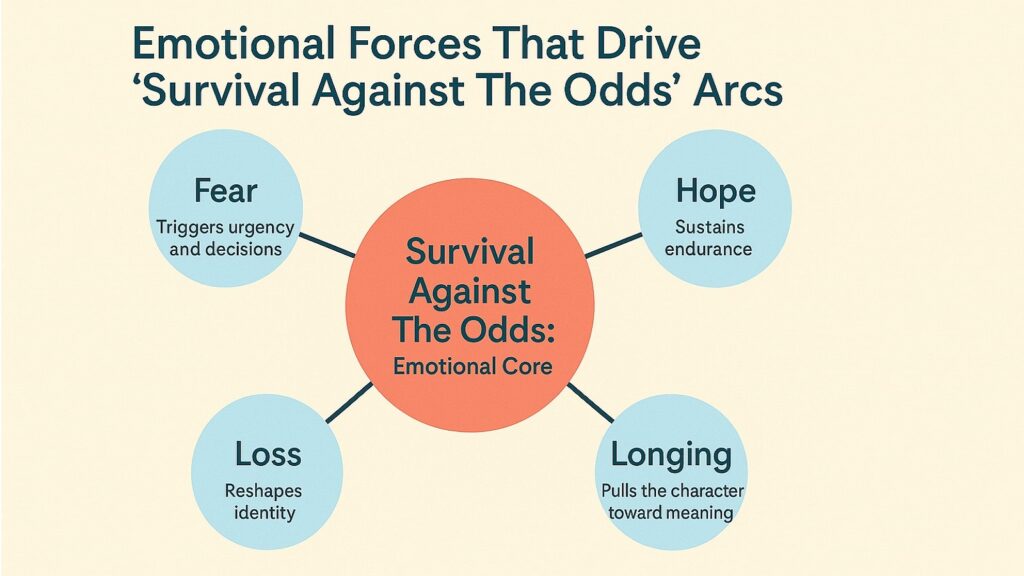
Physical survival matters, but emotional survival defines character. A person can escape a burning building yet spend years trapped in trauma. They can cross a desert yet never escape the memory of who they left behind. Writers who focus only on external obstacles miss the deeper layer of Survival Against The Odds storytelling. The internal journey—how fear transforms into courage, how loss reshapes identity, how hope persists against reason—is what makes these stories universal.
Fear comes in many forms. There’s the immediate terror of a bear charging through camp. There is also the gradual, unsettling anxiety associated with conserving the final canteen of water. Writers should distinguish between acute and chronic fear. Acute fear creates explosive scenes. Chronic fear erodes a character over time, changing their personality and decision-making. Both types serve the narrative, but chronic fear offers more opportunity for character development. We watch someone slowly fray under pressure, which feels more intimate than watching them react to sudden danger.
Hope functions as fuel in Survival Against The Odds stories. Viktor Frankl, who survived Nazi concentration camps, wrote about how prisoners who maintained hope had better survival rates. Those who gave up often died even when physically capable of continuing. Writers can show hope through small rituals, through memories of loved ones, through goals that keep a character moving forward. In Cormac McCarthy’s The Road, the father’s hope that his son represents goodness in a dead world keeps both of them alive. Hope doesn’t guarantee survival, but its absence almost guarantees failure.
Loss changes characters permanently. When someone dies during a survival ordeal, the survivor carries that death forward. They might feel guilt for living when others didn’t. They might inherit the dead person’s goals or values. In Jon Krakauer’s Into Thin Air, survivors of the Everest disaster spent years processing their feelings about teammates who froze to death. The mountain tested them physically, but grief tested them more deeply. Writers should show how loss accumulates during survival situations, how each death or sacrifice adds weight to the protagonist’s emotional burden.
Survival Against The Odds: Emotional States That Drive Character Change
| Emotional State | Effect on Character Arc |
|---|---|
| Paralyzing Fear | Forces character to confront limitations and find courage |
| Sustaining Hope | Provides motivation when physical resources are depleted |
| Survivor Guilt | Creates internal conflict that extends beyond immediate danger |
| Protective Love | Drives self-sacrifice and reveals core values |
| Existential Despair | Strips away pretense and reveals authentic self |
| Desperate Determination | Transforms ordinary people into extraordinary survivors |
3. Survival Against The Odds as a Battle Against the Environment
Sometimes the antagonist has no face. It’s the ocean, the desert, the mountain, the winter. Environmental survival stories work because nature is impartial. It doesn’t hate the protagonist. It doesn’t try to kill them personally. It simply exists according to its own rules, indifferent to human suffering. This indifference creates a unique psychological pressure. Characters can’t negotiate with a blizzard or reason with dehydration. They must adapt or die.
Jack London mastered environmental antagonism. His story “To Build a Fire” follows a man traveling through Yukon winter. The cold doesn’t hunt him. It just exists at seventy below zero. The man makes one mistake—getting his feet wet—and the environment kills him with mechanical inevitability. The story works because London shows us every step of the process. We watch the man’s fingers lose dexterity. We see him struggle to light matches. We know exactly why he fails. The environment reveals his overconfidence and lack of preparation.
Weather and terrain shape the rhythm of survival narratives. A storm might trap characters in one location, forcing intimacy and conflict. A mountain pass might offer hope, then prove impassable, crushing morale. Writers should think about how environmental conditions create natural story beats. The first night in the wilderness. The moment water runs out. The day a character realizes rescue isn’t coming. These beats arise organically from environmental realities rather than arbitrary plot structure and plot twists.
Social environments can function as antagonists too. A character might survive a plane crash only to face hostile locals. They might escape a disaster only to encounter government quarantine or martial law. The Stanford prison experiment showed how quickly social structures can turn oppressive. Writers exploring Survival Against The Odds should consider how human systems—bureaucracy, prejudice, mob mentality—create obstacles as deadly as any natural threat. The film Children of Men depicts a world where society itself has become hostile to survival.
Survival Against The Odds: Environmental Elements as Narrative Antagonists
| Environmental Factor | Storytelling Function |
|---|---|
| Extreme Temperature | Creates time pressure and physical deterioration |
| Water Scarcity | Forces prioritization and difficult rationing decisions |
| Hostile Terrain | Imposes navigation challenges and injury risk |
| Predatory Wildlife | Adds active threat beyond passive environmental danger |
| Limited Resources | Generates narrative conflict over distribution and consumption |
| Social Hostility | Introduces betrayal and tests trust in human nature |
4. Survival Against The Odds and the Role of Impossible Choices
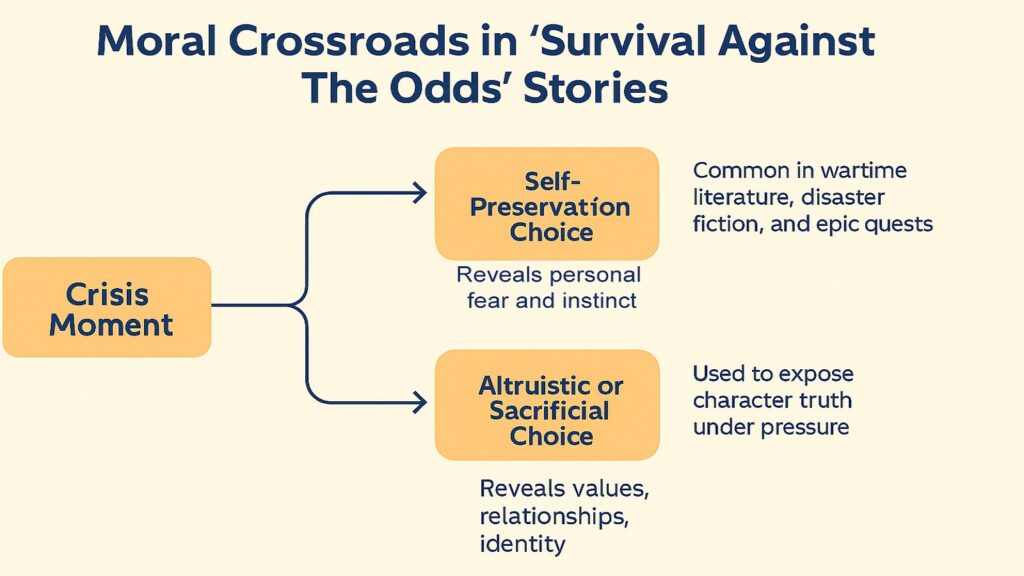
Survival situations force characters into moral corners. Do you eat the last food, or share it with someone weaker who might not survive anyway? Do you leave behind an injured companion to save yourself? Do you steal from others to feed your family? These dilemmas don’t have right answers. They reveal character in ways that normal life never could. Impossible choices make Survival Against The Odds stories morally complex rather than simple tales of endurance.
The trolley problem—a classic thought experiment about sacrificing one person to save five—appears constantly in survival narratives. The Donner Party faced these choices in the Sierra Nevada during winter. Some resorted to cannibalism to survive. Were they evil? Were they doing what humans must do when civilization’s rules no longer apply? Writers who explore these questions without judgment create more nuanced stories. The reader should feel the weight of the choice, understand why a character makes a terrible decision, and recognize that they might do the same.
Sophie’s Choice, William Styron’s novel about a mother forced to choose which child lives, represents the most extreme form of an impossible decision. The choice destroys her even though she survives the war. Writers should understand that impossible choices have long-term consequences. The character who abandons their friend might survive physically but die psychologically. They’ll carry that decision forever. This psychological aftermath is where much of the story’s emotional power resides.
Time pressure intensifies impossible choices. When a character has hours to deliberate, the decision feels more rational. When they have seconds, instinct and panic take over. The film 127 Hours shows Aron Ralston choosing to amputate his own arm after being trapped by a boulder. He had days to consider the choice, but the decision still required crossing an impossible psychological threshold. Writers should calibrate the time available against the stakes to create maximum tension.
Survival Against The Odds: Types of Impossible Choices Characters Face
| Choice Type | Moral and Psychological Stakes |
|---|---|
| Self vs. Others | Choosing personal survival over helping those who are weaker |
| Short-term vs. Long-term | Consuming resources now or rationing for uncertain future |
| Harm vs. Death | Causing pain or injury to oneself or others to prevent worse outcomes |
| Truth vs. Deception | Lying to maintain group morale or telling harsh truths |
| Violence vs. Victimhood | Fighting back with brutal force or accepting passive role |
| Loyalty vs. Pragmatism | Honoring commitments or breaking them for survival advantage |
5. Survival Against The Odds Through Symbols, Objects, and Memory
A photograph of a family. A wedding ring. A knife passed down through generations. These objects carry weight beyond their physical properties. In survival situations, they become anchors to meaning and identity. When everything else is stripped away, a small object can represent why someone chooses to keep living. Writers who understand symbolic power can create moments of profound emotional resonance in Survival Against The Odds narratives.
Memory functions similarly. A character trudging through snow might replay a conversation with their mother. Another drifting on a life raft might remember teaching their daughter to swim. These memories provide psychological sustenance when physical resources run low. They remind characters who they are and what they’re trying to return to. In The Road, the father’s memories of the world before the apocalypse torture him but also prove that beauty once existed. This tension between painful memory and comforting memory creates emotional complexity.
Objects often serve as promises. A father carries his child’s toy and promises himself he’ll return it. A soldier keeps a letter from home and vows to deliver a message. These promises give structure to survival efforts. They transform mere endurance into purposeful action. The object becomes a talisman, a physical representation of will and hope. When a character loses such an object, it should feel like a genuine setback, not just a plot point.
Writers should choose meaningful objects carefully. Generic symbols feel hollow. The object should connect to the character’s specific history and values. A botanist might carry seeds. A musician might protect an instrument. A parent might clutch a child’s drawing. The specificity matters because it reveals character while serving symbolic function. In Life of Pi, the protagonist’s attachment to Richard Parker the tiger serves as both practical survival strategy and symbolic representation of his own animal nature.
Survival Against The Odds: Symbolic Objects and Their Narrative Functions
| Object Type | Symbolic and Emotional Weight |
|---|---|
| Personal Photograph | Represents connection to loved ones and life before crisis |
| Tool or Weapon | Symbolizes agency, control, and ability to shape outcomes |
| Religious or Cultural Item | Provides spiritual comfort and connection to belief systems |
| Letter or Written Message | Carries voices from the past or obligations to the future |
| Natural Object | Represents hope, beauty, or continuity in hostile environment |
| Inherited Possession | Links character to ancestry, identity, and generational wisdom |
6. Survival Against The Odds and the Aftermath of Endurance
The helicopter arrives. The rescue boat pulls alongside. The character staggers into a hospital. Many stories end here, but this is where the real survival story often begins. Physical rescue doesn’t erase psychological damage. Survivors return to ordinary life carrying extraordinary experiences. They suffer nightmares, hypervigilance, survivor’s guilt, and disconnection from people who can’t understand what they’ve been through. Writers who ignore this aftermath deliver incomplete narratives.
Post-traumatic stress reshapes identity. A person who survived a plane crash might never fly again. Someone who endured starvation might hoard food. A combat veteran might startle at loud noises. These responses are adaptive—the nervous system learned valuable lessons about danger and now applies them aggressively. But they often interfere with normal life. The tension between survival instincts and peacetime reality creates rich material for character development. The protagonist must learn to survive survival itself.
Many survivors struggle with meaning. They ask why they lived when others died. They wonder if their suffering had a purpose. Viktor Frankl argued that humans can endure almost anything if they find meaning in it. Writers should show characters wrestling with these questions. Some find purpose through activism or helping other survivors. Others never find answers and carry that uncertainty forever. Both outcomes are realistic and powerful.
Relationships often fracture after survival ordeals. A survivor might feel alienated from people who continued their normal lives while the protagonist faced death. Spouses might struggle to reconnect. Friends might not know what to say. The film The Hurt Locker shows a soldier who survives Iraq only to find himself unable to function in suburban America. The grocery store overwhelms him more than combat did. This reversal—finding danger easier than safety—is common among survivors and offers profound storytelling opportunities.
Survival Against The Odds: Long-term Psychological Consequences of Survival
| Aftermath Elements of ‘Survival Against The Odds‘ | Impact on Character and Story |
|---|---|
| Traumatic Memory | Creates flashbacks and triggers that disrupt present-day life |
| Hypervigilance | Character remains in survival mode despite being safe |
| Survivor Guilt | Character questions their worthiness to live when others died |
| Identity Confusion | Character struggles to reconcile who they were with who they became |
| Relationship Strain | Character feels isolated from people without similar experiences |
| Post-traumatic Growth | Character develops new wisdom, resilience, or life perspective |
Conclusion: Why Survival Against The Odds Remains a Timeless Writer’s Tool
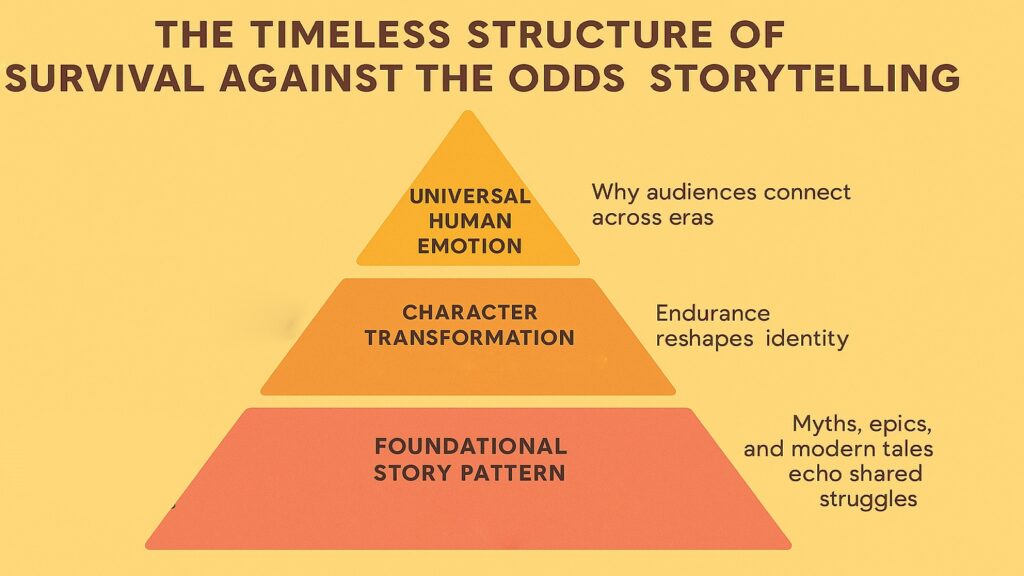
These six insights reveal why Survival Against The Odds endures as a storytelling theme. It engages primal instinct, creates emotional depth, turns environments into antagonists, forces impossible moral choices, invests meaning in symbols, and extends beyond physical rescue into psychological aftermath. Writers who master these elements create stories that feel urgent, intimate, evergreen, and universal.
This theme resonates across cultures because survival is humanity’s shared experience. Every person fears death. Every person wonders if they could endure when tested. Every person questions what they would sacrifice and who they would become under extreme pressure. Survival Against The Odds stories let us explore these questions safely. We face our fears through characters, experience their triumphs and failures, and carry their lessons forward.
The theme of ‘Survival Against The Odds’ also adapts endlessly. It works in historical fiction, science fiction, contemporary realism, literary fiction, and genre thrillers. It can focus on physical survival in wilderness, psychological survival in oppressive systems, or emotional survival after trauma. The core elements remain consistent—threat, limited resources, impossible choices, transformation—but the specific manifestation changes with context. This flexibility ensures the theme never grows stale.
Writers should approach Survival Against The Odds with respect for its psychological complexity. These stories ask readers to confront mortality and vulnerability. They work best when grounded in authentic human response rather than Hollywood heroics. Real people break down, make mistakes, lose hope, and sometimes fail to survive despite their best efforts. Honoring that reality creates stories that resonate long after the last page.
The theme will continue to matter because uncertainty is fundamental to human existence. We never know when disaster might strike us. We never know if we’ll have the strength to endure it. Survival Against The Odds stories help us prepare psychologically for possibilities we hope never arrive. They teach us about resilience, reveal our capacity for both cruelty and compassion, and remind us that survival is never just about staying alive. It’s about remaining human when everything tries to strip that humanity away.
Survival Against The Odds: Why This Theme Endures Across Eras and Genres
| Enduring Qualities of ‘Survival Against The Odds‘ | Why It Matters to Readers and Writers |
|---|---|
| Universal Fear | Every human understands mortality and vulnerability |
| Moral Complexity | Extreme situations reveal character truth unavailable in normal life |
| Emotional Intensity | High stakes create powerful reader engagement and catharsis |
| Psychological Depth | Internal struggle matches or exceeds external conflict |
| Adaptable Framework | Theme works across all genres, settings, and time periods |
| Transformative Power | Characters and readers emerge changed by the experience |
Read More Storytelling Articles
- Awakening Stories: 6 Powerful Cultural Archetypes
- Quest for Meaning: 6 Powerful Ways Stories Transform
- 6 Powerful Story Archetypes That Inspire Creativity
- 6 Amazing Ways Mirror Effect Reflects Reality In A Story
- 6 Amazing Ways Interactive Narratives Rewire Our Brains
- 6 Amazing Ways Digital Storytelling Preserves Culture
- 6 Amazing Ways ‘Show Don’t Tell’ Engross Readers
- 6 Amazing Ways Chekhov’s Gun Reloads Narrative Power