Table of Contents
Introduction: Why the Three Act Structure Makes Stories Stay in Memory
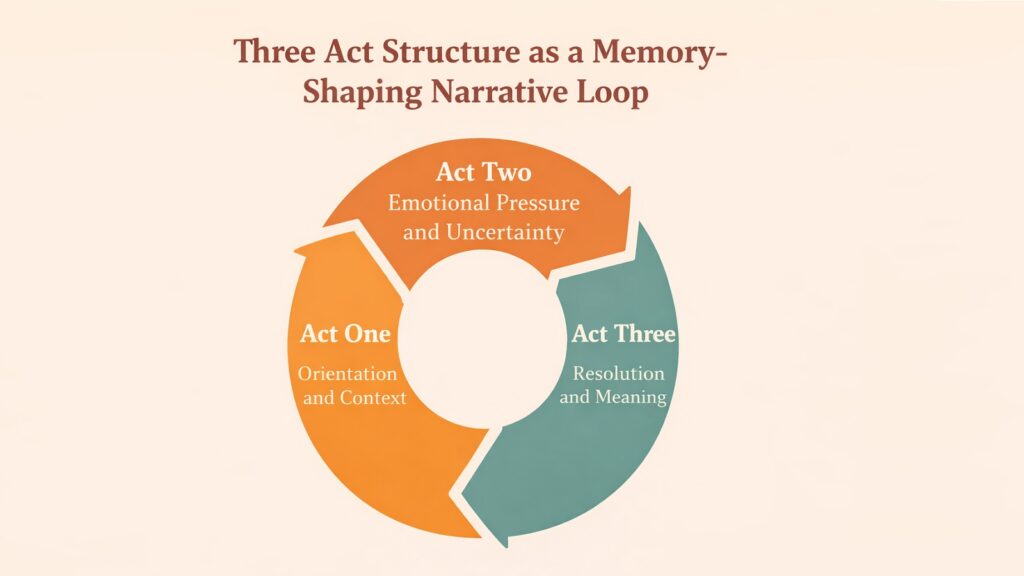
Some stories vanish from memory within hours of hearing them. Others return to us years later, unbidden and clear, as if they happened yesterday rather than existing only in fiction. The difference often lies not in spectacle or novelty but in structure itself. The Three Act Structure serves as one of the most important narrative structures because it mirrors how human minds naturally process experience and emotion. This framework divides stories into setup, confrontation, and resolution. Each phase corresponds to emotional and cognitive patterns that help audiences absorb and retain what they witness.
Memory favors coherence over chaos. When events connect through cause and effect, when tension builds steadily toward a release, the brain finds patterns it can preserve. The Three Act Structure provides exactly this kind of scaffolding. It creates anticipation in the first act, sustains emotional pressure through the second, and delivers closure in the third. These aren’t arbitrary divisions imposed by writers seeking to follow rules. They reflect how people remember their own lives, organizing experiences into beginnings that establish context, middles that test resolve, and endings that provide meaning.
The Three Act Structure has shaped storytelling across centuries and cultures. From ancient Greek tragedies to modern Hollywood blockbusters, from oral folktales passed down through generations to contemporary novels, this pattern appears again and again. Its persistence suggests something deeper than convention. It points to fundamental truths about how humans process narrative and emotion.
This article examines six specific mechanisms within the Three Act Structure that strengthen emotional recall. Each section explores a different aspect of how this framework shapes memory, supported by observations from literature and storytelling practice. The goal is to understand why certain narrative choices make stories linger in consciousness while others fade into forgetting. Understanding these mechanisms reveals why the Three Act Structure remains relevant even as storytelling mediums evolve.
Three Act Structure Compared to Other Narrative Structures
| Narrative Structures | Core Organizing Principle |
|---|---|
| Three Act Structure | Setup, confrontation, resolution with escalating emotional stakes |
| Four Act Structure | Setup, complication, development, resolution with additional midpoint emphasis |
| Five Act Structure | Exposition, rising action, climax, falling action, denouement with symmetrical rise and fall |
| Kishōtenketsu | Introduction, development, plot twist, reconciliation without central conflict requirement |
| Dan Harmon’s Story Circle | Comfort zone, desire, unfamiliar situation, adaptation, acquisition, payment, return, change through circular journey |
| Non-Linear Timelines | Events arranged by thematic connection or emotional logic rather than chronology |
| Parallel Narratives | Multiple storylines developing simultaneously with intersecting themes or events |
| Nested Stories | Story within story structure where outer narrative frames inner tale |
1. Three Act Structure as a Cognitive Anchor for Memory Formation
The first act of the Three Act Structure establishes who matters and why. Characters receive names, relationships form, and settings gain detail and texture. This phase builds what psychologists call schema, the mental frameworks people use to organize new information. Without these anchors, later events float untethered in memory, disconnected from context and meaning.
Consider how William Shakespeare opens Romeo and Juliet. He dedicates substantial time to the feud between the Montagues and the Capulets before the lovers ever meet. He shows us Verona’s violence through street brawls, introduces family members and their allegiances, and establishes the stakes of forbidden love. When Romeo first sees Juliet across a crowded room, audiences already understand what their attraction means. The memory of their first meeting carries tremendous weight because the setup phase provided essential context.
Act One creates reference points that help the brain file subsequent information efficiently. When a character makes a choice in Act Two, memory connects it back to what was established earlier in the narrative. The brain prefers linked information over isolated facts. Each callback to setup strengthens the neural pathway between the beginning and the middle. This interconnection makes the entire story more memorable than its individual parts.
This anchoring effect explains why stories with rushed or unclear beginnings often feel forgettable even when their middle sections contain exciting events. If audiences don’t know who they’re watching or what matters to these characters, emotional moments lack resonance. A death means nothing if we never knew the character who died. A betrayal carries no sting if we never understood the relationship being broken. The Three Act Structure prevents this by frontloading context deliberately. It gives memory something substantial to hold onto before raising the emotional temperature.
The opening act also establishes what researchers call the baseline state. This baseline becomes the measuring stick for all change that follows. When audiences see how things were before conflict erupted, they can appreciate the full scope of transformation. Memory works through comparison and contrast. The Three Act Structure provides both sides of the equation.
Three Act Structure Anchoring Elements in Act One
| Anchoring Component | Memory Function |
|---|---|
| Character introduction with specific traits | Creates recognizable emotional reference points |
| Establishment of ordinary world or status quo | Provides baseline for measuring later change |
| Presentation of initial problem or desire | Sets direction for audience expectation |
| Introduction of relationships and conflicts | Builds network of connections for recall |
| Environmental and contextual details | Anchors events in specific sensory memory |
| Initial tone and emotional register | Establishes mood framework for interpretation |
2. Three Act Structure and Emotional Escalation in the Second Act
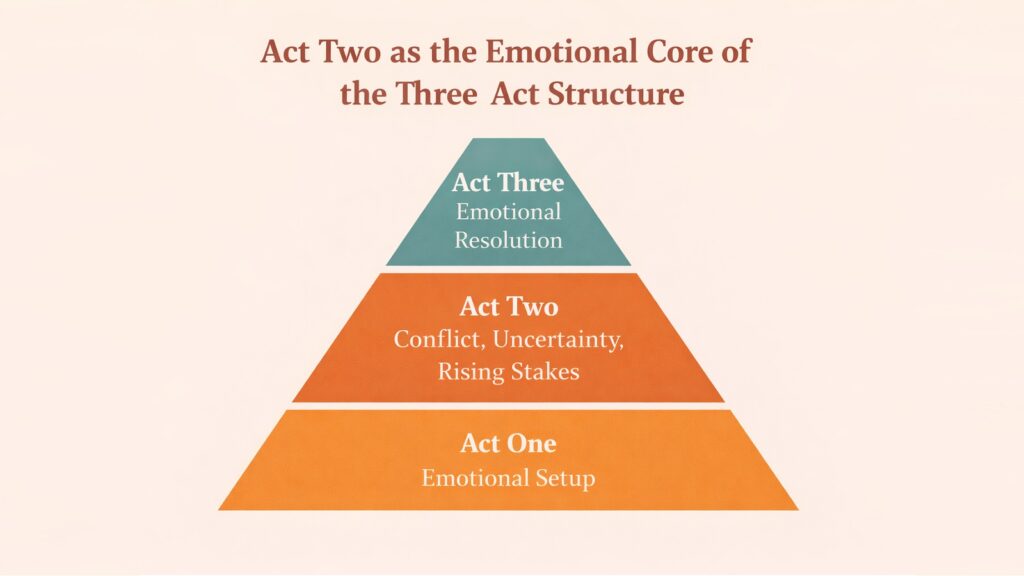
Act Two represents the emotional engine of the Three Act Structure. Here, conflict intensifies scene by scene. Characters face obstacles that test them in ways the first act only hinted at. Uncertainty grows, stakes rise, and comfort disappears. This sustained middle phase keeps arousal elevated, which neuroscience connects directly to memory formation and consolidation.
Emotional intensity acts like a chemical fixative for experience. When people feel strongly about something, stress hormones like cortisol and adrenaline enhance memory consolidation in the hippocampus. The second act of the Three Act Structure exploits this biological reality by maintaining pressure across extended narrative time. It refuses to let audiences relax.
In Francis Ford Coppola’s The Godfather, Michael Corleone’s transformation occupies most of the film’s middle section. Each scene adds complication and moral weight. He kills Sollozzo and McCluskey in a shocking burst of violence. He hides in Sicily, attempting to build a peaceful life. His wife dies in a car bomb meant for him. He returns to America changed, hardened, capable of things his earlier self couldn’t imagine. The relentless accumulation of consequence keeps audiences emotionally engaged throughout. No single scene carries all the weight, but the sustained sequence becomes unforgettable.
This differs fundamentally from structures that spike emotion briefly, then relax. The Three Act Structure extends the middle deliberately and without apology. It refuses quick resolution or easy answers. By sustaining emotional engagement across Act Two, it gives memory multiple opportunities to encode the experience. The longer the brain stays activated, the deeper the impression becomes.
The middle act also introduces what storytellers call complications. These aren’t merely obstacles but revelations that force characters and audiences to reassess everything they thought they knew. When information changes, the brain must reorganize its understanding. This reorganization process strengthens memory by forcing active engagement with the material.
Three Act Structure Emotional Escalation Mechanisms in Act Two
| Escalation Mechanism | Effect on Memory |
|---|---|
| Rising stakes through progressive complications | Increases emotional investment in outcomes |
| Deepening character vulnerability | Strengthens empathetic connection and recall |
| Introduction of time pressure or deadlines | Creates urgency that enhances attention |
| Revelation of new information that recontextualizes earlier events | Forces memory to reorganize and strengthen connections |
| Failed attempts and setbacks | Builds emotional frustration that intensifies climax impact |
| Isolation of protagonist from support systems | Heightens anxiety and identification |
3. Three Act Structure Creates Meaning Through Narrative Pressure
The Three Act Structure doesn’t just arrange events in temporal order. It forces audiences to interpret them, to search for significance. When conflict persists across acts without immediate resolution, people naturally search for patterns and meaning. This active processing transforms passive viewing into meaning-making, which memory strongly favors over simple observation.
Struggle creates the conditions necessary for interpretation. If a character achieves their goal immediately upon desiring it, there’s nothing to think about or process. But when the Three Act Structure delays resolution across an entire middle act, audiences must grapple with why things unfold as they do. They form theories, imagine outcomes, and weigh choices against alternatives. This mental activity embeds the story more deeply than passive reception ever could.
In Frank Darabont’s The Shawshank Redemption, Andy Dufresne endures decades of unjust imprisonment. The film refuses easy escape or quick vindication. Instead, it shows years of patience, small victories that mean little, crushing setbacks that erase progress. Audiences watching this extended suffering can’t help but ask what it means. Is the story about hope in darkness? Human dignity under oppression? Patient revenge? The film’s length and structure demand reflection rather than accepting answers.
Memory researchers distinguish between shallow processing and deep processing of information. Shallow processing involves noticing surface features like colors, sounds, or basic facts. Deep processing involves connecting information to existing knowledge and extracting meaning from patterns. The Three Act Structure promotes deep processing by creating gaps between setup and payoff. Those gaps become spaces for thought, interpretation, and emotional investment.
When audiences must work to understand a story, they own it in ways passive consumption never allows. The Three Act Structure makes audiences participate in meaning-making. This participation transforms viewers from consumers into collaborators. Memory favors experiences where we played an active role.
Three Act Structure Meaning-Making Elements Through Pressure
| Pressure Element | Cognitive Effect |
|---|---|
| Delayed gratification between acts | Promotes reflection and theory formation |
| Moral ambiguity in character choices | Requires audience judgment and interpretation |
| Consequences that ripple across acts | Forces tracking of cause-effect relationships |
| Suffering or sacrifice that demands justification | Activates search for thematic meaning |
| Symbolic or metaphorical elements given time to develop | Allows pattern recognition across narrative distance |
| Questions posed in Act One answered in Act Three | Creates satisfying cognitive closure and retention |
4. Three Act Structure and the Role of Anticipation in Memory Retention
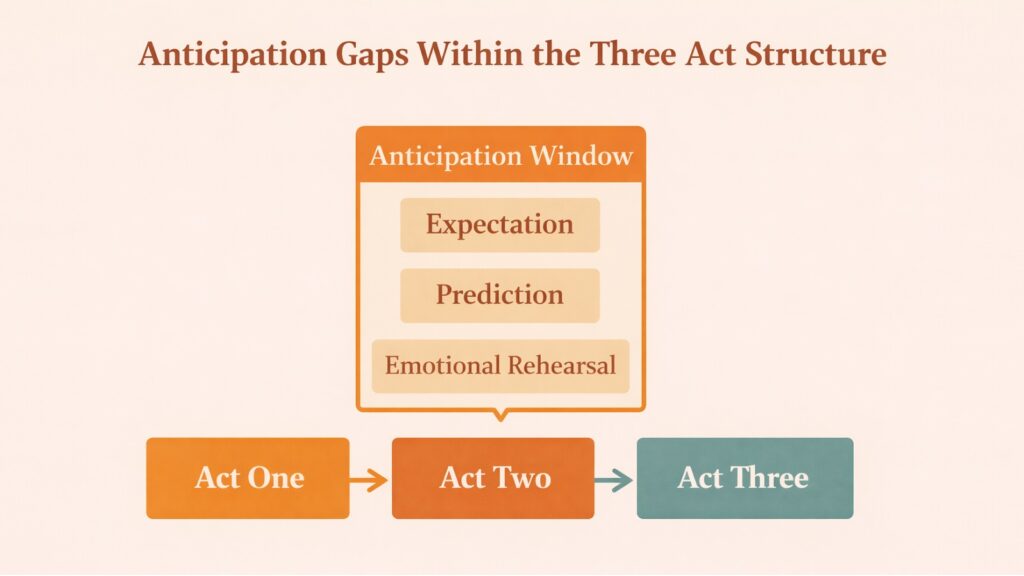
Anticipation functions as a kind of mental rehearsal. When the Three Act Structure establishes expectations in the first act and then withholds resolution until the third, audiences spend the intervening time imagining outcomes. This imaginative engagement strengthens memory through repetition, even though the repetition happens internally rather than through re-exposure to the material.
The gap between setup and payoff matters enormously for memory formation. If a promise is made and immediately fulfilled, there’s no time to wonder or anticipate. But the Three Act Structure inserts an entire middle act between question and answer. During this delay, minds naturally simulate possibilities. Each mental simulation reinforces the story’s presence in consciousness. The brain rehearses potential outcomes, playing through scenarios.
In Jane Austen’s Pride and Prejudice, Elizabeth Bennet and Mr. Darcy meet early in the narrative. Their attraction and conflict are established immediately through sharp dialogue and social tension. But Austen delays their union across hundreds of pages of misunderstanding and pride. Readers spend that time anticipating how misunderstandings will be resolved. They imagine conversations, predict revelations, and rehearse reconciliations in their minds. When the actual resolution arrives, it feels both surprising and inevitable because readers have been mentally preparing for various outcomes.
Neuroscience shows that anticipating an event activates similar brain regions as experiencing it directly. The Three Act Structure leverages this by creating narrative gaps that audiences fill with expectation and imagination. Each time someone wonders what will happen next, they’re reinforcing the story’s neural trace. The story lives in their mind between reading or viewing sessions.
This expectation also generates what psychologists refer to as the Zeigarnik effect in a deliberate manner. Incomplete tasks occupy cognitive space more enduringly than those that are finished. The Three Act Structure leverages this inclination effectively by leaving questions unanswered throughout the central act. Viewers take the narrative with them as it stays unresolved.
Three Act Structure Anticipation Mechanisms Across Acts
| Anticipation Mechanism | Memory Enhancement |
|---|---|
| Questions posed early requiring delayed answers | Creates mental holding space that maintains engagement |
| Promises or prophecies awaiting fulfillment | Generates repeated mental rehearsal of potential outcomes |
| Relationships established before they can fully develop | Allows audience projection and emotional investment |
| Threats or dangers introduced but not immediately confronted | Sustains background anxiety that heightens attention |
| Character flaws or wounds hinted at before resolution | Encourages audience to imagine healing or growth arcs |
| Mysteries or secrets revealed gradually across acts | Rewards sustained attention with progressive understanding |
5. Three Act Structure Resolves Emotion to Lock Memories In
The third act provides what psychologists call closure. It answers questions, resolves tensions, and delivers emotional payoff that has been building since the opening. This completion phase serves a crucial memory function. It transforms the story from an open-ended experience into a sealed unit that the brain can store efficiently and retrieve as a complete whole.
Unresolved experiences tend to linger in working memory, seeking completion and draining cognitive resources. The Zeigarnik effect describes how people remember unfinished tasks better than finished ones, but this heightened recall comes with psychological discomfort and mental occupation. The Three Act Structure uses Act Three to resolve this discomfort, converting active processing into consolidated memory that can be stored without constant mental attention.
In Harper Lee’s To Kill a Mockingbird, the trial of Tom Robinson represents the story’s emotional climax and moral center. The unjust verdict devastates readers who have invested in truth and justice. But Lee doesn’t end there, leaving readers in despair. Act Three provides Boo Radley’s rescue of the children, Atticus’s continued dignity despite defeat, and Scout’s moral growth and understanding. These resolutions don’t erase injustice or provide false comfort, but they provide emotional framing that helps readers process what happened. The ending reshapes how earlier events are remembered and understood.
Closure doesn’t require happy endings or conventional satisfaction. It requires emotional resolution, which can come through tragedy, acceptance, transformation, or understanding. The Three Act Structure’s final act provides this necessary framing. It tells audiences how to feel about what they witnessed, which helps memory categorize and preserve the experience appropriately.
The resolution additionally offers what narratologists refer to as the denouement, which is the process of untying narrative knots. This untying fulfills the brain’s need for closure. When the threads presented in Act One ultimately come together in Act Three, the brain experiences a sense of satisfaction that strengthens the overall narrative arc.
Three Act Structure Resolution Functions in Act Three
| Resolution Function | Memory Consolidation Effect |
|---|---|
| Answering central dramatic questions | Provides cognitive satisfaction and closure |
| Delivering emotional catharsis through climax | Releases built tension creating memorable peak experience |
| Transforming or revealing character growth | Shows meaning of earlier suffering |
| Recontextualizing earlier events with new information | Forces memory reorganization that strengthens retention |
| Providing thematic statement or moral clarity | Gives interpretive framework for storing experience |
| Returning to opening imagery or situations transformed | Creates symmetry that aids recall |
6. Three Act Structure Repeats Emotional Patterns the Brain Recognizes
Humans encounter the Three-Act Structure repeatedly across cultures and centuries. This repetition creates familiarity with its emotional rhythm without breeding contempt or boredom. The brain develops templates for this pattern, making new stories easier to encode and retrieve, even as each individual narrative offers something unique.
Pattern recognition serves memory efficiency at a fundamental level. When the brain recognizes a familiar structure, it doesn’t need to work as hard to organize incoming information. The Three Act Structure provides a reliable template: establish normalcy, disrupt it progressively, and resolve the disruption. This predictability paradoxically makes individual stories more memorable because the framework handles organization automatically, freeing cognitive resources to focus on character, theme, and emotional nuance.
Consider how many beloved films follow this structure precisely. George Lucas’s Star Wars, Victor Fleming’s The Wizard of Oz, Michael Curtiz’s Casablanca, and thousands of other culturally significant films use the same three-part architecture. Audiences don’t tire of this repetition because each story fills the template differently. The structure itself becomes invisible, supporting memory without demanding conscious attention or feeling formulaic.
This explains Three-Act Structure’s cross-cultural persistence across vastly different societies. From ancient Greek drama to modern blockbusters, from oral folktales told around fires to literary fiction published today, the pattern recurs because it works with human cognition. The brain has evolved to process experiences in terms of beginning, middle, and end. Stories that honor this tendency align with cognitive architecture.
The familiarity also creates what psychologists call processing fluency. When something feels easy to process, people tend to like it more and remember it better. The Three Act Structure provides this fluency without sacrificing novelty in content.
Three-Act Structure Pattern Recognition Advantages
| Pattern Recognition Element | Cognitive Benefit |
|---|---|
| Familiar emotional arc across acts | Reduces cognitive load in processing new stories |
| Predictable tension-release rhythm | Allows brain to anticipate and prepare emotionally |
| Consistent structural markers between acts | Provides mental signposts for navigation and recall |
| Universal applicability across genres | Creates transferable template strengthening each encounter |
| Cultural transmission through repeated exposure | Builds shared understanding that aids communication |
| Efficiency in encoding new narratives | Frees attention for character and theme details |
Conclusion: Why the Three Act Structure Keeps Stories Alive in Memory
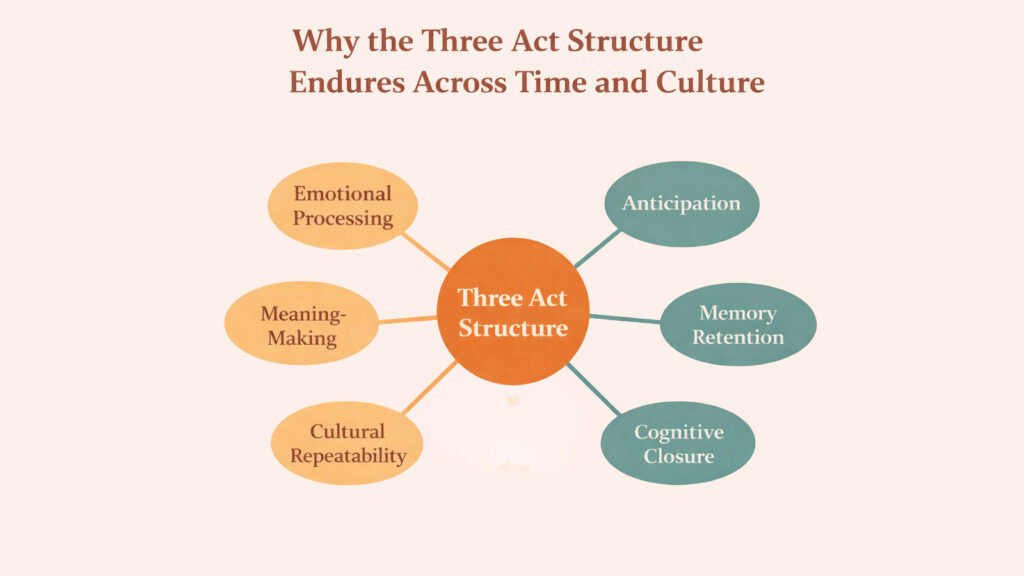
The Three-Act Structure endures across centuries because it corresponds to how humans naturally process emotion, build tension, and derive meaning from experience. Its three phases mirror the brain’s preference for coherent beginnings, sustained engagement, and satisfying closure. This isn’t an arbitrary convention imposed by writing teachers but alignment with psychological reality and cognitive architecture.
Each mechanism examined here, from cognitive anchoring to pattern recognition, demonstrates how the Three Act Structure supports memory formation at multiple levels. Act One provides the reference points memory needs to organize information. Act Two maintains the emotional intensity that fixes experience through neurochemical processes. Act Three delivers the resolution that transforms active processing into consolidated storage. Together, these phases create conditions optimal for retention and recall.
The structure’s power lies in repetition without exhaustion or staleness. Because the framework remains consistent while content varies infinitely, audiences build fluency with the pattern over time. This fluency makes each new story easier to remember. The brain recognizes the architecture and allocates attention to what matters: character development, thematic exploration, and emotional truth.
Stories following the Three-Act Structure feel timeless because they work with human nature rather than against it. They create anticipation, sustain pressure, and provide release in patterns the brain finds deeply satisfying. This psychological compatibility explains why the structure appears across cultures and centuries, from oral traditions to digital media. It shapes the stories people remember, revisit, and retell because it honors how memory actually functions at neurological and psychological levels.
Understanding these mechanisms doesn’t diminish the magic of storytelling. Instead, it reveals why certain patterns resonate so deeply. The Three Act Structure succeeds not through manipulation but through alignment with how we process our own lives and experiences.
Three Act Structure Memory Formation Summary
| Memory Formation Principle | Three Act Structure Application |
|---|---|
| Schema formation through context | Act One establishes reference framework |
| Emotional arousal enhances encoding | Act Two sustains elevated emotional engagement |
| Active processing creates deeper traces | Structural pressure demands interpretation |
| Anticipation strengthens through rehearsal | Gaps between acts generate mental simulation |
| Closure enables efficient storage | Act Three provides emotional resolution |
| Pattern familiarity reduces cognitive load | Repeated exposure builds recognition template |
Read More Storytelling Articles
- Franco Belgian Comics: 6 Powerful Storytelling Lessons
- Storytelling Themes: 8 Powerful Ideas Readers Love
- 6 Powerful Story Archetypes That Inspire Creativity
- 8 Storytelling Psychologies to Elevate Creative Edge
- Explore Mahabharata’s 6 Genius Storytelling Techniques
- Iliad’s 6 Bold Storytelling Techniques That Grip You
- Heike Monogatari: 6 Vivid Techniques for Epic Storytelling
- 6 Incredible Ways Hero’s Quest Defines Brokenness