
Table of Contents
Introduction: Winter Climate as Earth’s Natural Calibration Season
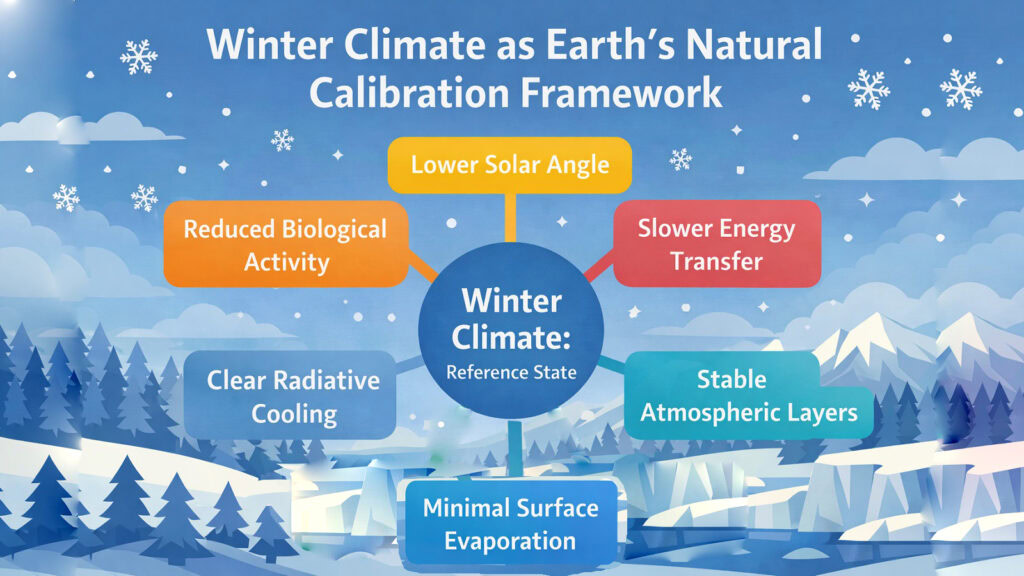
Winter Climate serves as Earth’s reference point rather than a season of harshness. When temperatures drop and daylight weakens, the planet enters a phase where physical processes become measurable in ways summer never allows. The noise fades. Biological activity slows across vast regions. Energy flows become traceable without the interference of growing plants or evaporating water, complicating every measurement.
Scientists have long recognized that winter climate provides stable boundary conditions. Solar angles decrease predictably. Atmospheric behavior settles into patterns governed more by physics than by living systems. Recovery cycles from warmer months become visible in data streams that would otherwise blur together. This clarity makes winter invaluable for understanding how Earth maintains equilibrium across decades and centuries.
The planet uses winter climate to reset balances that accumulate strain during active seasons. Six mechanisms stand out as particularly important for this self-calibration process. Each operates on fundamental principles of energy transfer, atmospheric physics, and system feedback. Together, they reveal why winter remains essential for planetary stability, regardless of what future climate variability might bring.
Winter Climate and Seasonal Rebalancing Mechanisms Across Earth
| Season/Climate Period | How It Contributes to Earth Rebalancing |
|---|---|
| Winter | Radiative cooling dominates energy budgets, reducing accumulated heat and providing clear baseline measurements for atmospheric and ocean systems |
| Monsoon | Redistributes tropical heat through massive moisture transport, balancing ocean-land temperature gradients built during dry months |
| Summer | Peak solar input drives photosynthesis and evapotranspiration, storing energy in biomass and moving heat through water phase changes |
| Autumn/Fall | Transition period allows gradual energy dissipation as biological activity winds down and surface processes shift toward net cooling |
| Spring | Snowmelt and vegetation awakening redistribute stored winter energy, testing ecosystem response to renewed solar forcing |
| Hemanta (Pre-Winter) | Marks cooling transition in South Asia where monsoon moisture clears and temperature drops prepare systems for true winter conditions |
| Harmattan | Dry wind season in West Africa creates sharp moisture gradients that drive regional circulation patterns and cool coastal zones |
| Tundra Seasons | Extreme seasonal swings in polar regions provide maximum albedo contrast and test cryosphere stability under changing light conditions |
1. Winter Climate and Earth’s Energy Balance Reset
Earth accumulates thermal energy throughout spring and summer. Oceans absorb radiation. Land surfaces heat up. Atmospheric water vapor traps outgoing longwave radiation. By late summer, the planet carries an energy surplus that must be released to maintain long-term stability. Winter climate provides the mechanism for this essential reset.
Radiative heat loss accelerates when solar input decreases. During the winter months, surface temperatures drop below atmospheric temperatures at higher altitudes. This inversion allows infrared radiation to escape more efficiently into space. Clear winter nights can release heat at rates approaching 100 watts per square meter, far exceeding typical summer cooling rates. The process operates continuously across entire hemispheres for months at a time.
Climate scientists rely on winter data to verify energy budget models. Summer measurements get complicated by evapotranspiration from forests and crops. Plants release water vapor that carries latent heat. Biological processes generate metabolic warmth. These variables make it harder to isolate pure radiative transfer. Winter climate eliminates most of this confusion by reducing biological heat exchange to negligible levels across mid and high latitude regions.
Snow cover enhances the cooling effect through multiple pathways. Fresh snow reflects up to ninety percent of incoming solar radiation. What little energy does get absorbed must first melt ice before raising temperatures. The phase change consumes enormous amounts of heat without producing temperature increases. Meanwhile, snow-covered surfaces continue radiating thermal energy into space throughout winter nights.
Ocean heat content measurements become more reliable during winter climate periods. Summer stratification in ocean layers makes it difficult to measure total heat storage. Warm surface water sits atop cooler depths with minimal mixing. Winter storms break down these layers. Cold air above the ocean surface creates strong temperature gradients that drive convective mixing. Scientists can measure ocean heat release directly as warm water rises and cools.
The calibration function of winter climate becomes clear in multi-year datasets. Energy balance models must account for seasonal variations to produce accurate long-term predictions. Winter provides the clearest signal for testing whether models correctly represent radiative transfer, surface albedo effects, and heat storage capacity. Models that fail to reproduce winter cooling patterns reliably also fail at longer timescales.
Winter Climate Energy Balance Components and Calibration Functions
| Energy Process | Role in Winter Calibration |
|---|---|
| Longwave radiation to space | Increases efficiency due to temperature inversions and dry air, providing clear measurements of radiative cooling rates |
| Solar input reduction | Low sun angles create predictable forcing that isolates other energy components from solar variation interference |
| Snow albedo feedback | High reflectivity and phase change effects offer stable reference for measuring surface energy exchange processes |
| Reduced evapotranspiration | Near-zero biological water cycling removes latent heat transfer as confounding variable in energy calculations |
| Ocean heat release | Enhanced mixing during winter allows direct measurement of stored thermal energy from previous seasons |
| Night cooling efficiency | Long winter nights at high latitudes maximize radiative cooling periods for testing heat transfer models |
2. Winter Climate as a Baseline for Atmospheric Pressure and Density
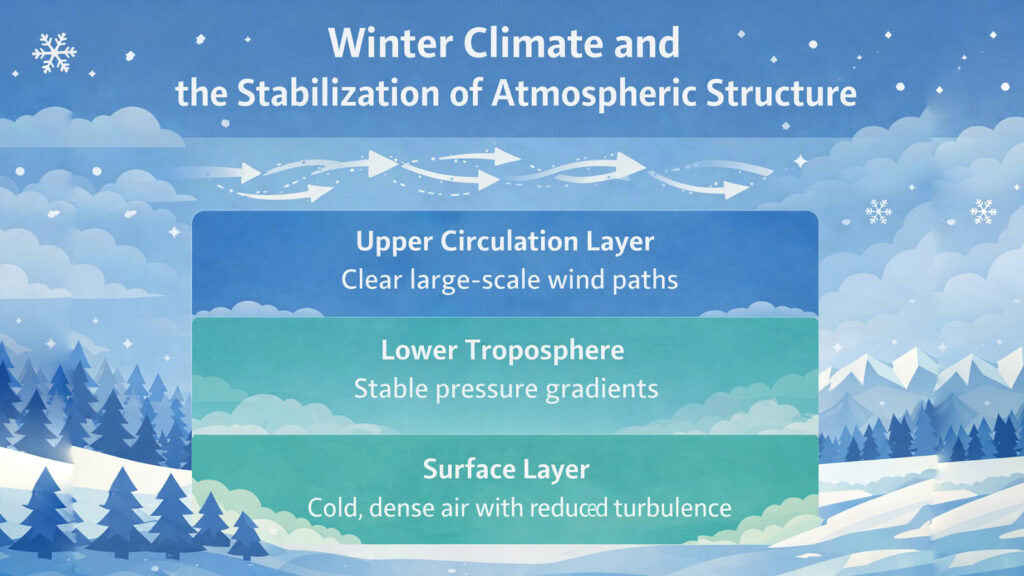
Cold air packs more molecules into each cubic meter than warm air. This simple physical fact transforms atmospheric behavior during winter climate in ways that make the entire system easier to understand and model. Density increases translate directly into pressure increases at the surface. Temperature gradients between cold continental interiors and relatively warm ocean surfaces sharpen dramatically.
Pressure gradients drive wind formation according to straightforward physics during winter months. The temperature contrast between Siberia and the Pacific Ocean can exceed fifty degrees Celsius. Air pressure differences respond proportionally. Winds develop along predictable paths determined by these gradients and modified by Earth’s rotation. Summer patterns become muddled by uneven heating, convective activity, and variable moisture content. Winter strips away these complications.
Large-scale circulation patterns stand out with particular clarity in winter climate data. The polar jet stream intensifies and follows more consistent paths when temperature contrasts reach their annual maximum. Subtropical high-pressure systems maintain steadier positions. The Hadley circulation cells that redistribute tropical heat show cleaner boundaries between ascending and descending air masses. Atmospheric models often validate their circulation physics specifically during winter months because the signal-to-noise ratio improves so dramatically.
Atmospheric stability increases across winter landscapes in ways that benefit scientific measurement. Cold surface air resists vertical mixing. Temperature inversions trap air near ground level for extended periods. This stability allows researchers to track air mass origins and movements with greater confidence. Trace gas concentrations become reliable markers of atmospheric transport rather than getting scrambled by convective turbulence.
Winter pressure systems develop and dissipate on timescales that models can handle effectively. Summer thunderstorms form and vanish within hours. Winter storm systems evolve over days to weeks. The slower pace means that numerical weather models have time to assimilate observations and adjust predictions. Forecast accuracy typically peaks during winter months when atmospheric behavior stays closer to baseline physics.
The density structure of winter climate air masses creates natural experiments in atmospheric dynamics. Arctic air outbreaks push extremely cold, dense air into temperate regions. The advancing cold front behaves according to fluid dynamics principles with minimal interference from solar heating or moisture effects. Scientists use these events to test fundamental understanding of atmospheric motion and energy transfer between air masses at different temperatures and densities.
Winter Climate Atmospheric Properties Supporting System Calibration
| Atmospheric Property | Winter Calibration Advantage |
|---|---|
| Air density distribution | Cold temperatures create predictable vertical structure that simplifies pressure calculations and circulation modeling |
| Pressure gradient clarity | Sharp land-ocean temperature contrasts produce strong, measurable pressure differences with minimal seasonal drift |
| Circulation pattern stability | Major atmospheric features maintain consistent positions allowing accurate validation of climate model dynamics |
| Reduced convective noise | Stable air masses limit turbulent mixing that obscures large-scale flow patterns during active seasons |
| Jet stream intensity | Maximum temperature gradients strengthen polar jet providing clear test cases for atmospheric wave theory |
| Forecast skill improvement | Slower evolution of weather systems during winter allows models to demonstrate their core physics capabilities |
3. Winter Climate and the Calibration of Ocean–Atmosphere Heat Exchange
Oceans store vast amounts of thermal energy throughout warmer months. Surface waters warm under summer sunshine. Heat penetrates dozens of meters into ocean mixed layers. This stored energy must eventually return to the atmosphere to prevent indefinite warming. Winter climate creates conditions that maximize this heat transfer while making it measurable at scales useful for climate science.
Cold air moving over relatively warm ocean surfaces drives intense heat exchange. A twenty-degree temperature difference between sea surface and air can transfer more than three hundred watts per square meter. This flux combines sensible heat moving directly through temperature gradients and latent heat released when ocean moisture evaporates into cold air. Winter storms enhance the process by generating waves that expose deeper warm water to surface cooling.
Mid and high latitude oceans serve as planetary heat reservoirs that release energy primarily during winter climate months. The North Atlantic continues warming Europe throughout winter by releasing heat stored during summer. Japanese ocean currents moderate East Asian winter temperatures through similar mechanisms. Without these ocean heat sources, continental winter temperatures would drop far lower than observed values.
Scientists measure ocean heat release most accurately during winter conditions. Summer measurements get complicated by solar heating of surface water. Daytime warming and nighttime cooling create daily cycles that obscure longer-term trends. Winter provides steadier boundary conditions. Solar input drops to minimal levels at high latitudes. Ocean heat flux becomes the dominant term in surface energy budgets. Researchers can isolate ocean contributions from other factors with much higher confidence.
Deep ocean convection occurs primarily during winter climate periods. Surface cooling increases water density. Dense water sinks, pulling warmer water up from below. This overturning circulation ventilates ocean interiors and redistributes heat vertically through hundreds of meters. The process connects surface climate to deeper ocean heat storage in ways that affect climate stability over decades and centuries.
Winter ocean-atmosphere coupling provides test cases for climate model performance. Models must correctly represent heat capacity differences between water and air. They must simulate how wind speed affects evaporation rates. They must capture how ocean currents transport heat horizontally while vertical mixing redistributes it through depth. Winter climate conditions create strong forcing that exposes model weaknesses more effectively than gentler seasonal transitions.
Winter Climate Ocean-Atmosphere Exchange Processes
| Exchange Process | Winter Measurement Advantage |
|---|---|
| Sensible heat flux | Large temperature gradients between ocean and air create strong signals easily detected above measurement uncertainty |
| Latent heat release | Cold air holds little moisture allowing ocean evaporation to dominate water vapor budgets over marine regions |
| Ocean mixed layer deepening | Winter cooling drives convective overturning that connects surface measurements to deeper heat storage |
| Current heat transport | Reduced solar interference allows clearer detection of ocean current contributions to regional heat budgets |
| Air-sea momentum transfer | Winter storm frequency provides repeated test cases for wind stress effects on ocean circulation |
| Deep water formation | Surface density increases during winter initiate ocean conveyor circulation that regulates multi-decadal climate |
4. Winter Climate as a Reference State for Cryosphere Feedbacks
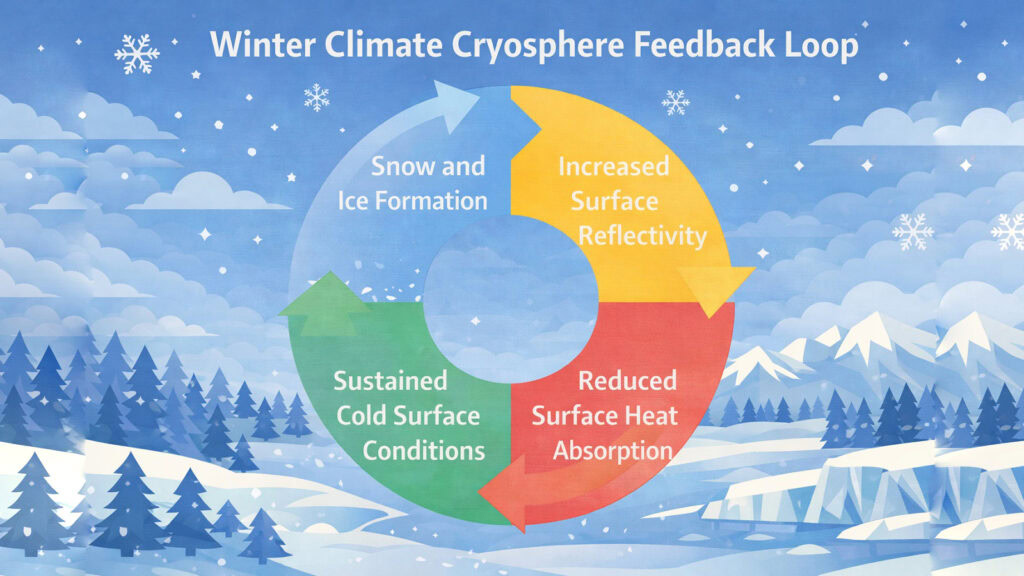
Snow and ice transform Earth’s surface properties in ways that create self-reinforcing feedback loops. Fresh snow cover can appear across millions of square kilometers within days. Surface reflectivity jumps from values around twenty percent for bare soil to ninety percent for new snow. This albedo change affects energy budgets immediately and measurably. Winter Climate provides the seasonal framework where these cryosphere feedbacks operate most clearly.
Snow cover insulates the ground beneath it while reflecting sunlight from above. The insulation effect matters more than many realize. A meter of snow can maintain soil temperatures near freezing even when air temperatures drop to minus thirty Celsius. This thermal barrier slows heat loss from Earth’s interior and from deeper soil layers. Meanwhile, the bright surface bounces solar radiation back to space before it can warm anything.
Ice formation on lakes and shallow seas demonstrates cryosphere feedback principles at manageable scales. Water releases latent heat when freezing. Air temperatures must drop below freezing and stay there long enough to extract this heat before ice forms. Once ice covers a water body, it blocks moisture transfer to the atmosphere. It also reflects solar radiation that would otherwise warm the water. The feedback operates in one direction during freeze-up and reverses during spring melt.
Winter Climate creates repeatable reference conditions for measuring cryosphere extent. Satellites track snow cover across continents with daily resolution. Year-to-year comparisons reveal how snow patterns respond to temperature variations. Multi-decade datasets show whether snow cover extent has shifted in response to longer-term climate changes. The measurements work because winter produces snow reliably enough to establish baselines against which changes become detectable.
Permafrost dynamics connect to Winter Climate through seasonal freeze-thaw cycles. Active layer thickness depends on how deeply summer warmth penetrates before winter freezing returns. The depth of winter cold determines how much of the soil column drops below zero. These annual cycles operate within longer-term trends but remain measurable because Winter Climate provides consistent timing and forcing each year.
Glacier mass balance calculations rely heavily on winter accumulation measurements. Snow that falls during Winter Climate represents the input side of the glacier budget. Summer melting represents output. The difference determines whether glaciers grow or shrink over time. Accurate winter measurements prove essential for understanding glacier response to climate variations. Winter provides cleaner measurement conditions than summer when melting and refreezing complicate surface observations.
Winter Climate Cryosphere Feedback Mechanisms
| Cryosphere Component | Feedback Role in Winter |
|---|---|
| Snow albedo effect | High reflectivity during winter establishes reference albedo values for measuring seasonal and annual variations |
| Surface insulation | Snow cover thermal resistance provides measurable barrier between atmosphere and ground heat sources |
| Lake ice formation | Freeze-up timing and thickness offer sensitive indicators of winter air temperature and heat flux changes |
| Sea ice extent | Annual maximum ice coverage during winter sets baseline for measuring summer minimum trends |
| Permafrost freezing depth | Winter cold penetration determines active layer recovery and multi-year temperature stability in frozen ground |
| Glacier accumulation | Winter snowfall measurements define mass input for calculating long-term glacier health and response |
5. Winter Climate and the Slowdown of Earth System Noise
Living systems generate complexity that obscures physical processes. Plants transpire water. Bacteria decompose organic matter. Animals migrate and alter landscapes. These biological activities peak during warm months and fade during winter. The quieting effect allows underlying climate mechanics to emerge from background noise in ways that improve scientific understanding across multiple disciplines.
Chemical reaction rates slow dramatically at winter temperatures. The decomposition of soil organic matter drops to near zero when the ground freezes. Photochemical reactions in the atmosphere decrease with reduced sunlight and lower temperatures. Gas exchange between soils and the atmosphere diminishes when biological activity ceases. Scientists studying fundamental chemical processes benefit from this slowdown because it isolates physical factors from biological ones.
Water cycling simplifies considerably during winter climate months. Evapotranspiration from forests can return more water to the atmosphere during summer than direct evaporation from soil and water surfaces. This biological water pump complicates regional water budgets. Winter eliminates plant transpiration across deciduous forests and reduces it drastically even in evergreen systems. Precipitation, snowmelt, and direct evaporation become the dominant terms in hydrological calculations.
Soil respiration represents a major carbon source during active seasons. Microbes consume organic matter and release carbon dioxide. Root respiration adds to the flux. Separating these biological sources from physical carbon exchanges proves difficult in summer. Winter freezing shuts down most biological respiration. Carbon fluxes measured during Winter Climate reflect physical processes like carbonate dissolution and gas diffusion through soils without biological interference.
Atmospheric composition measurements gain clarity during the winter climate. Plants take up carbon dioxide from the air during growing seasons. The drawdown varies by region, vegetation type, and weather conditions. Winter reverses the seasonal cycle as photosynthesis ceases, but biological respiration continues at low levels. More importantly, the seasonal swing becomes predictable enough that scientists can use winter measurements to establish atmospheric baselines for trace gases.
Albedo measurements become more reliable when vegetation goes dormant. Summer land surface reflectivity depends on plant growth stage, moisture content, and canopy structure. These variables change constantly. Snow-covered surfaces provide much steadier albedo values. Even without snow, dormant vegetation maintains more consistent reflective properties than active plant communities. Climate models use winter albedo measurements to validate their land surface schemes with greater confidence.
Winter Climate Reduction of System Interference
| System Component | How Winter Reduces Noise |
|---|---|
| Soil biological activity | Freezing temperatures halt microbial processes allowing measurement of physical soil properties without biological confounding |
| Plant water cycling | Dormancy eliminates transpiration from regional water budgets making precipitation and evaporation dominant terms |
| Atmospheric chemistry | Reduced photochemistry and biological emissions simplify air composition making trace gas measurements more interpretable |
| Carbon flux sources | Near-zero photosynthesis and respiration isolate physical carbon exchanges from biological ones in winter datasets |
| Land surface albedo | Dormant vegetation and snow cover provide stable reflectivity values for validating satellite measurements |
| Ecosystem respiration | Cold-limited metabolism reduces biological CO2 release revealing background physical emissions more clearly |
6. Winter Climate as a Validation Tool for Climate Models
Climate models attempt to simulate Earth system behavior using mathematical representations of physical processes. Model accuracy determines their usefulness for understanding past climates and projecting future changes. Winter Climate provides particularly demanding test conditions because it exposes model weaknesses that milder seasons might hide.
Temperature prediction accuracy peaks during winter validation exercises. Models must correctly represent radiative cooling, cloud formation, and surface energy exchange. Winter amplifies errors in these processes. A model that incorrectly calculates longwave radiation might show small errors in summer when solar heating dominates. The same error becomes obvious in winter when radiative cooling drives temperature changes. Scientists specifically test models against winter observations to catch these problems.
Circulation patterns during Winter Climate reveal whether models capture fundamental atmospheric dynamics. The polar vortex strengthens each winter in response to temperature gradients. Models must simulate this strengthening correctly to reproduce observed wind patterns. Jet stream positions during winter provide another stringent test. Models that place jets too far north or south during winter generally show similar biases in other seasons but the winter signal makes the error detectable.
Snow cover simulation challenges models to integrate multiple processes correctly. Models must predict when and where precipitation falls as snow rather than rain. They must calculate snow accumulation, accounting for wind redistribution. They must simulate snow aging, compaction, and melt. Winter provides months of continuous snow cover at high latitudes where satellite observations can validate model performance against reality.
Ocean-atmosphere coupling tests become more definitive during Winter Climate months. Models must represent how cold air cools ocean surfaces. They must simulate the resulting density changes and convective mixing. They must calculate heat and moisture fluxes across ocean surfaces under various wind conditions. Winter creates strong forcing that tests whether models have these processes right. Summer coupling involves weaker fluxes that hide model deficiencies.
Sea ice extent projections depend critically on model performance during winter freeze-up. Models must simulate when freezing begins, how quickly ice expands, and what maximum extent it reaches. These winter processes determine initial conditions for summer melt. Models that fail winter sea ice tests cannot be trusted for longer-term ice projections. Winter validation thus protects against overconfident predictions.
Climate model intercomparison projects routinely evaluate winter performance as a key metric. The seasonal cycle provides a test that models must pass before their projections gain credibility. Winter Climate creates conditions where physical processes dominate and biological complexity fades. Models built on correct physics succeed at winter simulation. Those relying on parameter tuning to match observations often fail when tested against winter data they were not specifically tuned to reproduce.
Winter Climate Model Validation Capabilities
| Model Component | Winter Testing Advantage |
|---|---|
| Radiative transfer | Reduced solar input and clear-sky conditions during winter expose errors in longwave radiation calculations |
| Atmospheric circulation | Maximum temperature gradients test whether models correctly simulate pressure systems and jet streams |
| Snow physics | Continuous winter snow cover at high latitudes provides extended validation period for surface process schemes |
| Ocean convection | Strong surface cooling drives deep mixing that tests ocean model vertical resolution and parameterizations |
| Sea ice formation | Annual freeze-up cycle offers repeatable test of model thermodynamics and ice dynamics components |
| Surface energy balance | Simplified winter conditions with minimal vegetation activity isolate fundamental heat transfer processes |
Conclusion: What Winter Climate Reveals About Earth’s Self-Calibrating Systems
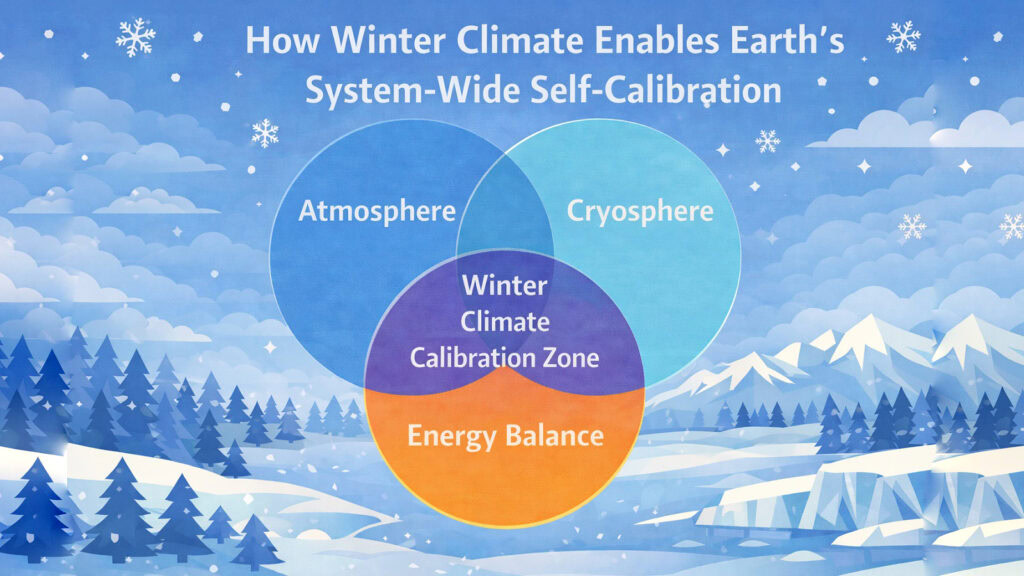
Winter Climate functions as Earth’s recurring calibration phase. The six mechanisms examined here work together across scales from local albedo effects to hemispheric circulation patterns. Each mechanism operates most clearly when biological activity slows, solar forcing weakens, and physical processes dominate system behavior. Together, they reset balances accumulated during active seasons and provide reference states against which changes become measurable.
Energy budgets balance over annual cycles because Winter Climate allows accumulated heat to radiate into space. Atmospheric pressure and density patterns become predictable when temperature contrasts sharpen during the winter months. Ocean heat storage connects to climate stability through winter release mechanisms that scientists can measure and models must reproduce. Cryosphere feedbacks operate most visibly during winter when snow and ice coverage reach annual maximums.
The quieting of biological noise during Winter Climate improves measurements across multiple Earth system components. Chemical processes slow to rates where physical factors become dominant. Water cycling simplifies to precipitation, evaporation, and runoff without transpiration complicating regional budgets. Atmospheric composition reflects physical exchanges more clearly than during biologically active months.
Climate models face their most stringent validation tests under Winter Climate conditions. Models must correctly represent fundamental physics to reproduce winter observations. Parameter tuning cannot hide structural deficiencies when winter forcing exposes errors in radiative transfer, atmospheric dynamics, and surface processes. Model credibility depends partly on winter performance metrics.
Understanding Winter Climate improves understanding of the entire climate system. The mechanisms that operate during winter inform knowledge about year-round processes. Energy balance principles tested in winter apply throughout the year. Atmospheric physics validated against winter data strengthens confidence in model projections. Cryosphere feedbacks measured during winter connect to longer-term climate responses.
Future climate variability will not eliminate the calibration role of Winter Climate. Even as temperatures shift and snow patterns change, winter will continue providing reduced solar forcing, enhanced radiative cooling, and simplified system behavior compared to summer. The seasonal cycle itself represents a fundamental feature of Earth’s orbit and axial tilt. Winter will remain central to climate science because it reveals how Earth maintains equilibrium through recurring cycles of calibration and recovery.
Winter Climate Integration of Self-Calibrating Earth Systems
| System Integration | Calibration Function |
|---|---|
| Energy-cryosphere coupling | Winter albedo changes from snow cover provide measurable feedback connecting surface properties to energy budgets |
| Atmosphere-ocean interaction | Cold season heat flux from oceans to atmosphere reveals stored energy release that balances annual accumulation |
| Physical-biological transition | Dormant season measurements establish physical baselines against which biological influences can be quantified |
| Model-observation validation | Winter data tests climate models under conditions where physical processes dominate and errors become detectable |
| Seasonal-decadal connections | Winter reference states repeated annually allow detection of longer-term trends in climate system components |
| Regional-global integration | Winter circulation patterns connect local temperature anomalies to hemispheric-scale atmospheric dynamics |
Read More Science and Space Articles
- Apricot Fruit Science: 6 Powerful Secrets of Fruit Chemistry
- Learn Physics Faster With 8 Proven Mental Models
- Lifestyle Diseases: 8 Dangerous Threats to Global Health
- Sports Science Reveals 8 Powerful Ways Games Are Won
- Fundamental Physical Theories: 8 Powerful Laws of Nature
- STEM Learning Skills: 6 Powerful Secrets Behind Real Success
- STEM Subjects: 8 Essential Insights for a Brighter Future
- Universe Odyssey: 8 Essential Stages Of A Remarkable Journey
- Cosmic Giants: 8 Incredible Titans Shaping Our Universe
- Cosmic Forces: 8 Powerful Phenomena Shaping Our Universe
- God: 6 Powerful Scientific Insights That Reveal Human Belief
- 6 Incredible Ways Missiles Obey The Laws of Physics
- Anthropomorphism: 6 Brilliant Benefits and Risks in AI
- Human Cell Secrets: 6 Powerful Insights Shaping Life