Table of Contents
Introduction: Best Smartphones in 2026: Eight Standout Smartphones for Every Buyer
Credit: iken3
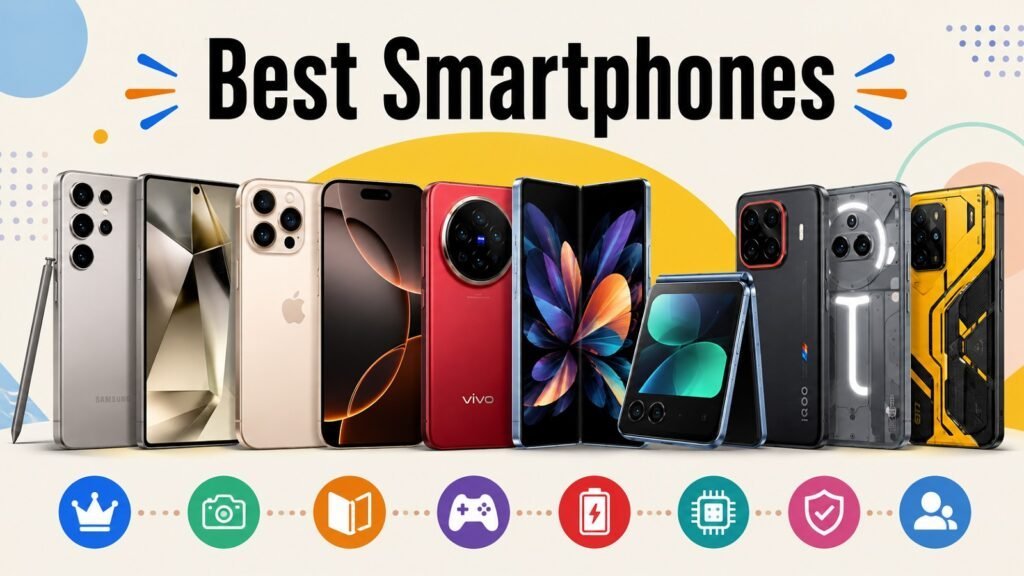
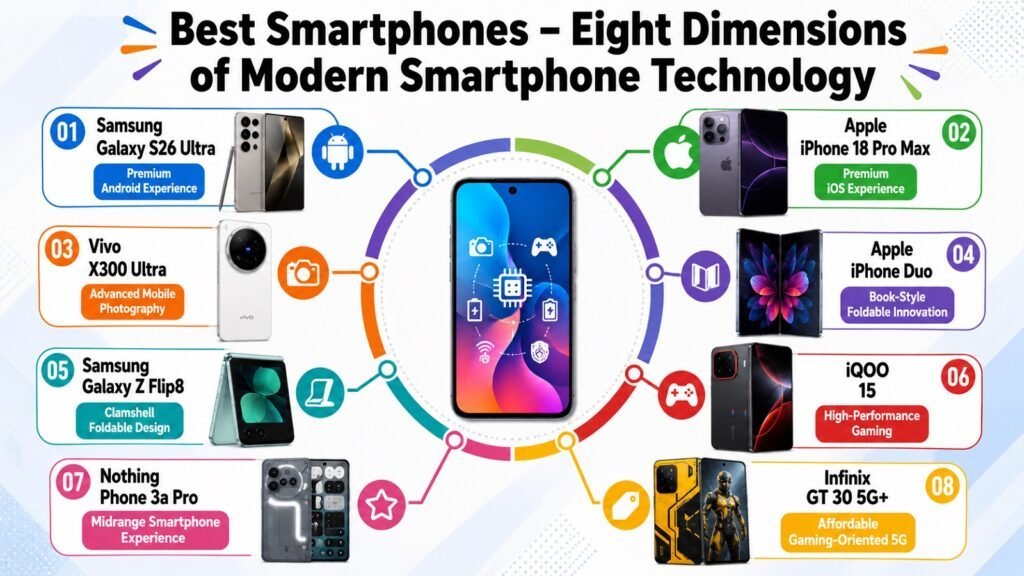
The 2026 smartphone market is crowded. Brands compete through cameras, chips, software, battery life and design. This guide to the best smartphones covers eight phones: the Samsung Galaxy S26 Ultra for its S Pen, the Apple iPhone 18 Pro Max for its A20 Pro chip, the Vivo X300 Ultra for dual 200MP cameras, the Apple iPhone Duo for its book-style fold, the Samsung Galaxy Z Flip8 for its pocket-friendly clamshell, the iQOO 15 for gaming speed, the Nothing Phone (3a) Pro for midrange zoom and the Infinix GT 30 5G+ for affordable 5G.
These smartphones suit photographers, gamers, creators, professionals, students and everyday users. We compare strengths, limits and real-world use so you can choose wisely.
Quick Comparison of the Eight Best Smartphones
| Best Smartphones | Key Highlight |
| Samsung Galaxy S26 Ultra | Premium Android flagship with S Pen |
| Apple iPhone 18 Pro Max | Premium iOS flagship with A20 Pro |
| Vivo X300 Ultra | Camera-centric flagship |
| Apple iPhone Duo | Book-style foldable |
| Samsung Galaxy Z Flip8 | Compact clamshell foldable |
| iQOO 15 | Performance and gaming flagship |
| Nothing Phone (3a) Pro | Midrange phone with periscope zoom |
| Infinix GT 30 5G+ | Affordable 5G gaming phone |
1. Samsung Galaxy S26 Ultra: One of the Best Smartphones for Android Power Users
Credit: iken3
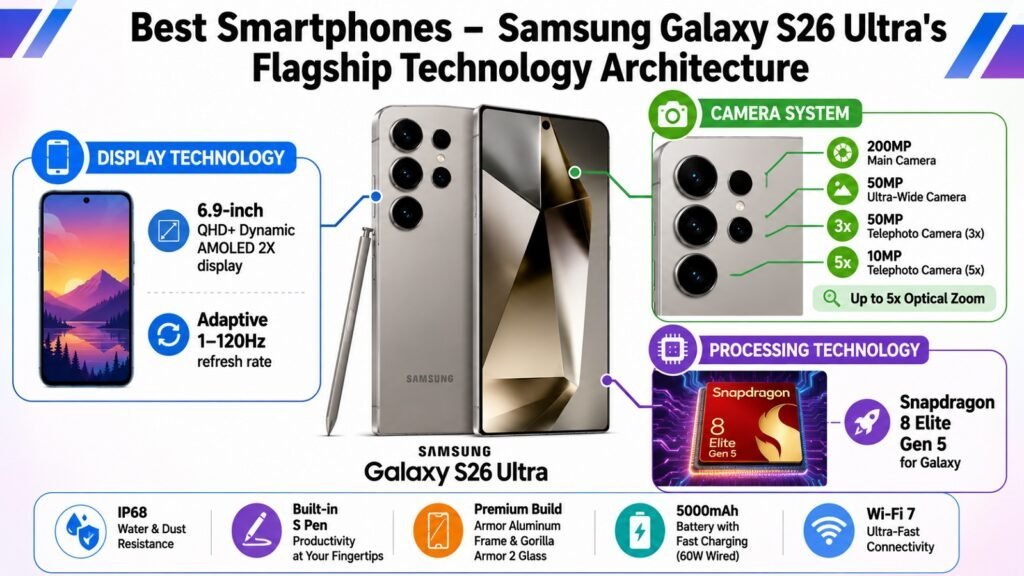
The Galaxy S26 Ultra makes our list of the best smartphones as the top Android flagship. It packs a 6.9-inch screen, four rear cameras, a built-in S Pen and a Privacy Display feature into one body, and Samsung promises up to seven major Android upgrades.
At a US base price of $1,300 it is costly, but it suits buyers who keep phones for years. Before buying, know that the 5,000mAh battery matches last year’s size, the design looks much like the S25 Ultra, and at 214g it is far from light. Overall it feels like a polished upgrade rather than a revolution, which suits people who prefer proven hardware over experiments. Its Gorilla Armor 2 glass also cuts reflections outdoors.
Samsung Galaxy S26 Ultra Specifications
| Specification | Details |
| 🧠 Chipset (Processor + GPU) | Snapdragon 8 Elite Gen 5 for Galaxy, 3nm, octa-core CPU up to 4.74GHz, Adreno 840 GPU |
| ⚙️ Operating System | Android 16 with One UI 8.5; Samsung promises up to seven major upgrades |
| 💾 RAM | 12GB; 16GB on the 1TB model |
| 🗄️ Storage | 256GB, 512GB or 1TB, no card slot |
| 🖥️ Display | 6.9-inch LTPO Dynamic AMOLED 2X, 1440 x 3120, 120Hz, 2,600 nits peak, anti-reflective glass |
| 📸 Camera Setup | Rear: 200MP f/1.4 main with OIS, 50MP ultrawide, 10MP 3x telephoto, 50MP 5x telephoto. Front: 12MP |
| 🔋 Battery & Charging | 5,000mAh; 60W wired (75% in 30 minutes), 25W Qi2.2 wireless, 4.5W reverse wireless |
| 📡 Connectivity | 5G, Wi-Fi 7, Bluetooth 5.4, NFC, ultra-wideband, USB-C 3.2 |
| 🛡️ Build & Protection | Corning Gorilla Armor 2 front, Victus 2 back, aluminum frame, IP68 dust and water resistance |
| ⚖️ Weight | 214g; 163.6 x 78.1 x 7.9mm |
Galaxy S26 Ultra User Recommendations: Who Should Buy It?
| User Type | Is This Smartphone a Good Fit? Why? |
| Students | ⚠️ Great screen, battery and long updates, but the price is high |
| Everyday Users | ✅ Smooth for browsing, streaming, calls and social apps, with long software support |
| Business Professionals | ✅ Strong multitasking, DeX desktop mode and S Pen notes |
| Photography Enthusiasts | ✅ Flexible zoom from 3x to 5x and a 200MP main sensor |
| Content Creators | ✅ Bright display, 8K video and up to 1TB of storage |
| Mobile Gamers | ✅ Top chip and a smooth 120Hz screen for long sessions |
Galaxy S26 Ultra Pros and Cons
| Pros | Cons |
| ✅ Very bright, anti-reflective display | ❌ High starting price |
| ✅ Versatile four-camera system | ❌ Battery size unchanged |
| ✅ Seven major Android upgrades | ❌ Design barely changed from last year |
| ✅ S Pen and DeX support | ❌ Heavy at 214g |
2. Apple iPhone 18 Pro Max: Among the Best Smartphones for iOS Fans
Credit: iken3
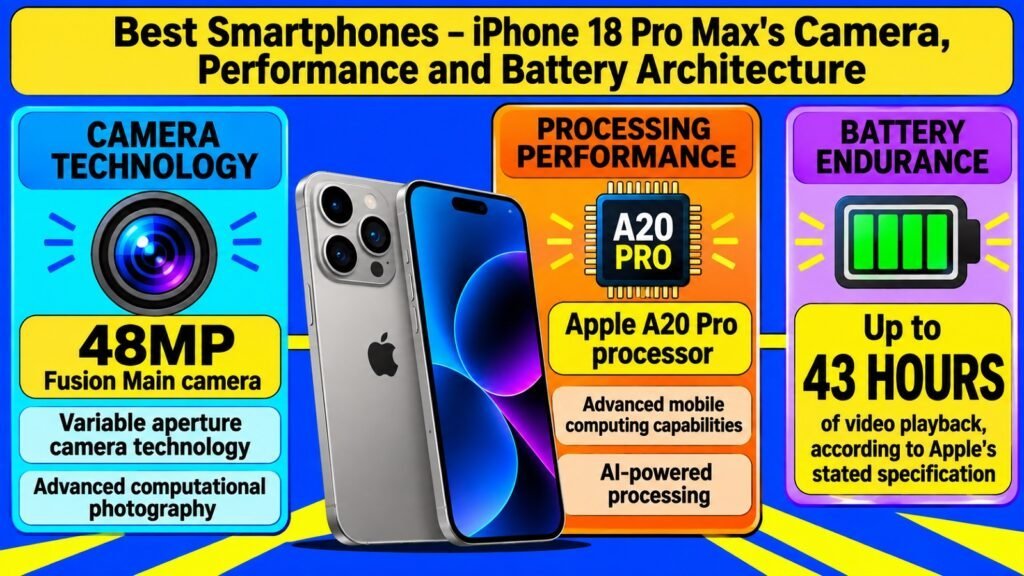
The iPhone 18 Pro Max leads the iOS side of our best smartphones list thanks to the A20 Pro chip, a 6.9-inch ProMotion display and a camera system where all three lenses are 48MP. Apple rates typical battery use at up to 29 hours. Value depends on how deeply you use Apple services, since the price is premium and storage starts at 256GB.
Before buying, note that Apple does not publish RAM or battery capacity, and fast wired charging needs a separate 60W-capable adapter. It also offers USB-C with DisplayPort and 10Gbps data speeds, which helps creators move large files quickly. Ceramic Shield 2 protects the front glass, and the 18MP front camera uses Center Stage for wider group selfies.
Apple iPhone 18 Pro Max Specifications
| Specification | Details |
| 🧠 Chipset (Processor + GPU) | A20 Pro; 6-core CPU with two super and four efficiency cores; 7-core GPU with ray tracing |
| ⚙️ Operating System | iOS 27 with Apple Intelligence and Siri AI (beta) |
| 💾 RAM | Not published by Apple; 12GB commonly reported |
| 🗄️ Storage | 256GB, 512GB, 1TB or 2TB |
| 🖥️ Display | 6.9-inch Super Retina XDR OLED, 2868 x 1320, 120Hz, 1,600 nits HDR, 3,000 nits outdoor peak |
| 📸 Camera Setup | Rear: 48MP main with variable aperture, 48MP ultrawide, 48MP 4x telephoto. Front: 18MP Center Stage |
| 🔋 Battery & Charging | Capacity not published; typical use up to 29 hours; 50% in 15 minutes with 60W adapter; 25W MagSafe and Qi2 |
| 📡 Connectivity | 5G, Wi-Fi 7, Bluetooth 6, NFC, ultra-wideband, Apple C2 modem, USB-C |
| 🛡️ Build & Protection | Aluminum body, Ceramic Shield 2 front, Ceramic Shield back, IP68 |
| ⚖️ Weight | 249g; 163.4 x 78.0 x 8.75mm |
iPhone 18 Pro Max User Recommendations: Who Should Buy It?
| User Type | Is This Smartphone a Good Fit? Why? |
| Students | ⚠️ Excellent performance and battery life, but costly for most students |
| Everyday Users | ✅ Smooth, secure and simple for daily apps, calls and streaming |
| Business Professionals | ✅ Face ID, strong security, long battery life and smooth multitasking |
| Photography Enthusiasts | ✅ Three 48MP cameras with 8x optical-quality zoom |
| Content Creators | ✅ 4K 120fps Dolby Vision video, ProRes and Apple Log 2 |
| Mobile Gamers | ✅ Fast GPU with hardware ray tracing and a smooth 120Hz screen |
iPhone 18 Pro Max Pros and Cons
| Pros | Cons |
| ✅ Fast A20 Pro chip | ❌ Premium price |
| ✅ Three 48MP cameras | ❌ RAM and battery size unlisted |
| ✅ Rated up to 29 hours of typical use | ❌ Adapter sold separately |
| ✅ Wi-Fi 7 and Bluetooth 6 | ❌ Heavy at 249g |
3. Vivo X300 Ultra: A Camera Powerhouse Among the Best Smartphones
Credit: iken3
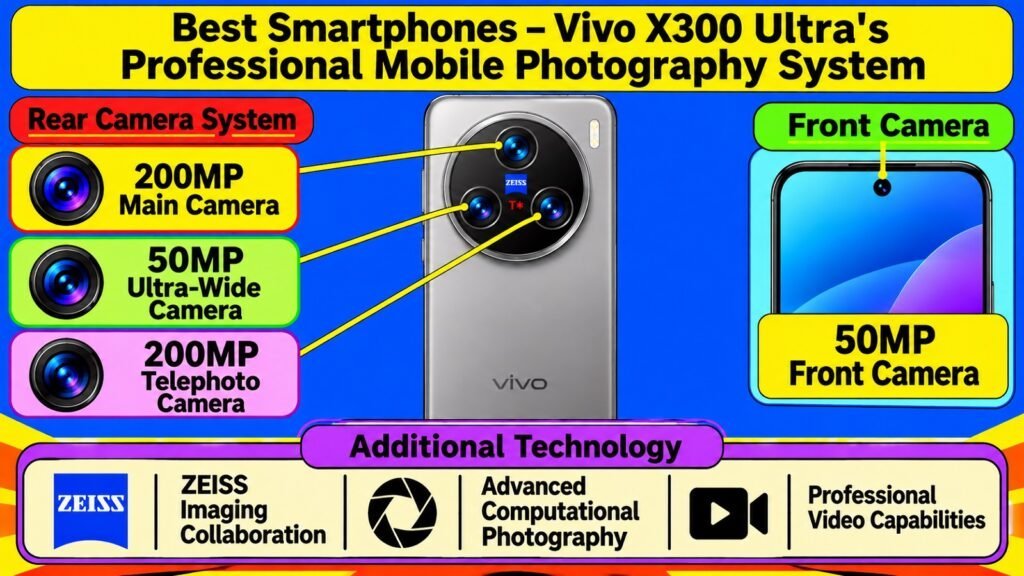
The Vivo X300 Ultra earns a place among the best smartphones for people who want a true camera phone. It carries two 200MP cameras and a 50MP ultrawide with Zeiss tuning, backed by a Snapdragon 8 Elite Gen 5 chip and a 6,600mAh battery. It costs ₹159,999 in India for the 16GB and 512GB model, and the optional telephoto extender adds more. Before buying, note that the camera island is chunky, the extender is sold separately, and the weight and IP rating are not officially confirmed in the sources reviewed. The body is only 8.19mm thick, which is slim for this much camera hardware. Buyers who mainly care about photos will find little else that matches it.
Vivo X300 Ultra Specifications
| Specification | Details |
| 🧠 Chipset (Processor + GPU) | Snapdragon 8 Elite Gen 5, 3nm, octa-core CPU up to 4.6GHz, Adreno 840 GPU, VS1+ imaging chip |
| ⚙️ Operating System | Android 16 with OriginOS 6; five years of OS updates promised |
| 💾 RAM | 12GB or 16GB LPDDR5X |
| 🗄️ Storage | 256GB, 512GB or 1TB UFS 4.1, by market, no card slot |
| 🖥️ Display | 6.82-inch LTPO AMOLED, 3168 x 1440, 144Hz, Dolby Vision, 510 ppi, 4,500 nits local peak, armor glass |
| 📸 Camera Setup | Rear: 200MP main, 200MP periscope with Zeiss optics, 50MP ultrawide. Front: 50MP autofocus |
| 🔋 Battery & Charging | 6,600mAh in India; 100W wired, 40W wireless, reverse charging |
| 📡 Connectivity | 5G, Wi-Fi 7, Bluetooth 5.4, NFC, infrared, dual-frequency GPS, USB-C |
| 🛡️ Build & Protection | Glass front and back, aluminum frame; IP68/IP69 reported, unconfirmed |
| ⚖️ Weight | Not confirmed; 8.19mm thick |
Vivo X300 Ultra User Recommendations: Who Should Buy It?
| User Type | Is This Smartphone a Good Fit? Why? |
| Students | ❌ Excellent phone, but far too expensive for most students |
| Everyday Users | ✅ Fast, bright and long-lasting for daily use |
| Business Professionals | ✅ Big battery, fast charging and Office Kit tools |
| Photography Enthusiasts | ✅ Dual 200MP cameras with Zeiss optics |
| Content Creators | ✅ 8K video, 10-bit Log, 3D LUT import and a 50MP selfie camera |
| Mobile Gamers | ✅ Flagship chip, 144Hz screen and large cooling area |
Vivo X300 Ultra Pros and Cons
| Pros | Cons |
| ✅ Dual 200MP cameras with Zeiss tuning | ❌ Very high price |
| ✅ 100W and 40W wireless charging | ❌ Bulky camera island |
| ✅ Bright 144Hz display | ❌ Weight and IP rating unconfirmed |
| ✅ Large 6,600mAh battery | ❌ Extender costs extra |
4. Apple iPhone Duo: A Book-Style Foldable Among the Best Smartphones
Credit: iken3
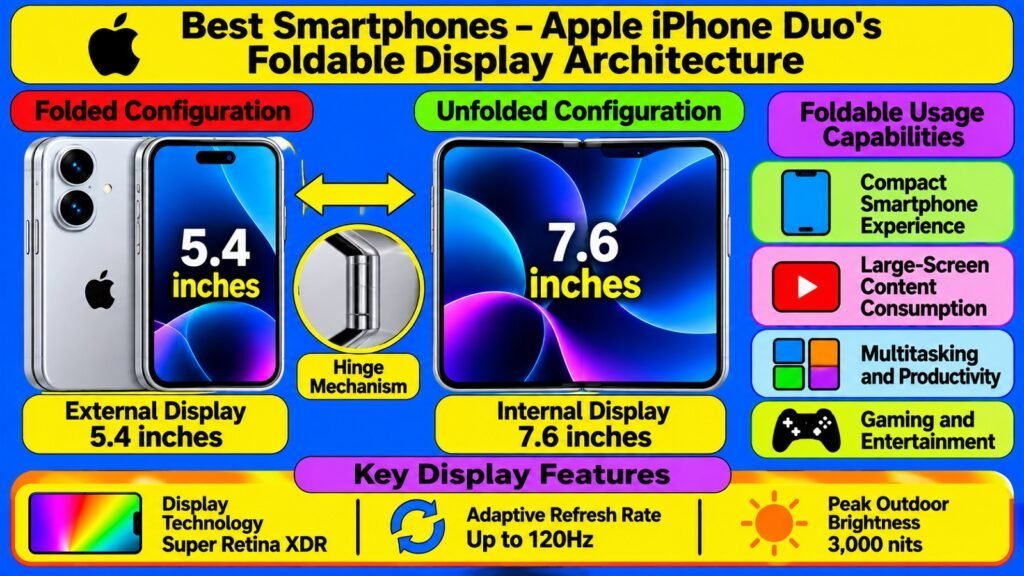
The iPhone Duo is Apple’s first foldable, and it earns a spot among the best smartphones for anyone who wants a tablet-sized screen in a pocket. It opens to a 7.6-inch display, closes to a 5.4-inch screen and uses the same A20 Pro chip as the Pro models. At $1,999 in the US for 256GB, value suits early adopters. Before buying, know that it has only two rear cameras, uses Touch ID instead of Face ID, and works with eSIM only, so there is no physical SIM tray. Apple Pencil support also makes the large inner screen useful for notes and sketches, and the titanium frame adds strength. At 5.2mm open, it is also the thinnest iPhone so far.
Apple iPhone Duo Specifications
| Specification | Details |
| 🧠 Chipset (Processor + GPU) | A20 Pro; 6-core CPU with two super cores; 7-core GPU with ray tracing |
| ⚙️ Operating System | iOS 27 with Apple Intelligence and Siri AI |
| 💾 RAM | Not published by Apple |
| 🗄️ Storage | 256GB, 512GB, 1TB or 2TB |
| 🖥️ Display | Inner 7.6-inch, 1878 x 2670, nano-texture; outer 5.4-inch; both OLED, 120Hz, 3,000 nits peak |
| 📸 Camera Setup | Rear: 48MP main, 48MP ultrawide, 2x optical-quality zoom. Front: 12MP outer, under-display inner |
| 🔋 Battery & Charging | Dual batteries, capacity unlisted; typical use up to 24 hours; 50% in 20 minutes with 60W adapter; 25W MagSafe |
| 📡 Connectivity | 5G, Wi-Fi 7, Bluetooth 6, NFC, UWB, eSIM only, USB-C |
| 🛡️ Build & Protection | Titanium frame, Ceramic Shield 2 front, Ceramic Shield back, IP68 |
| ⚖️ Weight | 254g; open 164.6 x 117.8 x 5.2mm; closed 84.1 x 117.8 x 11.3mm |
iPhone Duo User Recommendations: Who Should Buy It?
| User Type | Is This Smartphone a Good Fit? Why? |
| Students | ⚠️ Apple Pencil support helps notes, but the price is steep for students |
| Everyday Users | ✅ Two screens suit browsing, calls and video well |
| Business Professionals | ✅ Large screen, multitasking and Touch ID |
| Photography Enthusiasts | ⚠️ Good 48MP pair, but no dedicated telephoto |
| Content Creators | ✅ 4K 120fps video and a big editing canvas |
| Mobile Gamers | ✅ Fast chip and a large 120Hz screen |
iPhone Duo Pros and Cons
| Pros | Cons |
| ✅ Large 7.6-inch inner screen | ❌ Starts at $1,999 |
| ✅ Apple Pencil support | ❌ Only two rear cameras |
| ✅ Titanium frame and IP68 | ❌ No Face ID |
| ✅ Dual-battery design for a thin body | ❌ eSIM only |
5. Samsung Galaxy Z Flip8: Best Smartphones Pick for Clamshell Foldable Fans
Credit: iken3
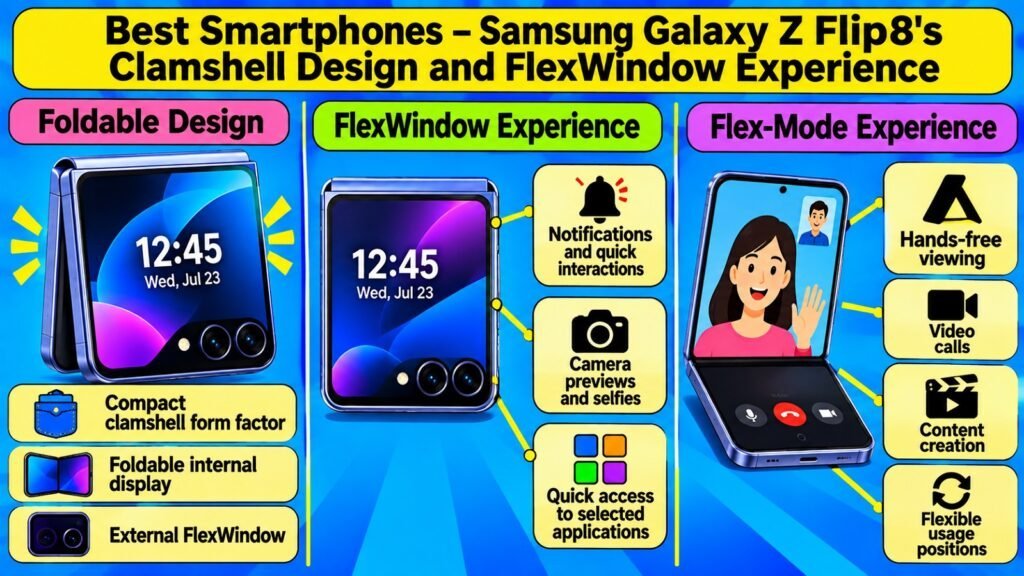
The Galaxy Z Flip8 earns a place on our list of the best smartphones for anyone seeking a compact device that unfolds to reveal a full 6.9-inch display. Weighing just 180g, it is the lightest phone in this selection, while its 4.1-inch cover screen is handy for quick tasks. In the US, it costs $1,199.99—a high price given that its cameras and 4,300mAh battery are unchanged from the Flip7.
Before purchasing, keep in mind that 25W charging is slow, the IP48 rating offers only limited dust protection, and gaming performance declines during extended play. The main display supports a 120Hz refresh rate for smooth scrolling, and Samsung has made the phone slimmer than the Flip7. It runs Android 17 with One UI 9 overlay, and it also runs all the Galaxy AI features.
Samsung Galaxy Z Flip8 Specifications
| Specification | Details |
| 🧠 Chipset (Processor + GPU) | Exynos 2600 (2nm) with Xclipse 960 GPU in many regions; a Snapdragon variant in others |
| ⚙️ Operating System | Android 17 with One UI 9 |
| 💾 RAM | 12GB |
| 🗄️ Storage | 256GB or 512GB; 1TB in some markets |
| 🖥️ Display | 6.9-inch Dynamic AMOLED 2X, 1080 x 2520, 120Hz, 2,600 nits peak; 4.1-inch Super AMOLED cover, 948 x 1048 |
| 📸 Camera Setup | Rear: 50MP main with OIS, 12MP ultrawide. Front: 10MP inner camera |
| 🔋 Battery & Charging | 4,300mAh; 25W wired, 15W wireless, 4.5W reverse wireless |
| 📡 Connectivity | 5G, Wi-Fi 7, Bluetooth 5.4, NFC, side fingerprint sensor, USB-C |
| 🛡️ Build & Protection | Aluminum frame, Victus 2 cover glass, polymer back, IP48 dust and water resistance |
| ⚖️ Weight | 180g; unfolded 166.9 x 75.4 x 6.1mm; folded 85.7 x 75.4 x 13.1mm |
Galaxy Z Flip8 User Recommendations: Who Should Buy It?
| User Type | Is This Smartphone a Good Fit? Why? |
| Students | ⚠️ Fun and pocketable, but pricey for most student budgets |
| Everyday Users | ✅ Compact, with a handy cover screen |
| Business Professionals | ⚠️ Fine for messaging, but battery is average |
| Photography Enthusiasts | ⚠️ Capable main camera, but no telephoto |
| Content Creators | ✅ Rear-camera selfies with the cover screen help vlogging |
| Mobile Gamers | ⚠️ Fine for short sessions, but performance drops over time |
Galaxy Z Flip8 Pros and Cons
| Pros | Cons |
| ✅ Lightest phone here at 180g | ❌ Slow 25W charging |
| ✅ Compact fold, big screen | ❌ Limited dust protection |
| ✅ Useful cover display | ❌ Cameras unchanged |
| ✅ Android 17 and One UI 9 | ❌ High price for the hardware |
6. Best Smartphones: iQOO 15 – Best Choice for Performance and Gaming
Credit: iken3
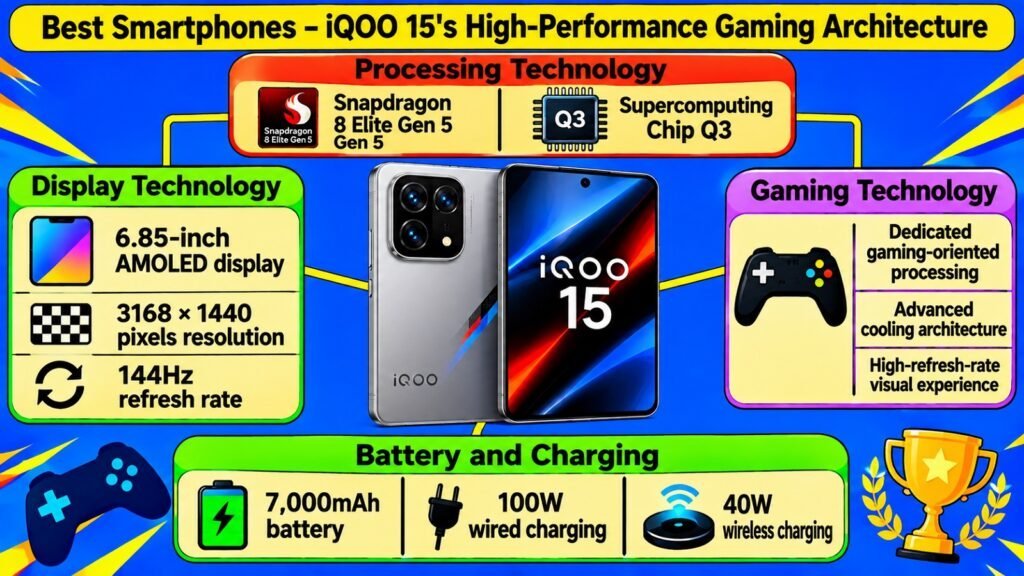
The iQOO 15 stands out among the best smartphones for gaming and speed. It pairs the Snapdragon 8 Elite Gen 5 with iQOO’s Q3 gaming chip, a 6.85-inch 144 Hz display and a 7,000 mAh battery. Value is its biggest strength, with India launch pricing from ₹72,999, well below other flagships here. Before buying, know that it runs OriginOS 6 instead of the older Funtouch OS, and its 50MP cameras are strong but not class-leading. Wireless charging is supported at 40W, and the display reaches 6,000 nits locally, which helps outdoors. iQOO also promises seven years of security updates, a long window for a gaming-focused phone. Stereo speakers and a large vapor chamber round out the gaming package.
iQOO 15 Specifications
| Specification | Details |
| 🧠 Chipset (Processor + GPU) | Snapdragon 8 Elite Gen 5, 3nm, octa-core, Adreno 840 GPU, Q3 gaming chip with ray tracing |
| ⚙️ Operating System | Android 16 with OriginOS 6; five OS and seven security years |
| 💾 RAM | 12GB or 16GB LPDDR5X |
| 🗄️ Storage | 256GB or 512GB UFS 4.1, no card slot |
| 🖥️ Display | 6.85-inch Samsung LTPO AMOLED, 3168 x 1440, 144Hz, Dolby Vision, 6,000 nits local peak |
| 📸 Camera Setup | Rear: 50MP Sony main with OIS, 50MP 3x periscope, 50MP ultrawide. Front: 32MP |
| 🔋 Battery & Charging | 7,000mAh; 100W wired, 40W wireless |
| 📡 Connectivity | 5G, Wi-Fi 7, Bluetooth 6.0, NFC, dual-frequency GPS, USB-C 3.2 |
| 🛡️ Build & Protection | IP68 and IP69 rated; materials not confirmed |
| ⚖️ Weight | 216.2g or 220g; 163.65 x 76.71 x 8.14mm |
iQOO 15 User Recommendations: Who Should Buy It?
| User Type | Is This Smartphone a Good Fit? Why? |
| Students | ✅ Flagship power at a lower price |
| Everyday Users | ✅ Fast, bright and long-lasting for daily use |
| Business Professionals | ✅ Big battery, Wi-Fi 7 and long updates |
| Photography Enthusiasts | ⚠️ Good triple 50MP setup, not class-leading |
| Content Creators | ✅ 2K 144Hz screen and 8K video |
| Mobile Gamers | ✅ Q3 chip, big cooling system and 144Hz display |
iQOO 15 Pros and Cons
| Pros | Cons |
| ✅ Strong gaming hardware | ❌ Cameras not class-leading |
| ✅ 7,000mAh battery with 100W charging | ❌ OriginOS may feel new |
| ✅ Very bright 2K display | ❌ Heavy at about 216g |
| ✅ Competitive flagship price | ❌ Build materials unconfirmed |
7. Nothing Phone (3a) Pro: A Midrange Option Among the Best Smartphones
Credit: iken3
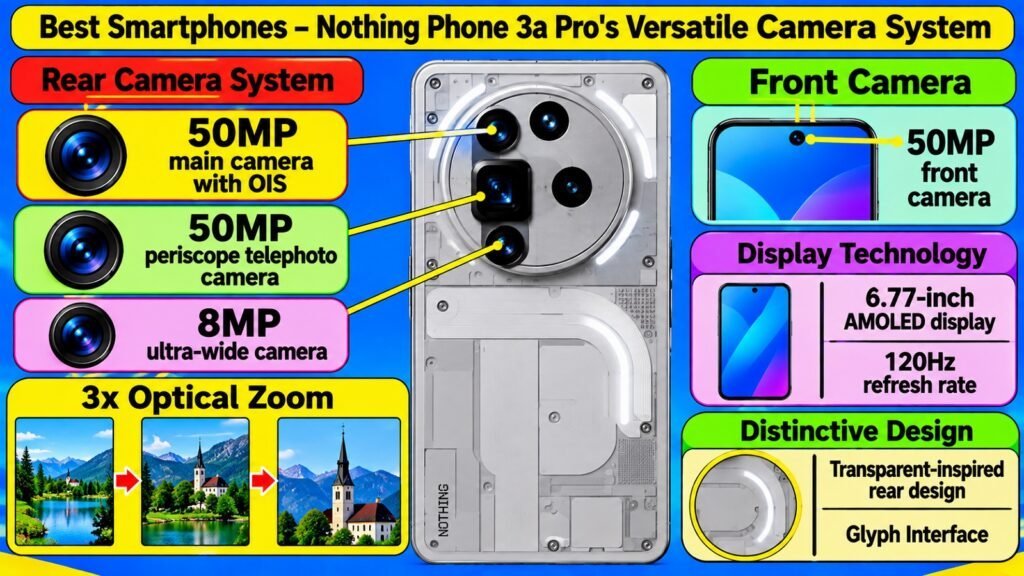
The Nothing Phone (3a) Pro is a stylish pick among the best smartphones for midrange buyers who want real zoom. Its Glyph lights and clean software look different, and a 50MP 3x periscope camera is rare at this price. It launched at about $459 in the US, which is fair value. Before buying, note that the Snapdragon 7s Gen 3 chip is modest for heavy gaming, the IP64 rating is basic, it launched on Android 15, and there is no wireless charging. The phone also promises six years of security patches, and its 50MP selfie camera records 4K video. The 6.77-inch screen peaks at 3,000 nits, so it stays readable outdoors.
Nothing Phone (3a) Pro Specifications
| Specification | Details |
| 🧠 Chipset (Processor + GPU) | Snapdragon 7s Gen 3, 4nm, octa-core, Adreno 810 |
| ⚙️ Operating System | Android 15 with Nothing OS 3.1; three major updates, six years of security patches |
| 💾 RAM | 8GB or 12GB, by market |
| 🗄️ Storage | 128GB or 256GB, no card slot |
| 🖥️ Display | 6.77-inch flexible AMOLED, 1080 x 2392, 120Hz, 3,000 nits peak, HDR10+ |
| 📸 Camera Setup | Rear: 50MP main with OIS, 50MP 3x periscope with OIS, 8MP ultrawide. Front: 50MP |
| 🔋 Battery & Charging | 5,000mAh; 50W wired (50% in 19 minutes); no wireless charging |
| 📡 Connectivity | 5G, Wi-Fi 6, Bluetooth 5.4, NFC, dual SIM with eSIM, USB-C 2.0 |
| 🛡️ Build & Protection | Panda Glass display, glass back, IP64 dust and splash resistance |
| ⚖️ Weight | 211g; 163.5 x 77.5 x 8.4mm |
Nothing Phone (3a) Pro User Recommendations: Who Should Buy It?
| User Type | Is This Smartphone a Good Fit? Why? |
| Students | ✅ Good value, strong display, solid battery and three years of updates |
| Everyday Users | ✅ Smooth software and a standout design |
| Business Professionals | ⚠️ Capable, but only IP64 and midrange power |
| Photography Enthusiasts | ✅ Rare 3x optical zoom at this price |
| Content Creators | ✅ 50MP selfie camera with 4K video |
| Mobile Gamers | ⚠️ Fine for casual games, but not heavy titles |
Nothing Phone (3a) Pro Pros and Cons
| Pros | Cons |
| ✅ Distinctive Glyph design | ❌ Modest chipset |
| ✅ 3x periscope camera | ❌ Basic IP64 rating |
| ✅ Bright 120Hz display | ❌ No wireless charging |
| ✅ 50W fast charging | ❌ Shorter update promise |
8. Infinix GT 30 5G+: An Affordable 5G Pick Among the Best Smartphones
Credit: iken3
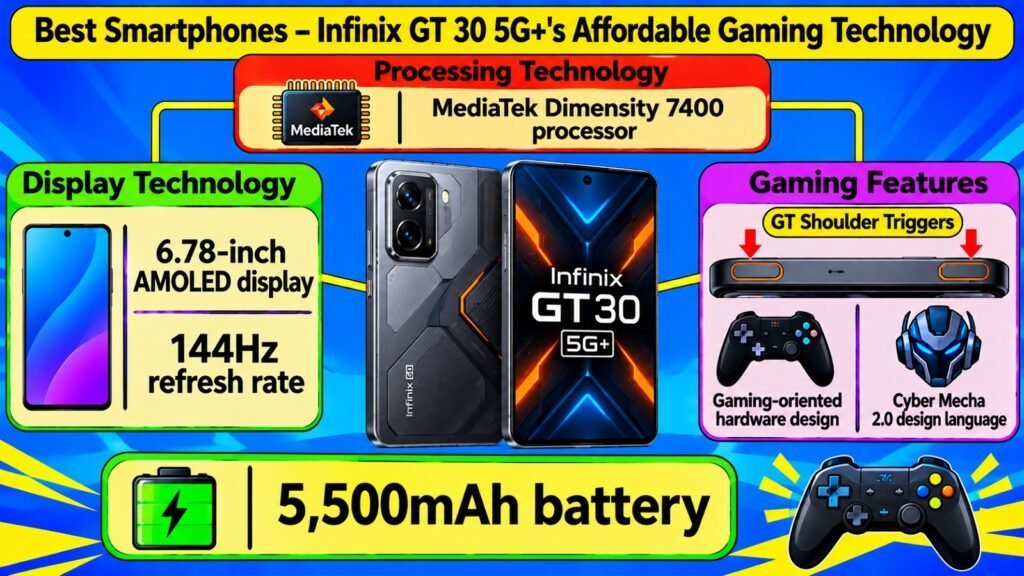
The Infinix GT 30 5G+ rounds out our list as the best smartphones in the budget gaming segment. Priced from ₹19,499 in India, it packs a Dimensity 7400 processor, a 144Hz AMOLED display, shoulder triggers and a 5,500 mAh battery—an impressive package for the price. Its screen offers peak brightness of 4,500 nits, while bypass charging powers the phone directly from the charger during gaming rather than drawing on the battery. Gorilla Glass 7i helps protect the front from scratches, and an IP64 rating provides basic splash resistance. However, its rear panel and frame are plastic, the camera system is modest with only two rear lenses, and Infinix promises just two major Android updates.
Infinix GT 30 5G+ Specifications
| Specification | Details |
| 🧠 Chipset (Processor + GPU) | MediaTek Dimensity 7400, 4nm, octa-core, Mali-G615 MC2 |
| ⚙️ Operating System | Android 15 with XOS 15; two major upgrades, three years of security updates |
| 💾 RAM | 8GB LPDDR5X |
| 🗄️ Storage | 128GB or 256GB UFS 2.2, no card slot |
| 🖥️ Display | 6.78-inch AMOLED, 1224 x 2720, 1.5K, 144Hz, 4,500 nits peak |
| 📸 Camera Setup | Rear: 64MP Sony IMX682 main, 8MP ultrawide. Front: 13MP |
| 🔋 Battery & Charging | 5,500mAh; 45W wired, bypass charging, reverse wired charging; no wireless charging |
| 📡 Connectivity | 5G, Wi-Fi 6, Bluetooth 5.4, infrared; NFC listings differ |
| 🛡️ Build & Protection | Gorilla Glass 7i, plastic back and frame, IP64 |
| ⚖️ Weight | 187g; 163.7 x 75.8 x 8mm |
Infinix GT 30 5G+ User Recommendations: Who Should Buy It?
| User Type | Is This Smartphone a Good Fit? Why? |
| Students | ✅ Low price, big battery and a smooth 144Hz screen |
| Everyday Users | ✅ Reliable for apps, video, calls and social media |
| Business Professionals | ⚠️ Works for basics, but updates are short |
| Photography Enthusiasts | ❌ Only a basic two-lens camera |
| Content Creators | ⚠️ Great screen, but average cameras |
| Mobile Gamers | ✅ Shoulder triggers, 144Hz display, bypass charging and LED lighting |
Infinix GT 30 5G+ Pros and Cons
| Pros | Cons |
| ✅ Very low starting price | ❌ Plastic build |
| ✅ 144Hz AMOLED display | ❌ Basic cameras |
| ✅ Large 5,500mAh battery | ❌ Short update promise |
| ✅ Gaming triggers | ❌ Slower 45W charging |
Conclusion: Choosing From the Best Smartphones in 2026
Credit: iken3
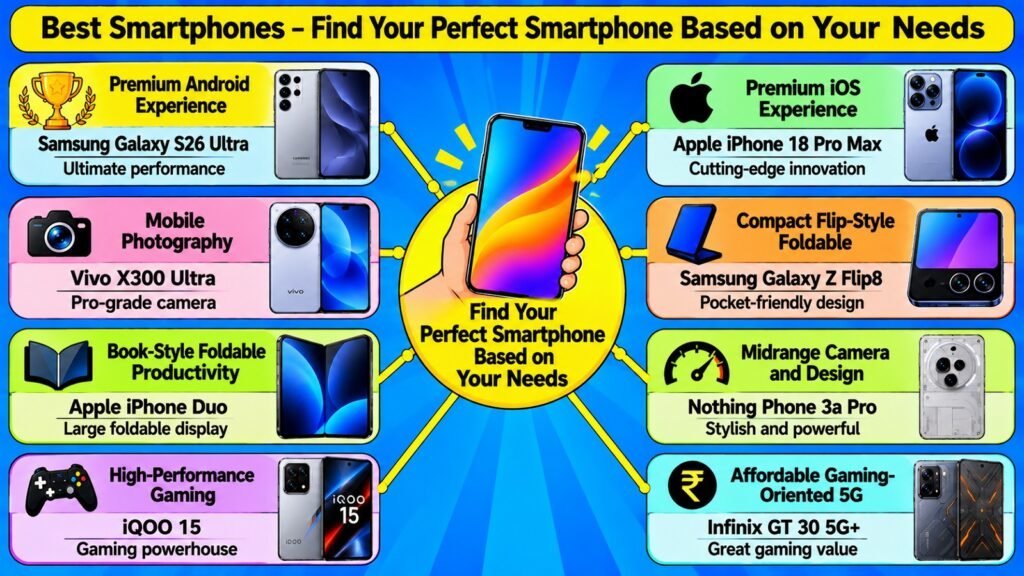
Each of the best smartphones in this list has a clear strength. The flagships lead in performance, cameras and display quality, while the foldables offer new ways to use a screen. The iQOO 15 shows how much power a lower price can buy, and the midrange picks keep costs down without dropping the essentials, such as a bright display and a solid battery. They also differ in battery life, design, software experience and value for money, so no two phones solve the same problem.
Before buying, think about your budget, your daily habits, the features you will really use and how long you plan to keep the phone. A student, a gamer and a business traveler will each reach a different answer. Also compare software update promises, since they range from two to seven major Android upgrades.
No single smartphone is ideal for everyone, and the right choice depends on your needs and expectations. Use this list to narrow your options, compare the tables and pick the phone that fits how you live. With so much variety among the best smartphones, there is a good match for almost every buyer.
Which of the Best Smartphones Should You Choose?
| Best Smartphones | Best Suited For |
|---|---|
| Samsung Galaxy S26 Ultra | Business professionals, Android power users and photography enthusiasts |
| Apple iPhone 18 Pro Max | iOS users, content creators and photography enthusiasts |
| Vivo X300 Ultra | Mobile photographers and professional content creators |
| Apple iPhone Duo | Multitaskers, professionals and users who prefer large foldable displays |
| Samsung Galaxy Z Flip8 | Style-conscious users, frequent travellers and compact-phone enthusiasts |
| iQOO 15 | Mobile gamers, performance enthusiasts and power users |
| Nothing Phone (3a) Pro | Students, everyday users and budget-conscious photography enthusiasts |
| Infinix GT 30 5G+ | Budget-conscious buyers and entry-level mobile gamers |