Table of Contents
Introduction: Global Data Flow – The Foundation of a Connected World
Global Data Flow is an important aspect of Internet Technology because it explains how worldwide digital communication, information exchange, and connectivity are actually achieved. Defined precisely, it is the movement and exchange of digital information among users, devices, applications, servers, data centers, and interconnected networks across geographical boundaries.
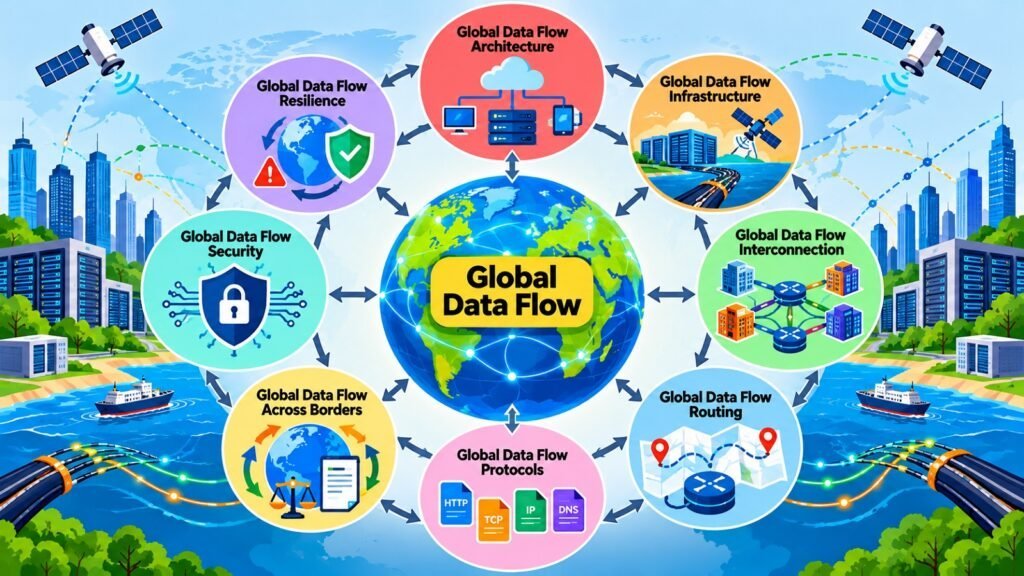
Understanding it demands more than familiarity with any single technology. Network architecture, physical infrastructure, interconnection, addressing, routing, communication protocols, cross-border data exchange, security, and resilience constrain one another: protocols presuppose addressing, addressing depends on interconnection, interconnection rides on physical links, and legal and security requirements shape how all of them are deployed. Treating these foundations as isolated topics therefore obscures more than it reveals.
This article adopts an academic orientation, combining theoretical explanation with verified technical evidence from IETF standards, regulatory texts, and engineering documentation, together with practical applications and critical evaluation. Factual information is distinguished from analytical perspective, and assertions regarding magnitude are omitted unless they possess verifiable sources. Four questions guide the analysis: how information reaches distant destinations, how independent networks cooperate, how data is protected, and how communication continues during disruption.
The parameters are intentionally circumscribed: Global Data Flow addresses the processes through which data is transmitted and the infrastructural frameworks that facilitate such transmission, while metrics concerning data volume, capacity utilization, network congestion, consumption behaviors, and expansion trajectories are addressed within the distinct article on Global Internet Traffic. The subsequent table delineates the eight foundational elements that organize the discourse, each of which is examined within its corresponding numbered section.
Table 1: Global Data Flow Foundations and Their Contributions
| Global Data Flow Foundations | Contribution to Understanding Global Data Flow |
| Global Data Flow Architecture | Conceptual model of endpoints, layers, and responsibilities |
| Global Network Infrastructure and Pathways | Physical media and facilities that carry signals |
| Global Network Interconnection | Cooperation among independently operated networks |
| Data Addressing and Routing | Identification of destinations and selection of paths |
| Data Transmission Protocols | Standardized rules for exchanging data between systems |
| Cross-Border Data Exchange | Legal and jurisdictional conditions on international transfers |
| Global Data Flow Security | Protection of confidentiality, integrity, and authenticity in transit |
| Global Data Flow Resilience | Continuity and recovery under failure |
1. Global Data Flow Architecture: The Essential Foundations
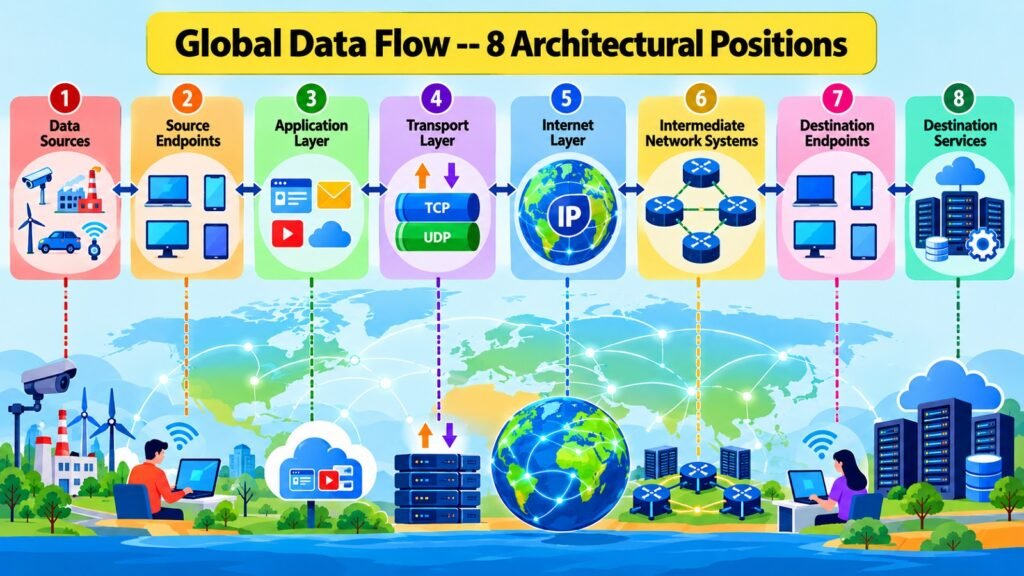
Architecture supplies the conceptual model on which every other foundation depends. Data originates at a source endpoint, is handled by an application, crosses communication networks and intermediate systems, and is finally consumed by a destination service. Each element carries distinct responsibilities: applications define meaning, networks deliver packets, and intermediate systems forward them without interpreting application content.
Two organizing principles dominate: layering, reflected in the host requirements of RFC 1122 and in the design reasoning of RFC 1958, divides communication into functions that can evolve independently, and it permits substitution, since an application need not change when the underlying link technology does. The end-to-end argument, articulated by Saltzer, Reed, and Clark in 1984, holds that functions requiring application knowledge are best implemented at the endpoints, leaving the network comparatively simple. The foundational principles of client-server interaction and broader distributed-system architectures extend this framework by distributing state management and computational processes across multiple hosts.
Logical data flow must not be confused with physical infrastructure: a logical exchange between a client and a server may traverse many links, operators, and media that neither endpoint perceives, and the same exchange can follow different physical paths over time. Conflating the two produces errors about both reliability and responsibility. Architecture describes who is responsible for what, whereas infrastructure describes what physically carries the signals.
A realistic example is a mobile application in one country retrieving account information from a cloud service hosted in another. The application issues a request, the device’s network stack encapsulates it, intermediate routers forward the resulting packets, and the destination service processes the request and returns a response. The route itself lies outside the example because it is neither fixed nor known to the endpoints.
Architectural choices carry costs: layering promotes interoperability and scalability, yet it can obscure cross-layer interactions, and the end-to-end principle has been tempered in practice by middleboxes that inspect or alter packets. Architecture therefore provides the organizing logic for Global Data Flow, while later sections examine the mechanisms that realize it.
Table 2: Global Data Flow Architectural Components and Roles
| Component or Principle | Role in Global Data Flow |
| Endpoints | Originate and receive data |
| Applications | Define the meaning of exchanged information |
| Network layers | Separate functions so each can evolve independently |
| Intermediate systems | Forward packets between networks without interpreting content |
| Destination services | Process requests and return responses |
| Distributed components | Spread state and computation across hosts |
| Interoperability | Allows independently built systems to communicate |
| End-to-end communication | Places application-dependent functions at the endpoints |
2. Global Data Flow Infrastructure: Networks and Pathways
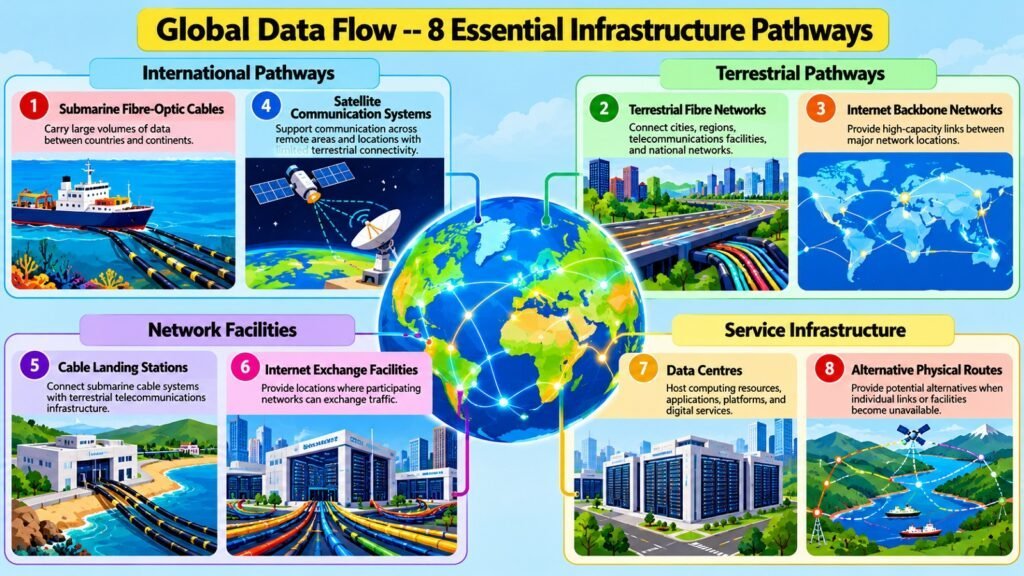
Physical infrastructure converts logical exchange into signals that actually cross cities, countries, and continents. Submarine fiber-optic cables connect continents and terminate at cable landing stations, where they join terrestrial fiber networks and backbone links operated by carriers. Satellite systems complement these facilities, particularly where terrestrial deployment is impractical, although they differ materially in propagation delay and deployment economics. Data centers and other network facilities host the equipment that terminates, aggregates, and exchanges these links. Cable infrastructure systems are typically held by consortia or telecommunications carriers and constructed to endure extended operational periods, resulting in design modifications that progress considerably more gradually than the applications and services that depend upon them.
A physical connection does not by itself determine the route selected for a given flow. Routing protocols choose among available adjacencies according to policy and metrics, so infrastructure establishes what is possible while logical decisions determine what is used. This separation explains why geography alone rarely predicts a path.
Distance, topology, and dependency structure shape continuity: propagation delay grows with path length, constraining latency regardless of capacity, and sparse topologies concentrate dependence on a few corridors. Industry bodies such as the International Cable Protection Committee identify fishing and anchoring among the leading causes of cable faults, while the 2008 damage to several Mediterranean cables showed how one localized event can degrade connectivity across multiple countries. Alternative pathways, whether additional cables, overland routes, or satellite links, widen the set of options available when one corridor fails.
Diversity should not be mistaken for resilience: two apparently separate connections may share a conduit, a landing station, a power source, or a seabed corridor, so a single event can disable both. Meaningful assessment therefore requires documentation of actual physical routes, which operators do not always publish.
Exchange arrangements between networks belong to Section 3, and logical path selection to Section 4. Here the emphasis falls on enduring engineering principles rather than transient infrastructure statistics, which age quickly.
Table 3: Global Data Flow Infrastructure Categories and Functions
| Infrastructure Category | Function in Global Data Flow |
| Submarine cables | Carry optical signals between continents |
| Terrestrial fiber networks | Connect landing stations, cities, and facilities overland |
| Backbone links | Join major networks over long distances |
| Satellite systems | Reach locations lacking practical terrestrial links |
| Cable landing stations | Join undersea systems to terrestrial networks |
| Data centers | Host servers that originate and receive data |
| Network facilities | House routing, switching, and power equipment |
| Alternative physical pathways | Offer separate routes if a primary path fails |
3. Global Data Flow Interconnection: How Networks Communicate
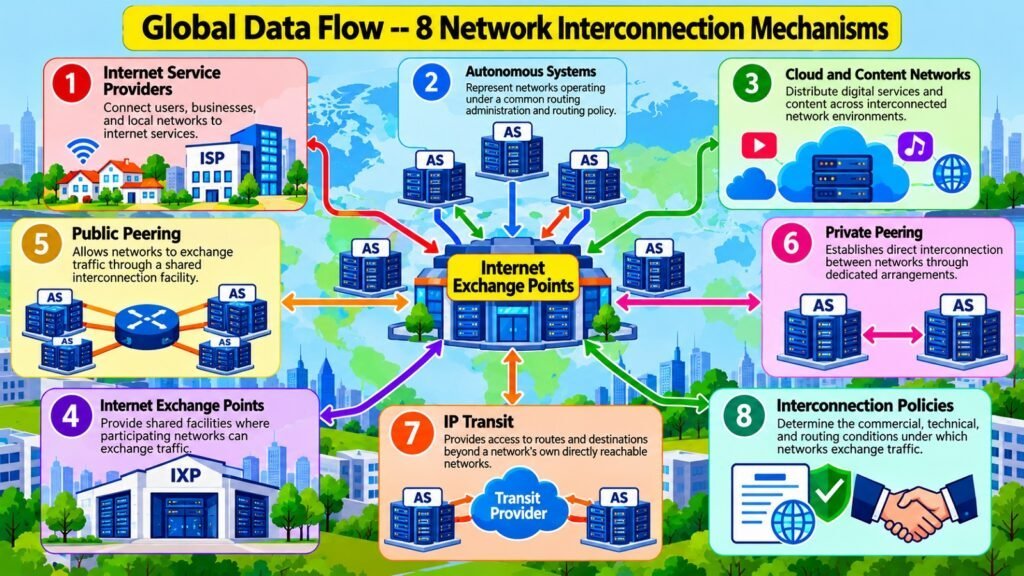
The internet constitutes a collection of autonomously managed networks rather than a unified system subject to centralized rule and governance. Each such network, identified as an autonomous system in the sense of RFC 1930, applies its own policies to the routes it accepts, advertises, and forwards. Global Data Flow is therefore possible only because a very large number of operators, including internet service providers, cloud providers, and content networks, agree to exchange reachability information and data.
Physical connectivity and exchange arrangements are distinct matters. A connection established between two networks does not impose an obligation upon either party to transmit the other’s data; the conditions governing such exchange are determined through interconnection agreements and upheld via routing policy. Two models are commonly distinguished: under settlement-free peering, networks exchange data destined for each other and their customers, whereas under IP transit one network is paid to provide reachability to the wider internet.
Internet exchange points lower the cost and complexity of these relationships by providing a shared switching fabric where many networks can interconnect. Documentation from the Internet Society and from established exchange operators stresses that exchanges facilitate, but do not mandate, peering, so each participant still chooses its counterparts. Regional internet registries contribute by allocating address space and autonomous system numbers and by maintaining the registration records on which operators rely.
These choices involve trade-offs: transit offers broad reachability at a price and with dependence on a provider, while peering reduces dependence and can shorten paths but demands operational effort and mutual interest. Because agreements are generally private, outsiders rarely know which networks exchange data and on what terms, and inferences about specific operators deserve caution. Direct interconnection between content or cloud networks and access providers can bypass intermediate carriers, altering traditional hierarchies without removing the need for agreement. Interconnection thus shapes the topology that routing later exploits.
Table 4: Global Data Flow Interconnection Concepts and Roles
| Interconnection Concept | Role in Global Data Flow |
| Autonomous systems | Independently administered networks with distinct routing policies |
| Internet exchange points | Shared facilities where many networks interconnect |
| Peering | Reciprocal exchange of data between networks and their customers |
| IP transit | Paid service providing reachability to the wider internet |
| Network operators | Providers, clouds, and content networks running autonomous systems |
| Interconnection agreements | Define commercial and technical terms of exchange |
| Routing-policy relationships | Govern which routes are accepted and advertised |
| Network interoperability | Common standards let dissimilar networks cooperate |
4. Global Data Flow Routing: Addressing and Path Selection
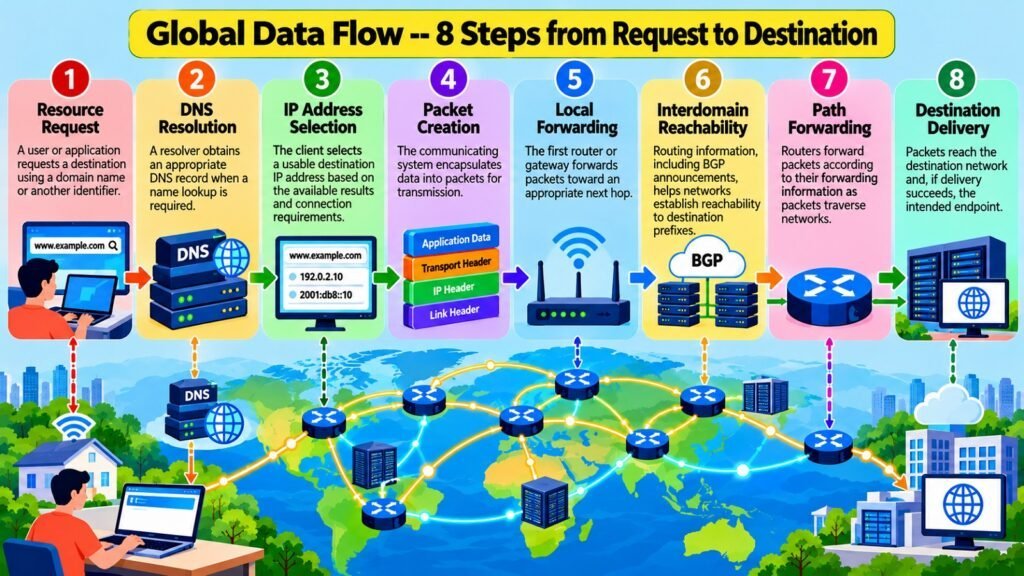
Reaching a destination involves three separable functions: naming, addressing, and path selection. The Domain Name System, specified in RFC 1034 and RFC 1035, associates domain names with records, including the IPv4 or IPv6 addresses that identify network interfaces. Addresses identify endpoints, but they do not describe how to reach them; that task belongs to routing.
IPv4, defined in RFC 791, and IPv6, defined in RFC 8200, encapsulate data in packets carrying source and destination addresses. Routers consult forwarding information derived from routing tables and select the entry with the longest matching prefix, a practice consistent with the classless addressing described in RFC 4632. Forwarding is a per-packet, per-router action, whereas routing is the process that populates the tables guiding it.
Between autonomous systems, the Border Gateway Protocol, specified in RFC 4271, exchanges reachability information annotated with attributes that support policy-based selection. BGP does not forward packets; it informs the decisions that routers subsequently apply. Because each network applies local policy, the selected path often reflects commercial preference rather than minimum distance. BGP also provides little inherent verification that a network is entitled to announce a prefix, which motivated the Resource Public Key Infrastructure described in RFC 6480.
Consider a user opening a remote service: the device asks a recursive resolver for the service’s address records, receives one or more addresses, and sends packets to its first-hop router. Each subsequent router forwards according to its own table, and the sequence of networks traversed remains unknown to the user unless measured. The utilization of measurement instruments such as traceroute provides visibility solely into the forwarding path that exists at a particular point in time, rather than furnishing a comprehensive understanding of the underlying physical topology.
Network routes undergo modifications when links experience failures, policies undergo revision, and route announcements disseminate throughout the system. Consequently, two packets transmitted during the same communication session may traverse distinct paths. Incomplete visibility and policy-driven selection are therefore intrinsic limitations of the system, not defects in particular networks.
Table 5: Global Data Flow Addressing and Routing Concepts
| Concept | Function in Global Data Flow |
| IPv4 | 32-bit addresses identifying network interfaces |
| IPv6 | 128-bit addresses expanding the address space |
| IP packets | Carry payloads with source and destination addresses |
| DNS resolution | Maps domain names to address records |
| Routers | Forward packets toward destinations hop by hop |
| Forwarding tables | Match destination prefixes to next hops |
| BGP | Exchanges interdomain reachability between autonomous systems |
| Routing policies | Constrain which paths networks accept and advertise |
5. Global Data Flow Protocols: The Rules of Data Transmission
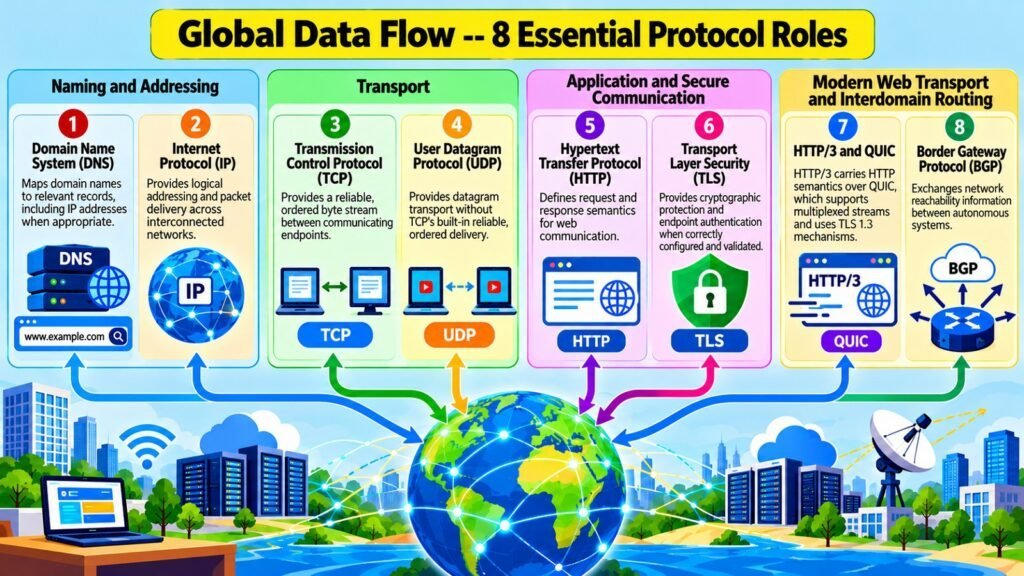
Protocols supply the shared rules that let independently developed systems interoperate. The Internet Protocol provides best-effort packet delivery and promises neither arrival, ordering, nor absence of duplication. Reliability is added above it by the Transmission Control Protocol, specified in RFC 9293, which establishes connections, sequences bytes, detects corruption through checksums, retransmits lost data, and performs congestion control. Each layer relies on the services below it while hiding its own internals from the layers above.
The User Datagram Protocol, defined in RFC 768, offers minimal service: datagrams are delivered without connection, ordering, or retransmission, which suits applications that tolerate loss or implement their own recovery. QUIC, as defined in RFC 9000, integrates reliable multiplexed streams with built-in TLS encryption and operates on UDP, enabling deployment outside kernel-level implementations. Reliability, ordering, security, and congestion control represent distinct characteristics, with each protocol delivering a particular combination thereof. Both TCP and UDP employ port numbers to route information to the appropriate application process on a given host.
Application protocols sit above these: HTTP, whose semantics are defined in RFC 9110, structures request-and-response exchanges and operates over TCP in HTTP/1.1 and HTTP/2 or over QUIC in HTTP/3, described in RFC 9114. DNS resolves names, and TLS, specified for version 1.3 in RFC 8446, protects exchanges, a subject developed in Section 7.
A typical web request illustrates the cooperation, with the caveat that implementations vary. The client resolves a name through DNS, establishes a transport connection, negotiates TLS, sends an HTTP request, and receives a response, with IP carrying every packet throughout. No single protocol performs the whole task; each contributes a bounded function, and a failure at one layer may be masked or amplified by another.
No single protocol demonstrates universal superiority: TCP’s guarantee of ordered delivery may introduce latency for subsequent data when preceding data fails to arrive, UDP delegates recovery mechanisms to the application layer, and QUIC exchanges implementation simplicity for enhanced adaptability. Standardization proves essential precisely because such trade-offs can subsequently be determined deliberately rather than by default.
Table 6: Global Data Flow Protocols and Their Roles
| Protocol | Role in Global Data Flow |
| IP | Addresses and forwards packets without guaranteeing delivery |
| TCP | Provides ordered, reliable byte streams with congestion control |
| UDP | Delivers connectionless datagrams without retransmission |
| QUIC | Offers multiplexed, encrypted transport over UDP |
| HTTP | Structures application requests and responses |
| DNS | Resolves domain names into address records |
| TLS | Protects confidentiality and integrity above the transport layer |
| ICMP | Reports delivery errors and supports diagnostics |
6. Global Data Flow Across Borders: International Data Exchange
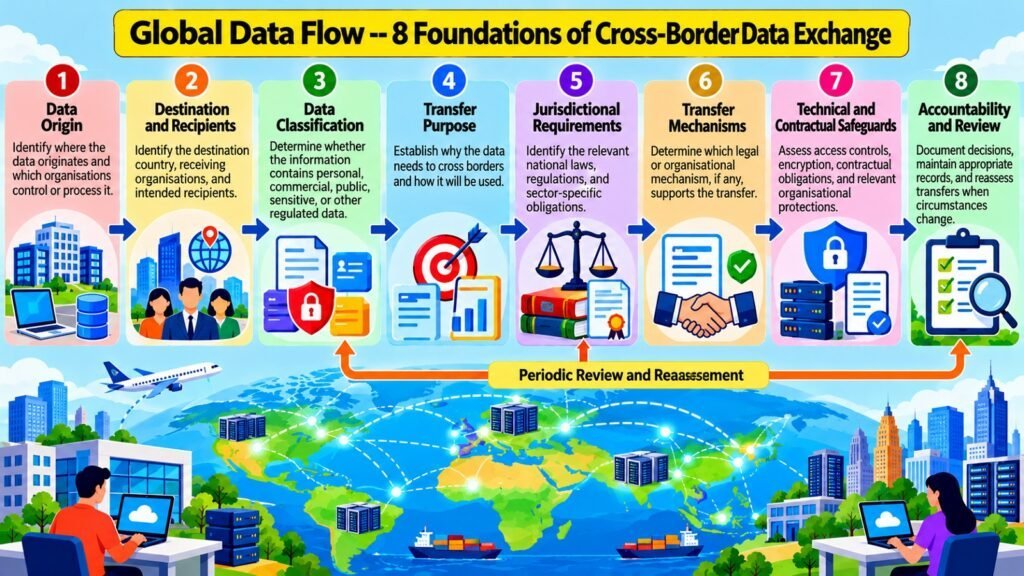
Global Data Flow lets individuals, organizations, and applications exchange information across national boundaries, and multinational cloud services, distributed business operations, international collaboration, and platform-to-platform exchange all depend on it. The technical ability to move data between countries, however, differs from the legal permission to collect, transfer, store, or process particular categories of it. A packet crosses a border without any assessment of lawfulness; obligations attach to the parties and the data, not to the route.
Jurisdictions regulate differently: the European Union’s General Data Protection Regulation (GDPR), Regulation (EU) 2016/679, restricts transfers of personal data outside the European Economic Area under Chapter V, permitting them where an adequacy decision, appropriate safeguards such as standard contractual clauses, or a defined derogation applies. The Commission’s adequacy decision for the EU-US Data Privacy Framework, adopted in July 2023, shows how such conditions are met for specific recipients and why they remain subject to review.
Other systems take different approaches: China’s Personal Information Protection Law, in force since November 2021, conditions outbound transfers on mechanisms such as security assessments or standard contracts, and several states impose localization requirements for defined categories of data. Instruments such as the OECD Privacy Guidelines articulate shared principles but create no uniform global rule. Sectoral rules, for example in finance or health, may impose further restrictions beyond general privacy law.
The interplay between technical architecture and governance presents significant complexity: when distributed services engage in data replication, caching, and processing across multiple geographic locations, ascertaining the precise location of processing activities and the applicable legal jurisdiction becomes substantially more challenging than identifying a user’s physical location. Contractual safeguards and organizational governance, including records of processing and transfer assessments, translate legal requirements into operational practice.
General guidance has limits: legal provisions change, and any question about a particular transfer requires jurisdiction-specific analysis by qualified counsel, so the instruments cited here should be verified before reliance.
Table 7: Global Data Flow Cross-Border Considerations and Relevance
| Consideration | Relevance to Global Data Flow |
| International data transfers | Movement of data between jurisdictions |
| Jurisdiction | Determines which legal system’s rules apply |
| Data localization | Requires certain data to be stored or processed domestically |
| Privacy obligations | Impose duties on collecting and handling personal data |
| Contractual safeguards | Bind recipients to protective terms, as with standard clauses |
| Regulatory requirements | Vary by country, sector, and data category |
| Distributed processing | Complicates identifying where data is handled |
| Organizational governance | Operationalizes compliance through policies and assessments |
7. Global Data Flow Security: Protecting Data in Transit
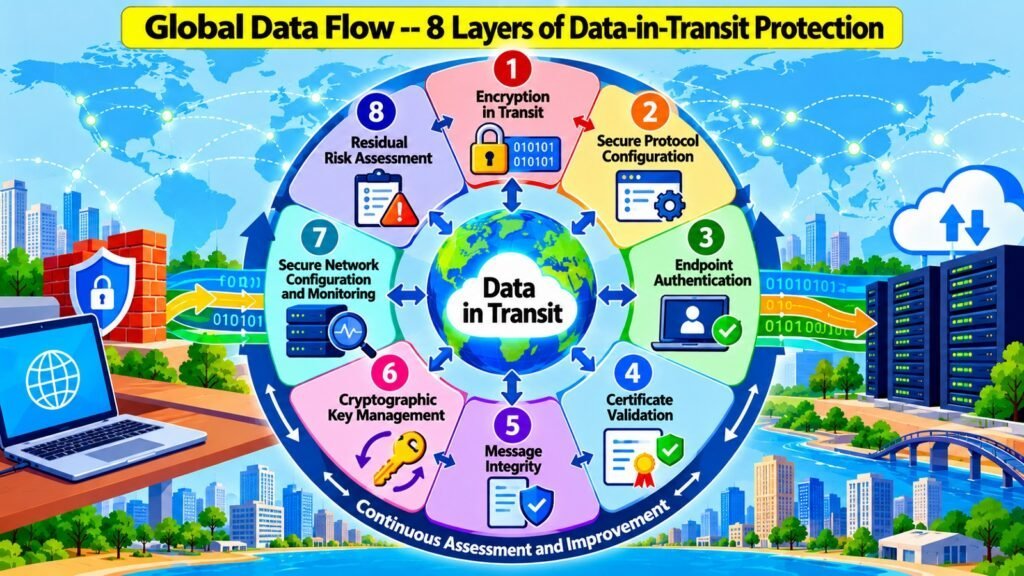
Data crossing interconnected networks passes through systems its sender does not control, which makes protection in transit essential. The principal threats are interception, impersonation, and unauthorized modification, and cryptographic mechanisms address each differently. This scope is narrower than the protection of stored data or organizational cybersecurity generally, both of which lie outside the present discussion.
Transport Layer Security, specified for version 1.3 in RFC 8446, combines encryption in transit, endpoint authentication, and message integrity. Encryption conceals content from observers, integrity protection allows tampering to be detected, and authentication assures a client that it has reached the intended server. Authentication rests on certificate validation, in which the client checks an X.509 certificate, profiled in RFC 5280, against trusted certificate authorities and the requested name.
Key management underpins everything else: session keys are negotiated per connection, while long-term private keys must be protected and rotated, since their compromise undermines the identities that certificates assert. Forward secrecy, which modern TLS configurations provide, limits the exposure of past sessions if a long-term key is later compromised. Authoritative standards including NIST SP 800-52 and IETF recommendations outlined in RFC 9325 establish permissible versions and configurations that must be validated against the most recent editions prior to any publication or deployment activities.
Encryption does not make a communication secure in every respect. A compromised endpoint reads data after decryption, a misconfigured server may accept weak parameters, and implementation flaws can defeat sound protocols. Metadata also remains observable, since network addresses, timing, and message sizes are visible to intermediaries even when payloads are not.
Trust models impose further limits: the certificate authority system distributes trust across many issuers, any of which may err, as the 2011 compromise of DigiNotar demonstrated. These mechanisms protect information only while it is in transit, and their value depends on correct deployment.
Table 8: Global Data Flow Security Mechanisms and Protections
| Mechanism or Concept | Protection and Limitation |
| Encryption in transit | Prevents content disclosure; does not hide metadata |
| TLS | Combines encryption, integrity, and authentication for connections |
| Endpoint authentication | Confirms the identity of the communicating party |
| Certificate validation | Checks trust chain and name; relies on issuers |
| Message integrity | Detects modification but cannot prevent it |
| Key management | Protects and rotates keys; weak practice undermines everything |
| Secure configuration | Restricts weak versions and parameters; needs ongoing review |
| Residual security risks | Compromised endpoints and implementation flaws persist |
8. Global Data Flow Resilience: Reliability and Recovery
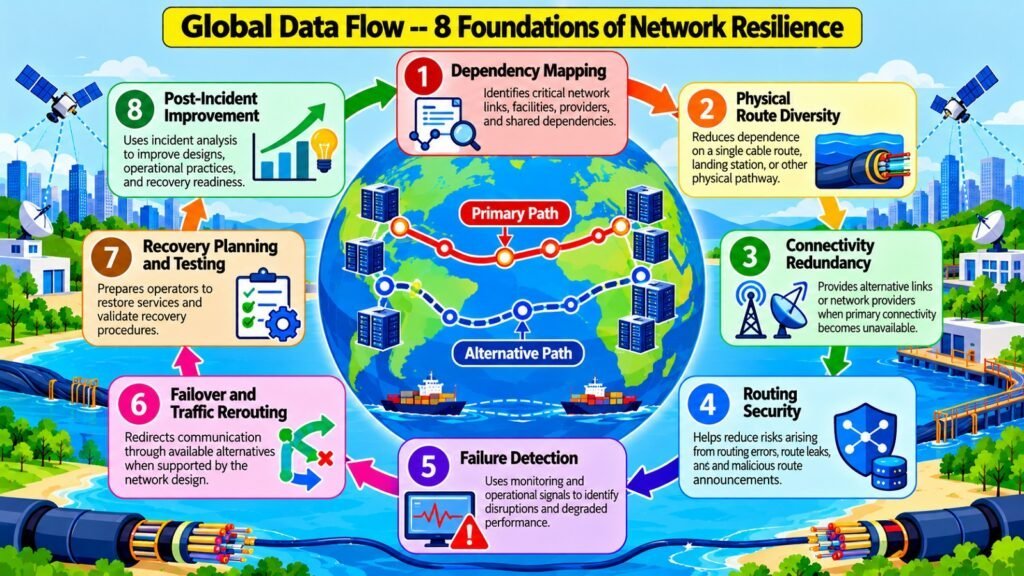
Resilience concerns whether Global Data Flow continues or recovers when links, routers, facilities, or services fail. Its principal mechanisms are redundant connectivity, alternative routes, failover, and fault tolerance, supported by monitoring, incident response, and recovery planning. No design guarantees uninterrupted operation under all conditions; the relevant question is which failures a design tolerates and which it does not. Resilience is a property of systems under stated assumptions, not an absolute attribute. Redundancy is the most visible mechanism but rarely the decisive one.
Routing can restore reachability automatically: when a link fails, BGP withdrawals and updates propagate, and routers may converge on alternative paths if they exist and policy permits them. Convergence is not instantaneous, however, and packets may be dropped or follow transient loops meanwhile. The recovery mechanisms employed at the routing layer operate distinctly from those implemented at the application level, as session states may be reinitialized and individual services may necessitate their own independent failover mechanisms before end users experience seamless service continuity. While operators possess the capacity to influence recovery outcomes through the implementation of route redundancy and carefully designed policies, they lack the authority to mandate that interconnected networks embrace compatible recovery strategies.
Failure dependencies limit the benefit of redundancy: multiple connections offer little protection if they share conduits, power, a single provider, or a common routing configuration. The 2008 Mediterranean cable damage illustrated physical correlation, and the October 2021 Facebook outage, which the company attributed to a faulty configuration change that disconnected its data centers and led its DNS servers to withdraw their routing advertisements, illustrated logical correlation.
Assessing the effectiveness of a resilience strategy demands explicit documentation of the failure scenarios being addressed, the foundational assumptions underlying the strategy, and the remaining unmitigated risks. The significance of testing cannot be overstated, as failover pathways that have not undergone rigorous validation frequently conceal latent defects, whereas comprehensive monitoring systems substantially reduce the interval between failure occurrence and detection. Resilience and security remain conceptually distinct yet interdependent: attacks can cause outages, and recovery procedures can themselves introduce vulnerabilities. Post-incident analyses published by operators are valuable because real incidents seldom unfold as designers anticipated.
Table 9: Global Data Flow Resilience Mechanisms and Limitations
| Mechanism or Consideration | Role and Limitation |
| Redundant links | Provide spare connections; ineffective if dependencies are shared |
| Alternative routes | Offer other paths when one fails; policy may restrict them |
| Failover | Shifts operation to standby components; requires testing |
| Fault tolerance | Continues operation despite faults; adds complexity |
| Routing recovery | Restores reachability; does not restore application state |
| Monitoring | Detects faults early; cannot prevent them |
| Incident response | Coordinates diagnosis and repair; depends on preparation |
| Shared failure dependencies | Common conduits, power, or configuration defeat redundancy |
Conclusion: Global Data Flow – Building a Reliable Connected Future
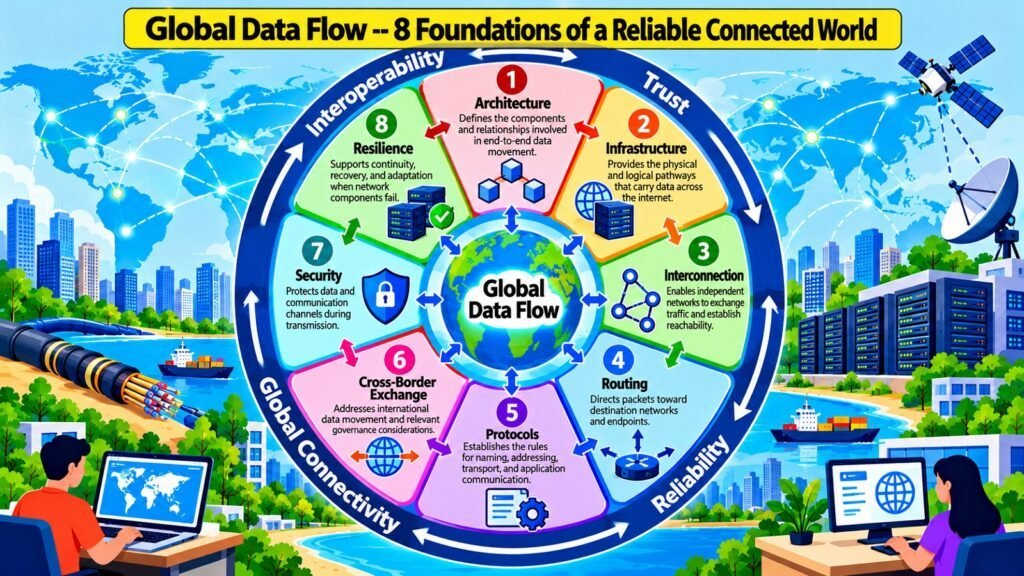
Global Data Flow is an important aspect of Internet Technology because it explains how worldwide digital information exchange is achieved, and it does so through eight foundations that function only in combination. Architecture provides the conceptual organization, infrastructure supplies physical pathways, and interconnection lets independent networks cooperate. Addressing and routing then direct packets, protocols govern their exchange, and legal frameworks condition their international movement, while security and resilience determine whether the whole arrangement can be trusted and sustained. The relationships operate bidirectionally: legal requirements determine infrastructure deployment locations, security requirements limit protocol selection, and resilience objectives influence interconnection strategy.
These relationships matter for distributed applications, cloud computing, and international digital services, whose behavior depends on assumptions made at every foundation. A cloud service may be architecturally sound yet vulnerable to shared physical dependencies, or technically secure yet legally constrained in where it may process data. Understanding underlying mechanisms, weighing technical evidence, and recognizing the limits of individual technologies guards against treating Global Data Flow as a simple sequence of transfer steps.
Foundational principles endure, but standards, implementations, research findings, and legal requirements evolve, so claims should be verified against current sources. Scope also remains distinct from Global Internet Traffic, which addresses volume and usage rather than mechanism. For researchers and practitioners alike, the durable value lies in asking which foundation a given failure, constraint, or design choice actually concerns. Dependable connectivity, in this sense, is an engineered and continually verified property rather than a given.
Table 10: Global Data Flow Foundations and Principal Contributions
| Global Data Flow Foundations | Principal Contribution |
| Architecture | Organizes responsibilities through layering and end-to-end principles |
| Infrastructure and pathways | Supplies physical media, though not route selection |
| Interconnection | Enables cooperation among autonomous systems |
| Addressing and routing | Separates identification from path selection |
| Transmission protocols | Standardize delivery semantics across systems |
| Cross-border exchange | Adds jurisdiction-specific legal conditions |
| Security | Protects data in transit within stated limits |
| Resilience | Sustains or restores communication after faults |