Table of Contents
Introduction: Emerging Computing Tech as the Backbone of Future Innovation
Think about your morning. Your phone wakes you up. A fitness tracker logs your sleep. Your coffee maker turns on by itself. The route to work adjusts based on live traffic. None of these systems works alone anymore. They connect, share data, and influence each other quietly in the background. This is the world that Emerging Computing Tech is building, one layer at a time.
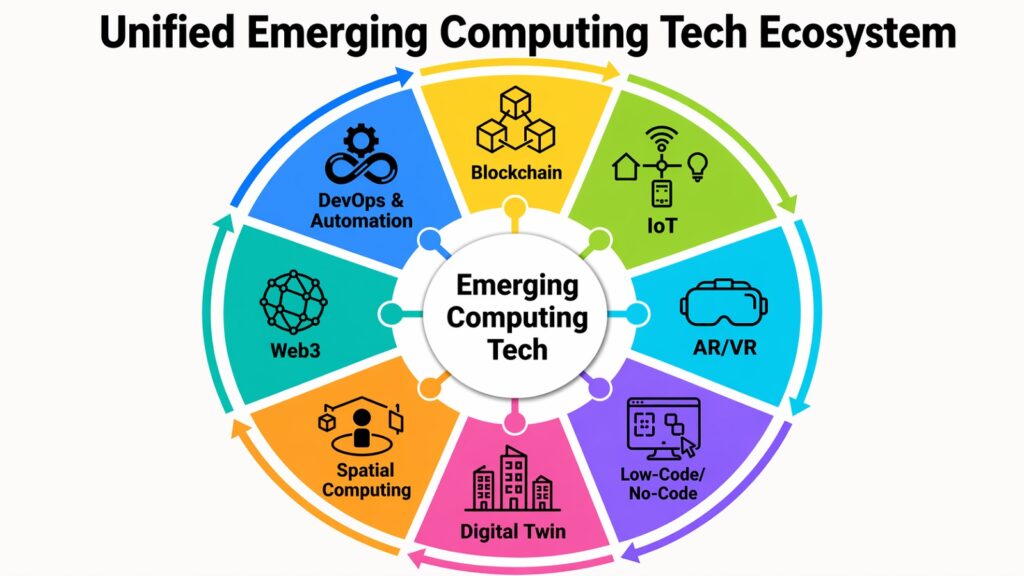
Emerging Computing Tech is not a single invention. It is a collection of technologies that are growing, linking up, and reshaping how industries function and how people experience the digital world. What makes this moment different from past technology waves is convergence. Blockchain reinforces IoT security. Digital twins feed on IoT data. Spatial computing relies on the same sensors that power smart cities. Web3 builds on the same blockchain principles that secure supply chains. These are not separate stories. They are chapters in the same book.
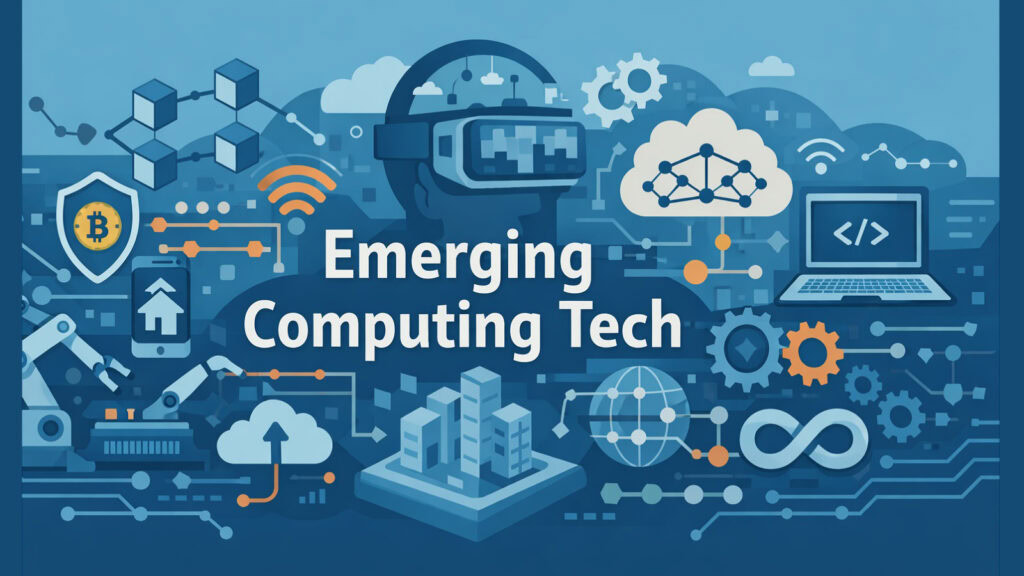
The eight trends in this article cover the most important directions in Emerging Computing Tech today: Blockchain, the Internet of Things, Augmented and Virtual Reality, Low-Code and No-Code Platforms, Digital Twin Technology, Spatial Computing, Web3, and DevOps and Automation. Each carries its own momentum. Together, they form a larger shift in how computing and modern technology work and how they serve human needs. Understanding them is not just useful for technologists. It matters for anyone navigating a world that these forces are actively reshaping.
Emerging Computing Tech at a Glance: Eight Trends and Their Primary Impact Areas
| Emerging Computing Tech Trends | Primary Impact Area |
| Blockchain Technology | Builds trust through tamper-proof distributed records, removing the need for central intermediaries |
| Internet of Things (IoT) | Connects physical objects to digital systems, enabling real-time data exchange and automated responses |
| Augmented and Virtual Reality | Layers digital content onto real or simulated environments, transforming training, education, and engagement |
| Low-Code and No-Code Platforms | Opens app development to non-developers, reducing cost and time to build digital tools |
| Digital Twin Technology | Creates live virtual replicas of physical assets for simulation, monitoring, and predictive maintenance |
| Spatial Computing | Merges digital data with physical space through sensors and 3D interfaces for richer human-computer interaction |
| Web3 Technologies | Shifts internet ownership toward users through decentralized systems and blockchain-based identity |
| DevOps and Automation | Accelerates software delivery through continuous integration, deployment pipelines, and automated testing |
1. Emerging Computing Tech and Blockchain Technology: Trust Without Intermediaries
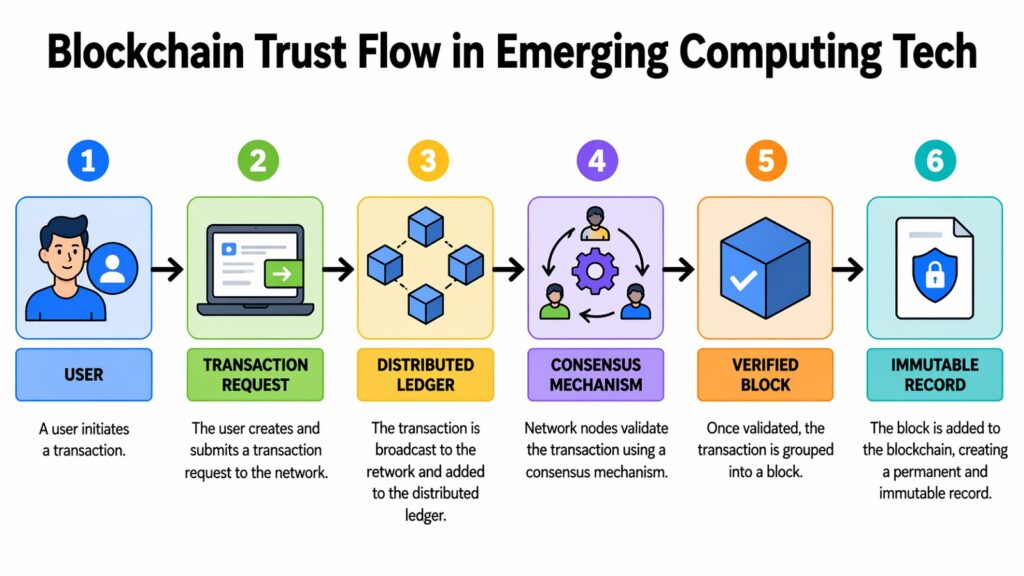
For most of human history, trust required a middleman or an authority. Banks verified the money, and the Governments around the world certified identities. Blockchain changes that by distributing trust across many participants instead of centralizing it in one authority. That shift is one of the most important ideas within Emerging Computing Tech today.
A blockchain is a shared ledger spread across a network of computers. When a new record is added, it links to the previous one through a cryptographic code. This chain cannot be altered without changing every subsequent record across every node. That immutability is what makes it trustworthy.
Walmart partnered with IBM Food Trust to trace food products on the blockchain. Before this system, tracing a mango from the store shelf to the farm took about a week. With blockchain, the same trace takes two seconds. When food contamination strikes, those seconds matter enormously. Ripple uses blockchain for cross-border payments that settle in under five seconds, compared to the three to five business days that traditional wire transfers require. The cost difference is equally significant, since blockchain removes the layers of correspondent banks that each add fees to the transaction.
Estonia runs one of the most advanced digital governance systems in the world, with blockchain at its core. Citizens use blockchain-verified identities to vote, pay taxes, access medical records, and register businesses entirely online. The system has operated reliably for years and is studied by governments worldwide. Smart contracts extend the idea further. An insurance contract, for example, can automatically release a payment the moment connected data confirms a flight was cancelled. No form, no adjuster, just code doing what it was told. Within Emerging Computing Tech, blockchain provides a reliable foundation for systems that need to exchange value or verify facts without relying on a single controlling party.
Emerging Computing Tech and Blockchain: Key Features with Real-World Applications
| Blockchain Feature | Real-World Application |
| Distributed Ledger | IBM Food Trust lets Walmart trace food contamination sources in seconds instead of days |
| Immutability | Financial records on blockchain cannot be altered, reducing fraud in interbank transactions |
| Smart Contracts | Ethereum-based contracts auto-release insurance payouts when flight delay conditions are confirmed |
| Digital Identity | Estonia’s e-Residency uses blockchain for citizen identity and secure digital governance |
| Cross-Border Payments | Ripple settles international transfers in under five seconds at a fraction of traditional banking costs |
| Healthcare Records | MedRec-style platforms give patients control over medical data across multiple providers |
| Asset Tokenization | Propy uses blockchain to tokenize real estate, enabling fractional ownership of physical property |
| Decentralized Voting | Voatz uses blockchain to enable secure mobile voting and reduce tampering risk in elections |
2. Emerging Computing Tech and Internet of Things (IoT): Connecting the Physical World
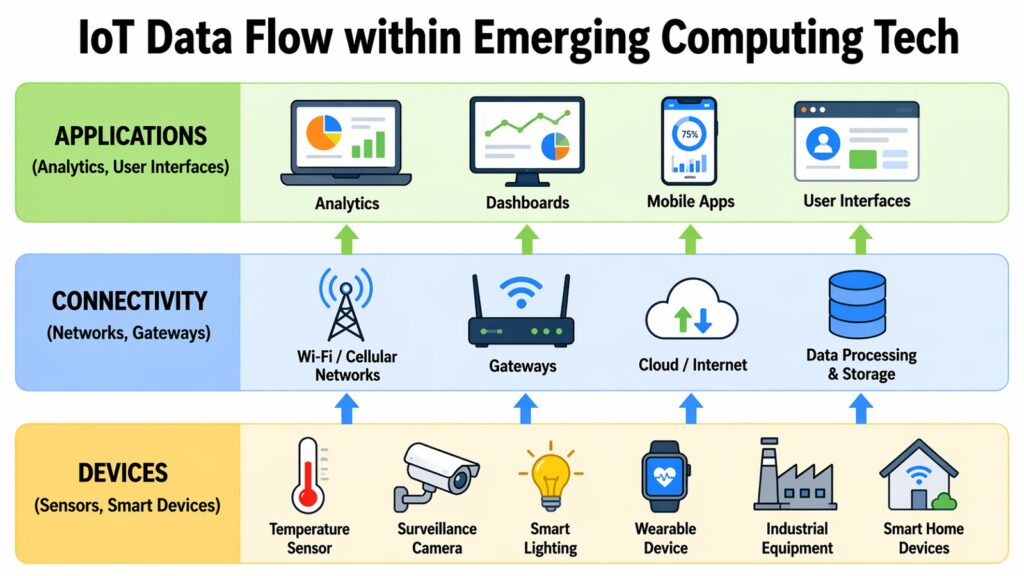
There is a version of the world where every physical object has a voice. A bridge that reports its own stress levels. A crop field that signals when it needs water. A factory machine that announces its own wear before breaking down. That world is arriving through the Internet of Things (IoT), one of the most expansive layers of Emerging Computing Tech.
Internet of Things (IoT) refers to physical devices embedded with sensors and connectivity that allow them to collect and exchange data. The range is vast, from industrial pressure gauges to consumer wearables, but what they share is the ability to turn physical conditions into digital information. In smart homes, this plays out through thermostats that learn your schedule and locks that recognize you. In the industry, Siemens deploys IoT sensors in factories to monitor machine vibration and temperature. When a reading drifts outside normal ranges, the system flags it immediately, allowing maintenance before a costly breakdown occurs.
A smart city shows IoT at its most ambitious. Barcelona’s smart street lighting adjusts brightness based on pedestrian activity, saving the city tens of millions in energy costs annually. Singapore, Amsterdam, and Songdo in South Korea are pursuing similar strategies across water management and public transport. John Deere’s IoT farming systems collect real-time soil data and automate planting decisions, improving yields while reducing water use. For agriculture facing pressure from climate change and population growth, efficiency matters enormously.
Within Emerging Computing Tech, IoT is the sensory layer that turns the physical world into a data stream that other technologies can process and act on. Without it, digital twins have no live data to mirror, and smart cities remain smart only in theory.
Emerging Computing Tech and IoT: Application Areas with Real-World Examples
| IoT Application Area | Real-World Example and Impact |
| Smart Homes | Amazon Echo and Google Nest let users control lighting, security, and temperature remotely |
| Industrial Automation | Siemens IoT sensors monitor machine output and trigger maintenance before failures occur |
| Smart Cities | Barcelona’s smart lighting adjusts to pedestrian activity, saving millions in annual energy costs |
| Healthcare Monitoring | Apple Watch tracks heart rate and blood oxygen, flagging health anomalies in real time |
| Agriculture | John Deere’s IoT tractors collect soil data and adjust planting depth automatically by field |
| Supply Chain Tracking | Maersk uses IoT sensors on containers to monitor temperature and location across global routes |
| Retail | Amazon Go uses shelf sensors and cameras to enable checkout-free shopping experiences |
| Energy Management | US smart grids use IoT sensors to balance electricity supply and demand, reducing outages |
3. Emerging Computing Tech and AR/VR: Redefining Human Experience
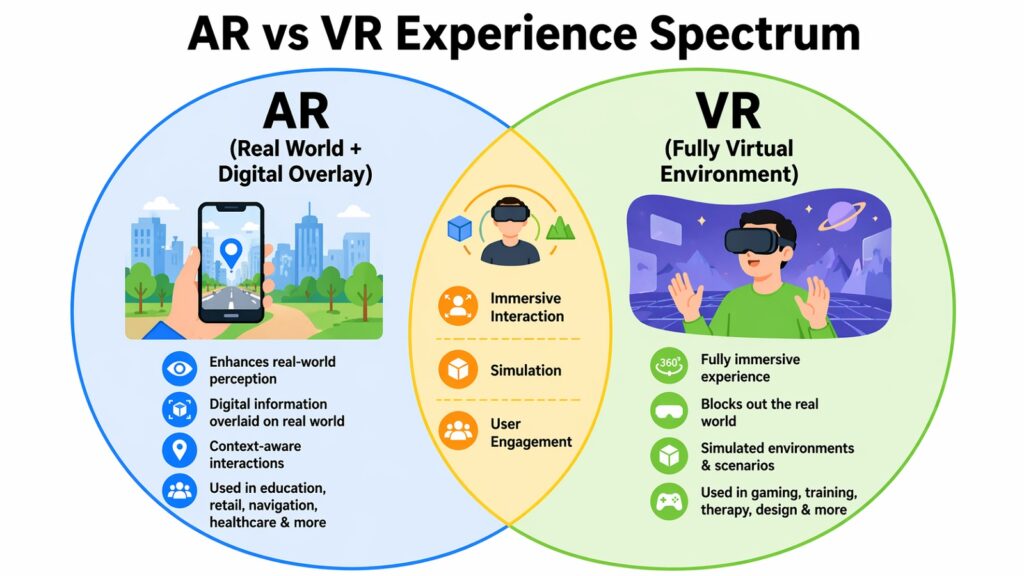
Augmented reality adds digital elements to a real-world view. Virtual reality replaces that view entirely with a computer-generated environment. Together they represent one of the most human-facing dimensions of Emerging Computing Tech, reshaping how people train, learn, heal, and experience information. The distinction between them matters because they serve different purposes.
AR is most powerful where real-time overlays help with tasks: navigation, product visualization, technical repair guidance. VR is most powerful where full immersion matters: surgical simulation, military training, psychological therapy. Osso VR provides surgical procedure simulations that let surgeons practice operations repeatedly before performing them on patients. Studies show VR-trained surgeons perform significantly better in real procedures than those trained through traditional observation methods alone.
Boeing implemented AR in aircraft assembly. Technicians wear glasses that overlay wiring diagrams directly onto the aircraft they are working on. Boeing reported a 25 percent reduction in both production time and errors. That kind of accuracy matters in an environment where a wiring mistake in a jet can have catastrophic consequences. Oxford VR has developed clinical programs for treating phobias and anxiety, with trials showing meaningful symptom reduction compared to traditional therapy alone. It is a reminder that Emerging Computing Tech can touch deeply personal dimensions of human life, not just industrial or commercial ones.
Emerging Computing Tech and AR/VR: Applications Across Industries
| AR/VR Application | Industry Use and Outcome |
| Medical Training | Osso VR surgical simulations improve surgeon proficiency without any patient risk |
| Military Simulation | The US Army uses VR environments to prepare soldiers for combat in safe controlled settings |
| Education | Google Expeditions takes students on virtual field trips to historical sites and space |
| Retail Try-On | IKEA’s AR app lets users visualize furniture in their homes before purchasing |
| Architecture | Zaha Hadid Architects use VR walkthroughs to present building designs before construction |
| Mental Health Therapy | Oxford VR offers clinical VR therapy for phobias and anxiety with proven symptom reduction |
| Gaming | Meta Quest headsets deliver fully immersive VR gaming driven by physical movement and gesture |
| Remote Collaboration | Microsoft Mesh lets distributed teams meet as avatars in shared holographic workspaces |
4. Emerging Computing Tech and Low-Code/No-Code Platforms: Democratizing Development
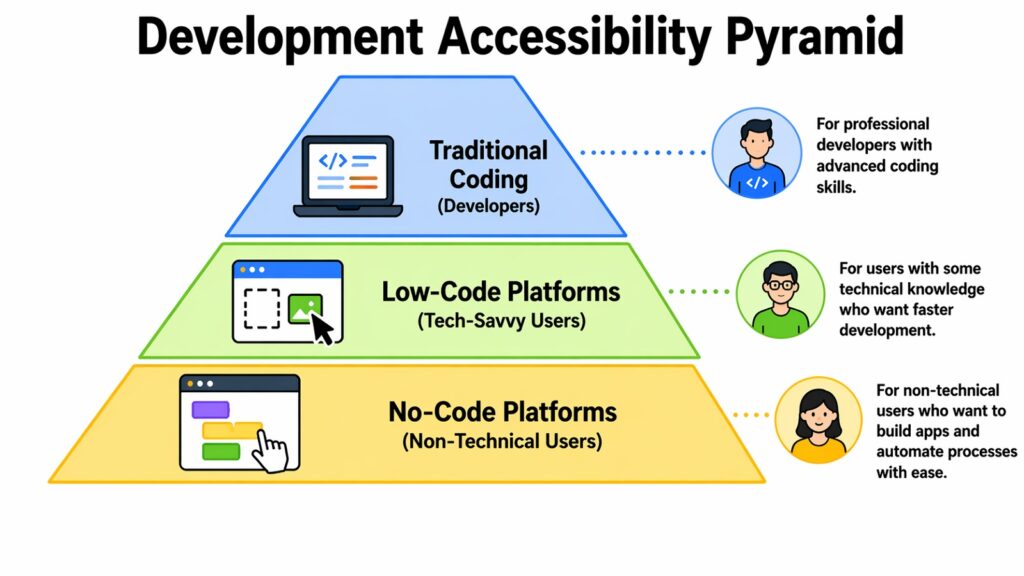
Building software used to require years of training. You needed to understand programming languages, database structures, and server architecture before shipping anything. That excluded most people from creating digital tools. Low-code and no-code platforms are changing that, and their rise is one of the more quietly radical developments in Emerging Computing Tech.
A low-code platform reduces hand-written code through visual interfaces and pre-built logic. A no-code platform eliminates code entirely, replacing it with drag-and-drop components. Microsoft Power Apps lets business teams build custom internal tools connected to Microsoft 365 without a developer. A human resources coordinator can build an onboarding tracker in an afternoon. A logistics team can create a delivery dashboard before lunch.
Startups use Bubble and Webflow to launch functional web products before they can afford engineers. Webflow generates clean, production-ready code behind the scenes while giving designers full visual control. Zapier connects over five thousand apps and lets non-technical users build automated workflows in minutes. Enterprise platforms like Mendix and OutSystems push this into complex organizational environments.
Deloitte has reported building applications with OutSystems at roughly ten times the speed of traditional development. Siemens uses Mendix to build IoT dashboards connected to live industrial data. The deeper shift is about who gets to build. When tools are accessible enough, the people who understand problems most deeply can solve them directly, without translation through a technical intermediary.
Emerging Computing Tech and Low-Code/No-Code Platforms: Tools and Their Applications
| Platform | Primary Use Case and Benefit |
| Microsoft Power Apps | Business teams build custom internal apps connected to Microsoft 365 data without writing code |
| Bubble | Entrepreneurs build functional web apps using drag-and-drop, cutting development time significantly |
| Zapier | Connects 5,000-plus apps and automates workflows without any coding knowledge required |
| Webflow | Designers build responsive websites with production-ready code generated automatically in the background |
| Appian | Enterprises automate complex processes like loan approvals and compliance workflows without developers |
| OutSystems | Deloitte builds enterprise applications up to ten times faster than traditional development methods |
| Airtable | Small teams build custom databases and project tools without any technical background needed |
| Mendix | Siemens builds IoT dashboards and operational apps by combining low-code tools with industrial data |
5. Emerging Computing Tech and Digital Twin Technology: Mirroring Reality in Data
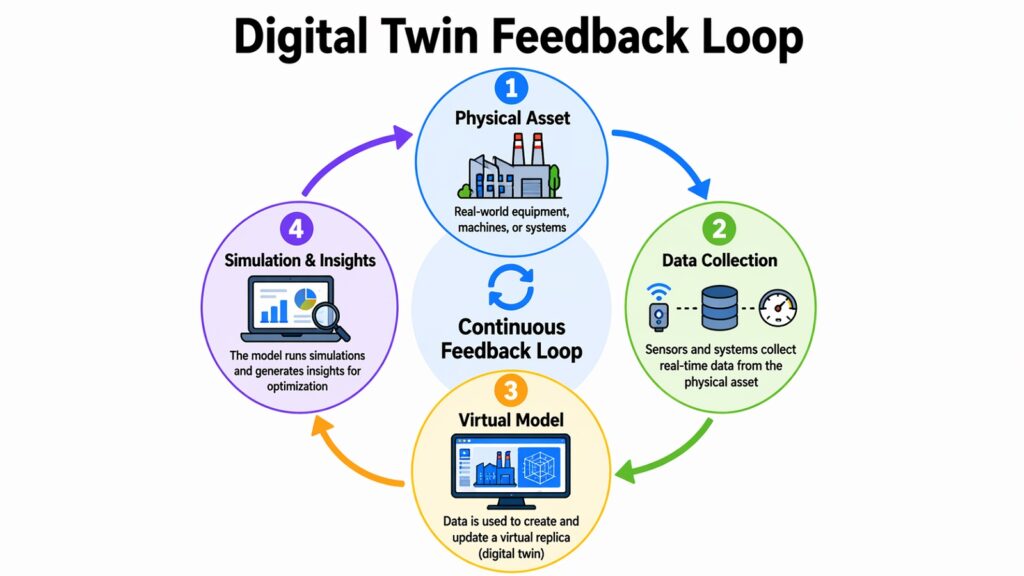
A digital twin is a dynamic virtual model of a physical object or system, continuously fed data from sensors in the real counterpart. The model behaves like its physical equivalent, allowing engineers and planners to test scenarios, predict failures, and optimize performance without touching the actual asset. It is one of the most analytically powerful tools in Emerging Computing Tech.
GE Aviation builds digital twins of its jet engines. Every engine has a virtual counterpart that accumulates operational data throughout its life. Engineers simulate failure scenarios on the twin to schedule maintenance before problems occur in flight. Siemens tests production line changes on digital models first, catching bottlenecks and safety issues before any physical modification is made.
Singapore’s Virtual Singapore project built a precise digital model of the entire city, incorporating data on buildings, terrain, and infrastructure. Planners use it to simulate new construction impacts and test emergency response routes. Dassault Systèmes is developing a Living Heart digital twin to let medical device companies test cardiac products virtually before clinical trials. Within Emerging Computing Tech, digital twins take the data that IoT generates and give it a space where it can be used to predict, plan, and prevent.
Emerging Computing Tech and Digital Twin Technology: Industry Applications and Benefits
| Digital Twin Use Case | Industry Application and Benefit |
| Manufacturing | Siemens simulates production line changes virtually before implementation, avoiding costly downtime |
| Aerospace | GE Aviation monitors jet engine components digitally to predict failures before they occur in flight |
| Urban Planning | Singapore’s Virtual Singapore models the entire city to plan infrastructure and disaster response |
| Healthcare | Dassault Systemes’ Living Heart model lets companies test cardiac devices virtually before trials |
| Energy | National Grid UK uses digital twins to simulate demand scenarios and prevent power outages |
| Automotive | BMW tests factory floor configurations in virtual models before making any physical changes |
| Construction | Autodesk BIM 360 tracks site progress and detects design conflicts early in the build phase |
| Oil and Gas | Equinor monitors offshore platform health and optimizes production using real-time digital twins |
6. Emerging Computing Tech and Spatial Computing: Bridging Digital and Physical Spaces
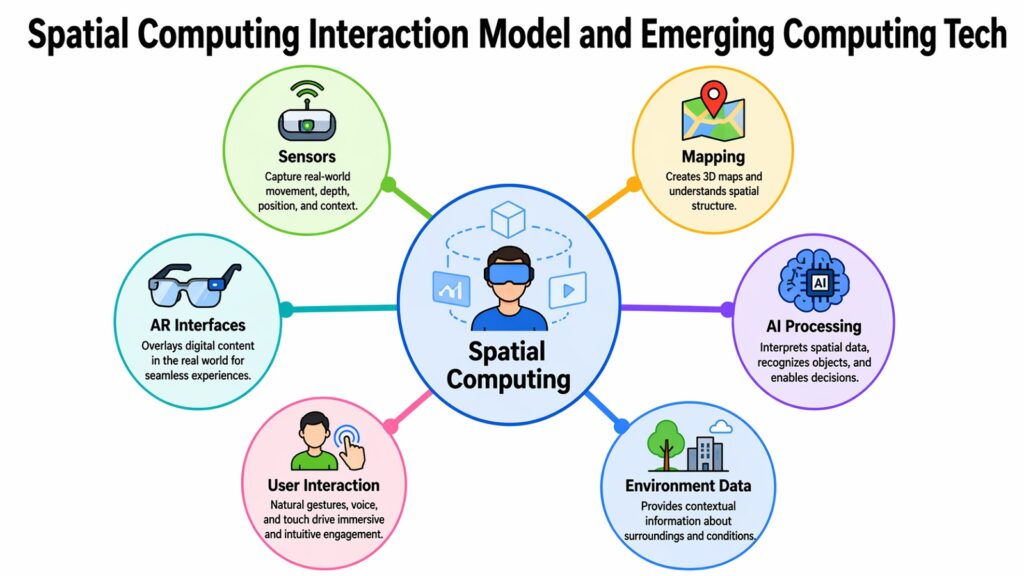
Screens have been the dominant interface between humans and digital information for decades. But screens are flat and disconnected from the three-dimensional world we actually live in. Spatial computing changes that by making digital information aware of and responsive to physical space. It is one of the more ambitious frontiers in Emerging Computing Tech, and it is beginning to move from concept to product.
Apple Vision Pro, released in 2024, brought spatial computing into mainstream conversation. Users interact with apps and workspaces as if they exist in the room around them, driven by eye tracking, hand gestures, and voice rather than a mouse and keyboard. Waymo’s autonomous vehicles use LiDAR-based spatial computing to build real-time 3D maps of their surroundings, detecting obstacles and pedestrians as they drive.
Boeing’s AR glasses understand the physical space around a technician and overlay instructions at the precise location on the aircraft being worked on. Google Maps Live View projects navigation arrows onto a live street view through a phone camera, bringing spatial computing to everyday users. As sensors get cheaper and devices less intrusive, spatial computing will move further into the background, making technology feel less like something you use and more like something you simply move through.
Emerging Computing Tech and Spatial Computing: Technologies and Their Applications
| Spatial Computing Technology | Application and Real-World Impact |
| Apple Vision Pro | Merges apps and workspaces into the physical environment using eye tracking and hand gestures |
| LiDAR Mapping | Waymo vehicles use LiDAR to build real-time 3D maps for safe autonomous navigation |
| AR Navigation | Google Maps Live View overlays turn-by-turn directions onto real-world camera views |
| Smart Retail | Amazon’s physical stores use spatial sensing to track product interaction without checkout counters |
| Geospatial Analytics | Esri ArcGIS helps governments manage natural resources, disaster zones, and urban growth |
| Industrial AR | Boeing AR glasses overlay wiring diagrams onto aircraft, cutting production errors by 25 percent |
| Theme Parks | Disney blends physical environments with digital characters for immersive spatial experiences |
| Remote Assistance | PTC Vuforia lets remote experts overlay digital guidance onto a technician’s live physical view |
7. Emerging Computing Tech and Web3 Technologies: Decentralizing the Internet
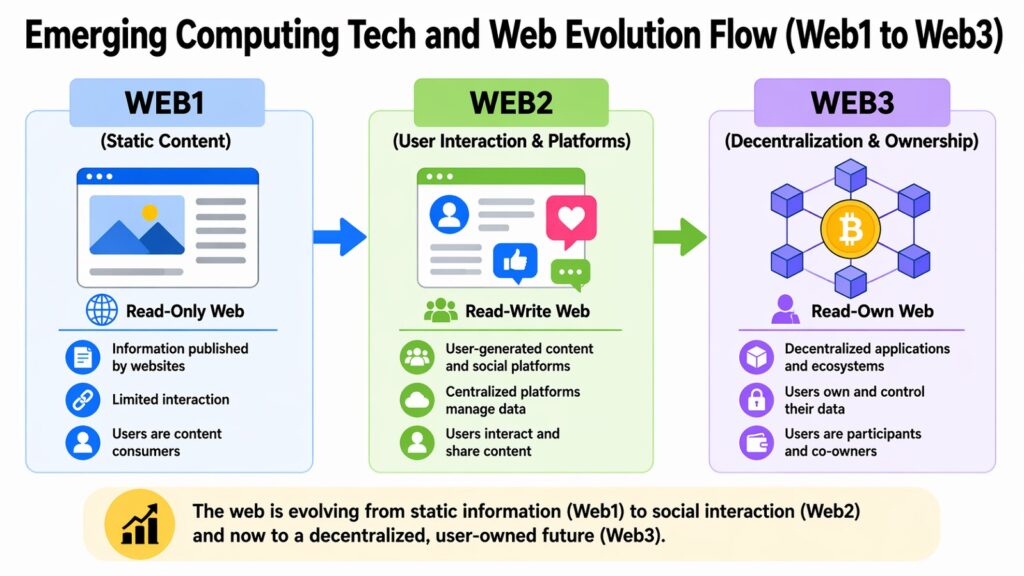
A small number of big companies own today’s internet. When you create an account on a platform, the platform owns your data and controls your access. Web3 proposes a different arrangement, one where users own their data, identity, and digital assets. It is a natural extension of the decentralization running through much of Emerging Computing Tech.
Decentralized finance, or DeFi, is one of the most developed expressions of this shift. Uniswap allows users to trade cryptocurrencies directly through automated smart contracts, without a bank or centralized exchange acting as an intermediary. The total value locked in DeFi protocols has reached hundreds of billions of dollars at various points, demonstrating real adoption rather than just theoretical interest. NBA Top Shot uses blockchain-based NFTs to sell officially licensed digital collectibles with verified, permanent ownership records. The Ethereum Name Service lets users create a portable digital identity they own and control, independent of any single platform.
MakerDAO is governed entirely by token holders who vote on protocol decisions with no CEO and no board. Decisions are made transparently through code and community votes. It is an unusual but genuinely novel model for organizational decision-making. Web3 infrastructure is still maturing, and the user experience remains a real barrier for mainstream adoption. But the ideas at its core, user ownership, transparent governance, and decentralized control, are likely to shape how the internet evolves over the next decade, whether or not the specific token-based implementations change significantly along the way.
Emerging Computing Tech and Web3: Decentralized Technologies and Their Applications
| Web3 Technology | Use Case and Decentralization Benefit |
| Decentralized Finance | Uniswap lets users trade crypto directly via smart contracts, bypassing banks and exchanges |
| NFTs | NBA Top Shot sells blockchain-verified digital collectibles with permanent on-chain ownership records |
| DAOs | MakerDAO is governed entirely by token holder votes with no central management team |
| User-Owned Identity | Ethereum Name Service gives users portable digital identities no single platform controls |
| Decentralized Storage | Filecoin offers token-based distributed file storage independent of centralized cloud providers |
| Web3 Gaming | Axie Infinity lets players earn cryptocurrency and truly own in-game assets as blockchain tokens |
| Creator Monetization | Mirror.xyz lets writers publish and collect payments directly on blockchain without platform fees |
| Supply Chain Transparency | VeChain lets consumers verify product authenticity and sourcing through blockchain tracking |
8. Emerging Computing Tech and DevOps and Automation: Accelerating Innovation Cycles
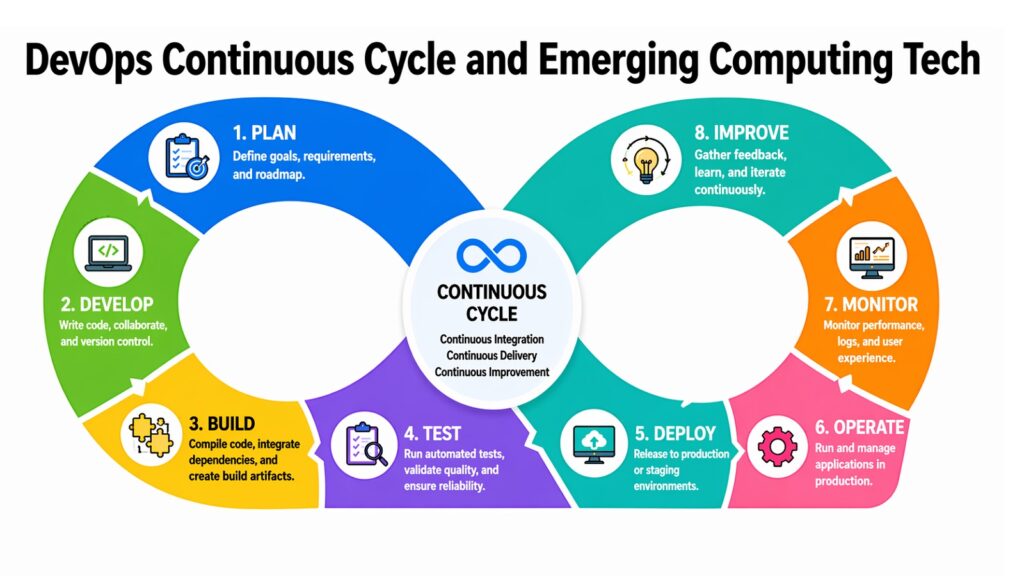
Software development used to move slowly. Teams spent months building features, tested extensively, and released in large batches. By the time software reached users, requirements had often changed. DevOps changed that rhythm entirely, and within Emerging Computing Tech it is what keeps everything else moving at the pace the market demands.
DevOps brings development and operations teams together around shared pipelines that move code from idea to production continuously. GitHub Actions automates testing every time a developer pushes code. Netflix deploys hundreds of changes to production daily through automated pipelines, with no human intervention between writing code and reaching millions of users. Terraform defines and provisions cloud infrastructure through code, eliminating configuration errors between development and production environments.
Docker packages applications with all their dependencies, ensuring consistent behavior wherever they run. Kubernetes manages fleets of containers automatically, scaling them up or down based on live demand. Datadog gives teams real-time visibility into application health. Within Emerging Computing Tech, DevOps is the operational backbone. It determines how quickly new capabilities in blockchain, IoT, AI, and spatial computing can be built and delivered. Without it, the pace of innovation slows. With it, the cycle from idea to working software keeps compressing.
Emerging Computing Tech and DevOps: Practices, Tools, and Their Benefits
| DevOps Practice | Real-World Tool or Example and Benefit |
| Continuous Integration | GitHub Actions runs automated tests on every code push, catching bugs before they reach production |
| Continuous Deployment | Netflix deploys hundreds of changes daily through automated pipelines with no manual steps |
| Infrastructure as Code | Terraform defines and provisions cloud infrastructure through version-controlled code files |
| Containerization | Docker packages apps with all dependencies, ensuring consistent behavior across environments |
| Container Orchestration | Kubernetes auto-scales containerized applications across server clusters based on live demand |
| Monitoring | Datadog gives teams real-time visibility into application performance and infrastructure health |
| Automated Testing | Selenium runs thousands of browser-based tests simultaneously before each software release |
| AIOps | IBM Watson AIOps detects anomalies in IT operations, reducing mean time to resolve system incidents |
Conclusion: Emerging Computing Tech as the Path to a Smarter Future
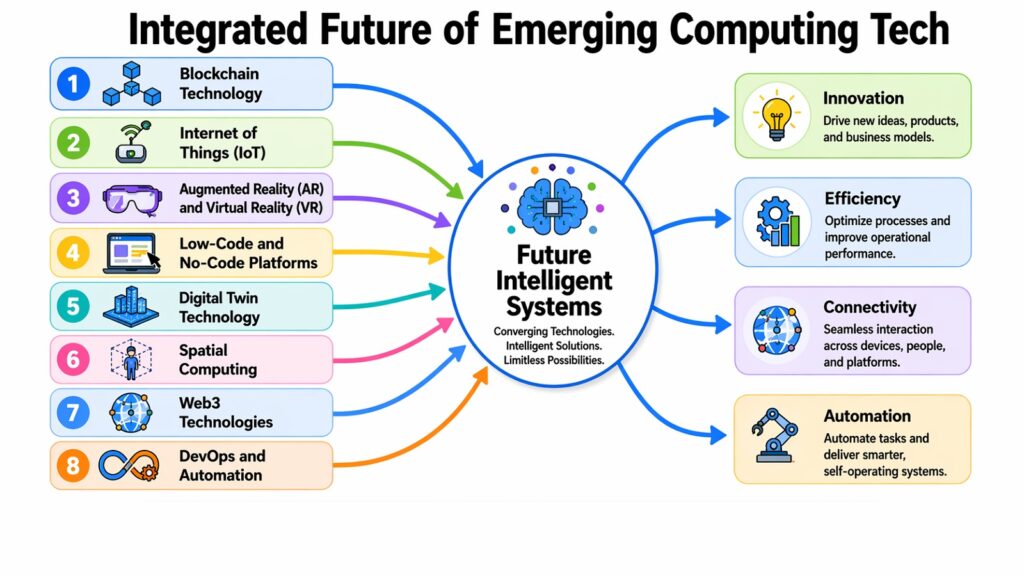
These eight Emerging Computing Tech do not live in separate boxes. IoT generates the data that digital twins need to stay current. Blockchain secures the transactions that Web3 depends on. Low-code platforms help more people build on the infrastructure that DevOps teams maintain. AR and VR draw on the spatial computing frameworks also reshaping how we navigate cities. Emerging Computing Tech is not a list. It is a system, and the connections between its parts are what give it real power.
What makes this moment interesting is that most of these technologies are still in early stages. Blockchain is past its speculative peak but is still finding its most important enterprise applications. Spatial computing is roughly where smartphones were in 2008, technically capable but waiting for the application that unlocks mass adoption. Low-code platforms are steadily transferring creative power to people with domain expertise rather than technical training, and that kind of shift tends to produce outcomes no specialist group would have predicted.
The thread running through all eight trends is a move toward systems that are more connected, more transparent, more automated, and more accessible. Emerging Computing Tech is not about making things complicated. It is about making complex things more manageable, predictable, and useful to more people. That is a direction worth understanding, regardless of the industry you work in or the role you play within it. The future being built here is not distant. It is already underway, in the devices in your pocket, the sensors on factory floors, and the code running silently on cloud servers that never sleep.
Emerging Computing Tech: Eight Trends and Their Long-Term Future Directions
| Emerging Computing Tech Trend | Long-Term Future Direction |
| Blockchain Technology | Will become standard infrastructure for supply chains, healthcare records, and digital identity systems |
| Internet of Things (IoT) | Billions more devices will drive smarter environments in cities and hospitals, powered by edge computing |
| Augmented and Virtual Reality | Convergence with AI and spatial computing will make immersive environments standard in work and learning |
| Low-Code and No-Code Platforms | Will expand access to app creation and dissolve the line between domain expert and digital builder |
| Digital Twin Technology | Will evolve to simulate entire ecosystems, from city infrastructure to biological and climate systems |
| Spatial Computing | As devices shrink and sensors improve, spatial computing will become embedded ambient intelligence |
| Web3 Technologies | User-controlled identity and digital ownership will gradually reach mainstream applications globally |
| DevOps and Automation | AI-assisted pipelines will further reduce human intervention in deployment, testing, and monitoring |