Table of Contents
Introduction: Good vs. Evil – A Timeless Storytelling Blueprint
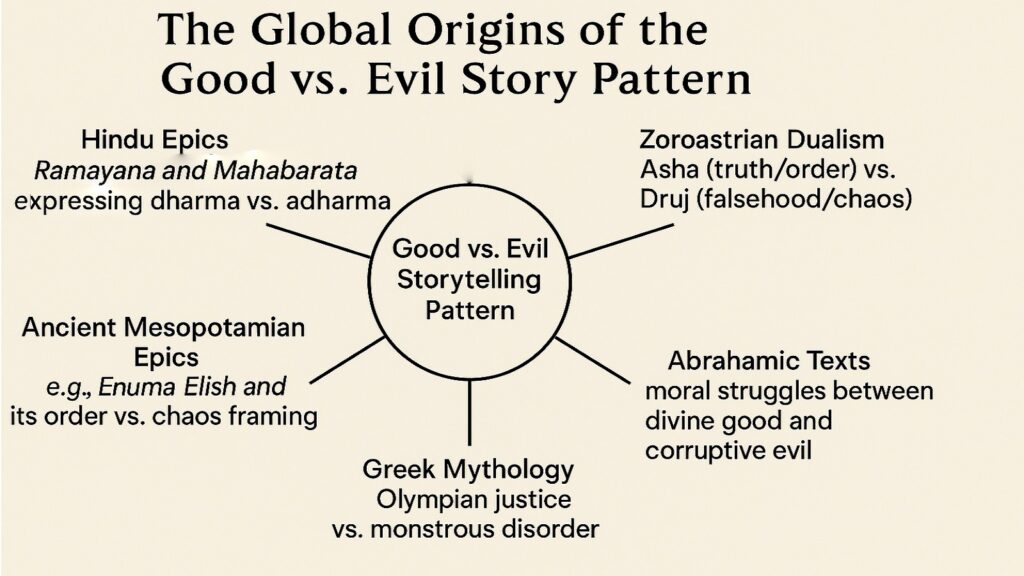
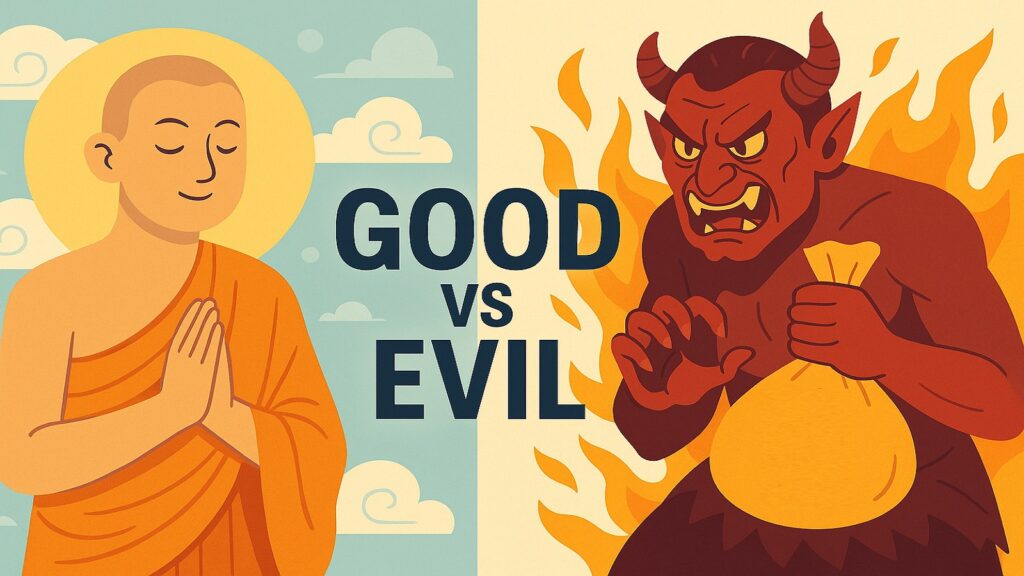
The conflict between Good and Evil stands as one of humanity’s oldest and most enduring narrative patterns. This moral divide appears in every culture, every era, and every form of storytelling we have created. From ancient cave paintings to modern cinema, the struggle between opposing moral forces shapes how we understand ourselves and the world around us.
Good vs. Evil works because it speaks to something fundamental in human consciousness. We live in a world of choices and consequences. We experience kindness and cruelty. We witness creation and destruction. Stories that explore this tension help us navigate the moral complexity of existence. They provide frameworks for understanding behavior, consequences, and meaning.
This article explores six powerful insights that reveal why Good vs. Evil remains central to storytelling. These insights show how this conflict shapes character development, reflects cultural values, creates emotional stakes, uses symbolic language, and forms a universal bridge across civilizations. Each section uncovers a different dimension of this primal narrative force.
The pattern endures not because it simplifies reality but because it clarifies the choices that define us. Every generation returns to this conflict because every generation must decide what it stands for and what it opposes.
Good vs. Evil Compared to Other Major Storytelling Themes
| Theme | Core Function in Storytelling |
|---|---|
| Good vs. Evil | Establishes moral framework and forces characters to choose between opposing values |
| Survival Against The Odds | Tests physical and psychological limits through immediate danger and resource scarcity |
| Love and Loss | Explores emotional vulnerability and the transformative power of human connection |
| Power and Corruption | Examines how authority changes individuals and the cost of ambition |
| Destiny vs. Choice | Questions whether characters control their fate or follow predetermined paths |
| Redemption and Forgiveness | Focuses on moral recovery and the possibility of change after wrongdoing |
1. Good vs. Evil as Humanity’s First Narrative Framework
Before written language existed, humans told stories around fires. These early narratives helped communities make sense of a dangerous and mysterious world. Good vs. Evil emerged as a way to explain forces that threatened or protected the tribe. Lightning, floods, predators, and disease became manifestations of malevolent powers. Sunshine, harvest, successful hunts, and healing represented benevolent forces.
Ancient creation myths from Mesopotamia, Egypt, Greece, and countless other cultures structured themselves around cosmic battles between order and chaos. The Babylonian Enuma Elish describes how Marduk defeated the primordial chaos goddess Tiamat. Egyptian mythology portrayed the daily struggle of Ra against the serpent Apep. These stories were not mere entertainment. They provided explanations for natural phenomena and reinforced social order.
Religious texts across traditions formalized Good vs. Evil into moral codes. The concept helped communities define acceptable behavior and warn against transgression. When the Hebrews wrote their scriptures, when Zoroaster articulated his dualistic vision, when Buddhist texts described the path away from suffering, they all used this fundamental opposition to guide human conduct.
The binary structure served a practical purpose. Early humans needed quick decisions about trust, threat, and alliance. Stories that clearly marked helpers from dangers gave listeners survival tools. A tale warning about a shape-shifting demon taught caution with strangers. A legend celebrating a protective ancestor reinforced tribal loyalty.
This narrative framework became humanity’s first moral compass. It organized experience into meaningful categories. It helped children learn boundaries and adults reinforce community standards. The stories were teaching tools wrapped in memorable characters and dramatic conflict.
Good vs. Evil in Early Human Narratives and Myths
| Civilization | Mythological Expression of Good vs. Evil |
|---|---|
| Mesopotamian | Marduk creating order by defeating Tiamat in the Enuma Elish |
| Egyptian | Ra’s eternal battle against Apep to preserve cosmic balance |
| Persian | Zoroastrian dualism between Ahura Mazda and Angra Mainyu |
| Norse | Aesir gods defending cosmos against destructive forces of Ragnarok |
| Hindu | Vishnu’s avatars descending to restore dharma when evil rises |
| Christian | Biblical narrative of spiritual warfare between God and Satan |
2. Good vs. Evil as the Engine of Character Transformation
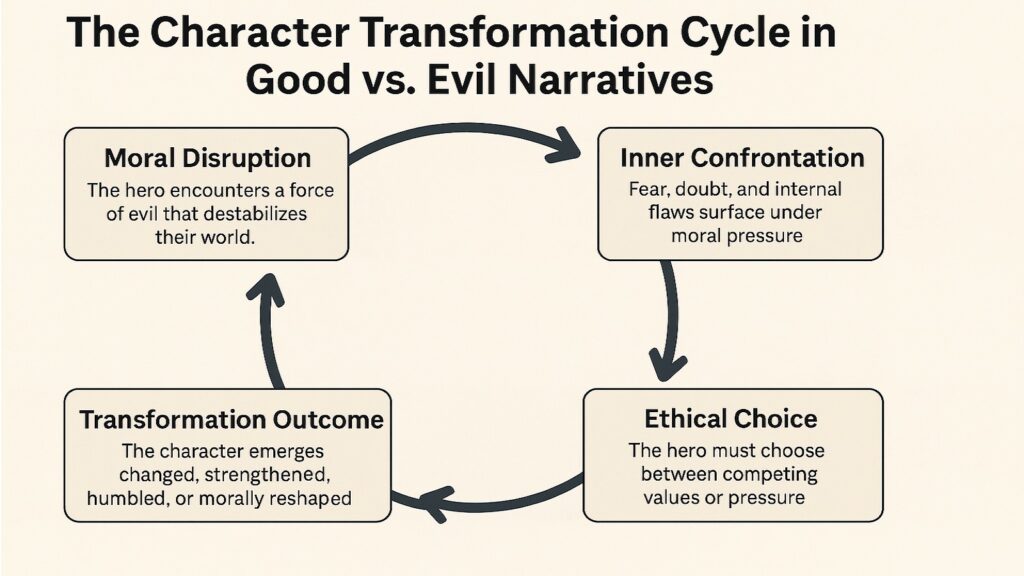
Characters become memorable when they face meaningful choices under pressure. Good vs. Evil creates the conditions for transformation by forcing protagonists to confront their deepest fears and flaws. The hero’s quest works because the struggle against external evil mirrors an internal battle with doubt, weakness, and temptation.
Consider how the presence of a villain sharpens a hero’s development. Darth Vader’s threat forces Luke Skywalker to develop courage and faith. Voldemort’s return pushes Harry Potter to accept responsibility and sacrifice. Sauron’s rising power compels Frodo to find strength beyond his hobbit comfort. The villain serves as both obstacle and catalyst. Without opposition, there is no test. Without a test, there is no growth.
The moral dimension adds weight to every decision. When heroes choose compassion over vengeance, they reveal character. When they resist corruption despite temptation, they prove their values. These choices matter because they occur in a framework where good and evil have clear consequences. A story without moral stakes may entertain, but it rarely transforms.
Villains also benefit from this structure. The best antagonists believe they serve a greater good or have suffered injustices that justify their actions. They think heroes are naive or misguided. This complexity makes conflict richer because both sides claim moral authority. The clash reveals what each character truly values.
The transformation arc depends on characters being pushed beyond their comfort zones into territory where old strategies fail. Good vs. Evil provides this pressure. Heroes must develop new strengths, overcome internal limitations, and discover reserves of courage they did not know existed. The external battle creates conditions for internal evolution.
Good vs. Evil and Character Development Patterns
| Character Type | How Good vs. Evil Drives Transformation |
|---|---|
| Reluctant Hero | Forced to overcome fear and self-doubt when confronted by clear injustice |
| Tragic Villain | Demonstrates how good intentions can corrupt into evil through gradual compromise |
| Mentor Figure | Tests their wisdom by guiding others through moral complexity and temptation |
| Anti-Hero | Struggles between selfish impulses and emerging sense of responsibility to others |
| Innocent | Loses naivety through exposure to evil but must choose between cynicism and hope |
| Redeemed Character | Proves transformation possible by choosing good after serving evil |
3. Good vs. Evil as a Mirror of Cultural Values and Fears
Every culture defines Good and Evil through its own lens. What one society celebrates as virtue, another may view as weakness. The stories each generation tells reveal what it fears most and what it aspires to become. Good vs. Evil serves as a mirror reflecting collective anxieties and hopes.
Medieval European literature portrayed evil as heresy and chaos threatening Christian order. Knights battled dragons and pagans to defend faith and hierarchy. The villains embodied threats to feudal structure and religious authority. These stories reinforced the values that held society together during unstable times.
American Western films of the mid-twentieth century used Good vs. Evil to explore frontier justice and individualism. The lone gunslinger represented self-reliance and moral clarity in lawless territory. These narratives reflected anxieties about social change and nostalgia for simpler moral certainties during the Cold War era.
Contemporary fantasy often complicates the binary by showing good characters making morally ambiguous choices. Stories like Game of Thrones reflect modern skepticism about absolute moral authority and simple solutions to complex problems. The moral landscape has become grayer because audiences live in times of competing values and uncertain answers.
Different cultures emphasize different aspects of the conflict. Japanese storytelling often explores duty versus desire within the Good vs. Evil framework. African folktales frequently use the theme to teach community values and warn against selfishness. Indian epics like the Mahabharata present elaborate scenarios where characters must choose between conflicting duties.
The evolution of this theme shows societies grappling with changing beliefs. When cultures face external threats, stories tend toward clear moral lines and unified heroes. During periods of internal division, narratives become more ambiguous and villains gain sympathetic dimensions. The mirror reflects not fixed truths but shifting perspectives.
Good vs. Evil Reflecting Different Cultural Eras and Values
| Historical Period/Culture | Manifestation of Good vs. Evil Theme |
|---|---|
| Medieval Europe | Religious righteousness against heresy and demonic forces |
| Victorian England | Moral propriety and social order against vice and criminality |
| Cold War America | Democratic freedom defending against totalitarian oppression |
| Post-Colonial Literature | Indigenous values resisting imperial domination and cultural erasure |
| Modern Dystopian Fiction | Individual humanity fighting dehumanizing technological control |
| Contemporary Fantasy | Morally complex characters navigating competing definitions of justice |
4. Good vs. Evil as the Source of Emotional Stakes and Tension
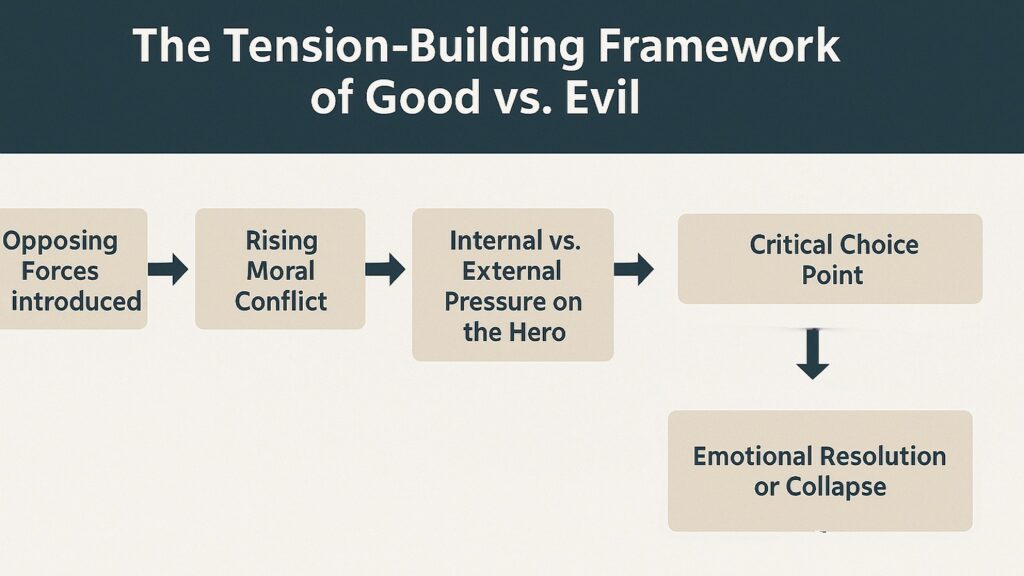
Stories need tension to hold attention. Good vs. Evil creates immediate emotional stakes by establishing clear consequences for success or failure. When audiences understand that characters fight for something meaningful against a genuine threat, every scene carries weight. The moral dimension transforms action into significance.
The conflict works mechanically by creating obstacles that force escalating choices. Each confrontation with evil raises the stakes. Heroes must sacrifice more, risk more, and dig deeper into their reserves. This escalation maintains narrative momentum. The audience stays engaged because they care about the outcome and fear for characters they have come to value.
Clarity of opposition helps audiences know where to invest emotion. When villains embody cruelty, oppression, or destruction, viewers naturally align with those who oppose these forces. The empathy flows automatically because the stakes are obvious. People root for characters trying to prevent harm and protect the vulnerable.
The binary also creates satisfying dramatic irony. Audiences often know more about the villain’s plans than heroes do. This knowledge generates tension as viewers watch protagonists walk into danger. The moral framework makes these moments work because audiences desperately want good to triumph and fear it might not.
Even subtle manifestations of the theme create tension. A character tempted by corruption generates anxiety because audiences sense the danger of moral compromise. A hero doubting their cause creates uncertainty about whether they will maintain integrity under pressure. These internal struggles carry dramatic weight because they occur within a larger moral context.
Resolution of Good vs. Evil conflict provides emotional catharsis. When heroes triumph, audiences experience relief and validation. When evil wins or the ending remains ambiguous, viewers feel unsettled but intellectually stimulated. Either outcome works because the moral stakes made every moment of the story matter.
Good vs. Evil Creating Narrative Tension and Stakes
| Tension Mechanism | How It Operates in Storytelling |
|---|---|
| Clear Opposition | Audiences immediately understand who to support and what is at risk |
| Escalating Sacrifice | Heroes must give up more as conflict intensifies to prove their commitment |
| Moral Temptation | Internal struggle between expedient wrong and difficult right creates suspense |
| Ticking Clock | Evil’s advancing threat creates urgency forcing heroes into action |
| Uncertain Outcome | Possibility that evil might win maintains tension throughout the narrative |
| Emotional Investment | Moral clarity allows audiences to care deeply about character choices |
5. Good vs. Evil as a Symbolic Language in Storytelling
Beyond literal conflict, Good vs. Evil operates through symbols that communicate meaning without explanation. Light represents clarity, truth, and hope. Darkness suggests deception, fear, and corruption. These associations run so deep in human experience that storytellers can evoke complex ideas through simple imagery.
Color coding reinforces moral positions. Heroes wear white or bright colors suggesting purity and openness. Villains dress in black or dark tones implying hidden motives and moral shadow. Settings follow similar patterns. Evil often inhabits wastelands, dungeons, or decaying structures. Good resides in gardens, towers of light, or thriving communities.
Physical appearance carries symbolic weight. Beautiful characters often represent good while disfigured ones suggest corruption. This troubling pattern reflects ancient anxieties about disease and difference, though modern stories increasingly subvert these assumptions. The symbolism persists because humans instinctively read faces and bodies for threat signals.
Natural imagery reinforces the theme. Storms, darkness, and winter frequently accompany evil’s ascent. Sunshine, spring, and calm weather signal hope and goodness. These patterns tap into humanity’s agricultural roots when weather determined survival. The symbols carry emotional resonance inherited from ancestors who depended on seasonal rhythms.
Archetypal characters serve as walking symbols. The wise mentor embodies knowledge and moral guidance. The innocent child represents purity worth protecting. The dark lord manifests pure corruption and destructive ambition. These figures communicate instantly because they draw on patterns repeated across countless stories and myths.
Music and sound design extend symbolic language. Dissonance, minor keys, and harsh tones accompany evil. Harmony, major keys, and gentle sounds surround good. Even without visual cues, audiences recognize moral positions through audio symbolism. The language operates below conscious awareness but shapes emotional response.
Good vs. Evil Expressed Through Symbolic Elements
| Symbolic Element | Representation in Storytelling |
|---|---|
| Light and Darkness | Knowledge versus ignorance and truth versus deception |
| Natural Settings | Flourishing gardens for good and barren wastelands for evil |
| Color Symbolism | Bright hues suggesting virtue and dark tones implying corruption |
| Weather Patterns | Clear skies representing hope and storms signaling danger |
| Architectural Spaces | Towering spires for aspiration and underground lairs for hidden threat |
| Musical Themes | Harmonic melodies for heroes and dissonant sounds for villains |
6. Good vs. Evil as a Universal Bridge Across Civilizations
Despite vast differences in culture, language, and history, humans across the world recognize and respond to Good vs. Evil in storytelling. This universality makes the theme a bridge connecting diverse audiences. A child in Tokyo and an elder in Cairo both understand when a story presents heroes defending innocents against destructive forces.
Ancient epics from different continents share remarkable structural similarities. The Mesopotamian Epic of Gilgamesh, the Indian Ramayana, the Greek Odyssey, and the West African Epic of Sundiata all feature protagonists battling forces that threaten cosmic or social order. These stories emerged independently yet employed similar moral frameworks because they addressed universal human concerns.
Modern global media demonstrates the theme’s continuing reach. Films, novels, and shows that explore Good vs. Evil travel across borders more easily than stories focused on culturally specific conflicts. Audiences everywhere connect with characters who protect the vulnerable, resist tyranny, and sacrifice for others. The moral language transcends local differences.
Religious and philosophical traditions worldwide have grappled with Good vs. Evil. Buddhism’s struggle against suffering, Islam’s concept of righteous conduct, Christianity’s spiritual warfare, and countless indigenous belief systems all structure human experience around moral choices between beneficial and harmful actions. The theme appears in every major tradition because it addresses fundamental questions about how to live.
The universality does not mean uniformity. Each culture inflects the theme with unique values and concerns. Japanese stories may emphasize honor and duty. African tales might focus on community and balance. American narratives often highlight individual freedom and justice. The core conflict remains recognizable while accommodating cultural particularity.
This shared pattern allows stories to function as common ground between civilizations. When people from different backgrounds discuss heroes, villains, and moral choices, they speak a language everyone understands. Good vs. Evil forms narrative esperanto that facilitates cross-cultural communication and mutual understanding.
Good vs. Evil Appearing Across World Civilizations
| Cultural Tradition | Expression of Good vs. Evil Theme |
|---|---|
| Greek Epic Poetry | Heroes like Odysseus battling monsters and hostile gods while seeking homecoming |
| Sanskrit Literature | Rama defeating Ravana to restore dharma in the Ramayana |
| African Oral Tradition | Anansi stories teaching moral lessons through trickster confronting threatening forces |
| Chinese Classical Fiction | Journey to the West showing pilgrims overcoming demons to reach enlightenment |
| European Medieval Romance | Knights errant defending Christian values against pagan and supernatural threats |
| Indigenous American Myths | Culture heroes battling chaos beings to establish order for human flourishing |
Conclusion: Good vs. Evil – The Everlasting Power of Conflict
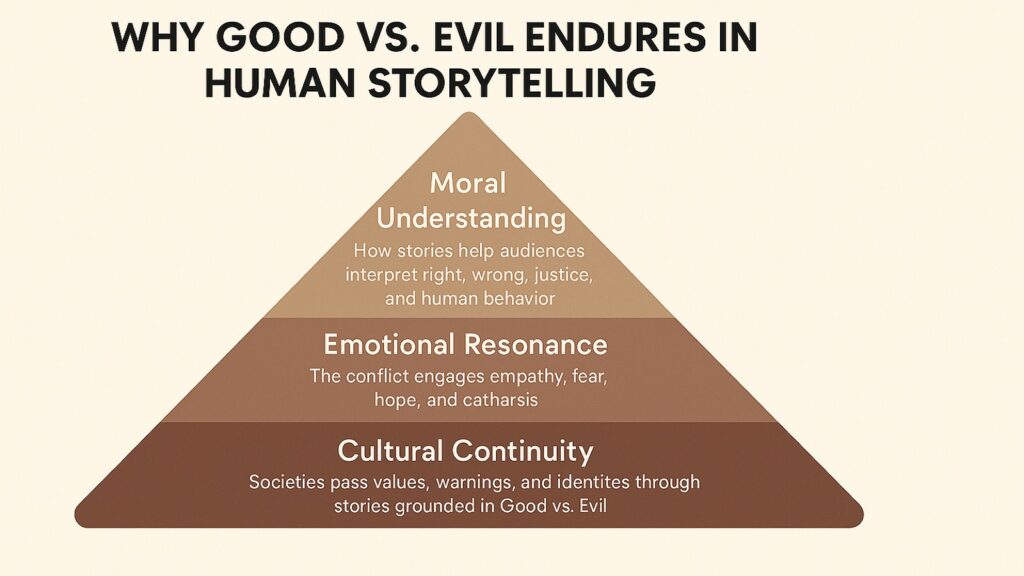
Good vs. Evil endures because it addresses something permanent in human experience. We face choices. We experience consequences. We witness suffering and joy. Stories that explore moral conflict help us understand these realities and imagine how we might respond when tested. The theme persists not through tradition alone but through continuing relevance to how humans navigate existence.
The conflict shapes storytelling by providing structure, meaning, and emotional resonance. It creates conditions for character transformation by forcing protagonists to confront their limitations and choose their values. It reflects cultural beliefs while offering a universal language that connects diverse audiences. It generates tension through clear stakes and communicates through symbols that bypass conscious thought.
Modern stories may complicate or subvert the binary, but they cannot escape it. Even narratives that blur moral lines acknowledge Good vs. Evil as the baseline they are challenging. The conversation continues because each generation must decide for itself what deserves defense and what requires opposition. The theme evolves without disappearing.
Humans return to this conflict again and again because we are meaning-making creatures living in a world where meaning is not obvious. We must construct it through choices and stories. Good vs. Evil provides a framework for that construction. It asks us to consider what we value, what we fear, and who we want to become.
The everlasting power lies not in simplicity but in adaptability. The theme can be stark or nuanced, ancient or contemporary, optimistic or tragic. It accommodates every variation while maintaining core recognizability. As long as humans tell stories about choices and consequences, Good vs. Evil will remain central to how we understand ourselves and the worlds we imagine.
Good vs. Evil’s Enduring Presence in Storytelling History
| Story Element | Why Good vs. Evil Remains Central |
|---|---|
| Moral Clarity | Helps audiences understand character motivations and story purpose |
| Emotional Engagement | Creates immediate investment through recognizable stakes and consequences |
| Cultural Flexibility | Adapts to reflect changing values while maintaining core structure |
| Character Development | Provides pressure that forces transformation and reveals true nature |
| Universal Recognition | Speaks to shared human experience across all cultures and eras |
| Narrative Momentum | Generates ongoing tension through escalating conflict and meaningful choices |
Read More Storytelling Articles
- 6 Powerful Story Archetypes That Inspire Creativity
- 8 Storytelling Psychologies to Elevate Creative Edge
- 6 Amazing Ways Interactive Narratives Rewire Our Brains
- 6 Incredible Ways Audio Storytelling Fuels Imagination
- 6 Ways Graphic Narratives Whisper Silence and Trauma
- 6 Incredible Ways Cliffhangers Make Us Keep Reading
- 6 Wild Ways the Unreliable Narrator Breaks Reality
- 6 Amazing Ways Chekhov’s Gun Reloads Narrative Power
- 6 Amazing Ways Foreshadowing Shapes Reader Emotion
- Top 6 Ways ‘In Medias Res’ Rewires Narrative Gravity