Table of Contents
Introduction: Sacrifice vs Duty as the Unanswered Question at the Heart of Storytelling
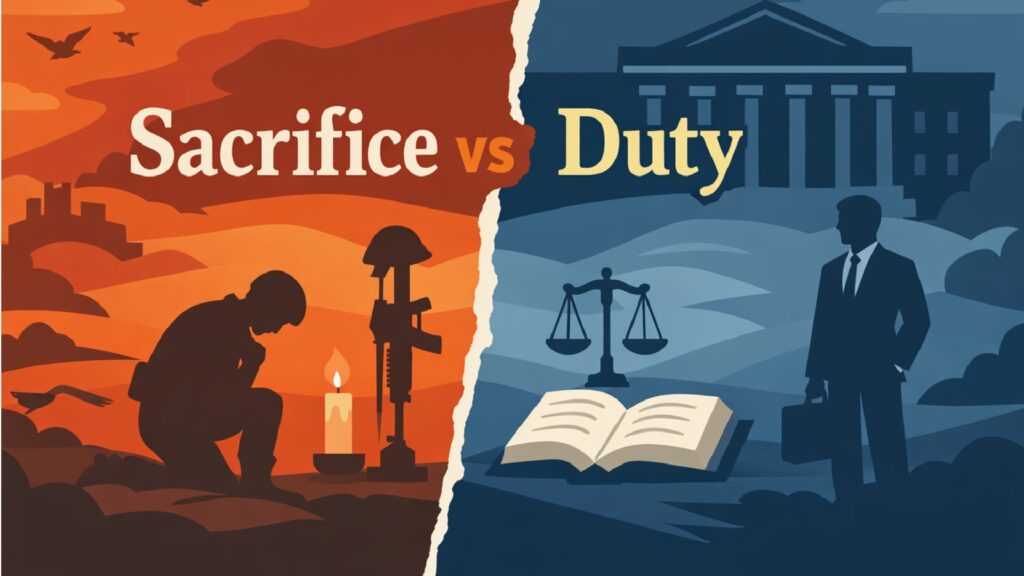
Stories rarely give clean answers. They ask hard questions and leave readers with the weight of choosing what feels right. Sacrifice vs Duty stands at the center of this tension, appearing across centuries of literature as a conflict that refuses resolution. This is not accidental. Writers understand that moral certainty flattens narrative depth, while ambiguity invites readers to wrestle with meaning long after the final page.
From ancient epics to modern fiction, characters face the pull between what they owe themselves and what they owe others. Achilles must choose between glory and a long life. Antigone must decide whether family loyalty matters more than state law. Harry Potter walks toward death to save his friends. These moments linger because they mirror the unresolved struggles we carry in our own lives.
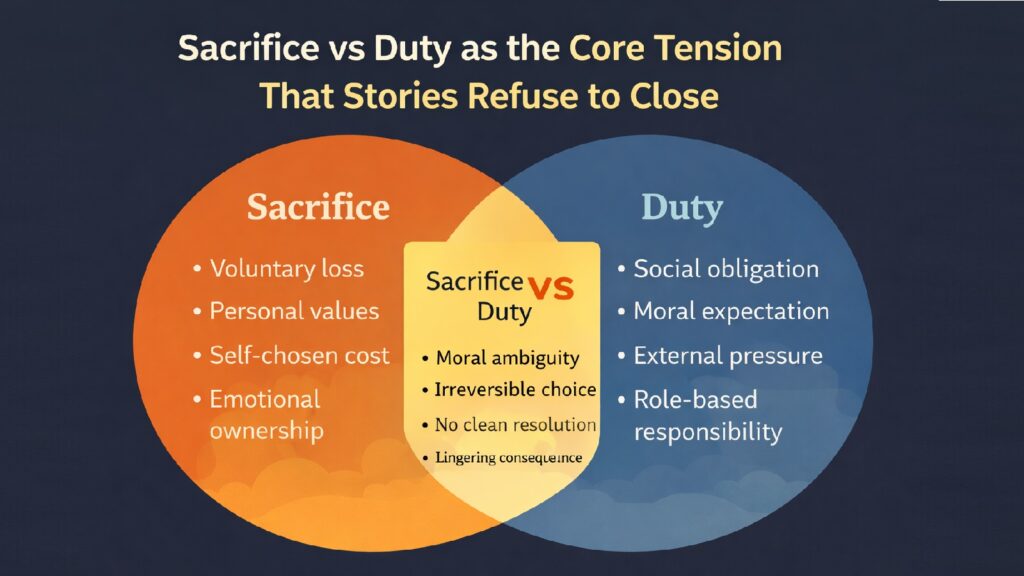
Sacrifice vs Duty is one of the most important storytelling themes because it touches the core of human obligation. Unlike straightforward conflicts where good triumphs over evil, this theme demands that something valuable must always be lost. No choice brings peace. Every path forward requires letting go of something worth keeping. Stories embrace this reality rather than soften it.
This article explores six powerful truths about why Sacrifice vs Duty remains unanswered in storytelling. Each truth reveals a deliberate choice by writers to preserve complexity over comfort. The refusal to resolve this tension is what gives stories their lasting power, transforming narrative into a mirror for our own moral framing and moral dilemmas.
Sacrifice vs Duty Compared to Other Major Storytelling Themes
| Storytelling Themes | How It Differs From Sacrifice vs Duty |
|---|---|
| Sacrifice vs Duty | Sacrifice vs Duty centers on conflict between two legitimate obligations, where choosing either path guarantees loss and leaves no moral closure. |
| Love and Loss | Often finds redemption through connection or memory, while Sacrifice vs Duty offers no reconciliation between competing obligations |
| Survival | Focuses on preservation of life with clear stakes, whereas Sacrifice vs Duty involves choosing which life or value to preserve |
| Good vs. Evil | Presents opposing moral forces, while Sacrifice vs Duty places two legitimate values in opposition with no clear villain |
| Power and Corruption | Examines moral decay over time, whereas Sacrifice vs Duty confronts immediate impossible choices without degradation |
| Destiny vs. Choice | Questions agency and predetermination, while Sacrifice vs Duty assumes agency but makes all choices painful |
| Redemption and Forgiveness | Offers paths toward healing, whereas Sacrifice vs Duty leaves wounds that cannot fully close |
| Chaos vs. Order | Deals with systemic forces, while Sacrifice vs Duty operates at the intimate level of personal obligation |
1. Sacrifice vs Duty Reveals What Stories Refuse to Judge
Great literature holds back judgment. When Hector returns to fight, knowing he will die, leaving his wife and son behind, Homer does not tell readers whether duty to Troy outweighs duty to family. The Iliad presents both loves as real and both losses as unbearable. This restraint creates space for readers to bring their own values into the story.
Writers who explore Sacrifice vs Duty understand that declaring a winner would collapse the tension that makes the conflict meaningful. Toni Morrison does not condemn Sethe for killing her daughter to save her from slavery in Beloved. Instead, Morrison shows the impossible mathematics of maternal love under dehumanizing conditions. The novel asks readers to sit with horror and empathy simultaneously, refusing the comfort of simple judgment.
This narrative neutrality serves a purpose beyond moral relativism. When stories withhold judgment, they transform readers from passive consumers into active participants. We must decide what we believe, what we would choose, and what we could live with. The absence of authorial verdict turns reading into a form of ethical exercise.
Ursula K. Le Guin demonstrates this approach in The Ones Who Walk Away from Omelas, where a utopian city depends on one child’s perpetual suffering. Some citizens accept this arrangement as the price of collective happiness. Others walk away, unable to bear the moral compromise. Le Guin offers no commentary on which choice shows more integrity. The story exists to make readers confront what they would do.
Stories that refuse to judge Sacrifice vs Duty often become the ones readers return to across lifetimes. We revisit them not because they provide answers but because they ask better questions than we can ask ourselves. They model complexity without demanding we embrace any particular conclusion.
Sacrifice vs Duty in Stories That Withhold Moral Judgment
| Literary Work | How the Story Refuses to Judge |
|---|---|
| The Iliad by Homer | Presents Hector’s choice to fight as both noble duty and abandonment of family without endorsing either value |
| Beloved by Toni Morrison | Shows Sethe’s infanticide as both unforgivable violence and desperate maternal protection without resolving the contradiction |
| The Ones Who Walk Away from Omelas by Ursula K. Le Guin | Describes both staying in the city and leaving as valid responses to impossible moral conditions |
| Crime and Punishment by Fyodor Dostoevsky | Explores Raskolnikov’s utilitarian murder while showing his psychological collapse, leaving judgment to readers |
| The Kite Runner by Khaled Hosseini | Depicts Amir’s failure to help Hassan as both moral cowardice and realistic human limitation under fear |
| Remains of the Day by Kazuo Ishiguro | Portrays Stevens’s devotion to duty as both dignified professionalism and tragedy of self-denial without privileging either reading |
2. Sacrifice vs Duty Turns Choice Into Emotional Weight, Not Resolution
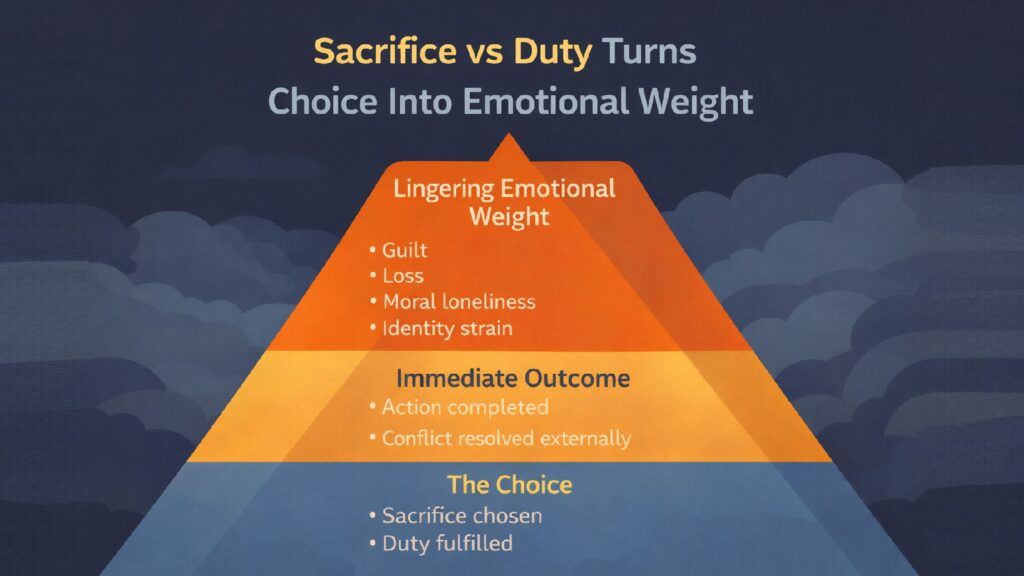
Stories built around Sacrifice vs Duty rarely grant characters peace after they choose. The decision becomes a new burden rather than a release from tension. This reflects lived experience more accurately than narratives where hard choices lead to cathartic closure. Real people carry their decisions forward like scars that ache in certain weather.
In Les Misérables, Jean Valjean must repeatedly choose between hiding his identity to protect those he loves and honoring his commitment to truthfulness and redemption. Each choice creates new complications rather than solving old ones. When he reveals himself as a convict to save an innocent man from prison, he gains moral integrity but loses his ability to care for Cosette safely. Victor Hugo shows that ethical action does not eliminate suffering.
This pattern appears throughout literature because it mirrors the way moral weight actually functions. We do not make one hard choice and move on unburdened. Instead, we live inside our decisions, second-guessing ourselves, wondering about alternate paths, feeling the absence of what we gave up. Stories that capture this reality resonate because they validate the ongoing nature of moral struggle.
Kazuo Ishiguro explores this in The Remains of the Day, where Stevens chooses professional duty over personal happiness throughout his life. By the novel’s end, he recognizes what his devotion has cost him, but he cannot recover the lost years or the love he never pursued. The emotional weight of his choices settles over him like evening fog. There is no moment of reconciliation, only the quiet acknowledgment of permanent loss.
Characters who face Sacrifice vs Duty often discover that choosing creates its own trap. They become defined by what they gave up, unable to forget the road not taken. This transforms them into living monuments to the impossibility of having everything we value simultaneously.
Sacrifice vs Duty: Creating Lasting Emotional Burden in Characters
| Character and Work | How Choice Becomes Ongoing Weight Rather Than Resolution |
|---|---|
| Jean Valjean in Les Misérables | Each choice to honor truth creates new danger for those he loves, making every ethical action produce fresh moral complications |
| Stevens in The Remains of the Day | Dedication to duty costs him love and self-knowledge, leaving him with regret that cannot be undone in old age |
| Katniss Everdeen in The Hunger Games trilogy | Survival and rebellion damage her psychologically, and her choices to protect others result in trauma she carries permanently |
| Eddard Stark in A Game of Thrones | Choosing honor over pragmatism leads to his execution and endangers his family, making his integrity catastrophic |
| Frodo Baggins in The Lord of the Rings | Bearing the Ring destroys his ability to live peacefully in the Shire, and his sacrifice for Middle-earth leaves him internally broken |
| Sydney Carton in A Tale of Two Cities | His sacrificial death for love brings no peace to his earlier wasted life, only a final meaningful act weighted with previous regrets |
3. Sacrifice vs Duty Exposes the Limits of Heroism in Literature
Traditional heroic narratives celebrate characters who endure hardship for noble causes. But stories exploring Sacrifice vs Duty often question whether such endurance deserves unqualified praise. They ask uncomfortable questions about the cost of heroism and whether anyone should have to choose between impossible obligations.
Sophocles examines this in Antigone, where the protagonist must choose between religious duty to bury her brother and obedience to state law. She chooses sacred obligation and dies for it. The play does not simply celebrate her martyrdom. Instead, it shows how rigid adherence to duty destroys young life and leaves everyone diminished. Antigone becomes heroic and tragic simultaneously, her steadfastness both admirable and wasteful.
This skepticism toward heroism appears throughout modern literature. In All Quiet on the Western Front, Erich Maria Remarque shows young soldiers destroyed by their duty to the nation and cause. Their sacrifice accomplishes nothing meaningful, and their deaths serve political abstractions rather than genuine human needs. The novel strips away the glory traditionally associated with military duty, revealing only loss and disillusionment.
Literature increasingly portrays heroism as something that should not be necessary rather than something to aspire toward. When characters face Sacrifice vs Duty, stories often highlight the structural failures that created such impossible choices in the first place. The hero becomes less a model of virtue and more a symptom of systemic cruelty.
Octavia Butler explores this in her Parable series, where Lauren Olamina must repeatedly sacrifice personal safety and relationships to pursue her vision of survival and community. Butler shows the exhaustion and trauma this creates, refusing to romanticize the burden of visionary leadership. Olamina’s heroism is real but presented as unsustainable, something that grinds her down even as it moves others toward survival.
Stories that expose the limits of heroism through Sacrifice vs Duty invite readers to question what we ask of people in desperate circumstances. They challenge cultural narratives that glorify self-denial and suggest that perhaps the need for such sacrifice represents a failure of imagination and compassion.
Sacrifice vs Duty: Undermining Traditional Heroic Narratives
| Literary Work | How Heroism Is Questioned or Shown as Costly |
|---|---|
| Antigone by Sophocles | Presents Antigone’s principled death as both courageous and tragically unnecessary, questioning whether duty should demand life |
| All Quiet on the Western Front by Erich Maria Remarque | Shows soldiers destroyed by nationalist duty, stripping military sacrifice of honor and revealing only waste |
| The Things They Carried by Tim O’Brien | Depicts Vietnam War soldiers carrying physical and emotional burdens that heroic narratives cannot contain or justify |
| Parable of the Sower by Octavia Butler | Portrays leadership and vision as exhausting burdens that damage those who carry them despite necessity |
| The Book Thief by Markus Zusak | Shows small acts of resistance under Nazi Germany as heroic but insufficient, with characters dying for gestures that cannot stop evil |
| Atonement by Ian McEwan | Questions whether Briony’s lifetime of guilt and literary penance can serve as adequate heroic atonement for her childhood lie |
4. Sacrifice vs Duty Creates Conflicts That Cannot Be Escaped
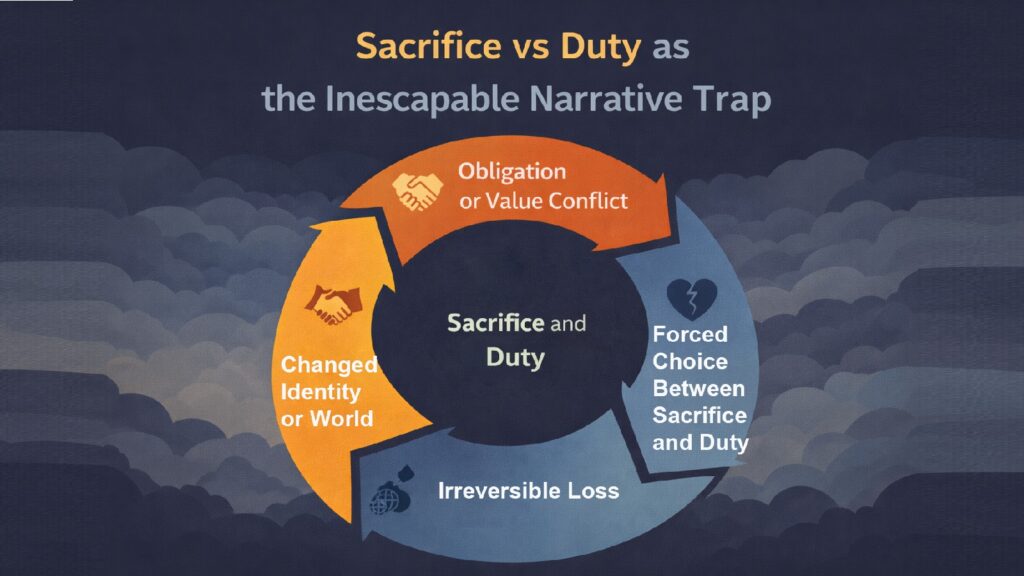
Some story conflicts offer the possibility of clever solutions or third options. Sacrifice vs Duty differs because it eliminates escape routes. Every available path demands genuine loss. Characters cannot negotiate their way out or find loopholes that preserve everything they value. This design choice creates narrative momentum through inevitability rather than triumph.
In Sophie’s Choice, William Styron presents perhaps the most devastating example of inescapable conflict. A Nazi officer forces Sophie to choose which of her two children will live and which will die. There is no good choice, no way to save both, no clever resistance that preserves innocence. She must choose, and the choice destroys her psychologically for the rest of her life. The novel’s power comes from the absolute impossibility of escape.
This structure appears whenever storytelling wants to examine the weight of obligation without offering relief. Characters cannot run away, cannot delay, cannot find alternatives that spare them pain. The story closes around them like a trap, and forward movement requires accepting loss.
Ursula K. Le Guin uses this structure in The Left Hand of Darkness, where Genly Ai must choose between loyalty to his mission and loyalty to Estraven, who has sacrificed everything to help him. His hesitation and political duty contribute to Estraven’s death. Le Guin designs the situation so that Genly’s obligations to his world and his obligations to his friend cannot both be honored. Something must break.
Stories built around inescapable conflicts do something important for readers. They validate the experience of being trapped between obligations, of facing situations where no amount of intelligence or virtue provides an exit. This validation matters because it acknowledges reality rather than offering false hope that perfect solutions exist for impossible dilemmas.
The absence of escape also accelerates the plot. When characters cannot avoid choosing, the narrative must move forward through decision and consequence rather than through external action. This creates a different kind of tension, one rooted in moral vertigo rather than physical danger.
Sacrifice vs Duty in Conflicts Designed Without Escape Routes
| Literary Work | How the Conflict Eliminates All Escape Possibilities |
|---|---|
| Sophie’s Choice by William Styron | Forces a mother to choose which child dies with no way to save both or refuse the choice |
| The Left Hand of Darkness by Ursula K. Le Guin | Creates political circumstances where helping a friend means betraying mission obligations |
| The Road by Cormac McCarthy | Traps a father between preserving his son’s physical survival and protecting his moral innocence in an immoral world |
| Hamlet by William Shakespeare | Designs revenge duty to require actions that violate Hamlet’s philosophical and religious values with no honorable alternative |
| Burial Rites by Hannah Kent | Places Agnes between accepting her execution with dignity and fighting a hopeless battle that would strip her of final humanity |
| Never Let Me Go by Kazuo Ishiguro | Creates a society where clones must accept their role as organ donors with no possibility of escape or rebellion |
5. Sacrifice vs Duty Separates Personal Identity From Social Obligation
One of the most profound aspects of Sacrifice vs Duty in literature is how it fractures identity. Characters who choose duty often lose connection to their authentic selves, becoming instruments of external expectations. Those who choose sacrifice may preserve personal integrity but lose belonging within their communities. Either path creates a form of alienation that stories explore with careful attention to psychological cost.
In The Handmaid’s Tale, Margaret Atwood shows how the society of Gilead demands that women surrender personal identity entirely to fulfill reproductive duty. Offred maintains fragments of self through memory and small acts of resistance, but her duty as a handmaid requires the erasure of who she was. The novel examines how obligation can consume identity until nothing recognizable remains.
This fracturing appears whenever stories place individual truth in opposition to collective expectation. Characters must choose between being true to themselves and being legible to their communities. Both choices carry exile. Internal exile for those who obey while dying inside. External exile for those who refuse and find themselves cast out.
Chinua Achebe explores this tension in Things Fall Apart, where Okonkwo’s rigid adherence to masculine duty and tribal tradition ultimately destroys him. His identity becomes so bound to warrior values that he cannot adapt when circumstances change. His duty to traditional masculinity separates him from his son, from his community’s evolving needs, and finally from life itself. Achebe shows how duty can petrify identity rather than preserve it.
The separation between personal identity and social obligation creates a particular kind of loneliness in literature. Characters who face this split often cannot explain their choices to others because the internal logic that drives them exists beyond language. They become isolated even when surrounded by people, carrying knowledge about themselves that cannot be shared or understood.
This theme resonates because it reflects the ongoing negotiation everyone conducts between authentic self-expression and social survival. Stories that explore Sacrifice vs Duty give shape to the wordless experience of feeling divided between who we are and who we must be.
Sacrifice vs Duty: Fracturing Identity and Belonging in Literature
| Literary Work | How Choosing Creates Alienation From Self or Community |
|---|---|
| The Handmaid’s Tale by Margaret Atwood | Shows how reproductive duty erases personal identity, leaving women as functional bodies without recognized selfhood |
| Things Fall Apart by Chinua Achebe | Depicts Okonkwo’s rigid duty to masculine tradition preventing adaptation and connection, leading to isolation and death |
| The Scarlet Letter by Nathaniel Hawthorne | Explores how Hester’s choice to protect her lover isolates her socially while preserving her inner truth |
| A Doll’s House by Henrik Ibsen | Shows Nora’s awakening to selfhood requiring abandonment of wifely and maternal duty, fracturing her social identity |
| The Remains of the Day by Kazuo Ishiguro | Portrays Stevens’s devotion to professional duty eroding his personal identity until he becomes unrecognizable to himself |
| Ceremony by Leslie Marmon Silko | Examines Tayo’s struggle between veteran’s duty and Native identity, showing how military service alienates him from his community |
6. Sacrifice vs Duty Is Left Unanswered So Readers Must Carry It
The final truth about Sacrifice vs Duty in storytelling is that its ultimate destination is not the character but the reader. Stories deliberately refuse narrative resolution to transfer the burden of judgment from the page to the person holding the book. This strategy transforms passive entertainment into active moral engagement, making readers complicit in meaning-making rather than simply receiving it.
Cormac McCarthy employs this technique powerfully in The Road, where a father must repeatedly choose between protecting his son’s physical survival through sometimes brutal means and preserving the boy’s moral innocence. The novel ends without clarifying whether the father made the right choices or whether survival justified his methods. McCarthy hands the question to readers, forcing us to consider what we would preserve if faced with apocalyptic collapse.
This transfer of responsibility explains why certain stories haunt readers for years after finishing them. When a narrative provides clear moral guidance, we can set it aside once understood. But stories that leave Sacrifice vs Duty unresolved follow us into ordinary life, surfacing during our own moments of conflicted obligation.
Jhumpa Lahiri uses this approach in her short fiction, particularly in stories where characters must choose between cultural duty to immigrant parents and personal desires rooted in American identity. She presents these conflicts with deep empathy for all parties but refuses to suggest that one path leads to better outcomes. Readers must sit with the discomfort of recognizing legitimate claims on both sides.
The deliberate ambiguity serves another purpose beyond individual moral development. It creates common ground for readers across different value systems to engage with the same text. When a story does not dictate the right answer, people with opposing beliefs can both find recognition in the conflict itself, even if they would choose differently.
Stories that hand Sacrifice vs Duty to readers acknowledge something important about the narrative’s role in human life. Literature does not exist primarily to teach lessons but to create spaces where difficult questions can be examined without immediate pressure to resolve them. This protected space for moral uncertainty becomes increasingly valuable in cultures that demand quick judgments and clear positions.
Sacrifice vs Duty in Stories That Transfer Judgment to Readers
| Literary Work | How the Story Refuses Resolution and Engages Readers |
|---|---|
| The Road by Cormac McCarthy | Ends without clarifying whether the father’s brutal survival methods preserved or destroyed what mattered most about humanity |
| The Lottery by Shirley Jackson | Presents ritual violence as community duty without explaining how readers should judge participants or resist similar pressures |
| Interpreter of Maladies by Jhumpa Lahiri | Depicts cultural and personal conflicts in immigrant families without suggesting which obligations should take precedence |
| Life of Pi by Yann Martel | Offers two versions of survival, one dutiful and brutal, one imaginative and transcendent, leaving readers to choose which feels true |
| Brokeback Mountain by Annie Proulx | Shows how social duty and personal desire destroy both men without indicating whether different choices would have been possible or better |
| The Yellow Wallpaper by Charlotte Perkins Gilman | Leaves ambiguous whether the narrator’s final state represents liberation from or destruction by gendered duty |
Conclusion: Sacrifice vs Duty as the Question Stories Intentionally Leave Open
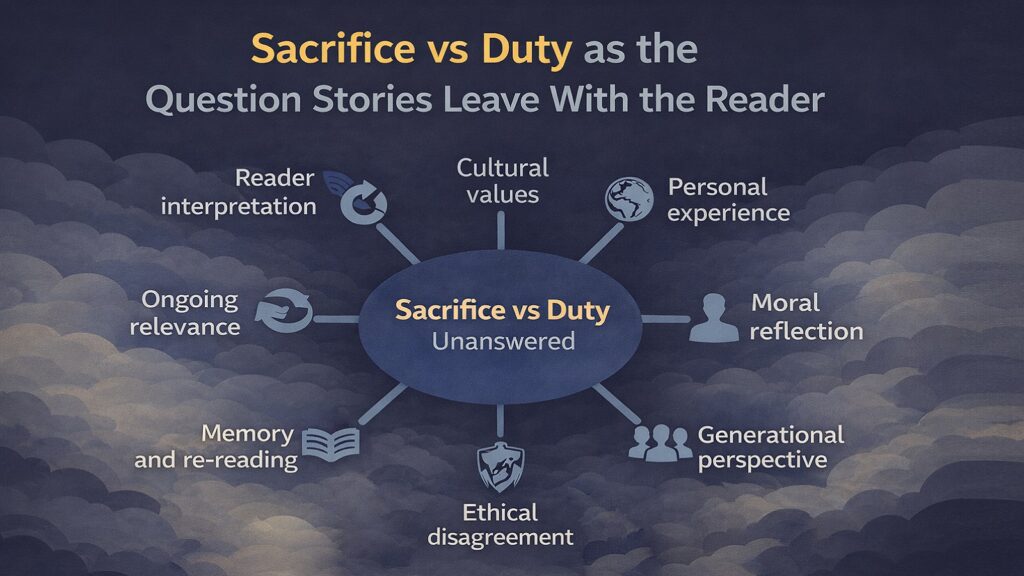
Stories return to Sacrifice vs Duty across centuries and cultures because this conflict captures something essential about being human. We live suspended between what we owe ourselves and what we owe others, between personal truth and collective obligation. Literature does not resolve this tension because a narrative resolution would be dishonest. The conflict is not a puzzle with a hidden solution but a permanent condition of social existence.
The six truths explored in this article reveal that storytelling’s refusal to answer Sacrifice vs Duty serves multiple purposes. It preserves narrative complexity by withholding moral judgment. It transforms choice into ongoing emotional weight rather than cathartic release. It questions whether heroism should be celebrated when it requires destroying the hero. It creates conflicts without escape routes, forcing forward movement through loss. It exposes how obligation can fracture identity and belonging. And ultimately, it transfers the burden of judgment to readers, making us active participants in meaning-making.
This deliberate incompletion explains why certain stories maintain their power across generations. We return to The Iliad, to Beloved, to The Road not because they answer our questions but because they articulate our confusion with precision and compassion. They give shape to the wordless experience of being torn between legitimate but incompatible values.
Literature built around Sacrifice vs Duty acknowledges that some questions do not have answers, only ongoing negotiation. The stories mirror back to us the same unresolved tension we carry in our own lives, validating the difficulty of ethical existence without pretending it can be simplified. This validation becomes its own form of wisdom, a recognition that moral clarity is often less truthful than moral complexity.
Readers return to these stories because we recognize ourselves in the characters’ struggles. We see our own impossible choices reflected in their dilemmas. We carry their unresolved conflicts alongside our own, finding company in the shared experience of being human in a world that demands more than we can give without loss. The stories stay open so that we might enter them, again and again, seeking not answers but better questions.
Sacrifice vs Duty as a Recurring Theme Readers Return to Across Time
| Reason for Return | What Readers Find in Unresolved Sacrifice vs Duty Stories |
|---|---|
| Validation of Experience | Recognition that moral conflicts legitimately lack clear resolution, affirming the difficulty of ethical life |
| Space for Personal Values | Opportunity to engage texts through individual belief systems without authorial prescription of correct answers |
| Ongoing Relevance | Stories remain applicable across changing circumstances because they address permanent human tensions rather than specific historical moments |
| Emotional Complexity | Access to nuanced feelings about obligation that daily life rarely allows time or safety to examine |
| Shared Human Condition | Connection to generations of readers who have grappled with the same unresolvable tension between self and society |
| Invitation to Growth | Stories that evolve in meaning as readers age and face different obligations, offering new insights at different life stages |