Table of Contents
Introduction: Artificial Intelligence and Its Growing Role in Modern Technology
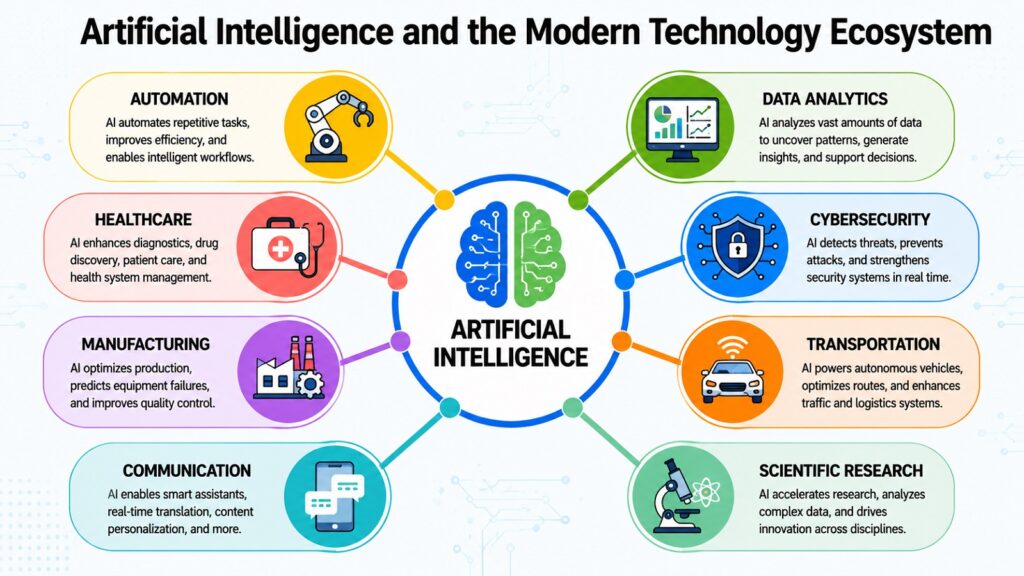
Artificial Intelligence has moved from research papers into the center of modern life. It runs the search engines people use every morning, powers medical tools that catch diseases early, and guides financial systems that move money across borders. It is one of the most important aspects of modern technology and one of the defining forces of this era.
The story of Artificial Intelligence is one of gradual, sometimes painful, progress. In its early decades, the field was confined to academic laboratories. The ambitions were enormous but the computing power was limited. Over time, as hardware improved and data became plentiful, the field gained real momentum. By the second decade of the twenty-first century, Artificial Intelligence had moved beyond the laboratory and into the products that billions of people use every day.
Today, Artificial Intelligence influences nearly every industry. Hospitals use it to analyze medical images. Banks use it to detect fraud in milliseconds. Retailers use it to predict what customers want. Governments use it to manage infrastructure. The reach of Artificial Intelligence is wide, and it continues to grow.
Table: Leading Artificial Intelligence Companies Worth Exploring
| Company | Why It Matters in AI |
|---|---|
| AI-powered search, Gemini, and cloud AI innovations | |
| OpenAI | ChatGPT, GPT models, and generative AI leadership |
| Microsoft | Enterprise AI through Copilot, Azure AI, and Microsoft 365 |
| NVIDIA | GPUs that power modern AI training and inference |
| Amazon | AI-driven e-commerce, logistics, and AWS AI services |
| Netflix | Personalized recommendations and content discovery |
| Tesla | Autonomous driving, computer vision, and AI robotics |
| Meta | AI-powered recommendations, assistants, and content moderation |
| IBM | Enterprise AI solutions with Watson and business automation |
| Adobe | Generative AI for creative design through Firefly |
| Salesforce | AI-powered CRM, automation, and intelligent business workflows |
| Spotify | AI-based music recommendations and personalized listening experiences |
Understanding Artificial Intelligence properly requires approaching it from several angles at once. The field is large, the terminology can be confusing, and the pace of change is fast. This guide covers eight essential pillars that together provide a complete picture.
The first pillar examines the foundations of the field. The second explores how Artificial Intelligence is classified. The third looks at the core components that make intelligent systems work. The fourth introduces the major subfields. The fifth walks through the development life cycle. The sixth explains the models and architectures that power modern AI. The seventh surveys real-world applications. The eighth examines ethics, safety, and governance. Together, these pillars offer a framework for thinking about Artificial Intelligence clearly and completely.
Table: Artificial Intelligence Article Roadmap — Eight Pillars at a Glance
| Pillar | Purpose |
| Foundations of Artificial Intelligence | Explains what AI is, its goals, history, and relationship with Machine Learning |
| Types and Classifications of Artificial Intelligence | Covers Narrow AI, General AI, Superintelligence, and functional categories |
| Core Components of Artificial Intelligence Systems | Examines data, algorithms, models, training, inference, and evaluation |
| Major Artificial Intelligence Subfields | Introduces ML, Deep Learning, NLP, Computer Vision, Robotics, and Generative AI |
| Artificial Intelligence Development Life Cycle | Walks through problem definition, data prep, training, testing, and deployment |
| Artificial Intelligence Models and Architectures | Covers neural networks, transformers, CNNs, RNNs, GANs, and diffusion models |
| Real-World Artificial Intelligence Applications | Surveys industry use cases, AI tool categories, and societal impact |
| Artificial Intelligence Ethics, Safety, and Governance | Addresses bias, transparency, accountability, privacy, and regulation |
1. What Is Artificial Intelligence? Understanding the Foundations of Artificial Intelligence
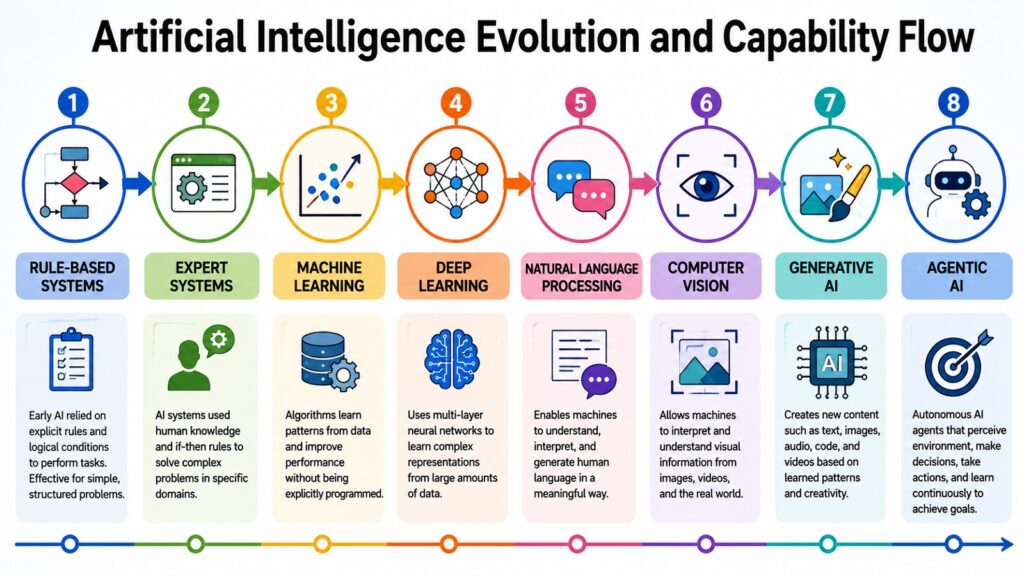
Artificial Intelligence is the science of building machines and software systems that can perform tasks normally requiring human intelligence. These tasks include recognizing patterns, understanding language, solving problems, making decisions, and learning from experience. The goal is not to replicate human thinking exactly but to create systems that produce intelligent results in useful ways.
Conventional software follows fixed rules written by programmers. Artificial Intelligence systems are different. They learn from data, adapt to new situations, and improve over time without needing every rule spelled out in advance. This distinction is what makes Artificial Intelligence so powerful.
The origins of Artificial Intelligence date back to the 1950s. In 1950, Alan Turing introduced the Turing Test as a standard for evaluating machine intelligence. The Dartmouth Conference in 1956 officially founded the discipline. Initial researchers held an optimistic view, convinced that general machine intelligence was merely decades from realization.
Reality proved harder. The field endured two major periods of reduced funding, known as AI winters, in the 1970s and late 1980s. Systems failed to meet early promises, and hardware remained limited. Each recovery brought new ideas and more realistic goals.
The modern era accelerated sharply after 2012, when deep learning systems achieved major gains in image recognition. Large language models and generative systems have since moved into mainstream use, reshaping what people expect from software.
Artificial Intelligence is the broadest term in the field. Machine Learning is a subset that focuses on systems learning from data rather than following hard-coded rules. Deep Learning is a subset of Machine Learning that uses multi-layered neural networks to process complex datasets. Each layer builds on the previous one, enabling the system to learn increasingly abstract representations. Together, these concepts form important AI foundations for understanding how modern intelligent systems work. AI has become necessary because modern problems involve too much data, information, and complexity for traditional rule-based systems to handle effectively.
Table: Artificial Intelligence Key Concepts, Milestones, and Characteristics
| Concept or Milestone | Significance |
| Turing Test (1950) | Proposed a benchmark for evaluating machine intelligence based on human-like responses |
| Dartmouth Conference (1956) | Formally established Artificial Intelligence as a field of academic research |
| AI Winters (1970s, late 1980s) | Periods of reduced funding due to unmet expectations and hardware limitations |
| Expert Systems (1970s–80s) | Rule-based programs that encoded specialist knowledge for narrow problem-solving |
| Machine Learning Expansion (1990s–2000s) | Shift toward data-driven approaches that learn patterns without explicit programming |
| Deep Learning Breakthrough (2012) | Convolutional neural networks achieved major gains in image recognition benchmarks |
| Large Language Models (2017–present) | Transformer-based models capable of advanced language understanding and generation |
| Generative AI Adoption (2022–present) | Widespread public use of AI tools for text, image, code, and multimedia generation |
2. Types of Artificial Intelligence and How Artificial Intelligence Is Classified
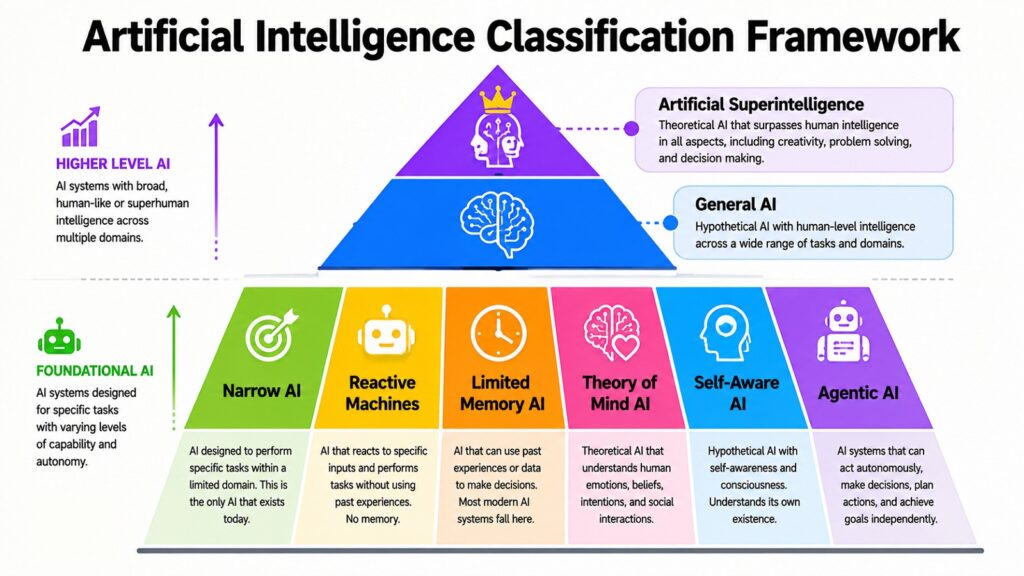
Artificial Intelligence is not a single uniform thing. It comes in many forms, and researchers classify it in several ways. Understanding these categories helps clarify what current systems can and cannot do, and where the field is heading.
The most common classification divides AI by capability. Narrow AI, also called Weak AI, refers to systems designed for one specific task. They can be extraordinarily good at that task, but cannot transfer the ability to other areas. A chess-playing AI cannot write an email. Virtually all AI systems in use today fall into this category.
General AI, or Artificial General Intelligence, refers to a hypothetical system that can perform any intellectual task a human can, reasoning across domains with human-level flexibility. No such system exists today, though research continues at several institutions. Artificial Superintelligence describes a theoretical AI that surpasses human ability across all domains. The gap between Narrow AI and Superintelligence is enormous.
Functionality-based classification adds a second lens. Reactive Machines respond to inputs using fixed rules with no memory of past interactions. IBM’s Deep Blue is a well-known example. Limited Memory AI uses historical data to inform decisions, as modern self-driving systems do. Theory of Mind AI would understand human mental states and emotions, but no such system currently exists. Self-Aware AI remains purely theoretical.
Agentic AI is an emerging development worth special attention. These systems plan and execute multi-step tasks autonomously, with minimal human guidance. Unlike chatbots that respond to single prompts, agentic systems can browse the web, write code, run tests, and manage workflows on their own, reshaping how organizations think about AI deployment.
Table: Artificial Intelligence Classification Types and Their Key Characteristics
| Classification | Key Characteristic |
| Narrow AI (Weak AI) | Performs one specific task extremely well but cannot generalize across domains |
| General AI (AGI) | Hypothetical system with human-level flexibility across all intellectual tasks |
| Artificial Superintelligence | Theoretical AI that would surpass human capability across every cognitive domain |
| Reactive Machines | Responds to inputs without memory; no learning from past interactions |
| Limited Memory AI | Uses historical data to improve decisions; most modern ML systems fall here |
| Theory of Mind AI | Would understand human emotions and intentions; does not yet exist |
| Self-Aware AI | Purely theoretical; would possess genuine consciousness and self-knowledge |
| Agentic AI | Plans and executes multi-step tasks autonomously with minimal human input |
3. Core Components That Power Artificial Intelligence Systems
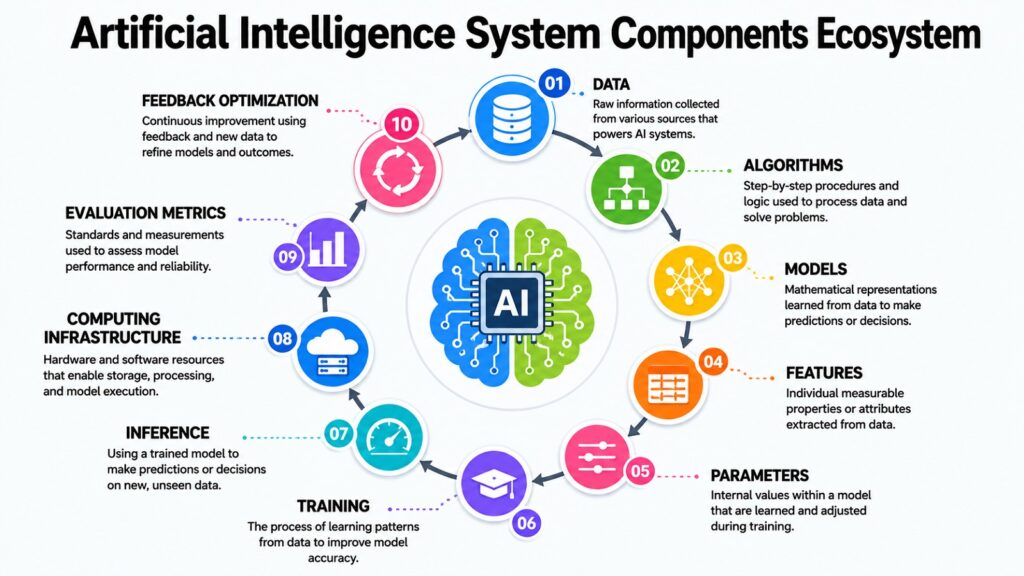
Every Artificial Intelligence system is built from a set of core components that work together. Understanding these building blocks explains both why systems succeed and why they sometimes fail.
Data is the starting point. Without large quantities of relevant, well-labeled data, a machine learning system cannot learn meaningful patterns. The quality and diversity of data directly shape what an AI system can do. Algorithms are the mathematical procedures used to process data and find patterns. Different algorithms suit different problems, and choosing the right one is a fundamental part of AI development.
Parameters are the internal values that an algorithm adjusts during training. Features are the specific characteristics extracted from raw data that a model uses to make predictions. Feature engineering, the process of selecting and transforming input variables, can have a major effect on model performance. In deep learning, much of this happens automatically.
Training is the process by which a model learns from data. The system repeatedly adjusts its parameters to minimize the gap between its predictions and the correct answers. This requires significant computing infrastructure for large models. Once training is complete, inference applies what was learned to make predictions on new data.
Evaluation metrics measure how well a model performs. Common ones include accuracy, precision, recall, and the F1 score. A model might score well on test data but still fail in real-world conditions. Feedback optimization, including reinforcement learning from human feedback, helps refine system behavior after initial training. Weaknesses in any component can undermine the entire system.
Table: Core Artificial Intelligence System Components and Their Primary Functions
| Component | Primary Function |
| Data | Provides the raw material from which AI systems learn patterns and relationships |
| Algorithms | Mathematical procedures that process data and identify patterns for learning |
| Features | Specific variables extracted from data that inform model predictions |
| Parameters | Internal values adjusted during training to improve model accuracy |
| Training | The process of exposing a model to data so it can learn and improve |
| Inference | Applying a trained model to new data to generate predictions or outputs |
| Computing Infrastructure | Hardware and cloud resources that support training and deployment at scale |
| Evaluation Metrics | Quantitative measures used to assess model performance and quality |
| Feedback Optimization | Processes that refine model behavior based on real-world outputs and user input |
| Models | Mathematical representations that capture learned relationships between inputs and outputs |
4. Major Artificial Intelligence Subfields Shaping Modern Innovation
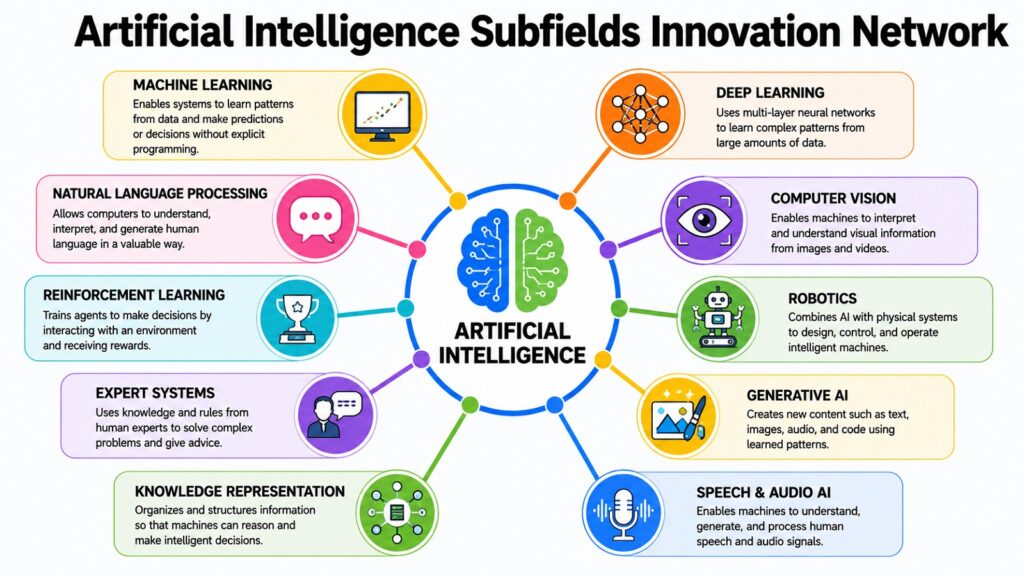
Artificial Intelligence is a collection of overlapping subfields, each with its own methods and goals. Understanding them explains where modern AI capabilities come from and how they continue to develop.
Machine Learning is the engine of modern Artificial Intelligence. It refers to systems that learn from data rather than following manually written rules. Its applications span every major industry. Deep Learning extends Machine Learning using neural networks with many layers, well-suited to unstructured data like images, audio, and text. Deep Learning drove the major performance gains in AI that began around 2012.
Natural Language Processing allows machines to comprehend and produce human language. It drives search engines, translation services, chatbots, and extensive language models. Computer Vision allows machines to analyze images and videos, with uses in medical imaging, self-driving cars, and quality control in manufacturing.
Reinforcement Learning educates systems through experimentation and rewards instead of using labeled data. An agent acquires knowledge by engaging with its environment and obtaining feedback. This method has led to exceptional performance in board games and demonstrates potential in robotics and resource management.
Robotics integrates AI with physical systems for perception and action. Expert Systems encode human knowledge into rule-based programs. Generative AI creates new content including text, images, music, and code. Knowledge Representation structures information for AI reasoning. Speech and Audio AI handles spoken language for voice assistants and transcription. These subfields interconnect and reinforce each other, collectively driving AI forward.
Table: Major Artificial Intelligence Subfields and Their Primary Focus Areas
| Subfield | Primary Focus |
| Machine Learning | Training systems to learn patterns from data without explicit rule programming |
| Deep Learning | Using multi-layer neural networks to process complex and unstructured data |
| Natural Language Processing | Enabling machines to understand, generate, and interact using human language |
| Computer Vision | Interpreting and extracting meaning from images and video data |
| Reinforcement Learning | Training agents through environmental interaction, trial, and reward feedback |
| Robotics | Integrating AI with physical systems for perception and autonomous action |
| Generative AI | Creating new content including text, images, code, audio, and video |
| Expert Systems | Encoding specialized human knowledge into rule-based reasoning programs |
| Knowledge Representation | Structuring information so AI systems can store, retrieve, and reason with it |
| Speech and Audio AI | Processing spoken language and sound for transcription, synthesis, and analysis |
5. The Artificial Intelligence Development Life Cycle Explained
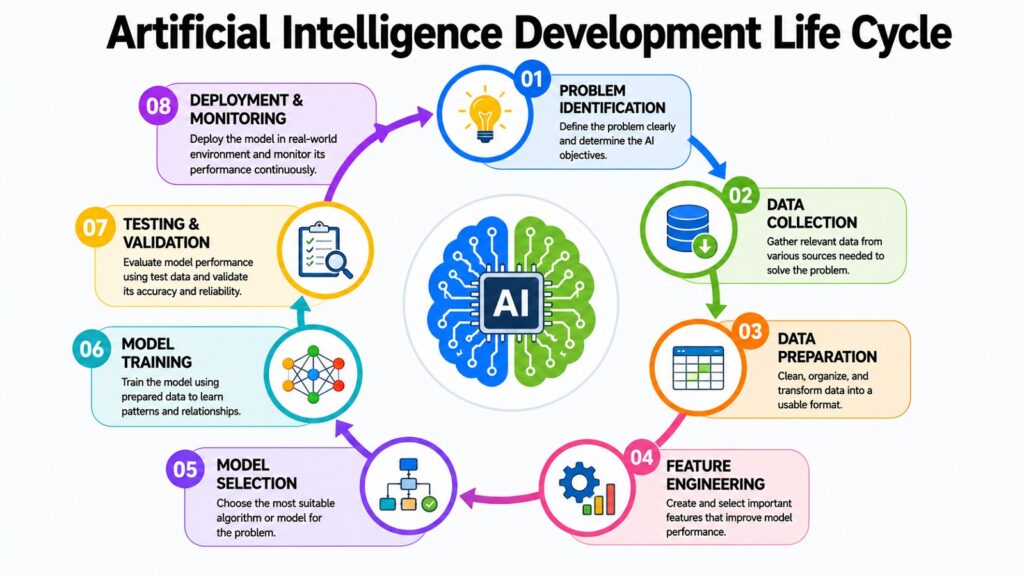
Building an Artificial Intelligence system is a structured process that unfolds across multiple stages. It is an iterative cycle that requires discipline and careful management from start to finish.
The process begins with problem identification. Developers must define the problem precisely before collecting any data. What question does the system need to answer? What does success look like? A poorly defined problem wastes effort and produces systems that miss the mark.
Data collection gathers relevant datasets from internal sources, public repositories, sensors, or third-party providers. Data preparation then cleans errors, handles missing values, normalizes formats, and splits data into training, validation, and test sets. Both stages directly shape the quality of everything that follows.
Feature engineering selects and transforms input variables to improve learning. Model selection chooses the algorithm best suited to the defined problem. Training adjusts the model’s parameters by exposing it to the training data repeatedly until performance improves.
Testing and validation measure how well the model performs on data it has not seen before. These stages reveal whether the system generalizes or merely memorized training examples. Deployment moves the validated model into production. Monitoring then tracks performance over time, catching problems that arise as data distributions shift and conditions change. This iterative nature defines responsible AI development.
Table: Artificial Intelligence Development Life Cycle Stages and Their Primary Objectives
| Stage | Primary Objective |
| Problem Identification | Define the task precisely and determine what a successful outcome looks like |
| Data Collection | Gather relevant, representative datasets from appropriate sources |
| Data Preparation | Clean, format, and split data into training, validation, and test sets |
| Feature Engineering | Select and transform input variables to maximize model learning potential |
| Model Selection | Choose the algorithm or architecture best suited to the defined problem |
| Training | Adjust model parameters by exposing the system to labeled training data |
| Testing and Validation | Evaluate model performance on unseen data to assess generalization ability |
| Deployment and Monitoring | Release the model into production and track its performance over time |
6. Artificial Intelligence Models and Architectures Behind Modern AI Systems
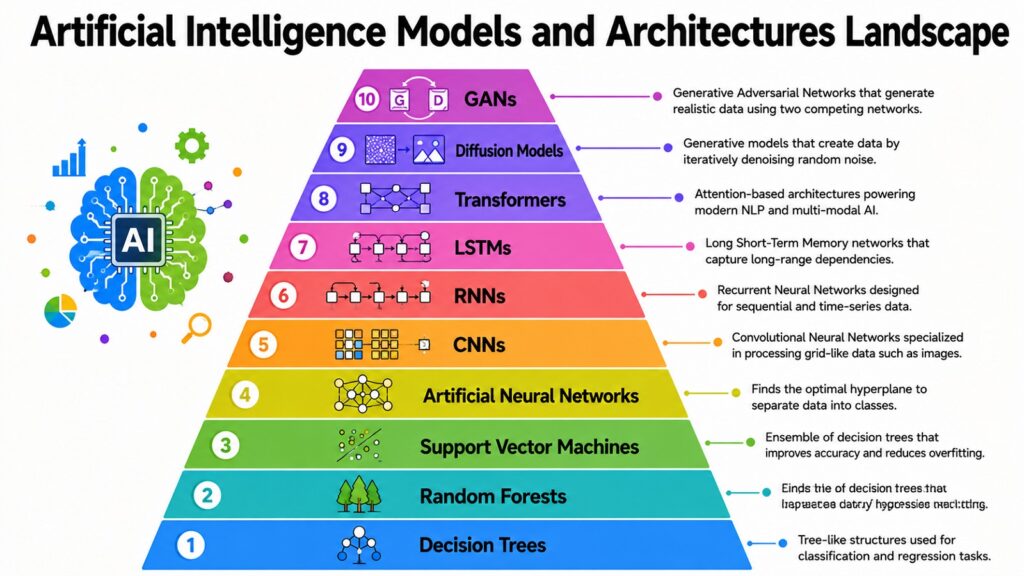
The models and architectures that power Artificial Intelligence have changed dramatically over the decades. Understanding the major approaches explains both what modern AI can do and why certain systems outperform others.
Conventional machine learning methods such as Decision Trees, Random Forests, and Support Vector Machines continue to be extensively utilized for structured data challenges. Decision Trees categorize data according to feature values and are appreciated for their interpretability. Random Forests aggregate multiple trees to enhance accuracy and mitigate overfitting. Support Vector Machines identify the optimal boundary that distinguishes classes and are based on robust theoretical principles.
Artificial Neural Networks process information through layers of interconnected nodes, loosely modeled on biological neurons. Each layer transforms its input and passes the result forward. Convolutional Neural Networks were designed for grid-structured data like images. They scan for features such as edges and shapes, building abstract representations layer by layer. Their success in image recognition launched the deep learning era.
Recurrent Neural Networks handle sequential data by keeping a record of prior inputs. Long Short-Term Memory Networks advance this capability by preserving information over extended sequences. These architectures played a crucial role in the early development of language processing.
Transformers are the dominant architecture in modern language AI. Introduced in 2017, they use an attention mechanism to weigh different parts of a sequence simultaneously. This parallelism allows very large-scale training. Most leading language models use transformer-based designs. Generative Adversarial Networks pair a generator and a discriminator in competition to produce synthetic data. Diffusion Models generate high-quality outputs by reversing a noise process. Both have powered the generative AI explosion.
Table: Major Artificial Intelligence Models and Architectures With Their Primary Use Cases
| Model or Architecture | Primary Use Case |
| Decision Trees | Interpretable classification and regression on structured tabular data |
| Random Forests | Ensemble learning for improved accuracy on structured prediction tasks |
| Support Vector Machines | Binary classification with clear decision boundaries in high-dimensional spaces |
| Artificial Neural Networks | General pattern recognition across diverse data types and domains |
| Convolutional Neural Networks | Image classification, object detection, and visual feature extraction |
| Recurrent Neural Networks | Sequential data processing including time series and early language tasks |
| Long Short-Term Memory Networks | Long-range sequence learning for language modeling and speech recognition |
| Transformers | Large-scale language understanding, generation, translation, and multimodal AI |
| Generative Adversarial Networks | Synthetic image generation, data augmentation, and creative AI applications |
| Diffusion Models | High-quality image synthesis and generative media production |
7. Real-World Artificial Intelligence Applications Across Industries and Society
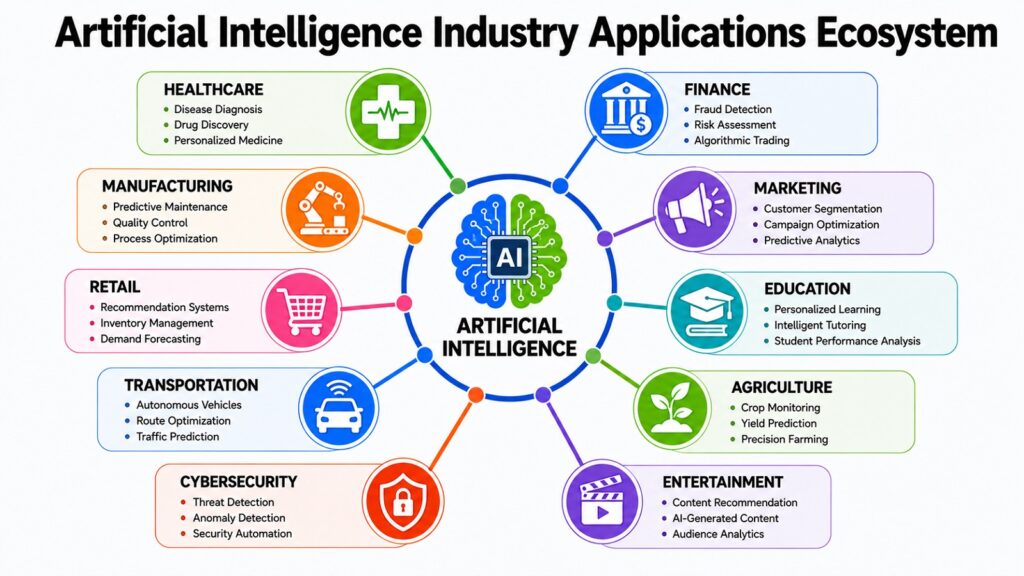
Artificial Intelligence has moved well beyond the laboratory. It operates inside systems that modern society depends on, and its influence continues to reach new sectors each year.
In healthcare, AI analyzes medical images to detect tumors, assess X-rays, and support clinical diagnosis. Predictive models help hospitals anticipate patient deterioration before it becomes a crisis. Drug discovery pipelines use AI to identify potential compounds far faster than traditional laboratory screening.
In finance, fraud detection systems process millions of transactions per second with precision no human team could match. Algorithmic trading systems execute trades in fractions of a second. Credit scoring models now use broader data signals to assess risk more accurately.
Manufacturing uses AI for predictive maintenance, visual quality inspection, and supply chain optimization. In marketing and retail, recommendation engines analyze purchase behavior to suggest what individual customers are likely to want next. In education, adaptive platforms adjust lesson difficulty based on each student’s performance.
Transportation AI oversees routing and the technology of autonomous vehicles. In the field of agriculture, AI-driven systems evaluate satellite and drone imagery to assess crop health and enhance irrigation efficiency. Cybersecurity solutions identify atypical network activities and react more swiftly than traditional manual methods permit. In the realm of entertainment, recommendation algorithms influence the content that billions of individuals engage with, whether it be watching, reading, or listening, daily.
Table: Artificial Intelligence Applications Across Major Industries and Sectors
| Industry or Sector | Representative AI Applications |
| Healthcare | Medical imaging analysis, drug discovery, patient risk prediction, clinical decision support |
| Finance | Fraud detection, algorithmic trading, credit scoring, regulatory compliance monitoring |
| Manufacturing | Predictive maintenance, defect detection, supply chain optimization, robotic automation |
| Marketing and Retail | Personalized recommendations, demand forecasting, dynamic pricing, customer segmentation |
| Education | Adaptive learning platforms, automated grading, personalized content delivery |
| Transportation | Autonomous vehicle systems, route optimization, traffic management, fleet logistics |
| Agriculture | Crop monitoring, yield prediction, precision irrigation, pest and disease detection |
| Cybersecurity | Threat detection, anomaly identification, automated incident response, phishing prevention |
| Entertainment | Content recommendation, generative media, audience analytics, interactive storytelling |
| Government and Public Services | Infrastructure monitoring, social services planning, public safety analytics |
Artificial Intelligence is not a single tool. It is an ecosystem of specialized categories, each designed for different tasks. Generative AI creates new content from learned patterns, including text, images, and code. Predictive AI uses historical data to forecast future outcomes, powering demand forecasting and risk scoring. Conversational AI enables natural dialogue for chatbots, voice assistants, and customer support systems.
Robotics and Autonomous AI integrate perception with physical actions in manufacturing robots and self-driving vehicles. Computer Vision AI analyzes images and videos for medical diagnostics and retail analytics. Natural Language Processing AI manages text and speech for translation, summarization, and content moderation. Specialized Domain AI utilizes targeted models for legal research, scientific analysis, and financial modeling. Agentic AI functions with increased autonomy, planning, and executing intricate tasks with minimal human supervision.
8 Major Types of Artificial Intelligence Tools and Their Sub-Categories
| Various Types of Artificial Intelligence Tools | Sub-Categories |
|---|---|
| 1. Generative AI Tools | 1) Image generation 2) Video generation 3) Text generation 4) Audio/voice generation 5) Music generation 6) 3D model generation |
| 2. Predictive AI Tools | 1) Classification systems 2) Regression models 3) Risk scoring engines 4) Forecasting tools 5) Recommendation engines |
| 3. Conversational AI Tools | 1) Chatbots 2) Voice assistants 3) Customer support AI 4) Dialogue systems 5) Multilingual conversational engines |
| 4. Robotics & Autonomous AI Systems | 1) Industrial robots 2) Service robots 3) Autonomous vehicles 4) Drones 5) Warehouse automation systems |
| 5. Computer Vision AI Tools | 1) Object detection 2) Image classification 3) Facial recognition 4) OCR tools 5) Medical imaging analysis |
| 6. Natural Language Processing (NLP) Tools | 1) Translation engines 2) Sentiment analysis tools 3) Summarization tools 4) Entity extraction 5) Document classification |
| 7. Specialized Domain AI Tools | 1) Healthcare diagnostic AI 2) Algorithmic trading tools 3) Cybersecurity threat detection 4) Educational AI tutors 5) Legal document analysis |
| 8. Agentic AI Tools (Autonomous AI Agents) | 1) Task automation agents 2) Research agents 3) Coding agents 4) Planning agents 5) Workflow orchestration agents |
The broader societal impact of Artificial Intelligence is already visible. Communication is being reshaped by real-time translation and AI-assisted writing. Education is becoming more personalized as adaptive systems tailor learning. Healthcare is reaching patients in regions with few specialists through AI-powered diagnostic tools.
At the same time, AI presents challenges worth honest attention. Workforce transformation is underway as automation displaces certain roles while creating demand for new skills. Questions about access and equity arise when powerful AI tools are concentrated in the hands of a few organizations. Concerns about misinformation grow as generative systems make it easier to produce convincing false content. These are not reasons to stop development, but reasons to guide it thoughtfully.
8. Artificial Intelligence Ethics, Safety, and Governance in the Modern Era
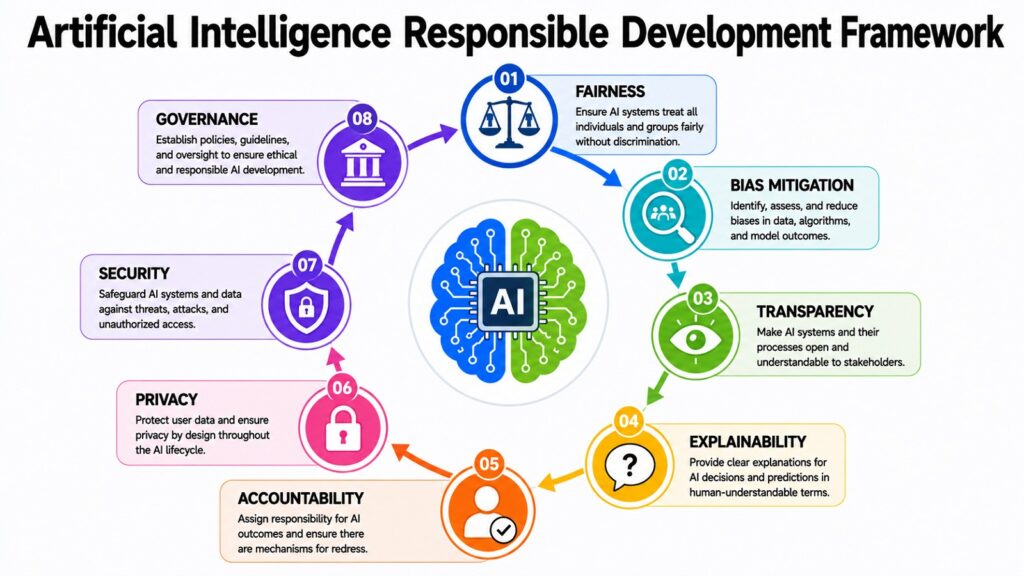
As Artificial Intelligence takes on greater responsibilities in healthcare, finance, law, and public life, questions of ethics, safety, and governance have moved to the center of the field. These are not theoretical concerns. They carry real consequences for real people.
Fairness and bias are among the most pressing issues. AI systems learn from historical data, and if that data reflects past discrimination, the system will reproduce those patterns. Hiring algorithms that disadvantage certain groups, lending models that deny credit unfairly, and facial recognition systems with accuracy gaps across demographics are real examples that have drawn serious scrutiny.
Transparency and explainability matter because many high-performing models are difficult to interpret. When a neural network rejects a loan application or flags a medical image, it may not be possible to explain exactly why. This creates problems for accountability and user trust. There is growing pressure on developers to build systems whose decisions can be understood and challenged.
Privacy is a serious concern because modern AI systems require large quantities of personal data. Security risks include adversarial attacks, data poisoning, and model extraction. Alignment concerns whether AI behavior matches the intentions of its designers. As AI systems increasingly rely on large-scale computing infrastructure, organizations are also paying greater attention to Compute Governance to ensure that computing resources are allocated, managed, and secured responsibly. These issues together define the reliability of AI systems over time.
Governance frameworks are developing in response. The European Union’s AI Act, adopted in 2024, classifies AI applications by risk level and imposes requirements accordingly. In the United States, executive guidance has outlined principles for responsible AI in federal contexts. Alongside data and model governance, responsible management of AI computing infrastructure is becoming an important part of the broader AI governance landscape. Responsible development is not just a moral imperative. It is the foundation on which the long-term success of Artificial Intelligence depends.
Table: AI Ethics, Safety, and Governance Considerations and Their Purpose
| Consideration | Purpose |
| Fairness and Bias Mitigation | Ensure AI systems do not replicate or amplify historical discrimination in their outputs |
| Transparency | Make it possible to understand how and why an AI system produces a given result |
| Explainability | Enable users and regulators to interpret model decisions in plain language |
| Accountability | Establish clear responsibility for AI system outcomes and errors |
| Privacy Protection | Govern the collection, storage, and use of personal data in AI development |
| Security and Robustness | Protect AI systems from adversarial attacks, manipulation, and failure |
| Alignment | Ensure AI system behavior matches the goals and values intended by its designers |
| Regulatory Governance | Apply legal frameworks and standards to guide responsible AI development and deployment |
Conclusion: The Future of Artificial Intelligence and Its Expanding Influence
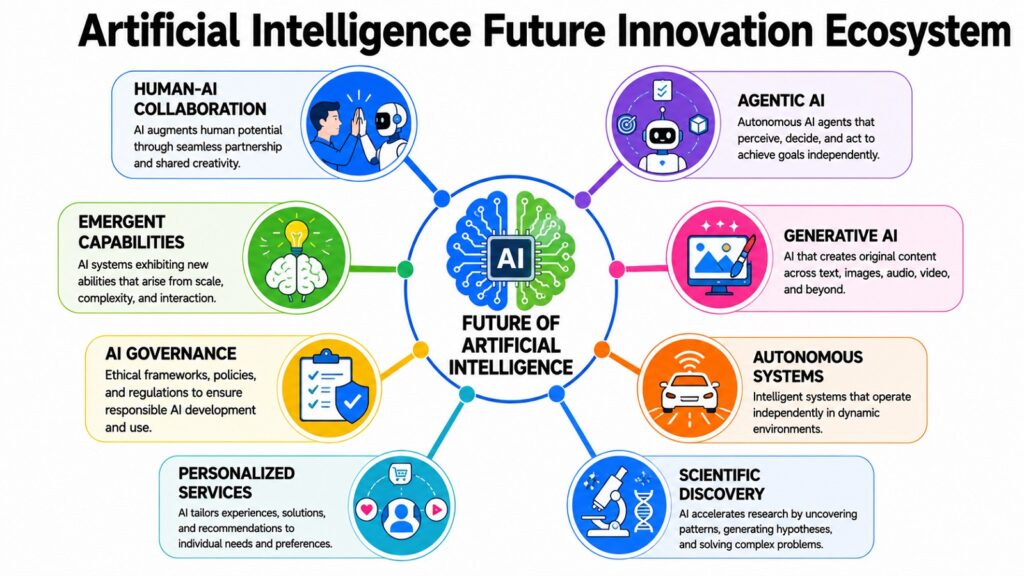
The eight pillars explored in this article reveal a field that is as complex as it is consequential. Artificial Intelligence is not one thing. It is a vast and evolving collection of theories, methods, systems, and applications that together are changing what is possible in almost every area of human activity.
Looking ahead, the trajectory of Artificial Intelligence points toward greater capability and broader adoption. Automation will continue advancing, handling more sophisticated tasks across more domains. Human-AI collaboration is becoming the dominant working model in many professions, with AI handling analysis and generation while humans provide judgment and oversight.
Emerging technologies, including multimodal AI, which integrates text, image, audio, and video understanding, are already showing early commercial deployment. Edge AI is expanding capabilities into environments with limited connectivity. Quantum computing, if it matures, could accelerate certain training tasks dramatically.
One significant development that researchers are monitoring attentively is the phenomenon of emergent capability. As AI models undergo training at increasingly larger scales, they occasionally acquire skills that were not specifically aimed for during the training process. Certain large language models have exhibited unexpected reasoning and multi-step planning abilities that their developers did not foresee. Gaining insight into these emergent behaviors represents a crucial focus of current research.
The societal impact of Artificial Intelligence will unfold over decades. Access to AI-powered education, healthcare, and economic tools could reduce global inequality if distributed wisely. Concentration of AI capability in a few organizations could deepen existing imbalances if left unchecked. Workforce displacement requires investment in retraining programs.
Responsibility and innovation are not opposites. The most durable progress will come from work that is technically rigorous and ethically grounded. Artificial Intelligence is not the future. It is the present, moving faster than most people expected and in directions that continue to surprise.
Table: Future Artificial Intelligence Trends and Their Potential Significance
| Future Trend or Development | Potential Significance |
| Multimodal AI Systems | Systems integrating text, image, audio, and video for richer and more flexible AI interactions |
| Advanced Autonomous AI Agents | AI systems that plan and execute complex multi-step tasks with minimal human direction |
| Human-AI Collaboration Models | New working frameworks where AI handles analysis and generation while humans guide strategy |
| Emergent AI Capabilities | Unexpected abilities arising in large models that researchers are working to understand and predict |
| Edge AI Deployment | Running AI models on local devices, expanding access and reducing dependence on cloud infrastructure |
| Quantum-Enhanced AI | Potential acceleration of training and optimization through quantum computing advances |
| AI Governance Maturity | Evolution of global regulatory frameworks to manage AI risk while enabling responsible innovation |
| AI and Scientific Discovery | Accelerating research in biology, materials science, climate, and medicine through AI-driven analysis |