Table of Contents
Introduction: Google AI Strategy and the Rise of an AI Powerhouse
Credit: iken3
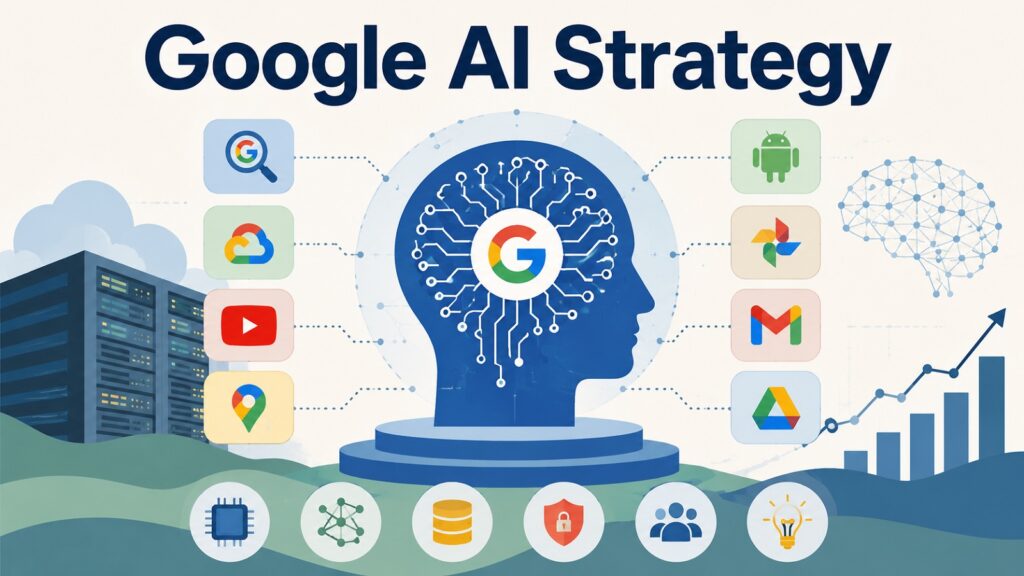
Most people think Google’s rise in artificial intelligence was just a string of lucky wins. That view misses the real story. Google AI Strategy deserves to be studied the same way business schools study Toyota’s factory system or Amazon’s delivery network. It was never just a tech success story. It was a business choice, repeated for more than a decade, to put intelligence at the center of almost everything the company builds.
This article looks at how Google moved from being a search engine company to one of the top AI firms in the world. The shift did not come from one lucky break. It came from steady planning, years of spending when the payoff was unclear, and a research culture that valued patient testing over quick wins. Each choice built on the one before it. Together, they formed a position that rivals still find hard to copy.
This piece does not just list Google’s AI products. It looks at the choices behind them. Why did Google build its own chips instead of buying them? Why did it pay top dollar for research talent long before that talent had any clear product use? Why did it keep publishing papers, even when rivals could learn from that work? Each major section below tries to answer four things: what happened, why it happened, why it mattered, and what lesson a reader can take from it.
Readers should treat Google’s choices as decisions worth questioning, not as settled history. Some choices paid off fast. Others took years to show results, and a few are still playing out today. The goal here is to mix solid facts with clear analysis, so that business leaders, founders, students, and tech workers can pull out real value, no matter what field they work in.
Table 1: Google AI Strategy Milestones That Shaped an AI Powerhouse
| Google AI Strategy: Milestone or Theme | Strategic Significance |
| Founding mission to organize information | Set up a clear path toward machine learning |
| Google Brain formed in 2011 | Brought deep learning into daily operations |
| Acquisition of DeepMind in 2014 | Added top research talent and global reputation |
| Development of TensorFlow in 2015 | Set a new standard for AI tools industry-wide |
| Custom Tensor Processing Units | Cut reliance on outside chip makers |
| AI woven into Search and Workspace | Turned lab work into daily tools for billions |
| AlphaFold and other science wins | Proved AI’s value well beyond consumer apps |
| Huge spending on AI infrastructure | Showed deep, long-term commitment to AI |
1. Google AI Strategy Began with a Long-Term Vision for Artificial Intelligence
Credit: iken3
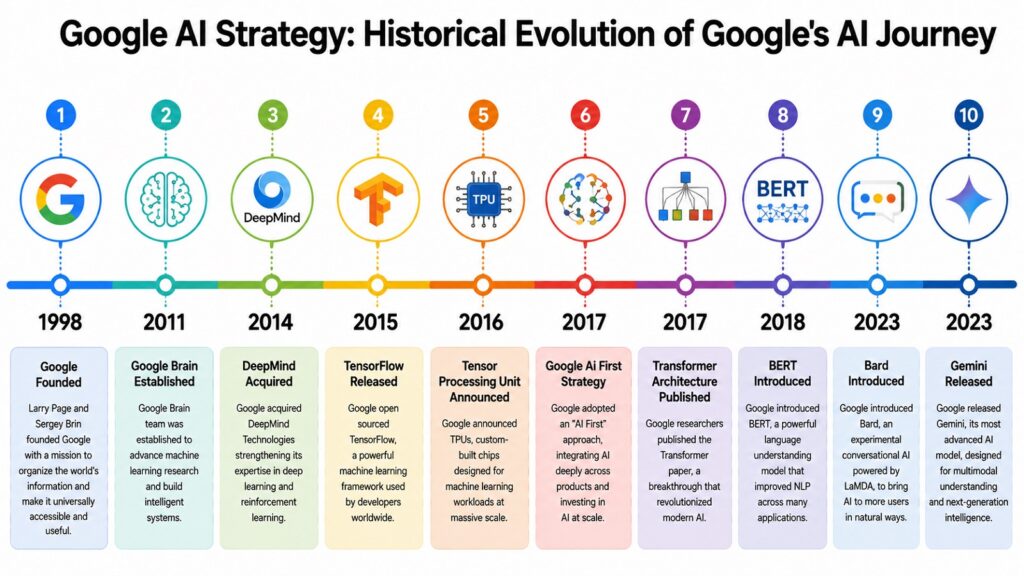
Google’s mission has barely changed since day one: organize the world’s information and make it useful to everyone. That goal sounds simple, but it grew harder every year. The web kept expanding, and search tools built on fixed rules could not keep up with so much messy data. Machine learning became the real answer, not because it was trendy, but because it was flexible enough to handle a web that never stopped changing.
This shift did not begin with a big press event. In 2011, Google engineer Jeff Dean teamed up with Stanford professor Andrew Ng and researcher Greg Corrado to start what became known as Google Brain. They trained a neural network across thousands of processors. With no labels at all, the system learned to spot cats in YouTube videos on its own. It sounds like a small trick, but it proved that large neural networks could learn real patterns from raw, messy data. That single insight shaped much of what Google built next.
What makes this period matter so much is the timing. Google poured money into deep learning years before most firms saw it as a true business priority. In strategy terms, this fits the resource-based view of the firm: a company builds a lasting edge by growing rare, hard-to-copy skills before rivals see their worth. Google’s early hires, its custom computer clusters, and its huge pile of search data combined into a lead that few rivals could match fast, no matter their budget.
Other tech firms saw the same trends, but most treated AI as a side project, not a core focus. Microsoft and IBM ran labs on related ideas, yet neither wove machine learning into core products as boldly or as early as Google did. This gap in commitment, more than any single clever idea, explains why Google’s path became the one others followed within just a few years.
The lesson for other firms is plain. Long-term thinking in research only pays off when paired with the patience to fund it before the payoff is clear. Google’s leaders treated AI research as core infrastructure, much like its data centers, not as a side bet to cut whenever budgets got tight.
Table 2: Google AI Strategy: Early Milestones in Google’s AI Journey
| Google AI Strategy – Early Milestone Year | Development |
| 2001 | Google starts using early machine learning to fight spam |
| 2006 | Google Translate launches using statistical methods |
| 2011 | Google Brain founded by Dean, Ng, and Corrado |
| 2012 | A neural network learns to spot cats with no labels |
| 2013 | Google buys Geoffrey Hinton’s firm, DNNResearch |
| 2014 | Google buys DeepMind for around four hundred million dollars |
| 2015 | TensorFlow is released as a free, open tool |
| 2016 | Google unveils its first custom AI chip, the TPU |
2. Google AI Strategy Accelerated Through Research, Talent, and Strategic Acquisitions
Credit: iken3
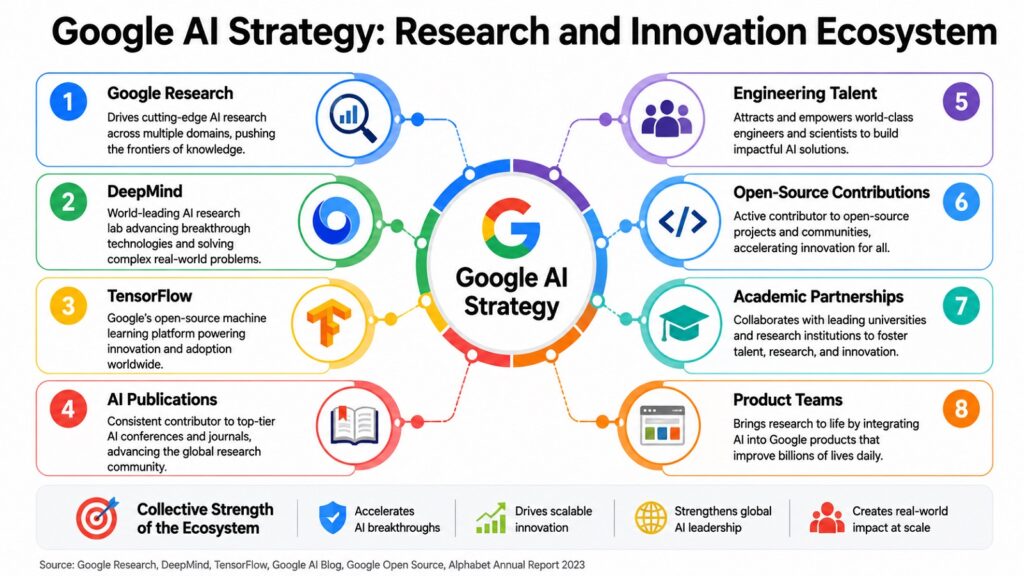
Once Google had shown deep learning could work at scale, the next test was keeping pace with a field that moved faster each year. The company met this test by pouring funds into top talent and buying outside skill rather than building every piece alone. The clearest case is the 2014 purchase of DeepMind, a London AI lab that Google bought for about four hundred million dollars, after a bidding race that reportedly included Facebook.
DeepMind brought more than tech. It brought a research style built around big, long-term goals rather than tight product deadlines. Its early wins in reinforcement learning, including systems that mastered Atari games without being told the rules, showed a focus on broad, general intelligence rather than narrow, one-off fixes. Google let DeepMind run with real freedom. The team stayed in London, and Google agreed to ethical limits, which kept alive the very culture that made the deal worth doing.
Deals alone do not explain Google’s progress. The firm also built an open research culture that, on its face, seems to give away its edge. Google’s scientists often published landmark papers, including the 2017 Transformer paper, which gave the world the design behind nearly all of today’s large language models. This looks odd from a pure business view, yet it served a deeper goal. Publishing drew top scientists who wanted credit for their work, and it made Google the clear hub of the field, which made hiring even easier down the line.
These moves tie back to long-standing ideas in management theory. Knowledge experts have long argued that brain power, not just gear, drives long-term gains in tech fields. Google’s shifting skills, meaning its power to mix, build, and rework talent faster than rivals, came right from this blend of hired stars, in-house research, and a culture that backed bold, sometimes risky bets.
The lesson for other firms building bold cultures is that talent and openness can sit side by side with sharp strategy. Locking up every idea inside the walls is not always wise. At times, a will to share and publish pulls in just the people a firm needs to stay ahead.
Table 3: Key Acquisitions and Research Milestones Behind Google AI Strategy
| Google AI Strategy: Acquisition or Initiative | Strategic Contribution |
| DNNResearch deal, 2013 | Brought deep learning pioneer Geoffrey Hinton to Google |
| DeepMind deal, 2014 | Added elite research talent and game-changing methods |
| TensorFlow launch, 2015 | Built a wide ecosystem that trained future engineers |
| Transformer paper, 2017 | Gave the field its base for modern language models |
| BERT model, 2018 | Sharpened Google’s own grasp of search language |
| Google Brain and DeepMind merge, 2023 | Joined research teams under one shared lead |
| Gemini model launch | Combined research strengths into one flagship brand |
| Steady buying of small AI startups | Filled narrow skill gaps fast and at low cost |
3. Google AI Strategy Built a Powerful Technology and Infrastructure Ecosystem
Credit: iken3
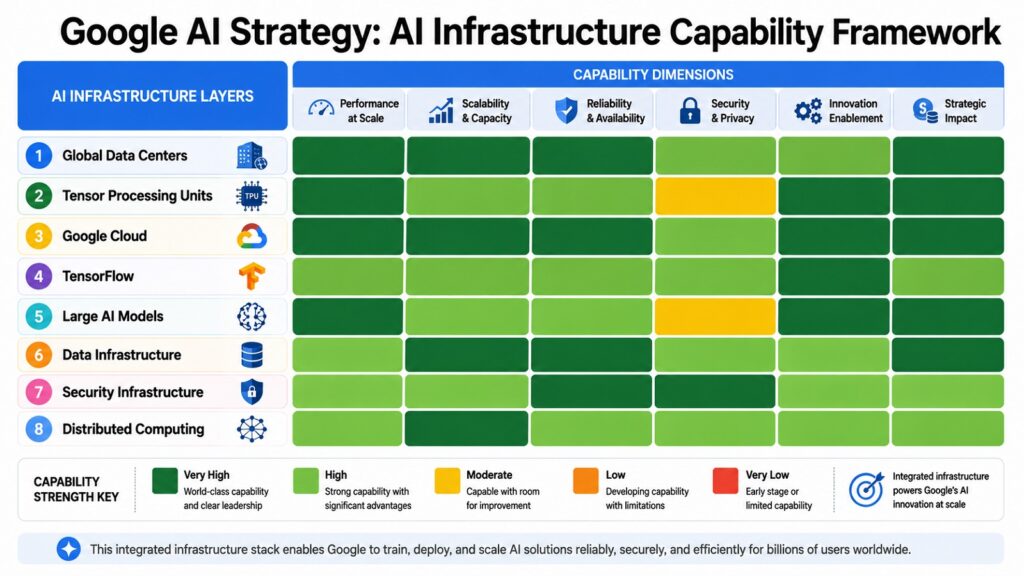
Algorithms get most of the public credit, but Google’s lead in AI rests just as much on years of hardware spending that few rivals could match fast. The clearest case is the Tensor Processing Unit, a chip Google built just for machine learning work, not general computing. Around 2013, Google’s team saw that if voice search kept growing at its current pace, the firm would need to double its whole data center setup just to keep up with normal chips. That fear led straight to the TPU, which Google’s own team built and rolled out in under fifteen months.
The TPU mattered for one big reason: it cut Google’s need for outside chip firms, mainly Nvidia, whose graphics chips had become the go-to tool for AI work across the field. By owning its own chip design, Google gained more grip on cost, supply, and the pace at which it could grow its training and use of models. This is now paying off in a big way. Google’s newest TPUs back both huge model training and the fast, snappy response needed for AI agents that work through many steps at once.
Hardware spending did not stop at chips. Google built TensorFlow as an open tool that let outside coders train models with ease, which grew the pool of skilled people the firm itself relied on. It grew its global data center web and built systems that could crunch huge piles of data across many machines at once. Each piece feeds the others. Faster chips make bigger models work, bigger models need more data and storage, and better setups bring the cost of running it all down.
This pattern fits a known idea from value chain theory. Michael Porter’s model shows how single steps, when joined, add up to more value than any one part alone. Google’s setup follows this exact path: data centers, chips, tools, and skilled staff all feed off one another, building a moat far harder to copy than any single AI model. Alphabet’s planned spend of up to one hundred eighty-five billion dollars in 2026 alone shows just how serious the firm is about this layer of its plan.
The real-world lesson is that hardware often outlasts any one product. Rivals can copy a feature within months, but they cannot copy a decade of chip design know-how or a worldwide web of custom-built data centers.
Table 4: Major Infrastructure Assets Supporting Google AI Strategy
| Google AI Strategy – Infrastructure Assets | Primary Strategic Purpose |
| Tensor Processing Units | Cut reliance on outside chip suppliers |
| TensorFlow framework | Build a developer base around Google’s tools |
| Global data center network | Back training and serving at huge scale |
| Custom cooling and power systems | Lower the cost of running AI workloads |
| Distributed computing systems | Crunch huge datasets at fast speed |
| JAX and related software tools | Speed up research on advanced models |
| Cloud TPU access for outside firms | Earn revenue while growing Google’s chip base |
| Massive 2026 spending plans | Show lasting commitment to AI at scale |
4. Google AI Strategy Turned Research into Products Used by Billions
Credit: iken3
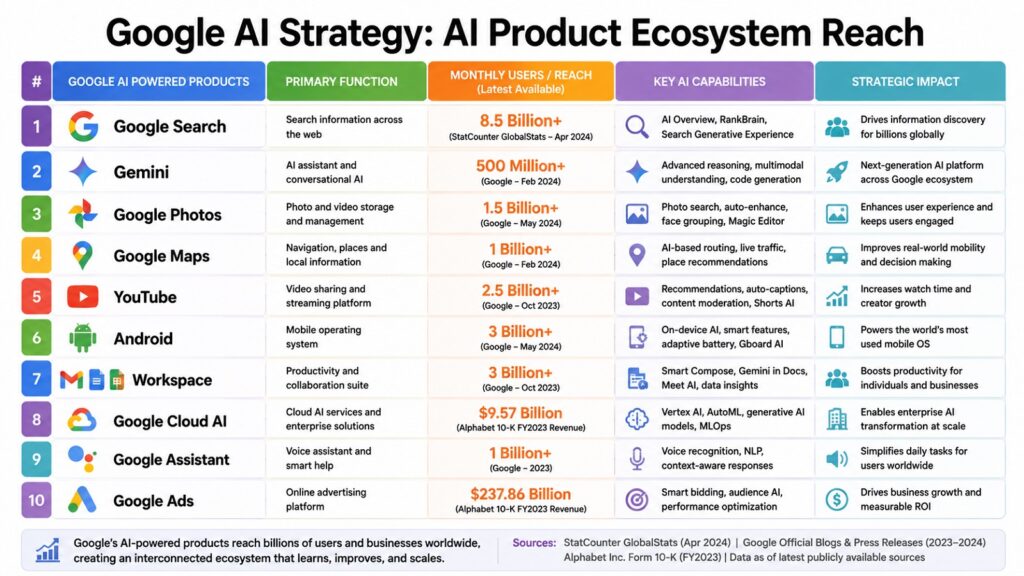
A lab win only becomes a real business gain once it reaches real users. Google’s strength lies in how often it carries AI work out of the lab and into tools that billions of people use each day. Search is the clearest case. Google’s AI Overviews tool, now built on the Gemini 3 model, gives quick answers right above normal search results and reaches more than two billion people each month across over two hundred countries. This one feature shows how fast Google can take a lab gain and push it across its biggest product.
The Gemini app itself grew from roughly three hundred fifty million monthly users to more than seven hundred fifty million in about eight months, while still trailing the most-used chatbot in raw count. What sets Google apart is its reach across many tools at once. Gemini models now run AI Overviews, a separate AI Mode search tool, Android’s Circle to Search feature on hundreds of millions of phones, and key Workspace tools like Gmail, Docs, and Sheets. Add it all up, and few rivals can match Google’s total audience.
Each use case solves a real problem rather than just showing off tech for its own sake. Google Photos uses machine learning to sort photos with no manual work. Maps uses AI to guess traffic and pick the best route. YouTube uses smart picks to keep its site useful despite the flood of new clips each minute. Workspace uses AI to draft emails and sum up long files. These are not stray tests. They form one linked system where user data sharpens the models, and sharper models pull in more users, a pattern often called a flywheel effect.
This pattern shows platform strategy at its clearest. Rather than treat AI as a lone new app, Google built it into a whole stable of tools that already held billions of users. Rivals that launched AI as a single fresh app, rather than weaving it into tools people already used, have mostly struggled to match this kind of free, built-in reach. The strategic lesson is that owning the path to users can matter as much as owning the tech itself.
Table 5: Google AI Strategy and Major Google AI Products and Their Business Impact
| Google AI Strategy: Product or Feature | Primary Business or Customer Impact |
| AI Overviews in Search | Reaches over two billion monthly users with quick answers |
| Gemini app | Passed seven hundred fifty million monthly active users |
| Circle to Search on Android | Puts AI on hundreds of millions of phones |
| Google Workspace AI tools | Boosts output across Gmail, Docs, and Sheets |
| Google Photos | Sorts and finds personal photos with no manual work |
| Google Maps | Improves routes through smarter traffic guesses |
| YouTube picks | Keeps users engaged despite a flood of new clips |
| Google Cloud AI services | Drives firm revenue and pulls in more developers |
5. Google AI Strategy Created a Sustainable Competitive Advantage
Credit: iken3
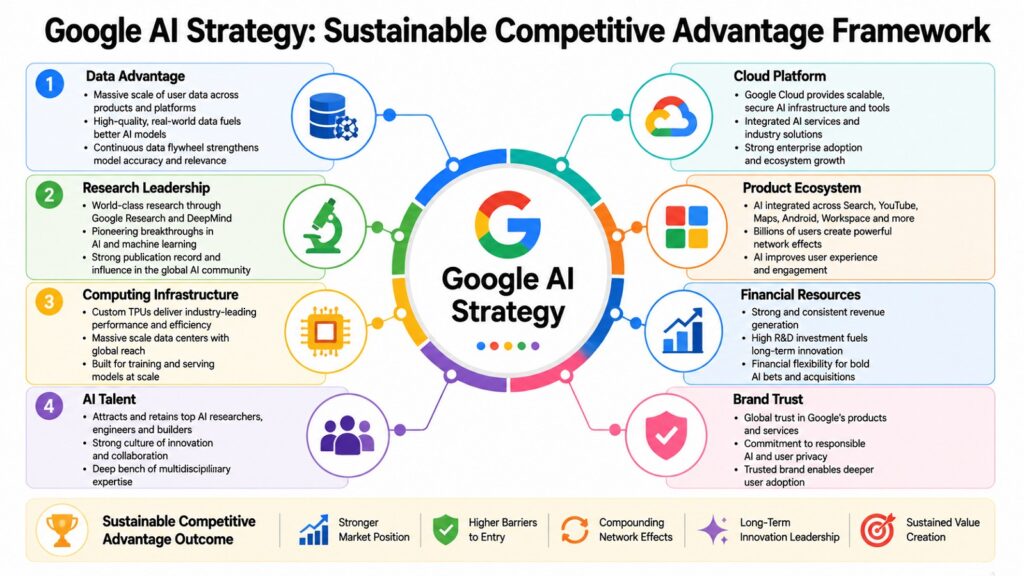
Many firms gain a short lead in tech, only to watch rivals catch up within a year or two. Google’s spot in AI has held far longer than that, and the reason why goes past any single product or model. The edge comes from several traits that feed each other, traits that are hard to copy alone, and close to impossible to copy as a group.
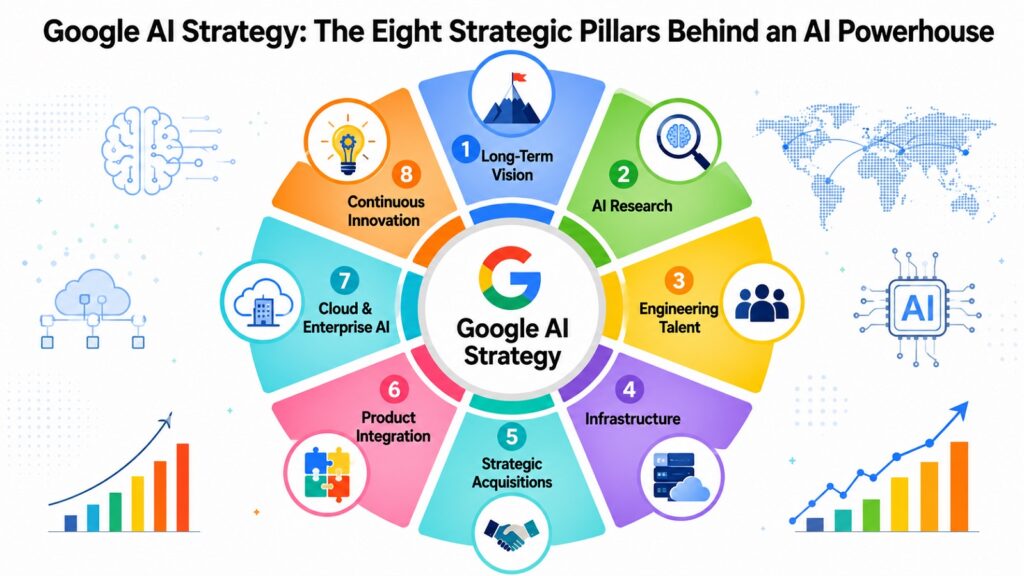
Look at the pieces at play. Google has research talent built up over more than a decade, much of it now housed inside Google DeepMind since its 2023 merger with Google Brain. It owns its own gear, including custom chips that took years to shape and refine. It controls the path to users through Search, Android, and Workspace, tools that already reach billions with no need for fresh ad spend. It has deep cash reserves that allow spending most rivals cannot match, plus data built up over decades of search clicks, map use, and video views.
Strategy models help explain why this mix holds up so well. The VRIO model asks if a trait is worth having, rare, hard to copy, and backed by the right team to use it. Google’s blend of data, talent, and gear scores high on each count. Moat thinking adds one more layer: switch costs, network gains, and scale all work in Google’s favor, since more users make more data, which sharpens models, which pulls in still more users and business clients.
None of this means Google’s lead will last forever. Rivals such as OpenAI, Anthropic, and Microsoft have made real strides, and the race for AI talent and computing power stays fierce across the whole field. What guards Google is not one single edge but how hard it is to copy the full system at once. A rival might match Google’s model quality in a given stretch, yet still lack the reach, the custom chips, or the decades of data that back Google at scale.
The wider lesson reaches well past tech. Lasting strength rarely comes from one smart move. It comes from several traits that feed each other, and as a group, they hold up far better than any one of them alone.
Table 6: Google AI Strategy: Google’s Principal Competitive Advantages in AI
| Google AI Strategy: Competitive Advantage | Strategic Value Provided |
| Deep research talent at Google DeepMind | Keeps a steady flow of new breakthroughs |
| Custom Tensor Processing Units | Cuts cost and trims reliance on outside firms |
| Massive existing user base | Gives built-in reach for new AI features |
| Decades of stored data | Sharpens models through constant feedback |
| Strong cash flow and balance sheet | Funds spending most rivals cannot match |
| Tightly linked product suite | Builds switch costs across Search and Cloud |
| Brand trust built over two decades | Eases uptake of new AI tools by users |
| Cloud AI business for firms | Adds revenue beyond plain ad sales |
6. Google AI Strategy Continues to Shape the Future of Artificial Intelligence
Credit: iken3
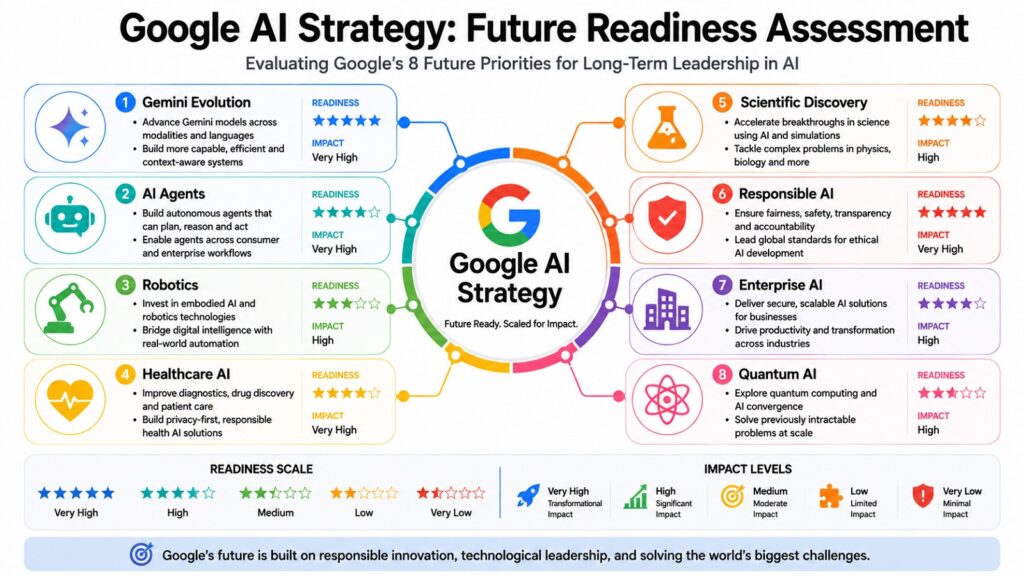
Google AI Strategy is not standing still, and its next phase looks quite unlike the search-first path that marked its first decade of machine learning work. Multimodal AI, where one model can handle text, images, sound, and video together, already sits at the core of the Gemini family. AI agents that can finish multi-step tasks with little human steering are now a major focus, which is part of why Google’s newest TPU line was built to support steady loops of thought and planning.
Scientific discovery has become one of the clearest proof points for Google’s long-term AI bet. AlphaFold, built inside Google DeepMind, cracked a fifty-year-old puzzle in biology by guessing how proteins fold into their shape. The feat earned a Nobel Prize in Chemistry in 2024 and has since been used by more than three million researchers across over one hundred ninety countries. This shows that Google’s AI plan reaches well past consumer apps and ad income into real gains for world science.
Health care, robotics, and cloud services for firms are other fields where Google is spending heavily, though results here stay less sure than in proven spots like Search. Safe and responsible AI use has also grown louder as a goal, partly in step with public worry about bias, false claims, and the speed of change. Google has kept on sharing safety research next to its product launches, a pattern that fits its long-held research style rather than a sudden change in path.
Staying on top going forward will take more than steady spending. The race for computing power, energy, and skilled staff has grown fierce across the whole field, and Alphabet itself has said that the tight supply of power and chips could slow its 2026 build-out plans. The lasting rule behind Google’s AI plan, no matter which tech wins out next, is its will to fund research years before its business worth becomes clear.
Table 7: Google AI Strategy: Future AI Priorities and Their Strategic Significance
| Google AI Strategy and Future Priorities | Strategic Significance |
| Multimodal AI models | Widens the range of tasks one model can handle |
| Autonomous AI agents | Pushes AI use into long, multi-step work |
| Tools like AlphaFold for science | Shows AI’s worth well past consumer apps |
| Health care AI uses | Opens up a huge, high-stakes new field |
| Robotics research | Links AI thought to tasks in the real world |
| Responsible AI rules | Builds public trust and cuts legal risk |
| Bigger cloud AI infrastructure | Backs growth among business clients |
| Steady capital spending | Signals lasting drive toward AI leadership |
Conclusion: Google AI Strategy and the Enduring Lessons of an AI Powerhouse
Credit: iken3
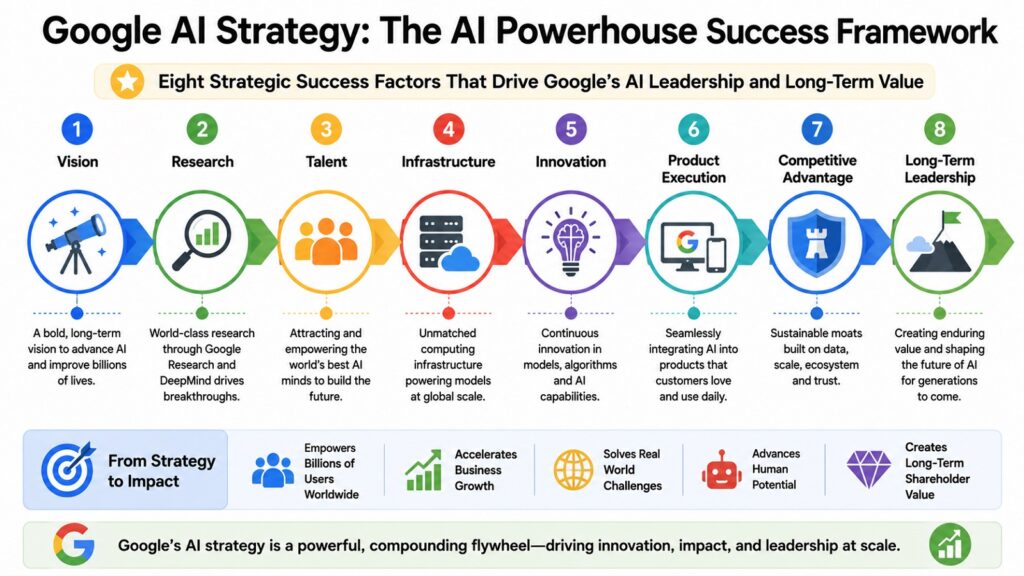
Google’s shift into an AI powerhouse cannot be boiled down to one breakthrough, one deal, or one product launch. It grew from the steady mix of several forces, working together for more than fifteen years: a long-term goal rooted in the firm’s founding mission, firm spending on research talent, a will to build costly gear years before its payoff was sure, and a steady habit of moving lab work into tools used by billions.
This piece has tried to look at that path through solid facts rather than guesses, while tying each choice back to the strategic thought behind it. The goal was never just to list what Google built. It was to show why those choices mattered, and why a firm that began as a search engine ended up shaping the path of a whole tech era. Readers should walk away with more than a timeline of Google’s AI work. They should grasp the strategic logic that turned single tech wins into one lasting, growing edge.
The real takeaway is not really about Google at all. It is about how lasting strength gets built in any group. It rarely comes from one clever move. It comes from years of steady work, a will to spend before gains show up, and the drive to keep tying research back to real tools that fix real problems. Readers in any field can use this same path, whether they lead a startup, run a research team, or just want to grasp how today’s biggest tech firms got to where they stand.
Table 8: Google AI Strategy: Eight Strategic Lessons from Google’s AI Journey
| Google AI Strategy: Strategic Lessons | Practical Takeaway |
| Tie AI spending to a clear long-term goal | Gives research a focus beyond short-lived trends |
| Fund talent and research before gains are sure | Builds an edge rivals cannot copy fast |
| Build core gear rather than rent it | Cuts reliance on outside suppliers |
| Link research right to real, live products | Speeds up real-world use at scale |
| Use built-in reach to launch new tech | Skips the cost of building an audience from zero |
| Mix many strengths, not just one | Builds an edge that is hard to fully copy |
| Stay willing to share and publish work | Draws talent and builds trust across the field |
| Treat safe AI use as part of the plan | Guards long-term trust and cuts legal risk |