Table of Contents
Introduction: Compute Governance and Its Growing Role in Modern Computing
Not long ago, computing resources were just part of the IT department’s maintenance checklist. Servers hummed in data centers. Administrators patched them, monitored them, and replaced them when they failed. Nobody called it governance. Nobody needed to.
That world is gone.
Currently, computing resources drive artificial intelligence models, cloud platforms, high-performance research settings, enterprise digital transformation initiatives, and innovative technologies that transform entire sectors. An inadequately managed GPU cluster not only hampers workload efficiency but also squanders millions of dollars, postpones AI implementations, exposes organizations to security risks, and generates regulatory liabilities. Computing has evolved into a strategic asset, and such assets necessitate strategic governance.
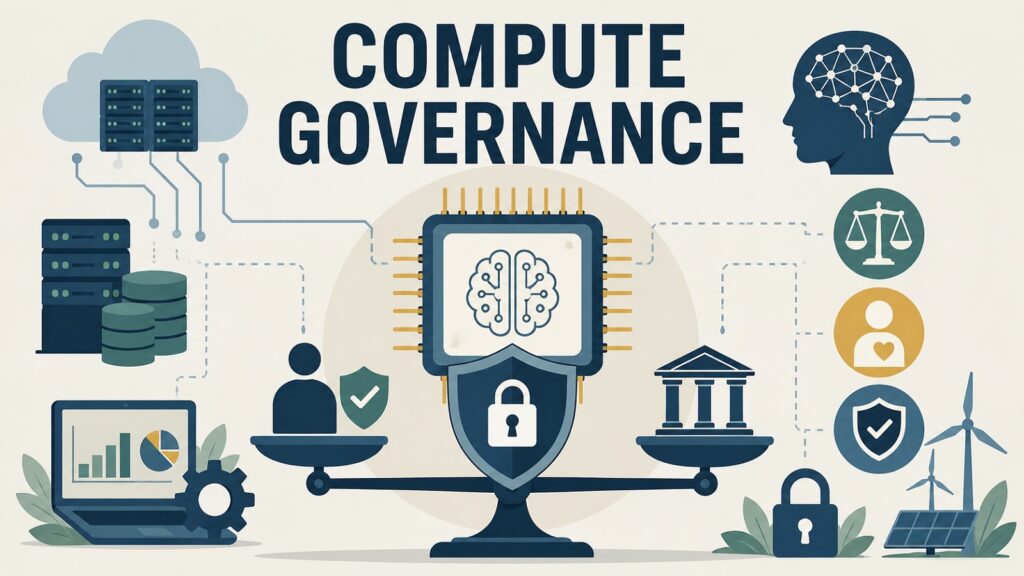
Compute Governance is the practice of establishing policies, controls, responsibilities, and oversight mechanisms that manage how computing resources are allocated, secured, monitored, optimized, and sustained across an organization. It sits at the intersection of technology, finance, ethics, law, and organizational accountability. It is not merely a technical discipline. It is a strategic one.
The connection to artificial intelligence is direct and urgent. Training a single large language model can require thousands of GPUs running continuously for weeks. The environmental impact is significant. The financial cost is enormous. The security implications are serious. If organizations allow AI workloads to run without proper governance, they risk decisions that are financially irresponsible, environmentally harmful, and ethically questionable. This is why Compute Governance is now recognized as an important dimension of the morality, ethics, and security aspects of artificial intelligence. Responsible AI demands responsible compute.
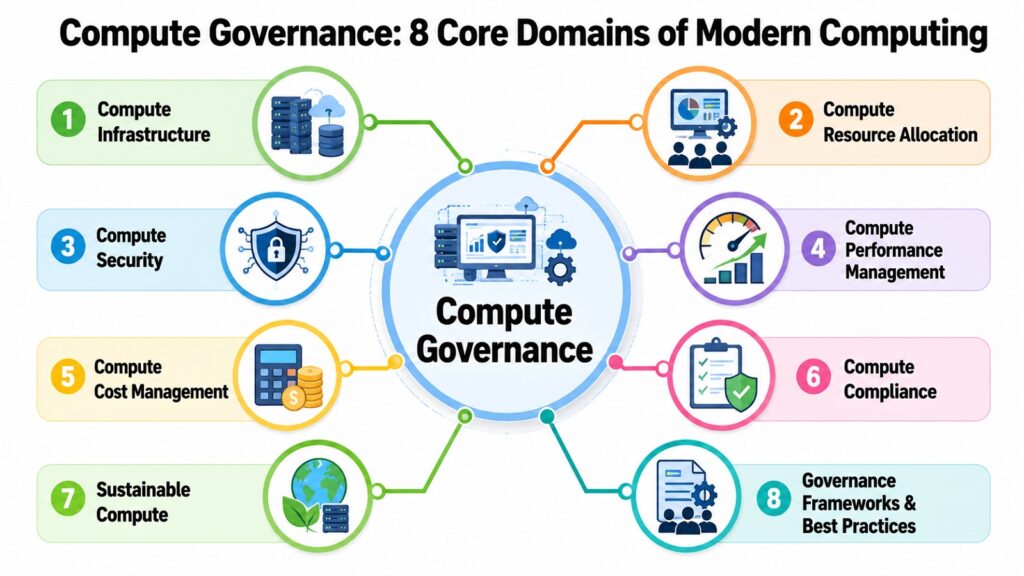
The eight concepts explored in this article build a complete picture of what mature Compute Governance looks like in practice. Each concept reinforces the others, creating a foundation that organizations can rely on as computing environments grow more complex and more consequential.
Table 1: Eight Aspects of Compute Governance at a Glance
| Aspects of Compute Governance | Role in Compute Governance |
| Compute Infrastructure | Forms the physical and virtual foundation for all governed computing resources |
| Resource Allocation | Ensures computing capacity is distributed intelligently across competing workloads |
| Compute Security | Protects infrastructure, data, and workloads from threats and unauthorized access |
| Performance Management | Monitors and optimizes computing resources to maintain efficiency and reliability |
| Cost Management | Controls financial expenditure on computing while preserving innovation capacity |
| Compliance | Aligns computing operations with regulatory requirements and organizational policies |
| Sustainable Compute | Reduces environmental impact and improves energy efficiency across infrastructure |
| Governance Frameworks | Provides the organizational structure and policies that unify all governance activities |
1. Compute Infrastructure: The Foundation of Compute Governance
Every governance framework must start with the infrastructure itself. Infrastructure is the physical and virtual substrate on which all computing activity depends. Without understanding what infrastructure exists and how it operates, no governance program can succeed.
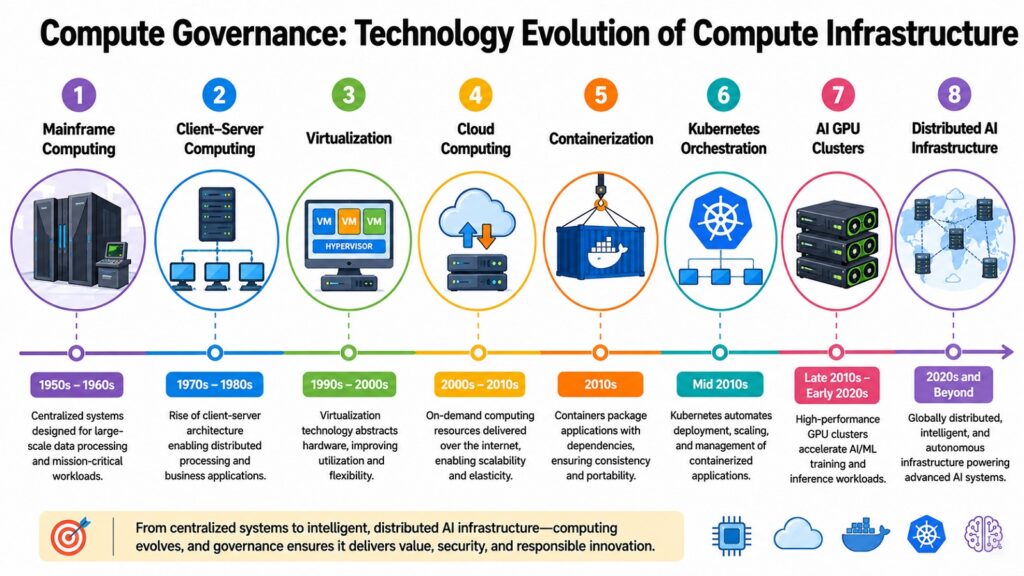
The evolution of compute infrastructure has been dramatic. Traditional organizations once relied on on-premises servers housed in corporate data centers. Today, organizations operate across hybrid environments combining on-premises hardware, public cloud services, private cloud platforms, edge computing nodes, GPU clusters for AI workloads, and high-performance computing systems. This diversity creates real governance challenges. Each infrastructure type has different performance characteristics, security requirements, cost structures, and compliance implications. A GPU cluster running AI training workloads requires different oversight than a web server handling customer transactions.
Research from the International Data Corporation indicates that global spending on computing infrastructure has grown substantially as organizations invest in AI-ready platforms. The adoption of AI accelerators, including graphics processing units and tensor processing units, has accelerated this investment. These specialized processors are expensive to procure, operate, and maintain, which means poor infrastructure governance translates directly into significant financial waste and missed operational targets.
A practical example comes from the financial services industry. Several major banks have migrated significant portions of their risk modeling workloads to hybrid cloud environments. The governance challenge they faced was establishing clear policies about which workloads could move to cloud environments and which had to remain on premises for security and compliance reasons. Infrastructure governance made that decision-making systematic rather than ad hoc, reducing both risk and cost.
Organizations need to know which infrastructure components are critical to operations, which are approaching end of life, and which are underutilized. They need policies defining how new infrastructure is procured, deployed, and eventually decommissioned. Without this foundation, every other dimension of Compute Governance becomes harder to execute and harder to justify to leadership.
Table 2: Compute Governance Infrastructure Components and Their Governance Purpose
| Infrastructure Component | Governance Purpose |
| On-premises servers | Provide direct control over sensitive workloads and regulatory data |
| Public cloud platforms | Enable scalable capacity with governance through cloud-native policy tools |
| GPU clusters | Support AI training workloads requiring specialized oversight and cost controls |
| Edge computing nodes | Extend compute governance to distributed environments near data sources |
| AI accelerators (TPUs) | Require utilization policies to justify high procurement and operating costs |
| High-performance computing | Governs shared scientific infrastructure through scheduling and access controls |
| Hybrid cloud environments | Demands consistent policy enforcement across on-premises and cloud boundaries |
| Data center networking | Governs bandwidth, latency, and connectivity that influence workload performance |
2. Compute Resource Allocation: Optimizing Compute Governance Through Intelligent Resource Management
Compute infrastructure without intelligent allocation is like a warehouse without an inventory system. Resources sit idle while other requests queue up. Critical workloads compete with lower-priority tasks. Costs rise without any corresponding improvement in output. Good allocation governance transforms this chaos into order.
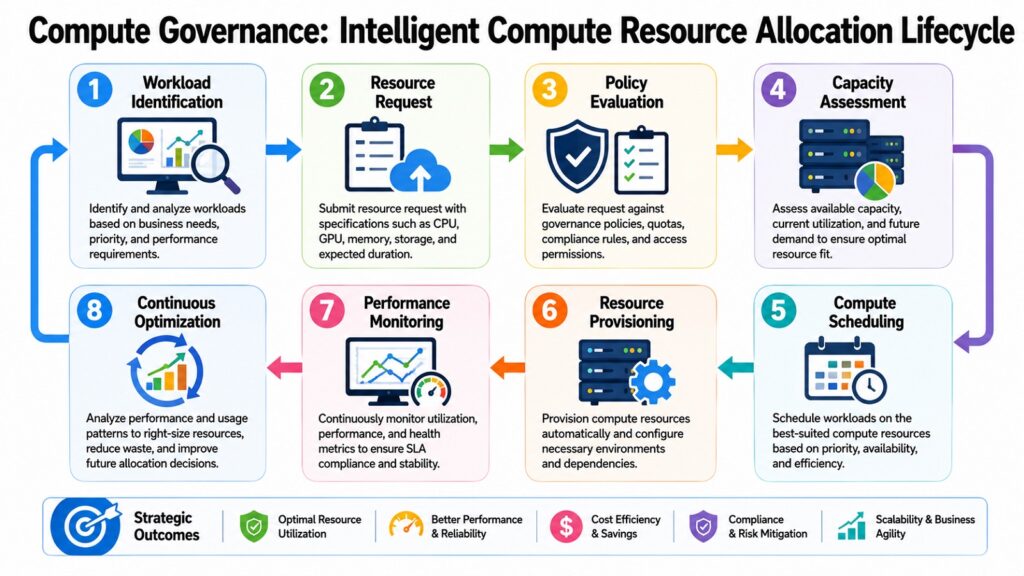
Resource allocation within Compute Governance refers to the policies, tools, and processes that determine how computing capacity is assigned to workloads across an organization. This covers scheduling, provisioning, autoscaling, and GPU allocation. GPU allocation has become one of the most contested resource governance challenges in organizations running AI systems, since training large models requires sustained access to significant GPU capacity for extended periods while inference workloads demand responsive, low-latency environments. These two requirements frequently conflict, and governance policies must navigate the tension.
Modern allocation governance relies heavily on containerization and orchestration. Kubernetes includes native support for resource quotas, reservations, and limits. Organizations can configure Kubernetes policies to ensure that high-priority workloads always have sufficient resources while preventing any single team from monopolizing shared infrastructure. This kind of policy-based allocation is a direct expression of Compute Governance in practice, making resource decisions consistent and auditable.
Universities and national laboratories that operate shared high-performance computing clusters have faced this challenge for decades. Many have adopted governance frameworks combining fair-share scheduling algorithms with formal quota systems. These frameworks allocate compute hours to research groups based on institutional priorities, then monitor actual usage to ensure fairness. The governance outcome is more equitable resource access and better overall utilization of expensive infrastructure.
Virtualization and containers give governance teams more granular control over how computing resources are divided, monitored, and reported. These tools make allocation policies enforceable at scale rather than aspirational on paper.
Table 3: Compute Governance Resource Allocation Practices and Their Governance Benefits
| Allocation Practice | Governance Benefit |
| Workload scheduling | Ensures compute resources align with business priorities and deadlines |
| Resource quotas | Prevents any team or application from consuming disproportionate capacity |
| Autoscaling policies | Matches resource consumption to actual demand, reducing waste |
| GPU reservation systems | Guarantees AI workload access while controlling GPU expenditure |
| Kubernetes namespaces | Enforces isolation and resource limits across shared cluster environments |
| Workload prioritization tiers | Aligns computing capacity allocation with business criticality |
| Capacity reservation agreements | Provides predictable compute access for time-sensitive workloads |
| Idle resource reclamation | Recovers underutilized capacity and reallocates it to active workloads |
3. Compute Security: Protecting Compute Governance Across Modern Infrastructure
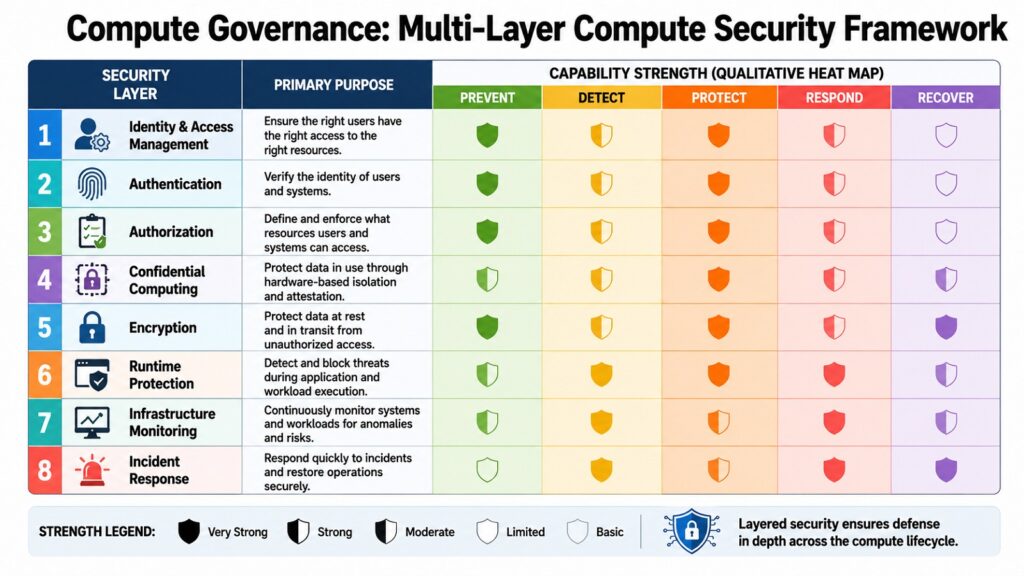
Security is not a peripheral concern in Compute Governance. It is a central responsibility. The computing resources that organizations govern today run critical AI systems, sensitive financial applications, healthcare workloads, and infrastructure that entire economies depend on. Protecting those resources is not optional, and it is not someone else’s problem.
The security dimension of Compute Governance encompasses identity and access management, Zero Trust Architecture, confidential computing, encryption, workload isolation, and infrastructure monitoring. Zero Trust, which assumes that no user or system should be trusted by default, has become an important model for securing modern compute environments where workloads span on-premises systems, cloud platforms, and edge devices. Every connection must be verified, every resource access must be authorized, and every action must be logged.
Confidential computing technologies such as Intel Trust Domain Extensions and AMD Secure Encrypted Virtualization allow sensitive workloads to run in hardware-protected trusted execution environments. These environments protect data even from the cloud provider’s own infrastructure, which matters enormously for organizations running regulated workloads in shared cloud environments. Encryption policies must cover data at rest, in transit, and increasingly in use, and governance must define acceptable standards and key management responsibilities.
Research from the Cloud Security Alliance has documented that misconfigurations in cloud computing environments represent one of the most common sources of security incidents affecting modern compute infrastructure. Without clear policies and continuous monitoring, organizations cannot detect or correct misconfigurations before they become serious vulnerabilities.
Several major health systems have implemented Zero Trust network architectures specifically to protect AI workloads that process patient imaging data. Governance policies define which users can access AI inference servers, how those connections are authenticated, and how access logs are reviewed for anomalies. Compute security governance is not theoretical. It protects real patients and real organizations.
Table 4: Compute Governance Security Controls and Their Governance Objectives
| Security Control | Governance Objective |
| Identity and access management | Ensures only authorized principals can interact with computing resources |
| Zero Trust Architecture | Eliminates implicit trust assumptions across distributed compute environments |
| Confidential computing | Protects sensitive workloads from infrastructure-level threats |
| Encryption at rest and in transit | Safeguards data processed and stored by compute resources |
| Workload isolation | Prevents security failures from propagating across shared infrastructure |
| Configuration management baselines | Reduces misconfiguration risk through standardized, auditable settings |
| Infrastructure monitoring and alerting | Enables rapid detection and response to security anomalies |
| Hardware security modules | Provides secure key storage and cryptographic operations for governed workloads |
4. Compute Performance Management: Measuring and Optimizing Compute Governance
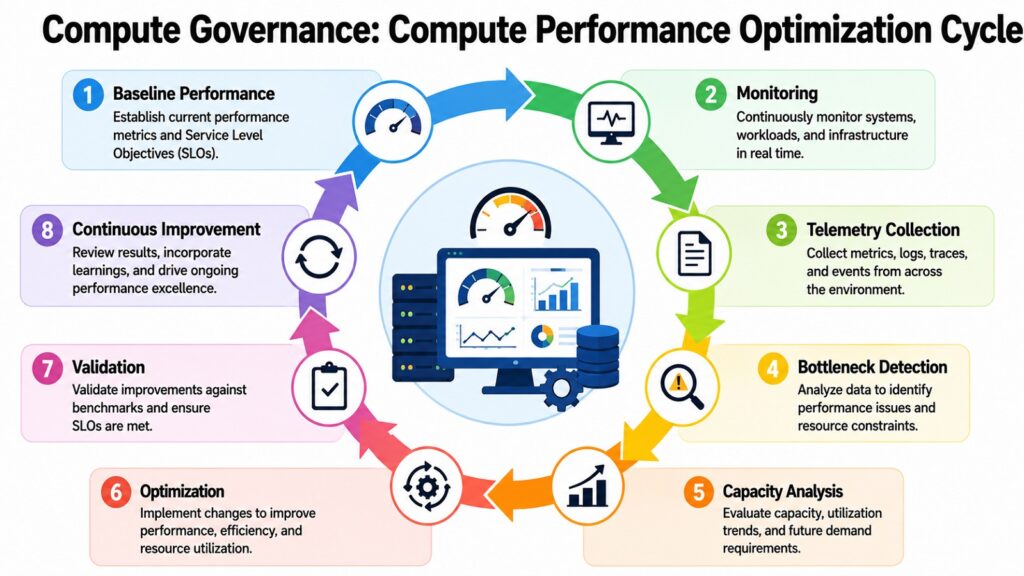
Governance without measurement is incomplete. Organizations that deploy compute infrastructure without systematic performance monitoring cannot tell whether their resources are being used efficiently, whether workloads are meeting service commitments, or whether infrastructure is approaching capacity limits that could cause failures.
Compute performance management means establishing the metrics, monitoring systems, and processes that give organizations visibility into how their computing resources are operating. This covers utilization, latency, throughput, and observability. Modern performance governance relies on telemetry pipelines that collect metrics, logs, and traces from computing infrastructure and aggregate them into monitoring platforms. Tools such as Prometheus and Grafana enable governance teams to set alert thresholds, track trends over time, and identify bottlenecks before they cause service disruptions.
AI workloads present distinctive performance governance challenges. GPU utilization for training jobs that underutilize GPU memory effectively wastes expensive capacity. Inference workloads require governance around latency targets to keep AI services responsive. Predictive maintenance approaches that use historical performance data to anticipate hardware failures before they occur are an increasingly important part of large-scale compute performance governance, reducing unplanned downtime.
Research published in association with major cloud providers indicates that a significant proportion of cloud compute instances run at low average utilization, often below thirty percent. Capacity planning processes that use historical utilization data to right-size compute allocations can significantly improve overall infrastructure efficiency and reduce unnecessary spending.
During peak shopping seasons, e-commerce platforms must handle dramatic spikes in compute demand. Organizations with robust performance monitoring and autoscaling governance respond to these spikes automatically. Those without such governance experience outages that result in measurable revenue losses. Performance governance is, in that sense, directly tied to business survival as much as operational efficiency.
Table 5: Compute Governance Performance Metrics and Their Role in Compute Governance
| Performance Metric | Governance Significance |
| CPU and GPU utilization | Reveals whether compute resources are being used efficiently or wasted |
| Request latency | Measures responsiveness and validates service level commitments |
| System throughput | Indicates how much productive work the infrastructure completes over time |
| Error rates | Identifies reliability problems that require governance intervention |
| Memory utilization | Prevents resource saturation that leads to performance degradation |
| Network bandwidth consumption | Ensures connectivity resources support workload communication requirements |
| Storage I/O performance | Governs the data access patterns that influence application responsiveness |
| Capacity utilization trends | Informs forecasting and planning decisions before resources become constrained |
5. Compute Cost Management: Improving Compute Governance Through Financial Efficiency
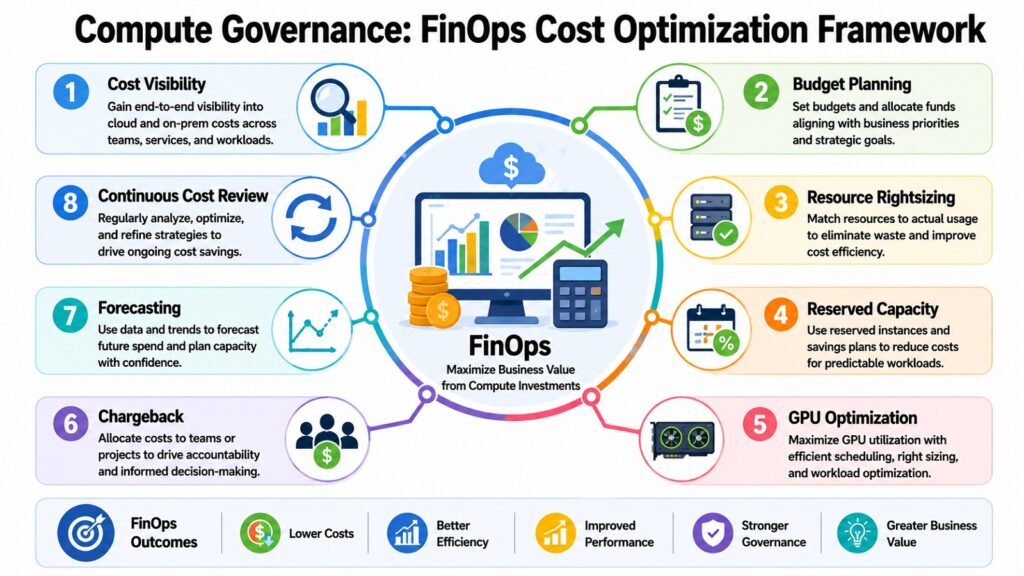
The financial dimension of Compute Governance has grown dramatically as organizations increase investment in AI infrastructure and cloud computing. Compute spending is no longer a predictable IT budget line item. It has become a dynamic, fast-moving cost category that can expand rapidly when governance controls are absent or poorly enforced.
FinOps, which applies financial operations principles to cloud computing, has emerged as a practical discipline within compute cost management. FinOps emphasizes shared responsibility for cloud costs across engineering, finance, and business teams. The goal is visibility into spending, accountability for cost outcomes, and a culture where financial efficiency and technical capability are pursued together rather than treated as opposing priorities.
Chargeback systems allocate actual compute costs to the business units or teams that incur them. Showback systems provide similar visibility without directly charging teams, which can be a useful starting point for organizations building financial awareness around compute consumption for the first time. GPU costs represent a particular governance challenge: high-performance GPUs can cost hundreds of dollars per hour to rent from cloud providers, and AI teams that occupy reservations long after job completion create significant avoidable waste.
Research from Gartner and similar analysts has consistently found that organizations waste twenty to thirty percent of their cloud computing spending on idle or underutilized resources. Better Compute Governance through cost management practices directly addresses this problem and represents one of the clearest returns on governance investment.
Some technology companies have adopted internal compute pricing models, establishing a notional price for compute resources and charging teams against it. This creates incentives for engineering teams to write more efficient code, shut down idle environments, and size workloads appropriately.
Table 6: Compute Governance Cost Management Practices and Their Governance Value
| Cost Management Practice | Governance Value |
| FinOps principles | Creates shared accountability for computing costs across business and technology teams |
| Chargeback systems | Allocates actual compute costs to responsible teams, driving financial awareness |
| GPU utilization monitoring | Identifies expensive idle capacity and triggers reclamation to reduce waste |
| Reserved capacity purchasing | Reduces per-unit compute costs through long-term commitment governance |
| Workload rightsizing | Aligns compute allocation with actual workload requirements to eliminate overprovisioning |
| Spot or preemptible instance governance | Reduces costs for fault-tolerant workloads through lower-cost capacity options |
| License lifecycle management | Prevents unnecessary software licensing costs on unused compute resources |
| Budget alerting and forecasting | Provides early warning of spending anomalies before they escalate |
6. Compute Compliance: Strengthening Compute Governance Through Policies and Regulations
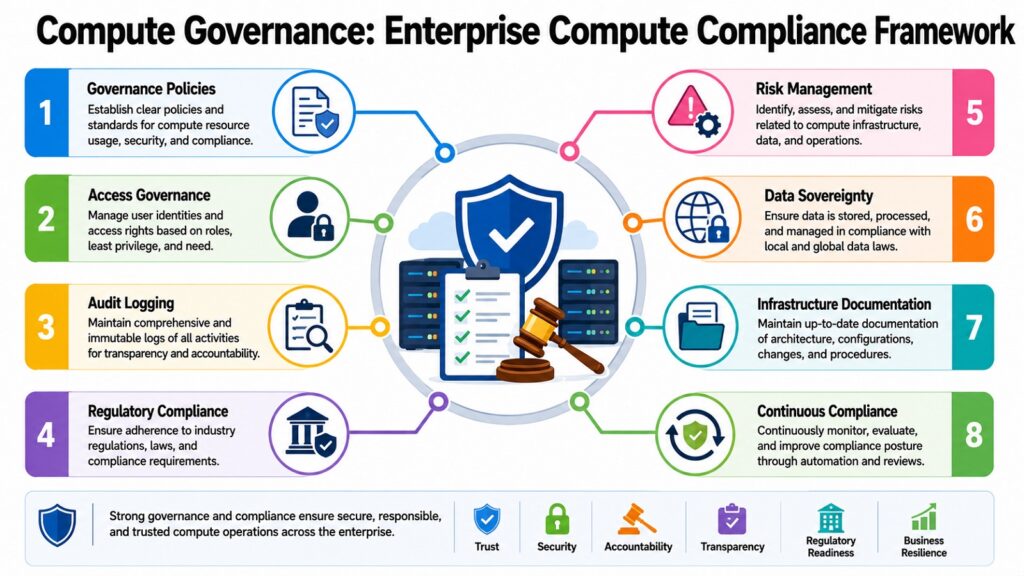
Compliance is the dimension of Compute Governance that connects computing operations to the legal, regulatory, and organizational frameworks that organizations must satisfy. It is sometimes treated as a burden, as a collection of checkboxes that the legal and audit teams care about but that engineers would rather ignore. That view misunderstands what compliance actually delivers for an organization.
Compute compliance means ensuring that policies governing how computing resources are used, configured, monitored, and documented align with applicable regulations, contractual requirements, and organizational standards. Healthcare organizations must comply with rules around systems that process patient data. Financial institutions must satisfy regulations governing computing environments running trading and payment systems. Government agencies face strict requirements about where data is stored, how systems are hardened, and who has access to compute resources. For all of them, compliance is not optional.
Audit trails are particularly important within compliance governance. When policies require that all changes to compute configurations be logged with timestamps and actor identities, organizations gain the ability to reconstruct what happened during incidents, demonstrate compliance with security standards, and identify patterns of policy violation. Cloud-native tools such as AWS CloudTrail, Azure Monitor, and Google Cloud Audit Logs provide the technical infrastructure for this kind of governance logging.
The European Union’s AI Act, which began entering into force in 2024, establishes requirements that extend into the infrastructure layer for high-risk AI systems. This means compute compliance increasingly intersects with AI governance, extending well beyond traditional data protection and system availability concerns.
Major banks operating in multiple jurisdictions must demonstrate to regulators in each country that their computing environments meet local data residency requirements. This means governing where compute workloads actually run, not just where data is nominally stored. Building and maintaining that governance capability requires systematic compliance management and continuous documentation.
Table 7: Compute Governance Policies and Compliance Areas in Compute Governance
| Compliance Area | Purpose in Compute Governance |
| Data residency policies | Ensures compute workloads run in jurisdictions required by regulation or contract |
| Configuration baseline audits | Validates that compute systems meet documented security and compliance standards |
| Access control documentation | Demonstrates that resource access is governed by defined and audited policies |
| Change management logging | Provides an auditable record of all modifications to compute infrastructure |
| Regulatory mapping | Connects specific compute governance controls to applicable legal requirements |
| Risk assessment processes | Identifies compliance vulnerabilities in compute environments before audits occur |
| Third-party audit readiness | Maintains compute governance documentation in a state suitable for external review |
| AI Act infrastructure alignment | Ensures high-risk AI system compute environments satisfy emerging regulatory demands |
7. Sustainable Compute: Advancing Compute Governance Through Environmental Responsibility
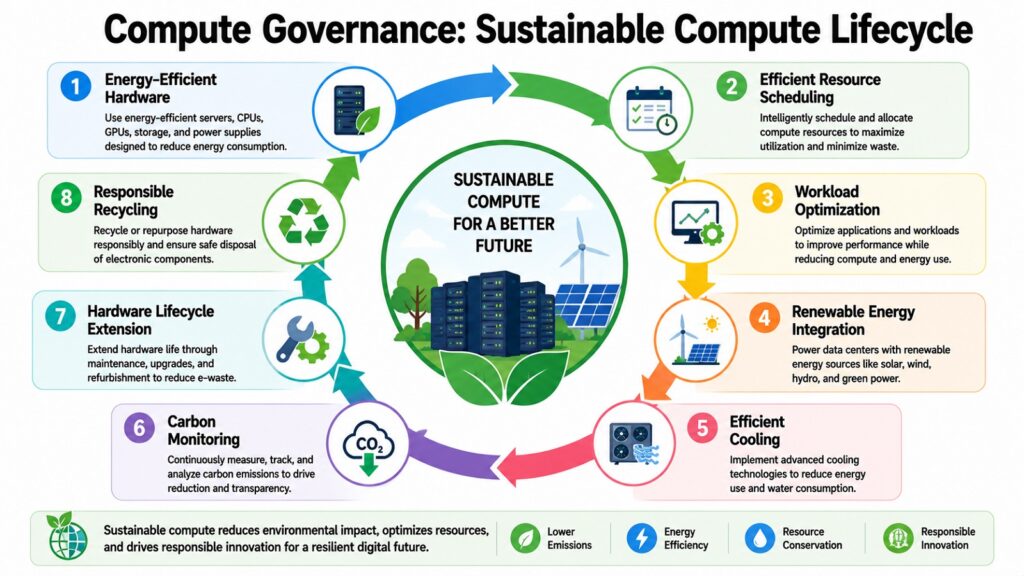
There is a growing recognition that computing has an environmental footprint that matters. Data centers consume enormous amounts of electricity. AI training workloads are among the most energy-intensive computing tasks ever created. Cooling systems use water in quantities that are difficult to ignore. As organizations invest more heavily in AI and cloud computing, the environmental implications of those investments have become a Compute Governance concern in their own right.
Sustainable Compute refers to the practices, policies, and technologies that reduce the environmental impact of computing infrastructure. The decisions that determine how much energy computing consumes, where that energy comes from, and what happens to hardware at end of life are governance decisions. They involve trade-offs between performance, cost, and environmental responsibility that leadership must consciously navigate rather than ignore.
Power-aware scheduling is a particularly interesting area within sustainable compute governance. By shifting certain workloads to times or locations where renewable energy is available, organizations can reduce the carbon intensity of their compute operations without sacrificing capability. Research from the International Energy Agency has found that data centers account for roughly one to two percent of global electricity consumption, and this figure continues to grow as AI adoption accelerates.
Circular economy approaches to hardware lifecycle management are another important sustainability governance practice. Rather than disposing of compute hardware after a few years, organizations can extend hardware lifetimes through refurbishment, resale, and component recovery programs. This approach reduces both the environmental impact of hardware manufacturing and the financial cost of infrastructure refreshes.
Microsoft has pursued agreements to match its data center energy consumption with renewable sources on an hourly basis in some markets. The governance mechanisms required to deliver on these commitments extend deeply into compute infrastructure planning, procurement, and operations, demonstrating that sustainability governance is operational discipline, not just public aspiration.
Table 8: Compute Governance Sustainability Practices and Their Contribution to Compute Governance
| Sustainability Practice | Contribution to Compute Governance |
| Renewable energy procurement | Reduces carbon footprint of compute operations through policy-driven sourcing |
| Power-aware workload scheduling | Shifts intensive workloads to periods of high renewable energy availability |
| Energy-efficient processor selection | Governs hardware procurement decisions to favor lower power consumption |
| Optimized cooling infrastructure | Reduces water and electricity use in compute-dense facility environments |
| Hardware lifetime extension | Limits electronic waste through refurbishment and responsible lifecycle policies |
| Carbon accounting integration | Incorporates emissions tracking into compute governance reporting frameworks |
| Idle resource shutdown policies | Eliminates unnecessary energy consumption from underutilized compute assets |
| Sustainability reporting requirements | Provides stakeholders with transparent data on compute environmental performance |
8. Compute Governance Frameworks & Best Practices: Building Responsible and Scalable Compute Governance
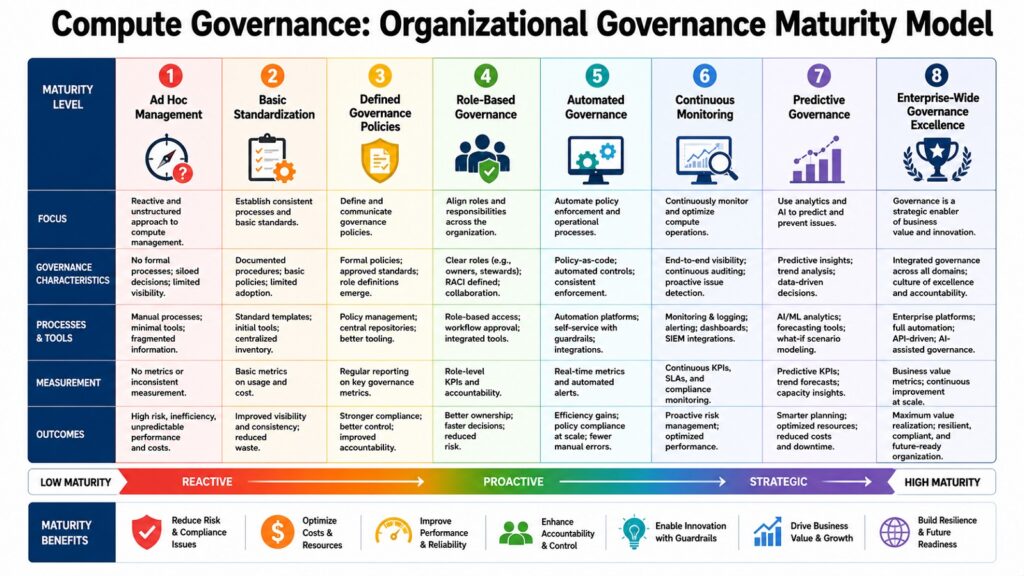
The seven concepts explored in the preceding sections are individually meaningful, but they reach their full potential only when they operate within a coherent organizational framework. Compute Governance frameworks provide the structure that connects infrastructure decisions, resource allocation policies, security controls, performance standards, financial discipline, compliance requirements, and sustainability practices into a unified approach that an organization can execute and sustain over time.
A governance framework is not a single document or software platform. It begins with clearly defined policies that establish expectations for how computing resources will be managed, who is responsible for decisions, and what standards apply across different infrastructure types and workload categories. Clear policies are what separate organizations that govern deliberately from those that rely on informal practices that erode under pressure.
Governance committees bring together representatives from technology, finance, legal, and business functions to review governance performance, make decisions about competing priorities, and ensure that compute governance keeps pace with the organization’s evolving needs. Without this kind of cross-functional oversight, compute governance tends to drift, becoming a collection of technical practices that nobody owns strategically.
Automation has become central to scalable Compute Governance. As computing environments grow more complex, manual governance processes cannot keep up. Organizations increasingly use infrastructure-as-code (IaC) approaches, policy-as-code frameworks like Open Policy Agent, and automated compliance checking tools to enforce governance standards continuously rather than through periodic audits that miss the intervals between reviews.
Research from governance and technology advisory firms consistently shows that organizations with mature governance frameworks spend less on compute waste, experience fewer security incidents, satisfy regulators more efficiently, and scale their computing environments more confidently because governance practices provide a reliable foundation for growth.
Large technology platforms have developed internal governance maturity models that rate teams and computing environments on dimensions like security posture, cost efficiency, compliance documentation, and sustainability performance. Making governance maturity visible and comparable across the organization creates constructive pressure that drives continuous improvement. Continuous improvement is the defining characteristic of mature Compute Governance. The goal is a framework that improves steadily and remains genuinely useful.
Table 9: Compute Governance Best Practices and Their Organizational Benefits
| Governance Best Practice | Organizational Benefit |
| Formal governance policies | Establishes clear expectations and accountability for compute resource management |
| Cross-functional governance committees | Ensures compute decisions reflect technology, financial, legal, and business perspectives |
| Infrastructure-as-code adoption | Makes compute configuration auditable, repeatable, and governed through version control |
| Policy-as-code frameworks | Enables automated, continuous enforcement of governance rules at scale |
| Governance maturity assessment | Measures and communicates governance progress to drive organizational improvement |
| Stakeholder reporting mechanisms | Provides visibility into compute governance performance across leadership audiences |
| Continuous improvement processes | Keeps governance frameworks relevant as technology and regulatory requirements evolve |
| Governance training programs | Builds organizational capability to implement and sustain compute governance practices |
Conclusion: The Future of Compute Governance in the AI-Driven World
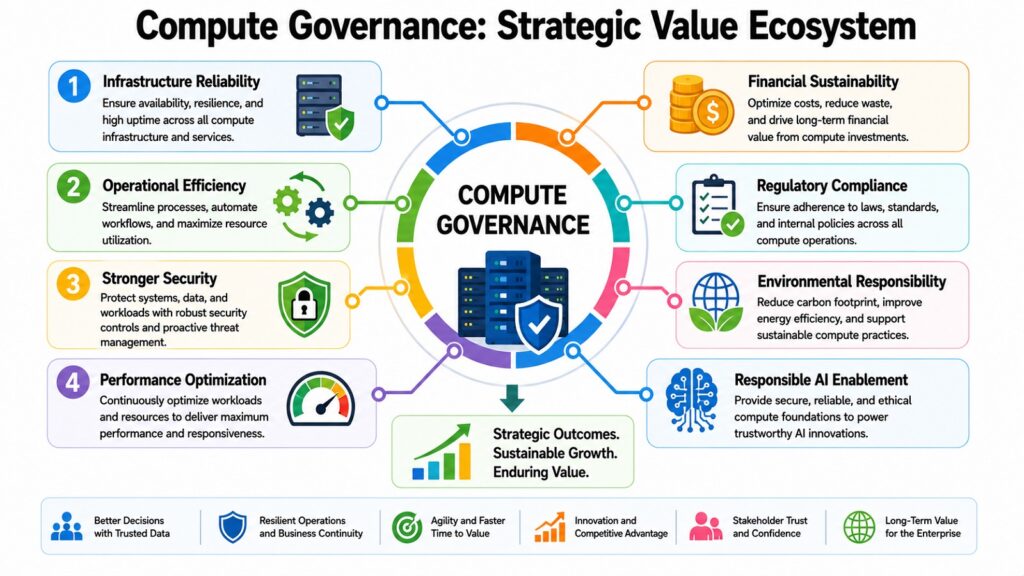
Compute Governance has traveled a long way from its origins in basic IT asset management. It has become a strategic discipline that shapes how organizations deploy artificial intelligence, manage cloud infrastructure, protect sensitive workloads, satisfy regulators, control costs, and meet environmental commitments. That transformation is not finished. It is still accelerating.
The eight concepts explored in this article represent the core dimensions of what mature Compute Governance looks like today. Infrastructure provides the foundation. Allocation policies ensure resources reach the right workloads. Security controls protect what has been built. Performance management keeps it running efficiently. Cost governance keeps spending rational. Compliance connects operations to regulatory reality. Sustainability policies address the environmental consequences of computing at scale. And governance frameworks pull all of this together into something an organization can actually operate day to day.
Looking ahead, AI systems will grow more powerful and more demanding of compute resources. Cloud infrastructure will become more complex as multi-cloud and edge architectures mature. Regulatory attention to AI and computing infrastructure will continue to expand. Environmental expectations from investors, regulators, and the public will remain significant forces. Organizations that invest in building strong Compute Governance capabilities now will be better positioned to navigate all of these pressures without losing momentum.
The organizations that treat Compute Governance as a genuine strategic priority, rather than as a compliance exercise or a cost-cutting program, will be the ones that use computing as a lasting source of competitive advantage. That is what governance, done well, actually delivers.
Table 10: Eight Compute Governance Concepts and Their Primary Takeaways
| Compute Governance Concepts | Primary Takeaway |
| Compute Infrastructure | Governing diverse infrastructure types is the starting point for all other governance activities |
| Resource Allocation | Intelligent allocation policies transform compute from a shared resource into a strategic asset |
| Compute Security | Protecting compute infrastructure requires layered controls and a Zero Trust mindset |
| Performance Management | Continuous measurement is the only way to know whether governance is actually working |
| Cost Management | Financial discipline in compute governance prevents significant and often invisible waste |
| Compliance | Compute compliance connects technical operations to regulatory and ethical standards organizations must meet |
| Sustainable Compute | Environmental responsibility is now a mainstream governance obligation, not an optional aspiration |
| Governance Frameworks | Mature frameworks integrate all governance dimensions into a unified, continuously improving capability |