Table of Contents
Introduction: Audio Technology and the Devices Shaping Modern Sound
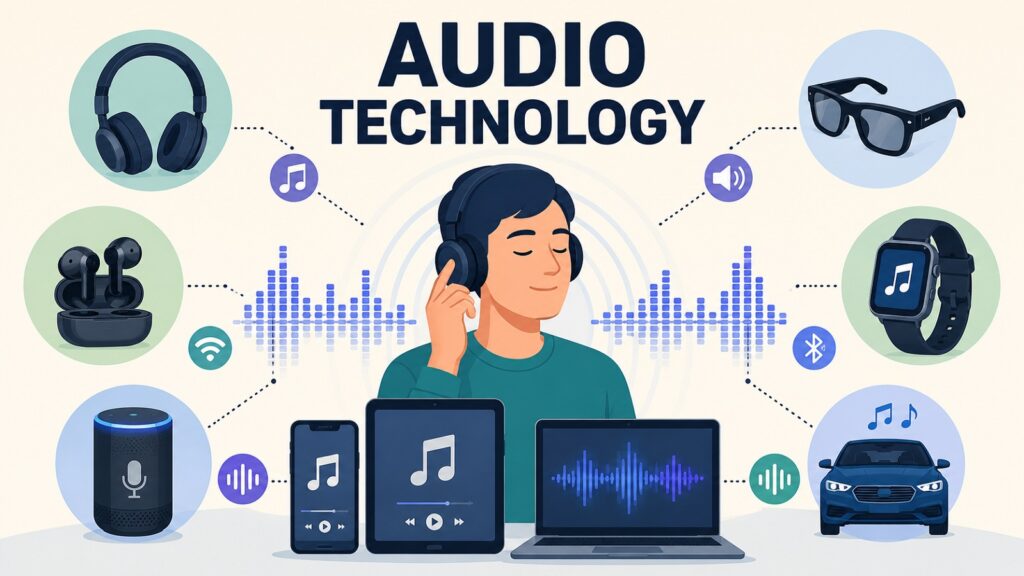
Sound has always been central to the human experience, but the tools we use to capture, transmit, and enjoy it have changed enormously. Audio Technology now stands as one of the most important categories within Personal Tech Devices, touching nearly every part of modern daily life. From the moment a morning alarm sounds to the last podcast episode heard before sleep, audio systems shape how people communicate, learn, relax, and move through the world.
Modern life depends on audio technologies in ways that often go unnoticed. In entertainment, streaming services deliver high-fidelity music and cinematic sound to devices of every size. In communication, clear microphones and speakers allow remote teams to collaborate effectively across time zones. For accessibility, hearing aids and assistive audio systems give millions of people the ability to participate more fully in conversations and public spaces. Even in transportation, in-vehicle audio systems have evolved from simple radio receivers into sophisticated platforms for navigation, streaming, and hands-free calling.
The journey from early audio reproduction to today’s digital sound ecosystems spans more than a century. The first practical phonographs appeared in the late nineteenth century. Magnetic tape recording, transistor radios, compact discs, and digital audio players followed across the decades. Each generation brought improvements in fidelity, portability, and convenience. Today, wireless connectivity, miniaturized components, artificial intelligence, and advanced signal processing drive a new era of audio innovation. Bluetooth technology allows earbuds to connect instantly across rooms. AI-powered noise cancellation removes distracting sounds in real time. Voice assistants embedded in speakers respond to spoken commands without any physical touch.
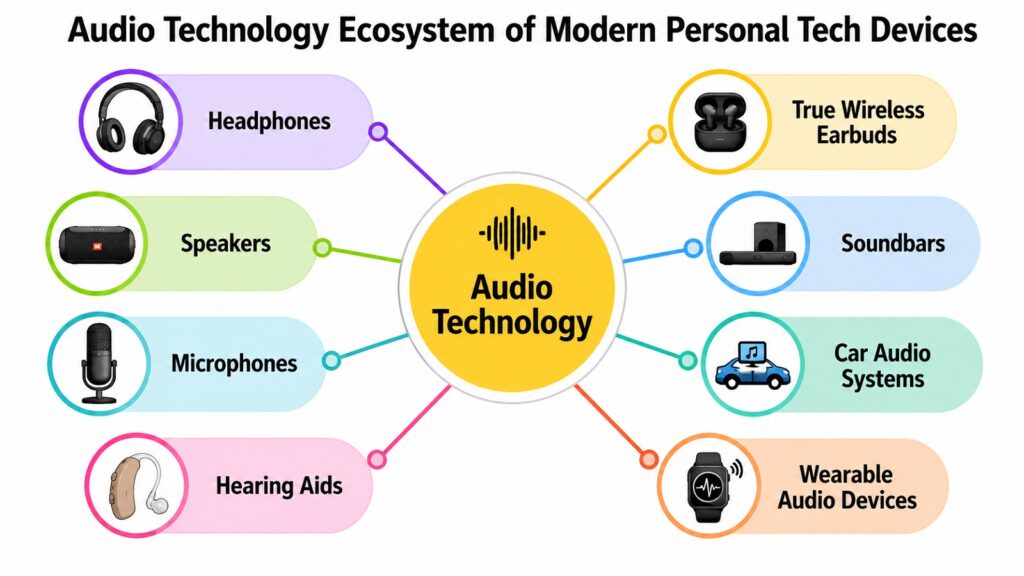
The eight audio technologies discussed in this article represent the most influential innovations shaping modern sound experiences. Headphones and earbuds define personal listening in an age of mobility. Speakers and soundbars bring communal audio into homes and shared spaces. Microphones empower creators, professionals, and everyday communicators. Hearing aids extend audio access to those who need it most. Car audio systems transform commutes and road trips. Wearable audio devices hint at a future where sound is integrated seamlessly into daily movement. Each technology reflects a distinct set of needs, but all share a common foundation in the broader progress of Audio Technology.
Audio Technology: Eight Innovations Shaping Modern Sound
| Technology | Primary Role or Contribution |
| Headphones | Private, high-fidelity listening with noise isolation |
| True Wireless Earbuds | Completely wireless portable audio for daily mobility |
| Speakers | Shared audio experiences in homes and public spaces |
| Soundbars | Enhanced TV and home entertainment audio performance |
| Microphones | Sound capture for communication and content creation |
| Hearing Aids | Accessible audio for individuals with hearing loss |
| Car Audio Systems | In-vehicle sound, navigation, and communication |
| Wearable Audio Devices | Emerging formats blending audio with physical awareness |
1. Audio Technology Through Headphones: Private Listening and Immersive Sound
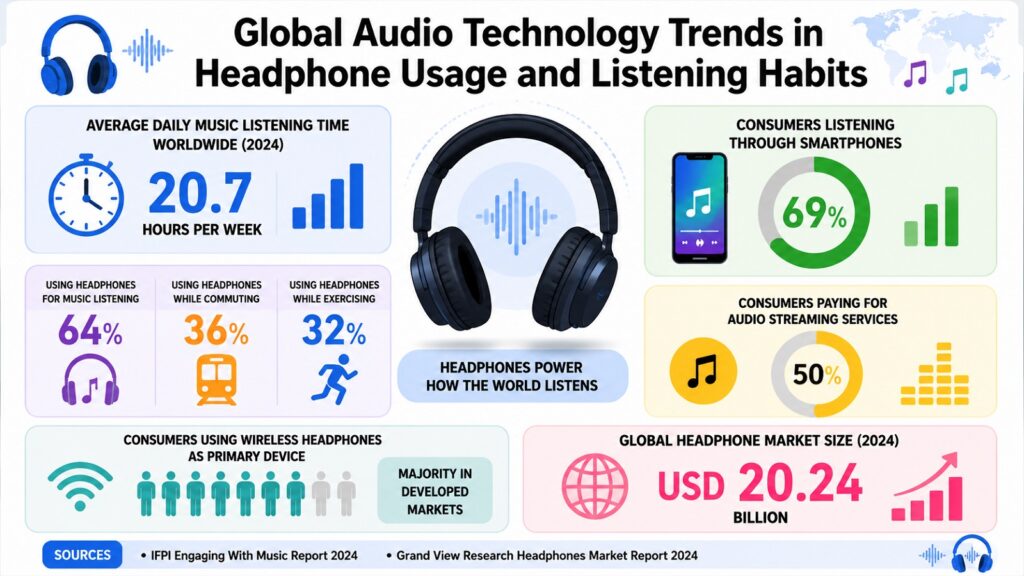
Headphones became one of the most transformative expressions of Audio Technology in the twentieth century, and they continue to evolve at a rapid pace. What began as large, heavy devices tethered to radio equipment or stereo systems is now a category defined by lightweight designs, wireless freedom, and audio processing capabilities that were unimaginable just two decades ago.
The shift to wireless listening reshaped the entire personal audio market. Bluetooth headphones removed the physical constraint of cables, giving users freedom to move during workouts, commutes, and work sessions. Battery technology improved alongside wireless standards, extending playback times from a few hours to more than thirty hours on a single charge for many premium models. Driver technology advanced as well, with manufacturers refining how sound is converted from electrical signals into audible frequencies. Planar magnetic drivers, once found only in high-end audiophile equipment, started appearing in mid-range headphones, delivering flatter frequency responses across the audio spectrum.
Active noise cancellation, or ANC, became perhaps the most significant headphone innovation of the early twenty-first century. The technology works by using microphones to detect ambient sounds and then generating an opposing audio signal to cancel them out before they reach the ear. Originally developed for aviation and military applications, ANC found its way into consumer headphones and changed how people listen in noisy environments like aircraft cabins, busy offices, and crowded transit systems. Research suggests that noise exposure in urban environments has measurable effects on concentration and stress, and ANC headphones provide a practical solution for people who need to focus or simply want uninterrupted sound.
Headphone applications have expanded well beyond music. Gamers rely on headsets with spatial audio processing to identify directional sounds that influence gameplay decisions. Remote workers depend on headphones with built-in microphones for video calls and virtual meetings. Students use them for language learning and online courses where audio clarity affects comprehension. Travelers use them as a buffer against the noise fatigue that long journeys create. The future of headphone Audio Technology includes deeper AI personalization, adaptive equalization that adjusts to individual hearing profiles, and tighter integration with spatial audio standards.
Audio Technology in Headphones: Key Innovations and Their Significance
| Innovation or Feature | Practical Significance |
| Bluetooth wireless connectivity | Eliminates cables, enabling free movement during use |
| Active noise cancellation (ANC) | Blocks ambient sound for focused listening in noisy settings |
| Planar magnetic drivers | Delivers flat, accurate frequency response across audio range |
| Over-ear cushion design | Improves passive noise isolation and listening comfort |
| 30-hour battery life | Supports full-day or multi-day use without recharging |
| Spatial audio processing | Creates directional soundscapes for gaming and immersive media |
| AI-driven sound personalization | Adapts audio output to individual hearing profiles |
| Built-in microphone arrays | Enables clear voice communication in remote work environments |
2. Audio Technology Through True Wireless Earbuds: Compact Sound Innovation
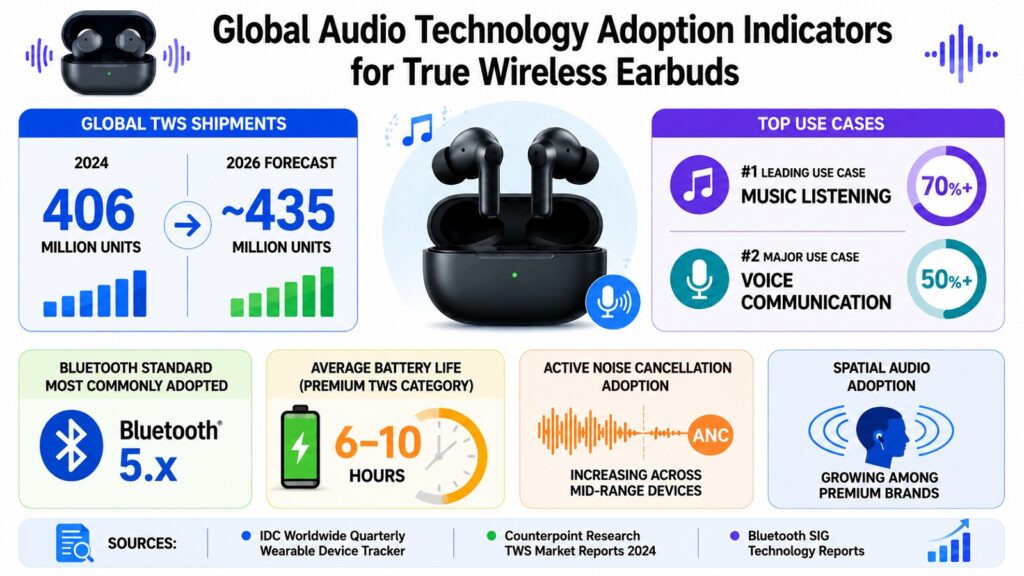
True wireless earbuds arrived as one of the most dramatic shifts in consumer Audio Technology within recent memory. The removal of every cable, including the short wire that previously connected left and right earpieces, required solving several difficult engineering problems at once. Bluetooth chips had to become small enough to fit inside a housing no larger than a pea. Batteries needed enough capacity for hours of listening while taking up minimal space. Audio codecs required optimization so that sound quality remained acceptable over wireless transmission with minimal delay.
The release of widely adopted earbuds from major technology companies in the mid-2010s validated the market and accelerated competition. Other manufacturers responded with devices at various price points, making truly wireless listening accessible across a much wider range of consumers. The introduction of charging cases changed how people related to battery anxiety. A compact case that both stores and recharges earbuds between uses effectively multiplied battery life, allowing users to recharge on the go without plugging into a wall outlet. Some models now offer combined case and earbud listening times exceeding thirty hours.
Transparency modes, where external sound is fed through the earbuds to the listener, made true wireless devices safer for outdoor use by allowing people to remain aware of traffic and other environmental sounds. This feature reflects an important design tension in personal Audio Technology: the desire for immersive listening versus the need for situational awareness. Manufacturers addressed this tension by giving users software controls to blend between full noise cancellation, transparency, and unamplified listening depending on context.
Health and wellness features have also entered the earbud category. Some devices now include heart rate monitoring, step counting, and integration with fitness platforms. Others track in-ear temperature or detect when the user has removed them, pausing playback automatically. The boundaries between audio devices and general wearables are becoming less clear. Future earbud developments may include real-time language translation, hearing enhancement modes for people with mild hearing difficulties, and contextually adaptive audio that changes based on location or activity.
Audio Technology in True Wireless Earbuds: Features and Their Value
| Feature or Milestone | Practical Value |
| Fully wire-free design | Maximum freedom of movement for active and daily use |
| Charging case with integrated battery | Extends total listening time without wall charging |
| Transparency mode | Allows environmental sound awareness during outdoor use |
| Miniaturized Bluetooth chips | Enables high-quality wireless audio in very small housings |
| Touch and gesture controls | Allows media and call management without handling a phone |
| Active noise cancellation | Brings studio-like focus to compact earbud formats |
| Fitness tracking integration | Combines audio with health data monitoring during exercise |
| Auto-pause on removal | Improves battery efficiency and user convenience automatically |
3. Audio Technology Through Speakers: Bringing Sound to Shared Spaces
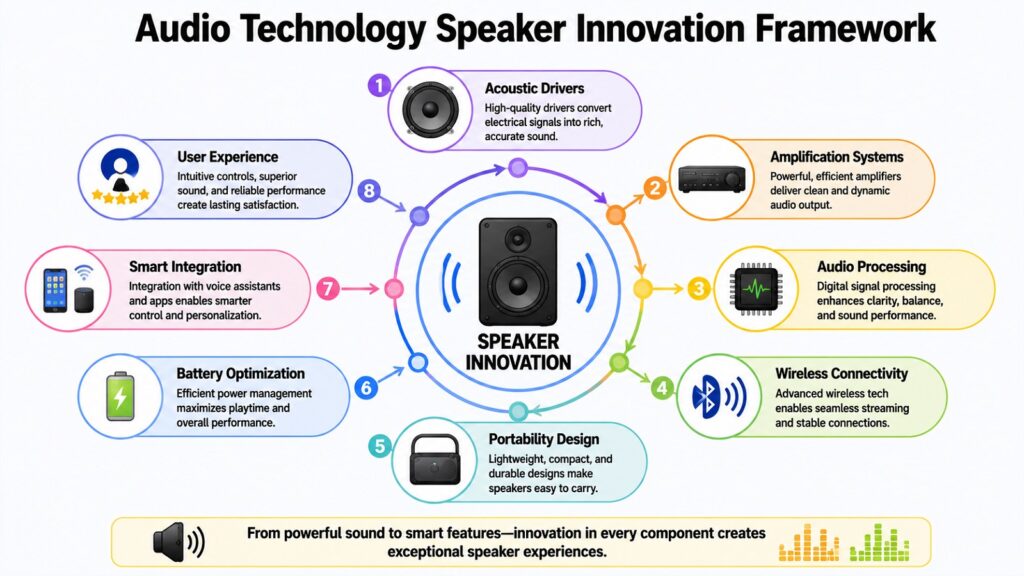
Speakers remain a foundational part of Audio Technology even as personal listening devices have grown in popularity. While headphones and earbuds serve the individual, speakers serve the room, the gathering, and the shared experience. From the earliest horn-driven phonograph speakers to today’s compact Bluetooth cylinders, the speaker has adapted continuously to the spaces and social contexts it serves.
The physics of speaker design involves converting electrical energy into mechanical motion that displaces air and produces sound. Early loudspeakers used large paper cones and permanent magnets to accomplish this conversion. Over decades, acoustic engineering has improved cabinet designs to minimize distortion, extend bass response, and project sound more evenly throughout a listening environment. Passive speakers relying on external amplifiers gave way to active or powered speakers that house amplifiers within the cabinet, simplifying setup and expanding options for consumers without dedicated audio equipment.
Wireless streaming transformed what speakers could do in a domestic environment. The ability to stream audio directly from a smartphone, tablet, or smart home hub removed the need for physical audio cables connecting devices across rooms. Multi-room audio systems allow different speakers in different rooms to play synchronized content or independent streams. Voice assistant integration gave speakers a second function as smart home hubs, responding to commands, setting timers, answering questions, and controlling connected devices. This convergence of audio and home automation expanded the speaker market to consumers who had not previously invested in dedicated audio equipment.
Portable Bluetooth speakers created an entirely new category of use cases. Outdoor gatherings, beach trips, camping, and impromptu social moments all became opportunities for shared audio experiences that previously required fixed installations. Ruggedized, waterproof models extended speaker use to environments where consumer electronics once would not have survived. Acoustic engineering adapted to small enclosures through passive radiators and advanced signal processing that compensate for physical limitations and produce fuller sound than cabinet size alone would suggest.
Audio Technology in Speakers: Types, Innovations, and Benefits
| Speaker Type or Feature | Primary Benefit |
| Passive radiator design | Extends bass response in compact enclosures without extra drivers |
| Multi-room wireless streaming | Synchronizes audio across multiple rooms from a single source |
| Voice assistant integration | Adds smart home control to audio playback capabilities |
| Waterproof portable design | Enables speaker use in outdoor and wet environments |
| Active powered speaker | Eliminates need for a separate external amplifier |
| Digital signal processing (DSP) | Compensates for room acoustics and enclosure limitations |
| Stereo pairing capability | Creates wider soundstage by linking two compatible speakers |
| USB-C charging with power bank | Provides charging flexibility and extended portable use |
4. Audio Technology Through Soundbars: Enhancing Modern Home Entertainment
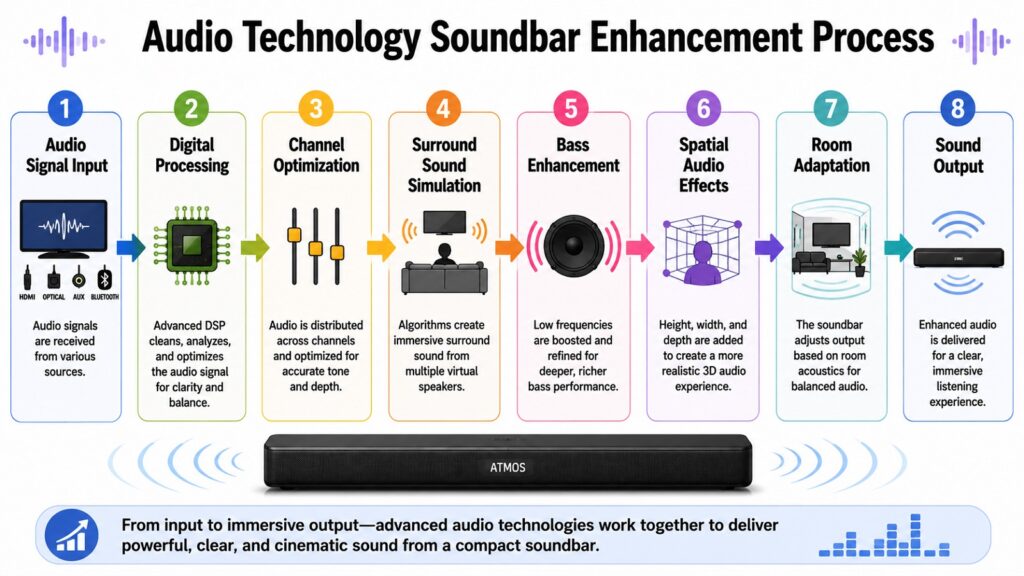
The soundbar emerged as a direct response to a problem created by television design trends. As flat-panel televisions grew thinner and larger, the physical space available for internal speakers shrank. Manufacturers prioritized slim profiles and bezel-free screens, leaving little room for speakers capable of producing substantial audio. The result was that television picture quality improved dramatically while audio quality often degraded. Soundbars addressed this gap by consolidating multiple speaker drivers and audio processing electronics into a single horizontal enclosure designed to sit beneath or above a television screen.
Early soundbars were relatively simple, offering modest improvements over built-in television audio through a wider speaker array spread across a longer cabinet. As the category matured, soundbar manufacturers incorporated increasingly sophisticated Audio Technology. Virtual surround sound processing creates the perception of audio coming from positions around the listener without requiring speakers to be physically placed throughout the room. This is achieved through psychoacoustic techniques that manipulate how the brain perceives the direction of sound based on timing and frequency differences between audio signals.
Dolby Atmos support brought a new dimension to soundbar performance. Unlike traditional channel-based audio, Dolby Atmos defines sound as objects in three-dimensional space and then renders those objects dynamically based on the playback system’s configuration. Some soundbars achieve overhead sound by angling upward-firing drivers toward the ceiling, bouncing sound downward to create a sense of height. Paired wireless subwoofers removed the last cable connecting soundbar systems to low-frequency reproduction, giving consumers cleaner installations while preserving the physical impact that deep bass provides in film and music listening.
Consumer adoption of soundbars grew substantially over the past decade as streaming services expanded their content libraries and began delivering spatial audio tracks to subscribers. The growing availability of Dolby Atmos content through platforms like Netflix and Apple TV+ created demand for playback systems capable of decoding and rendering that content at home. Soundbars offered a much simpler path to that capability than traditional multi-channel surround sound systems, which require multiple speaker placements and complex wiring throughout a room.
Audio Technology in Soundbars: Capabilities and User Benefits
| Soundbar Capability or Feature | Benefit to Users |
| Virtual surround sound processing | Creates surround effect without rear speakers using psychoacoustics |
| Dolby Atmos support | Renders three-dimensional object-based audio for immersive sound |
| Upward-firing height channels | Bounces sound off ceiling to simulate overhead audio layers |
| Wireless subwoofer pairing | Delivers deep bass without running cables across the room |
| HDMI eARC connectivity | Carries high-quality audio signals between TV and soundbar |
| Built-in streaming services | Allows direct audio playback without a separate source device |
| Dialogue enhancement mode | Boosts voice frequencies for clearer speech in TV and film |
| Adaptive audio calibration | Adjusts EQ settings based on room size and layout |
5. Audio Technology Through Microphones: Capturing and Sharing Sound
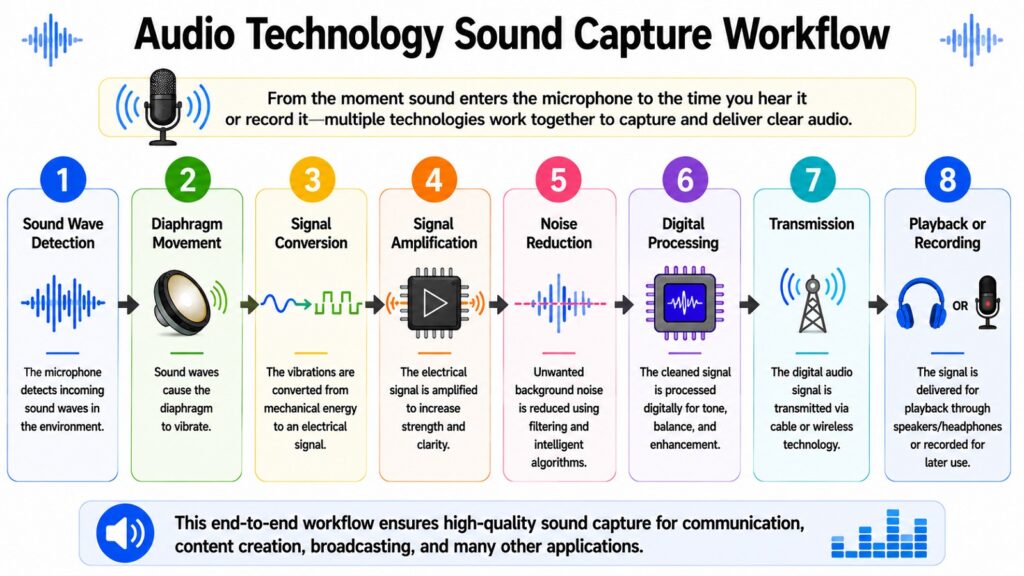
Microphones convert acoustic energy into electrical signals, making them the starting point for almost every audio experience that involves a human voice or live sound. Within Audio Technology, the microphone occupies a unique position because it is both a tool for capturing sound and a gateway to communication, broadcasting, content creation, and accessibility. Without reliable microphone performance, every other audio technology downstream in the signal chain becomes less effective.
Different microphone types serve different purposes based on the physical principles that govern how they convert sound into electrical signals. Dynamic microphones use electromagnetic induction and are durable enough for live performance environments where they may be handled roughly or exposed to loud sources. Condenser microphones use a charged capacitor plate to detect air pressure changes with greater sensitivity, making them popular choices for studio recording, podcasting, and broadcasting where capturing fine detail matters. USB condenser microphones brought professional-grade sound capture to general consumers by simplifying the connection process, requiring no separate audio interface.
The podcast and streaming boom that accelerated through the 2010s and into the 2020s created an enormous new market for consumer microphones. Independent creators producing audio for platforms like Spotify, Apple Podcasts, YouTube, and Twitch drove demand for microphones that deliver studio-quality results without professional acoustic environments. Manufacturers responded with microphones that include cardioid pickup patterns to reject sound from behind and beside the capsule, built-in pop filters to reduce plosive sounds, and internal shock mounting to minimize vibrations picked up from desks and surfaces.
In professional and enterprise settings, microphone arrays in conference rooms and communication devices have improved dramatically. Beam-forming microphone arrays use signal processing to focus on sounds coming from a specific direction while suppressing noise from other directions. AI-based noise suppression running either on-device or in cloud software removes keyboard clicks, ventilation noise, and ambient room sounds from video call audio in real time. These developments fundamentally changed how organizations communicate, making distributed and hybrid work arrangements sound significantly more natural than older systems allowed.
Audio Technology in Microphones: Technologies and Their Advantages
| Microphone Technology or Application | Purpose or Advantage |
| Dynamic microphone design | Handles loud sources and rough handling in live settings |
| Condenser capsule sensitivity | Captures fine audio detail for studio and podcast recording |
| USB connectivity for consumers | Simplifies connection to computers without audio interfaces |
| Cardioid pickup pattern | Rejects off-axis sound to minimize background noise capture |
| Beam-forming microphone arrays | Focuses audio capture on speakers in conference environments |
| AI-based noise suppression | Removes ambient sounds from voice calls in real time |
| Built-in pop filter design | Reduces distortion caused by hard consonant sounds in speech |
| Shock-mount isolation | Prevents desk vibrations from reaching the microphone capsule |
6. Audio Technology Through Hearing Aids and Hearing Enhancement Devices
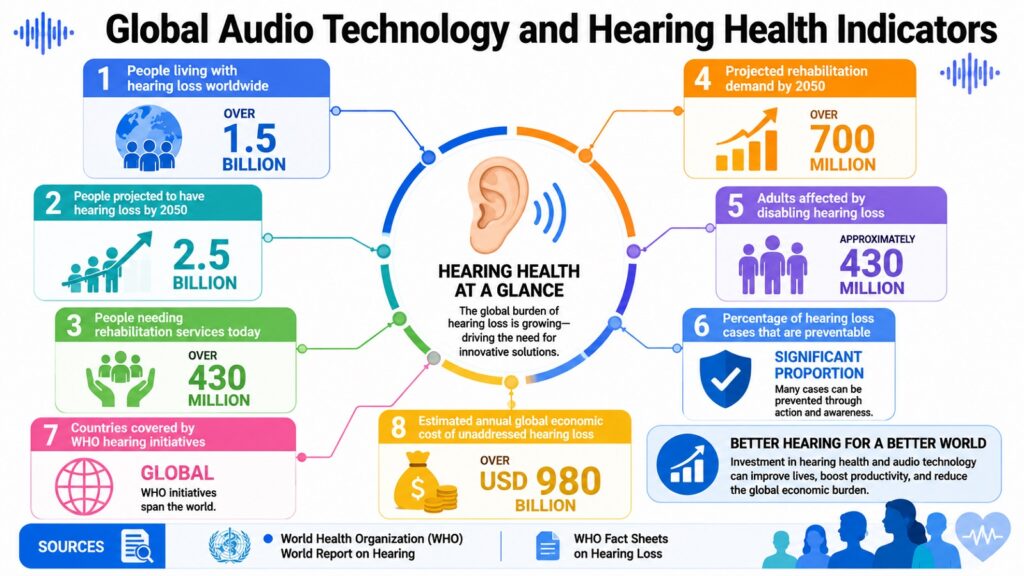
Hearing loss affects a substantial portion of the global population. The World Health Organization has estimated that over 1.5 billion people experience some degree of hearing loss, with that number expected to rise as populations age and noise exposure accumulates over lifetimes. Audio Technology plays a direct role in addressing this public health reality through hearing aids and related hearing enhancement devices that restore or improve the ability to participate in conversation, access information, and engage with everyday sound environments.
Digital hearing aids replaced analog predecessors during the 1990s and brought the ability to process sound with far greater precision. Rather than simply amplifying all incoming sounds uniformly, digital processing allows devices to distinguish speech frequencies from background noise, boost specific frequency ranges where a wearer’s hearing loss is most pronounced, and reduce the amplification of sounds that are already loud enough. Modern hearing aids apply these adjustments dynamically and continuously, adapting within milliseconds as the acoustic environment changes. A person moving from a quiet office into a busy restaurant receives automatic adjustments rather than manual control changes.
Wireless connectivity brought hearing aids into the broader Audio Technology ecosystem. Bluetooth-enabled hearing aids connect directly to smartphones, televisions, and streaming devices, allowing users to receive audio content directly into their hearing aids without interference from intermediate equipment. This capability removes a significant barrier that hearing aid users previously faced in environments designed around typical hearing. Rechargeable battery systems replaced traditional disposable batteries, reducing the operational burden on users who previously needed to manage small batteries that could be difficult to handle due to dexterity limitations.
AI-assisted personalization is one of the most significant recent advances in hearing aid technology. Machine learning algorithms analyze a user’s listening preferences and adjustment habits over time, then automatically optimize device settings to match those patterns. Some modern devices also use accelerometers and environmental classifiers to identify the acoustic context, distinguishing between environments like restaurants, outdoor settings, and telephone conversations and switching to pre-configured settings for each. These developments move hearing aids from passive amplification devices to intelligent, context-aware Audio Technology companions.
Audio Technology in Hearing Aids: Technologies and User Benefits
| Technology or Capability | User Benefit |
| Digital sound processing | Separates speech from noise with high precision |
| Frequency-specific amplification | Targets hearing loss in specific ranges without over-amplifying others |
| Bluetooth connectivity | Streams audio from phones and TVs directly to hearing aids |
| Rechargeable battery systems | Eliminates need for small disposable batteries |
| AI-based personalization | Adapts settings automatically based on user patterns and preferences |
| Environmental acoustic classifiers | Switches device modes based on detected listening environment |
| Directional microphone systems | Prioritizes sound from the front to improve speech clarity |
| Tinnitus masking features | Provides sound therapy options to reduce tinnitus perception |
7. Audio Technology Through Car Audio Systems: Sound on the Move
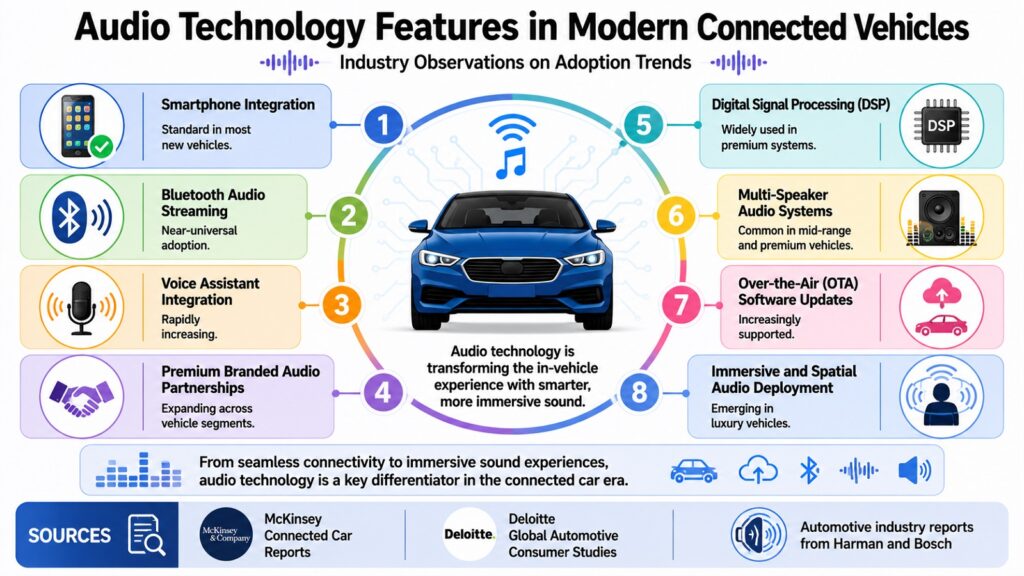
The automobile was among the earliest contexts outside the home where audio reproduction technology found a mass audience. AM radio receivers appeared in commercial vehicles during the 1930s, and from that starting point, in-vehicle audio evolved steadily through FM radio, 8-track tapes, cassettes, compact discs, satellite radio, and eventually digital media players and smartphone integration. Today’s car audio systems represent some of the most sophisticated Audio Technology that consumers interact with on a daily basis, integrated deeply into vehicle dashboards, safety systems, and digital platforms.
Speaker placement in vehicles presents acoustic engineering challenges that differ fundamentally from room-based listening. Irregular cabin geometry, varied surface materials, and the proximity of speakers to passenger ears create acoustic environments that require careful calibration. Premium car audio systems from brands like Bang and Olufsen, Bose, Harman, and Meridian address these challenges through speaker arrays that include multiple drivers positioned throughout the cabin, digital signal processing that compensates for acoustic reflections and timing differences, and amplification systems tuned specifically to the vehicle’s interior dimensions. These partnerships between automotive manufacturers and audio brands have become marketing advantages as well as genuine acoustic differentiators.
Smartphone integration changed the relationship between drivers and in-vehicle audio in fundamental ways. Apple CarPlay and Android Auto allow a smartphone’s audio library, navigation applications, streaming services, and communication functions to appear on the vehicle’s built-in display and be controlled through touchscreen inputs or voice commands. This integration effectively converts a vehicle’s audio system into an extension of the driver’s phone ecosystem, reducing the need to look at or interact with a handheld device while driving. Voice control capability expanded further as automotive voice assistants improved their accuracy and expanded the range of functions they could perform without requiring manual input.
Electric vehicles created a new context for car audio development. Without the acoustic masking effect of a combustion engine, electric vehicle cabins are significantly quieter at lower speeds, which makes both road noise and audio quality more noticeable. Several electric vehicle manufacturers have invested heavily in premium audio partnerships or developed proprietary sound systems to take advantage of the quieter cabin environment. Some electric vehicles also incorporate active road noise cancellation, using microphones and speakers to generate opposing audio signals that reduce tire and wind noise heard by passengers.
Audio Technology in Car Audio Systems: Features and Functions
| Car Audio Feature or Innovation | Practical Purpose |
| Multi-driver speaker arrays | Ensures even sound distribution throughout the vehicle cabin |
| Digital signal processing calibration | Compensates for cabin geometry and surface reflections |
| Apple CarPlay and Android Auto | Extends smartphone audio and apps to vehicle display and speakers |
| Satellite radio reception | Provides nationwide audio content independent of local radio |
| Branded audio partnerships | Applies specialist acoustic tuning tailored to vehicle interiors |
| Voice assistant integration | Enables hands-free control of audio, navigation, and calls |
| Active road noise cancellation | Reduces wind and tire noise through opposing audio signals |
| Over-the-air audio software updates | Allows system improvements and new features post-purchase |
8. Audio Technology Through Wearable Audio Devices: The Future of Personal Sound
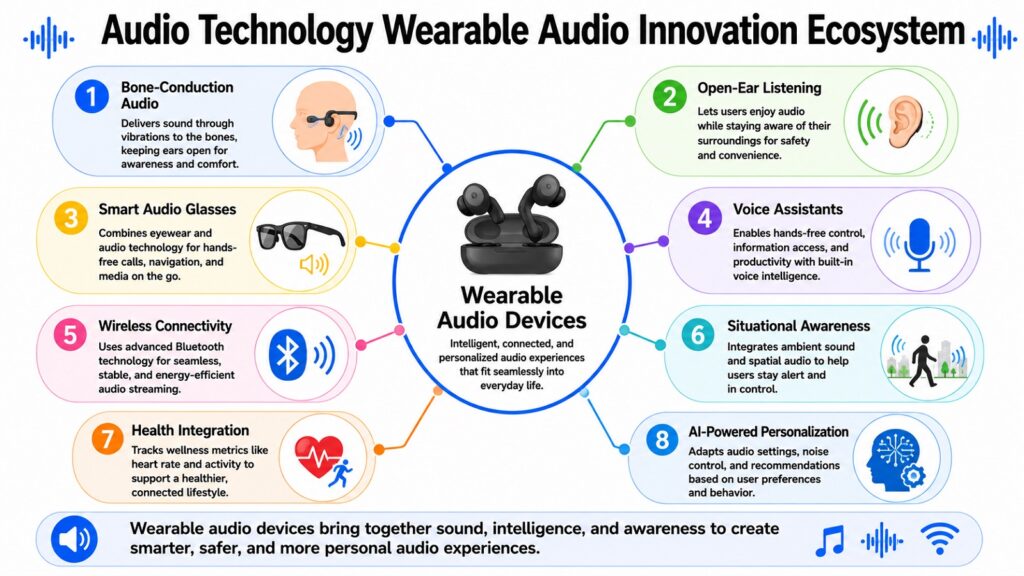
Wearable audio devices represent one of the most forward-looking areas within Audio Technology, combining sound delivery with physical awareness, mobility, and integration into daily activity. Unlike traditional headphones or earbuds that isolate the listener from their environment, many wearable audio formats are specifically designed to deliver sound while keeping the user connected to the world around them.
Bone-conduction headphones transmit sound through vibrations applied to the bones of the skull, bypassing the outer ear canal entirely. Because the ear canal remains open, wearers can hear both the transmitted audio and surrounding environmental sounds simultaneously. This makes bone-conduction devices particularly useful for outdoor activities such as running, cycling, and hiking, where awareness of traffic, other people, and environmental sounds matters for safety. Athletes, military personnel, and individuals with certain types of hearing loss have found practical value in the format for these reasons.
Smart audio glasses represent another category within wearable Audio Technology. These devices embed small speakers into the temple arms of eyeglass frames, delivering audio to the wearer through open-ear listening while appearing visually similar to standard eyewear. Some models also include microphones for voice calls and commands, touch-sensitive surfaces on the temples, and integration with voice assistants. Industry observers have noted that audio glasses attract users who want the utility of wireless audio without the in-ear format of traditional earbuds. The social and aesthetic dimensions of wearing visible earbuds remain a consideration for some consumer segments.
The broader category of wearable audio is moving toward deeper integration with artificial intelligence and contextual computing. Research into audio augmented reality, sometimes called audio AR, explores how sound layers can be added to real environments to provide navigation guidance, translate spoken language in real time, identify sounds for people with hearing difficulties, or add contextual information to physical experiences. Companies developing spatial computing platforms see audio as an essential component of how digital information will be overlaid on the physical world. Wearable audio devices that blend transparent hearing with intelligent audio processing may eventually become as common as smartphones are today.
Audio Technology in Wearable Audio Devices: Innovations and Significance
| Wearable Audio Innovation | Significance |
| Bone-conduction transmission | Delivers audio through skull vibration while leaving ears open |
| Open-ear speaker design | Maintains environmental awareness during audio playback |
| Smart audio glasses | Integrates speakers into eyewear for discreet listening experience |
| Audio augmented reality | Adds sound-based digital information to real-world environments |
| Real-time language translation | Provides instant spoken language interpretation through wearables |
| Touch-sensitive temple controls | Allows device control without handling a phone or separate device |
| Hearing enhancement modes | Amplifies specific frequencies to assist mild hearing difficulties |
| AI-driven contextual audio | Adapts sound delivery based on activity, location, and environment |
Conclusion: Audio Technology as a Driving Force in Modern Personal Tech Devices
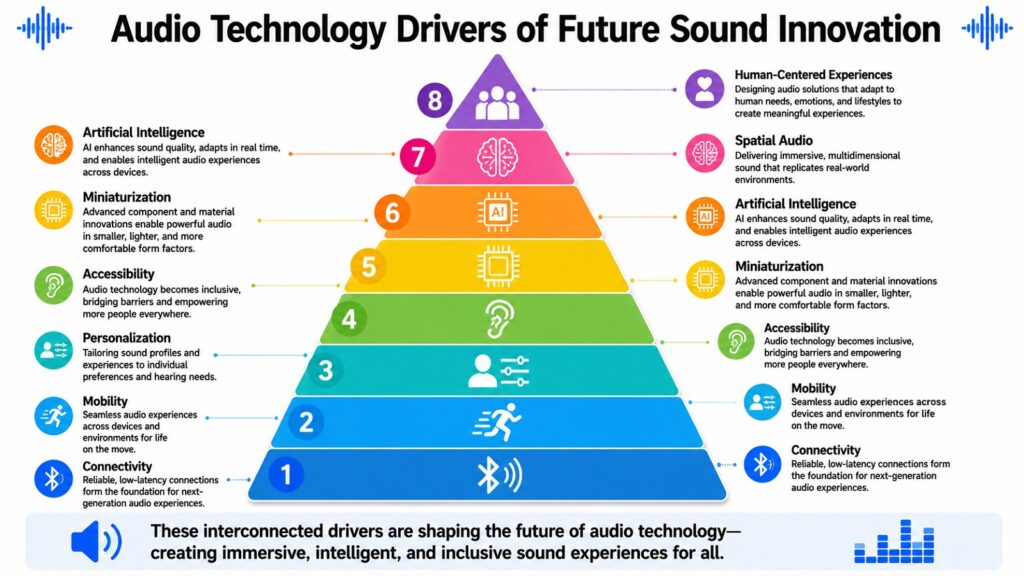
The eight technologies explored in this article share more in common than the fact that they all produce or capture sound. Each represents a distinct response to a human need: the need for private immersive listening, for cable-free convenience, for shared communal sound, for accessible cinema in the living room, for giving voice to ideas and communication, for hearing the world clearly, for sound that travels with us in our vehicles, and for audio that extends into the physical act of living. Together they illustrate why Audio Technology earns its place as a major pillar of modern Personal Tech Devices.
Several patterns connect all eight technologies and point toward where Audio Technology is heading. Wireless connectivity has become the assumed standard rather than a premium feature. Miniaturization continues to shrink components without meaningful loss in performance. Artificial intelligence has moved from a marketing term into genuine functionality, adapting sound experiences to individual users in real time. And user-centered design has pushed every category toward simpler controls, longer battery life, and more intuitive experiences that require less effort to manage.
Accessibility deserves specific recognition as a thread running through the entire Audio Technology landscape. Whether through hearing aids that restore participation in conversation, transparency modes on earbuds that keep outdoor users safe, or voice controls in vehicles that reduce distraction, audio innovations consistently address the needs of users with varying physical abilities and contexts. This broadening of design intention reflects a maturation of the category beyond pure consumer luxury.
The future of Audio Technology will likely be shaped by the continued convergence of audio with computing, sensing, and connectivity. Spatial audio standards will become more sophisticated. Wearable formats will move closer to mainstream adoption. AI processing will anticipate listening needs rather than simply responding to them. For those paying attention, the sounds of that future are already audible in the devices shaping modern sound today.
Audio Technology: Long-Term Contributions of Eight Key Innovations
| Technology | Long-Term Contribution to Modern Audio Technology |
| Headphones | Established personal listening as a private, immersive experience |
| True Wireless Earbuds | Removed physical cables, enabling fully mobile audio lifestyles |
| Speakers | Preserved communal listening while adapting to wireless and smart home ecosystems |
| Soundbars | Made spatial home audio accessible without complex multi-speaker installations |
| Microphones | Enabled the creator economy and transformed professional communication |
| Hearing Aids | Extended audio accessibility to millions through intelligent digital processing |
| Car Audio Systems | Integrated entertainment and communication into the daily commute |
| Wearable Audio Devices | Pointed toward audio as an ambient, context-aware layer of everyday life |