Table of Contents
Introduction: Understanding Why Automation Shapes Modern Technology
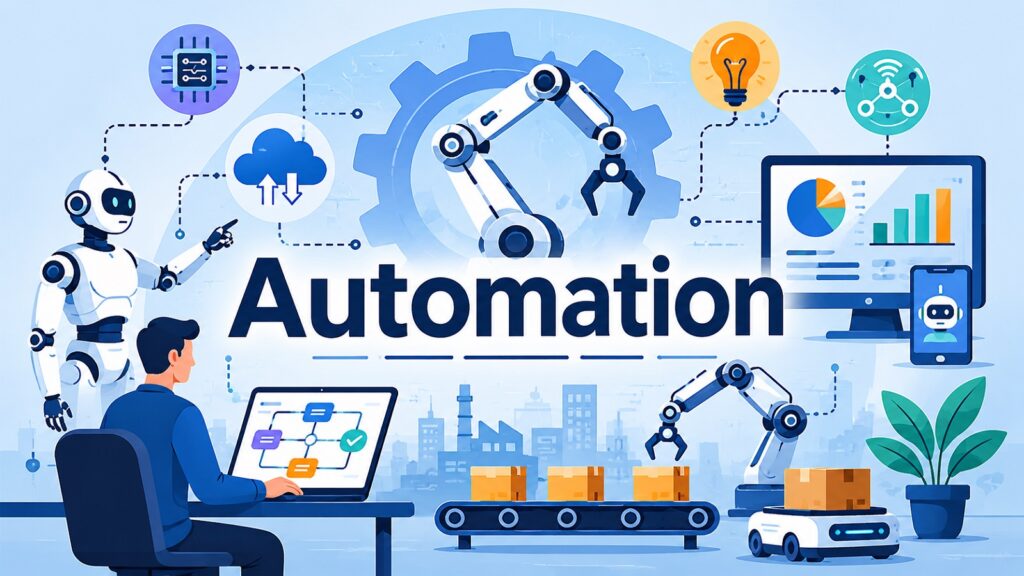
Automation or mechanization is an important aspect of modern technology, and that statement holds more weight than it first appears. Every industry that runs on consistent output, every software system that processes requests without human intervention, and every factory that ships products at scale owes something to automation. It is not simply a method for replacing manual effort. It is a way of thinking about how systems should be designed, how work should flow, and how organizations can grow without hitting the ceiling of human bandwidth.
At its core, automation means using technology, processes, or machines to perform tasks with minimal human involvement. But that definition undersells what actually happens in practice. When mechanization is done well, it changes the architecture of how things get done. It shifts decisions from the individual level to the system level. It turns one-time solutions into repeatable processes. And it creates the kind of consistency that is nearly impossible to achieve by hand, especially at scale.
Modern technology depends on automation in ways that are sometimes invisible. Cloud platforms spin up servers automatically in response to traffic. Financial systems run thousands of transactions every second without a person approving each one. Logistics networks reroute shipments in real time without a dispatcher sitting at a desk making calls. These are not futuristic ideas. They are already running behind the scenes of ordinary life.
What makes mechanization especially relevant today is that it does not belong to any single field. It connects manufacturing, software, finance, healthcare, retail, and government. It runs across digital systems and physical environments. It shows up in robotic assembly lines and in the email workflows of a small marketing team. The concept scales both up and down, which is one reason it continues to spread across sectors that seem very different on the surface.
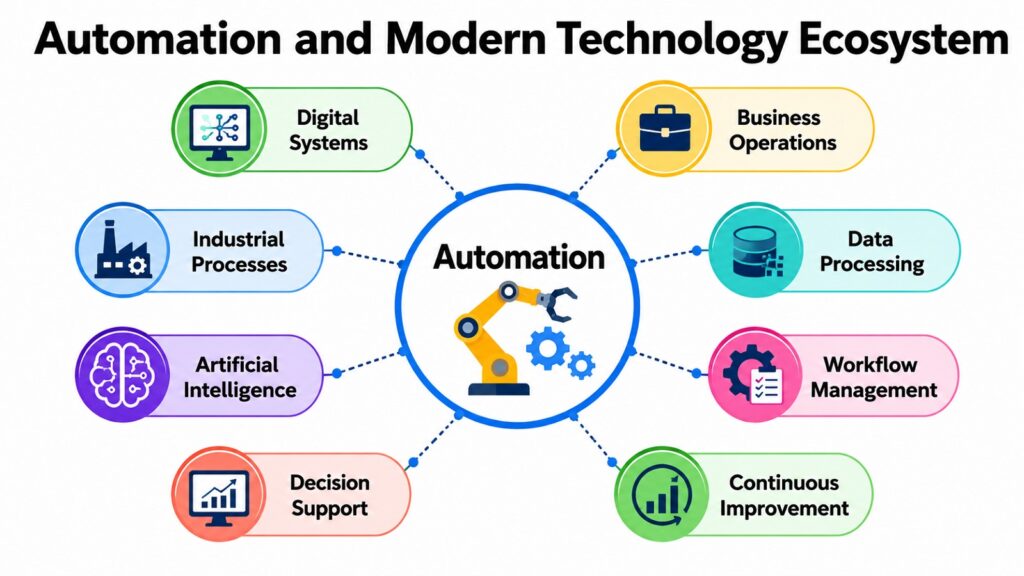
This article explores eight critical aspects of automation that together explain how it actually works in the modern world. Each aspect covers a different layer, from the categories and technologies that define mechanization, to the processes, industries, and organizations that apply it, to the intelligent systems that are expanding its reach, and finally to the strategies and future directions that will shape what mechanization becomes next. Together, these eight aspects paint a picture that is both broader and more detailed than any single definition can offer. The journey starts with how robotization is classified and why those classifications matter more than most people realize.
Table 1: Automation in Modern Technology – Key Contexts and Connections
| Key Contexts | Connection to Automation |
| Cloud computing | Scales resources without manual intervention |
| Financial systems | Processes high-volume transactions automatically |
| Logistics networks | Reroutes shipments using real-time data |
| Healthcare workflows | Automates scheduling and record management |
| Manufacturing lines | Maintains consistent output at high speed |
| Software development | Runs testing and deployment automatically |
| Customer service | Routes and responds to queries without agents |
| Data analytics | Collects, cleans, and reports data continuously |
1. Types of Automation: Understanding the Core Categories of Automation
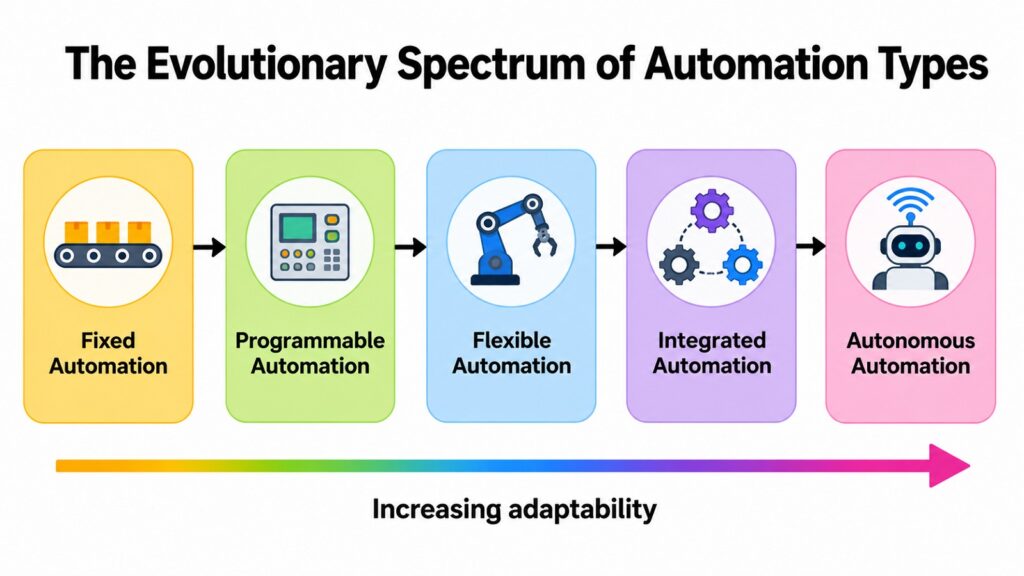
Not all automation works the same way, and that is actually the point. Different automation systems exist because different problems need different solutions. Treating all mechanization as a single approach leads to mismatched tools and disappointing outcomes. Understanding the systems means understanding the trade-offs. It is in the trade-offs that most implementation decisions really happen.
Fixed automation, sometimes called hard automation, is built around one specific task or product. Assembly lines in car factories are the classic example. The machines are configured to do one thing with great precision and very high speed. The efficiency is remarkable, but the flexibility is nearly zero. Changing what the system produces requires significant time and cost. This makes fixed mechanization a strong choice when volume is high, and variation is low.
Programmable automation offers more flexibility. Industrial robots that can be reprogrammed to handle different parts or tasks fall into this category. The setup time is longer than fixed mechanization, and output rates may be slower, but the ability to switch between configurations makes it suitable for batch production. Electronics manufacturers often use programmable mechanization when they need to run several product variants on the same equipment.
Flexible automation, also called soft automation, takes adaptability further. These systems can switch between tasks with minimal downtime, often guided by software instructions. Robotic arms in modern smart factories can pick, assemble, or inspect different components without lengthy reconfiguration. This makes flexible automation well-suited to environments where product variety is high and production runs are shorter.
In the software world, the categories shift toward process complexity. Basic task mechanization handles repetitive digital actions like moving files, sending scheduled reports, or running backups. Robotic process automation, or RPA, takes this further by mimicking the actions a human would take inside software systems, such as extracting data from one application and entering it into another. Intelligent automation adds decision-making capability by combining RPA with machine learning, allowing systems to handle exceptions and variations that purely rule-based tools cannot manage.
One insight worth remembering is that more advanced mechanization is not automatically better. A business that uses intelligent automation for a task that could be handled by a simple scheduled script is wasting resources. Category selection should match operational needs, not follow trend. The right category is the one that solves the actual problem at the actual scale, and nothing more. This is why understanding categories before selecting tools matters so much. The next question, naturally, is what technologies sit behind these categories and make them function.
Table 2: Automation Categories and Defining Characteristics
| Category | Defining Characteristic |
| Fixed automation | High-speed execution of one specific task |
| Programmable automation | Reconfigurable for batch production changes |
| Flexible automation | Rapid switching between varied tasks |
| Task automation | Handles simple, repetitive digital actions |
| Robotic process automation | Mimics human actions inside software systems |
| Intelligent automation | Combines rules with machine learning decisions |
| Cognitive automation | Processes unstructured data and language |
| Hyperautomation | Combines multiple tools across an entire organization |
2. Automation Technologies: The Systems That Power Modern Mechanization
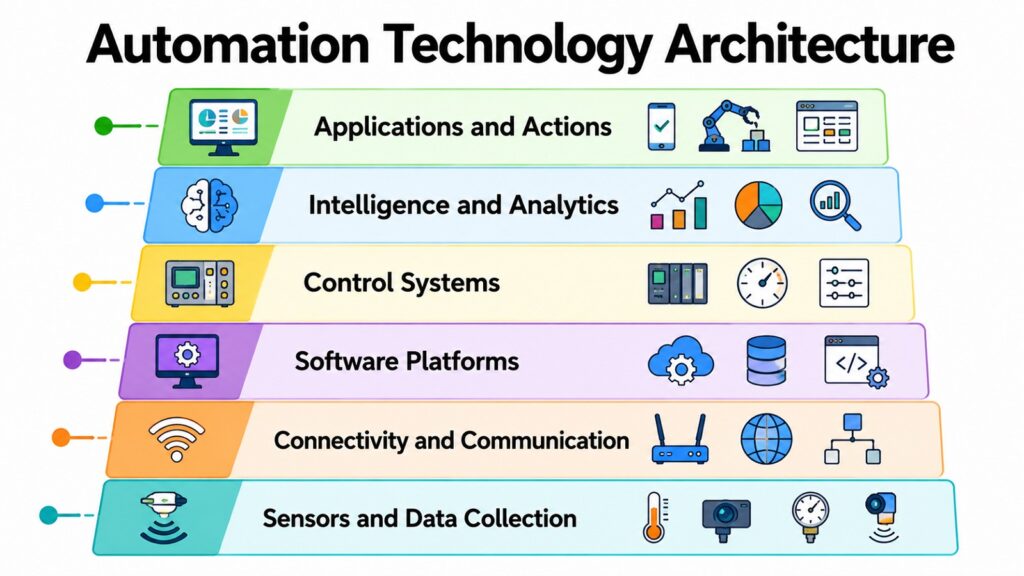
Automation does not run on a single technology. It runs on layers of interconnected systems that each play a specific role. Sensors gather information from the environment. Controllers interpret that information and issue instructions. Software platforms coordinate tasks across systems. Communication networks carry data between components. And increasingly, artificial intelligence adds a layer of analysis and prediction that earlier mechanization systems simply did not have. These layers do not operate independently. They depend on each other, and the quality of the connection between them often determines how well an automated system actually performs.
Sensors and input devices form the core of most physical automation systems. Temperature sensors, pressure gauges, machine vision cameras, and motion detectors collect data regarding real-world conditions. In the absence of dependable input, automated systems may make decisions based on incomplete or outdated information, resulting in errors. The quality and positioning of sensors are as crucial as the control software itself, a fact often overlooked in discussions that focus solely on software and algorithms.
Programmable logic controllers, commonly known as PLCs, have served as the foundation of industrial mechanization for many years. These specialized computers interpret inputs from sensors and manage machines according to programmed logic. They are designed for durability in challenging environments and can operate continuously for years with minimal upkeep. Simultaneously, distributed control systems, or DCS, oversee larger and more intricate environments where multiple PLCs and processes must be synchronized throughout a facility.
On the software side, robotic process automation platforms such as UiPath and Automation Anywhere have become widely used for automating digital workflows without changing underlying systems. Application programming interfaces, or APIs, allow different software systems to communicate and share data automatically. Workflow orchestration tools like Apache Airflow manage the sequencing and monitoring of complex automated processes that span multiple systems.
Communication technologies tie everything together. Industrial Ethernet, Wi-Fi, and increasingly 5G networks allow real-time data exchange between machines, software, and people. Cloud platforms provide scalable computing and storage that many modern mechanization deployments depend on for data processing and remote management. The Internet of Things, or IoT, expands the connected environment by embedding sensors and network capability into physical objects that were not previously part of any automated system.
One strategic insight is that technology selection often matters more than technology quantity. An organization with three well-integrated mechanization tools that communicate reliably will outperform one that has deployed fifteen disconnected platforms. Integration is where mechanization either delivers value or creates new complexity. The goal is a functioning system, not an impressive inventory of tools. These technologies are what turn mechanization categories into actual execution and measurable outcomes.
Table 3: Key Mechanization Technologies and Their Primary Roles
| Technology | Primary Mechanization Role |
| Sensors and detectors | Gather real-world input for control systems |
| Programmable logic controllers | Execute logic to control industrial machines |
| Distributed control systems | Coordinate large multi-process environments |
| Robotic process automation software | Automate repetitive tasks inside digital systems |
| APIs | Enable automatic data exchange between platforms |
| Workflow orchestration tools | Sequence and monitor multi-step automated processes |
| IoT devices | Connect physical objects to automated networks |
| Cloud computing platforms | Provide scalable infrastructure for automation at scale |
3. Process and Workflow Automation: How Mechanization Improves Execution
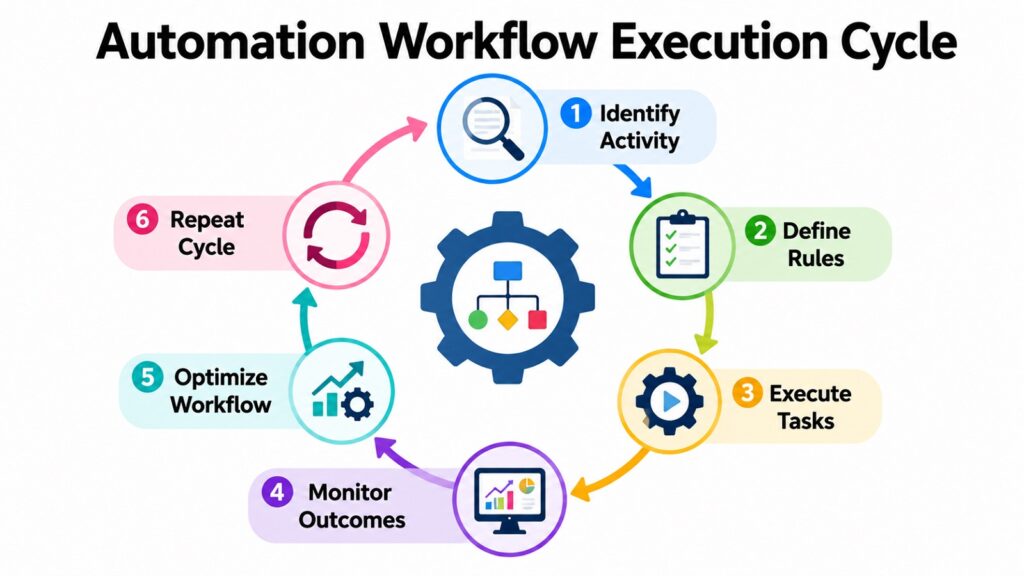
A process is only as good as the logic behind it. When mechanization is applied to workflows, the goal is not to make existing steps faster. The goal is to make the entire flow more structured, more reliable, and more visible. Organizations that apply mechanization without first examining the workflow often end up with faster versions of broken processes. The mechanization captures the problem and runs it at scale.
Workflow automation works by defining the sequence of steps, the conditions that trigger each step, and the rules that govern decisions along the way. When a customer submits a support request, an automated workflow can assign it to the right team, set a priority level, send a confirmation to the customer, and escalate it if no one responds within a defined window. None of those steps requires a human decision. They run on logic that someone defined in advance.
Sequencing is one of the most important elements of workflow design. Steps must occur in the right order, and dependencies must be respected. An invoice cannot be approved before it is received. A shipment cannot be labeled before an order is confirmed. Mechanization enforces these sequences without relying on individuals to remember them, which is especially important in high-volume environments where exceptions and errors tend to multiply quickly.
Monitoring and visibility are features that workflow automation often delivers as a byproduct. When processes run through a mechanized system, every step leaves a record. This creates an audit trail that helps teams identify where delays occur, where errors cluster, and where the process breaks down under load. Without mechanization, these patterns are buried in email threads, spreadsheets, and memory. With mechanization, they become measurable data.
Not every process is a good candidate for automation. Tasks that require nuanced judgment, creative problem-solving, or sensitive interpersonal interaction are generally poor fits. A process that changes frequently or depends on highly variable inputs may cost more to automate than it saves. The best candidates are tasks that are repetitive, rule-based, high-volume, time-sensitive, and prone to human error under pressure. Evaluating fit before automating is what separates effective implementations from expensive experiments.
Workflow automation also changes how teams think about their work. When routine tasks are handled automatically, people can direct attention toward higher-value work. This shift in focus is one of the more meaningful outcomes of well-designed process automation. It turns execution into a platform rather than an ongoing source of manual effort, and that platform becomes the foundation for operational scaling.
Table 4: Workflow Characteristics and Their Mechanization Impact
| Workflow Characteristic | Mechanization Impact |
| High repetition | Strong candidate for consistent automation |
| Rule-based decisions | Fully automatable without human judgment |
| High volume and time sensitivity | Reduces delays and processing backlogs |
| Clear sequencing requirements | Enforced automatically without manual tracking |
| Error-prone manual steps | Reduces mistakes through consistent execution |
| Frequent exceptions | Requires intelligent automation or human review |
| Audit and compliance needs | Automation generates automatic records |
| Variable and creative inputs | Poor fit, automation adds cost without benefit |
4. Industrial and Operational Automation: Automation Beyond Digital Work
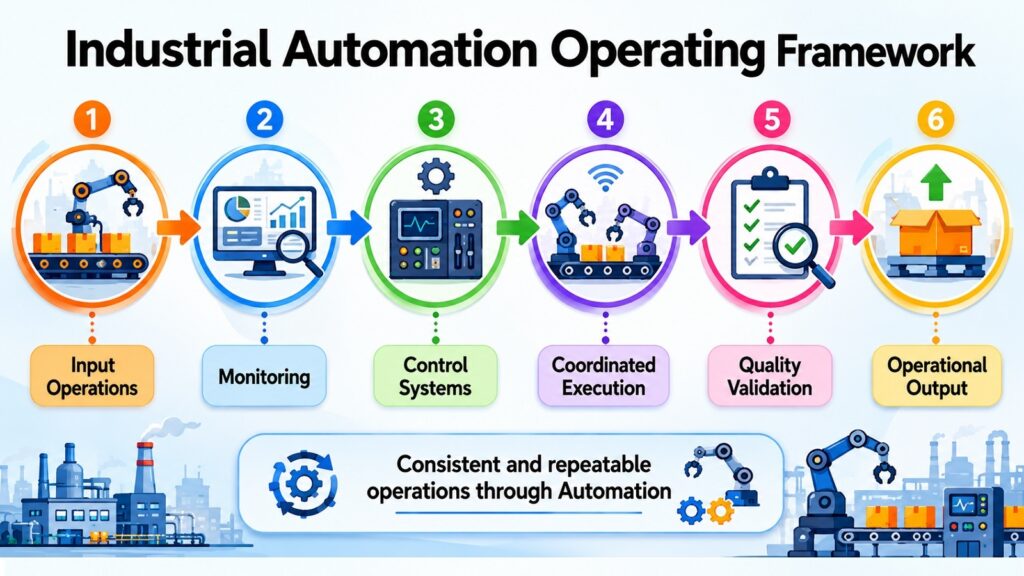
Industrial automation often gets pictured as robotic arms on a car assembly line, and while that image is accurate, it is only a small part of the story. Mechanization in operational and industrial environments reaches into every part of how physical work gets done, from how materials move through a facility to how systems monitor their own performance and raise alerts when something goes wrong. The scale and complexity of industrial automation make it one of the most consequential applications of the concept.
Consistency is the first major value that industrial automation delivers. A machine running a calibrated process will produce the same output on the thousandth cycle as it did on the first. A human performing the same task will experience fatigue, distraction, and variability over time. In manufacturing, pharmaceuticals, food production, and electronics assembly, that consistency is not just a quality preference. It is often a regulatory requirement and a competitive necessity.
Throughput improves significantly when mechanization removes the constraints imposed by human working hours, physical stamina, and sequential decision-making. Automated systems can run continuously, operate at speeds no person could match, and manage multiple inputs simultaneously. A packaging line that runs twenty-four hours without breaks is not replacing human ambition. It is meeting a demand that human labor alone cannot sustain at the required scale.
Safety is another area where operational automation produces clear benefits. Tasks that involve high temperatures, heavy machinery, toxic chemicals, or repetitive motion injuries are candidates for automation, not just for efficiency but for the protection of human workers. Automated systems can perform dangerous tasks with precision while keeping people at a safer distance from hazardous conditions. This is especially relevant in industries like mining, chemical processing, and heavy construction.
System visibility is an outcome that often goes underappreciated in discussions of industrial mechanization. Supervisory control and data acquisition systems, commonly known as SCADA, allow operators to monitor entire facilities from a central interface. Sensors throughout the environment feed data into dashboards that track performance in real time, flag anomalies, and log historical trends. This turns a physical facility into a data-generating environment, which supports both immediate decisions and longer-term planning.
Industrial automation is as much a management and system-design challenge as it is an engineering one. Deciding what to automate, how to integrate automated systems with human workers, how to handle failures gracefully, and how to maintain and update systems over time requires organizational thinking alongside technical expertise. The machines are only part of the picture. How they are managed determines whether the investment pays off. These operational principles apply equally well in organizational and business environments.
Table 5: Operational Functions and Their Mechanization Outcomes
| Operational Function | Mechanization Outcome |
| Assembly and manufacturing | Consistent output at continuous high speed |
| Hazardous task execution | Reduced human exposure to dangerous conditions |
| Quality inspection | Faster and more accurate defect detection |
| Inventory tracking | Real-time visibility into stock and movement |
| Facility monitoring | Continuous system health and performance data |
| Maintenance scheduling | Predictive alerts reduce unplanned downtime |
| Energy management | Automatic adjustment reduces waste |
| Logistics and material handling | Faster throughput with fewer routing errors |
5. Business and Enterprise Automation: How Mechanization Changes Organizations
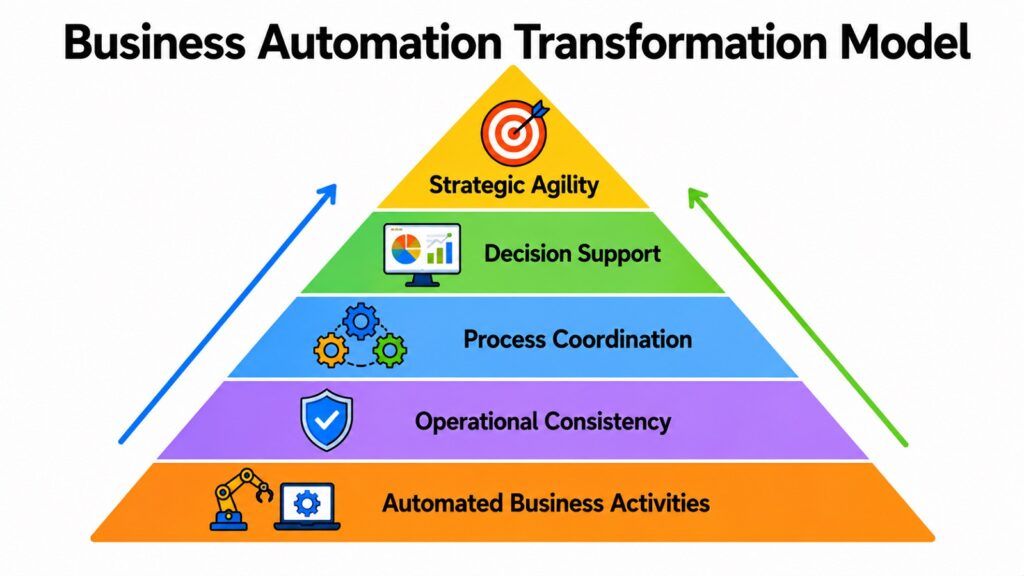
Businesses generate enormous amounts of repetitive, rule-driven work. Invoices need to be processed. Reports need to be generated. Contracts need to be routed. Employees need to be onboarded. Customer inquiries need to be answered and tracked. Most of these activities follow predictable patterns, which is exactly the kind of environment where mechanization creates lasting value. Enterprise automation is not about eliminating jobs. It is about redesigning how organizations execute so that people spend time on work that actually requires them.
The most visible layer of business automation is the replacement of manual data handling. Finance teams that once spent days reconciling spreadsheets can automate the extraction, matching, and flagging process so that human attention goes only toward exceptions and decisions. HR departments that managed onboarding through email chains and printed forms can automate the entire sequence so that new employees have access and equipment on day one without anyone manually tracking each step. These gains compound across an organization that has hundreds or thousands of employees.
Coordination improves when mechanization handles information flow between departments. Approval workflows that once sat in someone’s inbox for days can be routed, escalated, and resolved automatically based on predefined rules. Customer relationship management systems can trigger follow-up actions, notify sales teams, and update records across platforms without manual input. The organizational benefit is not just speed. It is reliability. Tasks do not get dropped because someone was sick, out of office, or distracted.
One of the more underappreciated benefits of enterprise automation is what it does for decision quality. When data collection and reporting are automated, leaders have access to accurate and timely information rather than reports assembled under pressure. When compliance steps are built into automated workflows, they happen consistently rather than depending on individual memory. When customer data is aggregated automatically, patterns become visible that would be missed in manually compiled summaries. Mechanization improves decision quality as much as it improves operational speed.
The limitations are worth acknowledging honestly. Mechanization is only as good as the process it encodes. If a business practice is inefficient or poorly designed, automating it makes the problem faster and harder to fix. Implementation often requires significant upfront investment in time, technology, and change management. People resist changes to familiar workflows, and that resistance is a real project risk. Organizations that treat automation as a purely technical deployment rather than an organizational change effort often underdeliver.
Notwithstanding these challenges, the rationale for enterprise automation remains robust. Organizations that operate consistently, react swiftly, and handle complexity without a corresponding rise in workforce size gain a structural edge over time. This advantage becomes increasingly evident as markets require quicker responses and enhanced service quality. The subsequent level of capability, where systems start to reason and learn instead of merely adhering to rules, is directly constructed upon this foundation.
Table 6: Business Functions and Automation Benefits
| Business Function | Benefits |
| Invoice processing | Reduces manual entry and reconciliation time |
| Employee onboarding | Ensures consistent completion of all steps |
| Approval workflows | Eliminates delays from inbox management |
| Customer data management | Keeps records accurate without manual updates |
| Compliance tracking | Enforces required steps without individual reminders |
| Sales pipeline management | Triggers follow-ups and updates automatically |
| Financial reporting | Generates accurate reports from live data |
| IT service management | Routes and resolves tickets without manual triage |
6. Intelligent Automation and AI: The Next Evolution
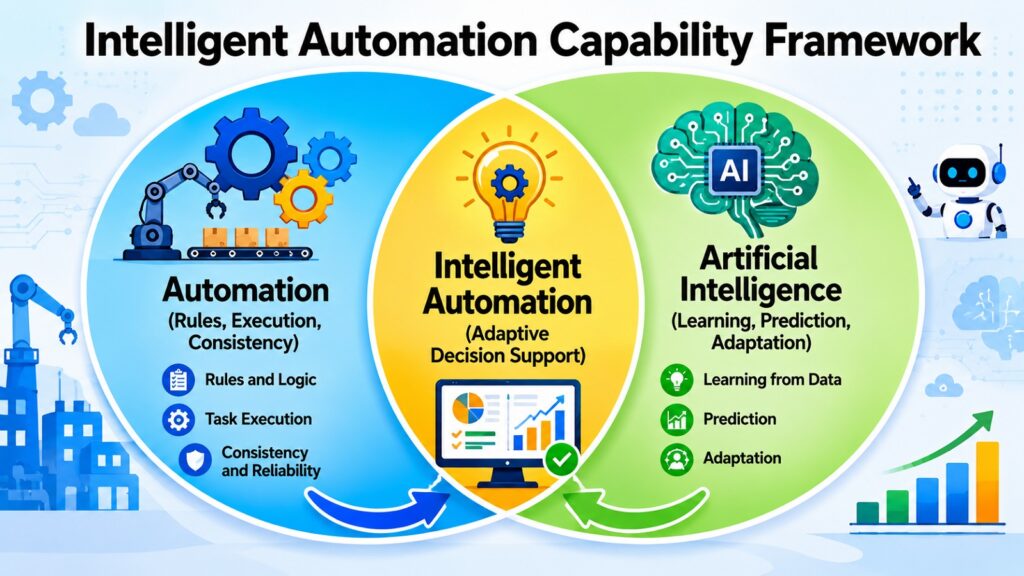
Traditional automation follows rules. It does what it is told, in the order it is told to do it, as long as conditions match what the rules anticipated. That is powerful, but it has a hard ceiling. The moment a situation falls outside the defined rules, the system either fails or escalates to a human. Intelligent automation pushes past that ceiling by adding the ability to learn, adapt, and make decisions in situations that were not explicitly programmed in advance.
Machine learning is the core technology that enables this shift. By training on historical data, machine learning models can identify patterns that humans would miss or take too long to find manually. A fraud detection system that learns from thousands of past transactions can flag suspicious activity with a level of accuracy and speed that no rule set could match. A predictive maintenance system that monitors equipment sensor data can estimate when a component is likely to fail before it actually does, allowing maintenance to be scheduled proactively rather than reactively.
Natural language processing, or NLP, has made intelligent automation accessible in environments where data arrives as text rather than structured numbers. Customer service platforms that automatically read, categorize, and respond to written inquiries are using NLP to handle work that previously required human comprehension. Document processing systems that extract information from contracts, invoices, and reports without structured templates are another practical application. These systems are not perfect, but they handle routine cases at a scale and speed that frees people for genuinely complex situations.
Computer vision adds perception to mechanization. Systems that inspect products for defects, read shipping labels, monitor facility conditions, or verify identity documents are using computer vision to do in milliseconds what a human inspector might take seconds or minutes to accomplish. The accuracy in well-trained systems often exceeds what is achievable through visual human inspection, especially under conditions of fatigue or high volume.
Adaptive systems represent the next step beyond these individual capabilities. Rather than being trained once and deployed statically, adaptive automation systems update their models as new data arrives. They can recognize when their predictions are drifting and adjust accordingly. This is particularly valuable in environments where conditions change over time and a static rule set or model would gradually become less accurate.
The important insight here is that intelligence extends mechanization without eliminating the need for human judgment. Intelligent systems can process more data, identify patterns faster, and handle more variation than rule-based tools. But they still require people to define objectives, evaluate outputs, set boundaries, and make decisions that carry ethical or strategic weight. Thinking of AI as an extension of mechanization rather than a replacement for human thinking keeps expectations realistic and implementation more likely to succeed. The challenge then becomes not just building intelligent systems but deploying them effectively.
Table 7: Intelligent Capabilities and Their Automation Contributions
| Intelligent Capability | Contributions |
| Machine learning | Identifies patterns and improves with data |
| Natural language processing | Handles text-based tasks and communications |
| Computer vision | Enables visual inspection and recognition tasks |
| Predictive analytics | Anticipates outcomes before problems occur |
| Anomaly detection | Flags deviations without predefined thresholds |
| Recommendation engines | Guides decisions based on learned preferences |
| Adaptive models | Adjust to changing conditions over time |
| Conversational AI | Manages interactive communication automatically |
7. Automation Implementation and Strategy: Building Effective Automation Systems
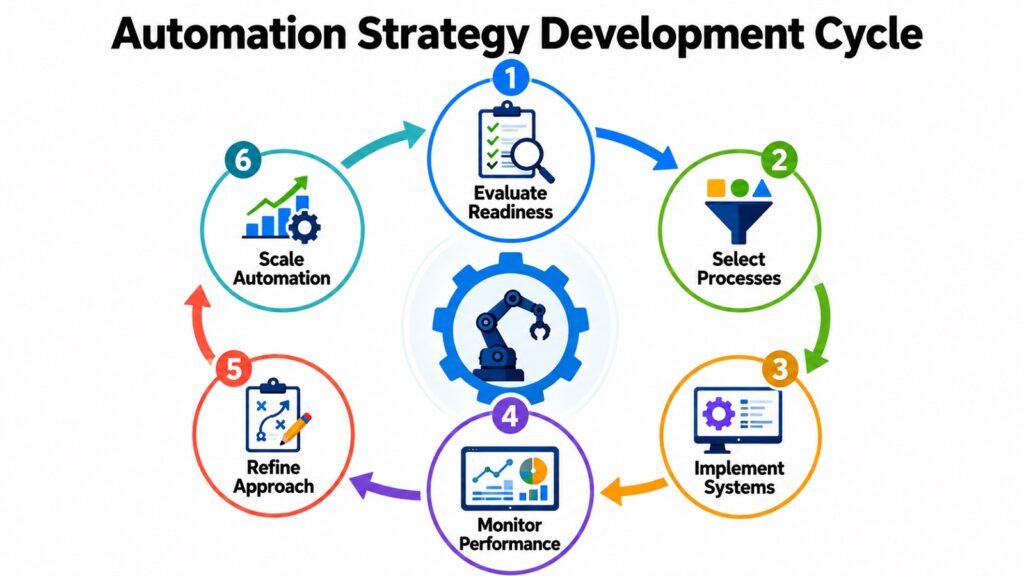
Comprehending automation is one aspect. However, constructing it, implementing it, and maintaining it over time is an entirely different matter. Numerous organizations understand the concept well but face difficulties in execution. The divide between a solid mechanization concept and an operational automation system is bridged by planning choices, integration obstacles, change management, and the less appealing task of assessing whether improvements are genuinely occurring. The implementation phase is where the majority of mechanization value is either achieved or forfeited.
The first question is always where to start. Choosing the right process to automate first matters more than moving quickly. A good starting candidate is one that is high-volume, clearly defined, currently error-prone, and important enough to justify the investment. Starting with a visible success builds organizational confidence and generates lessons that can be applied to more complex projects. Starting with a failing process or one that lacks clear ownership often ends in frustration and abandoned projects.
Readiness is an underappreciated factor. Organizations need data quality, process documentation, system access, and stakeholder alignment before automation can succeed. An automated process built on inconsistent data will generate inconsistent outputs. A workflow that cannot be clearly documented cannot be reliably automated. Taking time to clean up inputs and clarify process logic before building mechanization saves enormous effort later.
Adoption is the human side of implementation. When automated systems change how people do their jobs, resistance is a natural and predictable response. Effective implementation includes communication about what will change, training on new tools and responsibilities, and genuine attention to how the change affects people’s day-to-day experience. Automation projects that skip this work often see the technology deployed but not actually used, or used in ways that recreate the manual workarounds it was meant to eliminate.
Measurement is what turns deployment into improvement. Organizations that implement automation without clear performance metrics cannot tell whether it is working. Useful metrics include processing time, error rates, exception volumes, cost per transaction, and employee time freed for other work. Tracking these before and after mechanization creates the evidence base needed to justify further investment and to identify systems that need adjustment.
Sustainable automation comes from improving systems rather than maximizing replacement. Organizations that approach automation as a way to reduce headcount by a specific number often miss more valuable opportunities. Those that approach it as a way to improve how work is designed and executed tend to find more durable gains. The approach is not to automate to the greatest extent possible. Rather, it is to automate those elements that enhance the system’s capability, reliability, and scalability. This mindset is what influences long-term results, and it directly informs how organizations ought to consider their future.
Table 8: Automation Implementation Factors and Strategic Purposes
| Implementation Factor | Strategic Purpose |
| Process selection criteria | Ensures first projects succeed and build confidence |
| Data quality readiness | Prevents garbage-in-garbage-out outcomes |
| Process documentation | Creates the logic base automation requires |
| Stakeholder alignment | Reduces resistance and supports adoption |
| Change management planning | Supports people through workflow transitions |
| Performance measurement | Confirms value and identifies improvement areas |
| Governance and oversight | Keeps automated systems accountable over time |
| Scalability planning | Ensures initial designs can grow with demand |
8. Future of Automation: Emerging Trends and Opportunities
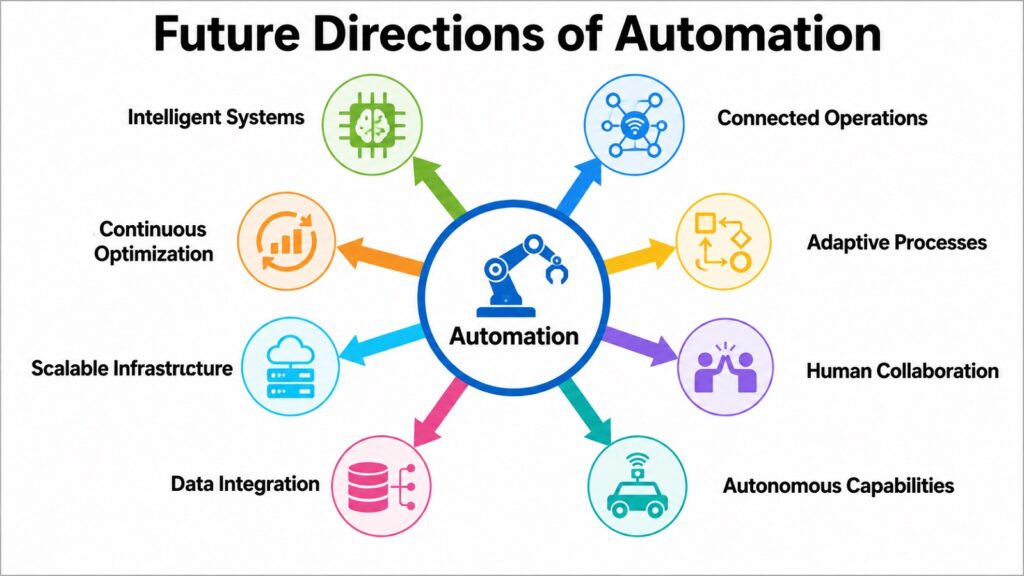
The future of automation is not a single technology or a single shift. It is a convergence of several developments that are already underway. Machine learning continues to improve. Computing costs continue to fall. Network connectivity keeps spreading into new environments. Physical robots become more dexterous and more affordable. And the tools that help organizations build and manage mechanization systems keep getting easier to use. Each of these trends reinforces the others, and together they expand what automation can realistically accomplish across more industries and contexts.
Hyperautomation is one of the more visible directions emerging from this convergence. Rather than automating individual tasks or isolated processes, hyperautomation refers to the systematic mechanization of as many business and operational processes as possible, using a combination of tools including RPA, AI, machine learning, and process mining. The idea is to treat mechanization not as a series of projects but as an organizational capability that continuously identifies and addresses automation opportunities. Gartner has consistently listed hyperautomation among its top strategic technology trends in recent years.
The expansion of automation into physical environments will continue as robotics technology matures. Collaborative robots, known as cobots, are already working alongside humans in manufacturing and logistics, designed to handle tasks that benefit from automation while remaining safe and adaptable in environments where human presence is constant. Autonomous mobile robots in warehouses and distribution centers are handling movement and sorting work that previously required large human teams. As sensor quality improves and motion planning software advances, these systems will be able to take on more varied and complex physical tasks.
Edge computing is changing where automation processing happens. Rather than sending all data to a central cloud server for analysis, edge systems process data locally, close to where it is generated. This reduces latency, which matters enormously in automation applications where decisions must happen in milliseconds. Manufacturing equipment, autonomous vehicles, and remote monitoring systems all benefit from edge intelligence that does not depend on a round trip to a distant server.
Low-code and no-code automation platforms are bringing automation capability to people who are not engineers or developers. These tools allow business users to build automated workflows, set up integrations, and configure logic using visual interfaces rather than programming. This democratization of automation means that organizations can build more automation faster, and that the people closest to the actual work can often design better solutions than a centralized technical team working from a distance.
The broader trajectory points toward automation that is more adaptive, more connected, more embedded in physical environments, and more accessible to a wider range of builders and users. The organizations and individuals that understand this trajectory will be better positioned to make use of it rather than react to it. Automation is already reshaping the world in ways that are visible every day. What changes next will build on the same foundations explored throughout this article. Those foundations converge in a final synthesis worth holding onto.
Table 9: Emerging Automation Directions and Expected Influence
| Emerging Direction | Expected Automation Influence |
| Hyperautomation | Organization-wide automation coverage across all processes |
| Collaborative robotics | Safer human-machine teamwork in physical environments |
| Edge computing | Faster local decisions without cloud round trips |
| Low-code platforms | Automation built by non-technical users close to the work |
| Autonomous mobile robots | Self-directed movement in warehouses and facilities |
| AI model improvements | More accurate handling of complex and variable tasks |
| Digital twins | Simulation-based automation testing before deployment |
| 5G and advanced connectivity | Real-time automation in previously unreachable environments |
Conclusion: What the Future Holds for Automation
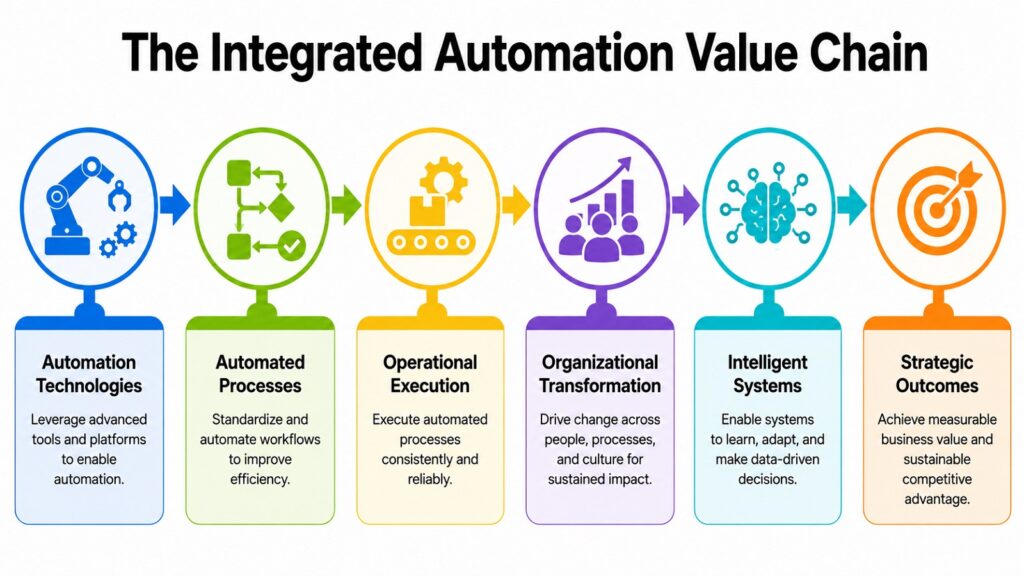
Eight aspects. One interconnected system. That is what this article has tried to show, and it is worth sitting with that idea for a moment before moving on. Automation is not a product you buy or a switch you flip. It is an approach that spans how technology is built, how organizations are structured, how work is designed, and how systems learn and adapt over time. The categories, technologies, processes, operations, enterprises, intelligent capabilities, implementation strategies, and future directions covered here are not separate topics. They are layers of the same evolving ecosystem.
What ties them together is a consistent underlying logic. Automation works when it is applied to the right problems, supported by reliable technology, integrated thoughtfully into human systems, and measured against outcomes that actually matter. It fails when it is treated as a shortcut, a cost-cutting tool applied blindly, or a technology project that ignores the people it affects. The difference between a successful mechanization and a failed one is rarely about the technology itself. It is about the thinking that guides its application.
The practical value of understanding all eight aspects is that it prevents tunnel vision. Organizations that focus only on technology miss the process design layer. Those focused only on implementation strategy miss the emerging capabilities that are reshaping what is possible. Readers who understand the full picture can see mechanization as what it really is, a continuously expanding set of tools, principles, and disciplines that make systems more capable without making them less human.
The single insight worth carrying forward is this. Automation does not reduce complexity. It relocates it. Manual complexity moves into system design, governance, and strategy. That shift is worth making, but it requires the same care and attention that any serious undertaking demands. The future of automation belongs to those who understand what it can do and what it still requires from the people behind it.
Table 10: Key Automation Takeaways and Their Broader Implications
| Key Takeaway | Broader Automation Implication |
| Category selection determines fit | No single automation type fits all problems |
| Technology integration matters more than quantity | Connected tools outperform fragmented stacks |
| Process design precedes automation | Bad processes automated faster are still bad |
| Operations and digital share the same logic | Automation principles apply across environments |
| Automation improves decision quality | Not just speed, but accuracy and consistency too |
| Intelligence extends, not replaces, judgment | Human oversight remains essential in AI systems |
| Implementation is a strategic discipline | Execution quality determines long-term outcomes |
| Future automation is adaptive and accessible | Capability expands as tools become easier to use |