Table of Contents
Introduction: Why Sustainable Technology Is Essential for a Green Future
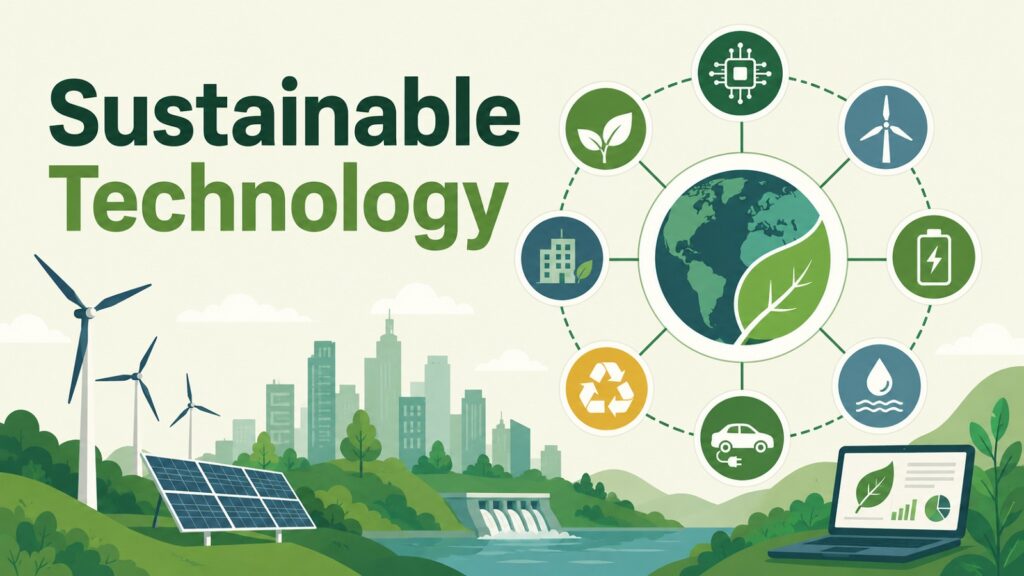
Sustainable Technology refers to the use of science, engineering, digital tools, and management systems to meet present-day human needs without compromising the ability of future generations to meet their own. It covers how we design, build, operate, and decommission the systems that power modern civilization. From how cities manage water to how manufacturers handle waste, sustainable technology reaches into nearly every corner of economic and social life.
Sustainable Technology is an important aspect of modern technology because it enables innovation, economic growth, environmental responsibility, and long-term resilience to coexist. These four goals were often seen as competing priorities. Businesses worried that environmental responsibility would raise costs. Governments feared that sustainability regulations would slow development. That view has been steadily dismantled by evidence showing that organizations and nations investing in sustainable approaches tend to perform better over time, not worse. Today, sustainability has become a core strategic objective worldwide. Investors evaluate companies on sustainability metrics. Regulators enforce emissions rules with real financial consequences. Consumers increasingly prefer brands with credible environmental commitments.
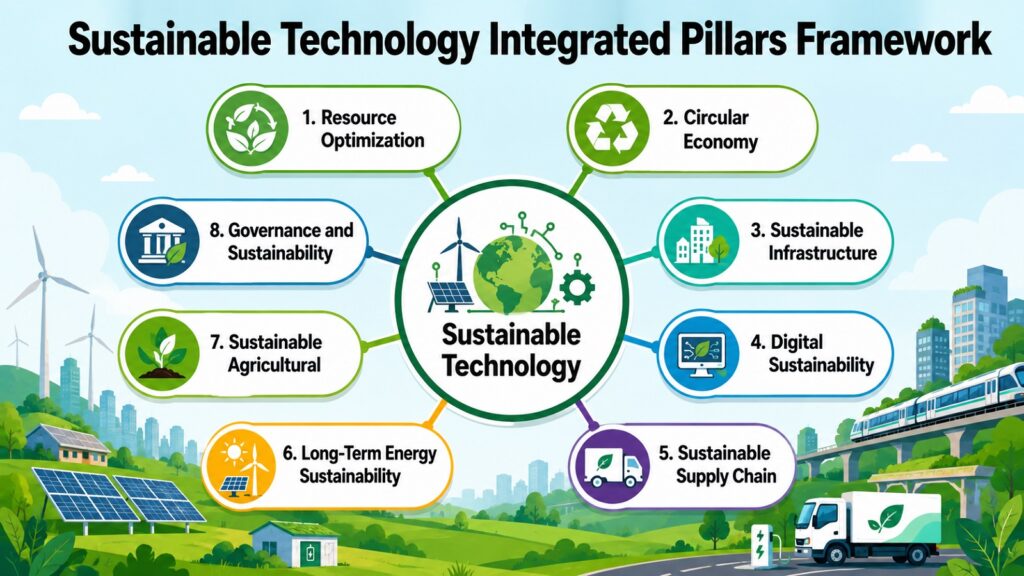
This article is a comprehensive guide to sustainable technology through eight interconnected pillars: resource optimization systems, circular economy technologies, sustainable infrastructure, digital sustainability platforms, supply chain management, energy sustainability systems, agricultural innovation, and governance. Each pillar is a distinct domain, but they do not work alone. Together they form an integrated framework where progress in one area supports progress in others. Organizations that grasp this interconnectedness absorb economic shocks better, adapt to regulatory change faster, and attract the talent and capital they need to grow. Sustainable technology is not a destination. It is a direction of travel.
Table 1: Eight Pillars of Sustainable Technology and Their Primary Contributions
| Pillar | Primary Contribution to Sustainable Technology |
| Resource Optimization Systems | Reduces waste and improves efficiency in energy, water, and materials use |
| Circular Economy Technologies | Extends product life and recovers materials, minimizing resource depletion |
| Sustainable Infrastructure | Creates efficient buildings, transport, and urban systems with lower emissions |
| Digital Sustainability Platforms | Enables data-driven monitoring, reporting, and decision-making |
| Sustainable Supply Chains | Improves traceability, reduces emissions, and promotes ethical sourcing |
| Energy Sustainability Systems | Supports transition to clean energy and strengthens grid resilience |
| Agricultural Innovation | Increases food production efficiency while protecting natural resources |
| Governance and Sustainability Management | Ensures accountability, compliance, and strategic sustainability alignment |
1. Sustainable Technology Through Resource Optimization Systems
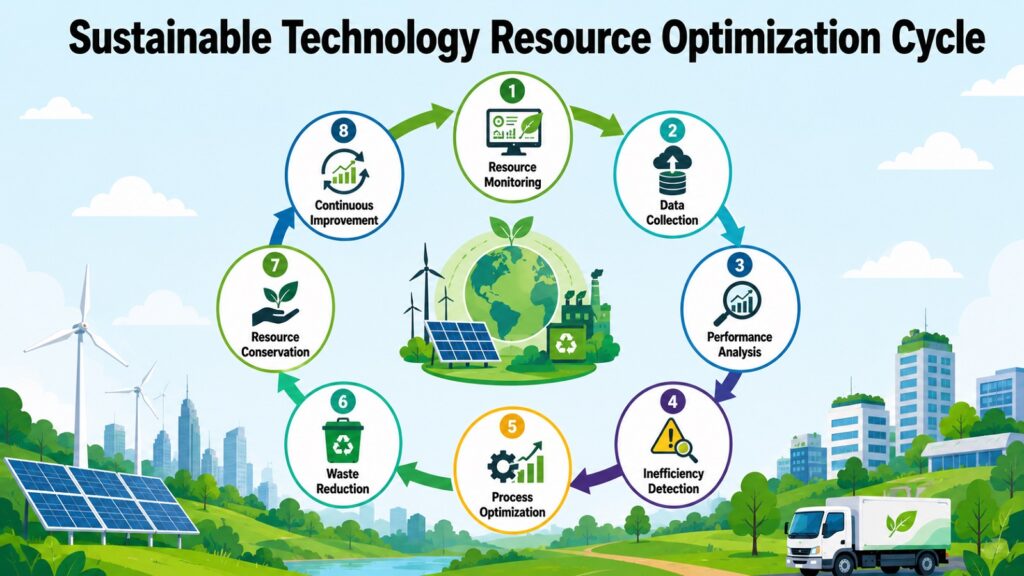
Every business, government agency, and community relies on resources. Energy powers buildings and machines. Water sustains agriculture and manufacturing. Raw materials feed production lines. The challenge is that these resources are finite, costly, and increasingly under environmental pressure. Resource optimization is the answer, and sustainable technology makes it possible at a scale that was not achievable before.
The need to optimize has grown sharper in recent years. Energy prices have become volatile due to geopolitical pressures. Water scarcity now affects regions that once took freshwater for granted. Supply chain disruptions have exposed the fragility of systems built around cheap, abundant inputs. Organizations that can do more with less are not just acting sustainably. They are acting strategically.
The technologies driving resource optimization often work together. Industrial sensors connected through the Internet of Things let facilities monitor energy, water, and material use in real time. Automation systems adjust processes based on live data, cutting waste at the source. Predictive analytics platforms use historical data and machine learning to anticipate equipment failures before they occur, preventing the resource losses that come with unplanned downtime. Artificial intelligence goes further by continuously learning from operational data and recommending improvements that human operators might never spot.
Results bear this out. Automotive manufacturers using digital process twins to simulate production lines have identified material savings of 15 to 30 percent before making any physical changes. Water utilities have cut distribution losses significantly by installing leak detection sensors across their networks. When organizations invest in tools that make resource use visible and manageable, waste falls and efficiency rises. Resource optimization serves as the foundation that every other pillar in this article rests on.
Table 2: Resource Optimization Technologies and Their Sustainability Benefits in Sustainable Technology
| Technology / Approach | Primary Sustainability Benefit |
| Industrial IoT Sensors | Continuously monitors resource consumption to detect waste in real time |
| AI-Driven Energy Management | Reduces energy use by predicting demand and adjusting systems automatically |
| Predictive Maintenance Platforms | Prevents equipment failures, reducing material waste and energy losses |
| Water Monitoring Systems | Identifies leaks and inefficiencies to cut water consumption across facilities |
| Smart HVAC Automation | Optimizes heating and cooling based on occupancy, lowering energy bills |
| Digital Process Twins | Simulates operations to find inefficiencies before implementing changes |
| Material Flow Tracking Software | Monitors raw material usage throughout production to reduce excess waste |
| Demand Forecasting Analytics | Aligns production levels with actual demand, preventing overuse of resources |
2. Sustainable Technology and the Rise of Circular Economy Technologies
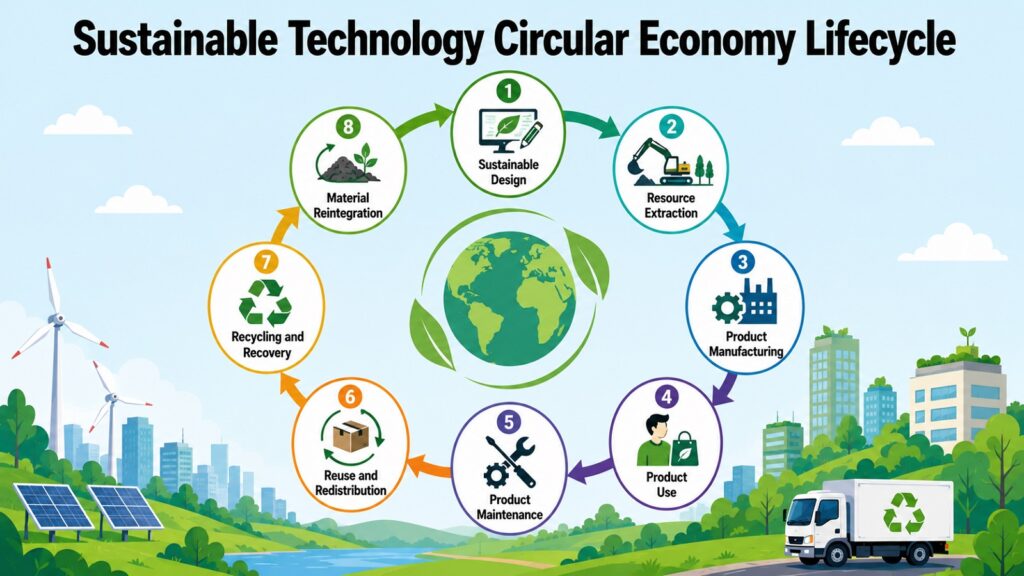
The traditional industrial model is straightforward but deeply problematic. Resources are extracted, made into products, and eventually discarded. This take-make-dispose pattern made sense when natural resources seemed unlimited and disposal was cheap. Neither condition holds anymore. Landfills are filling up. Raw material costs are rising. Regulatory pressure on waste is tightening. The linear model is running out of road.
The circular economy offers a fundamentally different logic. Instead of discarding products at end of life, a circular approach recovers them through reuse, refurbishment, remanufacturing, and recycling. The goal is to keep materials circulating for as long as possible, extracting maximum value before allowing any fraction to leave as waste. Sustainable technology makes circularity operationally viable. Chemical recycling systems break down plastics that mechanical recycling cannot handle. Remanufacturing technologies restore used components to original specifications. Digital product passports track materials throughout their lifecycle, making it easier for recovery operations to process them correctly.
Real-world examples show how far this has come. Caterpillar has built entire business lines around remanufacturing, recovering engine and hydraulic components that would otherwise be scrapped. The Renault factory in Flins, France, operates as a dedicated circular economy hub where end-of-life vehicles are disassembled and parts redirected into new products or remanufacturing streams. Philips adopted a product-as-a-service model for lighting, recovering luminaires at contract end for reprocessing, giving manufacturers a direct financial incentive to design products that last longer and can be fully recovered.
Circularity represents a systemic shift in how products, materials, and resources are managed across their entire lifecycle. It challenges industries to redesign not just their products but their entire business models. Sustainable technology provides the tools to make that redesign practical and financially attractive.
Table 3: Circular Economy Technologies and Their Contributions to Sustainable Technology
| Technology / Practice | Primary Sustainability Contribution |
| Reverse Logistics Platforms | Manages the return of used products for refurbishment, reuse, or recycling |
| Chemical Recycling Systems | Breaks down plastics and composite materials into reusable raw inputs |
| Remanufacturing Technologies | Restores used components to original performance, extending their usable life |
| Product-as-a-Service Models | Shifts ownership to manufacturers, incentivizing longer product lifespans |
| Digital Product Passports | Stores lifecycle data to support responsible repair, reuse, and recycling decisions |
| Advanced Sorting Robotics | Automates waste separation to improve recycling rates and material recovery |
| Material Recovery Facilities | Processes post-consumer waste to extract reusable metals, plastics, and fibers |
| Biodegradable Materials Innovation | Replaces single-use synthetics with compostable alternatives to reduce landfill |
3. Sustainable Technology for Sustainable Infrastructure Development
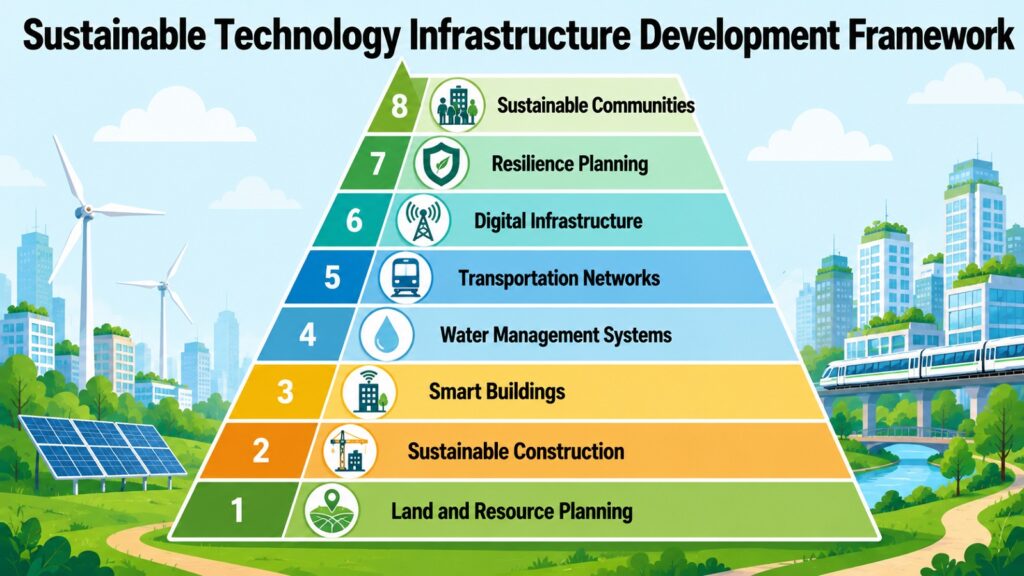
Infrastructure is the skeleton of society. Roads, buildings, water systems, energy grids, and communication networks are the physical platforms that everything else depends on. How infrastructure is built, operated, and maintained determines a society’s energy consumption, carbon footprint, and economic productivity for decades. Getting infrastructure right is one of the most consequential sustainability decisions any community or government can make.
Much of the world’s existing infrastructure was built when sustainability was not a priority. Older buildings are thermally inefficient. Legacy water systems lose enormous volumes through leakage. Transportation networks designed for combustion vehicles are poorly suited to electric mobility. The gap between what exists and what is needed is a major opportunity for sustainable technology.
Smart building management systems tackle this by optimizing energy, lighting, heating, and cooling in real time. Buildings with these systems routinely achieve energy savings of 20 to 40 percent. The Empire State Building retrofit in New York showed that even iconic older structures can be transformed, achieving annual energy savings of more than 38 percent. Green construction methods, including low-carbon concrete and modular prefabrication, reduce the embodied carbon of new buildings while cutting on-site waste. Intelligent transportation systems use traffic data and connected vehicle technology to reduce congestion and fuel consumption. In Singapore, a comprehensive urban mobility platform integrates transit, road pricing, and real-time navigation across the entire city-state, cutting emissions for millions of daily commuters.
Advanced metering networks in urban areas such as Amsterdam and Cape Town have enabled water utilities to accurately identify distribution losses, facilitating targeted repairs that minimize both waste and expenses. Each percentage of energy conserved in buildings, every liter of water saved, and every ton of carbon emissions avoided in construction accumulates over the lifespan of the asset. Infrastructure acts as the essential foundation upon which sustainable development relies.
Table 4: Infrastructure Technologies and Their Sustainability Value in Sustainable Technology
| Infrastructure Technology / Solution | Sustainability Value |
| Smart Building Management Systems | Controls energy, lighting, and ventilation to reduce consumption in real time |
| Green Roofing and Insulation | Reduces heating and cooling demands and manages urban stormwater naturally |
| Intelligent Transportation Systems | Optimizes traffic flow, cutting idle time and vehicle emissions in cities |
| Low-Carbon Concrete Formulations | Reduces embodied carbon in new construction without compromising structural strength |
| Digital Infrastructure Asset Management | Extends the useful life of infrastructure by scheduling proactive maintenance |
| Electric Vehicle Charging Networks | Supports clean transport adoption through accessible and efficient charging |
| Rainwater Harvesting Systems | Captures and stores precipitation for non-potable uses, reducing water draw |
| Modular Construction Technology | Cuts waste and build times by prefabricating components off-site at scale |
4. Sustainable Technology Powered by Digital Sustainability Platforms
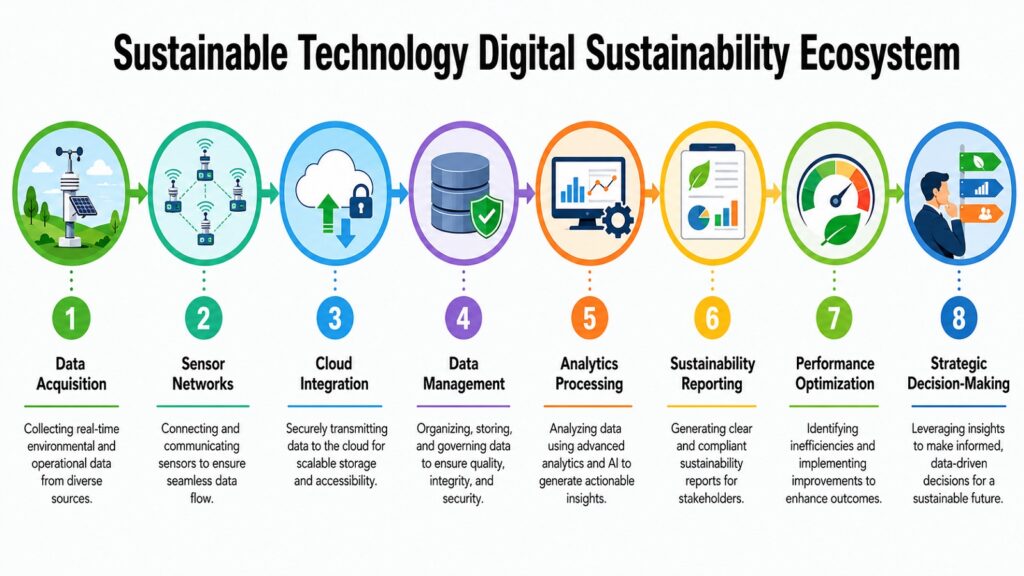
You cannot manage what you cannot measure. This principle sits at the heart of digital sustainability platforms and explains why they have become so important to organizations serious about sustainability. Without reliable data about what is actually happening across operations, supply chains, and environmental systems, sustainability becomes little more than an aspiration. Digital sustainability platforms are the information infrastructure that turns aspiration into action.
They collect, process, and analyze data from building energy systems, manufacturing processes, logistics networks, and environmental monitoring equipment. They present that data in forms useful for decision-making, from operational dashboards for facility managers to ESG reports prepared for investors and regulators. Cloud-based analytics platforms have democratized access to sustainability intelligence. A mid-sized manufacturer that once lacked the IT resources for reporting can now subscribe to platforms providing carbon accounting, energy benchmarking, and waste tracking at an affordable cost.
Digital twin technology is one of the most powerful tools in this space. By creating a real-time virtual replica of a physical facility, digital twins allow operators to simulate changes before implementing them. Arup used digital twin modeling during the design of the Singapore Sports Hub to optimize energy performance before construction began. Carbon accounting software enables companies to measure emissions across Scope 1, 2, and 3 categories with precision, supporting credible net-zero commitments rather than rough estimates.
Sustainability reporting tools support compliance with frameworks such as the Global Reporting Initiative, the Sustainability Accounting Standards Board, and the Task Force on Climate-Related Financial Disclosures. These have moved from voluntary guidelines to practical necessities as investors, regulators, and lenders demand standardized, auditable disclosures. Organizations investing in these platforms build the capabilities to identify where improvement is possible and to communicate progress with the credibility that external audiences require.
Table 5: Digital Sustainability Platforms and Their Functions in Sustainable Technology
| Platform Category / Tool | Primary Function |
| ESG Data Management Software | Aggregates and organizes environmental, social, and governance performance data |
| Carbon Accounting Platforms | Tracks greenhouse gas emissions across operations, supply chains, and products |
| Digital Twin Technology | Creates real-time virtual replicas of facilities to simulate and optimize performance |
| Sustainability Reporting Tools | Automates preparation of compliance reports aligned to GRI, SASB, or TCFD standards |
| Cloud-Based Analytics Platforms | Processes large datasets to identify sustainability trends and improvement areas |
| Environmental Monitoring Networks | Collects air, water, and soil quality data to support environmental compliance |
| Stakeholder Engagement Portals | Communicates sustainability performance transparently to investors and the public |
| Integrated Risk Assessment Tools | Identifies climate-related operational and financial risks for strategic planning |
5. Sustainable Technology in Modern Supply Chain Management
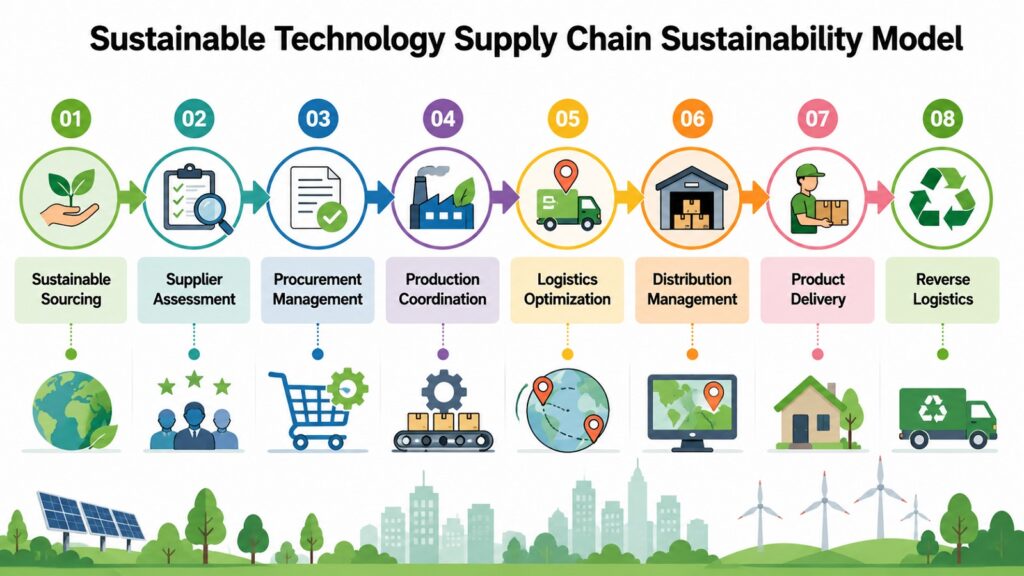
Global supply chains connect raw material sources to manufacturers to consumers, often through dozens of intermediate steps. They have made goods more affordable and accessible than at any point in history, but they have also created an accountability problem that sustainable technology is now helping to solve. When a company declares a commitment to sustainable sourcing, the complexity of global networks makes that commitment very hard to verify without the right tools.
A single consumer product may involve dozens of suppliers across multiple countries, each with its own environmental practices and carbon footprint. Blockchain-based traceability platforms address this by creating tamper-proof records of a product’s journey from raw material to finished good. Walmart used blockchain to trace food products from farm to shelf, cutting the time needed to identify a contamination source from days to seconds. The same approach verifies conflict-mineral provenance, sustainable timber credentials, and fair trade status of agricultural commodities.
Logistics route optimization tools assess traffic patterns and vehicle loads to determine the most fuel-efficient routes. UPS has reported that its route optimization platform conserves millions of gallons of fuel each year by eliminating unnecessary driving. Carbon footprint tracking tools assign emissions to specific products, routes, and supplier relationships, enabling procurement teams to incorporate carbon considerations into sourcing decisions alongside cost. Supplier sustainability scorecards systematically evaluate vendor performance, fostering accountability instead of depending on self-reported data. Inventory demand planning software synchronizes supply volumes with actual demand, reducing the resources allocated to products that remain unsold.
Visibility and accountability throughout the supply chain are becoming competitive necessities as customers, investors, and regulators demand evidence of responsible sourcing. Sustainable technology makes that evidence available, scalable, and credible.
Table 6: Supply Chain Technologies and Their Sustainability Benefits in Sustainable Technology
| Supply Chain Technology / Capability | Sustainability Benefit |
| Blockchain Traceability Platforms | Provides immutable records of product origin and handling for transparent sourcing |
| Logistics Route Optimization Tools | Reduces fuel consumption and delivery emissions through intelligent routing |
| Supplier Sustainability Scorecards | Evaluates vendor environmental and social performance for responsible procurement |
| Inventory Demand Planning Software | Minimizes overstock and waste by matching supply volumes to actual demand |
| Carbon Footprint Tracking Tools | Measures emissions across each stage of the supply chain for targeted reductions |
| Cold Chain Monitoring Systems | Prevents food and pharmaceutical spoilage, reducing waste in temperature-sensitive logistics |
| Ethical Sourcing Platforms | Monitors suppliers for compliance with labor and environmental standards |
| Predictive Demand Analytics | Improves forecasting accuracy to reduce excess production and raw material waste |
6. Sustainable Technology and Long-Term Energy Sustainability Systems
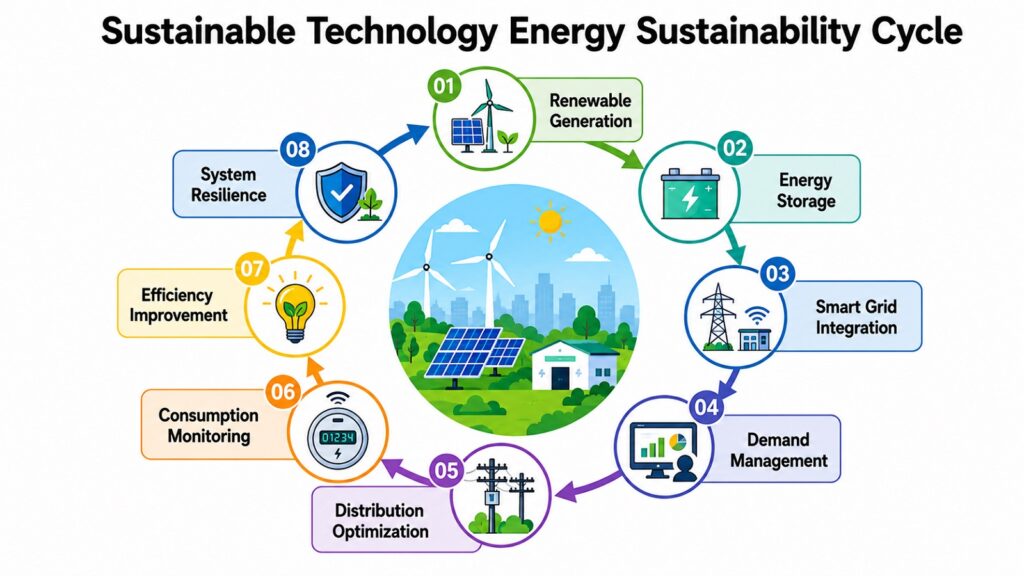
Energy is the lifeblood of modern civilization. It heats homes, powers hospitals, runs factories, and moves people and goods across the planet. The way humanity generates and uses energy is also the single largest driver of greenhouse gas emissions responsible for climate change. Transforming global energy systems is both the most urgent and the most challenging dimension of sustainable technology.
Traditional energy systems built around coal, oil, and natural gas carry costs that are increasingly hard to ignore. Carbon emissions from combustion are the primary cause of climate change. Air pollution from coal causes millions of premature deaths each year. Price volatility in fossil fuel markets creates economic instability that falls hardest on lower-income households and energy-importing nations. Renewable energy technologies have responded to these pressures by maturing rapidly. Solar photovoltaic costs have fallen by more than 90 percent since 2010, making solar the cheapest source of new electricity in most parts of the world. Wind energy has followed a similar path.
The challenge has always been intermittency. Energy storage addresses this by capturing surplus renewable generation for use when output is low. Tesla’s Hornsdale Power Reserve in South Australia demonstrated that large-scale battery storage can provide grid stability services faster and more cost-effectively than conventional gas peaker plants. Smart grid technology uses digital sensors and automated controls to balance supply and demand in real time, integrating rooftop solar, coordinating electric vehicle charging, and shifting flexible industrial loads to periods of peak renewable supply.
Microgrids extend grid resilience to isolated communities and critical facilities. Energy management systems in buildings and factories monitor consumption continuously and implement savings automatically. Green hydrogen uses surplus renewable electricity to produce clean fuel for sectors like steel manufacturing and long-haul freight that are difficult to electrify directly. Energy sustainability remains one of the most visible components of sustainable technology because it touches every sector of human activity.
Table 7: Energy Sustainability Technologies and Their Contributions in Sustainable Technology
| Energy Technology / System | Primary Contribution to Sustainability |
| Solar Photovoltaic Systems | Generates clean electricity from sunlight, reducing dependence on fossil fuels |
| Wind Energy Turbines | Produces renewable power with minimal land impact and near-zero operational emissions |
| Lithium-Ion Battery Storage | Stores surplus renewable energy for use during periods of low generation |
| Smart Grid Technology | Balances electricity supply and demand dynamically, improving efficiency and reliability |
| Microgrids | Provides energy independence for communities and facilities, improving resilience |
| Energy Management Systems | Monitors and controls building and industrial energy use to reduce consumption |
| Green Hydrogen Production | Uses renewable electricity to produce clean fuel for hard-to-electrify sectors |
| Advanced Metering Infrastructure | Provides real-time consumption data to support smarter energy use decisions |
7. Sustainable Technology in Agricultural Innovation and Food Systems
Feeding a global population expected to reach nearly 10 billion by 2050 is one of the defining challenges of this century. Agriculture already uses about 70 percent of the world’s freshwater and accounts for roughly a quarter of global greenhouse gas emissions. Expanding conventional production to meet growing demand would place enormous additional strain on land, water, and the climate. Sustainable technology offers a different path.
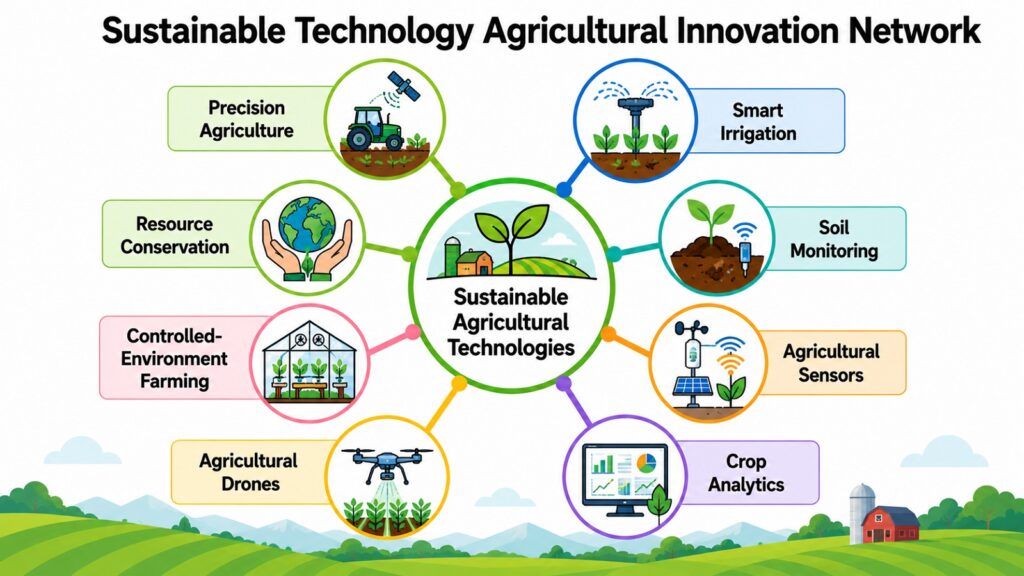
Precision agriculture platforms use GPS positioning, remote sensing, and machine learning to manage crop inputs accurately. Rather than applying fertilizers and pesticides uniformly across a field, precision systems analyze soil variability at the sub-meter level and apply only what is needed, where it is needed. This reduces fertilizer runoff that pollutes waterways, cuts pesticide use that harms pollinators and soil health, and saves farmers money while improving yields.
Smart irrigation systems are among the most impactful agricultural technologies in water-stressed regions. When drip irrigation is paired with soil moisture sensors and weather data, it can reduce agricultural water consumption by 30 to 50 percent. Israel has become a global leader in smart irrigation, achieving some of the highest crop yields per unit of water used anywhere in the world.
Agricultural drones equipped with multispectral cameras survey thousands of acres in a single flight, identifying crop stress, disease, or nutrient deficiency that would take weeks to find manually. Controlled-environment agriculture, including vertical farms, enables year-round production with dramatically reduced water and land requirements. AeroFarms in Newark, New Jersey, grows leafy greens using 95 percent less water than conventional field production in a converted warehouse, demonstrating this approach at commercial scale.
Technology is also improving livestock management and reducing food waste. Livestock monitoring platforms track animal health and feed conversion efficiency, reducing resource waste in meat and dairy systems. Food waste tracking software helps retailers identify where losses occur and take targeted action. The role of technology in sustainable food production will only expand as population pressure and climate change intensify demands on global agriculture.
Table 8: Agricultural Technologies and Their Sustainability Benefits in Sustainable Technology
| Agricultural Technology / Practice | Sustainability Benefit |
| Precision Agriculture Platforms | Applies inputs only where needed, cutting fertilizer, pesticide, and water use |
| Smart Drip Irrigation Systems | Delivers water directly to plant roots, reducing water waste significantly |
| Agricultural Drone Technology | Monitors crop health and applies treatments precisely, minimizing chemical use |
| Soil Sensors and Analytics | Tracks soil moisture and nutrient levels to support data-driven crop decisions |
| Controlled-Environment Agriculture | Enables year-round crop production with dramatically reduced water and land use |
| Livestock Monitoring Platforms | Tracks animal health and feed efficiency to reduce waste in livestock systems |
| Crop Rotation Management Software | Plans rotations to maintain soil health and reduce chemical dependency over time |
| Satellite Crop Monitoring | Provides large-scale field analysis to identify stress, disease, and yield gaps |
8. Sustainable Technology for Governance and Sustainability Management
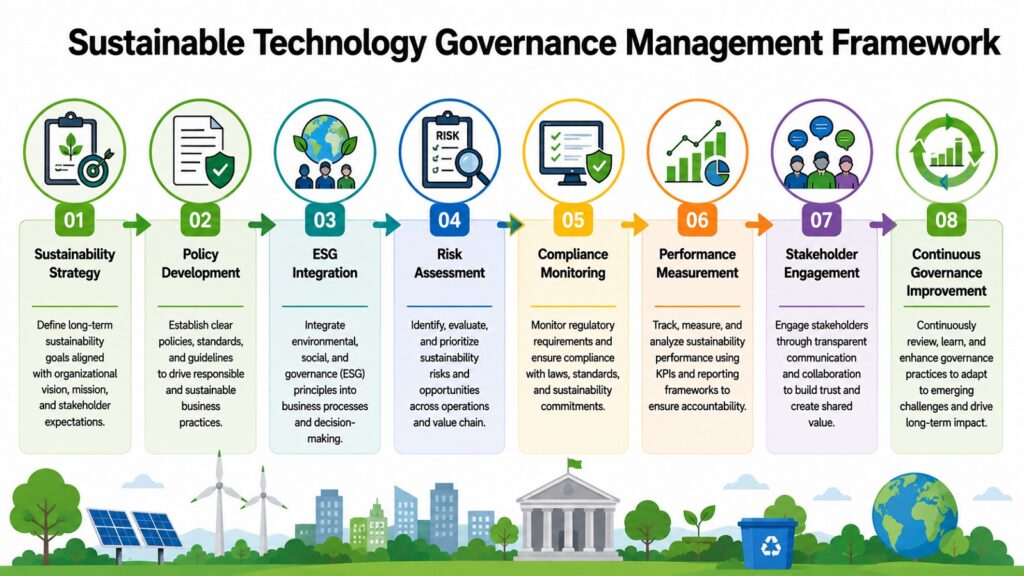
Technology can optimize energy systems, clean up supply chains, and transform agriculture. But without governance structures to set direction, measure progress, and hold organizations accountable, even sophisticated technical solutions can fall short. Governance is the connective tissue that holds sustainable technology strategies together, and a new generation of digital tools is making it more effective than ever.
ESG management platforms have become essential for organizations tracking environmental, social, and governance performance across complex operations. These platforms aggregate data from multiple sources, normalize it against recognized frameworks, and support disclosures that meet the expectations of investors, regulators, and rating agencies. As mandatory ESG reporting expands in the EU, the US, and other markets, producing accurate, auditable disclosures has become a basic operational requirement, not a competitive edge. Regulatory compliance software helps organizations navigate a growing web of environmental obligations — from emissions trading schemes to deforestation due diligence laws — that vary by jurisdiction and are too complex to manage manually.
Sustainability risk assessment tools help organizations identify the physical and transition risks linked to climate change. Physical risks include extreme weather events and rising sea levels. Transition risks include policy changes and shifting market preferences as economies decarbonize. Performance dashboards give leadership teams real-time visibility into sustainability KPIs. Materiality assessment platforms help organizations focus on the issues that matter most to their stakeholders, directing resources toward areas of greatest impact.
Effective governance transitions sustainability from merely a communications activity to a strategic discipline that is ingrained in culture and decision-making processes. Internal audit instruments confirm that programs fulfill their commitments. AI-driven analytics reveal patterns within extensive datasets that are not readily identifiable by human analysts. Governance is the mechanism that guarantees sustainable technology investments result in enduring, verifiable advancements instead of just well-meaning distractions.
Table 9: Governance and Sustainability Management Technologies in Sustainable Technology
| Governance / Management Technology | Primary Purpose |
| ESG Reporting Platforms | Automates sustainability disclosures for regulatory and investor stakeholder audiences |
| Regulatory Compliance Software | Tracks and manages compliance obligations across multiple environmental regulations |
| Sustainability Risk Assessment Tools | Identifies and quantifies climate and operational risks to guide strategic planning |
| Materiality Assessment Platforms | Helps organizations prioritize the sustainability issues most relevant to stakeholders |
| Stakeholder Communication Systems | Streamlines transparent reporting to investors, regulators, and the public |
| Internal Audit and Monitoring Tools | Verifies that sustainability programs deliver on commitments and stated targets |
| Performance Dashboard Software | Provides real-time visualization of sustainability KPIs for leadership teams |
| AI-Based Sustainability Analytics | Analyzes large data sets to surface insights for continuous sustainability improvement |
Conclusion: Building a Better Future With Sustainable Technology
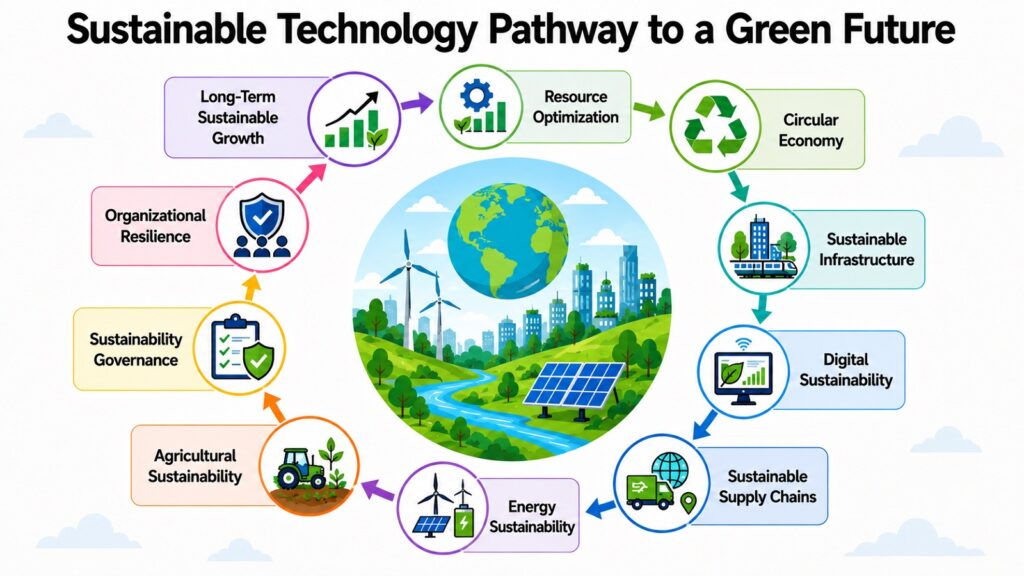
Sustainable technology is not a single innovation. It is a collection of technologies, operational practices, and governance frameworks working together toward a shared goal: meeting human needs while preserving the natural systems that life depends on. The eight pillars explored in this article represent the core domains through which that goal is being pursued across industries and societies.
These pillars of sustainable technology do not stand alone. Resource optimization supplies the efficiency gains that circular economy models need to be viable. Digital platforms provide the intelligence that governance systems use to measure and communicate progress. Energy sustainability underpins infrastructure and agricultural systems. Supply chain accountability connects commitments at headquarters to practices followed across global networks. Each pillar reinforces the others, and weaknesses in any one limit what the framework can achieve.
Continued technological advancement will deepen the impact of each pillar. Artificial intelligence will make resource optimization smarter and faster. Advanced materials science will expand what is possible in circular economy applications. The tools available to organizations and governments pursuing sustainable development will become more powerful, more accessible, and more integrated over time. Governance frameworks, regulatory incentives, institutional investment, and cultural shifts will shape how effectively these tools are deployed.
The societies and organizations that understand the interconnected nature of sustainable technology and commit to building across all eight pillars will be best positioned to thrive in a world where sustainability is not optional but essential. The green future that sustainable technology points toward is not distant. It is being built right now, one system, one facility, one decision at a time.
Table 10: Long-Term Contributions of Each Sustainable Technology Pillar to a Sustainable Future
| Pillar | Long-Term Contribution to a Sustainable Future |
| Resource Optimization Systems | Builds industrial and operational efficiency that reduces environmental strain permanently |
| Circular Economy Technologies | Reduces dependence on virgin resources and minimizes waste at the systems level |
| Sustainable Infrastructure | Creates the physical foundation for low-carbon communities and economies |
| Digital Sustainability Platforms | Enables ongoing measurement and accountability across every sustainability domain |
| Sustainable Supply Chains | Drives global responsibility for emissions, ethics, and resource use across industries |
| Energy Sustainability Systems | Accelerates the global shift to clean energy while ensuring reliable power access |
| Agricultural Innovation | Secures food production for future generations while protecting land and water |
| Governance and Sustainability Management | Embeds sustainability into organizational strategy and institutional accountability |