Table of Contents
Introduction: Best Samsung Smartphones in 2026: A Complete Buyer’s Guide
Credit: iken3
Samsung holds a commanding position in the global smartphone market. It consistently ranks among the top two manufacturers worldwide by both shipment volume and revenue. Known for pushing boundaries across every price segment, Samsung is one of the most important smartphone brands. It offers everything from budget-friendly A-series handsets to premium foldables and flagship Ultra models. What sets Samsung apart is its relentless focus on display technology, camera innovation, and AI-powered software — all packaged in devices that appeal to a remarkably broad range of users.
Whether you are a photography enthusiast hunting for the sharpest zoom, a content creator who needs a big, vivid screen, a business professional who depends on multitasking and security, a mobile gamer chasing the best GPU performance, a student looking for a reliable everyday device, or simply someone who wants a dependable phone that handles calls, messages, and social media without fuss, Samsung has a model designed with you in mind.
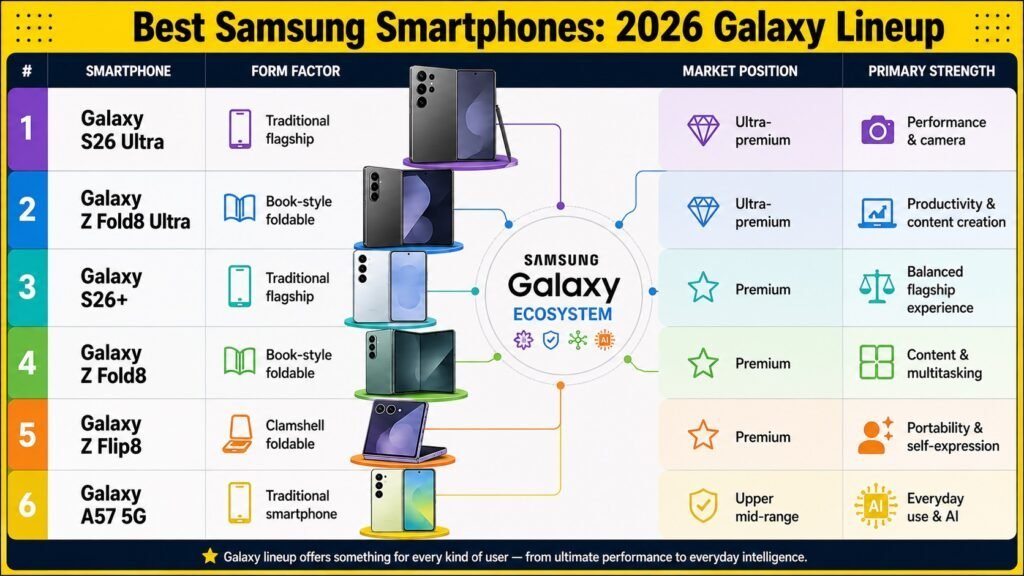
In this guide, we cover six of the best Samsung smartphones available right now: the Galaxy S26 Ultra, the Galaxy Z Fold8 Ultra, the Galaxy S26+, the Galaxy Z Fold8, the Galaxy Z Flip8, and the Galaxy A57 5G. Each model addresses a different set of priorities and budgets, so by the end of this article you should have a clear picture of which one best matches your needs.
Samsung vs. Major Smartphone Competitors
| Competitor Brand | Key Strength vs. Samsung |
| Apple | Samsung’s closest rival in the premium segment; leads on ecosystem integration and iOS. |
| Offers clean Android with strong AI via the Pixel series; competitive cameras. | |
| OnePlus | Known for fast charging and smooth software; popular in mid-to-high tier. |
| Xiaomi | Strong value for money; competitive specs at aggressive prices globally. |
| Oppo | Popular in Asia; innovates on charging speed and camera software. |
| Vivo | Focuses on camera hardware, especially telephoto and low-light performance. |
| Sony | Targets enthusiasts with pro-grade cameras and unique form factors. |
| Motorola | Offers reliable mid-range devices and long battery life at competitive prices. |
1. Best Samsung Smartphones: Samsung Galaxy S26 Ultra — Best for Power Users
Credit: iken3
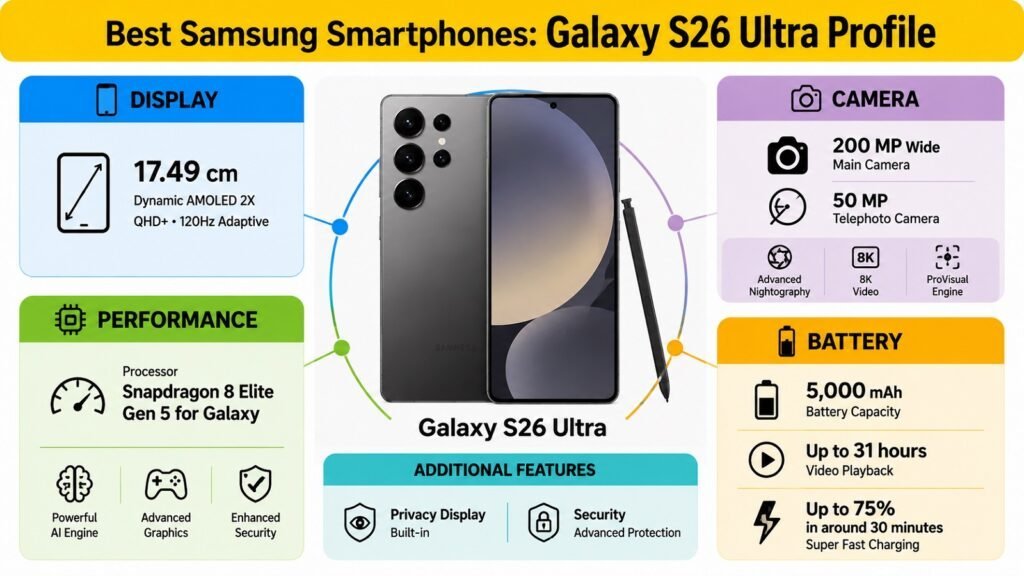
Samsung Galaxy S26 Ultra is Samsung’s most capable mainstream smartphone for 2026 and a worthy entry on any list of the best Samsung smartphones. Announced in February and available from March 11, it is powered by the Snapdragon 8 Elite Gen 5 — the fastest mobile chipset Samsung has ever shipped in a phone.
The headline additions this year include a 200MP main camera with a brighter f/1.4 aperture, 60W wired charging (up from 45W), 25W wireless charging, and the world’s first hardware Privacy Display. It is not without trade-offs — the aluminum frame replaces last year’s titanium, and the price starts at $1,299. However, for users who want the absolute best camera setup, the longest software support (seven major Android upgrades), and Galaxy AI in its most complete form, the S26 Ultra stands alone.
Best Samsung Smartphones: Samsung Galaxy S26 Ultra — Major Specifications
| Specification | Details |
| 🧠 Chipset (Processor + GPU) | Qualcomm Snapdragon 8 Elite Gen 5 (SM8850-AC, 3 nm); Octa-core (2×4.74 GHz Oryon V3 Phoenix L + 6×3.62 GHz Oryon V3 Phoenix M); Adreno 840 GPU |
| ⚙️ Operating System | Android 16 with One UI 8.5; up to 7 major Android upgrades |
| 💾 RAM | 12 GB LPDDR5X (256 GB and 512 GB variants); 16 GB LPDDR5X (1 TB variant) |
| 🗄️ Storage | 256 GB / 512 GB / 1 TB (UFS 4.0); no microSD slot |
| 🖥️ Display | 6.9-inch Dynamic LTPO AMOLED 2X; 3120 x 1440 (QHD+, ~498 ppi); adaptive 1–120 Hz; 2600 nits peak brightness; Corning Gorilla Armor 2 with DX anti-reflective coating; Privacy Display (hardware) |
| 📸 Camera Setup | Rear: 200 MP f/1.4 wide (1/1.3″, OIS) + 50 MP f/1.9 ultrawide (1/2.5″) + 10 MP telephoto 3x OZ (f/2.4) + 50 MP periscope telephoto 5x OZ (f/2.9, 1/2.52″); Front: 12 MP f/2.2 |
| 🔋 Battery & Charging | 5,000 mAh; 60W wired Super Fast Charging; 25W wireless; 4.5W reverse wireless; no charger in box |
| 📡 Connectivity | 5G (Sub-6 / mmWave in US); Wi-Fi 7 (tri-band); Bluetooth 6.0; NFC; GPS / GLONASS / BeiDou / Galileo; USB 3.2 Gen 1 (USB-C); Dual Nano-SIM + eSIM |
| 🛡️ Build & Protection | Glass front (Gorilla Armor 2), glass back (Gorilla Glass Victus 2), aluminum frame; IP68 (1.5 m / 30 min); integrated S Pen stylus; 163.6 x 78.1 x 7.9 mm |
| ⚖️ Weight | 214 g |
Best Samsung Smartphones: Samsung Galaxy S26 Ultra — Who Should Buy It?
| User Type | Good Fit? & Why? |
|---|---|
| Students | ⚠️ — High price makes it hard to justify, though excellent battery and seven years of software support add long-term value. |
| Everyday Users | ✅ — Handles all daily tasks effortlessly; excellent display, battery, and Galaxy AI tools enhance routine use. |
| Business Professionals | ✅ — Top-tier performance, S Pen for notes, Samsung DeX support, Privacy Display, and long software support make it a strong productivity device. |
| Photography Enthusiasts | ✅ — 200 MP main camera, f/1.4 aperture, dual telephoto lenses (3x and 5x), and improved Nightography deliver flagship photography results. |
| Content Creators | ✅ — 8K video, 120 Hz QHD+ display, S Pen, and ample storage options make it an excellent all-in-one creation tool. |
| Mobile Gamers | ✅ — Snapdragon 8 Elite Gen 5 with Adreno 840, 120 Hz adaptive display, large battery, and ray tracing support offer a top-tier gaming experience. |
Best Samsung Smartphones: Samsung Galaxy S26 Ultra — Pros & Cons
| Pros | Cons |
| ✅ World’s first hardware Privacy Display | ❌ Starts at $1,299 — expensive for most buyers |
| ✅ 200 MP f/1.4 camera with dual telephoto zoom | ❌ Aluminum frame instead of titanium used in predecessor |
| ✅ 60W wired + 25W wireless charging | ❌ No charger included in the retail box |
| ✅ Seven major Android upgrades guaranteed | ❌ Large size and weight (214 g) may not suit everyone |
2. Best Samsung Smartphones: Samsung Galaxy Z Fold8 Ultra — Best for Productivity
Credit: iken3
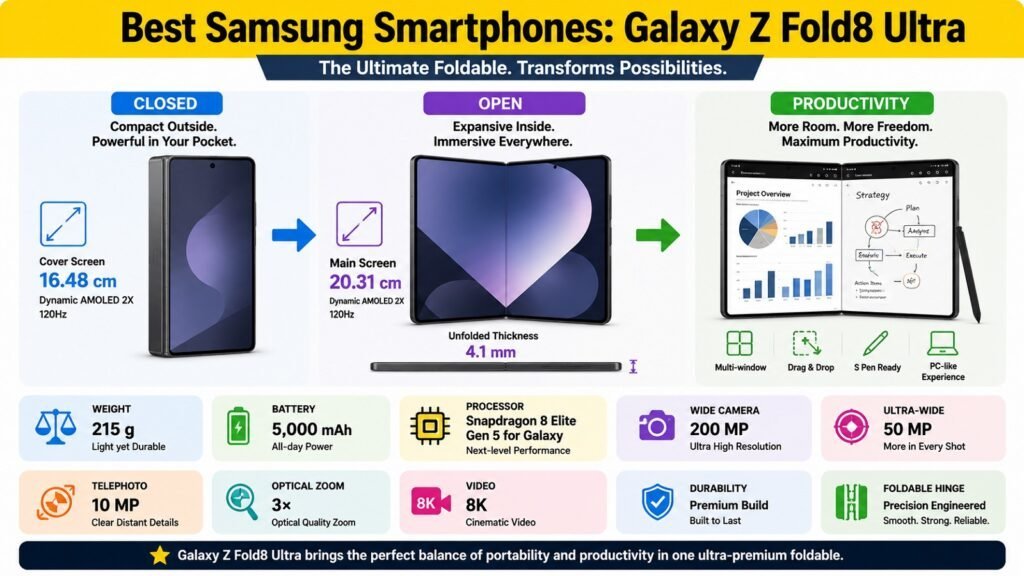
The Galaxy Z Fold8 Ultra, announced on July 22, 2026 and available from August 7, is Samsung’s first-ever Ultra-branded foldable — and it earns the title. It carries the same 200 MP camera system as the S26 Ultra, wrapped inside the thinnest Galaxy Fold design to date at just 4.1 mm when unfolded. At 215 g, it is remarkably light for a device with an 8-inch main display and a 6.5-inch cover screen.
The Snapdragon 8 Elite Gen 5, 5,000 mAh battery, and Android 17 with One UI 9 round out a seriously capable package. Worth knowing before you buy: it carries an IP48 rating rather than the IP68 found on conventional flagships, and it does not support the S Pen. At $2,099, it sits at the very top of the foldable price ladder, but for professionals who want tablet-level multitasking in a phone-sized package, few devices come close.
Best Samsung Smartphones: Samsung Galaxy Z Fold8 Ultra — Major Specifications
| Specification | Details |
| 🧠 Chipset (Processor + GPU) | Qualcomm Snapdragon 8 Elite Gen 5 for Galaxy (3 nm); Octa-core (2×4.7 GHz Oryon V3 Prime + 6×3.6 GHz Oryon V3 Performance); Adreno 840 GPU |
| ⚙️ Operating System | Android 17 with One UI 9; up to 7 major Android upgrades |
| 💾 RAM | 12 GB LPDDR5X (256 GB / 512 GB variants); 16 GB LPDDR5X (1 TB variant) |
| 🗄️ Storage | 256 GB / 512 GB / 1 TB; no microSD slot |
| 🖥️ Display | Main: 8.0-inch Dynamic LTPO AMOLED 2X; 2504 x 2256 pixels (~421 ppi); 120 Hz adaptive; Flex Titanium layer; Cover: 6.5-inch AMOLED; 2560 x 1080; 120 Hz |
| 📸 Camera Setup | Rear: 200 MP f/1.4 wide (OIS) + 50 MP ultrawide + 10 MP telephoto 3x OZ; Front (main screen): 4 MP under-display; Front (cover screen): Dual 10 MP |
| 🔋 Battery & Charging | 5,000 mAh; 45W wired; 15W wireless; reverse wireless charging supported |
| 📡 Connectivity | 5G (Sub-6); Wi-Fi 7; Bluetooth 6.0; NFC; GPS / GLONASS / BeiDou / Galileo; USB-C |
| 🛡️ Build & Protection | Armor Aluminum 2 frame; Gorilla Glass Victus Ceramic 3 outer panels; Flex Titanium display layer; IP48 (dust and water splash resistance); 163.4 x 75.3 x 7.9 mm (folded approx.) |
| ⚖️ Weight | 215 g (4.1 mm unfolded thickness — thinnest Galaxy Fold to date) |
Best Samsung Smartphones: Samsung Galaxy Z Fold8 Ultra — Who Should Buy It?
| User Type | Good Fit? & Why? |
|---|---|
| Students | ⚠️ — At $2,099, this is beyond most student budgets, though the large screen could replace both a phone and a tablet. |
| Everyday Users | ⚠️ — Capable of everything daily use demands, but its size and price are overkill for routine tasks. |
| Business Professionals | ✅ — Split-screen multitasking, Samsung DeX, large 8-inch canvas, and seven OS upgrades make it a true productivity powerhouse. |
| Photography Enthusiasts | ✅ — 200 MP main camera and dual-front camera system give exceptional flexibility for both professional shots and selfies. |
| Content Creators | ✅ — Large high-resolution display, capable video recording, and split-screen editing tools suit creators who work on the go. |
| Mobile Gamers | ✅ — Adreno 840 GPU, 120 Hz display, and 5,000 mAh battery provide a premium gaming experience on a near-tablet screen. |
Best Samsung Smartphones: Samsung Galaxy Z Fold8 Ultra — Pros & Cons
| Pros | Cons |
| ✅ Thinnest Galaxy Fold ever at 4.1 mm unfolded | ❌ IP48 rating is not as protective as IP68 |
| ✅ 200 MP Ultra-level camera system on a foldable | ❌ No S Pen support despite the Ultra branding |
| ✅ 8-inch main display with near-invisible crease | ❌ Priced at $2,099 — the most expensive phone in this guide |
| ✅ Android 17 with seven major OS upgrade promise | ❌ 45W wired charging is slower than the S26 Ultra’s 60W |
3. Best Samsung Smartphones: Samsung Galaxy S26+ — Best for Balanced Performance
Credit: iken3
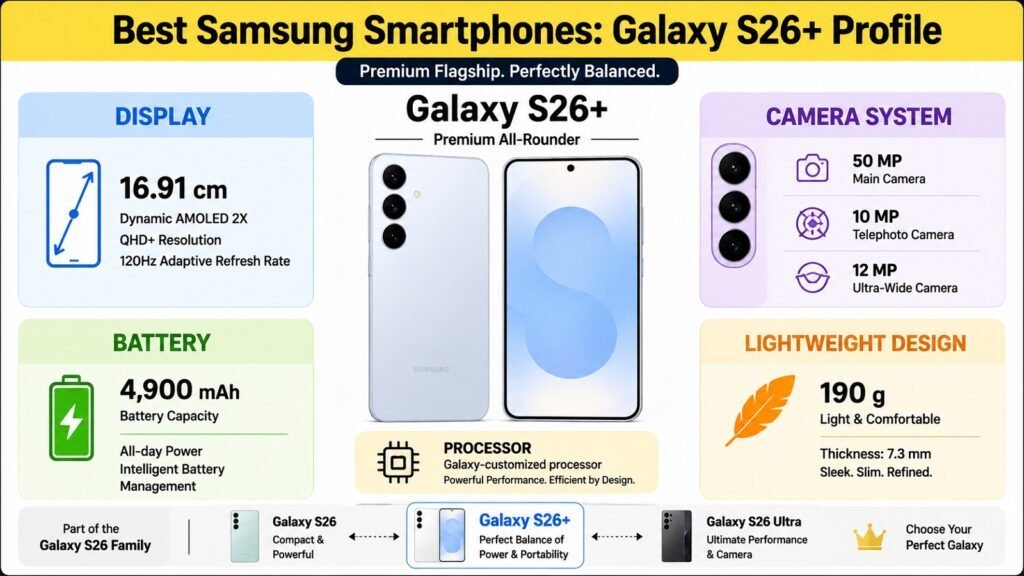
The Galaxy S26+ sits in a familiar position — between the standard S26 and the Ultra, offering a larger screen and bigger battery than the entry model without the steep pricing of the Ultra. Released on March 6, 2026, it carries a 6.7-inch QHD+ AMOLED display with a 2600-nit peak, 4,900 mAh battery, and 45W wired charging.
In the US and China, it runs the Snapdragon 8 Elite Gen 5, while other markets receive the Exynos 2600. The triple camera system is identical to the base S26, so buyers who specifically need the best possible camera should look at the Ultra instead. That said, the S26+ delivers a flagship experience — fast performance, an excellent display, Android 16 with One UI 8.5, and seven years of OS updates — at a price of around $1,099 to $1,299 depending on storage, making it a strong mid-flagship choice.
Best Samsung Smartphones: Samsung Galaxy S26+ — Major Specifications
| Specification | Details |
| 🧠 Chipset (Processor + GPU) | Qualcomm Snapdragon 8 Elite Gen 5 (3 nm) in US/China; Samsung Exynos 2600 (2 nm) in other markets; Adreno 840 (Snapdragon) or Xclipse 960 (Exynos) GPU |
| ⚙️ Operating System | Android 16 with One UI 8.5; up to 7 major Android upgrades |
| 💾 RAM | 12 GB LPDDR5X |
| 🗄️ Storage | 256 GB / 512 GB (UFS 4.0); no microSD slot |
| 🖥️ Display | 6.7-inch Dynamic LTPO AMOLED 2X; 3120 x 1440 (QHD+, ~516 ppi); adaptive 1–120 Hz; 2600 nits peak; Corning Gorilla Glass Victus 2; flat display |
| 📸 Camera Setup | Rear: 50 MP f/1.8 wide (1/1.56″, OIS, PDAF) + 12 MP f/2.2 ultrawide (1/2.55″) + 10 MP telephoto 3x OZ (f/2.4, OIS); Front: 12 MP f/2.2 PDAF |
| 🔋 Battery & Charging | 4,900 mAh; 45W wired Super Fast Charging; 20W wireless; 4.5W reverse wireless; no charger included |
| 📡 Connectivity | 5G (Sub-6 / mmWave in US); Wi-Fi 7; Bluetooth 5.4; NFC; GPS / GLONASS / BeiDou / Galileo; USB 3.2 Gen 1 (USB-C); Dual Nano-SIM + eSIM |
| 🛡️ Build & Protection | Glass front and back (Gorilla Glass Victus 2), aluminum frame; IP68 (1.5 m / 30 min); 158.4 x 75.8 x 7.3 mm |
| ⚖️ Weight | 190 g |
Best Samsung Smartphones: Samsung Galaxy S26+ — Who Should Buy It?
| User Type | Good Fit? & Why? |
|---|---|
| Students | ⚠️ — Good performance and long support life, but the price is still in the upper range for student budgets. |
| Everyday Users | ✅ — Larger display and bigger battery than the S26 make daily browsing, streaming, and social media more comfortable. |
| Business Professionals | ✅ — QHD+ display, excellent multitasking, Samsung DeX support, and seven OS upgrades cover professional needs well. |
| Photography Enthusiasts | ⚠️ — The triple camera is solid but lacks the 200 MP sensor and dual telephoto system of the Ultra. |
| Content Creators | ✅ — Big, bright QHD+ display and 8K video capability make it a capable creation device at a more reasonable price than the Ultra. |
| Mobile Gamers | ✅ — Flagship chipset, 120 Hz QHD+ display, and a 4,900 mAh battery handle extended gaming sessions comfortably. |
Best Samsung Smartphones: Samsung Galaxy S26+ — Pros & Cons
| Pros | Cons |
| ✅ 6.7-inch QHD+ display with 2600-nit peak brightness | ❌ Camera system is identical to the cheaper S26 model |
| ✅ 45W wired charging — faster than the base S26 | ❌ No S Pen support, no Privacy Display feature |
| ✅ IP68 dust and water resistance | ❌ Exynos 2600 in most global markets (not Snapdragon) |
| ✅ Seven major Android upgrades with One UI 8.5 | ❌ Mid-point pricing makes the value case harder vs. S26 or Ultra |
4. Best Samsung Smartphones: Samsung Galaxy Z Fold8 — Best for Creative Multitasking
Credit: iken3
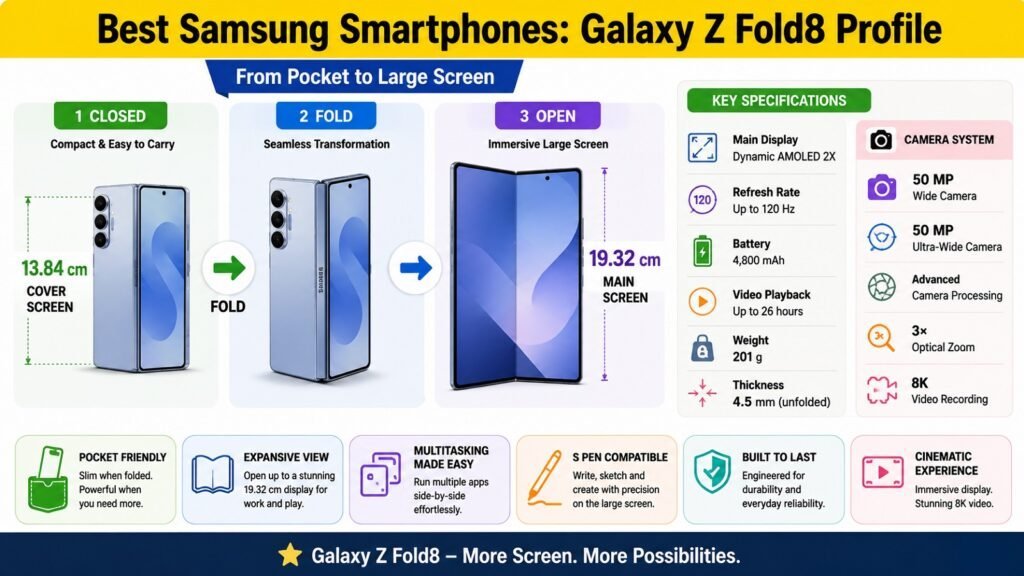
The Galaxy Z Fold8 is Samsung’s most dramatic rethinking of the Fold form factor in years. Rather than continuing the tall, book-style layout of previous generations, the Fold8 adopts a shorter, wider design — more like a landscape tablet when open, with a 4:3 inner display aspect ratio. At 201 g and 4.5 mm unfolded, it is the lightest and thinnest Fold in the lineup’s history.
The 7.6-inch main display and 5.5-inch cover screen offer a distinct experience from the Fold8 Ultra. One notable trade-off: the Fold8 has only two rear cameras (dual 50 MP system) with no telephoto, unlike the Ultra’s three-camera setup. Battery capacity stands at 4,800 mAh with 45W wired and 20W wireless charging. Starting at $1,899, it is a bold choice for users who want a foldable with a fresh form factor.
Best Samsung Smartphones: Samsung Galaxy Z Fold8 — Major Specifications
| Specification | Details |
| 🧠 Chipset (Processor + GPU) | Qualcomm Snapdragon 8 Elite Gen 5 for Galaxy (3 nm); Octa-core CPU; Adreno 840 GPU |
| ⚙️ Operating System | Android 17 with One UI 9; up to 7 major Android upgrades |
| 💾 RAM | 12 GB LPDDR5X (up to 16 GB in 1 TB variant) |
| 🗄️ Storage | 256 GB / 512 GB / 1 TB; no microSD slot |
| 🖥️ Display | Main: 7.6-inch Foldable Dynamic LTPO AMOLED 2X; 2448 x 1848 pixels; 120 Hz; 4:3 aspect ratio; Flex Titanium layer; Cover: 5.5-inch AMOLED; 2340 x 1080; 120 Hz; Gorilla Glass Ceramic 3 |
| 📸 Camera Setup | Rear: 50 MP f/1.8 wide (OIS, PDAF) + 50 MP ultrawide; no telephoto; Front (main screen): 4 MP under-display; Front (cover screen): 10 MP |
| 🔋 Battery & Charging | 4,800 mAh; 45W wired; 20W wireless; 4.5W reverse wireless |
| 📡 Connectivity | 5G (Sub-6); Wi-Fi 7; Bluetooth 6.0; NFC; GPS / GLONASS / BeiDou; USB-C |
| 🛡️ Build & Protection | Armor Aluminum 2 frame; Gorilla Glass Ceramic 3 outer; Flex Titanium display layer; IP48; Unfolded: 161.4 x 123.9 x 4.5 mm; Folded: 81.9 x 123.9 x 9.7 mm |
| ⚖️ Weight | 201 g |
Best Samsung Smartphones: Samsung Galaxy Z Fold8 — Who Should Buy It?
| User Type | Good Fit? & Why? |
|---|---|
| Students | ⚠️ — The $1,899 starting price is steep for most students, but the 4:3 display is excellent for reading, note-taking, and streaming. |
| Everyday Users | ⚠️ — Versatile for daily use but bulkier when folded compared to a standard slab phone. |
| Business Professionals | ✅ — Wide 4:3 display suits spreadsheets, documents, and split-screen productivity; Samsung DeX adds desktop flexibility. |
| Photography Enthusiasts | ❌ — No telephoto lens is a significant limitation for zoom photography compared to the Fold8 Ultra or S26 Ultra. |
| Content Creators | ✅ — The unique 4:3 display format and dual 50 MP cameras suit video watching and social content creation on a large canvas. |
| Mobile Gamers | ✅ — Snapdragon 8 Elite Gen 5, Adreno 840, and a wide display deliver an immersive gaming experience in landscape orientation. |
Best Samsung Smartphones: Samsung Galaxy Z Fold8 — Pros & Cons
| Pros | Cons |
| ✅ Lightest and thinnest Galaxy Fold ever (201 g, 4.5 mm) | ❌ No telephoto camera limits zoom capability |
| ✅ Unique 4:3 wide inner display — great for landscape content | ❌ IP48 rating offers limited water protection |
| ✅ Snapdragon 8 Elite Gen 5 with Adreno 840 GPU | ❌ No S Pen support |
| ✅ Seven major OS updates — Android 17 out of the box | ❌ Wide form factor when folded may not fit standard pockets |
5. Best Samsung Smartphones: Samsung Galaxy Z Flip8 — Best for Style and Portability
Credit: iken3
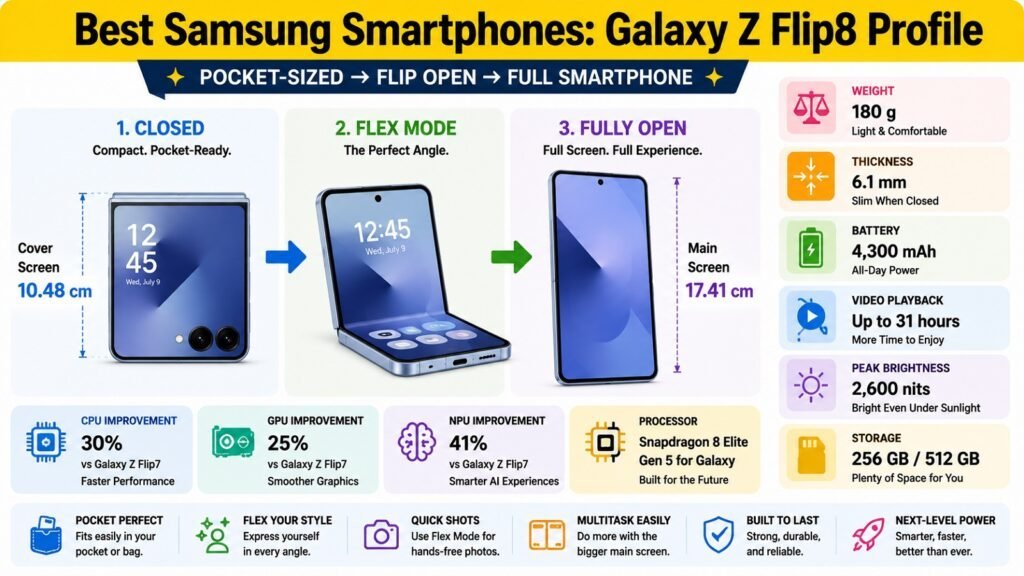
The Galaxy Z Flip8 launched alongside the Fold8 lineup on July 22, 2026, and is available from August 7. It is the thinnest and lightest Flip Samsung has made — 6.1 mm slim when open and 180 g — thanks to an improved hinge and refined chassis. The 6.9-inch main display and 4.1-inch FlexWindow cover screen are identical in size to the Flip7, but the Flip8 gets a meaningfully larger 4,300 mAh battery and ships with Android 17 on One UI 9.
The Exynos 2600 powers most international markets, while Snapdragon 8 Elite Gen 5 variants are available in some regions. Camera hardware stays at 50 MP + 12 MP on the rear with a 10 MP front sensor, which is solid but unspectacular. Starting at $1,199, it is the most accessible foldable in Samsung’s lineup and an excellent choice for anyone who values compact style without sacrificing modern performance.
Best Samsung Smartphones: Samsung Galaxy Z Flip8 — Major Specifications
| Specification | Details |
| 🧠 Chipset (Processor + GPU) | Exynos 2600 (2 nm) in most markets; Qualcomm Snapdragon 8 Elite Gen 5 (3 nm) in select regions; Xclipse 960 or Adreno 840 GPU depending on variant |
| ⚙️ Operating System | Android 17 with One UI 9; up to 7 major Android upgrades |
| 💾 RAM | 12 GB LPDDR5X |
| 🗄️ Storage | 256 GB / 512 GB; no microSD slot |
| 🖥️ Display | Main: 6.9-inch Foldable Dynamic LTPO AMOLED 2X; 2640 x 1080; 120 Hz adaptive; Cover: 4.1-inch FlexWindow AMOLED; 748 x 512; 60 Hz |
| 📸 Camera Setup | Rear: 50 MP f/1.8 wide (OIS, PDAF) + 12 MP ultrawide; Front: 10 MP f/2.2 |
| 🔋 Battery & Charging | 4,300 mAh; 25W wired; 15W wireless; reverse wireless charging supported |
| 📡 Connectivity | 5G (Sub-6); Wi-Fi 6E; Bluetooth 5.4; NFC; GPS; USB-C 3.2 |
| 🛡️ Build & Protection | Armor Aluminum 2 frame; Flex Glass outer panels; improved hinge; IP48; Unfolded: 166.9 x 71.9 x 6.1 mm; Folded: 85.5 x 71.9 x 13.5 mm approx. |
| ⚖️ Weight | 180 g |
Best Samsung Smartphones: Samsung Galaxy Z Flip8 — Who Should Buy It?
| User Type | Good Fit? & Why? |
|---|---|
| Students | ✅ — The $1,199 price is more accessible than other foldables; compact design is easy to carry; large FlexWindow reduces phone-opening frequency. |
| Everyday Users | ✅ — Stylish design, large cover screen for quick interactions, and a full flagship experience when unfolded suit most daily activities. |
| Business Professionals | ⚠️ — Compact and connected, but the smaller unfolded screen and lack of S Pen limit productivity compared to Fold models. |
| Photography Enthusiasts | ⚠️ — 50 MP main camera is decent, but no telephoto zoom limits versatility for serious photography. |
| Content Creators | ⚠️ — 6.9-inch display is good for viewing, but limited rear cameras and smaller form factor restrict professional content creation. |
| Mobile Gamers | ⚠️ — Flagship chipset performs well, but the tall folded display and 4,300 mAh battery may limit extended sessions. |
Best Samsung Smartphones: Samsung Galaxy Z Flip8 — Pros & Cons
| Pros | Cons |
| ✅ Lightest and thinnest Galaxy Flip ever (180 g, 6.1 mm open) | ❌ No telephoto camera — limited zoom capability |
| ✅ Large 4.1-inch FlexWindow for cover screen interactions | ❌ IP48 rating — not fully waterproof |
| ✅ Flagship-class chipset at the most affordable foldable price | ❌ 25W charging is slower than most flagship bar phones |
| ✅ Android 17 with seven major OS upgrade support | ❌ 4,300 mAh battery may not last two full days for heavy users |
6. Best Samsung Smartphones: Samsung Galaxy A57 5G — Best for Everyday Value
Credit: iken3
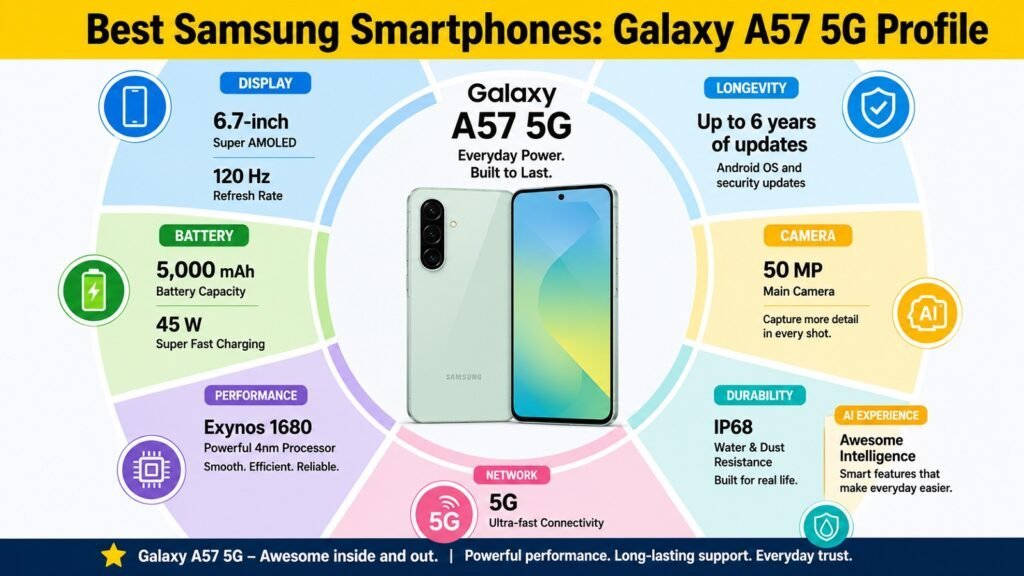
The Galaxy A57 5G was announced in March 2026 and represents Samsung’s best mid-range offering for the year. It delivers a surprisingly premium experience at a starting price of around $550. The 6.7-inch Super AMOLED Plus display, 120 Hz refresh rate, and Vision Booster brightness make it look and feel far more expensive than it is. Under the hood, the Exynos 1680 is a competent mid-range chipset with an upgraded NPU for Galaxy AI features.
The 5,000 mAh battery combined with 45W wired charging offers strong daily endurance. Camera performance is solid with OIS on the main sensor, though the 5 MP macro lens and absence of wireless charging are areas where the A57 trails flagship models. With six years of software support, IP68 water resistance — a notable upgrade for a mid-range device — and a genuinely attractive thin design at 6.9 mm, the A57 5G offers remarkable value for budget-conscious buyers.
Best Samsung Smartphones: Samsung Galaxy A57 5G — Major Specifications
| Specification | Details |
| 🧠 Chipset (Processor + GPU) | Samsung Exynos 1680 (4 nm); Octa-core (1×2.9 GHz Cortex-A720 + 4×2.6 GHz Cortex-A720 + 3×1.95 GHz Cortex-A520); Samsung Xclipse 550 GPU |
| ⚙️ Operating System | Android 16 with One UI 8.5; up to 6 major Android upgrades |
| 💾 RAM | 8 GB or 12 GB LPDDR5X |
| 🗄️ Storage | 128 GB / 256 GB / 512 GB (UFS 3.1); no microSD slot |
| 🖥️ Display | 6.7-inch Super AMOLED Plus; 2340 x 1080 (FHD+, ~385 ppi); 120 Hz; 1900 nits peak; Vision Booster; Corning Gorilla Glass Victus+; flat display |
| 📸 Camera Setup | Rear: 50 MP f/1.8 wide (1/1.56″, OIS, PDAF) + 12 MP f/2.2 ultrawide + 5 MP f/2.4 macro; Front: 12 MP f/2.2 |
| 🔋 Battery & Charging | 5,000 mAh Li-Ion; 45W wired Super Fast Charging 2.0 (up to 60% in 30 min); no wireless charging; no charger included |
| 📡 Connectivity | 5G (Sub-6); Wi-Fi 6E; Bluetooth 5.4; NFC; GPS / GLONASS / BeiDou / Galileo / QZSS; USB-C 2.0; Dual Nano-SIM + eSIM |
| 🛡️ Build & Protection | Glass front and back (Gorilla Glass Victus+), aluminum frame; IP68 (1.5 m / 30 min); optical in-screen fingerprint sensor; 161.5 x 76.8 x 6.9 mm |
| ⚖️ Weight | 179 g |
Best Samsung Smartphones: Samsung Galaxy A57 5G — Who Should Buy It?
| User Type | Good Fit? & Why? |
|---|---|
| Students | ✅ — Starting around $550 with strong battery life, 120 Hz display, and Galaxy AI features — excellent value for student budgets. |
| Everyday Users | ✅ — Solid all-rounder for calls, social media, streaming, and browsing; large display and long battery life suit all-day use. |
| Business Professionals | ⚠️ — Capable for light business tasks, but the Exynos 1680 is less powerful than flagship chips; limited multitasking for heavy workloads. |
| Photography Enthusiasts | ⚠️ — 50 MP main camera with OIS delivers good daylight shots, but the 5 MP macro and lack of telephoto limit versatility. |
| Content Creators | ⚠️ — Good for casual content creation and social media; 4K video recording is available, but no telephoto or professional-grade tools. |
| Mobile Gamers | ⚠️ — 120 Hz display and 5,000 mAh battery are positives, but Exynos 1680 is a mid-range chip and may struggle with the most demanding titles. |
Best Samsung Smartphones: Samsung Galaxy A57 5G — Pros & Cons
| Pros | Cons |
| ✅ IP68 water resistance — unusual for this price tier | ❌ No wireless charging support |
| ✅ 45W wired charging with 5,000 mAh battery | ❌ Mid-range Exynos 1680 lags behind flagship chipsets |
| ✅ Six years of Android OS upgrades guaranteed | ❌ 5 MP macro camera adds limited practical value |
| ✅ Thin, premium-looking design at 6.9 mm / 179 g | ❌ FHD+ display — lower resolution than flagship models |
Conclusion: Choosing from the Best Samsung Smartphones in 2026
Credit: iken3
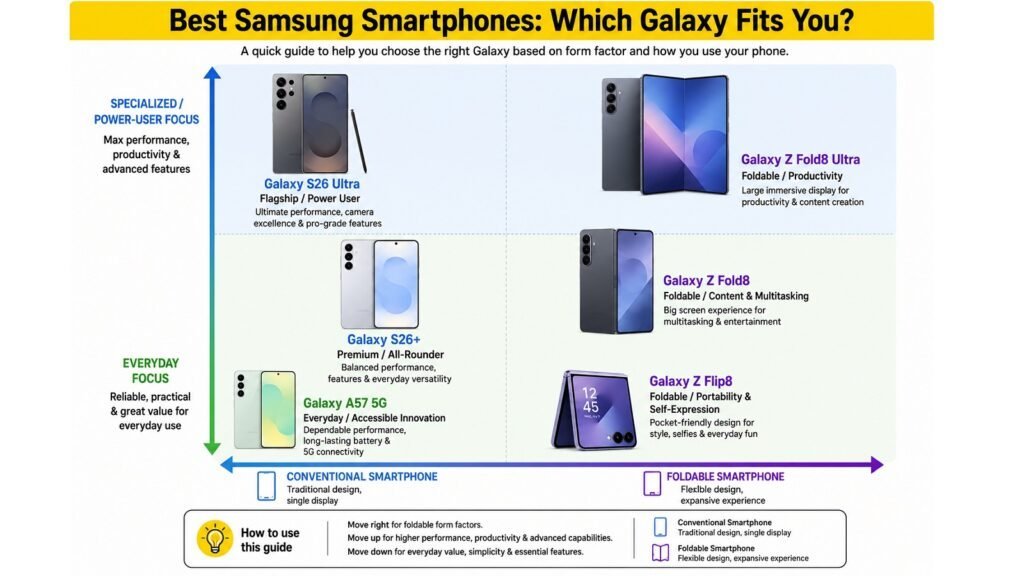
Six best Samsung smartphones covered in this guide span a wide spectrum of performance, design, camera capability, battery life, and price. The Galaxy S26 Ultra delivers the most powerful all-around package with its 200 MP camera, Privacy Display, 60W charging, and S Pen — making it the top pick for those who want no compromises. The Galaxy Z Fold8 Ultra brings that same Ultra-level camera performance to a foldable format with a stunning 8-inch display, ideal for productivity-first buyers. The Galaxy S26+ hits a sweet spot between the Ultra’s capabilities and a more manageable price point, making it the best balanced choice among the S-series.
The Galaxy Z Fold8 is the right pick for users drawn to the new wide-format foldable experience and effortless multitasking, while the Galaxy Z Flip8 suits those who want a stylish, compact foldable with modern performance and a large cover screen at the most accessible foldable price. The Galaxy A57 5G rounds out the list as the strongest value option — offering IP68 protection, 45W fast charging, and six years of software updates at a mid-range price.
Your budget, preferred usage style, and the features that matter most to you should guide your decision. Photography enthusiasts and professionals should lean toward the S26 Ultra or Z Fold8 Ultra. Students and everyday users will find the A57 5G or Z Flip8 more practical. There is no single best Samsung smartphone for everyone — the right model depends entirely on your own needs and expectations.
Best Samsung Smartphones: Which One Fits You?
| Smartphone | Best For |
|---|---|
| Galaxy S26 Ultra | Power users & photography |
| Galaxy Z Fold8 Ultra | Productivity & content creation |
| Galaxy S26+ | Premium all-round use |
| Galaxy Z Fold8 | Multitasking & entertainment |
| Galaxy Z Flip8 | Portability & style |
| Galaxy A57 5G | Everyday use & value |