Table of Contents
Introduction: B2B Lead Generation as the Foundation of Modern B2B Marketing
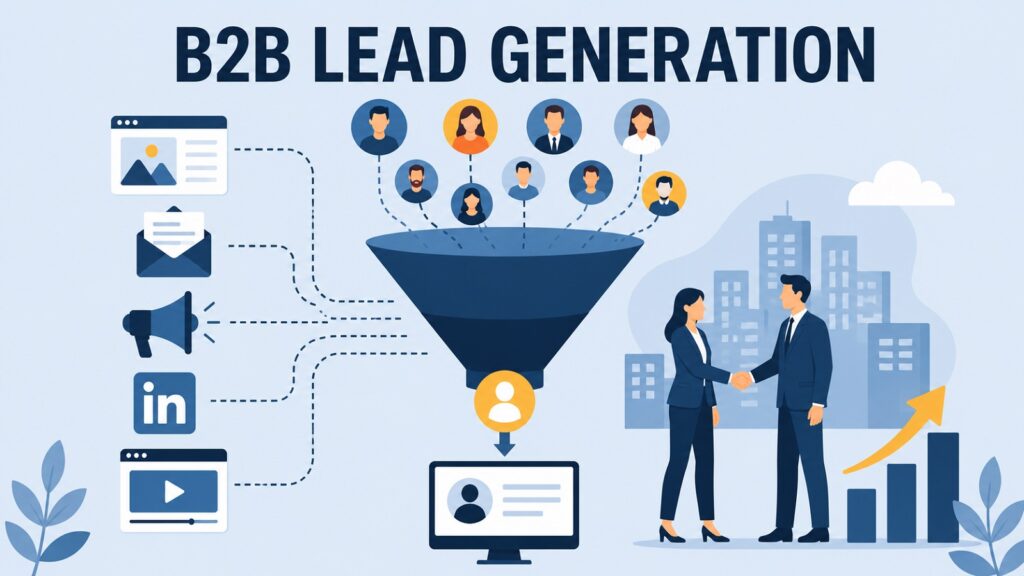
Every business that sells to other businesses faces one persistent challenge: finding the right people to talk to. B2B lead generation is the process of identifying, attracting, and engaging organizations and decision-makers who are most likely to benefit from what a company offers. It is not simply about collecting contact information. It is about building a pipeline of real opportunities that can eventually become long-term customer relationships.
B2B lead generation sits at the heart of modern B2B marketing because revenue growth depends on a consistent flow of qualified prospects. Without a structured approach to finding potential buyers, sales teams end up chasing poor-fit leads, wasting resources, and missing growth targets. Generating high-quality leads consistently remains one of the top priorities for B2B marketing teams across industries.
The B2B buying process is fundamentally different from B2C. A consumer might decide to buy a product in minutes, often based on price or convenience. A B2B purchase, in contrast, can take weeks or months, involve multiple stakeholders, and require careful evaluation of business fit and vendor credibility. This complexity means B2B lead generation demands greater trust-building and much tighter collaboration between marketing and sales.
Effective B2B lead generation moves potential customers through a structured journey, from first awareness to serious consideration and eventual conversion. When this process works well, it reduces sales cycles, improves close rates, and lowers the cost of acquiring new customers.
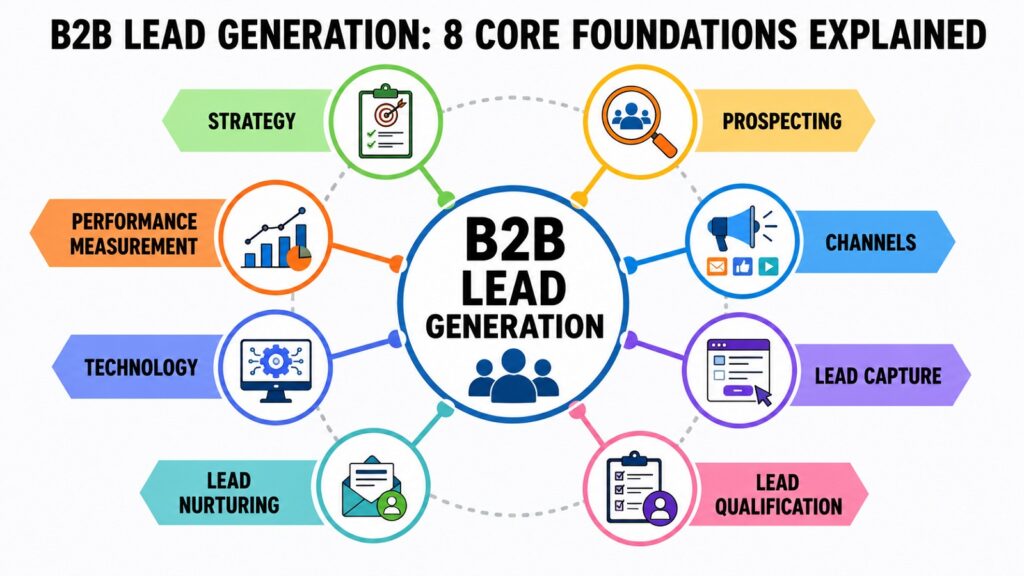
This article covers eight interconnected aspects of B2B lead generation that together form a complete framework organizations can use to build and scale their efforts. The discussion draws on established marketing principles, industry research, and practical business applications. The eight aspects are strategy, prospecting, channels, lead capture, qualification, nurturing, technology, and performance measurement.
Table 1: B2B Lead Generation – Eight Aspects and Their Roles
| Aspect | Role |
| Strategy | Defines the objectives, target profiles, and value propositions that guide all lead generation activities |
| Prospecting | Identifies the organizations and decision-makers most likely to become qualified customers |
| Channels | Determines how and where businesses attract, engage, and reach potential buyers |
| Lead Capture | Converts anonymous website visitors and audience members into identifiable business prospects |
| Qualification | Filters prospects by fit and readiness so sales teams focus on the most valuable opportunities |
| Lead Nurturing | Builds trust and sustains engagement with prospects who are not yet ready to purchase |
| Technology | Automates, scales, and improves lead generation activities through platforms and analytics |
| Performance Measurement | Tracks key metrics and drives continuous improvement across the entire lead generation system |
1. B2B Lead Generation Strategy: Building a Strong Foundation
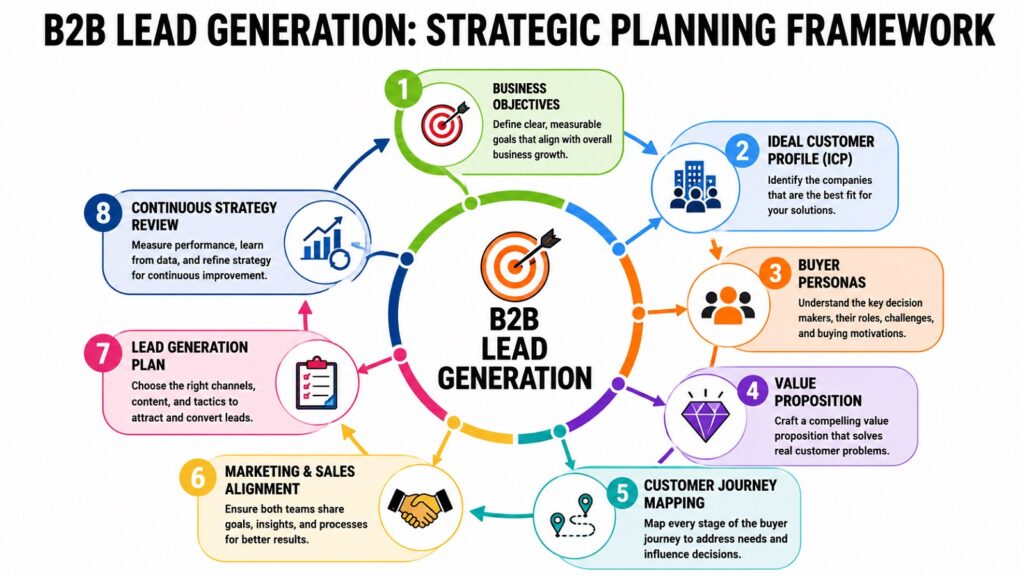
Strategy is the logic that connects a business’s goals to the actions it takes in the market. Without it, B2B lead generation becomes a collection of disconnected tactics that produce unpredictable results. Organizations that invest in strategic planning before launching campaigns consistently outperform those that jump straight into execution.
The foundation of any effective B2B lead generation strategy begins with defining the ideal customer profile, often called the ICP. An ICP describes the type of organization most likely to benefit from a product or service, based on industry, company size, budget, and business challenges. When a business knows exactly who it is targeting, every subsequent decision, from content topics to channel selection, becomes more focused and efficient.
Alongside the ICP, buyer personas add a human layer to strategic planning. While the ICP focuses on the company, the buyer persona describes the individual decision-makers and influencers within that company. Understanding their professional goals, daily pressures, and information preferences allows marketing teams to craft messages that feel relevant rather than generic.
Customer journey mapping traces the steps a potential buyer takes from recognizing a problem to evaluating solutions and making a final decision. Research from Gartner has found that B2B buying groups spend only a small fraction of their total buying time meeting with sales representatives. Most of their journey happens independently, through research and online content. A strategy that accounts for this reality ensures the right content and touchpoints are available at every stage.
Demand generation creates awareness and interest before any lead is captured, laying the groundwork for more effective conversion later. Marketing-sales alignment ensures that both teams share the same definitions, goals, and expectations around lead quality. Aligned organizations achieve significantly better win rates and revenue performance than those operating in silos. Emerging practices such as AI-assisted planning and data-driven decision-making are increasingly shaping how businesses build their strategies.
Table 2: B2B Lead Generation – Key Strategic Elements and Their Contributions
| Strategic Element | Contribution to B2B Lead Generation |
| Ideal Customer Profile (ICP) | Focuses efforts on organizations most likely to convert and deliver long-term value |
| Buyer Personas | Helps teams craft relevant messages for specific decision-makers and influencers |
| Customer Journey Mapping | Ensures the right content and touchpoints are present at every stage of the buying process |
| Value Proposition | Clearly communicates why a business is the right choice for a specific audience |
| Demand Generation | Builds awareness and market interest before formal lead capture begins |
| Marketing-Sales Alignment | Creates shared goals and reduces friction between the teams that attract and close leads |
| Data-Driven Planning | Uses real performance data to refine targeting, messaging, and resource allocation |
| AI-Assisted Strategy | Accelerates planning decisions by identifying patterns in customer behavior and market signals |
2. B2B Lead Generation: B2B Prospecting and Target Accounts
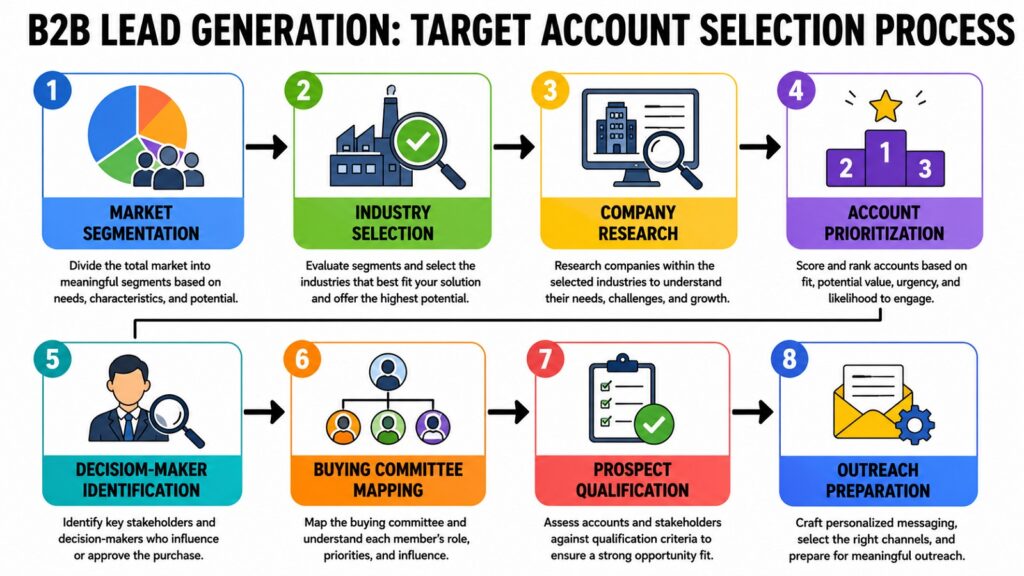
Prospecting is the disciplined practice of finding the right organizations and the right people within those organizations before any formal sales conversation begins. It gives B2B lead generation its direction. Without prospecting, teams spend energy reaching out to companies that are never going to be a strong fit, which wastes time and inflates the cost of acquiring new customers.
Target account selection is the starting point. Businesses choose specific companies to pursue based on factors like industry vertical, revenue size, geographic location, technology stack, and growth trajectory. This is not guesswork. Modern sales intelligence platforms pull data from dozens of sources to help teams build a list of accounts with the highest probability of conversion.
Once target accounts are identified, the next step is understanding the buying committee within each organization. B2B purchases rarely involve just one person. Research from Gartner has found that the average B2B buying group includes six to ten decision-makers and stakeholders. Identifying each of these individuals, understanding their roles, and knowing what they care about allows teams to engage the right people with the right message.
Account-Based Marketing, commonly called ABM, has become one of the most widely adopted prospecting frameworks in B2B lead generation. ABM treats each high-value target account as a market of one, coordinating personalized outreach, customized content, and multi-channel engagement. Research has shown that ABM consistently delivers a stronger return on investment compared to broader marketing approaches.
Outbound prospecting methods, including personalized email outreach and social selling through LinkedIn, complement ABM by opening conversations with decision-makers who may not yet be aware of a vendor. Sales intelligence tools enrich these efforts by providing information on intent signals and company news, allowing for more timely outreach. Effective prospecting is about directing resources toward accounts genuinely positioned to become long-term customers.
Table 3: B2B Lead Generation – Prospecting Practices and Their Purposes
| Prospecting Practice | Purpose in B2B Lead Generation |
| Target Account Selection | Focuses outreach on companies that match the ideal customer profile and have the highest conversion potential |
| Market Segmentation | Groups potential buyers by shared characteristics to enable more relevant and efficient outreach |
| Buying Committee Mapping | Identifies all key stakeholders involved in a purchase decision to prevent single-contact dependency |
| Account Research | Gathers intelligence on target companies to personalize outreach and identify business fit |
| Sales Intelligence Tools | Provides real-time data on contact details, intent signals, and company events to improve timing |
| Outbound Prospecting | Initiates conversations with qualified decision-makers who may not yet be aware of the vendor |
| Account-Based Marketing | Coordinates personalized, multi-channel engagement for high-value target accounts |
| Lead Prioritization | Ranks accounts and contacts by fit and readiness to ensure resources go to the best opportunities |
3. B2B Lead Generation Channels for Sustainable Growth
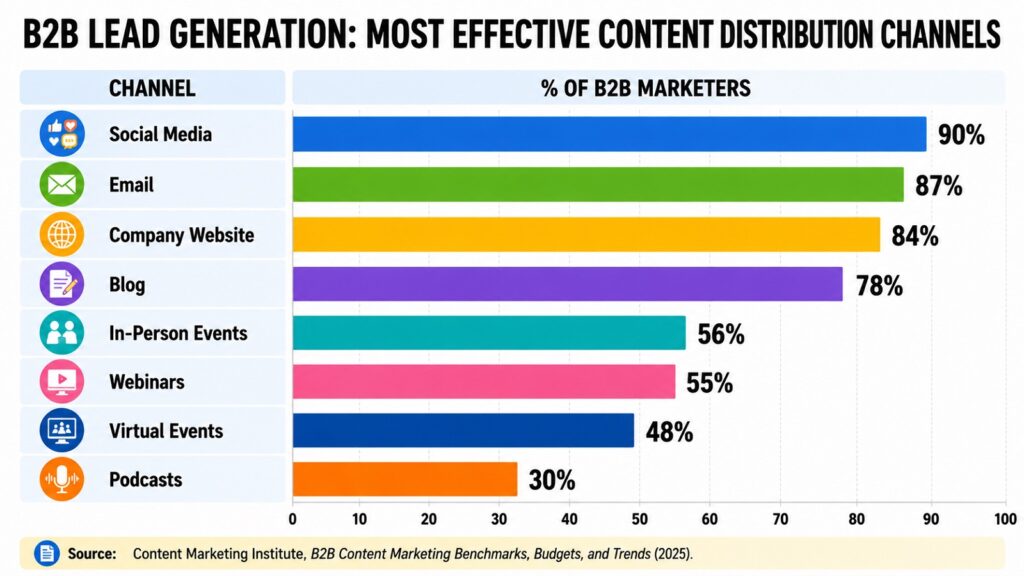
Not all channels are equal in B2B lead generation. The right channel depends on who the target audience is, where they spend their professional time, what stage of the buying journey they are in, and what resources the business has available. Choosing channels strategically is what separates efficient lead generation from expensive guesswork.
Search engine optimization, or SEO, remains one of the most cost-effective channels for long-term B2B lead generation. When decision-makers search for solutions to business problems, companies that appear in organic search results capture high-intent traffic without paying for every click. Content marketing works closely with SEO by providing the educational articles, guides, and case studies that buyers are actively looking for during their research phase.
Email marketing continues to deliver strong results in B2B contexts because it allows direct, personalized communication with specific contacts over time. It remains one of the most reliable channels for nurturing relationships with both new prospects and existing contacts. The key is segmentation and relevance, not volume.
LinkedIn has established itself as the dominant social platform for B2B lead generation. Its targeting capabilities allow marketers to reach specific job titles, industries, company sizes, and seniority levels with both paid campaigns and organic content. Webinars and virtual events create engagement opportunities with prospects who are actively seeking to learn, making them particularly effective for generating and qualifying leads simultaneously.
Referrals and strategic partnerships deliver some of the highest-quality leads available because they come with built-in trust. A peer recommendation carries more weight than any advertisement. Industry events allow for face-to-face engagement that accelerates relationship development in ways digital channels alone cannot replicate. Paid advertising delivers faster results for time-sensitive campaigns but requires ongoing optimization to stay cost-effective. The most successful B2B organizations integrate inbound and outbound channels into a coordinated multi-channel system.
Table 4: B2B Lead Generation – Major Channels and Their Primary Business Value
| Channel | Primary Business Value in B2B Lead Generation |
| SEO | Attracts high-intent prospects through organic search during the research and consideration stages |
| Content Marketing | Educates potential buyers, builds credibility, and supports organic discovery across the buying journey |
| Email Marketing | Enables direct, personalized communication with prospects and supports ongoing relationship building |
| Provides precise audience targeting and organic reach for decision-makers in professional contexts | |
| Webinars and Virtual Events | Generates and qualifies leads by engaging prospects who are actively seeking information or solutions |
| Referrals and Partnerships | Delivers high-trust leads through peer recommendations and collaborative business relationships |
| Industry Events | Creates face-to-face engagement opportunities that accelerate trust and relationship development |
| Paid Advertising | Generates faster pipeline growth for specific campaigns with defined audience targeting |
4. B2B Lead Generation: Lead Capture and Conversion
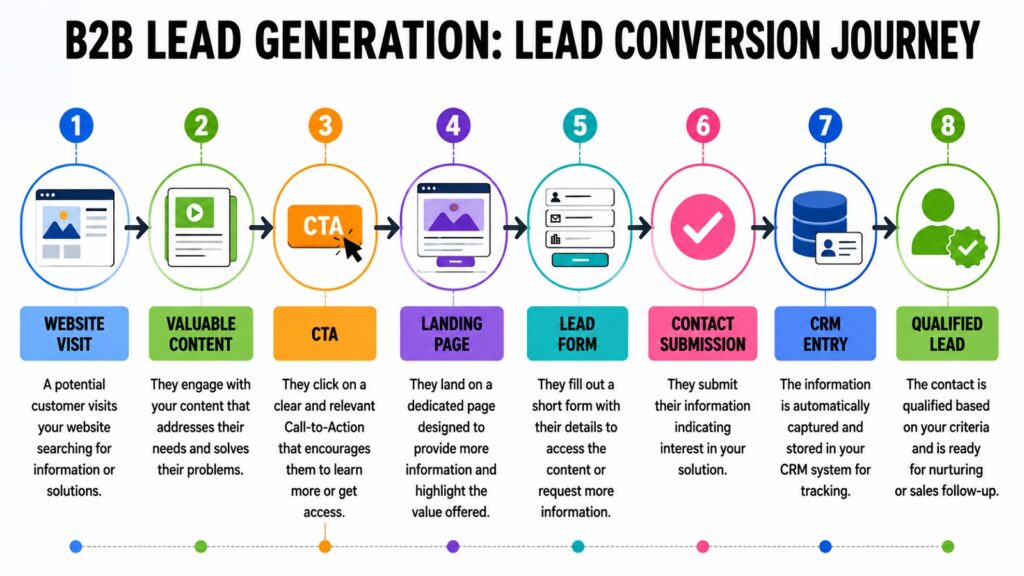
Attracting traffic and generating awareness is only half the job. The other half is converting those anonymous visitors and engaged audiences into identifiable prospects that the business can follow up with. Lead capture is the mechanism that makes this transition happen, and conversion rate optimization is the discipline that keeps improving it over time.
Landing pages are the workhorses of B2B lead capture. A well-designed landing page does one thing: it gives visitors a compelling reason to share their contact information in exchange for something of value. Every element, from the headline to the form fields, either helps or hurts that goal. Top-performing B2B landing pages convert at higher rates largely because they align their message precisely with what the visitor came to find.
Lead magnets are the value exchanges that make capture possible. In B2B contexts, these take the form of white papers, research reports, buyer’s guides, templates, or webinar registrations. If a lead magnet genuinely solves a problem or answers an important question, it attracts better-qualified prospects and establishes credibility from the very first interaction.
Forms are the bridge between interest and capture, but they must be designed thoughtfully. Asking for too much information early in the relationship reduces conversion rates. Progressive profiling, where additional data is gathered across multiple interactions, helps balance data collection with user experience. Trust signals including customer logos, testimonials, and privacy statements reassure buyers that their information will be handled responsibly, and in high-stakes B2B contexts they can be the difference between a submission and an abandoned page.
Calls-to-action must be specific and benefit-focused. Vague phrases like ‘submit’ underperform compared to action-oriented language that tells the visitor exactly what they will receive. Conversion rate optimization is a continuous process of testing and refining these elements to improve performance over time.
Table 5: B2B Lead Generation – Lead Capture Elements and Their Contribution to Conversion
| Lead Capture Element | Contribution to Conversion in B2B Lead Generation |
| Landing Pages | Focuses visitor attention on a single conversion goal with a clear value exchange |
| Lead Magnets | Provides a compelling reason for prospects to share their contact information |
| Forms | Collects prospect data while balancing detail with ease of completion |
| Calls-to-Action | Directs visitors toward the next step with specific, benefit-focused language |
| Progressive Profiling | Gathers additional prospect data gradually across multiple interactions |
| Trust Signals | Reduces conversion hesitation by demonstrating credibility and data responsibility |
| Website Usability | Ensures visitors can navigate easily and reach the conversion point without friction |
| Conversion Rate Optimization | Continuously tests and refines capture elements to improve lead volume and quality |
5. B2B Lead Generation: Lead Qualification and Sales Funnel
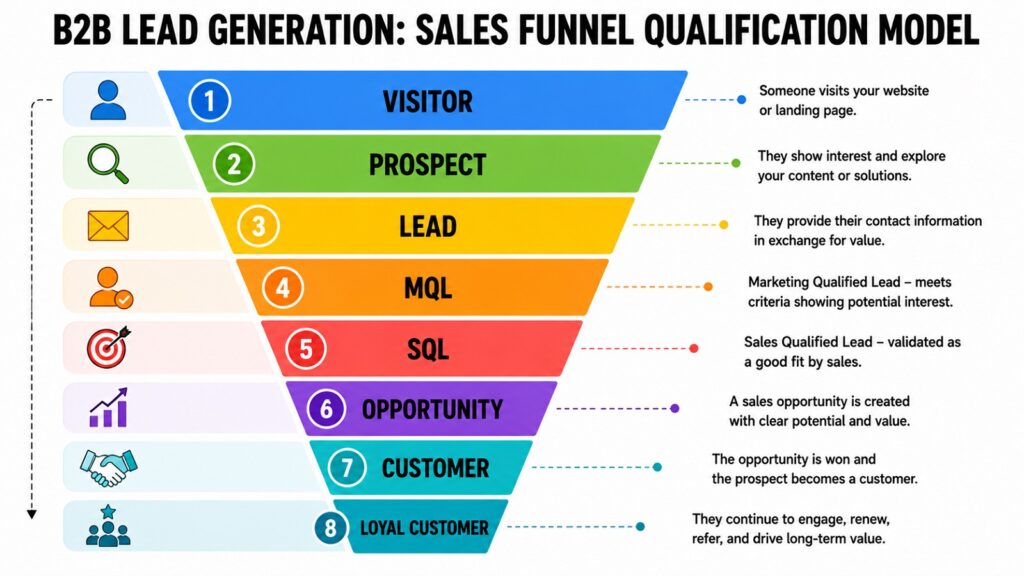
Not every lead is ready to buy, and not every lead that seems ready is actually a good fit. Lead qualification is the process of filtering prospects to ensure that sales teams focus their energy and time on the opportunities most likely to close. Without it, the cost of sales rises, conversion rates fall, and sales teams grow frustrated chasing leads that were never going to convert.
The distinction between Marketing Qualified Leads and Sales Qualified Leads is foundational. A Marketing Qualified Lead, or MQL, is a prospect who has shown enough engagement with marketing content to be considered ready for closer attention, but has not yet been evaluated by the sales team. A Sales Qualified Lead, or SQL, has been reviewed by sales and confirmed to meet the criteria for active follow-up. This two-stage progression prevents the pipeline from being flooded with unvetted prospects.
Lead scoring gives qualification a quantifiable structure. Points are assigned based on demographic factors like job title and company size, and behavioral signals like visiting the pricing page or downloading a white paper. When a lead accumulates enough points to cross a defined threshold, it moves to the next funnel stage. Research from Forrester has shown that businesses using lead scoring effectively see higher sales productivity and stronger revenue performance.
Qualification frameworks like BANT, which stands for Budget, Authority, Need, and Timeline, give sales teams a structured way to evaluate whether a prospect can move forward. While BANT has been supplemented by newer frameworks in many organizations, the underlying logic remains sound: knowing whether a prospect has the resources, the decision-making power, the relevant problem, and a reasonable timeframe is still the right place to start.
CRM integration is what holds qualification together at scale. When lead scores, engagement histories, and qualification statuses are stored in a central CRM system and shared between marketing and sales, pipeline management becomes more transparent and decisions become more consistent. The sales funnel stops being a guessing game and starts being a manageable process.
Table 6: B2B Lead Generation – Qualification Concepts and Their Role in the Sales Funnel
| Qualification Concept | Role in the B2B Lead Generation Sales Funnel |
| Marketing Qualified Lead (MQL) | Identifies prospects who have shown sufficient engagement to warrant closer marketing attention |
| Sales Qualified Lead (SQL) | Confirms that a prospect meets the criteria for active sales engagement |
| Lead Scoring | Assigns numerical values to prospect behaviors and attributes to measure conversion readiness |
| BANT Framework | Evaluates prospects on budget, authority, need, and timeline to prioritize sales effort |
| CRM Integration | Centralizes lead data and qualification status to support consistent pipeline management |
| Pipeline Management | Tracks leads across funnel stages to identify bottlenecks and improve flow |
| Funnel Stage Progression | Moves qualified leads from awareness to consideration to decision in a structured way |
| Sales-Marketing Handoff | Defines the exact criteria and process for transferring leads from marketing to sales |
6. B2B Lead Generation: Lead Nurturing and Customer Relationships
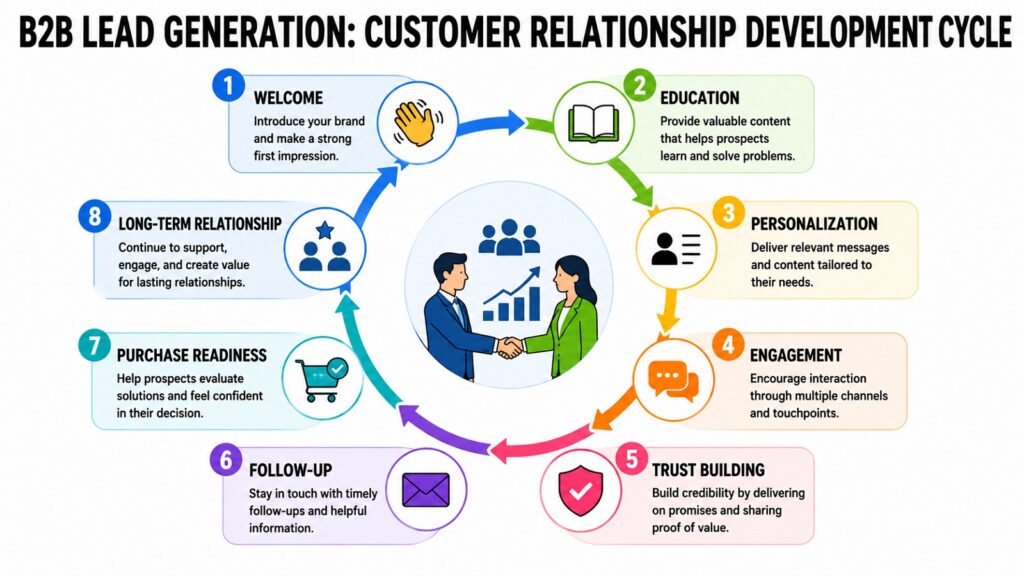
Most B2B prospects are not ready to buy the moment they first engage with a company. Research suggests that a large share of new leads never translate into sales, often because they are abandoned before they are ready for a serious conversation. Lead nurturing is the practice of maintaining meaningful contact with those prospects over time, building trust, and positioning the business as the right choice when the buying moment arrives.
Nurturing is not the same as repeatedly sending promotional messages. It is a structured approach to staying relevant during the long gap between first contact and purchase decision. The best nurturing programs deliver genuinely useful content, address specific business challenges, and reflect where the prospect stands in the buying journey.
Personalized email campaigns are the backbone of most B2B nurturing programs. When emails are segmented by industry, role, or funnel stage and tailored to address specific interests, open rates and engagement improve substantially. Generic broadcast emails produce diminishing returns in B2B contexts because decision-makers receive too many messages competing for their attention.
Educational content plays a central role in nurturing because it gives prospects a reason to keep engaging. Detailed guides, webinar recordings, case studies, and industry research help potential buyers understand their problems more clearly and evaluate potential solutions more confidently. This positions the nurturing business as a knowledgeable partner rather than just another vendor chasing a signature.
Marketing automation platforms make nurturing scalable by allowing teams to set up triggered workflows that deliver the right content to the right person at the right time. These systems track engagement, adjust lead scores, and notify sales teams when a prospect shows signs of increased purchase intent. Long-term relationship building extends beyond the sale. Businesses that maintain strong customer relationships after conversion generate higher rates of renewal and referral, feeding directly back into the lead generation system.
Table 7: B2B Lead Generation – Lead Nurturing Practices and Their Business Purposes
| Nurturing Practice | Business Purpose in B2B Lead Generation |
| Personalized Email Campaigns | Delivers relevant, stage-appropriate content to specific segments to drive engagement |
| Educational Content | Helps prospects understand their challenges and evaluate solutions more confidently |
| Marketing Automation | Enables scalable, timely nurturing workflows without requiring manual effort per contact |
| Lead Score Monitoring | Tracks engagement trends and flags when a nurtured prospect is approaching purchase readiness |
| Behavioral Triggers | Sends targeted messages based on specific actions a prospect takes during their research |
| Trust Building | Establishes credibility through consistent, valuable, and non-promotional communication |
| Customer Engagement | Maintains active relationships with existing customers to support renewal and referral |
| Long-Term Relationship Development | Converts one-time leads into loyal customers and brand advocates over time |
7. B2B Lead Generation Technology for Modern Businesses
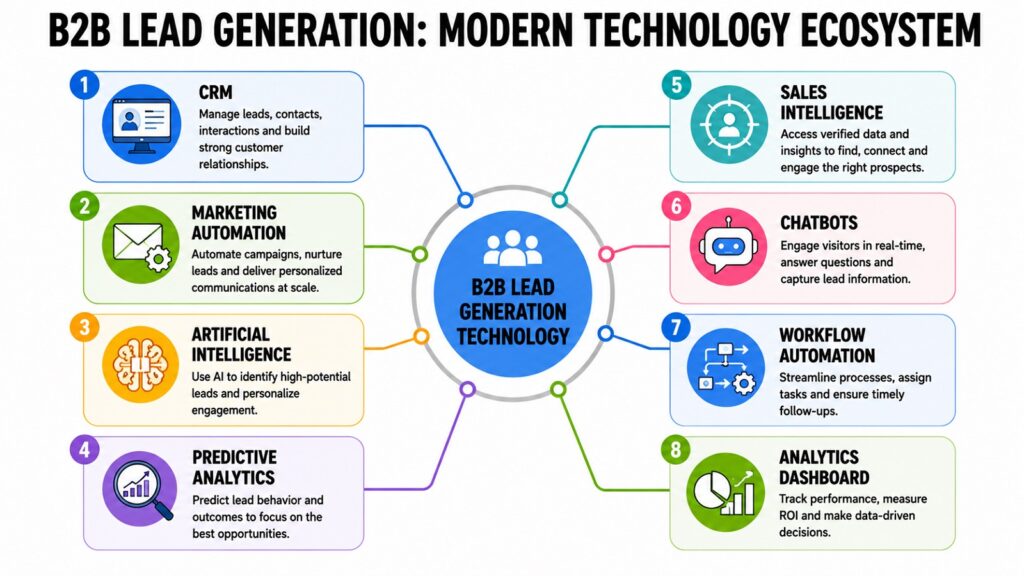
Technology does not replace good strategy or strong relationships, but it allows businesses to execute both at a scale that would be impossible manually. The right combination of tools can transform a modest lead generation operation into a high-performing system that identifies and converts prospects more efficiently than any team working alone.
CRM platforms are the operational center of B2B lead generation. They store contact and account information, track every interaction, and provide a shared record that both marketing and sales teams can access. A well-maintained CRM removes ambiguity from the pipeline and gives leadership the visibility they need to make informed resource decisions.
Marketing automation platforms extend CRM capabilities by managing email workflows, lead scoring, content delivery, and campaign tracking across large prospect databases. Research from Nucleus Research has found that marketing automation delivers measurable improvements in sales productivity and lead conversion performance for businesses that implement it effectively.
Artificial intelligence is reshaping how B2B lead generation works at a fundamental level. AI-powered tools can analyze vast amounts of behavioral and demographic data to predict which accounts are most likely to convert, identify the best time to reach out, and even personalize outreach content at scale. Predictive analytics helps sales teams prioritize their time on the accounts showing the strongest intent signals.
Chatbots engage website visitors in real time, qualify prospects through automated dialogue, and route high-value leads to sales representatives without delay. Sales intelligence platforms provide enriched account data including technographic information, funding events, leadership changes, and intent signals.
Data integration and workflow automation ensure that lead data flows cleanly from marketing tools into sales platforms without manual transfers. Performance analytics dashboards give teams a real-time view of what is working and where adjustments are needed.
Table 8: B2B Lead Generation – Technologies and Their Primary Contributions
| Technology | Primary Contribution to B2B Lead Generation |
| CRM Platforms | Centralizes lead and account data, tracks interactions, and supports marketing-sales alignment |
| Marketing Automation | Scales email nurturing, lead scoring, and campaign management across large prospect lists |
| Artificial Intelligence | Analyzes behavioral data to predict conversion likelihood and personalize outreach at scale |
| Predictive Analytics | Identifies accounts showing the strongest purchase intent to help teams prioritize effort |
| Chatbots | Engages website visitors in real time, qualifies prospects, and routes leads without delay |
| Sales Intelligence Tools | Provides enriched account and contact data including intent signals and business events |
| Workflow Automation | Removes manual data transfers and keeps lead information synchronized across platforms |
| Performance Analytics | Delivers real-time visibility into campaign and pipeline performance to guide optimization |
8. Measuring and Optimizing B2B Lead Generation Performance
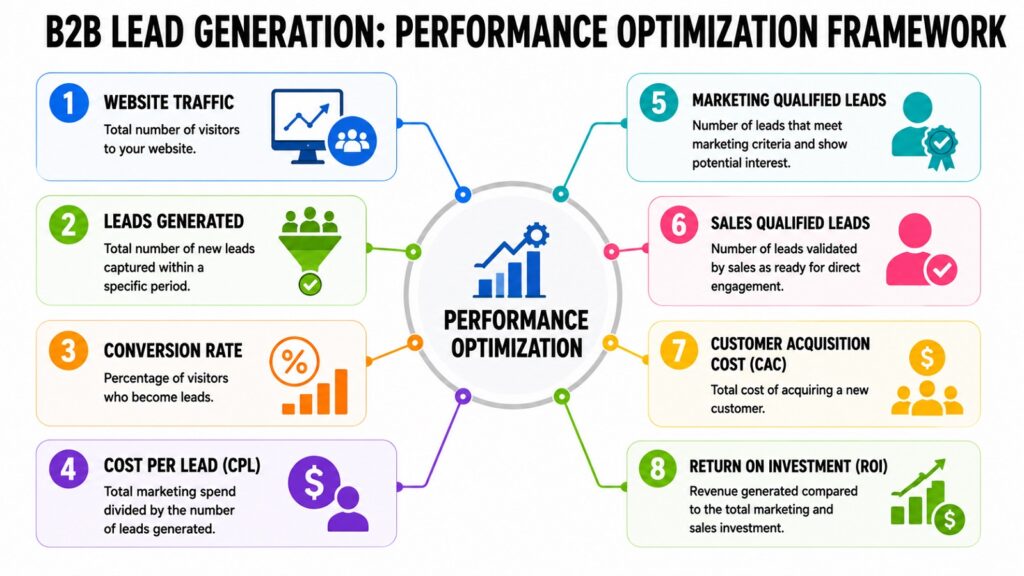
A lead generation program that is not measured cannot be improved. Performance measurement transforms a set of activities into a data-driven system that gets smarter over time. Organizations that track the right metrics and act on what they find consistently outperform those that rely on intuition alone.
Conversion rates sit at the center of most B2B lead generation measurement frameworks. They reveal what percentage of visitors become leads, what percentage of leads become qualified prospects, and what percentage of opportunities actually close. Tracking conversions at each stage of the funnel identifies exactly where prospects are dropping out and gives teams a specific problem to solve.
Cost per lead, or CPL, measures how much the business spends to attract each new prospect. It is one of the most practical efficiency metrics available because it enables direct comparisons across channels and time periods. When CPL rises without an improvement in lead quality, it signals that something in the system needs adjustment.
Customer acquisition cost, or CAC, takes the analysis a step further by measuring the total cost of converting a prospect all the way into a paying customer. This metric is particularly important in B2B contexts where sales cycles are long and total acquisition costs can accumulate across many touchpoints. Research from ProfitWell has shown that CAC has been rising steadily across industries, making optimization a financial priority rather than a nice-to-have.
Return on investment, commonly referred to as ROI, addresses the essential inquiry of whether the financial resources and efforts invested in lead generation are yielding returns in terms of revenue. Attribution models allocate credit to particular touchpoints that have impacted a conversion, providing teams with a clearer understanding of which channels are genuinely producing results. A/B testing and funnel analysis establish feedback loops that facilitate ongoing enhancement, and the incremental improvements at each stage accumulate to create substantial performance variations over time.
Table 9: B2B Lead Generation – Performance Metrics and What They Help Organizations Evaluate
| Performance Metric | What It Helps Organizations Evaluate in B2B Lead Generation |
| Conversion Rate | Measures the percentage of prospects moving from one funnel stage to the next |
| Cost Per Lead (CPL) | Tracks the efficiency of spend in generating each new prospect across channels |
| Customer Acquisition Cost (CAC) | Calculates the total cost of converting a prospect into a paying customer |
| Return on Investment (ROI) | Determines whether lead generation spending delivers proportionate revenue returns |
| Lead Quality Score | Assesses how well incoming leads match the ideal customer profile and qualification criteria |
| Attribution Models | Assigns credit to the touchpoints that most influence conversion to guide channel investment |
| A/B Testing Results | Compares performance variations in messages, offers, and formats to identify what works best |
| Funnel Drop-Off Analysis | Identifies where prospects exit the pipeline to focus optimization on high-impact stages |
Conclusion: The Future of B2B Lead Generation
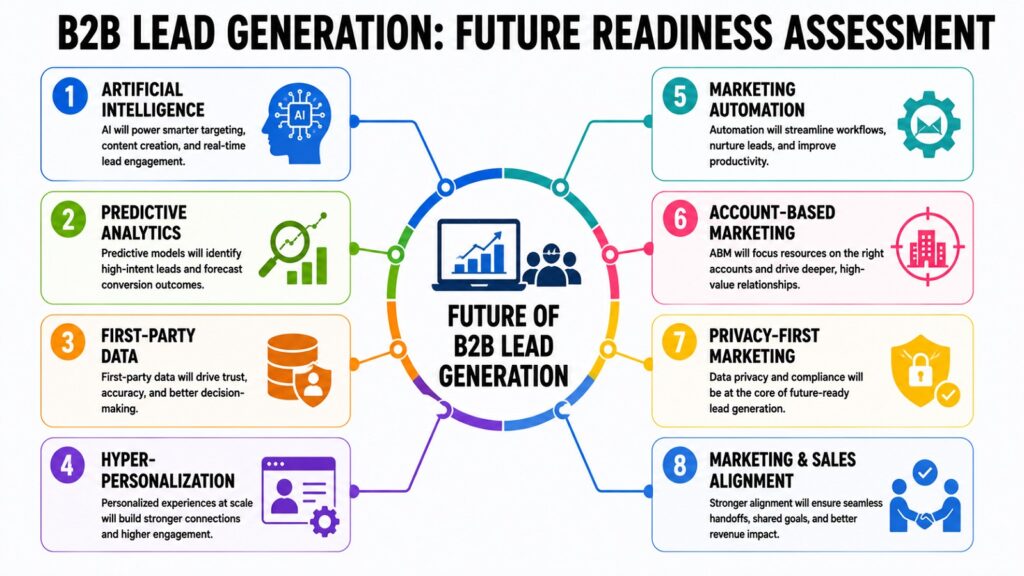
B2B lead generation is not a single campaign or a one-time effort. It is an ongoing system that connects a business to its market and keeps revenue growth moving. Every element covered in this article, from strategic planning and prospecting to channel selection, lead capture, qualification, nurturing, technology, and performance measurement, works best when treated as part of a unified whole rather than a standalone activity.
The future of B2B lead generation is being shaped by several converging forces. Artificial intelligence and predictive analytics are helping businesses identify and prioritize the right accounts faster than traditional methods allow. First-party data is becoming more valuable as privacy regulations tighten and third-party tracking becomes less reliable. Marketing and sales teams are being brought into closer alignment through shared technology platforms and shared accountability for revenue outcomes.
Automation will continue reducing manual work in nurturing and qualification, freeing teams to focus on conversations that require human judgment. Buyers are becoming more informed and more resistant to outreach that feels irrelevant. The quality of lead generation, measured by relevance and timing, will matter more than raw volume.
Organizations that treat B2B lead generation as a continuous learning process, improving through experimentation and honest evaluation of results, will build the most durable growth engines. The fundamentals covered in this article will remain relevant. What will change is how they are executed and refined.
Table 10: B2B Lead Generation – Key Takeaways from the Eight Aspects
| Aspect | Key Takeaway for B2B Lead Generation |
| Strategy | Define your ideal customer profile, align marketing and sales, and plan before executing |
| Prospecting | Focus on high-fit target accounts and map the full buying committee before outreach |
| Channels | Combine inbound and outbound approaches in a multi-channel system built for your audience |
| Lead Capture | Design landing pages and lead magnets that offer genuine value and build early trust |
| Qualification | Use lead scoring and shared criteria to ensure sales focuses on the best opportunities |
| Lead Nurturing | Stay relevant and helpful through personalized, stage-appropriate communication |
| Technology | Use CRM, automation, and AI to scale and improve lead generation without sacrificing quality |
| Performance Measurement | Track the right metrics, run consistent tests, and treat optimization as a permanent discipline |