Table of Contents
Introduction: Startup Ideas That Build Successful Businesses
Most people assume great startup ideas arrive in a flash. Maybe in the shower, or during a late-night drive home. The truth is far less neat than that. Successful startup ideas rarely come from luck or sudden inspiration. They come from careful research and close observation. They come from honest talks with real customers and a will to test guesses before falling in love with them. Founders who treat this as a habit, rather than a moment of genius, tend to build businesses that last.
Many new founders spend months chasing the perfect startup strategy or a perfect idea. They act as though one flawless concept will guarantee success on its own. Skilled founders take a different path. They study problems before products. They study markets before pitches. They study customers before logos. Only after this groundwork do they commit to a direction. By then, the idea had been shaped by real proof rather than a guess.
This article lays out a research-based way to find strong startup ideas. It draws on business theory, well-known case studies, and simple visual frameworks meant to make the process practical. Each of the eight sections below builds on the one before it. The path moves from spotting a problem, through market research, proof, rivals, founder fit, business models, what makes you different, and, at last, long-term growth. Together, they form a full process for judging whether a business idea is worth your time, money, and care.
The traits shared by winning startup ideas stay remarkably steady across fields. The table below sums up eight of the most common traits found in ideas that go on to become lasting businesses.
Eight Common Traits Behind Strong Startup Ideas
| Characteristics of Strong Startup Ideas | Why It Matters |
| Solves a clear problem | Reduces guesswork about whether demand exists |
| Backed by market research | Confirms the opportunity is sizable and timely |
| Validated with real customers | Replaces guessing with real evidence |
| Has a defensible position | Limits exposure to direct copycats |
| Matches founder strengths | Speeds up execution and decision-making |
| Built on a sound business model | Converts interest into lasting revenue |
| Offers genuine differentiation | Gives customers a reason to switch |
| Designed with scale in mind | Prevents early success from stalling later |
1. Startup Ideas Start by Solving Real Customer Problems

Every lasting business begins with a problem worth solving. Research on customer-focused work shows that companies built around real pain points tend to beat companies built around a product the founder just wanted to make. When a business starts with a problem, every later choice has a clear anchor, from price to ads. When a business starts with a product first, founders often learn too late that the market never asked for it.
The theory of startups supports this pattern. The lean startup methodology, popularized by Eric Ries, suggests that founders must validate a problem prior to investing resources into a solution. Similarly, Clayton Christensen’s concept of “jobs to be done” reinforces this notion. Customers do not simply purchase products; rather, they engage with products to fulfill specific roles in their lives.
Real stories make this clear. Airbnb began because its founders could not afford rent in San Francisco. They saw that local hotels were full during a design event. So they rented air mattresses in their own flat and found a real, paying need for cheap rooms. Uber grew from a spark. Its co-founder had a hard time finding a cab in Paris and pictured an easier way to call a ride from a phone. Dropbox began when its founder kept forgetting USB drives and wanted his files to follow him between machines on their own.
Now look at startups that built slick products nobody needed badly enough to pay for. Many had working code and skilled teams. Yet they failed because the root problem was small or made up, rather than urgent and shared widely. The gap rarely came down to skill in building. It came down to whether the problem was real in the first place.
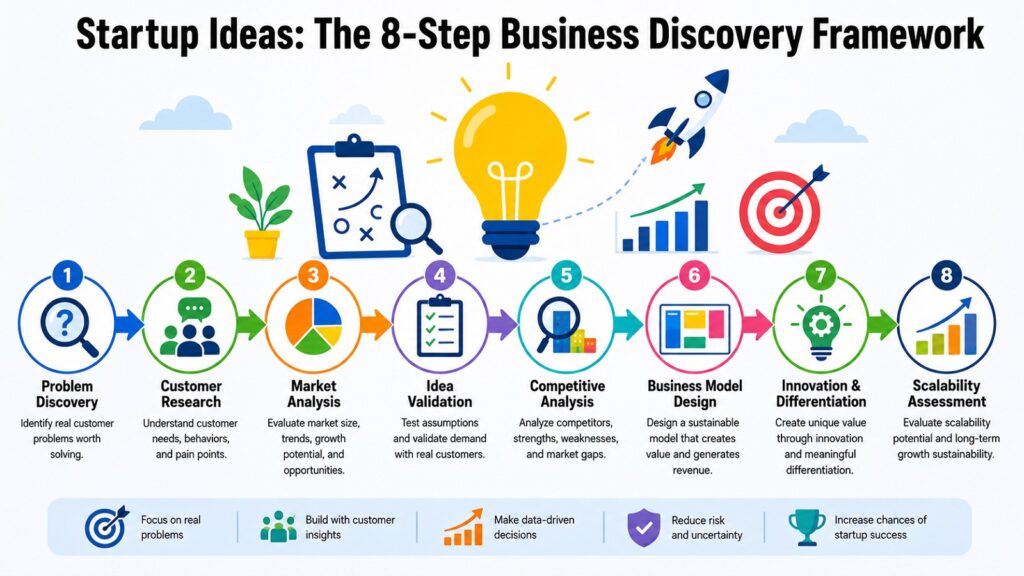
The framework graphic below shows how founders can move through this in steps. First, watch for daily gripes. Then talk to real people about them. Next, rank problems by how often they hit and how much they sting. Only then sketch out possible fixes.
Real Customer Problems Behind Famous Startup Ideas
| Customer Problems Behind Startup Ideas | Startup Solution |
| Hotels were overbooked and expensive | Airbnb’s home-sharing marketplace |
| Hailing a cab was slow and unreliable | Uber’s app-based ride requests |
| Files were stuck on a single device | Dropbox’s cloud file syncing |
| Online classifieds felt unsafe and cluttered | Trust-based listing platforms |
| Razors were overpriced at retail | Dollar Shave Club’s direct delivery |
| Finding a date required social risk | Match-based dating apps |
| Small businesses lacked payment tools | Square’s card readers for merchants |
| Office software was expensive to license | Google Workspace’s browser-based tools |
2. Startup Ideas Improve Through Market Research and Industry Trends
A good problem is not enough on its own. Startup ideas grow stronger when tested against real market research rather than personal guesses. This means studying market size and the pace of change in a field. It means tracking shifting buyer habits, how fast new tech catches on, shifts in age groups, and wider money trends. The goal is to split trends with real staying power from hype that fades within a year or two.
Business theory gives us useful guardrails here. The idea of market timing, often called the “why now” question, asks a simple thing. Has the tech or the customer habit needed for an idea only just become real? Everett Rogers’ theory on how new ideas spread shows how new products move through a group in stages. This helps founders judge whether a market is truly ready.
Several firms entered their markets at just the right time. Airbnb and Uber both launched soon after the 2008 financial crisis, when many people were newly open to renting spare rooms or driving for extra cash. Zoom grew fast when remote work became a daily need rather than a rare choice. Netflix shifted from DVDs to streaming once home internet speeds at last grew fast enough to support video on demand.
Other firms suffered from bad timing rather than a bad idea. Several well-funded plant-based meat startups raised large sums during a 2021 to 2022 wave of investor hype, then shut down once buyer demand failed to grow as fast as hoped. The tech was real, but the market had not caught up yet.
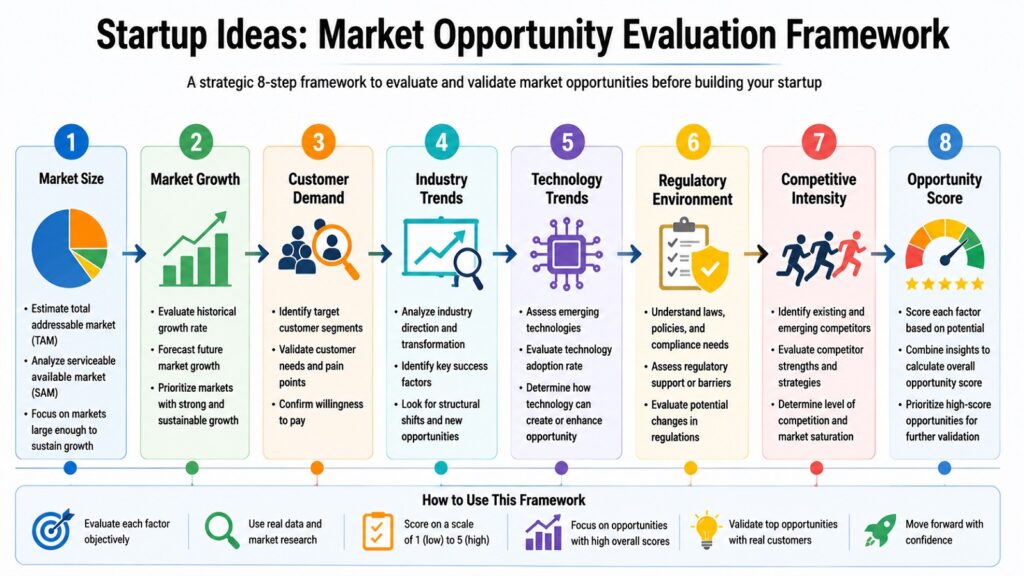
The framework graphic for this section walks through a clear way to weigh market chances. It means sizing up the market, tracking early use signs, and studying rule shifts. Swapping gut feel for research gives founders a sharper sense of whether they are early, on time, or simply too late.
Market Trends That Created New Startup Ideas
| Market Trends for New Startup Ideas | Startup Opportunity Created |
| Smartphone adoption became widespread | On-demand ride and delivery apps |
| Broadband speeds increased steadily | Video streaming platforms |
| Remote work became standard practice | Video conferencing and collaboration tools |
| Post-recession households sought income | Home and car sharing marketplaces |
| Cloud computing costs dropped sharply | Software-as-a-service business models |
| Consumers wanted healthier food options | Plant-based and functional food brands |
| Small businesses needed digital payments | Mobile point-of-sale systems |
| Social media use grew across age groups | Influencer marketing platforms |
3. Startup Ideas Need Customer Validation Before Launch
Even a well-researched idea can fail if nobody checks that real customers will use it. Validation closes that gap. Field data points again and again to weak market need as a top cause of startup failure. CB Insights looked at startup post-mortems and found that close to 42 percent named no real market need. That figure has held steady across years of work. It explains why validation earns real focus before a founder spends real time or cash.
Customer discovery, a method built by Steve Blank, asks founders to leave the office. It pushes them to test their guesses with real buyers, rather than guessing at a desk. The idea of a minimum viable product, pushed by Eric Ries, asks founders to build the smallest version of an offer. That small version still lets them learn whether people will pay for it.
Dropbox tested demand with nothing more than a short clip rather than a finished product. The clip laid out the core idea and let viewers join a wait list. Signups jumped from a few thousand to tens of thousands almost overnight, which gave the founders real proof before they put cash into heavy build work. Airbnb tested its idea with three paying guests during its first weekend. That tiny number still proved that strangers would pay to stay in someone’s home.
Now look at startups that built full products on their own, with no outside check. Many only learned after launch that customers wanted something else. These firms often had skilled teams and real cash behind them. Yet they skipped the step of testing guesses early, so their first real feedback came only after the money was already spent.
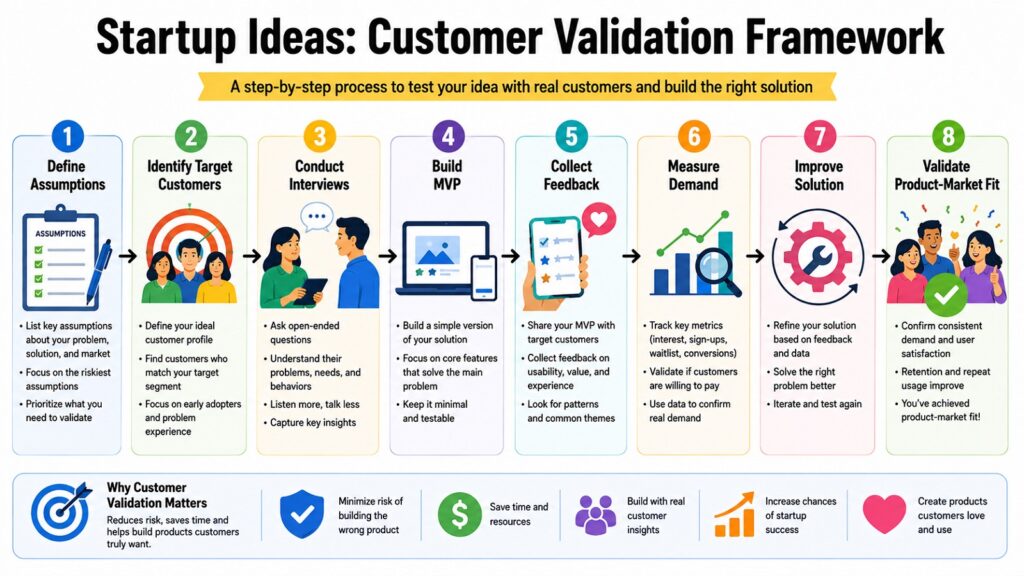
The framework for this section traces a clear path. It runs from a first guess to setting talks with real customers, then to a small version of the offer, and at last to product fixes based on feedback. Following this order turns guesswork into proof before a founder spends real money on a finished product.
Customer Validation Methods for Testing Startup Ideas
| Validation Methods of Startup Ideas | Primary Purpose |
| Customer interviews | Confirms the problem is real and urgent |
| Landing page with signups | Measures interest before building anything |
| Minimum viable product | Tests if people will actually use it |
| Pre-orders or paid waitlists | Confirms real willingness to pay |
| Concierge testing by hand | Reveals what customers value most |
| Open-ended surveys | Uncovers the language customers use |
| Small paid pilot programs | Tests retention over time |
| Reading competitor reviews | Reveals needs nobody has met yet |
4. Startup Ideas Become Stronger Through Competitive Analysis
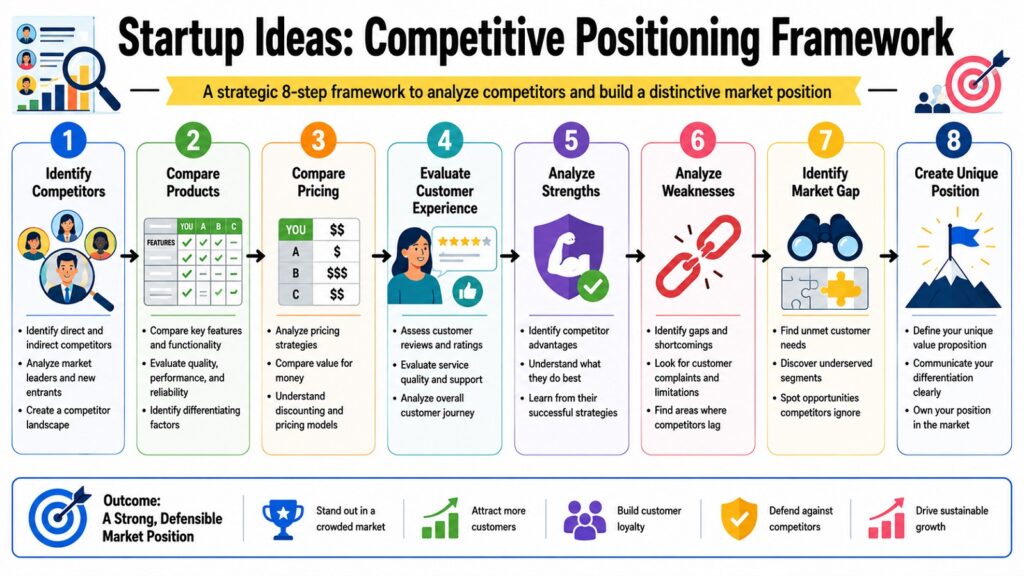
Many new founders see rivals as a bad sign. They think a crowded market means there is no room left for them. Skilled founders read this in a different way. A market full of active rivals is often a market with real, proven demand. The real question is not whether rivals exist, but whether they have left a gap open.
Strategy research on rivals, including Michael Porter’s work on competitive edge, treats rivals as a source of useful insight rather than a threat to dodge. A clear value claim often matters more than just being first to market. It should state plainly why a customer should pick one choice over another. Studying rivals closely shows their weak points, their pricing habits, and the gripes they have failed to fix.
Several startups won by spotting gaps that bigger rivals had missed. Dollar Shave Club noticed that razor brands set steep markups through stores. It built a direct subscription instead, cutting that markup out entirely. Canva noticed that pro design tools like Adobe’s felt scary to non-designers. It built a plain, browser-based tool aimed at small firms and casual users. Slack noticed that work email felt clunky for quick chats. It built a faster, more casual chat layer on top of tools people already used.
Other firms entered crowded fields without a clear enough edge, and they struggled to gain ground. Several food delivery and meal-kit startups went head-to-head with set rivals on price alone. They got stuck in discounts that rarely build real loyalty. Whoever spent the most on ads tended to win the customer in the end.
The framework graphic for this section lays out a clear process. It means mapping close and far rivals, then listing their strengths and weak spots. It means finding buyer groups nobody serves well, then setting a place that is hard for others to copy fast.
Startup Ideas and the Competitive Advantage That Set Companies Apart
| Company | Competitive Advantage |
| Dollar Shave Club | Cut retail markups through direct delivery |
| Canva | Simplified design for non-designers |
| Slack | Faster, more casual workplace messaging |
| Warby Parker | Affordable eyewear sold directly online |
| Southwest Airlines | Low-cost, point-to-point flights |
| Zoom | Simpler video calls with fewer setup steps |
| Netflix | Smart recommendations and no late fees |
| Spotify | Personalized playlists across a huge catalog |
5. Startup Ideas Should Match Founder Strengths and Resources
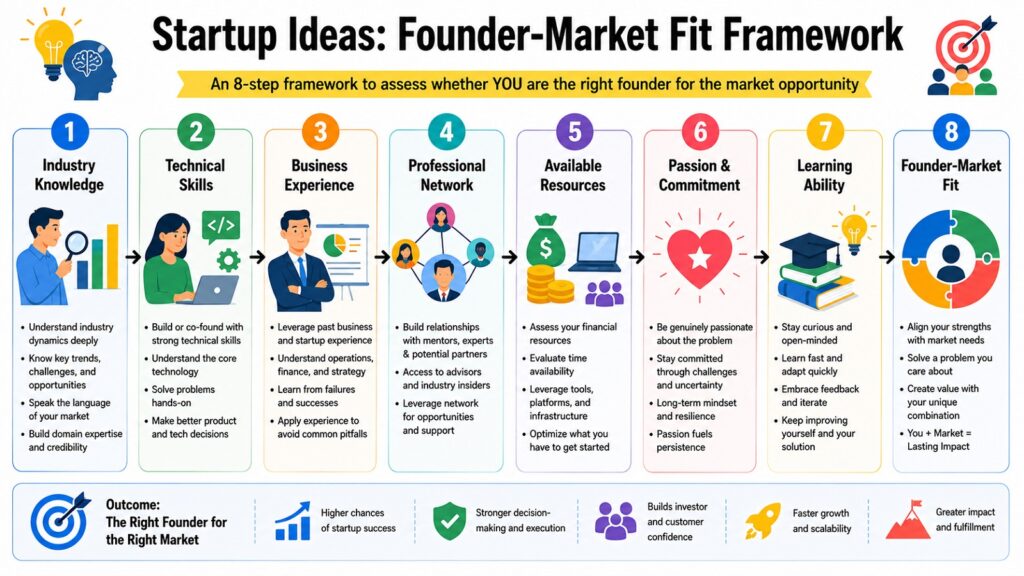
The strongest startup ideas often sit at the point where market need meets a founder’s real skill. This idea has a name: founder-market fit. It says a founder’s past, skills, and lived life can become a real edge, rather than just a nice line in a pitch deck.
Research on founder-market fit points to a few traits that show up often. These include deep field know-how, real lived time with the problem, tech skills suited to the fix, and a true network in that field. These traits speed up choices because the founder already grasps the small details of the market rather than learning them from scratch under stress.
Sara Blakely built Spanx after she struggled to find the right base layer to wear under white pants. It was a problem she had lived with herself before she ever tested a fix. Her years selling fax machines door to door gave her real sales skills, which helped her win over stores later on. Reed Hastings built Netflix’s early plan partly out of anger at late fees at video stores. He later drew on his coding background to spot when streaming finally grew strong enough to support a full shift away from DVDs. Jeff Bezos worked in finance and tech before he set up Amazon. That past gave him an early read on how fast online retail could grow.
Now look at firms where founders went into fields they did not know well. They could not foresee rules or customer needs unique to that field. Outside help and cash can close some of that gap. But founders with no real tie to their market often spend their first year learning what a skilled hand already knows.
The framework presented in this section encourages founders to evaluate an opportunity in relation to their previous experiences. It assesses practical skills, technological expertise, available funds, and the determination to persevere through challenging times. A robust market alone is insufficient; the concept must also align with the individual pursuing it.
Startup Ideas: Expertise of Founders That Supported Their Success
| Founder | Relevant Expertise |
| Sara Blakely | Years of direct sales before Spanx |
| Reed Hastings | Software background behind Netflix’s pivot |
| Jeff Bezos | Finance and tech experience before Amazon |
| Sergey Brin and Larry Page | Research into web search algorithms |
| Whitney Wolfe Herd | Dating app experience before Bumble |
| Howard Schultz | Retail and coffee experience at Starbucks |
| Brian Chesky | Design training applied to Airbnb’s product |
| Melanie Perkins | Teaching design software before Canva |
6. Startup Ideas Create Value Through Strong Business Models
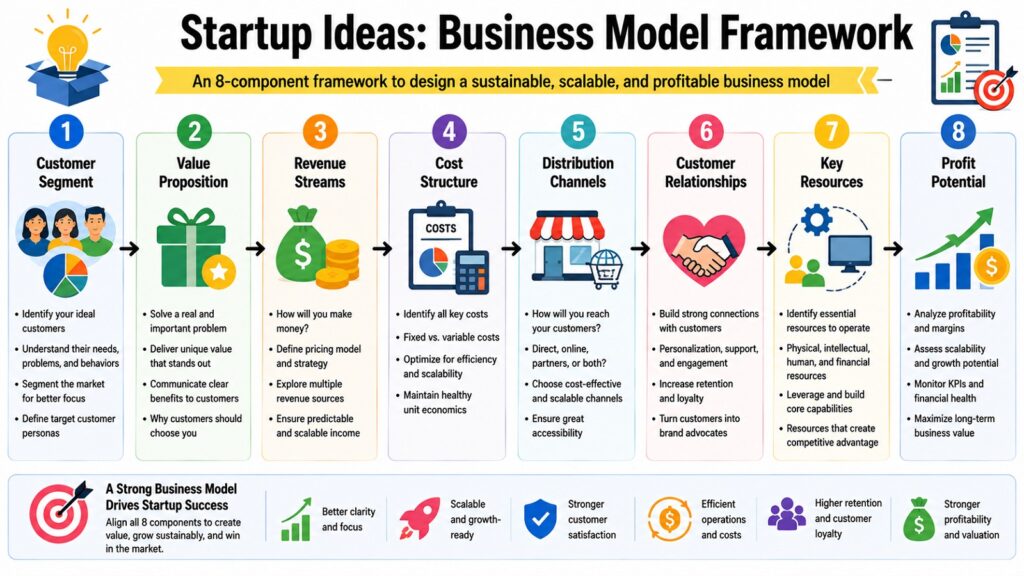
A great idea without a sound business model is just a costly hobby. Research on business health shows again and again that long-term success rests less on the cleverness of an idea. It rests more on whether the company has a clear way to make value, bring in cash, and keep costs in check as it grows. A business model answers a few plain questions: who pays, how much, how often, and why do they keep paying?
Set frameworks help founders work through this in a clear way. The business model canvas, built by Alexander Osterwalder, breaks a company down into customer groups, value claims, channels, cash flow, and cost structure. It pushes founders to test each piece, rather than think it will just work itself out. Many top firms broke new ground more in their business model than in their tech.
Dollar Shave Club flipped the old razor industry model on its head. Razors were once sold cheaply so brands could earn cash on the blades sold later. Dollar Shave Club built a flat plan instead, which customers found simpler and fairer. Spotify built a free-plus-paid model that let free, ad-backed users live side by side with paying ones.
By 2023, the bulk of its cash, more than 87 percent, came from paid plans rather than ads. Netflix swapped per-disc rental fees for one flat fee each month. This cut out late fees fully and made the tie with customers far more steady on both ends. Amazon Web Services made pay-as-you-go cloud pricing the norm. It let firms of any size rent computing power with no high cost up front.
The framework graphic for this section helps founders test their model before launch. It means naming who pays, then weighing costs against expected cash per customer. It also means checking whether the model still holds up as the company grows much larger. A startup idea with strong demand but a broken cost structure will run out of money in time, no matter how much people like the product.
Common Business Models Behind Strong Startup Ideas
| Business Model Types for Strong Startup Ideas | Real Company Example |
| Subscription | Netflix’s flat monthly streaming fee |
| Freemium | Spotify’s free and premium tiers |
| Marketplace | Airbnb connecting hosts and guests |
| Platform | Uber connecting riders and drivers |
| Software-as-a-service | Salesforce’s cloud-based licensing |
| Pay-as-you-go | Amazon Web Services’ usage-based pricing |
| Direct-to-consumer | Dollar Shave Club’s subscription razors |
| Advertising-supported | Google’s free search funded by ads |
7. Startup Ideas Gain Advantage Through Innovation and Differentiation
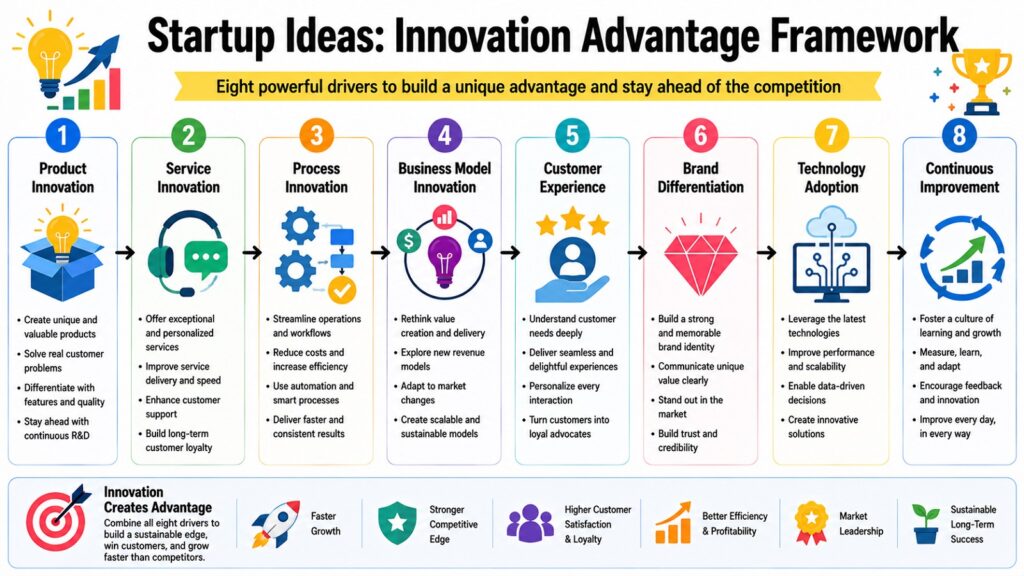
Copying a business that already exists rarely builds a lasting company. Buyers have little reason to switch if the new choice offers nothing new. Lasting startup ideas need a real point of difference. That difference can come from the product, the business model, the customer experience, or a tight niche.
Work on a new business strategy shows a few clear paths. A new product changes what gets sold. A new business model changes how value gets sent and paid for. A new customer experience changes how a buyer feels while they use a product. A niche focus goes after a small group instead of fighting every rival at once. Each path can work well on its own. Mixing newness for its own sake, with no real gain for the buyer, tends to fall flat.
Warby Parker stood out through both its product and its experience. It sold sharp glasses online at a slice of the usual shop price. A simple home try-on plan cuts the risk of buying glasses unseen. Southwest Airlines stood out through its business model, not its product. It chose low-cost, direct flights over the hub setup big airlines used. That choice kept its costs much lower across the board. Patagonia stood out through its values and its customer experience. Its repair program built trust around fixing gear rather than tossing it out. That choice gave real weight to its green stance.
Firms that struggled here often raced on price alone. That left them open to a hit the moment a bigger rival cut prices still more. With no real reason for buyers to stay loyal, growth became hard to keep up once the early buzz wore off.
The framework graphic for this part maps four paths side by side: product, business model, customer experience, and niche focus. It helps founders see which lever fits their own cash and skill. The goal here is never newness for its own sake. It is a value that rivals cannot copy with ease.
Startup Ideas and Their Primary Differentiation Strategy
| Company | Differentiation Strategy |
| Warby Parker | Direct-to-consumer pricing with home try-on |
| Southwest Airlines | Low-cost point-to-point route network |
| Patagonia | Repair-focused, sustainability-driven brand |
| Canva | Simplicity for non-professional designers |
| Dollar Shave Club | Convenience through direct subscription delivery |
| Tesla | Direct sales and over-the-air software updates |
| Airbnb | Authentic, local lodging instead of standard hotels |
| Duolingo | Free, gamified language learning experience |
8. Startup Ideas Succeed Through Scalability and Long-Term Evaluation

A good launch is only the first step. The best startup ideas get built with growth in mind from the start. Founders need to ask whether the model can grow into new markets and handle rising demand without breaking under its own weight. Many firms get early wins, only to learn that their work cannot stretch to support a much bigger customer base.
Research on growth points to a few themes that show up often. Day-to-day work should grow more lean, not less, as size goes up. Tech systems need to be built ahead of growth, rather than patched up after problems show up. The Startup Genome project found that a large share of fast-growth startups, close to 74 percent, ran into real trouble because they grew too soon. They added staff or spent before demand had caught up.
Firms that grew well often did so with care, not all at once. Uber and Airbnb both grew city by city, picking spots based on facts about local need. This let them learn and adjust before they moved to the next market. Amazon grew from books into wider retail, and at last cloud work, only once it proved its systems could support each new step. Zoom put real cash into its systems well before remote work shot up. That meant the tool could soak up a huge jump in use without big crashes.
By contrast, several hopeful startups grew into new markets faster than their systems could handle. This led to crashed service, growing losses, and broken customer trust that proved hard to fix. Growth that comes too soon rarely looks reckless at the time. It often looks like drive, which is part of why it catches founders off guard.
The framework graphic for this section ties the past seven parts of this article into one model for checking ideas. It asks founders to weigh problem clarity, market timing, proof, the rival picture, founder fit, business model strength, and real difference, all at once before they put cash into growth. Used often, this kind of check helps founders grow with a real aim instead of pure speed.
Practical Evaluation Criteria for Scaling Startup Ideas
| Evaluation Criterion | Key Question to Ask |
| Problem clarity | Is the core problem still urgent at scale? |
| Market timing | Is demand growing or merely temporary? |
| Validation evidence | Do paying customers exist beyond early adopters? |
| Competitive position | Can the advantage hold as competitors react? |
| Founder fit | Does leadership still match the company’s needs? |
| Business model strength | Do unit economics improve with more customers? |
| Differentiation | Does the advantage survive direct imitation? |
| Operational readiness | Can infrastructure handle sustained demand? |
Conclusion: Startup Ideas That Stand the Test of Time
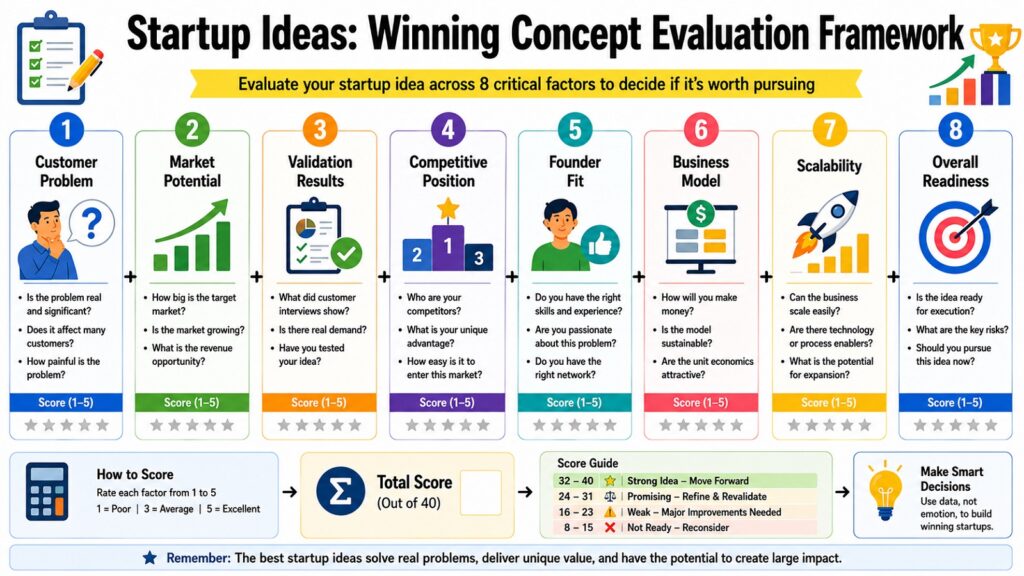
Startup ideas that last are rarely the result of chance or a single bolt of insight. They come from careful research into real problems. They come from close study of market timing and honest checks with paying customers. They come from smart moves against rivals, a real match between founder and market, and a sound business model. They also come from a true point of difference and a long-term plan for growth. Each of these eight parts builds on the ones before it. Skipping any single step tends to show up later as a costly shock.
The theories, facts, and real stories in this article are not meant to replace a founder’s own judgment. They are meant to sharpen it. They give founders a way to test their guesses before they risk real time and money. The graphics in each section can serve as a guide to come back to each time a new idea shows up.
Finding a winning startup idea is rarely about finding something nobody has thought of. More often, it means combining a real problem with solid research and steady follow-through. Readers who come back to these frameworks will find good ideas easier to spot, and weak ones easier to set aside before they turn costly.
Key Lessons From This Article on Startup Ideas
| Key Lessons on Startup Ideas | Practical Takeaway |
| Solve real problems first | Validate the pain point before building anything |
| Use market research, not assumptions | Confirm timing and demand with real data |
| Validate before large investment | Test cheaply before building expensively |
| Treat competitors as intelligence | Identify gaps rather than avoiding crowded markets |
| Match ideas to founder strengths | Pursue markets where experience gives an edge |
| Build a sustainable business model | Confirm the math works before scaling it |
| Differentiate meaningfully | Give customers a real reason to switch |
| Plan for scale early | Avoid premature growth that outpaces operations |