Table of Contents
Introduction: Understanding B2B Marketing as a Powerful Marketing Model
B2B Marketing, or business-to-business marketing, stands as one of the most influential Marketing Models in the world today. Rather than targeting individual consumers, it focuses on helping companies market their products and services directly to other businesses. This distinction shapes everything about how organizations communicate and build relationships. Manufacturing, technology, healthcare, logistics, finance, and professional services all depend on B2B Marketing to create, sustain, and grow their commercial relationships.
The essence of B2B Marketing lies in the nature of the transactions it facilitates. When businesses engage in purchasing from other businesses, they do not make spontaneous decisions. Instead, they meticulously assess suppliers, negotiate contracts, and anticipate consistent value over time. A procurement decision within a large organization may involve numerous individuals from various departments. This level of intricacy necessitates a marketing strategy grounded in logic, evidence, and trust, rather than emotional appeal.
Furthermore, B2B Marketing is distinct from consumer marketing regarding the sales cycle. While consumer purchases can occur within minutes, B2B transactions may extend over months or even years, traversing through stages of research, evaluation, approval, and contract finalization before any purchase is made. Marketers in this domain must sustain engagement throughout this prolonged journey while fostering relationships with patience.
The rise of digital technologies has changed how B2B Marketing operates. Buyers now conduct most of their research independently before speaking to a salesperson. Artificial intelligence, data analytics, and marketing automation have given organizations new tools to understand buyer behavior, personalize communication, and measure results with greater precision.
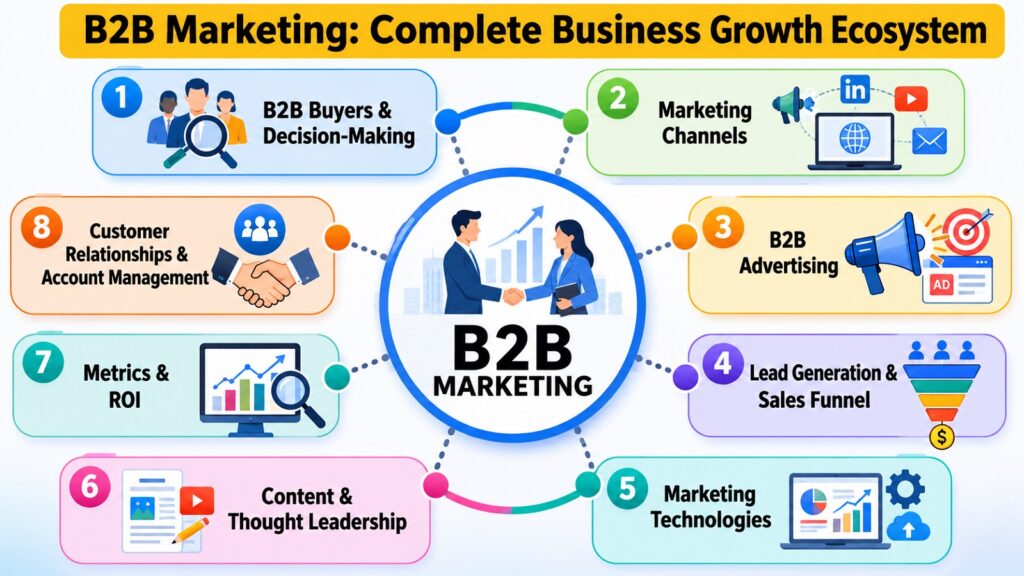
This article explores eight major aspects of B2B Marketing, each contributing to a complete picture of how businesses grow through effective marketing. From buyer psychology to content creation, from digital advertising to account management, every section builds toward a clearer understanding of what successful B2B Marketing looks like in practice.
B2B Marketing — Eight Major Aspects Covered in This Article
| Aspect | Summary |
| Buyers and Decision-Making | Understanding who makes purchasing decisions and why |
| Marketing Channels | Selecting the right platforms to reach business buyers |
| Advertising Strategies | Using paid and sponsored media to generate qualified leads |
| Lead Generation and Sales Funnel | Attracting, qualifying, and converting prospects |
| Technologies Driving Digital Transformation | Tools that improve marketing efficiency and personalization |
| Content and Thought Leadership | Educating buyers and building industry authority |
| Metrics and Return on Investment | Measuring what works and allocating budgets wisely |
| Customer Relationships and Account Management | Building loyalty and growing long-term partnerships |
1. B2B Marketing Buyers and Decision-Making Process
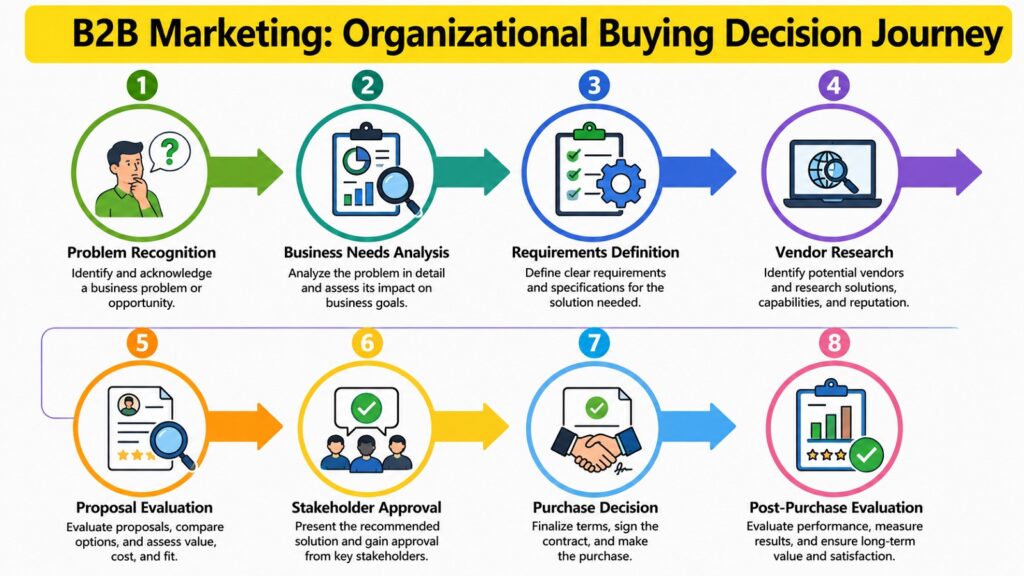
At the heart of effective B2B Marketing lies a clear understanding of how businesses actually make purchasing decisions. Unlike individual consumers, organizations buy through structured processes involving multiple people with different responsibilities and levels of authority. Marketers who understand this dynamic are better positioned to reach the right people with the right message at the right time.
The notion of the decision-making unit, commonly referred to as DMU, plays a pivotal role in the behavior of organizational purchasing. A DMU generally comprises business leaders who establish strategic direction, technical evaluators who determine if a solution aligns with operational needs, procurement specialists who oversee sourcing, financial approvers who manage budgets, and end users who will utilize the solution on a daily basis. Each member has distinct priorities, which implies that a singular marketing message seldom addresses the concerns of all stakeholders involved.
Research from the Gartner Group suggests that the average B2B buying group involves between six and ten decision-makers, each bringing independent information to the table. This finding has significant implications for how campaigns should be designed. Rather than targeting one person, successful B2B Marketing campaigns address multiple roles across the DMU, building familiarity and trust at every level of the organization.
In B2B environments, purchasing criteria are influenced by factors such as return on investment, total cost of ownership, vendor reliability, compliance issues, and alignment with long-term strategic goals. Additionally, business buyers are driven by the desire to mitigate risk. They bear responsibility to their organizations for the decisions they make, and a suboptimal choice can adversely affect their reputation. This reality influences their approach to information gathering and the careful evaluation of alternatives.
Consider a manufacturing company evaluating a new supply chain platform. The operations team wants efficiency, the finance team wants cost savings, the IT team wants security, and the CEO wants competitive advantage. The vendor that addresses all of these concerns, not just one, wins the business. This kind of layered, audience-aware B2B Marketing separates strong campaigns from forgettable ones.
B2B Marketing — Organizational Buying Decision Participants and Their Roles
| Participant | Primary Responsibility |
| Executive Sponsor | Sets strategic direction and final approval authority |
| Technical Evaluator | Assesses product fit with operational requirements |
| Procurement Manager | Manages sourcing, negotiation, and vendor compliance |
| Financial Approver | Reviews budgets, pricing, and return on investment |
| Department Manager | Oversees implementation and day-to-day usage |
| End User | Interacts with the product and provides usability feedback |
| Legal/Compliance Officer | Reviews contracts, risk, and regulatory requirements |
| IT/Security Specialist | Evaluates integration, data security, and technical compatibility |
2. B2B Marketing Channels for Business Growth
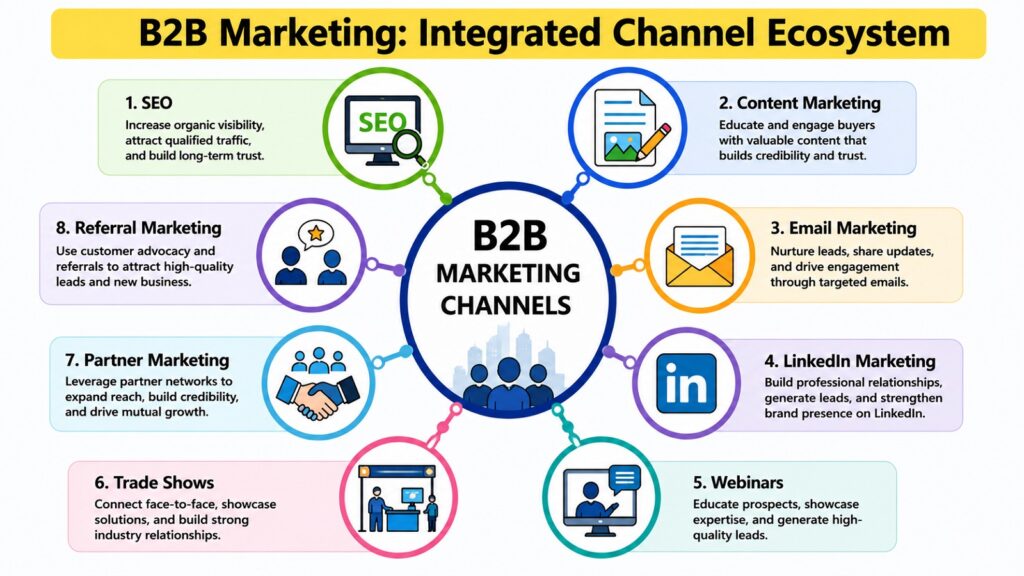
B2B Marketing does not depend on a single channel to connect with potential customers. Instead, it employs a mix of platforms tailored to engage various types of buyers at different stages of their decision-making process. The objective is not to be omnipresent but to be available where business buyers actively seek information and make decisions.
Content marketing stands out as one of the most prevalent channels in B2B Marketing. Business buyers conduct thorough research prior to interacting with vendors. By creating valuable articles, guides, white papers, and case studies, organizations position themselves in front of buyers during these research phases, thereby establishing credibility before any direct sales discussions occur.
Search engine optimization enhances content marketing by ensuring that educational materials are prominently displayed when buyers search for information pertinent to their challenges. A company that consistently ranks for relevant business search terms can generate a steady stream of organic traffic without incurring costs for each visit. Over time, this fosters a significant competitive edge.
LinkedIn has emerged as the dominant social platform for B2B Marketing. With its professional user base and targeting capabilities, it allows organizations to reach specific job titles, industries, company sizes, and seniority levels. Webinars have also become effective tools for demonstrating expertise and engaging decision-makers in structured learning environments.
Email marketing, despite being one of the oldest digital channels, continues to deliver strong results in B2B settings. Personalized campaigns that address specific business challenges outperform generic newsletters consistently. Industry events and trade shows, now available in hybrid formats, extend their reach far beyond physical attendance.
Referral and partner marketing deserve particular attention. In B2B environments, a recommendation from a trusted peer often carries more weight than any advertisement. A technology firm entering the healthcare market might combine SEO-driven content, LinkedIn articles, webinars for clinical decision-makers, and outreach through industry associations to build consistent visibility across the entire buying journey.
B2B Marketing — Major Channels and Their Business Purpose
| Channel | Primary Business Purpose |
| Content Marketing | Educates buyers and builds brand authority during research phases |
| Search Engine Optimization | Generates organic traffic from buyers searching for solutions |
| LinkedIn Marketing | Targets specific professional roles and business decision-makers |
| Email Marketing | Nurtures relationships and keeps prospects engaged over time |
| Webinars | Demonstrates expertise and engages qualified audiences directly |
| Industry Events and Trade Shows | Builds relationships and increases brand visibility in specific sectors |
| Referral Marketing | Generates trusted leads through professional recommendations |
| Partner Marketing | Extends market reach through strategic alliances and reseller networks |
3. B2B Marketing Advertising Strategies
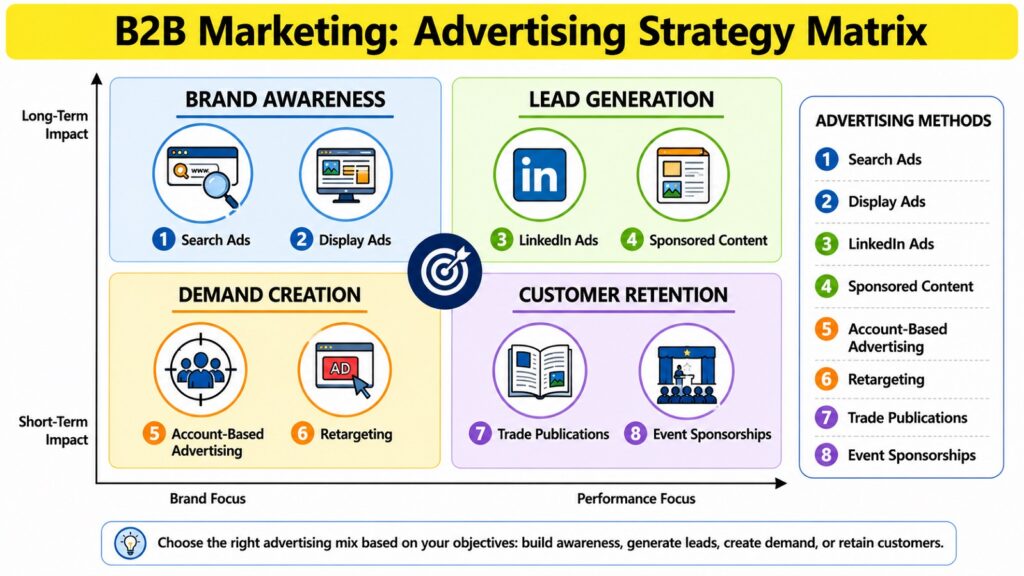
Advertising plays an important role in B2B Marketing, though it operates very differently from consumer advertising. B2B advertising is not designed to create immediate purchases through emotional appeals. Instead, it builds brand awareness, establishes credibility, generates qualified leads, and supports prospects through long and complex decision-making processes.
Search advertising through platforms like Google Ads allows B2B organizations to appear at the top of search results for relevant commercial queries. When a procurement manager searches for enterprise logistics software or a CFO looks for financial planning tools, search advertising ensures that relevant vendors appear immediately. The intent behind such searches is often high, making this a valuable channel for capturing buyers who are already looking for solutions.
LinkedIn advertising stands apart because of its professional targeting precision. Organizations can direct sponsored content, lead generation forms, and message ads to specific job titles, functions, seniority levels, industries, and company sizes. For campaigns targeting senior decision-makers, this specificity translates directly into better lead quality and lower wasted spend.
Account-based advertising focuses resources on a defined list of high-value target companies. Supported by tools like Terminus and Demandbase, it delivers coordinated advertising across multiple channels simultaneously to accounts that match an ideal customer profile. Retargeting campaigns complement this approach effectively. A prospect who visits a website today may not make a purchase for another nine months, and retargeting keeps the brand visible throughout that extended period.
Trade publications and industry-specific magazines continue to serve B2B advertisers well in specialized sectors. Event sponsorships provide visibility at precisely the moments when buyers are actively thinking about their industry challenges, comparing vendors, and assessing new solutions. A cybersecurity firm, for example, might combine search ads, LinkedIn campaigns, and conference sponsorships to maintain a consistent and credible presence across every touchpoint of a lengthy enterprise sales cycle.
B2B Marketing — Advertising Methods and Their Primary Marketing Objectives
| Advertising Method | Primary Marketing Objective |
| Search Advertising | Captures active buyers searching for specific business solutions |
| LinkedIn Advertising | Reaches professional decision-makers with precision targeting |
| Account-Based Advertising | Focuses resources on high-value target company lists |
| Display Advertising | Builds brand awareness across relevant business websites |
| Retargeting Campaigns | Keeps brand visible to prospects throughout long buying cycles |
| Sponsored Content | Builds credibility by placing expert material on trusted platforms |
| Trade Publication Ads | Reaches specialized industry audiences in their professional context |
| Event Sponsorships | Increases brand visibility at industry conferences and summits |
4. B2B Marketing Lead Generation and Sales Funnel
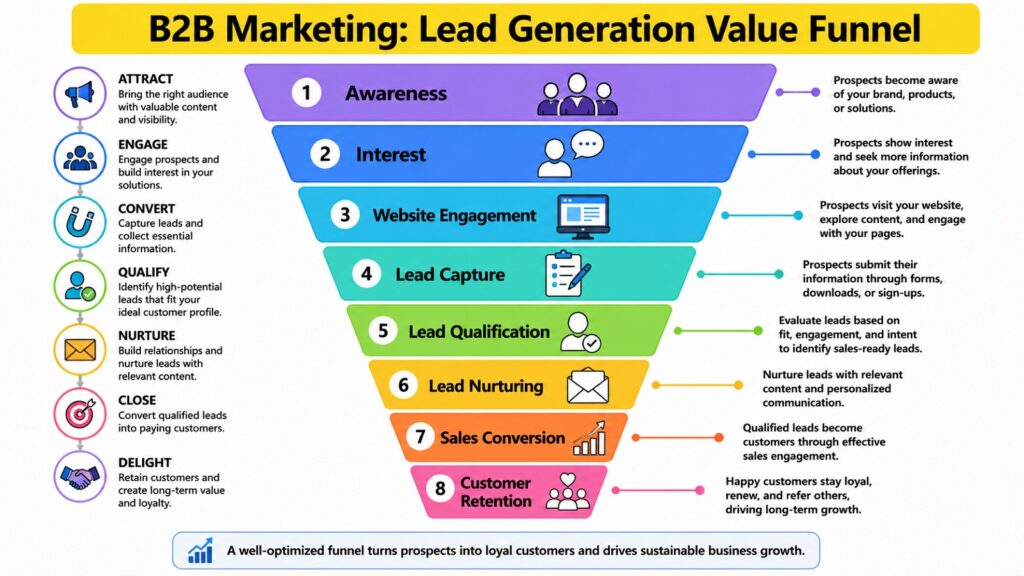
B2B Lead generation sits at the center of B2B Marketing Model, connecting marketing activities to revenue outcomes. Without a consistent and well-managed pipeline of prospects, even the most sophisticated strategies cannot produce sustainable business growth. Understanding how to attract, qualify, and convert leads is therefore one of the most important practical skills in B2B Marketing.
The B2B sales funnel begins with awareness, where potential buyers first learn that a solution to their problem exists. Inbound marketing through content, SEO, and social engagement attracts prospects organically. Outbound prospecting through targeted emails and paid advertising supplements inbound efforts by reaching buyers who have not yet discovered the brand on their own.
Lead magnets help transition anonymous visitors into known prospects. Research reports, free tools, templates, and webinar registrations give buyers a reason to share their contact information. The value of the lead magnet must match the sophistication of the target audience. Business buyers respond well to original research, detailed frameworks, and practical tools that address specific operational challenges rather than generic content.
Marketing Qualified Leads, or MQLs, are prospects who have shown meaningful engagement but are not yet ready for direct sales conversation. Sales Qualified Leads, or SQLs, are contacts assessed by sales teams and meeting specific criteria related to budget, authority, need, and timeline. Managing this transition cleanly is one of the most common challenges in B2B organizations.
CRM platforms such as Salesforce, HubSpot, and Microsoft Dynamics support the entire lead lifecycle, tracking interactions and coordinating follow-up across marketing and sales teams. Research by MarketingSherpa found that organizations with strong lead nurturing generate significantly more sales-ready leads at substantially lower cost than those without structured nurturing programs.
A SaaS company targeting mid-market businesses might use gated research reports to generate MQLs, automated email sequences to nurture leads over several weeks, and discovery calls to qualify SQLs before passing them to a sales team. Focusing on lead quality rather than quantity reduces wasted sales effort and improves close rates meaningfully.
B2B Marketing — Sales Funnel Stages and Primary Objectives
| Funnel Stage | Primary Objective |
| Awareness | Attract potential buyers through content, SEO, and advertising |
| Interest | Engage prospects with relevant educational resources and insights |
| Consideration | Demonstrate solution fit through case studies and product content |
| Intent | Identify high-intent leads through behavior signals and engagement data |
| Evaluation | Support detailed vendor comparison through demos and consultations |
| Decision | Convert qualified prospects into customers through proposals and negotiation |
| Retention | Deliver post-sale value to encourage renewal and long-term loyalty |
| Advocacy | Turn satisfied customers into referral sources and brand ambassadors |
5. B2B Marketing Technologies Driving Digital Transformation
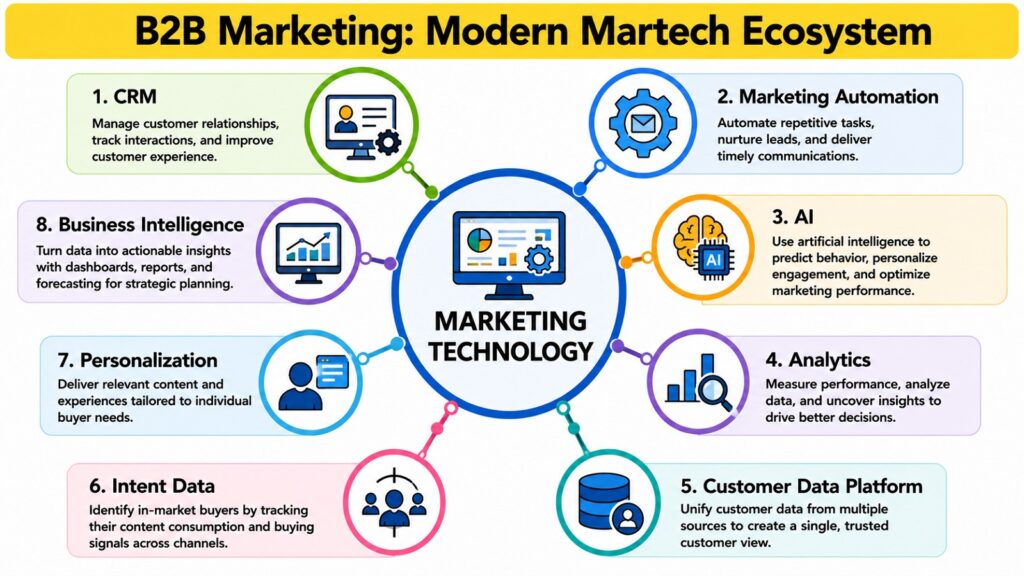
Technology has become inseparable from modern B2B Marketing. The volume of data generated across buyer interactions, the complexity of multi-channel campaigns, and the expectation of personalized communication at scale have made marketing technology a necessity rather than a luxury. Organizations that invest intelligently in the right tools gain real advantages in efficiency and targeting accuracy.
Customer relationship management systems form the foundation of the marketing technology stack. CRM platforms like Salesforce, HubSpot, and Zoho consolidate contact data, track communication history, and provide sales teams with complete visibility into every buyer interaction. Without a reliable CRM, B2B Marketing efforts lose coherence as leads move between teams.
Marketing automation platforms extend CRM functionality by enabling behavior-triggered communication at scale. Tools like Marketo, Pardot, and ActiveCampaign allow organizations to design automated nurturing sequences that respond to specific buyer actions, delivering the right content at the right moment without requiring manual intervention.
Artificial intelligence has brought forth capabilities that were once deemed impossible or excessively costly. Predictive lead scoring leverages historical conversion data to determine which prospects are most likely to convert into customers. AI-driven personalization tailors website experiences and emails according to the unique behavior patterns of individual buyers.
Customer data platforms aggregate behavioral and demographic data from multiple sources into unified buyer profiles. Intent data providers such as Bombora and G2 track behavioral signals across the web to identify companies actively researching specific solutions, allowing B2B Marketing teams to prioritize outreach toward prospects already in active buying cycles.
A global industrial equipment manufacturer that adopted an integrated technology stack combining CRM, marketing automation, and intent data found that sales team productivity improved measurably because representatives spent more time with high-intent prospects. Selecting technologies based on integration capability, scalability, and organizational objectives matters more than choosing tools with the most features.
B2B Marketing — Key Technologies and Their Primary Business Applications
| Technology | Primary Business Application |
| CRM Platform | Centralizes contact data and tracks buyer interactions across the lifecycle |
| Marketing Automation | Delivers behavior-triggered, personalized communication at scale |
| Artificial Intelligence | Enables predictive scoring, personalization, and content optimization |
| Customer Data Platform | Unifies behavioral and demographic data into single buyer profiles |
| Intent Data Tools | Identifies companies actively researching solutions in specific categories |
| Business Intelligence | Analyzes marketing performance data to support strategic decisions |
| Workflow Automation | Reduces manual tasks and improves team efficiency across departments |
| Performance Dashboards | Provides real-time visibility into campaign results and pipeline health |
6. B2B Marketing Content and Thought Leadership
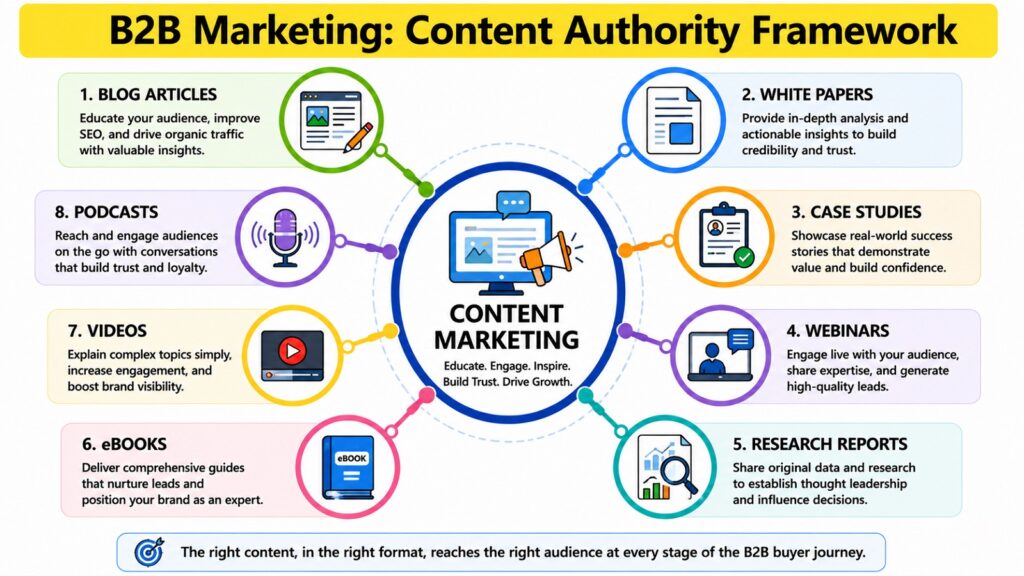
Content has become one of the most powerful assets available to B2B marketers. In an environment where buyers conduct extensive independent research before contacting vendors, the organization that provides the most useful and credible information during that research phase earns a significant competitive advantage. Content is no longer simply a tool that supports sales teams. It has become a primary driver of demand, trust, and long-term relationships.
Blog articles and website content capture buyers in the early awareness stage by answering common questions and surfacing relevant solutions. White papers and research reports appeal to buyers in the evaluation stage who need detailed, evidence-based information to support internal business cases. Case studies demonstrate real-world results for buyers close to making a decision who need proof that a solution actually works.
Webinars and video content provide educational value while creating personal connections between buyers and the people behind a brand. eBooks and comprehensive guides serve as lead magnets that generate qualified contacts in exchange for valuable information. Newsletters maintain consistent engagement with audiences who have already shown interest. Podcasts have grown significantly in B2B environments, offering long-form educational content that professionals consume during commutes or between meetings.
Thought leadership elevates content from simple education to genuine industry authority. When executives and subject matter experts share original perspectives and contribute meaningful insights to their industries, they build credibility that no advertising campaign can replicate. LinkedIn articles, conference speaking engagements, and contributions to industry publications are powerful vehicles for this kind of positioning.
Research from Edelman and LinkedIn found that 55 percent of business decision-makers use thought leadership content to evaluate whether they want to work with an organization. That figure reflects how deeply content shapes buyer perception before any sales conversation begins. A cybersecurity firm that consistently publishes original threat research and contributes to industry discussions becomes the organization buyers think of first when they need a security partner.
B2B Marketing — Content Formats and Their Primary Marketing Purpose
| Content Format | Primary Marketing Purpose |
| Blog Articles | Builds organic search visibility and attracts early-stage buyers |
| White Papers | Provides in-depth analysis that supports internal business cases |
| Research Reports | Establishes authority through original data and industry insights |
| Case Studies | Demonstrates proven results for buyers evaluating vendor options |
| Webinars | Educates qualified audiences and builds direct relationships |
| eBooks | Generates qualified leads through valuable gated educational content |
| Newsletters | Maintains consistent engagement with interested prospects and customers |
| Podcasts | Delivers long-form expert content to professional audiences over time |
7. B2B Marketing Metrics and Return on Investment (ROI)
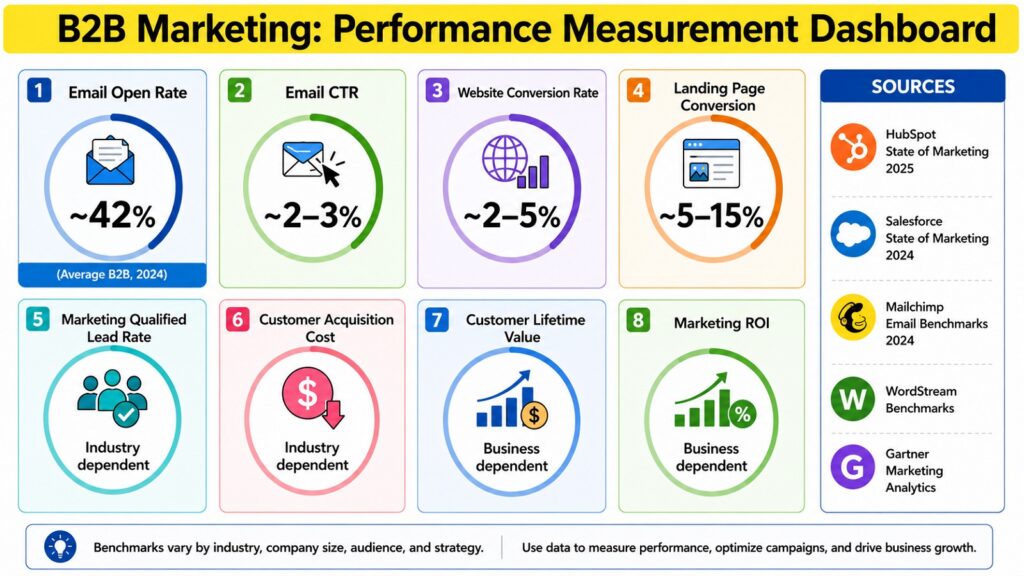
Measuring performance is not optional in professional B2B Marketing. Organizations invest significant resources in campaigns, technology, content, and people. Without disciplined measurement, it is impossible to know which investments are producing returns. Good measurement transforms marketing from a cost center into a growth engine.
Customer acquisition cost, or CAC, measures how much it costs to acquire a single new customer across all marketing and sales activities. If CAC rises faster than the revenue each customer generates, the business model is under pressure regardless of how many new customers are being added.
Customer lifetime value, or CLV, provides the necessary counterpoint to CAC. Businesses with high CLV can afford to spend more acquiring each customer because the long-term relationship compensates for the initial investment. This metric is especially relevant in B2B settings where contracts span multiple years and expansion from upselling is common.
Lead conversion rate reveals problems at specific funnel stages. A low MQL to SQL conversion rate suggests marketing is generating contacts who do not meet the criteria that the sales team considers qualified. Pipeline velocity measures how quickly opportunities move through the sales funnel, providing a forward-looking indicator of revenue health. Marketing attribution assigns credit to the channels that influenced each buying decision, helping teams understand where budget produces the best results.
Research from Forrester indicates that B2B organizations with aligned marketing and sales measurement frameworks grow revenue at roughly twice the rate of those where these functions use separate metrics. A software company that tracked pipeline velocity and customer lifetime value by channel was able to reallocate its budget toward high-performing channels, producing revenue growth without increasing total spend.
The most important principle in B2B measurement is alignment with business outcomes. Tracking impressions and website visits is useful only when those figures connect to pipeline and customer retention.
B2B Marketing — Key Metrics and What They Measure
| Metric | What It Measures |
| Customer Acquisition Cost | Total spend required to acquire one new customer |
| Customer Lifetime Value | Total revenue expected from a customer over the full relationship |
| Lead Conversion Rate | Percentage of leads that progress to become paying customers |
| Cost Per Lead | Average marketing spend required to generate each new lead |
| Marketing Qualified Lead Rate | Share of leads meeting threshold engagement criteria |
| Pipeline Velocity | Speed at which opportunities move through the sales funnel |
| Marketing Attribution | Credit assigned to channels that influenced a buying decision |
| Return on Marketing Investment | Revenue generated relative to total marketing expenditure |
8. B2B Marketing Customer Relationships and Account Management
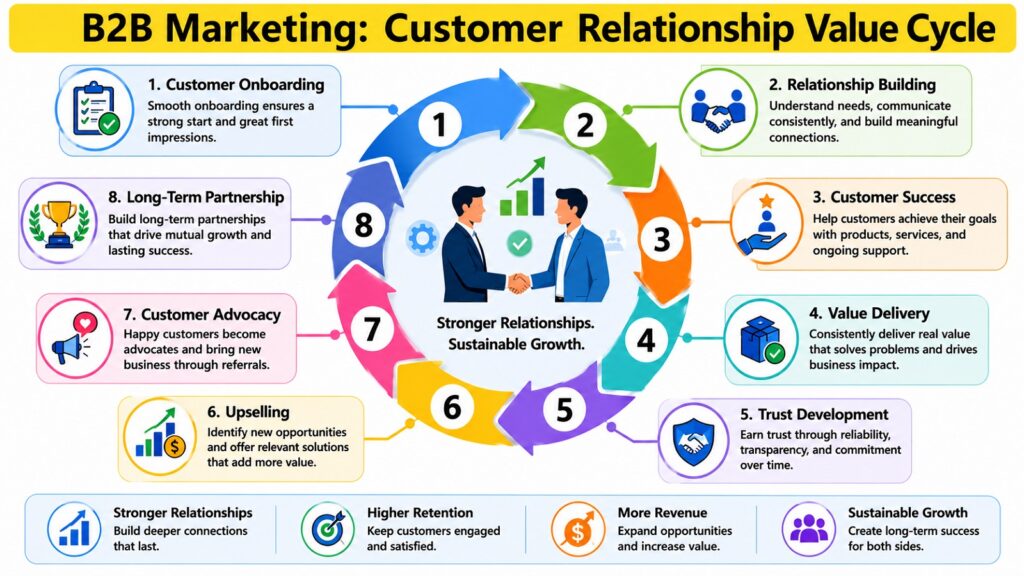
Long-term customer relationships are not simply a desirable outcome of good B2B Marketing. They are one of its most important strategic objectives. The cost of acquiring a new B2B customer is substantially higher than the cost of retaining and growing an existing one. Organizations that excel at relationship management consistently outperform those focused purely on new customer acquisition.
Relationship marketing in B2B contexts holds that partnerships create more value when treated as ongoing collaborations rather than transactional exchanges. When a vendor invests in understanding a customer’s evolving challenges and adapts accordingly, the relationship becomes genuinely difficult to replace. That mutual dependency creates natural loyalty that holds against competitor pricing pressure.
Key account management, or KAM, dedicates specific resources to the most valuable customer relationships. Key account managers serve as strategic partners, spending time understanding customer strategy, identifying growth opportunities, and coordinating internal teams to deliver consistent value. Research from the Strategic Account Management Association suggests that companies with formal KAM programs retain key accounts at meaningfully higher rates than those using standard relationship management.
Customer success has emerged as a distinct function within B2B organizations, particularly in technology and subscription businesses. Customer success teams monitor product adoption, identify renewal risks, and address issues proactively before they become reasons for a customer to leave. The difference between reactive support and proactive success management is significant in terms of retention outcomes.
Upselling and cross-selling within existing accounts represent some of the most efficient paths to revenue growth in B2B settings. A customer who already trusts a vendor is far more open to additional products than a new prospect who has not yet experienced the relationship. An enterprise application company that combined structured quarterly business reviews with a dedicated customer success team improved net revenue retention over two years without additional investment in new customer acquisition.
B2B Marketing — Relationship-Building Practices and Their Business Benefits
| Practice | Primary Business Benefit |
| Key Account Management | Builds strategic partnerships that resist competitive pressure |
| Customer Success Programs | Improves retention by proactively addressing adoption and risk issues |
| Quarterly Business Reviews | Aligns vendor and customer goals while identifying growth opportunities |
| Upselling and Cross-Selling | Generates efficient revenue growth from existing trusted relationships |
| Post-Sale Onboarding | Ensures customers achieve early value and builds initial loyalty |
| Customer Advocacy Programs | Converts satisfied customers into credible referral and testimonial sources |
| Personalized Communication | Demonstrates genuine understanding of each customer’s unique needs |
| Long-Term Contract Renewal | Creates revenue predictability and strengthens partnership commitment |
Conclusion: The Future of B2B Marketing for Sustainable Business Growth
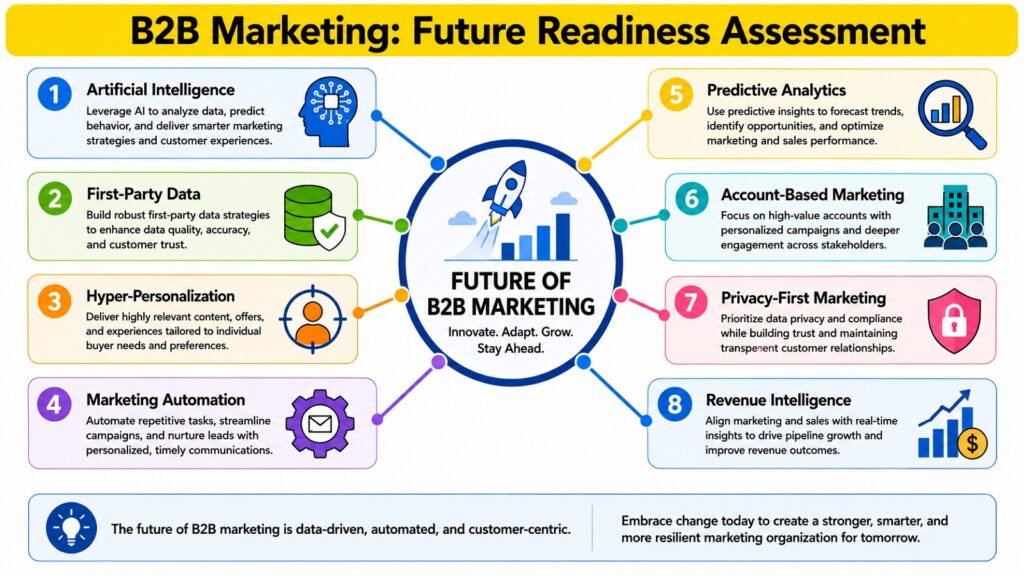
B2B Marketing has earned its place as one of the most important Marketing Models in the global economy. The eight aspects explored in this article form a practical framework that organizations can apply to grow more sustainably and build stronger commercial partnerships.
The most significant lesson is that B2B Marketing rewards patience and genuine value creation. Buying decisions involve multiple people, complex requirements, and long evaluation periods. Marketers who respect that complexity build the kind of trust that leads to durable commercial relationships.
Looking ahead, artificial intelligence is accelerating personalization at scale. First-party data is growing more valuable as privacy regulations restrict third-party tracking. Account-based marketing is combining intent data and multi-channel execution in increasingly sophisticated ways. Buyer expectations for digital-first experiences continue to rise.
Organizations that earn buyer trust through transparency and genuinely useful content hold meaningful advantages where attention is scarce. The businesses that approach B2B Marketing as a discipline of continuous learning will remain competitive and capable of building lasting partnerships.
B2B Marketing — Key Strategic Takeaways from Eight Core Topics
| Topic | Strategic Takeaway |
| Buyers and Decision-Making | Address every DMU participant, not just one decision-maker |
| Marketing Channels | Combine channels to engage buyers across their full research journey |
| Advertising Strategies | Target with precision to generate quality leads over raw volume |
| Lead Generation and Sales Funnel | Prioritize lead quality and structured nurturing over lead quantity |
| Technologies and Digital Transformation | Integrate tools strategically to improve efficiency and targeting |
| Content and Thought Leadership | Educate consistently to earn trust before the sales conversation starts |
| Metrics and Return on Investment | Align measurements with business outcomes rather than marketing activity |
| Customer Relationships and Account Management | Retain and grow existing accounts as a primary growth strategy |