
Table of Contents
Introduction to Business Communication: Why It Matters
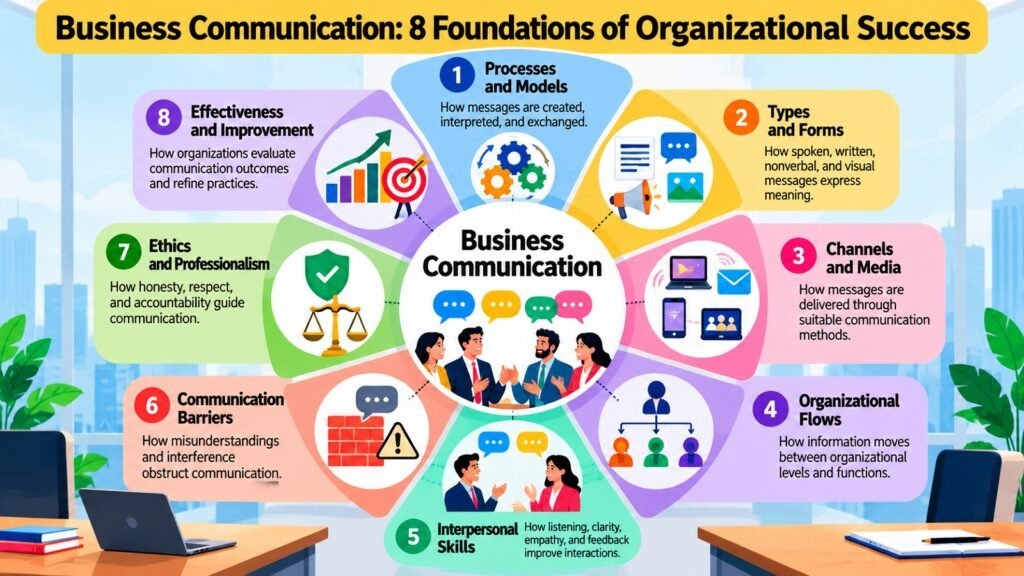
Business Communication is the systematic exchange of information, ideas, instructions, feedback, and meaning within and around an organization, and it is an important aspect of Leadership and Management. Chester Barnard (1938) identified communication as the executive’s primary responsibility, recognizing that organizational coordination cannot occur when organizational objectives remain unexpressed. Leaders articulate vision, managers translate it into coordinated work, and employees interpret both through their own roles, so communication links strategic intent to shared understanding, teamwork, organizational objectives, and stakeholder trust. Its relevance extends across industries, firm sizes, and environments, from a ten-person startup to a multinational operating across several time zones.
Transmission alone is insufficient. Effective Business Communication also requires interpretation, feedback, shared understanding, and responsible conduct, since a message that is delivered but misread has failed in practice, however polished its wording. Mintzberg’s (1973) study of managerial work reached a related conclusion by identifying information handling as a distinct managerial role.
This article proceeds through eight aspects: processes and models, forms, channels, organizational flows, interpersonal skills, barriers, ethics, and evaluation. It is intended as a foundational resource that combines theoretical knowledge, credible research, and practical application, with claims anchored in established scholarship rather than generalization. The progression advances from foundational concepts to applied assessment, ensuring that each component establishes prerequisites for subsequent sections, with each division concluding in a summary table that distills principal concepts for expedited consultation.
Overview of Eight Aspects of Business Communication
| Aspects of Business Communication | Core Focus |
| Processes and Models | How messages are encoded, transmitted, interpreted, and answered, and what theory explains |
| Types and Forms | Oral, written, nonverbal, and visual communication and their respective strengths |
| Channels and Media | Delivery media, synchronous and asynchronous exchange, and criteria for channel selection |
| Organizational Flows | Downward, upward, horizontal, and diagonal movement of information through structures |
| Interpersonal Skills | Listening, questioning, feedback, empathy, and assertiveness in managerial interaction |
| Barriers and Solutions | Linguistic, cultural, psychological, organizational, and technological obstacles and remedies |
| Ethics and Professionalism | Honesty, confidentiality, accountability, and responsible conduct toward stakeholders |
| Effectiveness and Improvement | Evaluation methods and cycles for refining communication practice |
1. Business Communication Processes and Models
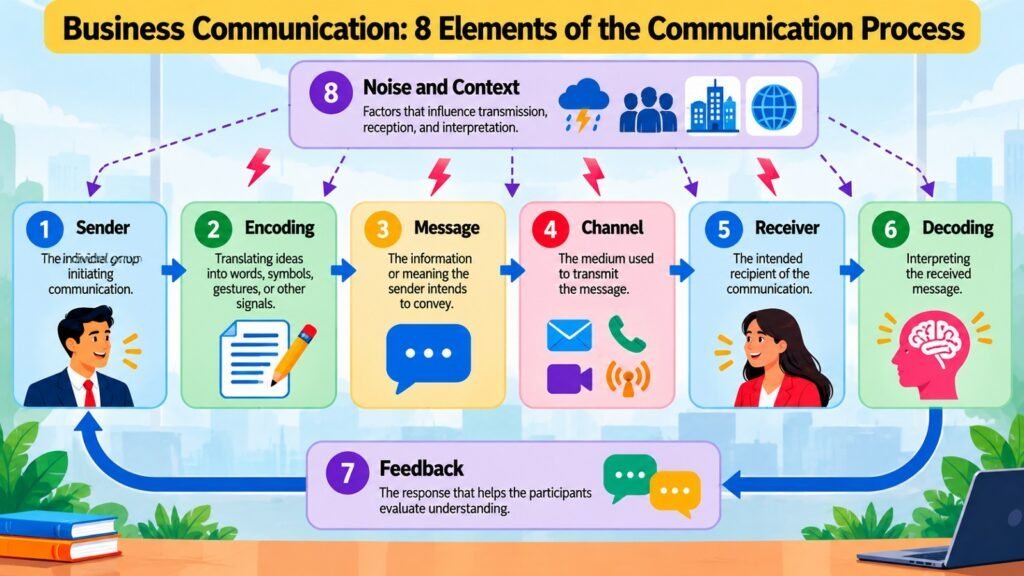
Business Communication unfolds as a sequence in which a sender forms an intention, encodes it into symbols, transmits it through a channel, and relies on a receiver to decode and interpret it within a particular context. Noise, whether semantic, psychological, or physical, can distort any stage, and feedback is the mechanism through which the sender learns what the receiver actually understood. A managerial instruction to prioritize a key account may be transmitted flawlessly yet interpreted differently by sales and operations, because each department attaches its own meaning to priority.
Shannon and Weaver (1949) conceptualized communication as the transmission of signals between a source and recipient, employing a linear framework whose technical foundations provide both analytical rigor and inherent constraints. This model presupposes meaning as predetermined and cannot account for why comparable terminology generates disparate understandings. Schramm (1954) incorporated intersecting domains of knowledge, and Barnlund (1970) developed a transactional framework wherein participants simultaneously transmit and receive information while deriving meaning from contextual indicators. The transactional approach demonstrates particular utility in dialogic exchanges, collaborative problem-solving, and interdepartmental communication, though linear models retain applicability for institutional-scale communications.
Complementary theoretical frameworks enhance these foundational models. Berlo’s (1960) SMCR framework emphasizes the communicator’s competencies, dispositions, expertise, and organizational context, redirecting analytical focus toward the individuals engaged in communication rather than the message itself. Weick’s (1995) sensemaking theory reframes the inquiry from message transmission mechanisms to the processes through which organizational participants construct retrospective, coherent interpretations of uncertain circumstances, a framework particularly valuable during organizational transitions when formal communications remain fragmentary.
No model explains every situation. Their value is diagnostic: managers can ask whether a failure arose from unclear encoding, an unsuitable channel, delayed feedback, or mismatched frames of reference, and can verify understanding by asking recipients to restate commitments in their own words rather than simply acknowledging receipt.
Core Concepts and Models in Business Communication
| Concepts or Models in Business Communication | Explanation and Business Application |
| Shannon–Weaver model | Linear source-to-destination transmission with noise; diagnoses signal distortion in broadcast messages. |
| Schramm model | Overlapping fields of experience determine shared meaning; guides adaptation to audience background. |
| Transactional model | Simultaneous sending and receiving; suits negotiations, appraisals, and team dialogue. |
| Berlo’s SMCR model | Source, message, channel, and receiver attributes, including skills and attitudes, shape effectiveness. |
| Feedback loop | Returned information confirms or corrects interpretation; verifies that instructions were understood. |
| Noise | Semantic, psychological, or physical interference with decoding; its type directs the remedy. |
| Context | Situational, relational, and cultural setting shaping interpretation; explains divergent departmental readings. |
| Sensemaking (Weick) | Members construct plausible interpretations of ambiguous events; relevant during change and crisis. |
2. Types and Forms of Business Communication
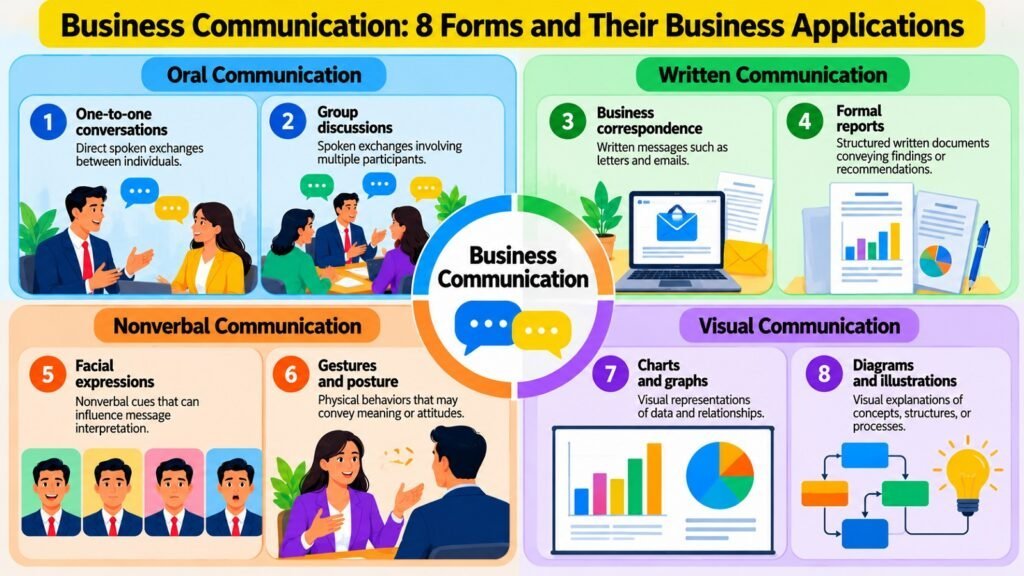
Business Communication takes four principal forms: oral, written, nonverbal, and visual. Oral communication supports immediacy and rapid clarification, which makes it suitable for negotiation and coaching, but it leaves no durable record and depends on memory. Written communication provides precision, documentation, and accountability, yet it lacks immediate feedback and can strip out tone. Because each form exploits a different perceptual pathway, its fit depends on what must be conveyed, to whom, and under what practical constraints of time and attention.
Nonverbal communication, comprising facial expression, posture, gesture, vocal quality, and use of space, frequently signals attitude and credibility. The research is often misquoted: Mehrabian’s well-known percentages concerned inconsistent messages about feelings, not communication in general. Visual communication, including charts, diagrams, and dashboards, compresses complex relationships and supports comparison, although poor design or truncated axes can mislead as readily as clarify. Formal and informal communication, by contrast, describe organizational status rather than form, since a written memo and a hallway conversation can each be either, depending on sanction and structure.
Each form also has a characteristic failure mode. Spoken explanations drift as they are retold, written instructions are skimmed rather than read, gestures are interpreted through cultural lenses, and visual displays invite conclusions the underlying data may not support. Redundancy across forms mitigates these weaknesses, which explains the common practice of following a meeting with written minutes that record decisions and responsibilities. The cost is additional effort, so redundancy is best reserved for consequential or easily misunderstood information.
Choice among them should follow audience expertise, message complexity, context, and objective. A quarterly performance report may combine written analysis with visual summaries, whereas a restructuring announcement benefits from spoken delivery followed by written confirmation.
Principal Forms of Business Communication
| Types or Forms of Business Communication | Characteristics and Business Application |
| Oral | Immediate and interactive; used in meetings, negotiations, and coaching, though unrecorded. |
| Written | Permanent and precise; supports contracts, policies, and reports requiring documentation. |
| Nonverbal | Gesture, expression, and posture convey attitude; shapes credibility in presentations and interviews. |
| Vocal (paralanguage) | Pitch, pace, and volume modify meaning; important in calls and presentations. |
| Visual | Charts and diagrams condense relationships; effective for decisions when accurately designed. |
| Audiovisual | Combined sound and image in training and recorded briefings; supports scalable instruction. |
| Formal (status category) | Sanctioned, documented exchanges such as policies and memoranda; ensures accountability. |
| Informal (status category) | Spontaneous exchanges outside official structures; spread context quickly but may distort facts. |
3. Business Communication Channels and Media
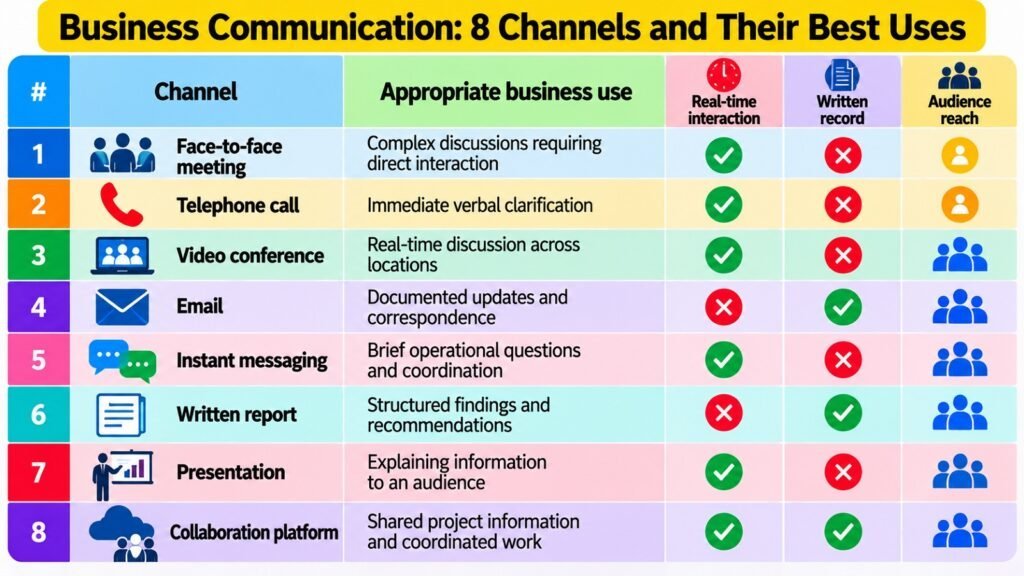
Channels are the media through which a message travels, and their attributes determine what the message can carry. Daft and Lengel’s (1986) media richness theory ranks media by their capacity to convey multiple cues, provide rapid feedback, and personalize content, placing face-to-face dialogue above email and formal reports. Empirical support has been mixed, and later work on channel expansion and social influence shows that experience and organizational norms modify perceived richness, so richness is better treated as a heuristic than a rule.
Synchronous channels, such as meetings, calls, and video conferencing, enable real-time interaction, whereas asynchronous channels, including email, reports, and collaborative platforms, permit reflection and documentation across time zones. Contemporary distributed and hybrid work environments depend substantially on asynchronous communication practices, which diminish scheduling constraints yet may postpone resolution of uncertainties and attenuate interpersonal signals.
Communication channel selection should consider multiple factors: the degree of urgency, confidentiality requirements, the scope of the intended audience, the intricacy of the message content, the necessity for documentation, and applicable organizational guidelines. Messages of a sensitive or unclear nature typically warrant the utilization of richer media formats, while standardized notifications and routine communications are appropriately conveyed through streamlined, indexable channels.
The effectiveness of organizational results is contingent upon the quality of collective decision-making processes rather than isolated individual choices. In the absence of established team conventions regarding the appropriate application of each communication channel, critical communications may remain overlooked in message queues while routine information disrupts concentrated work efforts, thereby compromising coordination effectiveness.
The implementation of formalized communication protocols—such as designating distinct channels for decisions requiring documentation and separate channels for informal inquiries—substantially mitigates this operational inefficiency. Given that empirical research on the comparative effectiveness of particular communication platforms remains incomplete, organizational leaders should assess their own institutional experience rather than presume that mere tool implementation automatically enhances team collaboration.
Accessibility deserves explicit attention, since captions, readable formatting, and alternatives to real-time participation prevent exclusion. No medium is universally superior; coordination improves when channels are matched to purpose and their limits are acknowledged.
Common Channels Used in Business Communication
| Business Communication Channel | Best-Fit Uses and Limitations |
| Face-to-face meetings | Rich cues suit sensitive discussions; costly to schedule and rarely documented. |
| Asynchronous, searchable, and documentable; weak for tone and prone to overload. | |
| Telephone | Immediate voice contact for urgent clarification; lacks visual cues and written record. |
| Video conferencing | Combines visual and vocal cues across distance; vulnerable to fatigue and connectivity problems. |
| Instant messaging | Fast, informal team coordination; interruptions and fragmented records limit depth. |
| Reports | Structured documentation supporting decisions; slow to produce and minimally interactive. |
| Presentations | Efficient for groups with visual support; limited dialogue unless deliberately planned. |
| Collaborative platforms | Shared workspaces support project coordination; require governance to avoid information sprawl. |
4. Organizational Communication Flows in Business Communication
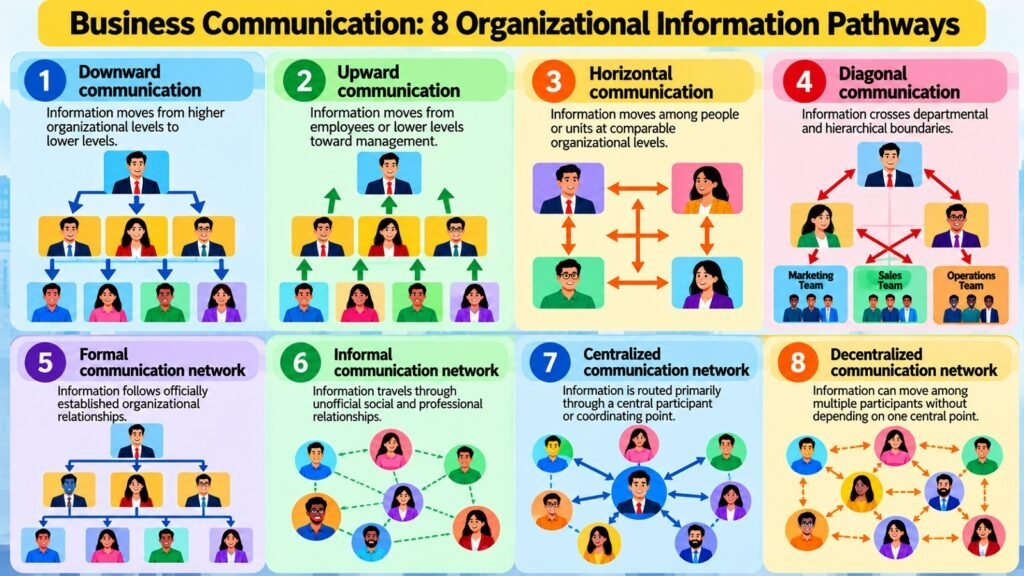
Within organizational frameworks, business communication progresses through discernible pathways and directions. Downward communication carries strategy, policy, and instructions from leadership to employees, while upward communication returns feedback, concerns, and operational knowledge to management. Horizontal communication coordinates peers and departments, and diagonal communication connects members of different functions and levels without following the formal chain. Katz and Kahn (1966) treated these flows as central to organizational integration, since each subsystem depends on information produced elsewhere.
Official networks adhere to the established hierarchy, while unofficial networks—including the grapevine—emerge from interpersonal relationships and physical proximity. Unofficial networks frequently convey information more rapidly than official ones, either reinforcing authorized channels or distorting them when formal communications are insufficient.
Heightened hierarchical complexity intensifies this challenge: Roberts and O’Reilly (1974) demonstrated that information distortion in upward communication correlates with subordinates’ confidence in their supervisors and their career advancement expectations. Organizational network analysis provides an empirical approach to identifying actual information exchange patterns among personnel.
Directional examination also reveals characteristic organizational tensions. Communications directed downward typically stress justification and adherence to policy, whereas communications directed upward reflect what employees perceive management expects to receive. Horizontal communications rely on mutual cooperation between departments whose objectives may diverge, and diagonal communications may circumvent supervisors who believe they should control information regarding their personnel.
Executives who recognize these tensions can establish communication pathways that maintain oversight while facilitating the information sharing that collaborative operations demand. Network analysis can determine whether the formal organizational structure corresponds to actual communication practices, and deviations frequently indicate where coordination relies on key individuals rather than established systems.
Improving flow involves clarifying responsibilities, creating accessible feedback routes, and permitting cross-functional links where interdependence is high. No single structure suits every organization, because rigid routing may protect accountability in regulated settings while flatter arrangements favor speed in volatile ones.
Communication Flows and Networks in Business Communication
| Business Communication Flow or Network | Direction and Organizational Purpose |
| Downward | Leadership to employees; communicates strategy, policy, and instructions. |
| Upward | Employees to management; supplies feedback, problem reports, and operational knowledge. |
| Horizontal | Among peers or departments; coordinates interdependent tasks. |
| Diagonal | Across levels and functions; shortens routes in project and matrix settings. |
| Formal network | Follows official hierarchy; ensures accountability and recorded authority. |
| Informal network | Arises from social ties; transmits context quickly but may spread inaccuracy. |
| Grapevine | Unofficial pathways within informal networks; signals concerns and information gaps. |
| Wheel and circle patterns | Small-group structures studied by Leavitt (1951); centralization aids simple tasks, decentralization complex ones. |
5. Interpersonal Communication Skills in Business Communication
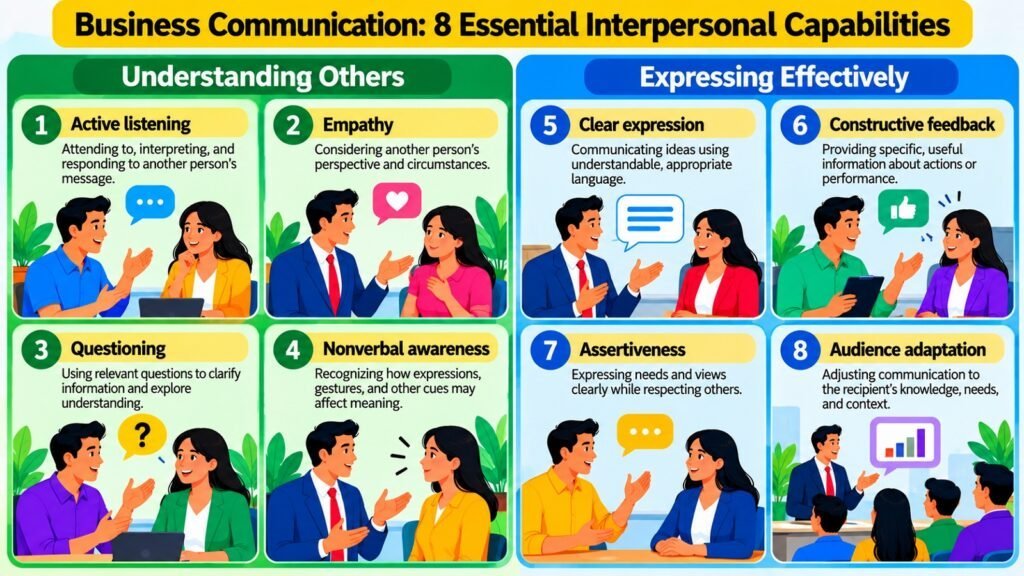
Interpersonal competencies are fundamental to the practical operation of organizational frameworks. As Rogers and Farson (1957) have established, effective listening involves comprehending the speaker’s intended message and validating that comprehension through restatement, thereby avoiding hasty evaluation. Clear expression, purposeful questioning, and empathy extend this foundation, enabling managers to diagnose problems and respond to the other person’s perspective instead of merely delivering a message. Audience adaptation and nonverbal awareness complete the repertoire by aligning vocabulary and demeanor with context.
Feedback and assertiveness carry particular managerial weight. Kluger and DeNisi’s (1996) meta-analysis found that feedback interventions improved performance on average but reduced it in more than a third of cases, especially when attention shifted from the task to the self. Feedback should therefore address observable behavior and outcomes. Edmondson (1999) showed that psychological safety supports team learning, which suggests that managers who respond constructively to dissent make it easier for employees to voice concerns.
Managers also communicate expectations through the structure of ordinary interactions. Regular one-to-one conversations create a predictable setting for clarifying priorities, reviewing progress, and surfacing difficulties before they escalate. Expectations stated as observable outcomes, with explicit criteria and timelines, leave less room for divergent interpretation than appeals to general effort or attitude. Where employees hesitate to speak, managers can invite concerns through direct questions, acknowledge them without defensiveness, and report what was done in response, which reinforces the perception that speaking carries value.
Consider an illustrative scenario, not a documented case: a manager who restates an employee’s objection before responding discovers a resourcing constraint that would otherwise have surfaced only after a missed deadline. The same practice applies to performance discussions, meetings, and difficult conversations, where the other person’s response matters more than the elegance of the original message.
Interpersonal Skills Supporting Business Communication
| Interpersonal Skill | Practical Application in Business |
| Active listening | Paraphrasing and clarifying to confirm understanding in briefings and client discussions. |
| Clear expression | Stating expectations, deadlines, and criteria precisely to reduce ambiguity. |
| Questioning | Open and probing questions uncover assumptions and causes in one-to-one conversations. |
| Empathy | Recognizing others’ perspectives to maintain trust during conflict or change. |
| Constructive feedback | Addressing specific behavior and outcomes in performance reviews. |
| Assertiveness | Stating needs and positions directly while respecting others in negotiations. |
| Nonverbal awareness | Aligning tone and posture with the message; reading colleagues’ reactions. |
| Audience adaptation | Adjusting vocabulary, detail, and structure to listeners’ expertise and role. |
6. Business Communication Barriers and Solutions
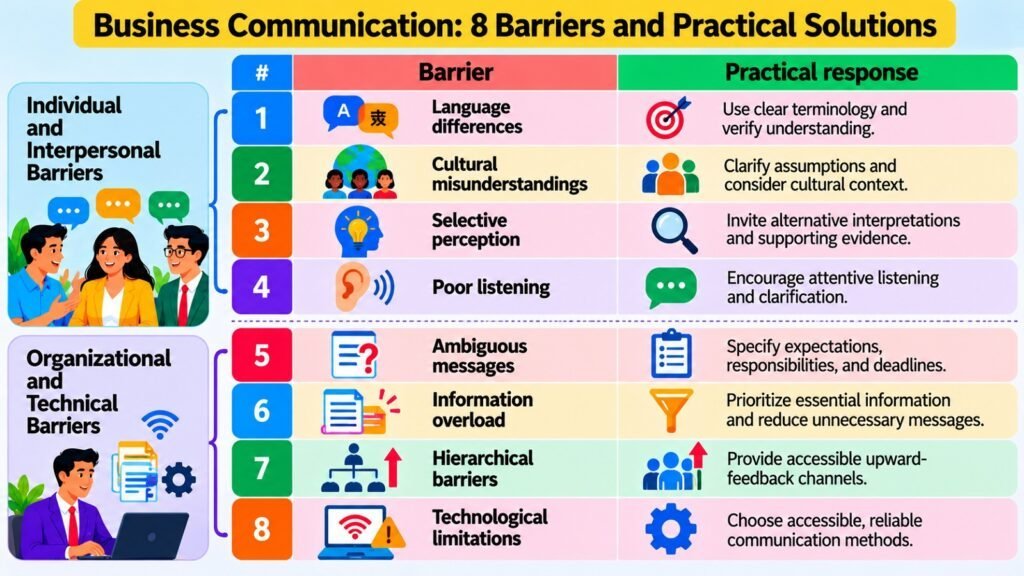
Communication effectiveness is hindered by obstacles that originate from multiple sources. Barriers at the individual and psychological level encompass selective attention, defensive reactions, and inadequate listening practices; barriers between communicating parties include unclear language and power imbalances; barriers within organizational structures encompass hierarchical arrangements and departmental fragmentation; and barriers related to technology pertain to communication systems that are unreliable or mismatched to organizational needs. Cultural barriers warrant distinct consideration: Hall’s (1976) framework distinguishing between high-context and low-context communication systems demonstrates how an oblique rejection may be transparent in one cultural context yet interpreted as acceptance in another.
Message saturation represents a separate challenge. Eppler and Mengis (2004), synthesizing research across multiple fields, determined that message properties, individual characteristics, task demands, and structural factors all contribute to this problem. Effective intervention requires initial assessment, as enhanced written communication cannot address situations where staff members are reluctant to communicate openly, and strengthened listening skills cannot offset technological failures during essential business events. Comprehensive solutions therefore integrate refined message construction, suitable communication channels, opportunities for dialogue and clarification, user-friendly information presentation, systems for gathering input, and organizational cultures that permit the expression of concerns without adverse consequences.
Communication failures frequently result from multiple contributing factors working in concert. Imagine a scenario involving the introduction of a new product in which technical and commercial divisions assign different meanings to the term release—one referring to internal system deployment and the other to market introduction—while an authoritarian organizational structure prevents entry-level employees from challenging timelines. The underlying issue combines linguistic ambiguity, cultural norms, and structural constraints, making a terminology reference insufficient to prevent similar problems in future initiatives.
Since each intervention addresses a particular source of difficulty, the cumulative effect of multiple approaches proves more valuable than reliance on a single solution. Implemented interventions should be evaluated subsequently, as a measure designed to mitigate one barrier may inadvertently amplify another, such as when increased communication frequency, intended to enhance message clarity, exacerbates information saturation.
Language differences warrant particular care in multinational firms and diverse teams, where plain wording, defined terms, and written confirmation reduce misreading without implying any deficiency in speakers.
Barriers to Business Communication and Responses
| Communication Barrier | Practical Response |
| Language differences | Use plain wording, avoid idioms, and confirm key points in writing. |
| Cultural misunderstanding | Learn context norms and state expectations explicitly in cross-cultural teams. |
| Psychological barriers | Address defensiveness through neutral framing and trust-building. |
| Poor listening | Train paraphrasing and protect uninterrupted attention in meetings. |
| Ambiguous messages | Specify actions, owners, and deadlines; test comprehension before wider circulation. |
| Information overload | Prioritize, summarize, and limit distribution lists. |
| Organizational hierarchy | Provide skip-level routes and anonymous feedback options. |
| Technological limitations | Match media to need and supply backup channels and accessibility features. |
7. Business Communication Ethics and Professionalism
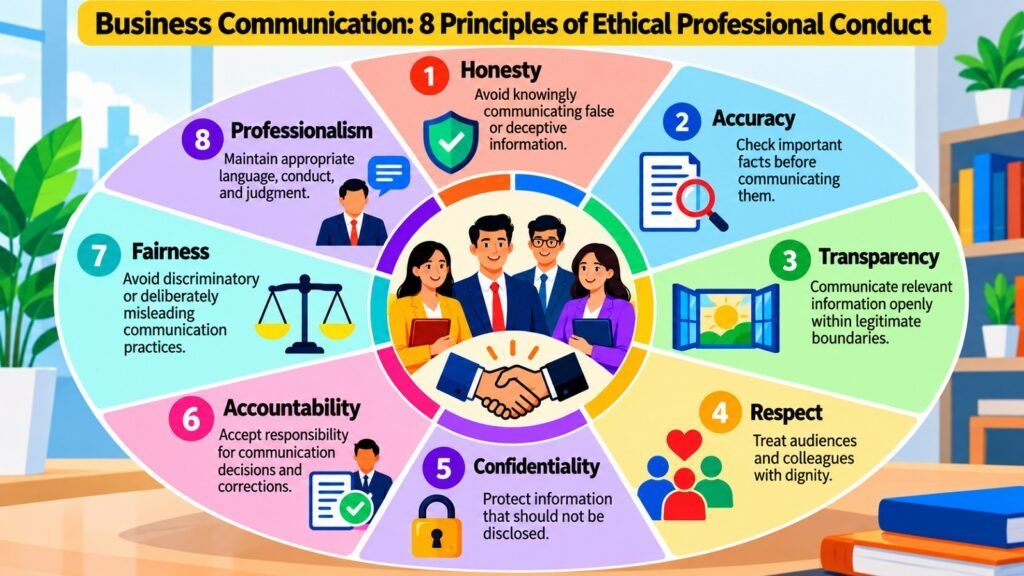
Ethical Business Communication rests on honesty, accuracy, transparency, respect, confidentiality, and accountability. Grice’s (1975) cooperative principle, with its maxims of quality, quantity, relation, and manner, offers a useful analytical lens, because a statement can be literally true while violating quantity by omitting material facts. A message that announces restructuring benefits while withholding anticipated redundancies therefore fails ethical scrutiny even though it contains no falsehood.
Stakeholder theory (Freeman, 1984) explains why such conduct matters beyond compliance, since employees, customers, partners, and communities rely on organizational messages when making consequential decisions. Professional bodies such as the International Association of Business Communicators publish codes of ethics emphasizing truthfulness and respect for confidentiality. These responsibilities become acute during organizational change, crises, and decisions affecting livelihoods. Digital communication adds risk, as forwarded emails, informal messages, and public posts can disclose sensitive information or damage professional standing.
Practical illustrations help distinguish responsible communication from merely defensible messaging. Consider a hypothetical manager who tells a team that no layoffs are planned while knowing that a decision is imminent: the statement may be accurate within a narrow time frame, yet it violates the good faith that trust requires. Responsible alternatives acknowledge uncertainty, state what is known and unknown, and commit to timely updates. Conflicts of interest raise a related issue, since an adviser who recommends a supplier without disclosing a financial relationship deprives the audience of information needed to weigh the advice. Accountability also extends to correction, because promptly acknowledging an error generally serves stakeholders better than allowing it to persist unchallenged.
Ethical responsibilities, professional standards, and statutory requirements constitute distinct yet overlapping categories. Actions may comply with legal frameworks while simultaneously violating ethical principles, and since regulatory mandates concerning transparency and information security differ across jurisdictions, organizational leaders should seek guidance from competent professionals when uncertainty arises.
Ethical Principles in Business Communication
| Ethical Principle | Professional Application |
| Honesty | Avoid false or misleading statements in reports and announcements. |
| Accuracy | Verify data before sharing and correct errors promptly. |
| Transparency | Disclose material information and the rationale for decisions. |
| Respect | Communicate courteously and without discrimination, including in digital settings. |
| Confidentiality | Protect sensitive business and personal data; share only with authorization. |
| Accountability | Accept responsibility for messages and their consequences. |
| Conflict-of-interest disclosure | State affiliations that could influence advice or recommendations. |
| Sensitivity to context | Adapt timing and wording to circumstances without concealing facts. |
8. Business Communication Effectiveness and Improvement
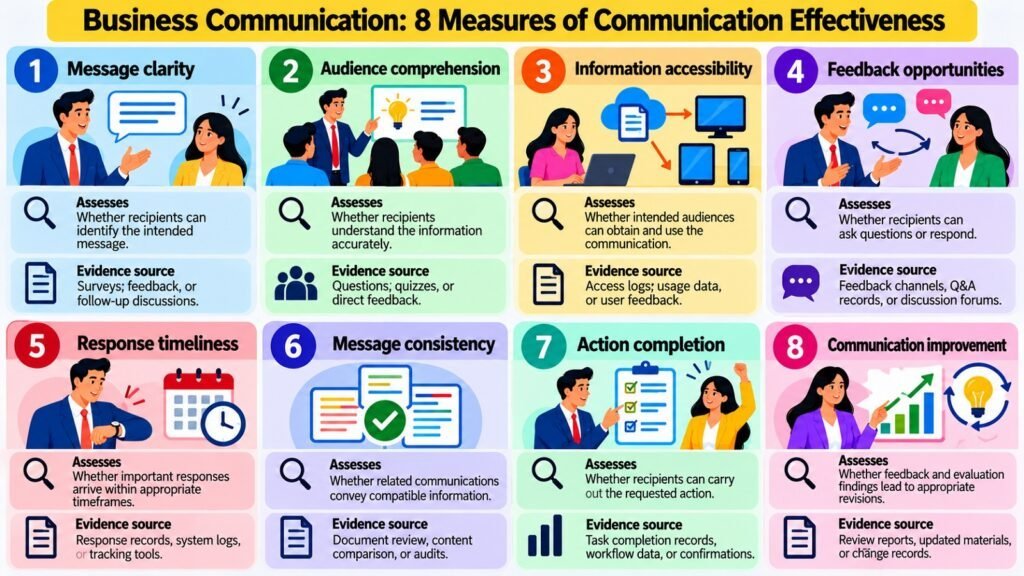
Evaluating Business Communication requires distinguishing outputs from outcomes. Counting messages sent or meetings held measures activity, whereas improved understanding, faster coordination, or better decisions indicate effect. The Barcelona Principles, developed by AMEC for communication measurement, similarly separate outputs, outcomes, and impact, and the logic transfers to internal communication. Measures should reflect the stated objective, because a high open rate says little about comprehension.
Established approaches include communication audits (Hargie and Tourish, 2000), employee surveys such as the Communication Satisfaction Questionnaire of Downs and Hazen (1977), and qualitative feedback analysis. Comprehension checks, such as teach-back, test understanding directly. Quantitative indicators offer comparability, while qualitative evidence explains why results occur, so the two complement one another. Interpretation requires context, since organizational results seldom trace to communication alone.
Measurement design carries its own risks. Indicators that are easy to collect, such as message volume or response speed, tend to displace those that matter, and targets attached to them invite behavior that satisfies the metric without improving understanding. Survey results may reflect mood on the day, and low participation can bias findings toward the most engaged or most aggrieved employees. Employing multiple data sources and integrating them with direct observation or stakeholder interviews produces more dependable conclusions than reliance upon isolated metrics. Results must be communicated transparently to workforce members, as assessment processes that fail to provide feedback to participants compromise the evaluative culture essential for sustaining future assessment initiatives.
A workable improvement cycle begins by identifying a communication need, then evaluating current practice, selecting an intervention, reviewing feedback, and refining the approach. Leaders who treat findings as diagnostic evidence rather than performance scorecards for individual managers are more likely to secure candid responses and sustained improvement.
Methods for Evaluating Business Communication Effectiveness
| Evaluation Method or Indicator | Purpose and Interpretation |
| Communication audit | Systematic review of practices and flows; reveals gaps but demands time and expertise. |
| Employee surveys | Measure perceived clarity and satisfaction; reflect perception rather than behavior. |
| Satisfaction questionnaire | Validated Downs–Hazen instrument assessing several dimensions of communication satisfaction. |
| Comprehension checks | Teach-back or quizzes confirm understanding of key messages; limited to tested content. |
| Feedback analysis | Review of comments and queries identifies recurring confusion; may overrepresent vocal minorities. |
| Response time | Tracks reply speed; indicates responsiveness, not quality. |
| Network analysis | Maps actual information exchange; highlights bottlenecks and isolated groups. |
| Process review | Examines workflows for delay or rework attributable to unclear communication. |
Conclusion: Business Communication as a Foundation for Success
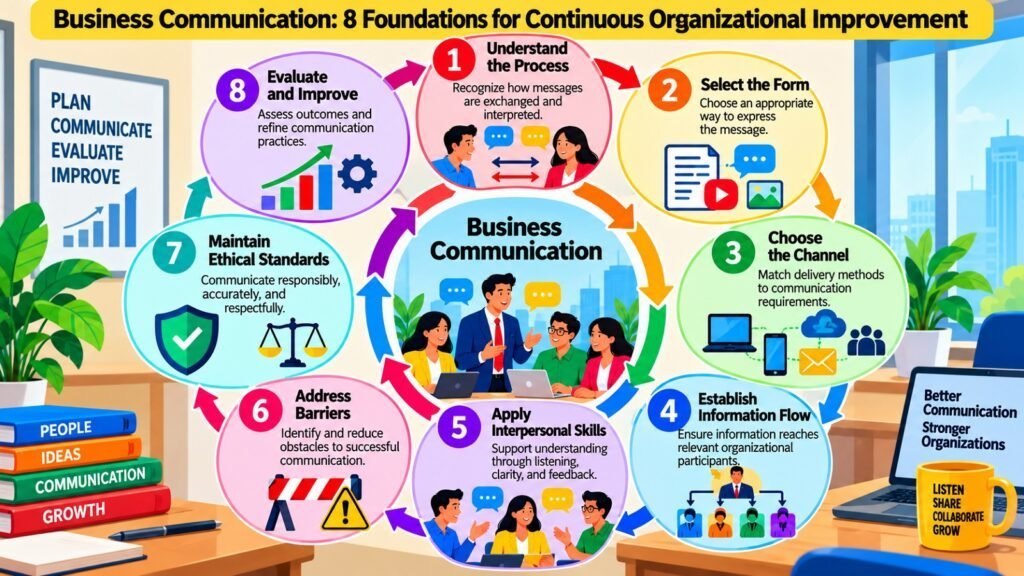
Business Communication supports leadership, management, coordination, professional relationships, ethical conduct, and business performance because it converts intention into shared action. Setting direction is insufficient unless people understand expectations, exchange relevant information, raise concerns, and coordinate their responsibilities, which is why Business Communication is an important aspect of Leadership and Management. The eight foundations examined here operate as an interdependent system rather than a checklist. In this sense, communication is less an auxiliary activity than the medium through which leadership and management are enacted.
Processes and models explain how meaning is formed and where it fails. Forms and channels determine how messages are expressed and delivered, while organizational flows determine who receives them. Interpersonal skills shape the quality of exchanges, barrier management removes obstacles, ethical standards sustain trust, and evaluation closes the loop by showing whether understanding and coordination have improved. Weakness in any one foundation can compromise the others, since a well-chosen channel cannot rescue a misleading message and sound ethics cannot repair a blocked flow.
Institutions that conceptualize communication as a systematic competency, reinforced through intentional skill development, principled management, and continuous enhancement, demonstrate superior capacity to connect employees with organizational mission. No approach guarantees particular results, but sustained attention to these foundations makes understanding more probable and coordination more reliable. The most useful starting point is modest: examine one recurring misunderstanding, trace its cause through the framework above, and adjust the practice responsible.
Summary of Business Communication Foundations
| Business Communication Foundations | Key Takeaway |
| Processes and models | Communication is reciprocal meaning-making, not mere transmission. |
| Types and forms | Match oral, written, nonverbal, and visual forms to purpose. |
| Channels and media | Choose by urgency, complexity, sensitivity, and record needs. |
| Organizational flows | Information must move in every direction to support alignment. |
| Interpersonal skills | Listening, feedback, and empathy make exchanges productive. |
| Barriers and solutions | Diagnose the cause before selecting the remedy. |
| Ethics and professionalism | Honesty and accountability sustain stakeholder trust. |
| Effectiveness and improvement | Measure outcomes, not only outputs, and refine continuously. |