
Table of Contents
Introduction: Business Operations – The Engine of Modern Business
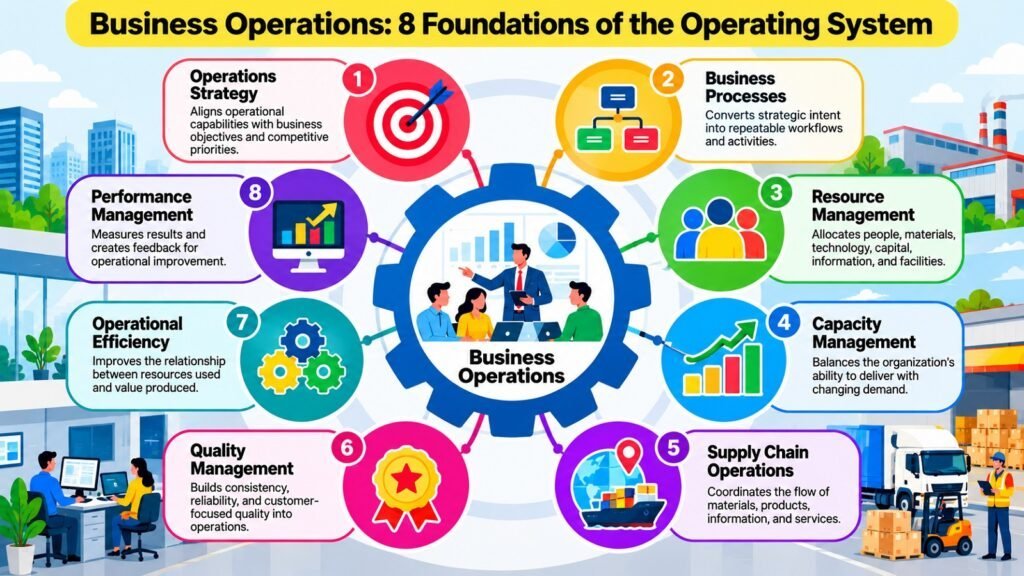
Business Operations is one of the most fundamental functions within any organization. It sits at the center of how a business actually works, converting resources, people, processes, information, and technology into products, services, customer value, and measurable business outcomes. Without effective operations, even the most compelling strategy remains theoretical.
In theoretical terms, Business Operations refers to the system of coordinated activities, decisions, and capabilities that an organization uses to produce and deliver value repeatedly and sustainably. In practical terms, it encompasses every activity that directly contributes to making things, delivering services, managing resources, fulfilling demand, and satisfying customers — far broader than routine administrative work.
Business Operations is an important business function, and it matters across every sector. A manufacturer depends on production processes, supply chains, and capacity management. A hospital relies on patient flow, resource scheduling, and quality protocols. A technology company depends on development workflows and service reliability. A retailer must coordinate inventory, logistics, and customer fulfillment. The specific activities differ, but the underlying challenge is the same: creating reliable value while managing resources, processes, costs, and complexity effectively.
Strategic direction and operational execution maintain a reciprocal relationship. Strategy establishes the competitive landscape an organization seeks to enter; Business Operations ascertains whether the organization possesses the capability to fulfill that strategic vision. When these two elements function in concert, organizations realize dependable and expandable results.
It is equally important to clarify the distinction between Business Operations and Operations Management: Operations Management constitutes the theoretical field encompassing models and best practices, whereas Business Operations represents the tangible implementation of these concepts. This examination explores eight critical elements that collectively constitute an integrated operational framework rather than a series of disconnected undertakings.
Table 1: Eight Foundations of Business Operations
| Foundation | Contribution to Business Operations |
| Operations Strategy | Aligns operational capabilities with strategic priorities such as cost, quality, speed, and flexibility |
| Business Processes | Provides the repeatable workflows that consistently convert inputs into outputs and customer value |
| Resource Management | Ensures people, materials, technology, and financial resources are available and used effectively |
| Capacity Management | Matches the organization’s ability to produce or deliver with actual and anticipated demand |
| Supply Chain Operations | Coordinates the flow of materials, information, and services across the supply network |
| Quality Management | Embeds quality standards into processes and continuously reduces defects and variation |
| Operational Efficiency | Maximizes value creation from available resources while minimizing waste and unnecessary cost |
| Performance Management | Measures, monitors, and improves operational outcomes against meaningful business objectives |
1. Business Operations and Operations Strategy
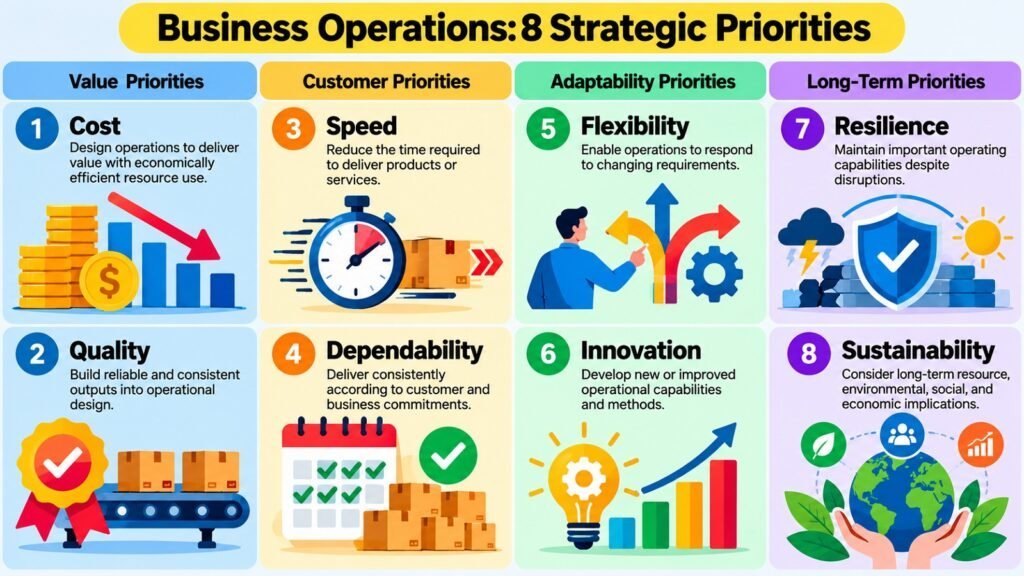
Strategy without operational grounding produces intentions rather than results. Operations Strategy is the set of decisions that determine how an organization designs its operating capabilities to support its competitive position. It connects high-level strategic direction to the practical choices that govern how resources are deployed, processes are designed, and value is created day to day.
The relationship here is well established. An organization competing on low cost needs capabilities oriented toward efficiency, scale, and waste reduction. One competing on quality requires capabilities centered on precision, consistency, and continuous improvement. A business prioritizing speed must design its operations around agility and short cycle times. These represent genuine trade-offs, not preferences. Designing for maximum efficiency often limits flexibility; building in resilience usually adds cost. Clarity about strategic priorities is therefore essential before operational capabilities can be designed coherently.
Consider a mid-sized manufacturer choosing between two market positions. Targeting premium buyers on product reliability means prioritizing quality assurance and careful supplier selection, even at higher cost. Shifting to volume and price competition demands a fundamentally different operational design emphasizing throughput, standardization, and cost control. The same company with the same factory faces entirely different operational requirements under each strategy. Misaligning the two produces recognizable symptoms: persistent cost overruns, quality failures under volume, or an inability to scale. Evaluating alignment means asking whether resources, processes, capacity, and supplier relationships genuinely support the strategic priorities the organization is trying to execute.
Table 2: Operational Priorities and Their Implications for Business Operations
| Operational Priority | Implication for Business Operations |
| Cost leadership | Requires high throughput, process standardization, waste elimination, and scale efficiency |
| Quality differentiation | Demands consistent process control, skilled resources, inspection, and defect prevention |
| Speed and responsiveness | Calls for short cycle times, flexible capacity, reduced waiting, and agile workflows |
| Dependability | Requires reliable processes, consistent resource availability, and strong supplier performance |
| Flexibility | Needs adaptable capacity, cross-trained staff, modular processes, and agile supply chains |
| Innovation capability | Demands collaborative workflows, experimentation culture, and iterative development cycles |
| Resilience | Requires redundancy, supplier diversification, buffer capacity, and contingency planning |
| Customer experience | Aligns operational activities with customer touchpoints, wait times, and service consistency |
2. Business Operations and Business Processes
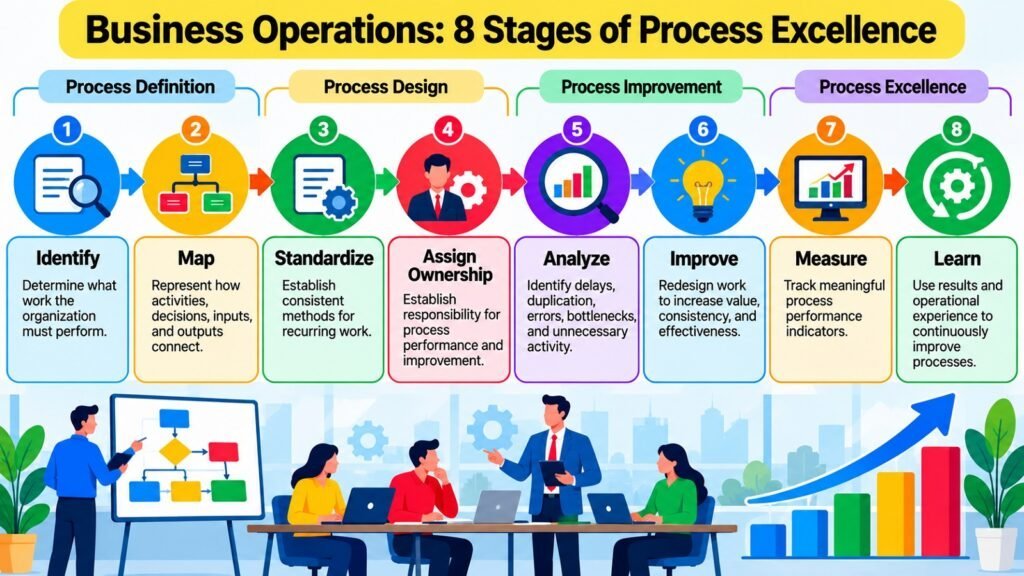
Processes are the mechanisms through which Business Operations delivers value repeatedly and consistently. A business process is a structured sequence of activities that transforms defined inputs into specific outputs — a product, a service, a decision, or a customer interaction. Processes are not incidental to operations; they are the operational system made tangible, determining how work flows, how tasks connect, and whether the organization produces consistent results at the required speed and quality.
The utility of process-oriented analysis becomes evident when organizational operations fail to meet performance expectations. Processes that lack coherent structure, suffer from inadequate design, or remain undocumented generate delays and errors throughout each transition point. A process characterized by excessive handoff requirements diminishes operational throughput and magnifies the occurrence of errors. In the absence of defined accountability, processes deviate from their prescribed specifications. These deficiencies represent substantial operational challenges; they directly correlate with increased expenditures, reduced output velocity, quality deterioration, and customer dissatisfaction.
Systematic analytical instruments, including process mapping, SIPOC analysis, value-stream mapping, and root-cause investigation methodologies, enable teams to differentiate between actual workflow patterns and intended operational design, thereby exposing previously undetected bottlenecks and superfluous steps.
A compelling illustration exemplifies the significance of process redesign. A professional services organization that encountered recurring invoicing inaccuracies conducted a thorough examination of its billing procedures and identified that identical data traversed through five distinct departments prior to invoice generation. Every transition between teams presented a risk of information deterioration or misunderstanding.
By streamlining the workflow and establishing explicit accountability, the firm substantially diminished errors by resolving the fundamental structural issue rather than merely implementing additional staff training. Effectively structured processes facilitate expandability, consistency, and operational effectiveness because they permit systematic replication and continuous enhancement. Identifying procedural deficiencies requires evaluating whether operations possess transparent accountability, standardized performance, quantifiable results, and periodic assessment mechanisms.
Table 3: Key Process Concepts in Business Operations
| Process Concept | Relevance to Business Operations |
| Process mapping | Visualizes the actual flow of work to identify redundancies, delays, and improvement opportunities |
| SIPOC analysis | Defines process boundaries by clarifying Suppliers, Inputs, Process steps, Outputs, and Customers |
| Handoff management | Reduces errors and delays at transition points between teams, functions, or process steps |
| Process ownership | Assigns accountability for process performance and ensures consistent execution over time |
| Standardization | Reduces variation by defining how work should be performed across people and locations |
| Bottleneck identification | Locates constraints that limit throughput and slow overall operational performance |
| Value-stream mapping | Distinguishes value-adding from non-value-adding activities to guide improvement efforts |
| Continuous improvement | Embeds systematic review and incremental enhancement into regular operational activity |
3. Business Operations and Resource Management
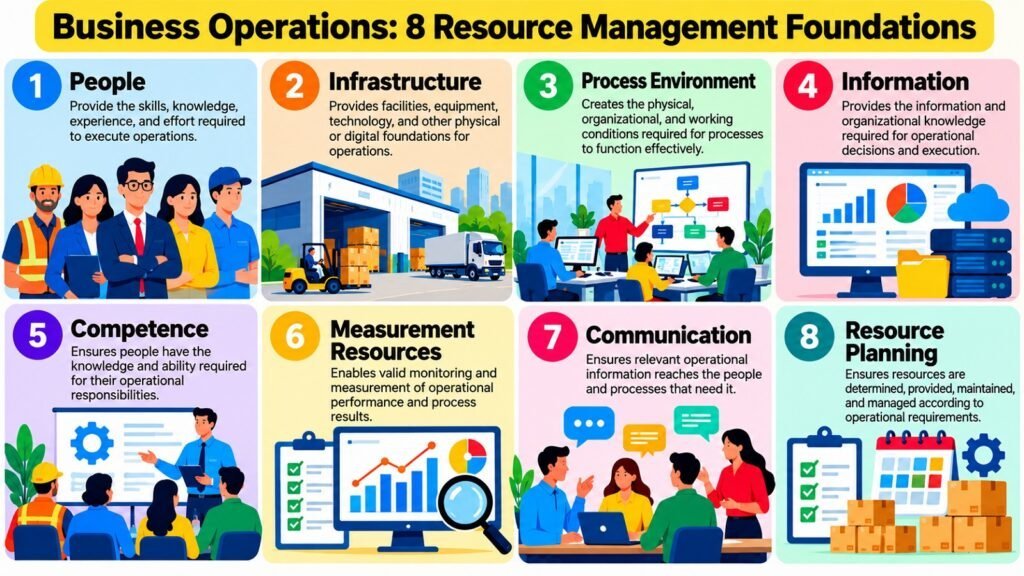
Business Operations cannot function without resources. Every process that creates and delivers value requires people, materials, technology, equipment, financial capital, information, and facilities to be available in the right quantity, at the right time, and in the right condition. Resource management within operations is the discipline of ensuring these inputs are allocated, coordinated, and utilized in ways that support operational objectives rather than constrain them.
Resource allocation involves more than procurement. It requires prioritizing against competing demands, anticipating constraints before they become crises, and matching deployment to strategic priorities. Maximizing utilization is not the same as improving performance. An operation running at full resource utilization with no slack may appear efficient while remaining highly vulnerable — any demand surge, equipment failure, or staff absence will immediately create a bottleneck, because no buffer exists to absorb disruption. The resource-based perspective in management theory adds a strategic dimension: investing in skilled people, proprietary knowledge, and advanced technology can create operational capabilities that competitors find difficult to replicate.
A common failure illustrates the coordination challenge. An organization may have sufficient total resources across departments yet still face serious operational problems because the right resources are unavailable at the right time or location. A construction project may have adequate workers overall but face delays because specialist trades are scheduled elsewhere when needed. The issue is not resource volume but coordination and availability at the point of need.
Evaluating resource effectiveness means looking beyond utilization rates to ask whether resources are deployed where they create the most operational value and whether the resource mix genuinely supports current strategic requirements.
Table 4: Resource Categories and Their Roles in Business Operations
| Resource Category | Operational Relevance |
| People and skills | Execute processes, apply expertise, and adapt to changing operational requirements |
| Materials and inventory | Provide physical inputs required for production, delivery, or service operations |
| Financial resources | Fund operational activities, capital investment, and capacity management decisions |
| Technology and systems | Enable process automation, data management, communication, and operational control |
| Equipment and machinery | Provide the physical capacity to produce, process, or handle operational outputs |
| Facilities and space | House operational activities and determine geographic reach and service coverage |
| Information and data | Support decision-making, performance monitoring, and coordination across operations |
| Supplier relationships | Provide access to external resources, capabilities, and inputs that support operations |
4. Business Operations and Capacity Management
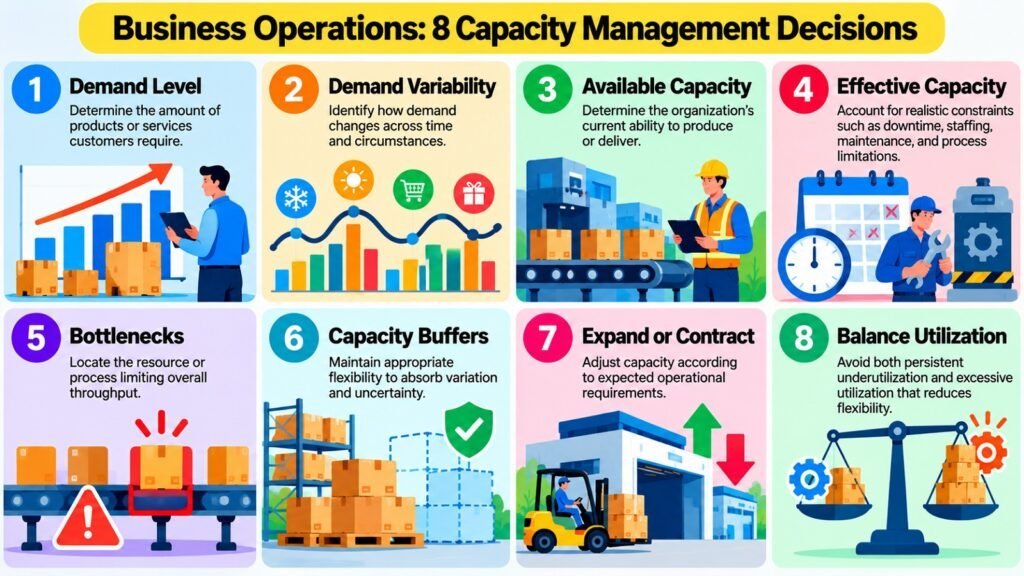
Capacity is the maximum output an organization can produce or deliver within a given period using its current resources and processes. Capacity Management is the operational discipline of matching that productive capability to actual and anticipated demand. Both insufficient capacity and excess capacity create serious problems, though in different ways. Insufficient capacity produces visible consequences: waiting times, delayed orders, quality decline under pressure, and overburdened staff. Excess capacity is less visible but equally real: fixed costs spread across fewer units, idle resources consuming capital, and pressure to fill capacity driving poor strategic decisions.
The Theory of Constraints, developed by Eliyahu Goldratt, provides a rigorous framework for understanding why adding resources does not always solve capacity problems. Every operating system has at least one constraint — a bottleneck that limits overall throughput regardless of how efficiently other parts of the system perform. Improving non-bottleneck activities without addressing the true constraint does not increase output; it only builds queues in front of the constraint. The practical implication is clear: capacity investment should target the actual limiting constraint, not be distributed across the system based on intuition.
A distribution center example illustrates this directly. Management invests in additional picking staff because throughput appears too low. The actual constraint, however, is a single packing station processing all orders before dispatch. Adding pickers creates larger queues at packing without increasing shipment volume. Diagnosing the real constraint before intervening would have produced a far better outcome. Capacity decisions also interact with demand variability: organizations facing predictable demand can plan with precision, while those facing seasonal peaks or unpredictable surges need strategies incorporating flexibility, buffer capacity, or alternative sourcing arrangements.
Table 5: Capacity Management Concepts in Business Operations
| Capacity Concept | Operational Significance |
| Design capacity | The theoretical maximum output under ideal conditions, rarely achieved in practice |
| Effective capacity | Realistic output after allowing for maintenance, scheduling, and operational constraints |
| Utilization rate | The proportion of effective capacity in use; high rates can mask operational vulnerability |
| Bottleneck | The constraint in a system that limits overall throughput regardless of other improvements |
| Capacity buffer | A deliberate reserve of unused capacity to absorb demand variability and disruptions |
| Demand variability | Fluctuations in customer demand that create the need for flexible capacity responses |
| Scalability | The ability to expand or contract operational capacity in response to changing demand |
| Theory of Constraints | A framework for identifying and managing the binding constraint on system throughput |
5. Business Operations and Supply Chain Operations
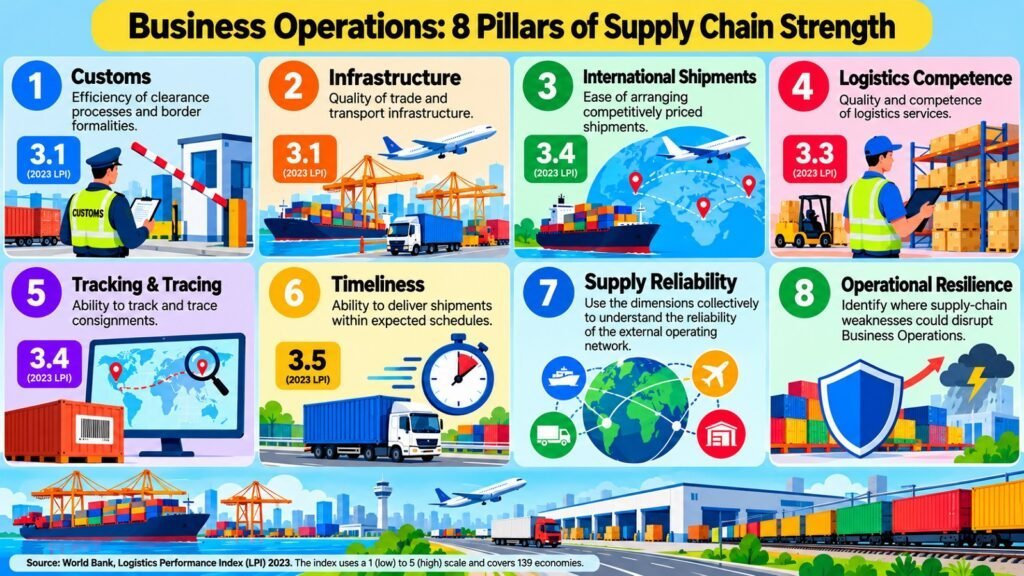
No organization operates in isolation. Every business depends on a network of suppliers, logistics providers, manufacturers, and distributors to acquire inputs and deliver outputs to customers. Supply Chain Operations is the part of Business Operations concerned with managing this network, ensuring that materials, components, services, and information flow to the right places at the right time and in the right condition. A reliable, well-coordinated supply network provides operational continuity, cost predictability, and the ability to meet customer commitments consistently.
Disruptions in supply tend to propagate through Business Operations in ways that are disproportionate to the original event. The bullwhip effect captures one well-studied dynamic: small fluctuations in end-customer demand amplify as they travel up the supply chain, causing significant swings in ordering patterns and inventory levels at upstream stages. A retailer ordering slightly more than usual triggers higher orders from its distributor, which triggers even larger orders from the manufacturer, leading to unnecessary production surges and subsequent inventory overhangs. Information sharing, demand visibility, and collaborative planning across the supply network genuinely reduce this amplification and improve operational stability.
Supplier performance directly influences operational quality, cost, and reliability. Selecting suppliers based solely on unit price, without evaluating delivery reliability and quality consistency, trades short-term cost savings for longer-term operational risk. Building relationships that include shared performance standards and collaborative problem-solving produces more stable supply operations over time. Resilience has also become a central consideration: single-source dependencies and just-in-time inventory strategies reduce cost but increase vulnerability. Organizations should examine their exposure to single points of failure, available inventory buffers across critical materials, and the visibility they have into supplier capacity before problems occur.
Table 6: Supply Chain Elements That Directly Influence Business Operations
| Supply Chain Element | Operational Influence |
| Sourcing and procurement | Determines input quality, cost, lead time, and supplier reliability for operations |
| Supplier relationships | Influences supply consistency, problem-solving speed, and collaborative improvement |
| Inventory management | Balances product availability against holding cost and the risk of excess stock |
| Inbound logistics | Affects the timing and condition of materials arriving to support production or fulfillment |
| Demand visibility | Enables more accurate planning and reduces the amplification effects of the bullwhip effect |
| Supply chain resilience | Protects operational continuity against disruptions through diversification and contingency |
| Lead time management | Shorter, reliable lead times reduce inventory needs and improve operational responsiveness |
| Outbound distribution | Determines how reliably and cost-effectively products or services reach end customers |
6. Business Operations and Quality Management
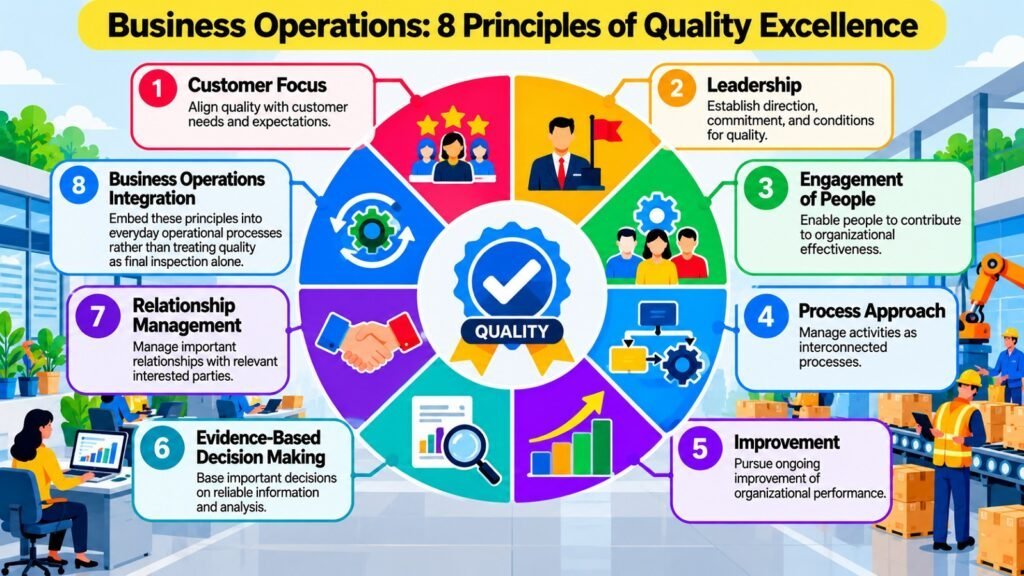
Quality in Business Operations constitutes not merely a final inspection function executed upon completion of work, but rather the consequence of how processes are structured, resources are allocated, and standards are upheld throughout the comprehensive operating framework. Quality control represents a reactive methodology: it identifies defects subsequent to their occurrence. Quality assurance embodies a proactive approach: it concentrates on the procedural conditions that generate quality results from inception.
Organizations that depend substantially on inspection discover that detection proves costly, unreliable, and perpetually delayed — the defect has already depleted resources by the moment of discovery. Embedding quality into the process via standardization, defect prevention mechanisms, and uniform inputs mitigates substantially more defects than inspection methodologies can ever identify.
Established quality philosophies offer useful operational principles. The Plan-Do-Check-Act cycle provides a structure for systematic improvement that keeps quality management continuous rather than episodic. Lean thinking addresses quality partly through waste reduction, recognizing that rework and variation are forms of waste. Six Sigma brings statistical rigor to defect reduction, using data to identify root causes. These are not interchangeable formulas; they address quality from different angles and are most useful when applied to the specific problems they were designed to solve.
A practical scenario shows why process improvement outperforms inspection. A medical device company experiencing consistent assembly defects initially responded by adding inspection staff, which improved detection rates but left the defect rate unchanged. When the assembly process was analyzed, it emerged that a specific component was difficult to orient correctly under standard lighting. Improving workstation design, adding an orientation guide, and standardizing the assembly sequence reduced defects at source, eliminating most of the inspection burden. Recognizing whether quality is embedded in Business Operations or merely inspected at the end requires examining where standards are defined, how consistently they are applied, and whether process improvement or defect detection consumes the majority of quality-related effort.
Table 7: Quality Concepts and Their Roles in Business Operations
| Quality Concept | Role in Business Operations |
| Quality assurance | Focuses on process conditions to prevent defects and ensure consistent outputs proactively |
| Quality control | Detects and removes nonconforming outputs before they reach customers or downstream processes |
| Plan-Do-Check-Act | A structured improvement cycle that embeds systematic quality review into operational routines |
| Error-proofing (Poka-yoke) | Designs processes and tools so that common errors become physically or logically impossible |
| Process standardization | Reduces variation by ensuring consistent method, materials, and conditions across operations |
| Six Sigma | Uses statistical analysis to identify and reduce process variation and defect causes |
| Cost of quality | Quantifies prevention, appraisal, and failure costs to guide quality investment decisions |
| Continuous improvement | Sustains quality gains through regular review, root-cause analysis, and incremental refinement |
7. Business Operations and Operational Efficiency
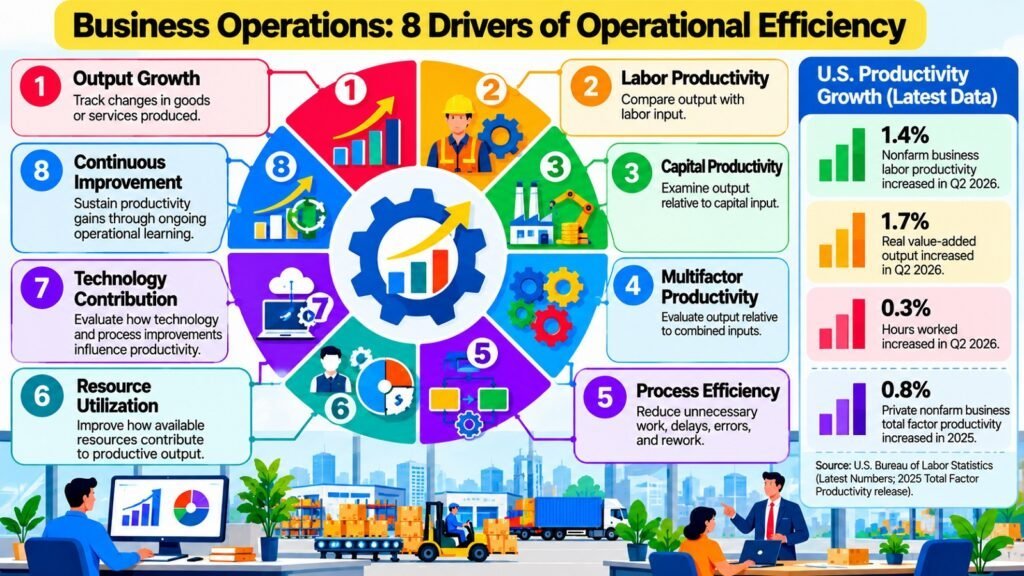
Operational Efficiency is the ability to create desired outputs and value using available resources effectively while minimizing unnecessary waste, delay, effort, cost, and complexity. The critical word is “unnecessary.” Genuine efficiency is not about cutting resources to the minimum; it is about removing activities and delays that do not contribute to the value being created. Confusing efficiency with cost reduction leads organizations to damage quality, reduce resilience, or demoralize people in pursuit of financial targets that ultimately undermine operational performance.
Originating from the Toyota Production System, Lean methodology represents one of the most extensively utilized frameworks for enhancing operational efficiency. Within the Lean framework, waste is characterized as any activity that depletes resources without generating value from the customer’s perspective. The seven fundamental waste classifications — overproduction, waiting periods, unnecessary transportation, excessive processing, surplus inventory, superfluous movement, and defects — furnish a valuable mechanism for recognizing areas where Business Operations expends resources without delivering corresponding value.
Automation and technological solutions further enhance efficiency by eliminating error-susceptible manual procedures and reallocating human resources toward activities demanding analytical thinking. Nevertheless, automating a defectively structured process merely produces an efficient rendition of an incorrect process; process refinement should precede automation implementation.
The relationship between efficiency and resilience constitutes a significant trade-off consideration. Operations engineered for maximum efficiency characteristically function with constrained margins, minimal inventory reserves, and optimized resource utilization — which diminishes expenses under standard circumstances but introduces fragility during operational disruptions. An operation designed exclusively for efficiency optimization may sustain greater losses during a single disruption incident than it accumulated through extended periods of cost reduction.
When investigating an efficiency deficiency, the underlying cause proves essential: process design complications necessitate process enhancement, resource allocation problems require improved planning methodologies, and capacity disparities demand fundamental structural modifications. Implementing performance demands without resolving the fundamental system architecture generates temporary adherence while inflicting sustained operational deterioration.
Table 8: Efficiency Concepts and Approaches in Business Operations
| Efficiency Concept | Application to Business Operations |
| Lean thinking | Identifies and eliminates non-value-adding activities from operational workflows |
| Waste reduction | Targets overproduction, waiting, transport, processing, inventory, motion, and defects |
| Cycle time reduction | Shortens the time from input to output to improve throughput and customer responsiveness |
| Process standardization | Ensures repeatable, consistent execution that reduces variation and unnecessary rework |
| Automation | Replaces repetitive, rule-based tasks to reduce error, cost, and processing time |
| Utilization analysis | Assesses how effectively available resources are deployed against operational requirements |
| Efficiency vs. resilience | Balances cost-focused optimization against the need for buffers and flexibility under disruption |
| Continuous improvement | Sustains efficiency gains through systematic review and incremental operational refinement |
8. Business Operations and Performance Management
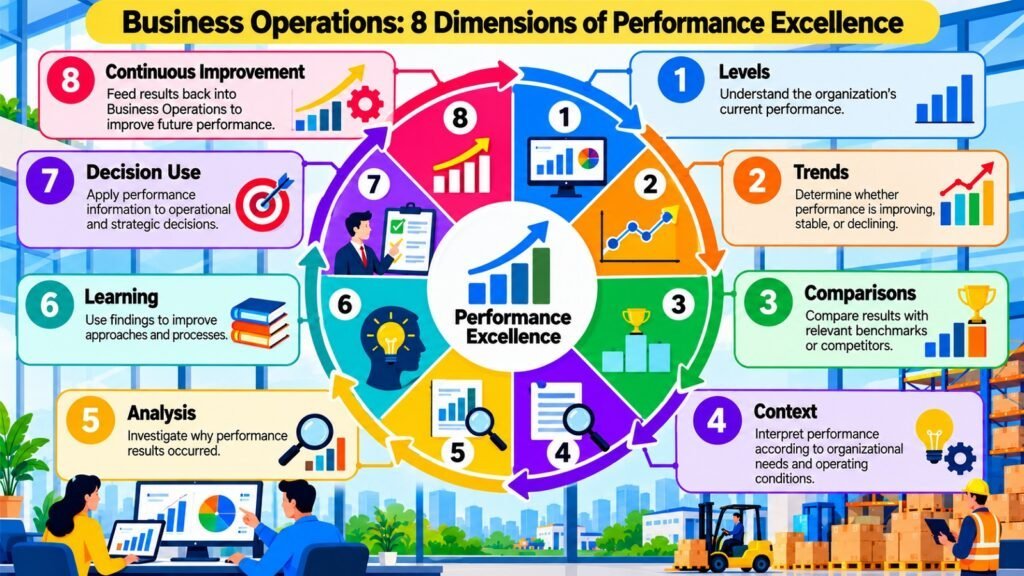
Measurement is the mechanism through which Business Operations learns, corrects, and improves. Without systematic monitoring, operational problems go undetected until their consequences become serious, and improvement efforts lack the evidence needed to confirm that changes are actually working. Performance management connects daily activity to business objectives, creating a feedback loop that links operational execution back to strategy, quality, efficiency, and customer outcomes.
Measuring activity is not the same as measuring performance. An operation can track tasks completed or products assembled without gaining any insight into whether those activities produce the outcomes the business actually needs. Useful measurement connects operational activity to meaningful results: quality rates, delivery reliability, customer satisfaction, cost per unit, and process cycle times.
The differentiation between leading and lagging indicators holds considerable importance in this context. Lagging indicators, exemplified by customer complaints, demonstrate that a problem has already materialized. Conversely, leading indicators, such as process adherence metrics or equipment status assessments, provide early warning signals of emerging issues before they result in adverse consequences, thereby enabling managers to implement preventive interventions. The selection of key performance indicators (KPIs) carries equal significance: an excessive number of metrics generates reports that remain unread by stakeholders, whereas an insufficient number creates information gaps that permit undetected problems to continue unabated.
A practical scenario illustrates how performance management improves decision-making. A distribution company noticed that on-time delivery had declined over three months. Initial analysis focused on driver performance. A more thorough review of operational data revealed a pattern of late order releases from the warehouse, consistently compressing dispatch time. By identifying the difference between the visible symptom and the operational cause, management addressed the correct problem and improved delivery performance without changing the logistics team. Benchmarking adds an external dimension, helping organizations evaluate whether performance is genuinely strong or merely acceptable relative to industry standards — most usefully when it prompts investigation and learning rather than simple numerical comparison.
Table 9: Operational Metrics and Performance Management Principles
| Metric or Principle | What It Reveals or Contributes |
| On-time delivery rate | Measures whether the operation consistently fulfills commitments to customers on schedule |
| Defect or error rate | Tracks the frequency of process failures that produce nonconforming outputs |
| Cost per unit | Indicates resource efficiency by measuring the cost required to produce each unit of output |
| Capacity utilization | Shows how fully available operational capacity is being used relative to its effective limit |
| Cycle time | Measures the time from input to output, reflecting process speed and potential for improvement |
| Leading indicators | Signal developing problems before they produce poor outcomes, enabling early intervention |
| KPI framework | Selects a balanced set of metrics that provide actionable insight into operational performance |
| Benchmarking | Compares operational performance against external or internal reference points to identify gaps |
Conclusion: Business Operations – Building Stronger Businesses
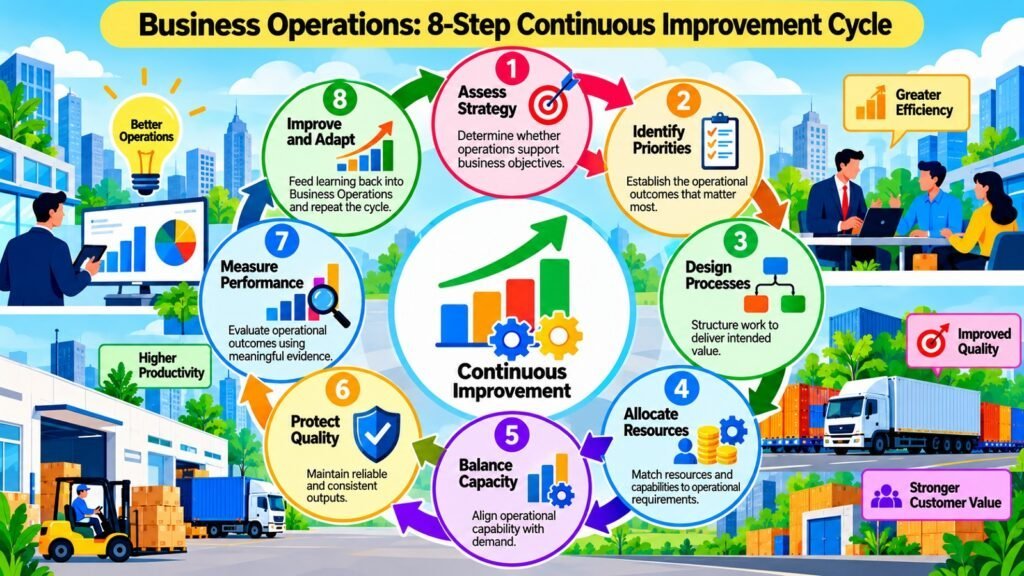
Business Operations is most powerful when understood as a system rather than a collection of separate management disciplines. The eight foundations examined in this article — Operations Strategy, Business Processes, Resource Management, Capacity Management, Supply Chain Operations, Quality Management, Operational Efficiency, and Performance Management — are deeply interconnected. A weakness in any one tends to affect the others. Poor process design creates resource waste and capacity problems. Supply chain failures expose quality and capacity vulnerabilities. Misaligned operations strategy leads to efficiency investments that generate no competitive benefit. Performance management without clear operational objectives produces data without insight.
Effective Business Operations transforms organizational resources and capabilities into reliable customer value and business outcomes. This transformation requires strategic alignment, disciplined process management, effective resource use, balanced capacity, resilient supply chains, embedded quality, genuine efficiency, and systematic measurement. Organizations that treat these as independent projects often improve one area while inadvertently creating problems elsewhere. Those that approach them as components of a single operating system are better positioned to achieve durable improvements.
Assessing Business Operations through a maturity lens helps organizations understand where they currently stand. At the reactive end, operations are managed largely through firefighting, with problems addressed as they arise and few systematic processes in place. More structured organizations establish documented processes, clear resource plans, and regular performance reviews. Optimized operations apply continuous improvement disciplines systematically. The most adaptive organizations embed learning and resilience into their operating models, enabling them to respond to disruption without losing operational stability.
Operational excellence is not a destination — organizations that achieve strong Business Operations continue to face evolving customer expectations, competitive pressure, technological change, and supply uncertainty. The foundations examined here become the stable base from which continuous improvement and adaptation remain possible, and strong Business Operations remains one of the most durable sources of competitive advantage.
Table 10: Eight Foundations and Their Primary Contributions to Business Operations
| Foundation | Primary Contribution to Stronger Business Operations |
| Operations Strategy | Aligns operational design with strategic priorities to ensure competitive relevance |
| Business Processes | Provides the repeatable workflows that deliver consistent outputs and customer value |
| Resource Management | Ensures that the right resources are available, allocated, and utilized effectively |
| Capacity Management | Matches productive capability to demand while managing bottlenecks and flexibility |
| Supply Chain Operations | Maintains reliable flow of inputs and outputs across the wider supply network |
| Quality Management | Embeds standards and improvement into operations to prevent defects and build reliability |
| Operational Efficiency | Removes waste and optimizes resource use without compromising quality or resilience |
| Performance Management | Creates the feedback loop that connects operational activity to business objectives |