Table of Contents
Introduction: Strategic Planning for Business Success
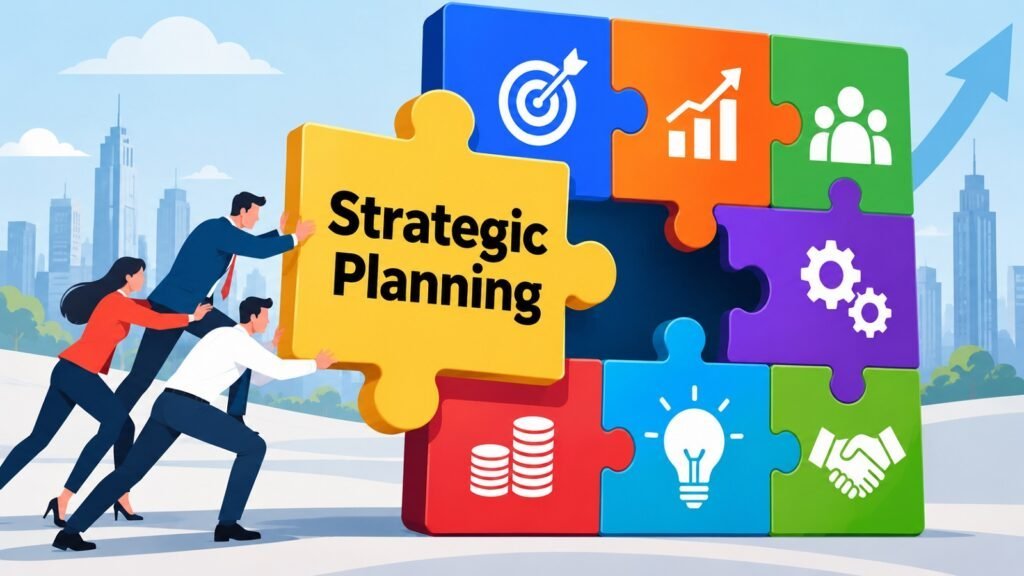
Strategic Planning is frequently diminished to a yearly procedural exercise that produces a refined document with minimal substantive impact. Within contemporary business environments, it is more appropriately characterized as an institutional mechanism for establishing transparency, exercising intentional decision-making, synchronizing organizational efforts, distributing limited assets, tracking advancement, and modifying approaches responsively as circumstances evolve. Furthermore, it constitutes a vital element of comprehensive Business Strategy.
Business Strategy furnishes the overarching framework and essential determinations regarding the competitive landscape in which an organization operates and its intended approach to achieving competitive advantage, whereas Strategic Planning furnishes the systematic framework for converting those determinations into measurable targets, key focus areas, strategic undertakings, resource allocation, organizational coherence, performance oversight, and continuous refinement.
The distinction matters because the empirical record on planning is mixed. Mintzberg’s influential critique argued that formal planning cannot substitute for strategic thinking, while Miller and Cardinal’s 1994 synthesis of more than two decades of research found a positive association between planning and performance that depends on context and on how planning is practised. Together these findings suggest that value lies in the quality of the planning discipline rather than in the mere existence of a plan.
Organizations across all stages—from emerging startups to mature enterprises—face a fundamental challenge: allocating limited resources amid numerous possibilities. This universal constraint underscores why strategic planning maintains significance regardless of organizational size. Conceptualizing planning as a competency to be developed, rather than merely a deliverable to be generated, represents the more robust approach and informs the framework presented herein.
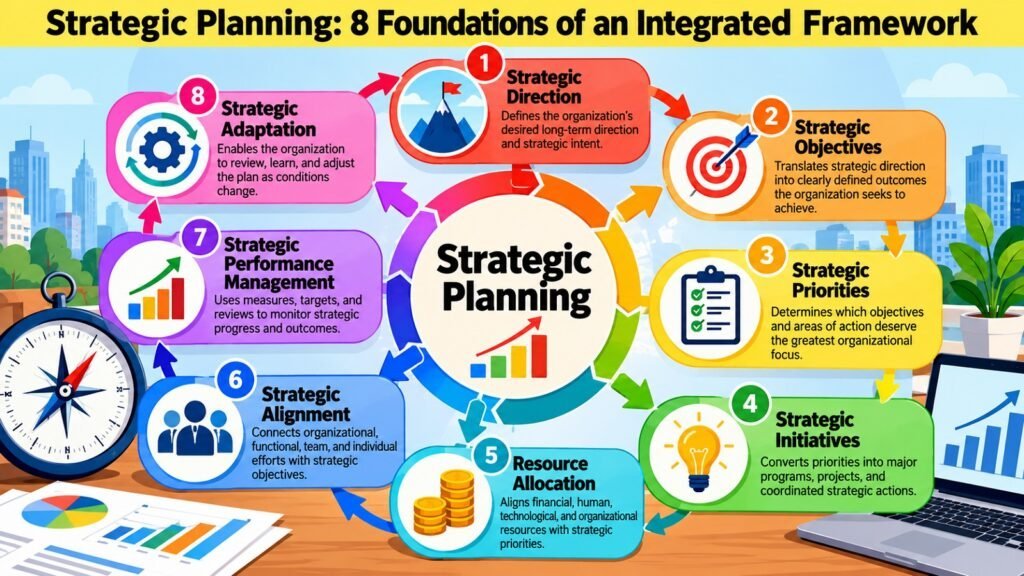
This article examines eight interdependent elements: Strategic Direction, Strategic Objectives, Strategic Priorities, Strategic Initiatives, Resource Allocation, Strategic Alignment, Strategic Performance Management, and Strategic Adaptation. Their real power emerges when they operate as an integrated system rather than as isolated activities, and the table below offers a quick-reference view of that system.
Strategic Planning Framework: Eight Interdependent Elements
| Strategic Planning Elements | Core Function |
| Strategic Direction | Defines purpose and desired future |
| Strategic Objectives | Specify intended outcomes |
| Strategic Priorities | Focus attention on critical choices |
| Strategic Initiatives | Convert priorities into coordinated action |
| Resource Allocation | Funds and staffs priorities |
| Strategic Alignment | Synchronizes functions and levels |
| Strategic Performance Management | Tracks progress against objectives |
| Strategic Adaptation | Revises plans as evidence emerges |
1. Strategic Planning and Strategic Direction
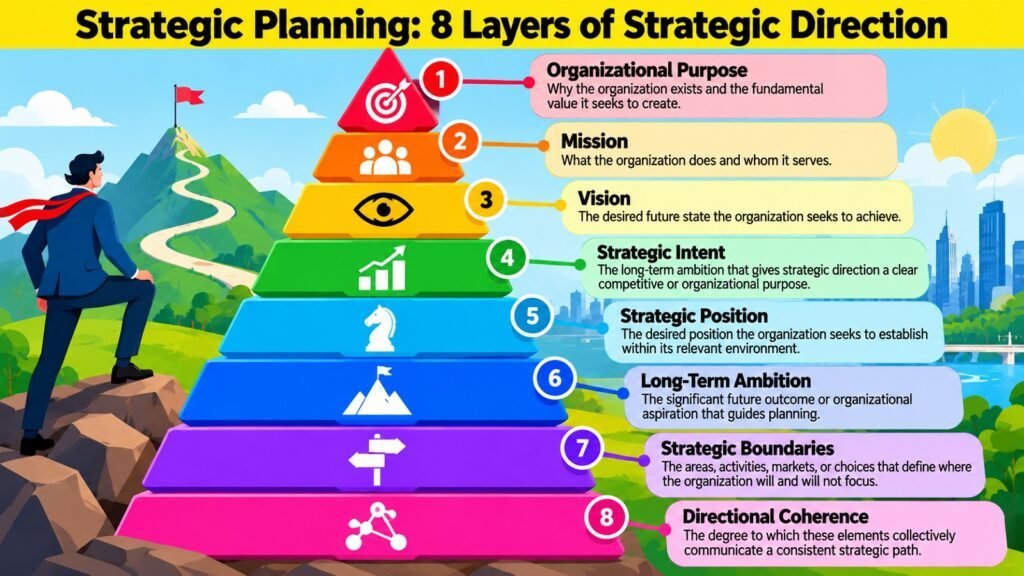
Strategic Planning commences with an assessment regarding the organization’s intended trajectory, as objectives, priorities, and resource allocations derive significance exclusively within the context of a defined destination. Strategic direction synthesizes purpose, which articulates the organization’s rationale for existence, alongside vision, mission, strategic intent, and an envisioned future state.
The strategic intent framework developed by Hamel and Prahalad proves particularly valuable in this context, as it characterizes a persistent aspiration that demands resource expansion and directs concentrated effort across extended periods, rather than functioning as a decorative statement in entrance halls. In the absence of such a destination, even methodologically sound planning frequently concentrates on optimizing discrete activities rather than achieving comprehensive organizational objectives.
Why does clarity of direction matter analytically? Bounded rationality limits managers’ capacity to evaluate every option, so a shared direction acts as a screening device that narrows the field and lowers coordination costs. Rumelt’s diagnosis of bad strategy, which stresses fluff, failure to face the challenge, and the mistaking of goals for strategy, supports the same conclusion. Consider a hypothetical regional logistics company whose leaders announce a pursuit of growth and customer excellence. Sales chases high-volume contracts at thin margins, operations protects service quality by refusing them, and finance withholds investment from both. Once leaders define their intent as becoming the most reliable temperature-controlled carrier in the region, these conflicts largely dissolve because the selection criteria become explicit.
Leadership teams can test a direction against four criteria: is it clear enough to exclude options, meaningful enough to motivate, realistic enough to be resourced, and relevant enough to the organization’s competitive position? Common errors include treating a vision statement as though it were a strategic direction and writing aspirational language that carries no implications for what the organization will stop doing.
A pragmatic decision-making framework comprises five essential inquiries: What reputation do we aspire to establish? Which customer segments and operational activities shall we intentionally forgo? What competencies must the organization cultivate to reach its objectives? By what metrics shall we assess advancement? What findings would necessitate a strategic reassessment? A strategic direction incapable of addressing these inquiries constitutes mere aspiration rather than a substantive foundation. Furthermore, these inquiries facilitate the identification of executive disagreements at an early stage, which proves considerably more advantageous than encountering such discord during the implementation phase.
Strategic Planning and Strategic Direction: Core Concepts
| Concept | Role in Strategic Planning |
| Purpose | Explains reason for existing |
| Vision | Describes aspired future state |
| Mission | Defines present scope and value |
| Strategic intent | Sustains long-term ambition |
| Desired future position | Specifies target competitive standing |
| Strategic scope | Delimits markets and activities |
| Core values | Constrain acceptable choices |
| Direction testing | Verifies clarity and realism |
2. Strategic Planning and Strategic Objectives
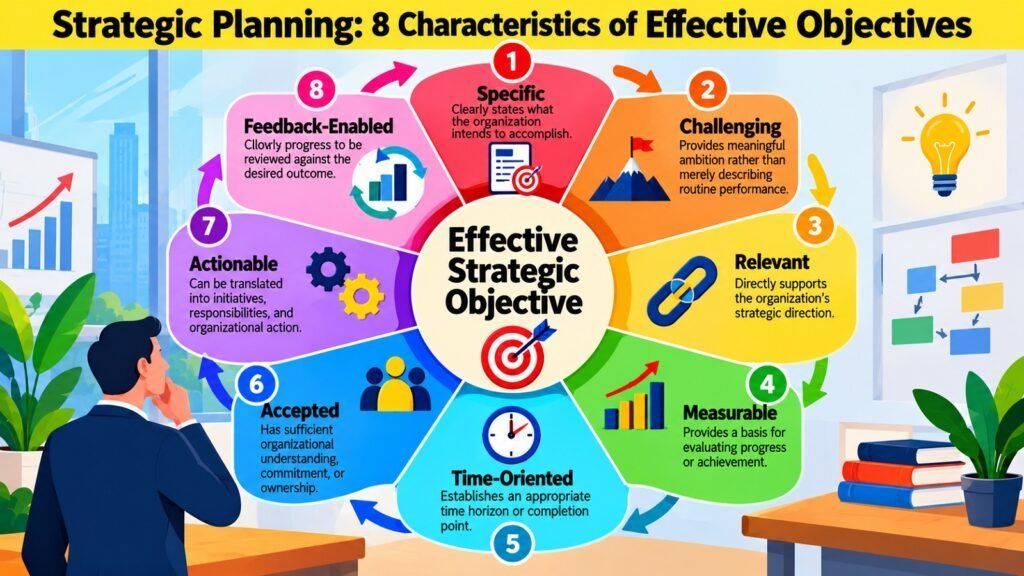
Strategic Planning translates direction into strategic objectives, which state what the organization intends to achieve and by when. Locke and Latham’s goal-setting theory, supported by decades of experimental and field evidence, shows that specific and appropriately difficult goals generally outperform vague exhortation, provided people have commitment, feedback, and ability. Effective objectives therefore combine clarity, relevance, measurability, a defined time horizon, strategic significance, and accountability. SMART criteria, usually attributed to Doran, and OKRs, associated with Grove at Intel, are practical expressions of these properties rather than ends in themselves.
Objectives occupy a distinct position in a hierarchy. A broad ambition expresses aspiration, a strategic objective specifies a measurable outcome over a multi-year horizon, an operational target governs a unit’s near-term performance, and routine activities sustain daily functioning. Collapsing these levels leaves organizations with either unmeasurable aspirations or strategic claims attached to administrative tasks. Well-designed objectives bridge strategic intent and business outcomes. An ambition to lead in sustainable packaging, for example, becomes more useful when restated as reducing the share of revenue derived from virgin-plastic products below a specified threshold by a fixed date, under a named owner.
Frequent mistakes include setting too many objectives, selecting measures that capture activity rather than outcomes, privileging short-term results at the expense of long-term capability, and defining objectives detached from strategic direction. Locke and Latham also caution that narrowly specified goals can encourage neglect of unmeasured dimensions of performance, a limitation worth remembering. A quick test asks five questions of any proposed objective: does it follow from our direction, can progress be observed, does it have an owner, is the horizon explicit, and would its achievement alter our competitive position?
The theoretical case for objectives also carries limits that careful planners should acknowledge. Goal-setting research indicates that difficult targets can motivate effort, yet they can also encourage excessive risk-taking or the manipulation of reported results when rewards depend narrowly on attainment. Balancing a small set of stretching objectives with attention to long-term capability, ethical conduct, and learning therefore produces more durable performance than pursuing any single measurable outcome. This trade-off explains why it is best to review strategic objectives periodically.
Strategic Planning Criteria for Effective Strategic Objectives
| Strategic Planning Criterias | Meaning |
| Clarity | Unambiguous wording |
| Relevance | Follows from strategic direction |
| Measurability | Observable indicators of progress |
| Time orientation | Explicit horizon and milestones |
| Strategic significance | Alters competitive position |
| Accountability | Named responsible owner |
| Appropriate difficulty | Challenging yet attainable |
| Limited number | Preserves organizational focus |
3. Strategic Planning and Strategic Priorities
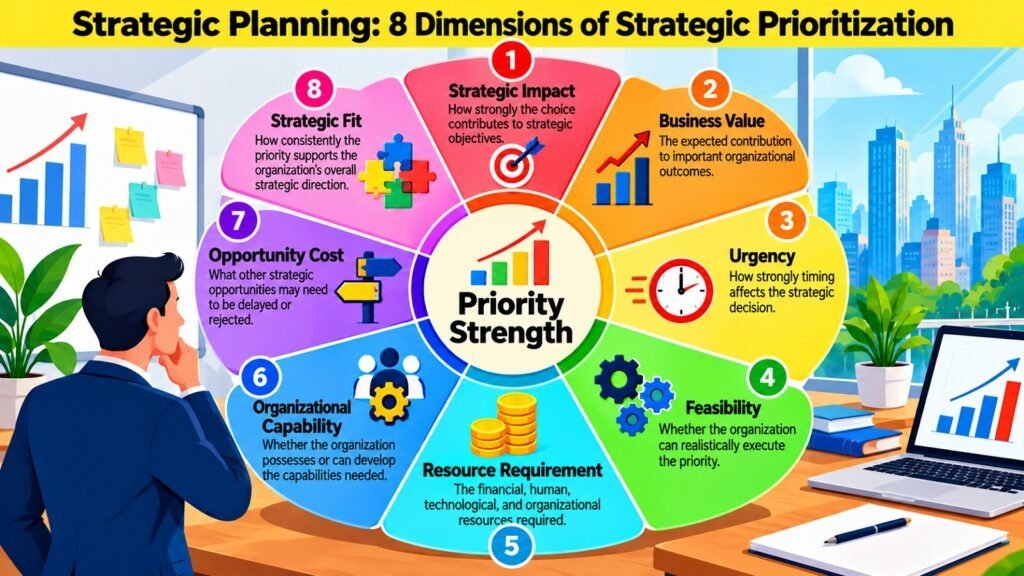
Prioritization is among the most demanding disciplines in Strategic Planning because organizations operate under constraints of money, people, time, capabilities, management attention, and organizational capacity. When everything is declared a priority, the word loses its discriminating function and resources are distributed by habit or negotiating strength rather than strategic merit. Porter argued that the essence of strategy lies in choosing what not to do, and the economic concept of opportunity cost explains why: every commitment forecloses an alternative use of scarce resources. Strategic choice therefore demands explicit trade-offs, not merely additional ambition.
Imagine a mid-sized software firm with four attractive objectives: entering a new region, rebuilding its core platform, launching an adjacent product, and improving customer retention. Funding all four would leave each under-resourced and slow. Leaders can evaluate candidates against strategic impact, urgency, feasibility, organizational capability, and resource requirements, recognizing that an important activity is not automatically a strategic priority. A product-quality improvement may be valuable yet fall outside the few commitments that determine the organization’s trajectory.
Typical failures include proliferating priorities, executive preference overriding evidence, priorities that shift with every quarterly review, and the omission of an explicit list of what will not be pursued. A useful discipline is the stop-list principle: for each priority adopted, leaders name an activity that will be deferred, reduced, or ended, and record the capacity thereby released. This keeps prioritization tethered to constraints, whereas an additive list merely disguises indecision. Prioritization should also remain within the remit of Strategic Planning, concerned with allocating organizational attention rather than surveying the competitive landscape.
An additional analytical consideration addresses the interplay between organizational priorities and operational capability. Strategic decision-making is inherently limited by the organization’s capacity to implement, meaning that priority objectives that surpass existing capabilities may necessitate foundational investments in talent development, technological infrastructure, or strategic alliances before responsible pursuit becomes feasible.
Consequently, the sequencing of priorities carries equal significance to their selection: certain priorities create prerequisites for others, while others demand identical pools of specialized personnel and executive focus. Rendering these interdependencies transparent enables leadership to distribute commitments across time horizons rather than initiating all endeavors concurrently, thereby safeguarding implementation fidelity and maintaining strategic flexibility. The corresponding disadvantage involves deferred tangible advancement in certain domains—a compromise that responsible leaders should communicate with transparency.
Strategic Planning Considerations for Evaluating Strategic Priorities
| Consideration | Decision Value |
| Opportunity cost | Reveals forgone alternatives |
| Strategic impact | Gauges contribution to objectives |
| Urgency | Reflects time sensitivity |
| Feasibility | Tests realistic achievability |
| Organizational capability | Matches ambition to competence |
| Resource requirements | Exposes funding and staffing needs |
| Interdependencies | Identifies enabling relationships |
| Explicit trade-offs | Documents what is deferred |
4. Strategic Planning and Strategic Initiatives
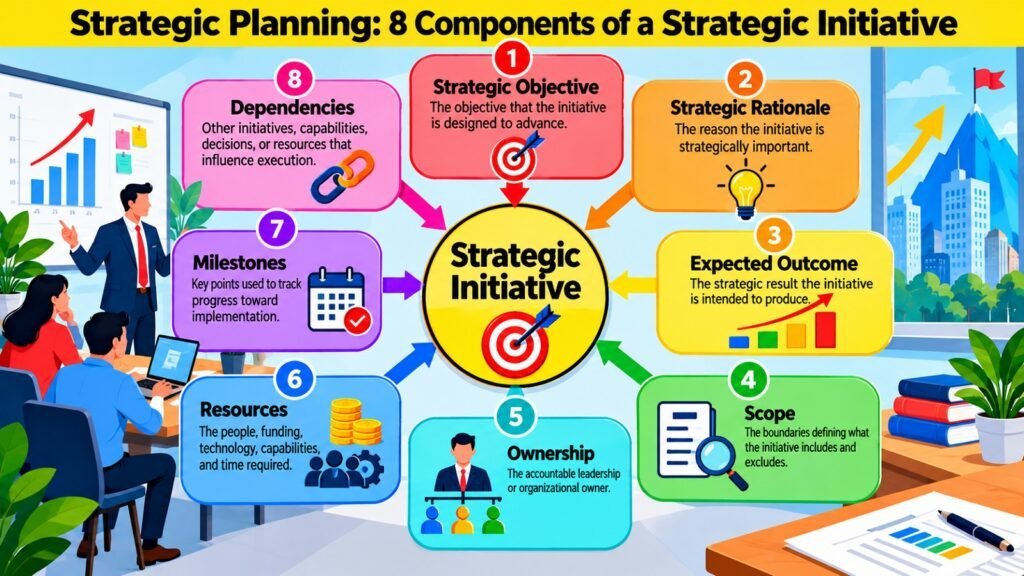
Strategic Planning converts objectives and priorities into strategic initiatives, the major, cross-cutting undertakings through which an organization actually changes its position. Initiatives differ from routine operational activity in scale, cross-functional reach, and direct contribution to strategic objectives; a software upgrade scheduled for maintenance is a project, whereas a platform redesign enabling a new customer proposition may be strategic. Qualifying initiatives can include transformation programs, major investments, capability development, market expansion, technology change, and customer programs, but only when the link to an objective can be stated plainly.
The execution literature explains why this link matters. Studies of strategy implementation, including Hrebiniak’s work and Mankins and Steele’s analysis of value lost between planning and delivery, identify weak coordination, unclear accountability, and poor resourcing as recurrent causes of execution gaps. A retail enterprise seeking to enhance customer retention through increased repeat transactions may establish a comprehensive loyalty and fulfillment optimization program. This strategic initiative would be characterized by the appointment of a designated executive sponsor, allocation of dedicated resources, establishment of measurable progress checkpoints, explicit identification of interdependencies with supply chain and technology infrastructure, and articulation of anticipated business results.
Failures typically arise from launching too many initiatives, assigning ownership weakly, neglecting coordination, underfunding delivery, leaving outcomes undefined, and permitting initiatives to drift away from priorities. A practical design approach proceeds in sequence: confirm the objective served, define the outcome, assign a single accountable owner, specify resources and dependencies, set milestones with review points, and test the whole set for overload. Strategic Planning should yield a coherent portfolio in which initiatives reinforce one another, with capacity limits capping its size, rather than a long list of disconnected projects.
Initiative governance deserves separate attention because it connects design with delivery. Effective portfolios are reviewed as a whole, so leaders can compare contributions, identify overlapping efforts, and stop initiatives whose rationale has weakened, however much has already been spent. The sunk-cost fallacy presents an ongoing challenge in this context, as organizations frequently justify initiatives based on prior expenditures rather than evaluate them according to anticipated benefits. Implementing periodic stage-gate assessments aligned with predetermined design milestones serves as an organizational safeguard against this bias. Furthermore, these evaluations produce valuable data regarding which categories of undertaking the organization executes effectively, thereby informing subsequent strategic planning processes.
Strategic Planning Components of Effective Strategic Initiatives
| Component | Purpose |
| Objective linkage | Anchors action to strategy |
| Accountable ownership | Assigns clear responsibility |
| Defined scope | Separates strategic from routine |
| Resource commitment | Secures funding and people |
| Milestones | Enable staged review |
| Dependencies | Expose coordination needs |
| Expected outcomes | Clarify intended results |
| Portfolio coherence | Prevents fragmented projects |
5. Strategic Planning and Resource Allocation
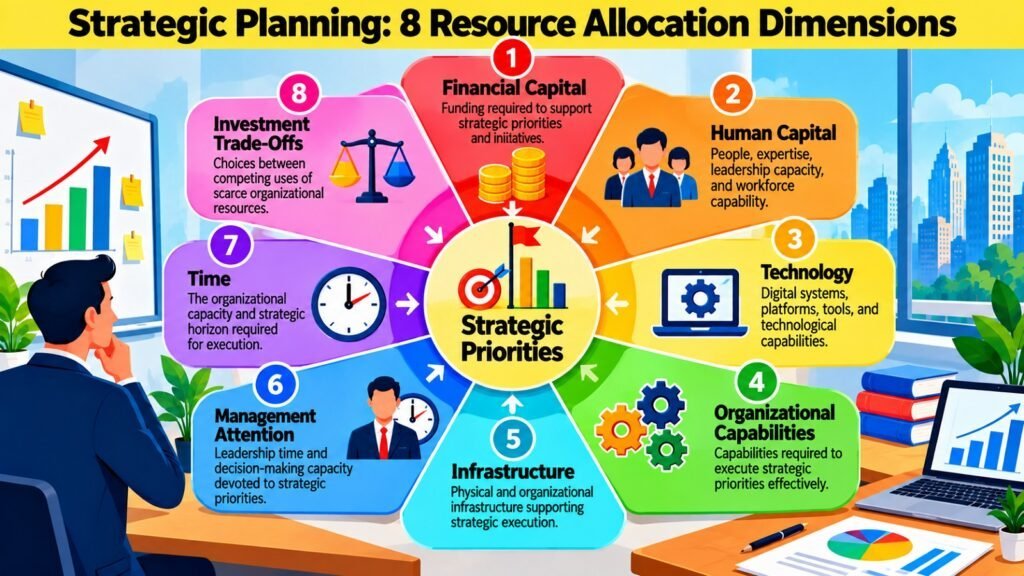
A strategic plan has limited practical value when resource allocation fails to mirror its stated priorities. Strategic Planning therefore links priorities to the resources needed to achieve them, including financial capital, human resources, organizational capabilities, technology, infrastructure, time, and management attention. The last two are frequently overlooked, yet they are often the binding constraints. Budgeting, investment decisions, capacity planning, capability development, and resource trade-offs are the channels through which strategy either becomes real or remains rhetorical.
Theoretical frameworks illuminate the fundamental issues at stake. The resource-based view, attributed to Barney, identifies valuable, rare, and difficult-to-replicate resources as foundations of competitive advantage, whereas Bower and Gilbert’s examination of resource allocation mechanisms demonstrates that strategy emerges through the successive choices made by managers overseeing budgets and initiatives, irrespective of what the formal strategic plan prescribes. Consider a manufacturing enterprise whose documented strategy emphasizes digital services, yet whose capital allocation process persistently directs funding toward legacy facility expansion according to historical proportions. The digital division operates with insufficient personnel, project timelines deteriorate, and senior management incorrectly concludes that the strategic direction itself was inadequate.
Leaders can test genuine alignment by comparing stated priorities with actual spending, staffing, and executive calendars. Useful questions include whether the largest share of discretionary investment supports the top priorities, which legacy commitments persist without strategic justification, which funded initiatives lack adequate people, and whether allocation follows strategic importance or political influence. Recurrent challenges encompass dispersing resources across too many priorities, safeguarding established business units, providing insufficient capital to pivotal programs, and prioritizing negotiation proficiency above objective performance criteria. Given that these patterns persist beyond temporary budgeting methodologies, the fundamental insight is that actual resource deployment communicates strategic intent more accurately than formal documentation.
Resource allocation reveals a fundamental tension between leveraging established capabilities and cultivating emerging ones. March’s conceptual framework distinguishing between exploitation and exploration provides valuable insight into this dynamic, as mature organizations typically demonstrate a natural preference for funding initiatives with assured returns while allocating insufficient resources to developing competencies whose benefits remain uncertain and temporally distant.
A structured planning methodology that actively mitigates this inclination may designate a circumscribed allocation of investment specifically for capability advancement, deliberately accepting diminished short-term operational efficiency to enable long-term strategic transformation. The optimal allocation percentage constitutes a strategic determination contingent upon sectoral conditions, organizational financial position, and organizational risk appetite, thereby precluding the formulation of any universally applicable prescriptive framework. Communicating the underlying reasoning transparently serves to diminish concerns regarding preferential treatment based on organizational politics.
Strategic Planning Considerations for Resource Allocation
| Consideration | Practical Insight |
| Financial capital | Funds priority initiatives |
| Human capital | Matches talent to priorities |
| Organizational capabilities | Sustain competitive advantage |
| Technology and infrastructure | Enable execution capacity |
| Management attention | Scarce and finite |
| Opportunity cost | Every allocation forgoes alternatives |
| Capacity planning | Prevents overcommitment |
| Budget linkage | Ties spending to priorities |
6. Strategic Planning and Strategic Alignment
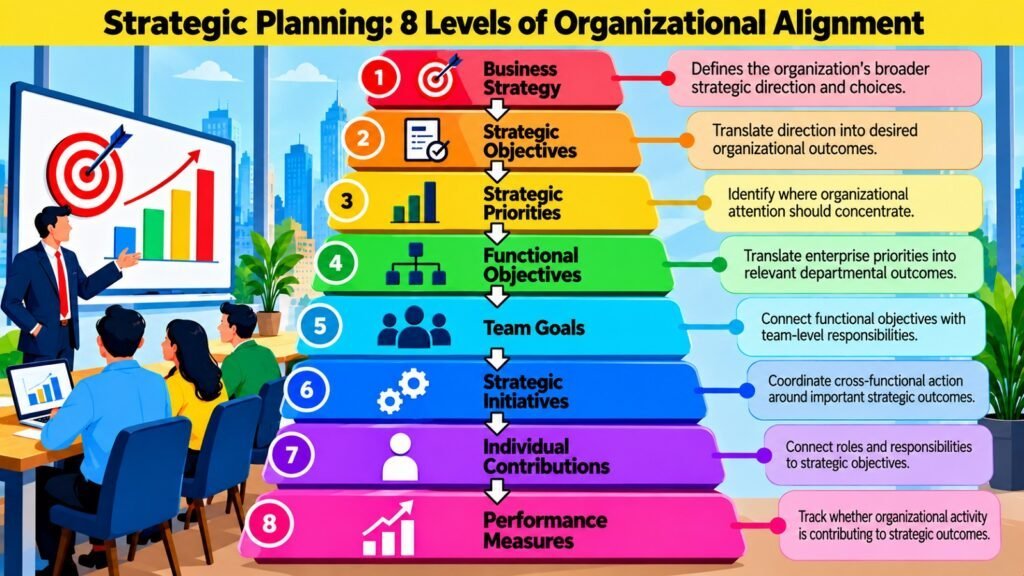
Strategic Planning creates alignment by connecting overall strategy to the functions, teams, capabilities, and activities that must execute it. Vertical alignment links organizational objectives to functional and individual goals, while horizontal alignment coordinates departments and business units whose work is interdependent. The objectives, priorities, initiatives, resources, responsibilities, communication protocols, and performance expectations must function in concert to reinforce each other; any deficiency in a single component compromises the effectiveness of all remaining elements.
Organizational theory explains the stakes. Lawrence and Lorsch showed that differentiated functions require integrating mechanisms, and Galbraith’s information-processing view treats coordination as a design problem. Without it, conflicting goals, duplicated work, wasted resources, slow decisions, and execution gaps follow. Consider a company whose plan prioritizes premium customers: marketing expands entry-level promotions to meet lead targets, procurement cuts component costs, and service teams are measured on call speed rather than resolution quality. Each department behaves rationally relative to its own incentives, yet the combined effect undermines the strategy.
Achieving alignment does not necessitate the elimination of specialized knowledge or valid distinctions, as the development of expertise through specialization constitutes a fundamental source of organizational capability. Practical mechanisms include shared objectives that cross departmental boundaries, clear ownership, cross-functional forums, consistent communication, and cascaded goals that translate rather than copy corporate objectives. A concise alignment test asks four questions: can each team explain how its work serves the strategy, do departmental goals conflict, are shared dependencies owned, and do incentives reward the intended behavior? Negative answers signal coordination gaps that planning must address.
Alignment also has limits and costs that deserve candid discussion. Excessive cascading can produce rigidity, as units pursue the letter of their assigned goals while ignoring local information that would improve outcomes. Tight coupling across functions may likewise slow decisions when every choice requires consensus. Effective planning therefore distinguishes between a small number of enterprise-level commitments that demand strict alignment and a wider zone in which teams retain discretion to experiment. Kaplan and Norton’s strategy maps illustrate the logic by showing how objectives in different perspectives are causally linked, thereby clarifying where coordination is essential. The fundamental objective is to achieve coherence while preserving diversity, ensuring that specialized knowledge remains distinct while organizational direction remains unified.
Strategic Planning Dimensions of Strategic Alignment
| Dimension | Alignment Function |
| Vertical alignment | Links organizational levels |
| Horizontal alignment | Coordinates across functions |
| Goal cascading | Translates objectives downward |
| Clear ownership | Assigns accountability |
| Cross-functional coordination | Manages interdependencies |
| Communication | Shares strategic understanding |
| Incentive consistency | Rewards intended behavior |
| Resource coherence | Backs shared priorities |
7. Strategic Planning and Strategic Performance Management
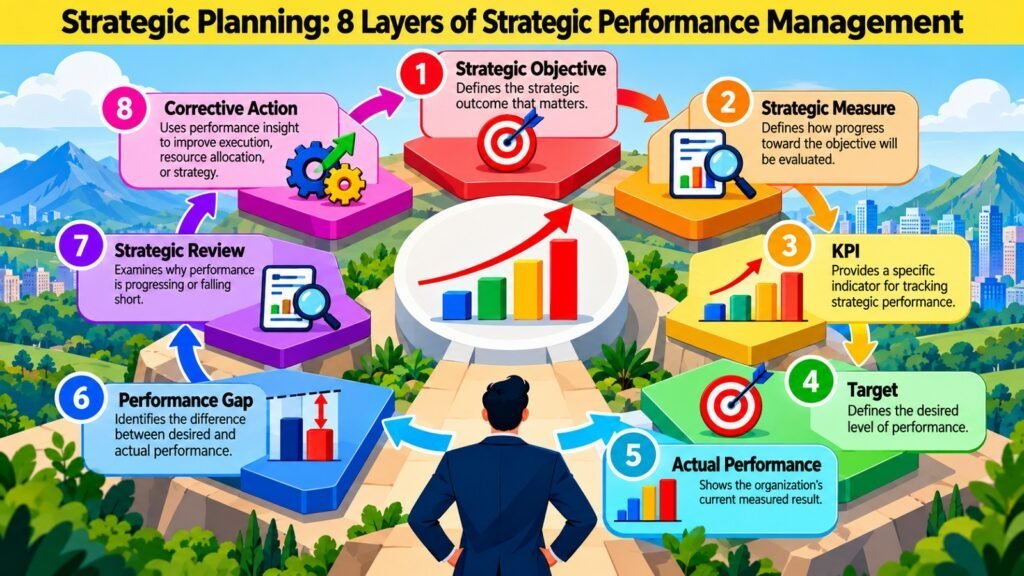
Strategic Planning establishes the foundation for monitoring whether objectives and priorities are producing intended outcomes. Strategic performance management differs from routine operational measurement because it asks whether the strategy is working, not merely whether activity is occurring. Measures should therefore reflect strategic progress, such as customer retention or capability maturity, rather than activity volume, such as meetings held or campaigns launched. The fundamental elements encompass strategic key performance indicators, predetermined objectives, developmental phases, responsibility assignment, periodic evaluations, measurement dashboards, constructive input, and remedial measures.
Kaplan and Norton’s Balanced Scorecard rests on the principle that financial results are lagging indicators and must be complemented by customer, internal process, and learning and growth perspectives that explain how results are produced. Research on feedback and goal achievement, together with Argyris’s distinction between single-loop and double-loop learning, suggests that measurement matters most when it prompts questioning of assumptions rather than merely adjusting effort. An organization pursuing customer loyalty that tracks the number of surveys distributed illustrates the problem: the figure rises while retention stagnates, because the measure captures activity rather than outcome.
Typical errors encompass an excessive quantity of key performance indicators, prioritizing readily quantifiable metrics over substantively significant ones, depending solely on monetary indicators, neglecting to establish clear ownership, and accumulating information that fails to influence organizational decisions. Readers can assess their own system with a few questions: does each KPI trace to an objective, is every measure owned, are reviews decision-oriented, and has performance information ever changed a plan? Measurement should enable learning and better decisions, not become an administrative reporting exercise.
Performance management also requires attention to behavioral side effects. Goodhart’s law, often paraphrased as the observation that a measure becomes unreliable once it becomes a target, warns that people optimize indicators in ways that may diverge from the underlying objective. Combining several complementary measures, reviewing them periodically, and supplementing quantitative indicators with qualitative judgement mitigates this risk. Review cadence matters as well: frequent operational reviews and less frequent strategic reviews serve different purposes, and merging them tends to crowd out deeper questions about whether the strategy itself remains sound.
Strategic Planning Considerations for Strategic Performance Management
| Consideration | Practical Value |
| Strategic KPIs | Track progress on objectives |
| Targets | Define success thresholds |
| Milestones | Mark interim progress |
| Balanced perspectives | Combine financial and non-financial measures |
| Leading and lagging indicators | Explain and predict results |
| Ownership | Assigns accountability |
| Performance reviews | Prompt decisions |
| Corrective action | Closes the feedback loop |
8. Strategic Planning and Strategic Adaptation
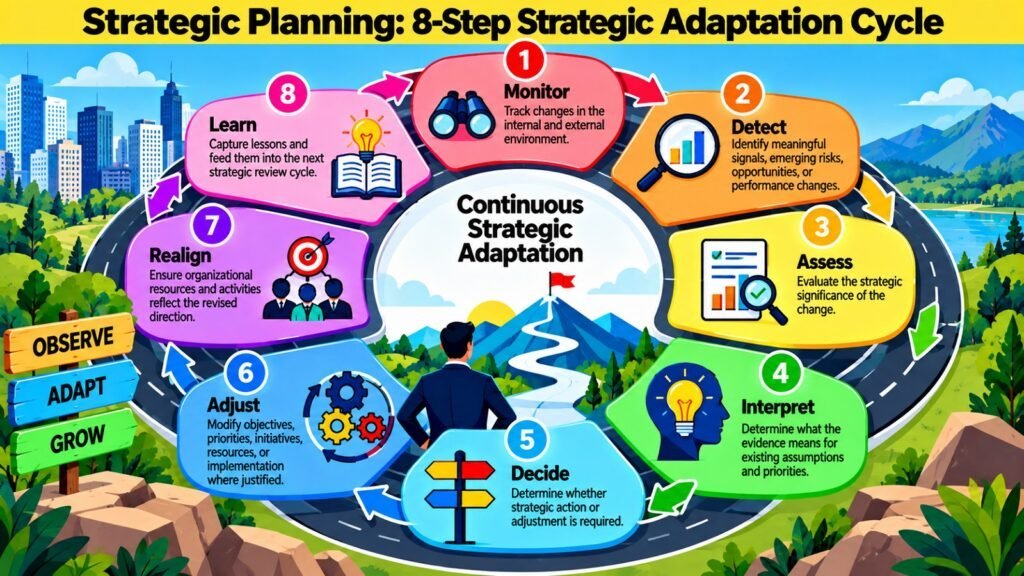
Effective Strategic Planning is adaptive rather than a fixed document immune to circumstances. Markets, customer expectations, technology, regulation, competition, internal capabilities, economic conditions, and unexpected disruptions all shift, and the plan must respond without losing coherence. Mintzberg’s conceptualization regarding the dichotomy between intentional and adaptive strategy illuminates this fundamental challenge, as the ultimate strategy typically represents a synthesis of predetermined objectives and behavioral patterns that materialize through organizational learning. Teece’s examination of dynamic capabilities likewise underscores the significance of environmental awareness, strategic exploitation, and organizational restructuring as persistent institutional strengths.
The practical challenge is distinguishing disciplined adaptation from constant change. Consider a firm whose leadership abandons a multi-year service investment after one disappointing quarter and pivots again six months later, producing fatigue and no accumulated learning. By contrast, a firm that reviews its assumptions annually, discovers that a key technology assumption has failed, and adjusts initiatives while preserving its direction demonstrates controlled adjustment. Organizations can examine assumptions, objectives, priorities, initiatives, resources, and performance information in that order before deciding whether change is warranted, and scenario thinking helps test plans against plausible futures.
Common mistakes include refusing to adapt, reacting to every short-term signal, changing priorities too frequently, abandoning long-term objectives prematurely, and confusing flexibility with lack of discipline. A memorable adaptation cycle has five steps: sense signals, test assumptions, decide what to change, adjust and communicate, and learn from results. Because the cycle rests on learning, review, and resilience rather than any particular disruption, it remains useful across eras.
Adaptation also depends on organizational conditions that planning can deliberately cultivate. Psychological safety and a tolerance for reporting bad news allow weak signals to reach decision makers before problems become crises, while predefined review triggers, such as sustained deviation from a key assumption, reduce the temptation to rely on intuition alone. Review triggers should be few and well specified. Rudd, Greenley, Beatty, and Rapp’s research on planning flexibility suggests that flexibility can enhance the benefits of comprehensive planning rather than diminish them. The inference suggests that adaptation functions as a complement to planning rather than serving as a substitute, inasmuch as an established baseline framework is essential for rendering deviations perceptible and comprehensible.
Strategic Planning Considerations for Strategic Adaptation
| Consideration | Review Function |
| Strategic review | Periodically reassesses the plan |
| Assumption testing | Detects invalid premises |
| Organizational learning | Converts experience into insight |
| Feedback loops | Inform timely correction |
| Scenario thinking | Prepares for plausible futures |
| Dynamic capabilities | Sense, seize, and reconfigure |
| Controlled adjustment | Changes tactics, preserves direction |
| Strategic discipline | Prevents reactive drift |
Conclusion: Strategic Planning for Sustainable Business Success
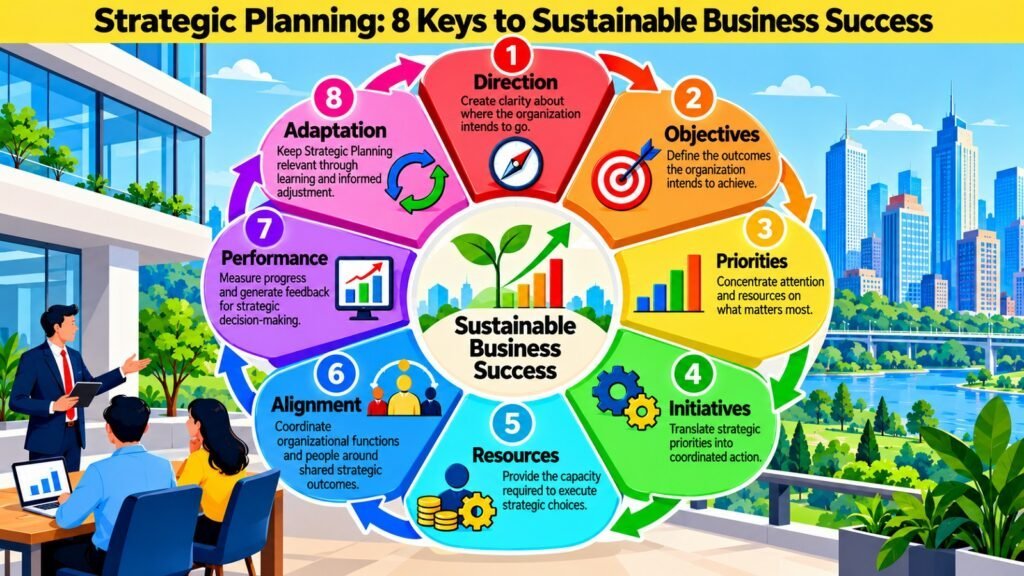
Strategic Planning is not a document, an annual exercise, or a collection of business goals; it is an integrated organizational discipline. Strategic Direction establishes where the organization intends to go, Strategic Objectives define the outcomes sought, Strategic Priorities create focus, and Strategic Initiatives translate priorities into action. Resource Allocation makes the plan feasible, Strategic Alignment coordinates the organization, Strategic Performance Management measures progress, and Strategic Adaptation keeps the whole relevant. Each element depends on the others, so weakness in one limits the value of the rest.
The central distinction of this article lies between having a strategic plan and developing an effective Strategic Planning capability. A maturity perspective helps. Reactive or fragmented planning is episodic, disconnected from budgets, and rarely reviewed. Comprehensive planning integrates objectives, priorities, initiatives, and resources into a unified and coordinated framework. Performance-driven planning adds disciplined measurement and accountability, and adaptive planning treats review and learning as routine rather than exceptional. Most organizations will find that different elements sit at different levels of maturity, which is itself a useful diagnostic. Progress along this path is rarely linear, and organizations may regress when leadership changes or external pressure intensifies, so maturity should be reassessed periodically rather than declared once.
The framework can serve as a planning reference, a leadership discussion tool, an organizational assessment instrument, and a starting point for deeper exploration of each element. Strategic Planning creates value when it converts strategic intent into disciplined choices, coordinated action, measurable progress, and informed adaptation. Used in this way, the eight-part model provides a shared vocabulary that allows executives, managers, and advisers to locate weaknesses precisely rather than describing planning problems in general terms.
Strategic Planning Takeaways: Eight Elements at a Glance
| Strategic Planning Elements | Key Takeaway |
| Strategic Direction | Defines the destination |
| Strategic Objectives | Specify intended outcomes |
| Strategic Priorities | Concentrate scarce resources |
| Strategic Initiatives | Translate priorities into action |
| Resource Allocation | Makes the plan feasible |
| Strategic Alignment | Coordinates functions and levels |
| Strategic Performance Management | Measures strategic progress |
| Strategic Adaptation | Keeps the plan relevant |