Table of Contents
Introduction: Why the Business Ecosystem Is a Core Business Essential
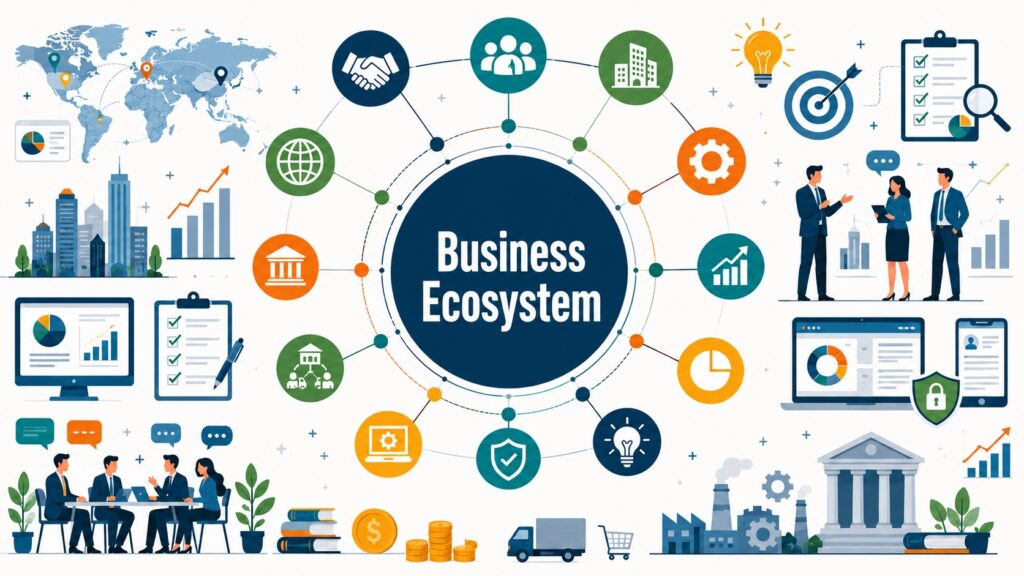
Every business operates inside a larger web of forces, actors, and interdependencies. That web has a name. It is called the business ecosystem, and understanding it is no longer optional for modern enterprises. It has become a fundamental business essential for organizations trying to stay relevant in markets that are more volatile, more connected, and more demanding than ever before.
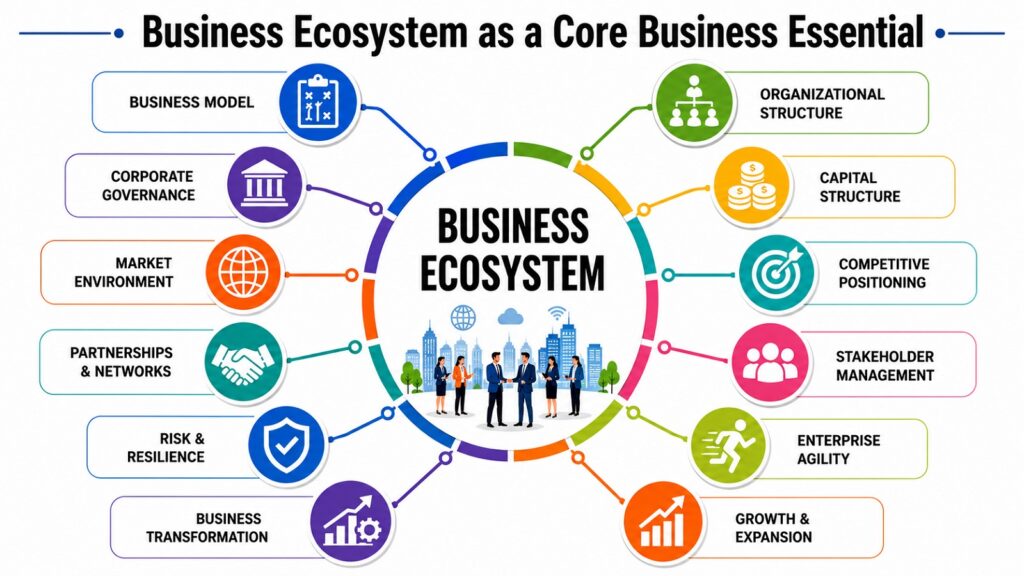
A business ecosystem is not simply a collection of departments or supply chains. It is a strategic framework that draws together business models, organizational structures, governance practices, capital decisions, market forces, competitive strategies, partnerships, stakeholder relationships, risk management, agility, transformation, and growth planning into one coherent perspective. Each of these elements interacts with the others. Change one, and the ripple moves through the rest.
Traditional business thinking often treated each function in isolation. Finance sat apart from strategy. Operations stayed separate from market intelligence. That fragmented approach made sense when markets moved slowly and competition was more predictable. It no longer holds. Today, a regulatory shift in one country can disrupt a global supply chain overnight. A technology breakthrough from a startup can erode the market share of an established corporation within months. Businesses that operate in silos lose the ability to see these threats or opportunities coming.
Ecosystem thinking changes that. When a business understands how its internal structure connects to external market forces, and how its governance connects to stakeholder trust, and how its capital structure connects to its ability to transform, it gains a strategic clarity that isolated thinking cannot produce. The business ecosystem provides that clarity.
This article examines twelve core dimensions of the business ecosystem: business model strategy, organizational structure, corporate governance, capital structure, market environment, competitive positioning, partnerships and networks, stakeholder management, risk and resilience, enterprise agility, business transformation, and growth and expansion. Together, these dimensions explain why ecosystem thinking has become an important business essential for executives, managers, entrepreneurs, and anyone serious about building a lasting enterprise.
Business Ecosystem: Overview of 12 Strategic Dimensions
| Dimension | Strategic Role within the Business Ecosystem |
| Business Model | Defines how value is created, delivered, and monetized within evolving market conditions |
| Organizational Structure | Shapes authority flow, coordination, and adaptability across enterprise operations |
| Corporate Governance | Provides accountability, ethical oversight, and institutional trust for long-term stability |
| Capital Structure | Determines financial flexibility, investment capacity, and strategic resilience |
| Market Environment | Reflects the external conditions that shape competitive dynamics and enterprise positioning |
| Competitive Positioning | Establishes differentiation and sustained relevance in the marketplace |
| Partnerships & Networks | Creates strategic leverage through alliances, collaboration, and ecosystem interdependence |
| Stakeholder Management | Builds trust and alignment with investors, employees, customers, regulators, and communities |
| Risk & Resilience | Enables organizations to absorb disruptions and sustain operations through uncertainty |
| Enterprise Agility | Supports rapid responsiveness, strategic flexibility, and adaptive decision-making |
| Business Transformation | Drives modernization, digital evolution, and strategic reinvention over time |
| Growth & Expansion | Guides scaling, diversification, and market development with ecosystem alignment |
1. Business Ecosystem and Business Model Strategy
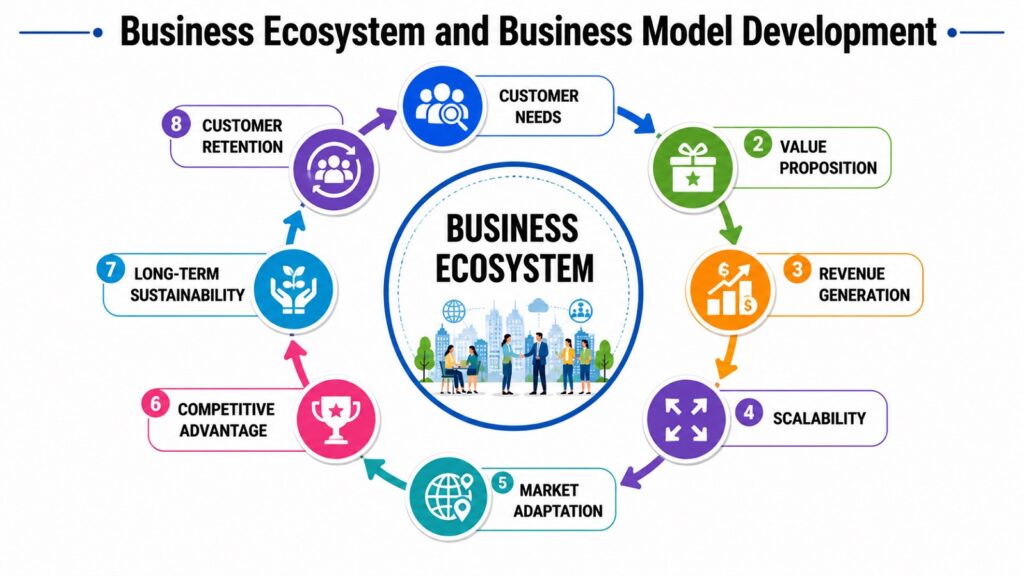
A business model is the foundational logic through which an organization creates value, delivers it to customers, and captures a portion of that value as revenue. Within the business ecosystem, the business model does not exist in isolation. It is shaped by the competitive landscape, influenced by technological shifts, and tested constantly by changing customer expectations.
The classic business model framework, popularized by Alexander Osterwalder, outlines nine building blocks: customer segments, value propositions, channels, customer relationships, revenue streams, key resources, key activities, key partnerships, and cost structure. These blocks describe the internal logic of a business. But the business ecosystem adds a critical external layer. It forces organizations to ask not only how they create value, but how they sustain that value creation over time as conditions around them change.
Amazon began as an online bookstore with a straightforward retail model. Over time, its business model evolved dramatically. It built cloud infrastructure, launched a marketplace for third-party sellers, developed a subscription service, and entered advertising. Each evolution was a response to ecosystem signals: shifting consumer behavior, emerging technology capabilities, new competitive threats, and untapped capital opportunities. That continuous evolution is what ecosystem-level business model thinking looks like in practice.
Scalability is a central concern. A business model that works for a startup of fifty employees may not hold up for an enterprise of fifty thousand. The ecosystem introduces new complexity at each stage of growth: more stakeholders, more regulatory exposure, more competitive pressure, and a greater need for governance. A business model built without considering these ecosystem pressures tends to break under the weight of its own success.
Revenue diversification is another strategic consideration. Businesses that rely on a single revenue stream carry greater vulnerability in a dynamic ecosystem. The disruption of one market condition can threaten the entire organization. Companies like Apple, which generates revenue from hardware, software, services, and content, demonstrate how multiple revenue layers provide strategic insulation within a complex ecosystem.
The strategic insight here is straightforward. The business ecosystem does not simply host business models. It continuously challenges them. Organizations that treat their business model as a fixed structure rather than a living strategic instrument tend to fall behind. Those that monitor ecosystem dynamics and adjust their value creation logic accordingly tend to maintain relevance and competitive strength over time.
Business Ecosystem and Business Model: Strategic Dimensions
| Business Model Element | Strategic Role in the Business Ecosystem |
| Value Proposition | Defines why customers choose an organization over competitors in a given market context |
| Revenue Diversification | Reduces vulnerability by spreading income across multiple products, services, or markets |
| Scalability | Determines the capacity of a model to grow without proportional increases in cost or complexity |
| Cost Structure | Shapes competitive pricing, margin sustainability, and investment capacity |
| Customer Segmentation | Enables targeted value delivery and improves capital efficiency across market channels |
| Platform Model | Creates network effects by enabling third-party participants to co-create and exchange value |
| Subscription Model | Generates recurring revenue and deepens customer retention within competitive ecosystems |
| Business Model Evolution | Requires continuous reassessment as market conditions, technology, and competition shift |
2. Business Ecosystem and Organizational Structure
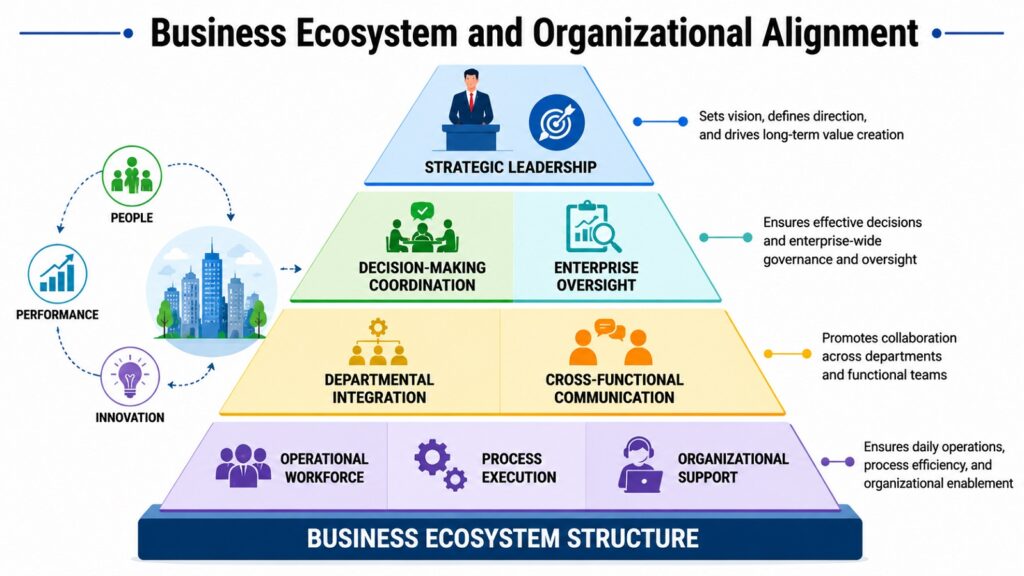
Organizational structure is the skeleton of an enterprise. It determines who reports to whom, how decisions travel through a company, where authority lives, and how communication flows across functions. Within the business ecosystem, structure is not a neutral administrative arrangement. It is a strategic tool that either enables or restricts the organization’s ability to respond to market change, manage complexity, and sustain growth.
Hierarchical structures concentrate authority at the top and pass decisions downward through layers of management. They provide clarity, consistency, and control. Large manufacturers and financial institutions often favor this model because it supports regulatory compliance and operational discipline. The trade-off is responsiveness. A deeply hierarchical structure can slow decision-making in markets where speed matters.
Flat structures distribute authority more broadly. Employees in flat organizations typically have more autonomy, fewer management layers, and faster access to decision-makers. Technology startups frequently adopt flat models in their early stages because rapid iteration and creative problem-solving benefit from minimal bureaucratic friction. As these organizations scale, however, flat structures often struggle to maintain coordination and accountability across larger teams.
Matrix structures introduce dual reporting lines, typically combining functional and project-based authority. Consulting firms and multinational corporations often use matrix models because they allow specialists to contribute across multiple projects while maintaining a functional home. The complexity of matrix reporting can create role confusion, but the model excels at combining deep expertise with project flexibility.
Decentralized structures push authority toward business units, regional offices, or subsidiary entities. Companies like Berkshire Hathaway operate with high levels of decentralization, allowing each subsidiary to function almost independently. This approach supports ecosystem diversity by enabling each unit to adapt to its own market conditions while operating under shared governance principles.
The strategic insight is that no single structure fits every ecosystem condition. What matters more than the type of structure is whether the structure enables the organization to achieve its strategic objectives within its specific ecosystem. Businesses that align their structure to their ecosystem demands tend to operate more efficiently, innovate more consistently, and respond to disruption more effectively than those that treat structure as fixed.
Business Ecosystem and Organizational Structure: Key Characteristics
| Structure Type | Strategic Implication within the Business Ecosystem |
| Hierarchical | Supports control and compliance but can slow responsiveness in dynamic markets |
| Flat | Enables speed and autonomy but may struggle with coordination at scale |
| Matrix | Combines functional expertise with project flexibility but can create role ambiguity |
| Decentralized | Allows business units to adapt locally while operating under shared governance |
| Network Structure | Distributes authority across partners and external collaborators for ecosystem-wide coordination |
| Divisional Structure | Groups operations by product, geography, or customer segment for focused accountability |
| Holacratic Structure | Replaces fixed roles with dynamic circles, supporting high agility in innovative environments |
| Hybrid Structure | Blends multiple models to balance agility, control, and coordination across complex ecosystems |
3. Business Ecosystem and Corporate Governance
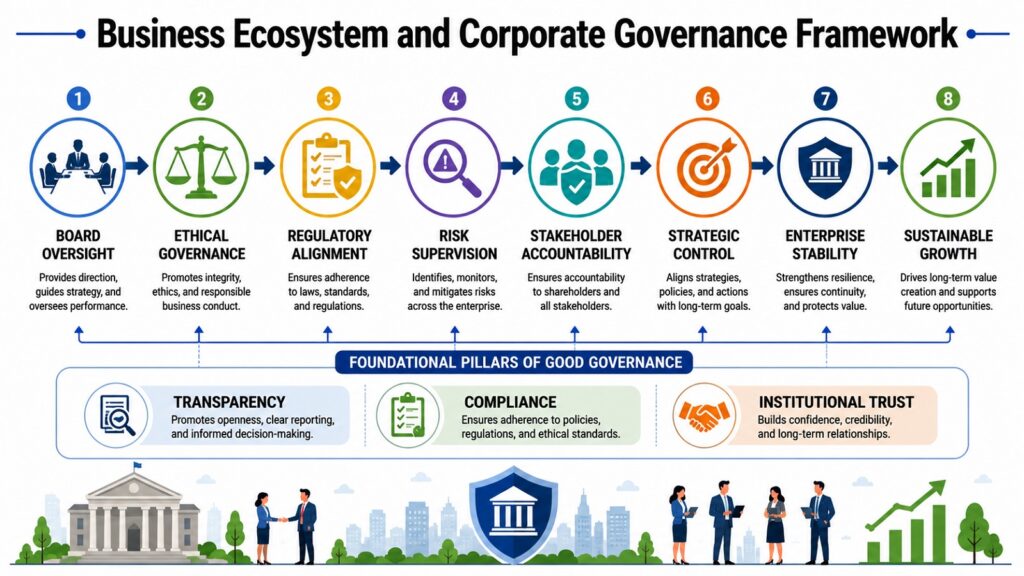
Corporate governance defines the systems, processes, and principles by which organizations are directed and controlled. Within the business ecosystem, governance is not merely a compliance requirement. It is a strategic foundation that supports long-term institutional credibility, stakeholder confidence, and sustainable enterprise performance.
The core purpose of corporate governance is accountability. Boards of directors exist to represent shareholder interests, oversee executive decision-making, and ensure that an organization’s strategy aligns with its stated visions, mission, and core values. Without effective oversight, executives may pursue short-term gains at the expense of long-term stability. Governance mechanisms, including audit committees, independent directors, executive compensation frameworks, and disclosure obligations, exist to prevent that misalignment.
The Sarbanes-Oxley Act of 2002, introduced in the United States following the Enron and WorldCom scandals, significantly strengthened corporate governance requirements for publicly listed companies. It mandated more rigorous financial disclosures, increased the independence of audit committees, and imposed personal accountability on corporate officers for the accuracy of financial statements. This legislation reflected a broader ecosystem reality: governance failures do not stay contained within individual companies. They damage investor confidence, trigger regulatory overreach, and erode market trust across entire industries.
Good governance also intersects with environmental, social, and governance considerations, commonly known as ESG. Institutional investors increasingly use ESG performance as a signal of long-term organizational health. Companies with weak governance records face higher costs of capital, greater regulatory scrutiny, and reduced access to certain institutional investors. Within the business ecosystem, this creates a direct financial incentive to invest in governance quality.
The relationship between governance and resilience is particularly important. Organizations with strong governance frameworks tend to navigate crises more effectively. Clear accountability structures, transparent decision-making protocols, and robust risk oversight mean that when disruptions arrive, the organization responds in a coordinated, credible, and legally compliant manner. Poor governance, by contrast, tends to amplify the damage of crises by creating confusion, enabling cover-ups, and undermining stakeholder trust at the moment it is needed most.
Business Ecosystem and Corporate Governance: Core Principles
| Governance Element | Strategic Significance in the Business Ecosystem |
| Board Independence | Reduces conflicts of interest and strengthens oversight of executive decision-making |
| Audit Committee | Ensures financial accuracy and regulatory compliance, protecting investor confidence |
| Executive Accountability | Links leadership decisions to measurable performance standards and ethical obligations |
| ESG Integration | Connects governance quality with sustainability, investor access, and long-term institutional trust |
| Transparency | Builds credibility with regulators, investors, and the public through accurate and timely disclosure |
| Risk Oversight | Establishes governance-level visibility into operational, financial, and reputational risks |
| Regulatory Alignment | Ensures organizational conduct meets legal requirements across jurisdictions and industries |
| Governance Frameworks | Structures like COSO and King IV provide recognized standards for enterprise accountability |
4. Business Ecosystem and Capital Structure
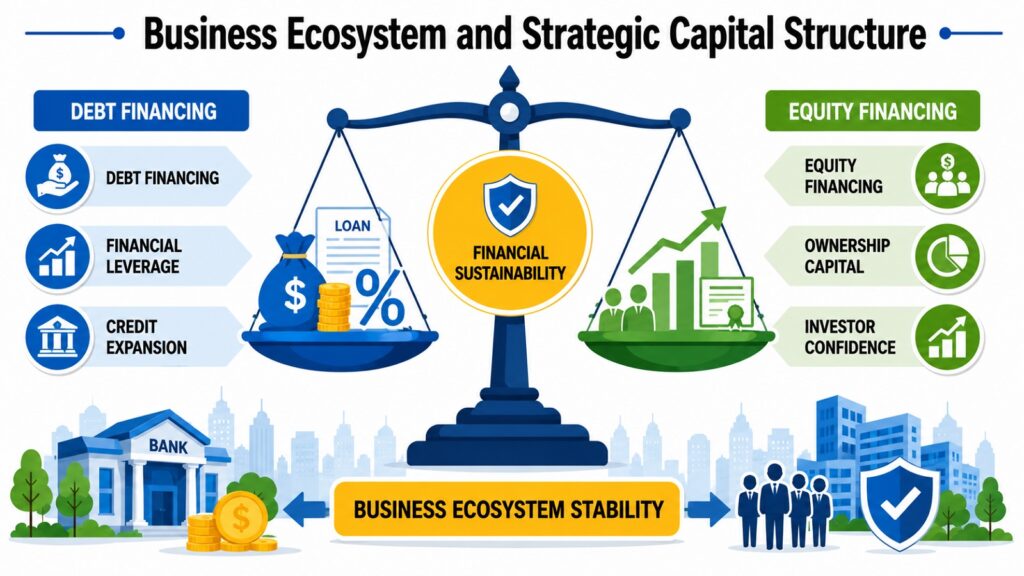
Capital structure pertains to the combination of debt and equity that a company employs to fund its operations, investments, and strategic endeavors. In the context of the business ecosystem, capital structure transcends mere financial decision-making. It influences the level of strategic flexibility available to a business, its responsiveness to market disruptions, and its ability to seize growth opportunities as they present themselves.
Debt financing involves borrowing funds from banks, bond markets, or other creditors with an obligation to repay principal and interest over time. Equity financing involves issuing ownership stakes to investors in exchange for capital, with no repayment obligation but a sharing of future profits and control. Most mature enterprises use a combination of both, and the balance between them has significant strategic implications.
A business with high debt relative to its equity, known as a highly leveraged company, carries fixed financial obligations regardless of its revenue performance. This can amplify returns during strong periods but creates acute vulnerability during downturns. The financial crisis of 2008 exposed many highly leveraged financial institutions whose debt obligations exceeded their ability to sustain operations when market conditions deteriorated rapidly.
Conversely, companies with low leverage and strong equity bases, such as many technology firms that retained large cash reserves, entered the same crisis with more flexibility. Apple, for instance, had accumulated significant cash holdings that allowed it to continue investing in product development, acquisitions, and talent even during periods of broad economic contraction. That financial resilience was a direct product of capital structure decisions made over the years.
Within the business ecosystem, industries carry different capital structure norms. Capital-intensive industries such as utilities, telecommunications, and manufacturing typically carry higher debt loads because their asset bases support long-term borrowing. Technology firms and professional service businesses often carry less debt because their value resides in intellectual assets and human capital rather than physical infrastructure. Understanding these industry-level ecosystem norms is essential for structuring capital appropriately.
The strategic insight is that capital structure is an ecosystem-responsive decision. Businesses that align their financing mix with their industry conditions, growth stage, competitive environment, and risk tolerance tend to maintain a greater strategic freedom than those that allow capital structure to form by default rather than by design.
Business Ecosystem and Capital Structure: Strategic Characteristics
| Capital Element | Strategic Significance in the Business Ecosystem |
| Debt Financing | Provides capital without diluting ownership but creates fixed obligations regardless of performance |
| Equity Financing | Reduces fixed obligations and brings strategic investors but dilutes ownership and control |
| Leverage Ratio | Measures debt dependency; high leverage increases risk exposure during market downturns |
| Cash Reserves | Provide strategic flexibility for investment, acquisitions, and resilience during disruptions |
| Capital Allocation | Determines how financial resources are distributed across operations, growth, and risk mitigation |
| Cost of Capital | Reflects the blended return required by debt and equity providers; lower cost improves investment viability |
| Working Capital | Supports day-to-day operations and determines the ability to respond quickly to market opportunities |
| Funding Diversification | Reduces dependence on any single capital source, improving financial stability across ecosystems |
5. Business Ecosystem and Market Environment
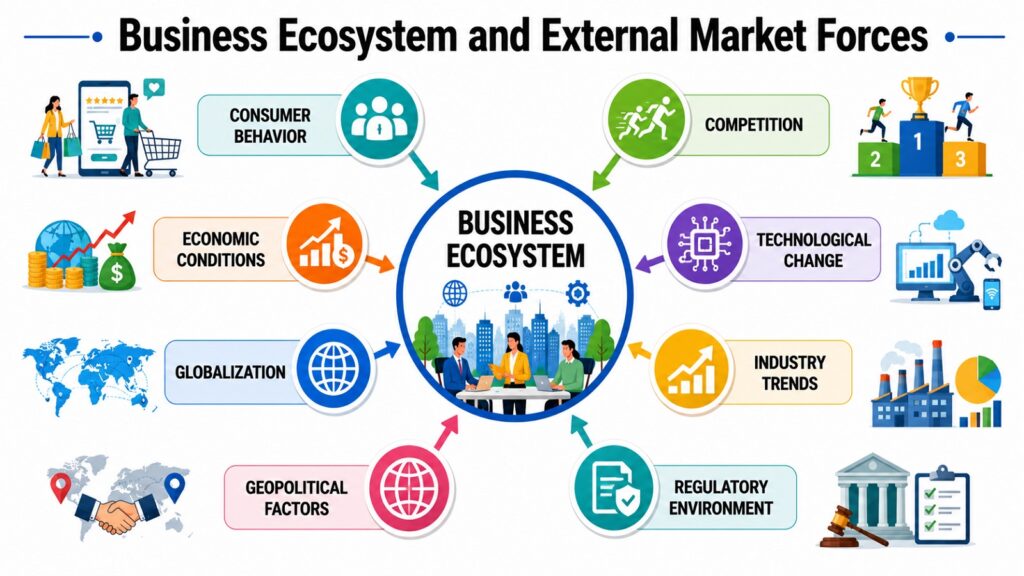
The market environment is the collection of external forces that shape the conditions under which businesses compete, grow, and sometimes fail. Within the business ecosystem, understanding the market environment is not about tracking news headlines. It is about developing a systematic view of how industry trends, competitive dynamics, consumer behavior, regulation, technology, globalization, and macroeconomic conditions interact to create strategic opportunities and threats.
Michael Porter’s Five Forces framework, developed at Harvard Business School, remains one of the most useful tools for analyzing market environment conditions. It examines the threat of new entrants, the bargaining power of suppliers and buyers, the threat of substitute products, and the intensity of competitive rivalry. Together, these forces shape the profitability potential and strategic attractiveness of a given market. A business ecosystem analysis extends this by also considering the regulatory environment, geopolitical context, and technology infrastructure that surround industry competition.
The COVID-19 pandemic provided a dramatic illustration of how rapidly the market environment can shift. Entire industries, including aviation, hospitality, and physical retail, experienced revenue collapses within weeks. Organizations that had built ecosystem resilience through digital infrastructure, flexible cost structures, and diversified revenue streams survived more effectively. Those that had concentrated risk in physical assets and single-channel distribution faced existential challenges.
Technology shifts represent a more gradual but equally powerful form of market environment change. The rise of artificial intelligence is reshaping labor markets, competitive dynamics, and business models across industries simultaneously. Companies that position themselves early within this shifting ecosystem tend to capture advantages in efficiency, customer experience, and speed of innovation that are difficult for slower-moving competitors to replicate.
Geopolitical factors have also become increasingly significant within the market environment. Trade tariffs, sanctions, export controls, and supply chain nationalism have complicated the strategic calculations of multinational enterprises. The decoupling of technology supply chains between the United States and China, for instance, has forced companies like Taiwan Semiconductor Manufacturing Company to manage extraordinary ecosystem pressures simultaneously across multiple geopolitical environments.
Business Ecosystem and Market Environment: Key Factors
| Market Force | Strategic Implication for the Business Ecosystem |
| Competitive Rivalry | Intense rivalry compresses margins and accelerates the need for differentiation and innovation |
| Consumer Behavior Shifts | Changing preferences alter value propositions and require business model adaptation |
| Technology Disruption | Emerging technologies redefine competitive barriers and create new ecosystem entrants |
| Regulatory Change | New compliance requirements alter cost structures and competitive dynamics across industries |
| Globalization | Expands market access while increasing exposure to currency risk, geopolitics, and supply chain complexity |
| Economic Cycles | Macroeconomic contractions reduce demand and test capital structure resilience |
| Geopolitical Risk | Trade policies and international tensions affect supply chains, expansion strategies, and partnerships |
| Industry Convergence | Boundaries between sectors blur as technology enables cross-industry competition and collaboration |
6. Business Ecosystem and Competitive Positioning
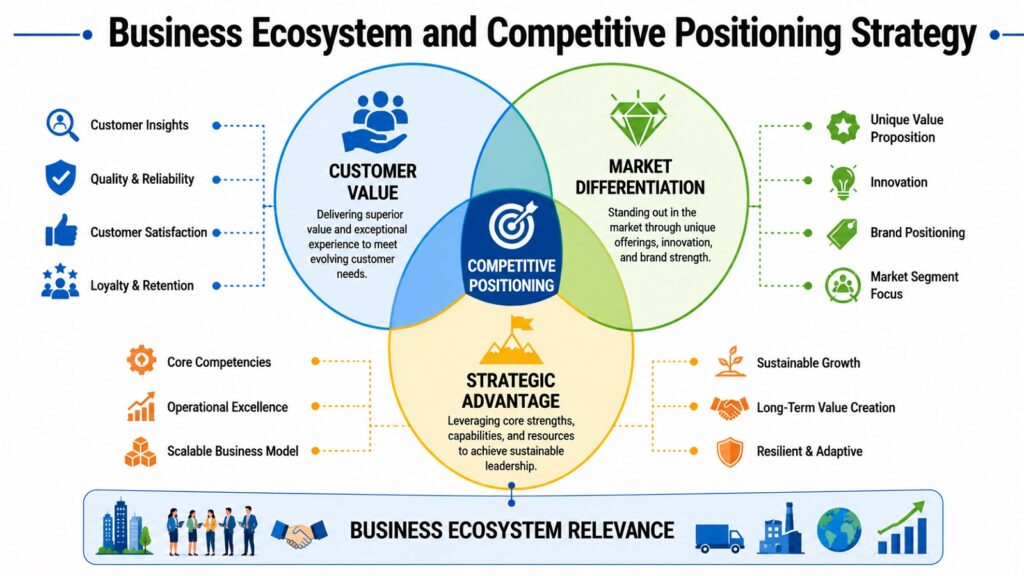
Competitive positioning describes the place an organization occupies in the minds of its customers and within its industry relative to competitors. Within the business ecosystem, competitive positioning is not just a marketing concept. It is a strategic commitment that shapes resource allocation, partnership choices, innovation priorities, and long-term enterprise direction.
Michael Porter identified three generic competitive strategies: cost leadership, differentiation, and focus. Cost leaders compete on price efficiency, achieving profitability through scale and operational discipline. Differentiators compete on distinctiveness, commanding premium pricing through unique products, services, or experiences. Focus strategies target a narrow market segment with either cost or differentiation advantages. Each of these positioning choices has different implications within the broader ecosystem.
Walmart built its position around cost leadership. Its enormous scale, proprietary logistics infrastructure, and supplier negotiating power allow it to consistently undercut competitors on price. That positioning is deeply embedded in its business model, organizational structure, and capital strategy. Every major decision Walmart makes reinforces its cost leadership position within the retail ecosystem.
Apple, by contrast, has built its position around differentiation. Its products command premium prices not primarily because of component superiority but because of design philosophy, brand perception, software integration, and the strength of its ecosystem. Apple customers pay more because they value the experience, not just the hardware. That positioning shapes everything from product development to retail strategy to partnership decisions.
Within the business ecosystem, maintaining a sustainable competitive position necessitates ongoing reinforcement. A position that is secured today may diminish if market conditions alter, technology modifies customer expectations, or new competitors present an attractive alternative. At the start of the twenty-first century, Nokia enjoyed a leading position in the mobile phone market, which it lost within ten years. This decline was not merely a failure of technology; it represented a failure in ecosystem positioning, as the company failed to recognize the swift changes in consumer expectations and competitive dynamics occurring around it.
The strategic insight is that positioning must be actively managed, not passively maintained. Organizations that monitor their ecosystem continuously and adjust their positioning strategies in response to changing conditions tend to sustain competitive relevance far longer than those that treat their market position as permanent.
Business Ecosystem and Competitive Positioning: Key Dimensions
| Positioning Strategy | Strategic Implication in the Business Ecosystem |
| Cost Leadership | Achieves competitive advantage through scale, efficiency, and price competitiveness |
| Differentiation | Commands premium value through unique products, experiences, or brand perception |
| Focus Strategy | Targets a specific segment with tailored value, reducing competitive exposure |
| Brand Positioning | Shapes customer perception and loyalty, creating psychological barriers to competitor entry |
| Innovation Positioning | Establishes leadership through continuous product or process advancement within the ecosystem |
| Customer Experience | Differentiates through service quality, interaction design, and relationship depth |
| Geographic Positioning | Establishes competitive strength in specific markets before expanding to broader ecosystems |
| Platform Positioning | Captures value by controlling the infrastructure others use to compete or collaborate |
7. Business Ecosystem and Partnerships & Networks
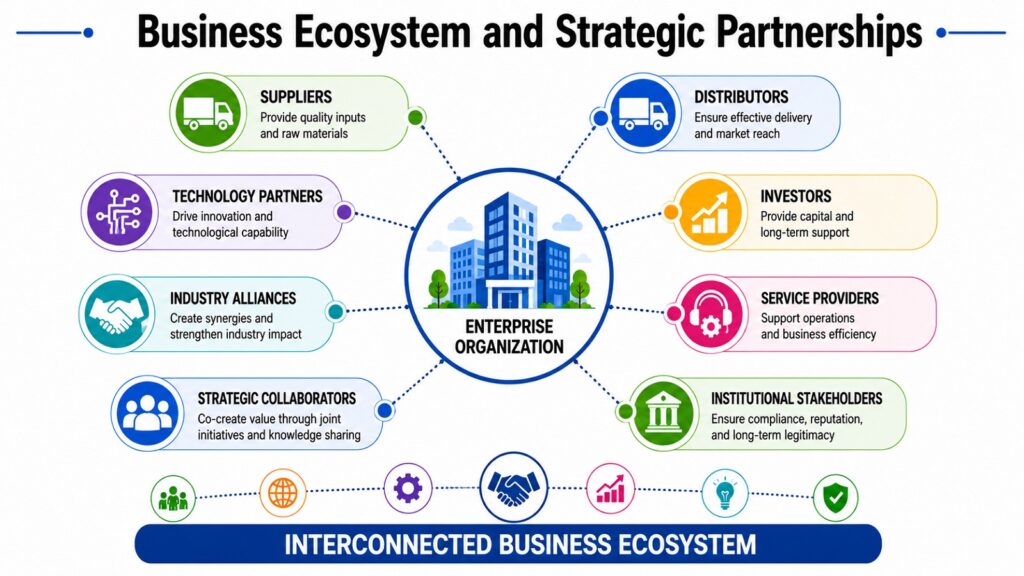
Modern enterprises rarely succeed through self-sufficiency alone. Within the business ecosystem, strategic partnerships and collaborative networks have become critical mechanisms for accessing resources, expanding market reach, accelerating innovation, and managing risk. Understanding how to build, sustain, and leverage partnerships is a core strategic capability for any organization operating in interconnected markets.
Strategic alliances allow two or more organizations to cooperate toward shared objectives while remaining legally independent. These alliances can take many forms: joint ventures, distribution agreements, technology licensing, co-development programs, and industry consortia. The Star Alliance in aviation, for example, connects airlines across multiple continents, allowing members to share routes, loyalty programs, and operational infrastructure. None of the individual members could replicate that network reach independently without enormous capital investment.
Ecosystem networks extend beyond direct business partnerships to include regulatory bodies, industry associations, academic institutions, technology providers, and community stakeholders. Apple’s App Store ecosystem, for instance, involves millions of developers who create applications that enhance the value of Apple’s platform. These developers are partners in an economic sense, even though most have no formal contractual relationship with Apple beyond the developer agreement. The ecosystem network creates value for all participants while reinforcing Apple’s market position.
Supply chain partnerships represent another critical dimension of network strategy. Companies like Toyota have built supplier relationships based on deep collaboration, shared quality standards, and long-term trust rather than purely transactional price negotiations. That approach reduces procurement risk, improves product quality, and creates resilience against supply chain disruptions because suppliers are invested in the partnership’s success.
Digital platform businesses have taken ecosystem network thinking to its logical extreme. Amazon Marketplace, Alibaba’s merchant ecosystem, and Airbnb’s host network all derive their primary value from the density and quality of their participant networks rather than from assets owned directly by the platform operator. In these models, the business ecosystem and the partnership network are essentially the same thing.
The strategic insight is clear. Organizations that build strong partnership networks within their ecosystems tend to access resources more efficiently, scale faster, and withstand disruptions more effectively than those that rely entirely on internal capabilities. Ecosystem interdependence, when managed strategically, is a source of competitive strength rather than a vulnerability.
Business Ecosystem and Partnerships: Strategic Models and Benefits
| Partnership Model | Strategic Benefit within the Business Ecosystem |
| Strategic Alliance | Shares resources and market access without requiring full organizational integration |
| Joint Venture | Creates a shared entity for specific projects, combining capabilities while distributing risk |
| Distribution Partnership | Extends market reach through established networks without direct investment in infrastructure |
| Technology Licensing | Transfers intellectual property rights to generate revenue or expand ecosystem presence |
| Platform Ecosystem | Builds network effects by enabling third parties to co-create and exchange value on shared infrastructure |
| Supply Chain Collaboration | Deepens supplier relationships to improve quality, resilience, and cost efficiency |
| Industry Consortium | Coordinates pre-competitive cooperation on standards, research, or regulatory engagement |
| Academic Partnership | Connects enterprises with research institutions to accelerate innovation and talent development |
8. Business Ecosystem and Stakeholder Management
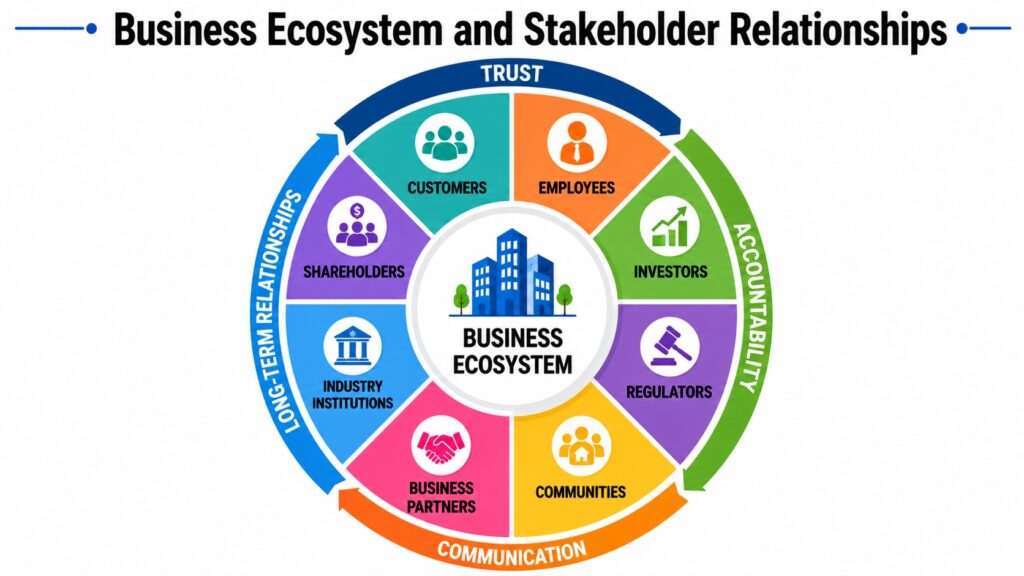
A stakeholder is any individual or group that has an interest in or is affected by the activities and outcomes of an organization. Within the business ecosystem, stakeholder management is the practice of identifying, understanding, and building productive relationships with those individuals and groups in a way that supports organizational objectives and long-term institutional trust.
The stakeholder landscape of a modern enterprise is broad and complex. It includes shareholders who expect financial returns, employees who depend on the organization for livelihood and development, customers whose trust sustains revenue, suppliers and partners whose cooperation enables operations, regulators who establish the legal boundaries of conduct, communities affected by the organization’s environmental and social footprint, and media whose coverage shapes public perception.
R. Edward Freeman, who developed stakeholder theory in the 1980s, argued that managing for stakeholder value rather than shareholder value alone was both ethically sound and strategically superior. His argument was that organizations that damaged their relationships with employees, communities, or customers in pursuit of short-term shareholder returns were eroding the very foundations that made shareholder returns possible. Decades of research since then have broadly supported that insight.
Investor relations is a particularly important dimension of stakeholder management in publicly listed companies. Clear, consistent, and credible communication with institutional investors, analysts, and individual shareholders shapes how the market values an enterprise. Companies that communicate strategy clearly and deliver against stated objectives tend to maintain stronger investor confidence, lower cost of capital, and more stable share prices during market volatility.
Employee stakeholder management has gained new urgency following significant shifts in labor market dynamics and organizational culture expectations. Companies like Google, Microsoft, and Salesforce have invested heavily in employee development, well-being, and a sense of organizational purpose. These investments are not purely philanthropic. They reduce turnover costs, improve productivity, and attract talent that might otherwise choose competitors.
The strategic insight is that stakeholder relationships are strategic assets. Organizations that invest in building and maintaining stakeholder trust tend to operate with stronger social licenses, better regulatory relationships, more loyal customer bases, and more engaged workforces. These advantages compound over time within the ecosystem, creating competitive resilience that is difficult for less stakeholder-conscious organizations to replicate.
Business Ecosystem and Stakeholder Management: Key Relationships
| Stakeholder Group | Strategic Priority within the Business Ecosystem |
| Shareholders / Investors | Require transparent performance reporting and long-term value creation strategy |
| Employees | Demand fair treatment, development opportunities, and a meaningful organizational purpose |
| Customers | Expect consistent quality, ethical conduct, and a value proposition that meets their evolving needs |
| Suppliers & Partners | Need reliable commitments, fair terms, and collaborative engagement for sustained cooperation |
| Regulators | Require compliance, transparency, and constructive engagement on policy and standards development |
| Communities | Expect environmental responsibility, social contribution, and economic benefit from organizational activity |
| Media & Analysts | Shape market perception through coverage and ratings that influence reputation and investor confidence |
| Board of Directors | Provides strategic oversight, governance accountability, and institutional stewardship |
9. Business Ecosystem and Risk & Resilience
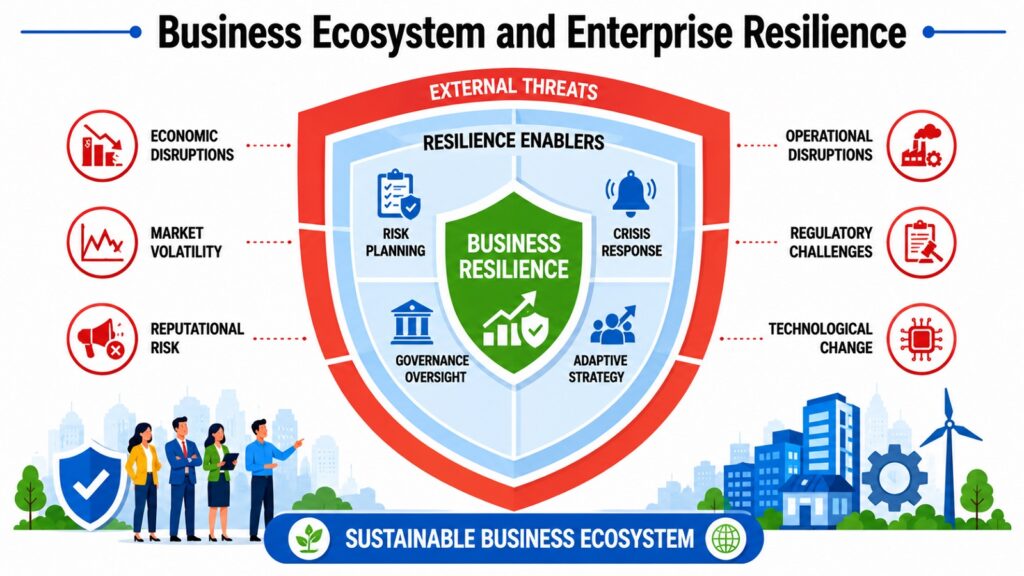
Every business operates under conditions of uncertainty. Markets shift, technologies disrupt, crises arrive without warning, and competitive landscapes change faster than any organization can fully anticipate. Within the business ecosystem, risk management and organizational resilience are not simply about avoiding harm. They are about building the structural capacity to absorb shocks, maintain operations, and recover with purpose.
Risk manifests in various forms within the ecosystem. Financial risks encompass changes in interest rates, defaults on credit, and fluctuations in currency. Operational risks include failures in the supply chain, outages in technology, and breakdowns in processes. Reputational risks stem from product failures, ethical breaches, or negative media attention. Strategic risks pertain to competitive threats, disruptions in the market, and regulatory changes that modify the operational environment of a business. Systemic risks, such as global pandemics or financial crises, impact entire ecosystems at once.
The Enterprise Risk Management framework, created by the Committee of Sponsoring Organizations of the Treadway Commission, commonly referred to as COSO ERM, offers a widely recognized structure for managing risk at the organizational level. It links the processes of risk identification, assessment, response, and monitoring to the strategic goals of the enterprise. This alignment of risk management with strategy is exactly what is needed for resilience at the ecosystem level.
Business continuity planning ensures that organizations can maintain critical operations during and after a disruption. The disruptions to global supply chains caused by the semiconductor shortage of 2021 and 2022 revealed significant resilience gaps in the automotive and electronics industries. Companies like Toyota, which had invested in inventory buffers and supplier relationship diversity, weathered the shortage more effectively than competitors who had pursued pure just-in-time efficiency without building ecosystem redundancy.
Organizational resilience is not only about crisis response. It is also about the long-term capacity to adapt to structural change. Companies that invest in continuous learning, flexible operating models, and diverse strategic options tend to maintain resilience even during extended periods of market disruption. Resilient organizations tend to emerge from crises not just intact but stronger, having captured market share, talent, or positioning advantages while less resilient competitors contracted.
Business Ecosystem and Risk & Resilience: Key Strategies
| Risk Category | Resilience Approach within the Business Ecosystem |
| Financial Risk | Managed through diversified capital structures, hedging instruments, and cash reserve policies |
| Operational Risk | Addressed through redundancy planning, process controls, and technology backup systems |
| Reputational Risk | Mitigated through transparent stakeholder communication, governance quality, and ethical conduct |
| Strategic Risk | Requires continuous market monitoring, scenario planning, and adaptive strategy processes |
| Supply Chain Risk | Reduced through supplier diversification, inventory buffers, and collaborative risk-sharing agreements |
| Regulatory Risk | Managed through proactive compliance programs and constructive regulatory engagement |
| Systemic Risk | Prepared for through crisis response plans, liquidity reserves, and ecosystem-wide coordination |
| Technology Risk | Addressed through cybersecurity investment, data governance, and digital infrastructure resilience |
10. Business Ecosystem and Enterprise Agility
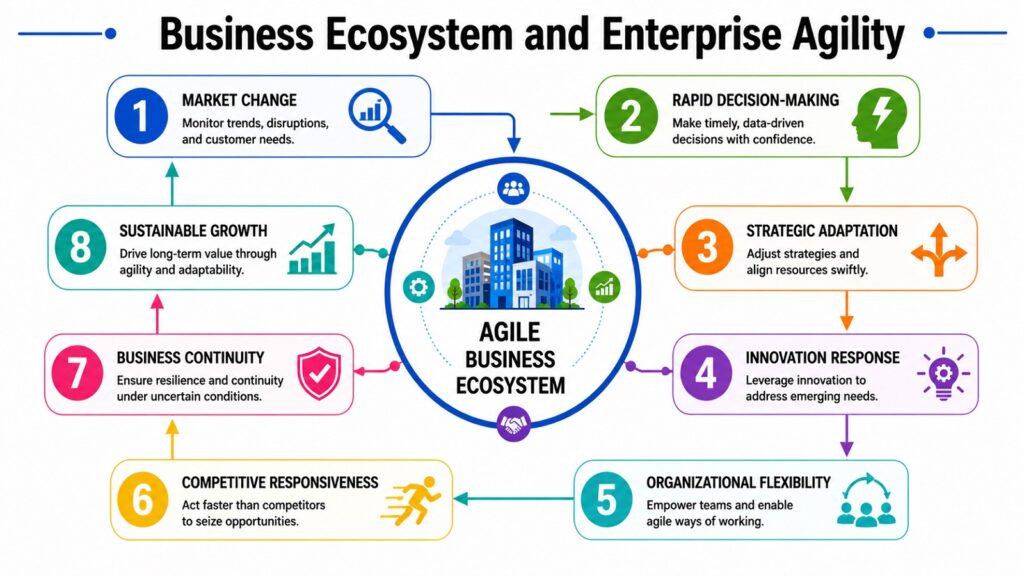
Enterprise agility is the capacity of an organization to sense changes in its environment and respond to them quickly, effectively, and with strategic intent. Within the business ecosystem, agility has moved from a desirable trait to a competitive necessity. Markets are moving faster. Technology is advancing faster. Customer expectations are evolving faster. Organizations that cannot match that pace of change risk becoming strategically irrelevant.
Agility is often associated with software development, particularly the Agile methodology that emerged from the Manifesto for Agile Software Development published in 2001. Agile development prioritizes iterative progress, close collaboration with customers, responsiveness to change, and working outcomes over rigid process adherence. These principles have since migrated from software teams to entire enterprise operating models, giving rise to the concept of the agile enterprise.
Spotify’s organizational model, known as the Squad Framework, became widely referenced as an example of enterprise agility at scale. The company organized its workforce into small, autonomous squads focused on specific product areas, with tribes, chapters, and guilds providing coordination across squads. This structure reduced bureaucratic friction, accelerated decision-making, and allowed the organization to respond to market feedback faster than more hierarchically structured competitors.
Strategic flexibility is a closely related concept. It refers to the degree to which an organization can alter its strategic direction in response to ecosystem signals without incurring prohibitive switching costs. Organizations with strategic flexibility maintain diverse option portfolios rather than committing entirely to a single path. Alphabet, Google’s parent company, has structured itself to maintain flexibility across search advertising, cloud computing, autonomous vehicles, life sciences, and venture investments simultaneously.
Agility and resilience are related but distinct capabilities. Resilience is the ability to absorb a disruption and recover. Agility is the ability to move before the disruption fully arrives, positioning the organization advantageously in a changing ecosystem. The most strategically capable organizations develop both. They are resilient enough to survive unexpected shocks and agile enough to capitalize on the shifts those shocks create.
Business Ecosystem and Enterprise Agility: Strategic Characteristics
| Agility Dimension | Strategic Significance in the Business Ecosystem |
| Iterative Decision-Making | Accelerates strategic responsiveness by replacing annual planning with continuous adaptation |
| Squad-Based Organization | Enables autonomous, cross-functional teams to respond rapidly to specific market opportunities |
| Strategic Flexibility | Maintains multiple strategic options to avoid excessive commitment to any single direction |
| Customer Feedback Loops | Connects market intelligence directly to product and service development cycles |
| Digital Infrastructure | Provides the technological foundation for rapid scaling, adaptation, and ecosystem integration |
| Cross-Functional Collaboration | Reduces silos that slow decision-making and inhibit coordinated market responses |
| Rapid Prototyping | Tests new business concepts quickly, reducing investment risk in uncertain ecosystem conditions |
| Leadership Agility | Enables executives to shift strategic orientation in response to ecosystem signals without delay |
11. Business Ecosystem and Business Transformation
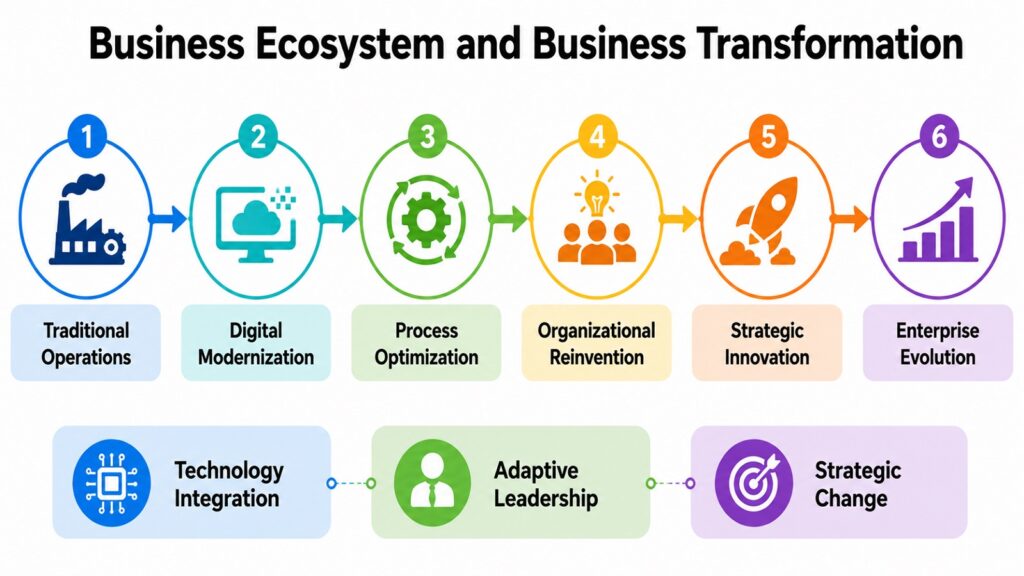
Business transformation is the process by which an organization fundamentally changes how it operates, competes, and creates value. Within the business ecosystem, transformation is not a periodic event triggered by crisis. It is an ongoing strategic imperative driven by the continuous pressure of market evolution, technology advancement, competitive dynamics, and shifting stakeholder expectations.
Digital transformation has been the defining transformation challenge of the early twenty-first century. Organizations across every industry have been compelled to rebuild their operations, customer experiences, and business models around digital infrastructure. McKinsey Global Institute research has consistently found that companies that fully commit to digital transformation generate significant revenue and cost advantages over those that adopt digital tools incrementally without transforming underlying processes and decision-making structures.
The transformation journey at Microsoft under Satya Nadella, who became CEO in 2014, is frequently cited as a model of successful enterprise transformation. Nadella repositioned Microsoft from a primarily personal computing software company to a cloud-first, mobile-first enterprise. He restructured the organization, shifted the culture from internal competition to collaboration, and made cloud services, particularly Azure, the central driver of the company’s growth strategy. Microsoft’s market capitalization increased from approximately 300 billion dollars to over three trillion dollars in the decade following this transformation, reflecting how deeply effective ecosystem-aligned transformation can rebuild enterprise value.
Organizational transformation requires more than technology investment. It demands changes in culture, leadership behavior, talent strategy, governance processes, and sometimes business model fundamentals. Companies that invest heavily in new technology without addressing the cultural and structural conditions that will either enable or undermine that technology tend to see limited return from their transformation investments.
The relationship between transformation and agility is direct. Agile organizations can navigate transformation more effectively because their structures and decision-making processes are already designed for adaptation. Transformation becomes harder, slower, and more expensive when it requires simultaneously changing the operating model, the culture, the technology, and the structure of an organization that has been optimized for stability rather than change.
Business Ecosystem and Business Transformation: Key Drivers
| Transformation Driver | Strategic Impact within the Business Ecosystem |
| Digital Transformation | Rebuilds operations and customer experiences around digital infrastructure and data capability |
| Cultural Change | Shifts organizational mindset and behavior to align with new strategic priorities and market realities |
| Process Modernization | Replaces outdated workflows with more efficient, integrated, and data-driven operating methods |
| Business Model Reinvention | Redesigns value creation logic in response to market disruption or strategic opportunity |
| Leadership Transition | New leadership often catalyzes transformation by bringing different strategic perspectives to the ecosystem |
| Merger & Acquisition | Transforms the organizational structure, capabilities, and market position through strategic consolidation |
| Technology Adoption | Integrates emerging tools such as AI, cloud computing, and automation to enhance competitive capability |
| Ecosystem Repositioning | Shifts how an organization relates to partners, competitors, and market segments within the ecosystem |
12. Business Ecosystem and Growth & Expansion
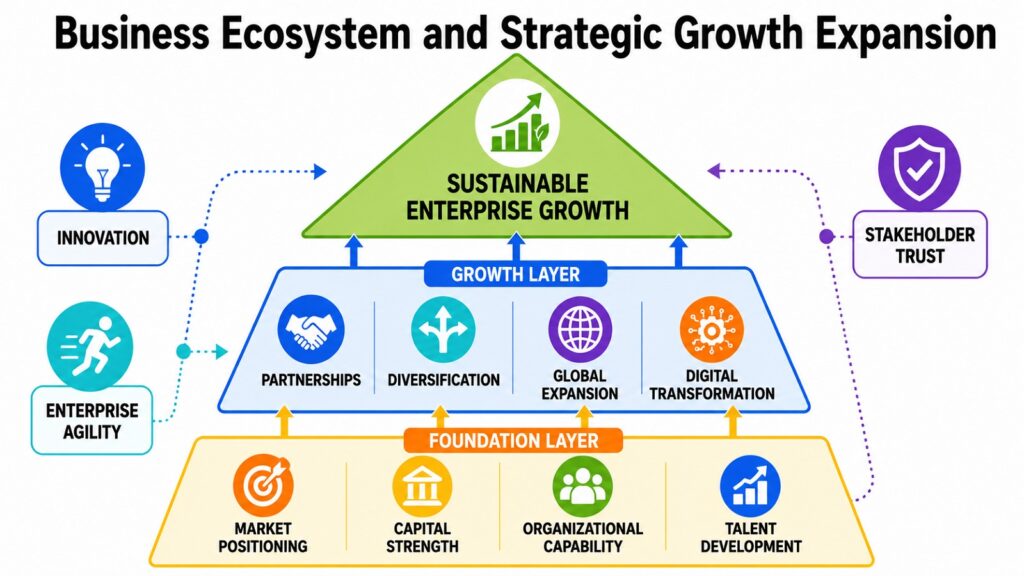
Growth is the most visible measure of business success, but sustainable growth within the business ecosystem is far more complex than simply increasing revenue. It requires coordinating business model evolution, market positioning, capital allocation, stakeholder alignment, partnership development, and operational capability in a way that scales without sacrificing the strategic foundations that made the organization valuable in the first place.
Igor Ansoff’s Growth Matrix, developed in 1957 and still widely used in strategic planning, identifies four growth strategies based on the combination of existing and new markets with existing and new products: market penetration, market development, product development, and diversification. Each of these strategies carries different risk profiles, capital requirements, and ecosystem implications. Market penetration in a known market with an existing product is the least risky but also the most competitively crowded. Diversification into new markets with new products offers the highest growth potential but demands the most robust ecosystem capabilities.
Geographic expansion is one of the most common growth strategies for established enterprises. Starbucks entered new international markets by carefully studying local consumer behavior, adapting its menu and store design to cultural preferences, and building supply chain relationships appropriate to each market. That localized approach, backed by global brand standards, allowed the company to grow from fewer than a thousand locations in the early 1990s to over thirty-five thousand locations across more than eighty countries by the mid-2020s.
Acquisition-led growth has been a defining strategy in many industries. Companies like LVMH, the French luxury conglomerate, have grown primarily by acquiring established luxury brands, preserving their individual identities while benefiting from shared distribution, capital, and institutional infrastructure. This approach allows LVMH to expand its ecosystem presence rapidly without the time investment required to build new brands from scratch.
Organic growth through innovation, customer retention, and market deepening is slower but more sustainable in many ecosystem contexts. Amazon Web Services grew organically from an internal technology infrastructure into the world’s largest cloud services provider, generating revenues that now subsidize Amazon’s broader business ecosystem. That organic growth path created a competitive moat that proved difficult for even well-resourced competitors to overcome.
The strategic insight is that growth within the business ecosystem must be coordinated rather than reactive. Organizations that grow without ensuring their governance, capital structure, talent base, and operational capabilities can support that growth often create fragility rather than strength. Ecosystem-coordinated growth, where expansion decisions are made with awareness of their implications across the entire ecosystem, tends to produce more durable and strategically sound outcomes.
Business Ecosystem and Growth & Expansion: Strategic Approaches
| Growth Strategy | Ecosystem Implication and Strategic Consideration |
| Market Penetration | Deepens share in existing markets; most effective when competitive differentiation is strong |
| Market Development | Enters new geographies or customer segments; requires ecosystem adaptation to local conditions |
| Product Development | Innovates within existing markets; demands R&D investment and agile commercialization capability |
| Diversification | Enters new markets with new products; highest risk but can reduce ecosystem dependency on single markets |
| Acquisition | Accelerates growth through strategic consolidation; requires governance and integration discipline |
| Organic Growth | Builds capability incrementally; slower but creates deeper competitive moats and cultural coherence |
| Platform Expansion | Extends ecosystem reach by adding new participants, use cases, or geographies to a platform model |
| Strategic Scaling | Grows operations in proportion to ecosystem capacity, maintaining quality and governance standards |
Conclusion: The Strategic Importance of the Business Ecosystem
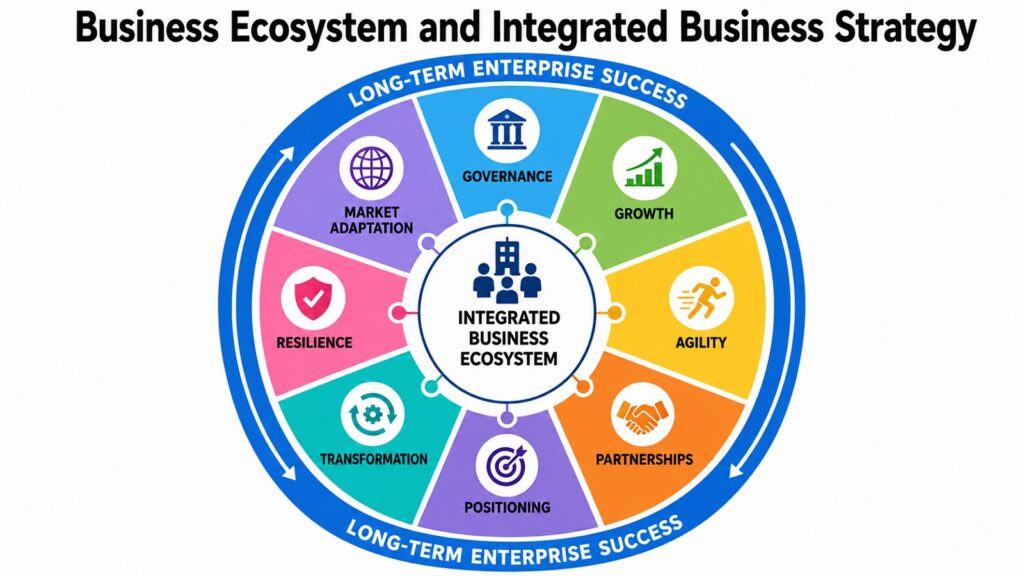
The business ecosystem is not a metaphor. It is a practical strategic reality that shapes every major decision a modern enterprise must make. What this article has examined across twelve dimensions is the depth of interconnection within the business ecosystem. Business models depend on market environment signals for their evolution. Organizational structures either enable or constrain competitive positioning and agility. Corporate governance shapes stakeholder trust and capital access. Capital structure determines resilience capacity. Partnerships extend the reach that internal resources cannot achieve alone. Each of these connections reinforces the others. Weaken one, and the ecosystem loses coherence.
For entrepreneurs building new ventures, understanding the business ecosystem means designing for the world as it exists rather than the world as it existed when a given business model was originally conceived. For executives leading established organizations, ecosystem thinking means continuously interrogating whether the structures, strategies, and relationships that enabled past success are adequate for the competitive demands of the present and future.
For managers operating at every level of an enterprise, the business ecosystem provides a lens for understanding why their individual decisions matter beyond their immediate departmental context. A procurement decision affects supply chain resilience. A governance lapse affects capital access. A talent investment affects transformation capability. Ecosystem thinking connects these dots in ways that functional silos cannot. The organizations that thrive over the long term are rarely the largest or the most heavily resourced. They are the most strategically coherent within their ecosystems.
The business ecosystem has become an important business essential, not because it is a fashionable concept but because the world in which businesses operate has made it necessary. Markets are more interconnected. Competition is more dynamic. Stakeholder expectations are more demanding. Technology is evolving faster. In that context, ecosystem thinking is not a strategic luxury. It is a strategic survival skill.
Business Ecosystem: Strategic Synthesis of 12 Business Drivers
| Strategic Theme | Ecosystem-Level Insight |
| Integration over Isolation | Every business driver gains strategic power through its connection to the broader ecosystem, not in separation |
| Governance as Foundation | Strong governance underpins every other strategic capability, from capital access to stakeholder trust |
| Agility as Competitive Necessity | The pace of ecosystem change has made agility a prerequisite for long-term strategic relevance |
| Resilience as Investment | Resilience-building is not a cost but a strategic investment that pays returns during disruption |
| Partnerships as Leverage | Ecosystem networks extend capabilities beyond what any single organization can build independently |
| Transformation as Continuity | Continuous transformation is the mechanism through which businesses remain aligned with evolving ecosystems |
| Growth as Ecosystem Coordination | Sustainable growth requires alignment across capital, governance, talent, and market positioning |
| Stakeholder Trust as Strategy | Long-term competitive strength is increasingly inseparable from the quality of stakeholder relationships |